The Effect of Hall Parameter on MHD Fluid Flow
of a Periodically Accelerated Plate
P. Satish1, T. Linga Raju2, M. Srikanth3
1
Department of Mathematics, Aditya Engineering College (A), Surampalem, A.P., India.
2
Department of Engineering Mathematics, AU College of Engineering (A), Visakhapatnam, A.P., India.
3
Department of Mathematics, Aditya Engineering College (A), Surampalem, A.P., India.
Abstract: The current study Focus on the effect of Hall current on an unsteady Magneto hydrodynamic fluid flow of a periodically accelerated plate relative to a rotating fluid. The Laplace Transform technique is used to determine the analytical solutions of the derived mathematical model. The study has also presented graphically, the axial and transverse velocity profiles for different values of the parameters using symbolic Math software. Variation of the skin friction components are presented in the form of graphs.
Keywords: MHD flow, Hall current, periodically accelerated plate, Laplace Transforms.
Nomenclature
A Constant Acceleration Applied magnetic field
Component of magnetic field H Component of current density J µ Magnetic permeability
m Hall parameter M Hartmann number
Kinematic viscosity
Component of angular velocity
Ω Non dimensional angular velocity
ρ Fluid density
σ Electric conductivity t Time
T Non dimensional time
(u,v,w) Components of velocity fieldq
(U,V,W) Non dimensional velocity components (x,y,z) Cartesian coordinates
I. INTRODUCTION
Magneto hydrodynamics (MHD) is the study of the relationship between magnetic fields and moving conducting fluids. In recent years MHD flow problems have become in view of its significant applications in industrial manufacturing processes such as plasma studies, petroleum industries, Magneto hydrodynamics power generators, boundary layer control in aerodynamics.
The flow due to a single infinite plate was first discussed by Vonkarman and Biot [1]. Batchelor [2] discussed a particular problem in MHD fluid flow of a moving plate. Stokes [3] observed viscous incompressible flow through an infinite that was at rest and then suddenly started the motion powerful with constant velocity in its own plane. Rossow [4] discussed MHD flow to start off an infinite flat plate. It was shown by Cowling [5] that when the magnetic field strength is sufficiently high then Ohm’s law is adapted to Hall current.
[8-10]. Hayat and Abbas [11] observed the rotating flow of a second grade fluid past a porous heated plate with variable suction and Hall current. While Takhar et al [12] studied the combined effects of Hall current and free stream velocity on the MHD flow over a moving plate in a rotating fluid.
The purpose of this study is to explain rotational unsteady Magneto hydrodynamic fluid flow of a periodically accelerated plate with Hall current by using Laplace Transform approach. It is observed that the phenomenon discussed in this research work occurs in different situations, such as in tornadoes or in moving blades of a helicopter, blood flow through the heart, water turbines and many other situations. In this analysis the axial velocity, transverse velocity and skin friction components are presented graphically with
the effect of the Hall parameter (m), Hartmann number (M) and the rotational parameter (Ω) using symbolic math software.
II. MATHEMATICAL FORMULATION AND SOLUTION OF THE PROBLEM
Consider incompressible fluid flow through an infinite plate occupying on a plane at z=0. Initially, the fluid and the plate are
rotating with uniform angular velocity about z-axis. The x-axis is in the direction of motion of the plate and the y-axis lies on
the plate normal to the x and z-axis. H is the applied magnetic field to the system. is the uniform magnetic field is parallel to
z-axis and the plate is electrically non conducting since ∇ = 0 this implies that is constant which further implies that =
,every where in the flow. Here (u, v, w) are components of the velocity vector q , From the equation of continuity ∇ = 0 ,
gives w=0 everywhere in the flow such that the boundary condition w=0 is satisfied. Because of the horizontal homogeneity of the problem, the flow quantities depend only on z and t. Here u is the axial velocity and v is the transverse velocity and the problem so
defined suggests that for uniform pressure ∇ = 0. Under these considerations, the momentum equation and generalized Ohm’s
law for unsteady case of rotational flow with MHD effect are given by
= + 2Ω − ( ) ( + ) (1)
= −2Ω −
( ) ( − ) (2)
Where is Kinematic velocity, µ is magnetic permeability, is applied magnetic field, m is Hall parameter and ρ is fluid
density.
The initial and boundary conditions are given by
u=0 ; v=0 at t ≤ 0 for all (3) u= ; v=0 at z=0, t ˃ 0 (4) u→ 0 ; v → 0 as z → ∞, t ˃ 0 (5)
where ˃ 0 is a constant.
By introducing the dimensionless quantities =
( ) / =( ) / = ( ) /
= ( ) / = ( ) / = µ /
/ = ( )
/ (6)
From the above transformations; Eqs. (1) and (2) in dimensionless form as
= + 2 − −2 ( ) (7)
= −2 − −2 ( ) (8)
The transformed boundary conditions are
U = 0, V=0 at T ≤ 0 for all Z (9) U = A sin KT, V = 0 at Z = 0, T ˃ 0 (10) U → 0 V → 0 as Z → ∞, T˃ 0 (11)
Where = ( ) /
Now introduce F = U+ i V, which is substituted into (7)-(11), we have
= −2 − + ( ) (12)
= − (13)
Where = 2 − + 2( ) (14)
F = 0 at T ≤ 0 for all Z (15) F = A sin KT at Z = 0 , T ˃ 0 (16)
F → as Z → ∞, T˃ 0 (17)
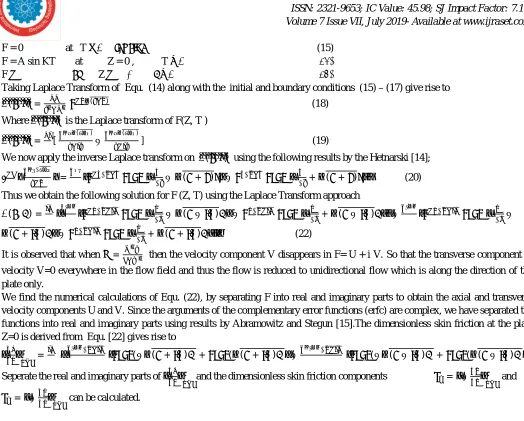
Taking Laplace Transform of Equ. (14) along with the initial and boundary conditions (15) – (17) give rise to
( , ) = ( ) (18)
Where ( , ) is the Laplace transform of F(Z, T )
( , ) = [ ( )− ( ) ] (19)
We now apply the inverse Laplace transform on ( , ) using the following results by the Hetnarski [14];
√
= √
√ − ( + ) −
√
√ + ( + ) (20)
Thus we obtain the following solution for F (Z, T) using the Laplace Transform approach
( , ) = √ √ − ( − ) − √ √ + ( − ) − √ √ − ( + ) − √
√ + ( + ) (22)
It is observed that when = then the velocity component V disappears in F= U + i V. So that the transverse component of
velocity V=0 everywhere in the flow field and thus the flow is reduced to unidirectional flow which is along the direction of the plate only.
We find the numerical calculations of Equ. (22), by separating F into real and imaginary parts to obtain the axial and transverse velocity components U and V. Since the arguments of the complementary error functions (erfc) are complex, we have separated the functions into real and imaginary parts using results by Abramowitz and Stegun [15].The dimensionless skin friction at the plate Z=0 is derived from Equ. [22] gives rise to
= √ (− ( + ) + ( ( + ) − √ (− ( − ) + ( ( − )
Seperate the real and imaginary parts of and the dimensionless skin friction components = − and
= − can be calculated.
III. RESULTS AND DISCUSSION
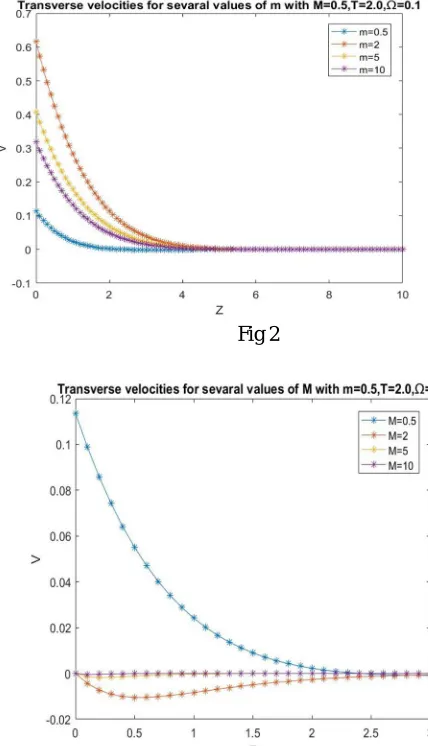
The effect of Hall parameter on the axial and transverse velocity components are presented in Fig 1 and Fig 2 .It is observed that due to an increase in the Hall parameter there is a growth in both the axial and transverse velocity components.
[image:3.612.39.563.35.456.2]Variation of the Hartmann number M for both velocity components is also investigated. Fig 3 and Fig 4 display that the amplitude of both the axial and transverse components of velocity decrease more rapidly as the Hartmann number increases.
Fig 5 and Fig 6 show clearly that the behaviour of the velocity components with various rotational parameters Ω on the axial and
transverse components of velocity. With increase in the rotational parameter the values of the velocity components behave in an oscillatory manner.
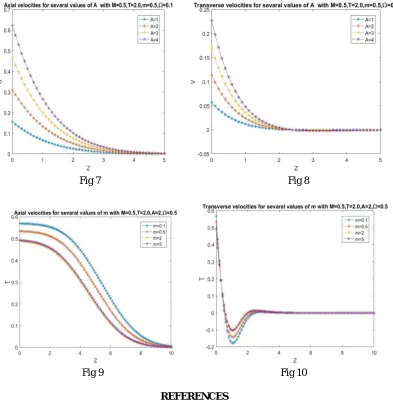
In Fig 7 and Fig 8, we note that the behaviour of velocity components with variation in the amplitude parameter A. As this parameter is directly proportional to both the velocities, we observe that increasing its value leads to increase in both velocities. Finally we plot the effect of increasing in Hall parameter m, over dimension less shear stress for both velocity components in Fig 9 and Fig 10.It is observe that for increasing values of m, the values of dimensionless skin friction components behave in an oscillatory manner.
IV. CONCLUSIONS
The study of Hall current on an unsteady magneto hydrodynamic fluid flow of a periodically accelerated plate relative to a rotating fluid reveals the phenomenon of reducing the two dimensional flow to a one dimensional flow. In the absence of rotation this type
of phenomenon does not occur. Thus here we investigate that when the rotational parameter =
( ) then the flow is in the
Fig 1 Fig 2
[image:4.612.334.548.83.456.2]Fig 3 Fig 4
Fig 7 Fig 8
Fig 9 Fig 10
REFERENCES
[1] V. karman, M.A. Biot, Mathematical methods in Engineering: An introduction to the Mathematical Treatment of Engineering problems, first ed., McGraw-Hill, New York, 1940.
[2] G. K. Batchelor, An Introduction to Fluid Dynamics, Cambridge University Press, Cambridge, 1967.
[3] G. Stokes, “On the effect of the internal friction of fluid on the motion of pendulums,” Camb. Phil. Soc. Trans, IX , 8- 106 (1851). [4] V. J. Rossow, “On Rayleigh’s Problem in magneto hydrodynamics,” Phys. Fluids , 3(3), 395-398 (1960).
[5] T. G. Cowling, Magneto hydrodynamics, Inter science, New York, 1957.
[6] T. Watanabe, I. Pop, “Hall effects on magneto hydrodynamic boundary layer flow over a continuous moving flat plate,” Acta Mechanics 108, 35-47 (1995). [7] I. Pop, “The effect of Hall current on hydro magnetic flow near an accelerated plate,” Jour. Math. Phys. Sci. 5, 375- 379 (1971).
[8] H. S. Takhar, A. J. Chamkha , G. Nath, “Flow and heat transfer on a stretching surface in a rotating fluid with a magnetic field,” International Journal of Thermal Sciences 42(1), 23-31 (2003).
[9] L. Debnath, “Exact Solutions of the unsteady hydrodynamic and hydro magnetic boundary layer equations in a rotating fluid system,” (ZAMM) 55, 431-438 (1975).
[10] N. Datta, Jana, “Oscillatory magneto hydrodynamic flow past a flat plate with Hall effects,” Jour. Phys. Soc. Japan 40 (1976) 1469-1474.
[11] T. Hayat,Z. Abbas, “ Effects of Hall Current and Heat Transfer on the Flow in a Porous Medium with Slip Condition,” Journal of Porous Media. 10(1), 35-50 (2007).
[12] H. S. Takhar, A. J. Chamkha and G. Nath, “MHD Flow over a moving plate in a rotating fluid with magnetic field, Hall currents and free stream velocity,” Int. J. Eng. Sci. 40(13) , 1511-1527 (2002).