The Interaction between Convective Flow and
Interface Morphology of the Particle Growth
Mingwen Chen, Longfei Zuo, Han Jian, Guobiao Lin, Hong Zhang, Zidong Wang
Abstract—The interaction between the convective flow and the interface morphology of the particle growing in the convective undercooled melt is studied for three types of straining flow by means of the matched asymptotic expansion method. The analytical results show that the convection driven by the far field uniform flow makes the growing particle enhance its velocity in the upstream direction of the flow but inhibit its growth in the downstream direction, both the particle growth in the upstream direction and the decay in the downstream direction make the particle evolve into an oval; both the uniaxial straining flow effect and the biaxial straining flow effect result in higher local growth rate near the surface where the flow is incoming and lower local growth rate near the surface where the flow is outgoing, and cause an initially spherical particle evolve into an oblate spheroid. The convection leads to destabilize the interface morphology of the particle growth.
Index Terms—particle growth, convective flow, interface morphology, asymptotic solution
I. INTRODUCTION
The convective flow caused by mechanical and electromagnetic stirring is often employed in the experimental frame and practical materials processing to control the interface morphology of particle growth in melt and obtain the final materials of high property microstructure. The interaction between the convective flow and the morphology of the particle growth is of great interest in the
field of materials science and technology. Mullins and Sekerka[1] first studied the morphological stability of growing particles controlled by diffusion in the supercooled liquid and found that the particle growth is stable below and unstable above a critical radius for instability. During several decades after their study of the interface morphological stability theory, significant progress [2-5] has been made by the inclusion of various additional effects such as the interface kinetics, anisotropy etc., among which convection effects are of utmost importance in the development of interface microstructures. The experiments and numerical simulations have shown that the convection helps to nucleate directly in the melt and grow spheroidally to a large scale from the convective melt[4-6]. Theoretically, however, when the melt convection is included, the morphological control of particles is modeled in a nonlinear dynamics problem, which does not have an exact analytical solution generally and whose theoretical study is greatly hindered. By employing the method of the matched asymptotic expansion[7-10], we seek the approximate analytical solution for the particle growth in the convective undercooled melt. With the obtained analytical result we show that the convection significantly increases the local growth rate, change the interface morphology of the particle in the undercooled melt and leads to destabilize interface morphology of the particle growth.
Manuscript received Apr. 16, 2012; revised Apr. 20, 2012. This work was supported by the National Natural Science Foundation of China (Grant No.10972030, No. 50904005), the 863 Project of China (Grant No. 2007AA03Z108), the Fundamental Research Funds for the Central University, Overseas Distinguished Scholar program by the Ministry of Chinese Education. The authors sincerely thank Professor Jian-Jun Xu (University of Science and Technology Beijing, China; McGill University, Canada) for his instructive help
M. W. Chen is with the School of Mathematics and Physics, University of Science and Technology Beijing, Beijing 100083, China (corresponding author: 086-010-80786220; fax:086-010-62333152; e-mail: chenmw@ustb. edu.cn).
L. F Zuo is with the School of Materials Science and Engineering, University of Science and Technology Beijing, Beijing 100083, China; e-mail: zulo1986@)126.com.
H. Jiang is with the School of Materials Science and Engineering, University of Science and Technology Beijing, Beijing 100083, China; e-mail: [email protected]).
G. B. Lin is with the School of Materials Science and Engineering, University of Science and Technology Beijing, Beijing 100083, China; e-mail:[email protected]).
H. Zhang is with the School of Materials Science and Engineering, University of Science and Technology Beijing, Beijing 100083, China; e-mail: [email protected]).
Z. D. Wang is with the School of Materials Science and Engineering, University of Science and Technology Beijing, Beijing 100083, China (corresponding author: 086-010-62333152; fax:086-010-62333152; e-mail: [email protected]).
II. FORMATION OF THE PROBLEM
Assuming a particle with an initial radius grows in the convective undercooled melt that is referred to as an isotropic and incompressible Newtonian fluid. The temperature in the far field is T
0
r
∞, which is below the solidification equilibrium temperature for the pure substance TM. The interface of the particle, r=R( , , )θ ϕ t , separates the melt into solid phase and liquid phase. When the particle grows in the undercooled melt, the relative fluid velocity near the particle for the flow field can be approximately decomposed into the uniform streaming flow past the particle and the linear flow about the particle. For the ambient flow fields, we consider the effect of three types of axisymmetric flow fields[13]: the uniform streaming flow, the uniaxial straining flow and the biaxial straining flow on the interface morphology of the particle, i.e. the following convection driven conditions are respectively, given by
∞
→
U U , (1) for the uniform streaming flow,
z
U
∞ = − ∞
U e ;
∞ =
U ( 1 1 )
2 2
x y z
x y z
β e − e − e ;
and for the biaxial straining flow,
1 1
( )
2 2
x y z
x y z
β
∞ = − + +
U e e e ,
where U∞ is a positive constant, ex, ey and ez are the unit vector in the rectangular coordinates, β is the principal rate of strain of the linear flow, x, and are the rectangular coordinates. The governing equations of the particle growth contain the temperature equations in the solid phase and liquid phase, the kinematical equation and the continuity equation, which are subject to the boundary conditions: the thermal dynamical equilibrium condition, the Gibbs-Thomson condition, the enthalpy conservation condition, the continuity condition of the tangential and normal components of velocity, etc.. By using the nondimensionalization given in Ref. [9,11] in which the initial radius of the particle as the length scale, the characteristic velocity of the interface as the velocity scale,
y z
p V
0/ p
r V as the time scale, and the undercooling as the temperature scale, we derive the dimensionless governing equations[11]. For the sake of writing, we still use
M T T T∞
Δ = −
L
T and to denote the dimensionless temperature distributions in the liquid phase and solid phase respectively, to denote the dimensionless flow field in the liquid phase and R to denote the dimensionless interface shape.
S T
U
The governing equations are as follows 0
∇ ⋅ =U , (2) 2
( ) P Pt
t
ε⎛⎜∂ + ⋅∇ ⎞⎟= −∇ + ∇ ∂
⎝ ⎠
U
U U U, (3)
2
( )
L
L L
T
T t
ε⎛⎜∂ + ⋅∇ ⎞⎟= ∇
∂
⎝ U ⎠ T , (4)
2 S S
T T t
ελ ∂ = ∇
∂ S, (5) where
/ ( p L)
T
H c
ε
ρ Δ =
Δ , Pt
υ κ
= , T S
S
κ λ
κ
= ,
in which υ is the kinematical viscosity, κT and κS are the thermal diffusivities in the liquid and solid phases, respectively. It is assumed that the densities in the liquid and solid phases are equal, and the buoyancy effects are neglected.
At the interface, the total mass conservation condition and the tangential non-slip condition, the thermal equilibrium condition, the Gibbs-Thomson condition and energy conservation condition hold, i.e.
1 2
L S I
T =T = Γ −ε K εE MU− , (6) (
I S L
U k T T )
ε = ∇ − ∇ ⋅n, (7) where UI is the local interface velocity of the interface, the local mean curvature at the interface,
K
0 (TM)D
r H T
γ Γ =
Δ Δ ,
and γ is the isotropic surface energy, S
L
k k
k
= ,
and kL and are respectively the heat conduction coefficients in the liquid and solid phases,
S
k
( M)D
T E
T
Δ
= ,
( M)D
V M
T
μ
= ,
and μ is the kinetics coefficient.
The far field temperature condition and the convection driven condition are respectively that, as r→ ∞,
L
T → −ε, (8) ∞
→
U U , (9) where U∞ is rescaled the characteristic velocity of the interface Vp, for the uniform streaming flow,
z
U
∞= − ∞
U e ; for the uniaxial straining flow,
1 1
( )
2 2
x y z
Pe x y z
∞ = − + +
U e e e ;
and for the biaxial straining flow,
1 1
( )
2 2
x y z
Pe x y z
∞= − −
U e e e ,
in which x, and are the rectangular coordinates, Pe
is defined as the Peclet number,
y z
2 0
r Pe
V
β
=
,
and β is a constant.Finally, the initial condition holds, in which the initial condition for the interface is, at time t=0,
( , , 0) 1
Rθ ϕ = . (10)
III. ANALYTICAL RESULTS AND ANALYSIS By using the method of matched asymptotic expansion, we can obtain the uniformly valid asymptotic solution in the entire melt region. For the uniform streaming flow, we have that for the interface shape and its growth velocity
0 1 1
( , , ) ( ) (cos )
Rθ ϕ t =R t +εR P θ +",
(11)
0 1
1(cos )
dR dR
R
P
t dt ε dt θ
∂ = +
∂ +", (12)
where
2 1
0 1
( 1) (2
2
0 0
2
( 1) 2 ln
1 2
R
R − Γ
⎡ ⎤
×⎢ − + Γ ⎥ − Γ
⎣ ⎦, (13)
0 0 1 0 0 2 , ( ) dR R
dt R R E M−
− Γ =
+
1 0,0( ) 1,0( )
R =g t +g t ,
2 0
0,0 2 0
0
( 2 )
( ) 3(1 4 ) 1 2
6
U R
g t R
R
∞ − Γ ⎡
= ⎣− + Γ Γ − + Γ
2 3 3 0
0 0
2
3 24 ln
1 2
R
R R − Γ ⎤
+ Γ + + Γ ⎥
− Γ ⎦,
2
1,0 0
3
( ) ( 1)
16
U
g t = ∞ R −
1 0
3 ( 2)
( 1
8
U k E M
R − ∞ + − − ) 1 2 2 2
0
1 ( 2)
3 ( 2)
ln
8 1 ( 2)
R k E M
U k E M
k E M
− − ∞ − + + + + + + ;
(
)
(
)
0,0 0 0 0,0
2 1
0 0
( ) 4 ( 2 ) ( )
( 1)
n
dg t R R d g t
dt R R nk n E M−
− Γ − − Γ = −
+ + +
0 0
1 2 0
( 2 )
2( )
U R R
R E M
∞ −
− Γ +
+ ,
1,0 0 0
1 1
0 0
( ) 3 ( 2 )
8( )( ( 2) )
dg t U R R
dt R E M R k E M
∞ − − − Γ = + + + , in which, 1 1 0 2 n E M d
R E E
− −
=
− Γ + M
r=R
.
The formula in (13) is the relation between the time t and the leading order radius of the interface shape , then it is equivalent whether the time t or the leading order radius of the interface shape of the particle is given.
0( )t
0
R
-15 -10 -5 0 5 10 15
[image:3.595.322.523.64.216.2]-5 0 5 10 15 x z U∞ melt crystal
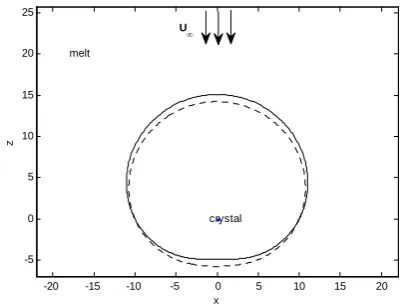
Fig. 1. The intersection of the interface shape of a particle in the convective undercooled melt driven by the far field uniform flow, where R0=8,
, 0.55
U∞= ε=0.5, E=0.4, M=0.16, .k=1
-20 -15 -10 -5 0 5 10 15 20
-5 0 5 10 15 20 25 x z U∞ melt crystal
Fig. 2. The intersection of the interface shape of a particle in the convective undercooled melt driven by the far field uniform flow, where R0=10,
, , , , .
0.55
U∞= ε=0.5 E=0.4 M=0.16 k=1
Fig.1 and Fig.2 show that the convective flow induced by the far field uniform flow makes the growing interface of the particle enhance its growth velocity in the upstream direction of the far field uniform flow but inhibit its growth in the downstream direction.
For the uniaxial straining flow, we have that
0
0 0,0 2,0 2 (cos )
R=R +εh +εh P θ
2
2,2 2 (cos ) cos 2
h P
ε θ ϕ
+ +"
,
(14)0,0 2,0 0 0
2(cos )
dh dh
dR R
P
t dt ε dt ε dt θ
∂
= + + ∂
2,2 2
2(cos ) cos 2
dh P dt
ε θ ϕ
+ +"
,
(15)where Pnm(cos )θ is the modified Legendre polynomial, 0
0,0 1
0 0
( 2 )
3 ( )
R h
R R E M−
− Γ = +
0 1 3 2 1 1
(6 6 )
( 2 ) ( )
R
S
E M k
d E M
ω λ ω ω ω
ω ω
−
−
⎡ Γ − + × ⎢ − Γ +
⎣
∫
0
4
2 1
1
(2 3 )
+ ,
( 2 ) ( )
R
S
k
d E M
λ ω ω ω
ω ω −
⎤ Γ −
⎥ − Γ + ⎦
∫
2 1
0 0 2,0
0
5 ( (2 3) )
16( 2 )
c
b
R R k E M
P h e R − + + = − Γ 0 1 1 1
( 2 )
( (2 3) )
b R
c d
k E M
ω ω
ω − +
− Γ × + +
∫
,
2 1 0 0 2,2 05 ( (2 3) )
32( 2 )
c
b
R R k E M
h
R
Pe + + −
= −
− Γ
0
1 1 1
( 2 )
( (2 3) )
b R
c d
k E M
ω ω ω
ω − +
− Γ × + +
∫
; 0,0 0 0 0,0 2 1 0 0 1( , 0)
( )
dh R
R h
dt = −R ℜ + R +E M−
0 0 0
0
( ) ( )
3
S
k R d b t db t
dt R dt
λ ⎛ ⎛ ⎞ ⎞ ×⎜⎜ ⎜ ⎟− ⎟⎟ ⎝ ⎠ ⎝ ⎠
,
2,0 0 0 2,0 2 1 0 05 ( )
1
( , 2)
16( 7 )
Pe
dh b t
R h
[image:3.595.64.266.586.741.2]2,2 0 0 0 2,2
2 1
0 0
( ) 1
( , 2)
32( 7 )
5
dh PeR b t
R h
dt = R ℜ − R + E M−
,
in which,
[
]
0
0 1
0
( 2) 2 ( 1)( 2)
( , )
( 1)
B B
B
R kn n n n
n R
R nk n E M−
− + + + + + ℜ =
+ + +
Γ
0 1 0
( 2 )
( 1)
n B B
d R
R nk n E M− − Γ −
+ + + ,
0 0
0 1
0
( 2 )
( ) R R
b t
R E M−
− Γ =
+
,
and and are two abbreviations, b c
1
1
2(2 3)(2 )
2 (2 3)
k E
b
k E M
− −
+ Γ + =
Γ + +
M
,
1 1
10 8 (2 3)
2 (2 3)
k k E
c
k E M
− −
Γ + Γ + + =
Γ + +
M
.
It is seen from (14) and (15) that the growth of the particle contains two parts: one is the symmetrical growth that is not influenced by the uniaximal straining flow, in which the term
0,0
h
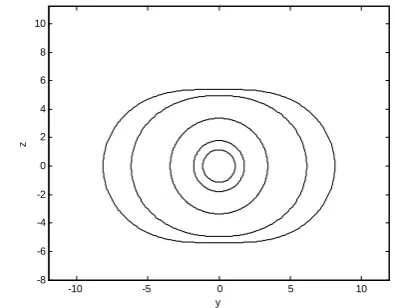
ε is due to the change of temperature in the melt; the other terms represent the non-symmetrical growth that is influenced by the uniaximal straining flow. The solution for the interface shape of a growing particle in a uniaximal straining flow is the function of both θ and ϕ. Fig. 3 shows the interface shape evolutions of a particle growing in a uniaxial straining flow on the cross-section of the Oxz plane. The energy transfer rate is higher near the poles and lower near the Oxz plane of the equatorial plane and the particle grows into a prolate shapes on the cross-section of the Oxz plane. It is consistent with the results on the cross-section of interface shape evolution made by Noh et al.[13]. However, the situation on the cross-section of the Oyz plane is contrary to that on the cross-section of the Oxz plane. Fig. 4 shows the evolution shapes of a particle growing in a uniaxial straining flow on the cross-section of the Oyz plane. The energy transfer rate is higher near the Oyz plane of the equatorial plane and lower near the poles and then the growth velocity near the Oyz plane of the equatorial plane is higher than that near the poles, and the particle grows into an oblate shape on the cross-section of the Oyz plane. This is the case that Noh et al.[13] neglected in their numerical simulations.
For the biaxial straining flow, we have that 0
0 0,0 2,0 2(cos )
R=R +εh +εh P θ
2
2,2 2 (cos ) cos 2
h P
ε θ ϕ
+ +"
,
(16)0,0 2,0 0 0
2(cos )
dh dh
dR R
P
t dt ε dt ε dt θ
∂
= + + ∂
2,2 2
2(cos ) cos 2
dh P dt
ε θ
+ ϕ+", (17)
where
0
0,0 1
0 0
( 2 )
3 ( )
R h
R R E M−
− Γ =
+
0
1 3
2 1
1
(6 6 )
( 2 ) ( )
R
S
E M k
d E M
ω λ ω ω ω
ω ω
−
−
⎡ Γ − + × ⎢ − Γ +
⎣
∫
0
4
2 1
1
(2 3 )
+ ,
( 2 ) ( )
R
S k
d E M
λ ω ω ω
ω ω −
⎤ Γ −
⎥ − Γ + ⎦
∫
2 1
0 0 2,0
0
5 ( (2 3) )
16( 2 )
c
b
R R k E M
h
R
Pe + + −
= −
− Γ
0
1 1 1
( 2 )
( (2 3) )
b R
c d
k E M
ω ω
ω − +
− Γ ×
+ +
∫
,
2 1
0 0 2,2
0
5 ( (2 3) )
32( 2 )
c
b
R R k E M
P
h e
R
−
+ + =
− Γ
0
1 1 1
( 2 )
( (2 3) )
b R
c d
k E M
ω ω ω
ω − +
− Γ ×
+ +
∫
;
0,0 0
0 0,0
2 1
0 0
1
( , 0)
( )
dh R
R h
dt = −R ℜ + R +E M−
0 0 0
0
( ) ( )
3
S
k R d b t db t
dt R dt
λ
⎛ ⎛ ⎞ ⎞
×⎜⎜ ⎜ ⎟− ⎟⎟ ⎝ ⎠
⎝ ⎠
,
2,0 0
0 2,0
2 1
0 0
5 ( )
1
( , 2)
16( 7 )
Pe
dh b t
R h
dt = R ℜ − R + E M−
,
2,2 0 0
0 2,2
2 1
0 0
( ) 1
( , 2)
32( 7 )
5
dh PeR b t
R h
dt = R ℜ + R + E M−
.
-6 -4 -2 0 2 4 6
-4 -2 0 2 4 6
x
[image:4.595.323.518.50.488.2]z
Fig. 3. The cross-sections of interface shape of a particle in the uniaxial
straining flow, at time t=5,10,15, 20, 25 (from inside to outside), where
0.5
β= , 0.1Γ = , 370Δ =T , λS=0.01, E=0.4, M=0.16, ε=0.15.
-10 -5 0 5 10
-8 -6 -4 -2 0 2 4 6 8 10
y
[image:4.595.320.518.573.727.2]z
Fig. 4. The cross-sections of interface shape of a particle in the uniaxial straining flow, at time t=10, 20, 30, 40, 50 (from inside to outside), where
0.5
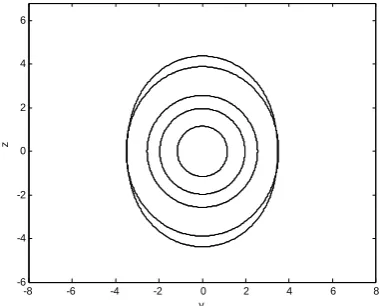
It is seen from (16) and (17) that similar to the case of uniaxial straining flow the solution for the shape of a growing particle in a biaximal straining flow is the function of both θ and ϕ . Fig. 5 shows the interface evolution shapes of a particle growing in a biaxial straining flow on the cross-section of the Oxz plane. The energy transfer rate is higher near the poles and lower near the Oxz plane of the equatorial plane and the particle grows into a prolate shapes on the cross-section of the Oxz plane. It is consistent with the results on the cross-sections of the interface shape made by Noh et al.[13]. However, Fig.6 shows the situation on the cross-sections of the Oyz plane is contrary to that on the cross-sections of the Oxz plane.
Further study on the interface stability of the particle growth shows that the convection significantly leads to destabilize the interface morphology of the particle growth. The convection makes the particles growing in the undercooled melt evolve into various shapes of the interface morphology which have high strength/weight ratio and specific surface fraction and then help to form the final material of excellent mechanical and physical properties[7].
-10 -5 0 5 10
-8 -6 -4 -2 0 2 4 6 8 10
x
[image:5.595.69.263.311.464.2]z
Fig. 5. The cross-sections of interface shape of a particle in the biaxial straining flow, at time t=10, 20, 30, 40, 50 (from inside to outside), where
0.5
β= , Γ =0.1, Δ =T 370, λS=0.01, E=0.4, M=0.16, ε=0.15.
-8 -6 -4 -2 0 2 4 6 8
-6 -4 -2 0 2 4 6
y
z
Fig. 6. The cross-sections of interface shape of a particle in the biaxial straining flow, at time t=5,10,15, 20, 25 (from inside to outside), where
0.5
β= , Γ =0.1, Δ =T 370, λS=0.01, E=0.4, M=0.16, ε=0.15.
IV. CONCLUSION
We have studied the interaction between the convective flow and the morphology of the particle growth in the
convective undercooled melt for three types of straining flow by using the method of matched asymptotic expansion. The analytical results show that the convection driven by the far field uniform flow makes the interface of the growing particle enhance the growth velocity in the upstream direction of the flow but inhibit growth in the downstream direction. Both the growth in the upstream direction and the decay in the downstream direction make the particle evolve into an oval; both the uniaxial straining flow effect and the biaxial straining flow effect result in higher local growth rate near the surface where the flow is incoming and lower local growth rate near the surface where the flow is outgoing, and both the uniaxial straining flow and the biaxial straining flow cause an initially spherical particle evolve into an oblate spheroid. The convection leads to destabilize the interface morphology of the particle growth.
REFERENCES
[1] W. W. Mullins and R. F. Sekerka, “Morphological stability of a particle growing by diffusion or heat flow,” J. Applied Physics, vol. 34, pp. 323–329, 1963.
[2] C. W. Lan, C. C. Liu, and C. M. Hsu, “Adaptive phase field simulation of non-isothermal free dendritic growth of a binary alloy,” J. Computational Physics, vol. 178, pp. 464–497, 2002.
[3] D. M. Herlach and P.K. Galenko, “Rapid solidification: in situ diagnostics and theoretical modelling,” Mater. Sci. Eng. A, vol.449–451, pp. 34–41, 2007.
[4] P. K. Galenko, O. Funke, J. Wang and D. M. Herlach, “Kinetics of dendritic growth under the influence of convective flow in solidification of undercooled droplets,” Mater. Sci. Eng. A, vol.375–377, pp. 488–492, 2004.
[5] Y. H. Zheng and Z. D. Wang, “A novel periodic dendrite microstructure in Al–La binary alloy,” J. Cryst. Growth, vol.318, pp.1013–1015, 2011.
[6] T. Li, X. Li and W. D Huang, “Morphological evolution during solidification under stirring,” Acta Mater., vol. 54, pp. 4815-4824, 2006.
[7] Z. D. Wang, X. W. Wang, Q. S. Wang, I. Shih and J. J. Xu., “Fabrication of a nanocomposite from in situ iron nanoparticle reinforced copper alloy,” Nanotechnology, vol.20, pp. 075605(6pages), 2009.
[8] M. W. Chen, X. F. Wang, Z. D. Wang and J. X. Xie, “Dendritic growth from a binary system in an external flow: Steady state solution with zero surface tension,” J. Cryst. Growth, vol. 310, pp. 655–664, 2008. [9] M. W. Chen, Z. D. Wang, J. X. Xie and J. J. Xu, “The effect of far field
flow on a spherical crystal growth in the undercooled melt,” Acta Mech. Sinica, vol.24, pp. 681–689, 2008.
[10] M. W. Chen, Z. D. Wang and J. J. Xu, “The evolution and morphological stability of a spherical crystal,” Sci. in China E, vol.51, pp. 225–243, 2008.
[11] M. W. Chen, H. Jiang, Y. L. Wang, Q. S. Wang and Z. D. Wang, “The effect of far-field uniform flow on the particle growth in an undercooled alloy melt,” J. Cryst. Growth, vol. 318, pp. 145–149, 2011.
[12] M. W. Chen, Y. L. Wang, H. Zhang, L. Y. Wu and Z. D. Wang, “The interface morphology of a spherical crystal in the undercooled melt affected by a far-field uniform flow,” Journal of Applied Physics, vol.109, pp.103517 (17 Pages), 2011.
[image:5.595.71.261.527.680.2]