Development of a Web-based Tailored
Intervention for Excessive Gaming
Y. Y. Chen, K. N. Goh and M. F. Abdul Razak
Abstract- Playing video games is one of the common leisure activities among youths in Malaysia. They treat gaming not only as entertainment but also as a means of socializing with their friends. However, when too much time is devoted into gaming and causes disruption in their daily lives, they might become pathological gamers. The paper proposes the development of a web intervention, Smart Gamers, to influence youth behavior towards online gaming. The theories that have been studied and chosen to be applied in the design of the web intervention are Gagne’s Learning Theory, Cognitive Dissonance and Fogg’s Behavioral Model. We designed a preliminary lab experiment to assess the feasibility of our design approach by recruiting 30 university students, age ranging from 18 to 22 to participate in the experiment. The gamers were presented with video clips that are tailored base on their gaming behavior, followed by persuasive communication emphasizing the negative effects of excessive gaming and suggested different methods on living a healthy lifestyle. Our preliminary study revealed that both learning theory and cognitive dissonance are able to trigger their thoughts and feelings regarding their gaming behavior and intentions to make positive behavioral changes.
Keywords- web intervention, excessive gaming, cognitive dissonance, learning theory, persuasive technology
I.INTRODUCTION
Excessive gaming or video games addiction has become one of the rising social problems occurring among youths in Malaysia. Excessive video gaming could be defined as compulsive use of video games, console games or online games which leads to interference in daily routine. Youth treats gaming not only as a form of entertainment but also as a social tool to communicate with their peers and social groups [1]. Research by Hasiah et al. [1] also suggested that the increase in the number of gamers is due to: easy access of video games in Malaysia, and wide range of video games
Manuscript received July 25, 2011; revised August 16, 2011.
Y. Y. Chen is with Department of Computer and Information Sciences, Universiti Teknologi PETRONAS, Bandar Seri Iskandar, 31750, Tronoh, Perak, Malaysia; e-mail: chenyokeyie@ petronas.com.my.
K. N. Goh is with Department of Computer and Information Sciences, Universiti Teknologi PETRONAS, Bandar Seri Iskandar, 31750, Tronoh, Perak, Malaysia; e-mail: gohkimnee@ petronas.com.my.
M. F. Abdul Razak was with Department of Computer and Information Sciences, Universiti Teknologi PETRONAS, Bandar Seri Iskandar, 31750, Tronoh, Perak, Malaysia; e-mail: farhanabdrazak@ gmail.com.
available such as First Person Shooter (FPS), Mass Multiplayer Online Role-Playing Game (MMORPG), real time strategy, puzzle solving etc.
Excessive gaming does not necessarily become problematic, however, research has shown that gamers who spent an excessive amount of time in playing games showed numerous pathological behaviors such as preoccupation, loss of control, interpersonal or intrapersonal conflicts [2]. The prolonged inability to control excessive gaming habits coupled with the willingness to sacrifice progressively more in order to continue playing is likely to cause disruptions in the lives of players due to displacement of other important activities, such as educational pursuits or interpersonal contacts [3, 4]. Although video game addiction has not been agreed as a clinical disorder, it is obvious that some gamers find themselves devoting too much of their time on playing video games, which causes disruption in their personal life, work performance and social bonds.
In Malaysia, most of the universities and colleges provide 24/7 Internet access in the students dorm. Students tend to spend more time playing games especially when they have friends who are also involved in the game. Therefore, the aim of this study is to develop a web-based intervention that can help influence a person’s behavior towards online gaming. The focus of this study is not to stop a person from playing online games but to reduce a person’s sign of negative behavior that is caused by playing video games, in example, the average amount of time that the player plays the video game in a day has reduced. In addition, the web intervention is not meant to replace face-to-face treatment; rather, it serves as an alternative to patients who are unable to receive face-to-face treatment due to barriers such as embarrassment, insufficient funds and location.
II.RELATED WORKS
A. Traditional Approach
gaming behavior. These websites provide symptoms, diagnosis and treatment information to users to help them further understand their situation and the place to get help. Others also provide online forums, for excessive gamers who seek for treatment, to share problems, experiences and solutions. However, there are two main drawbacks which are observed for this approach. Firstly, the information delivered does not cater to specific age group. Individuals might find the information irrelevant to them. Secondly, it is rather a reactive approach in helping excessive gamers in reducing their symptoms of ‘addiction’ to video games. Gamers who do not realize that they have spent excessive time in playing video games will not seek for help. Therefore, a proactive approach needs to be available, to provide a more effective method to help them. For example, allow them to realize that they have spent too much of their time in gaming.
B. Web Intervention Approach
The use of the Internet to provide health education to individuals is not new. Previous research has shown that personalizing message for each individual will help them to remember the message that is being delivered [5]. They will find it relevant to their own situation and thus would pay more attention to the given message. Therefore, individuals will benefit from online health education. Previous study has shown that the use of computer-tailored behavioral health interventions, in which many of these interventions had led to positive outcomes on different health care domains such as smoking, nutrition and diet, diabetes treatment, skin cancer treatment and others [6, 7]. Hence, a web-based intervention that is tailored to individuals is a promising approach to help young adults who have excessive gaming issue.
Research work by Oinas-Kukkonen and Harjumaa [8] has conceptualized the design of a persuasive system known as the Persuasive System Design Model (PSD). The PSD model consists of the persuasion context (Intent, Event and Strategy) and persuasive elements that employ for persuasive system design (primary task support, dialogue support, system credibility support and social support). This framework has provided a set of guidelines for researchers to design persuasive systems for different purposes such as health intervention, advertising etc. However, there is still the need to conceptualized system design methodologies [9].
III.RESEARCH METHODOLOGY
A. Participants
The study was conducted in the University of Technology PETRONAS. Purposive sampling is a sampling method that helps reach our research target group quickly by obtaining information required from the participants. Therefore, purposive sampling was used to recruit 30 students, age ranging from 18 to 22 to participate in the experiment. We choose students within the same degree program for easy
tracking of students to do follow-up questions after a period of 6 months.
B. Preliminary Experiment Design
The preliminary experiment was carried out in a lab that is equipped with personal computers with Internet connections. Participants attended sessions individually and none of the participants were inform that they are going through an intervention program to avoid bias in the experiment. Participants were required to answer pre-screening questions by launching the Smart Gamer website and followed the instructions given in the website. Observations were made during the intervention experiment. Interview and survey were conducted with the participants after the experiment.
IV.SYSTEM DESIGN
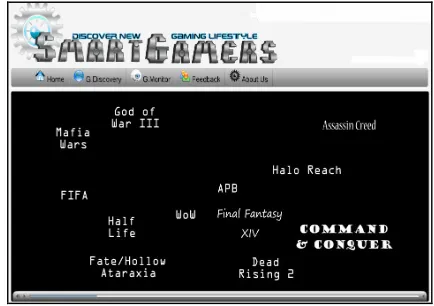
There are three main modules in Smart Gamers: G. Home, G. Discovery and G. Monitor. As shown in Fig 1, G. Home is the launching page of the website. Once the home page is launched, a short video will be played, showing a preview of all the current top selling video games to make the participant feel relevant to the website and to gain their attention.
[image:2.612.335.552.350.503.2]Fig 1. Smart Gamers Home Page
G. Discovery consists of pre-screening questions to identify the type of gamers. There are 4 pre-defined groups of gamers: non-gamers, casual, moderate and excessive gamers. Since there were no universal standard to determine what type of gamers they are, we have benchmark this group of gamers as follows:
Non-gamers (x = 0)
Casual gamers (1 ≤ x ≤ 13 hours) Moderate gamers (14≤ x ≤ 21 hours) Excessive gamers (>21 hours)
Based on the results of the pre-screening questions, each participant is allocated to the appropriate category. For each category, the respondent will be given a different set of messages to encourage them to better manage their gaming lifestyle. Table I shows the example of messages for each type of gamers.
TABLE I:MESSAGES FOR EACH CATEGORY OF GAMERS
Types of Gamers Messages
Non-gamers Participants will be informed that they are non-gamers. They will be educated on symptoms of pathological gamers, the negative effects of excessive gaming and ways to live a healthier lifestyle. Casual gamers Participants were informed that they
are casual gamers. They will be praise for their ability in proper time management.
Moderate gamers Participants were informed that they are moderate gamers. They will be advice to be more careful in managing their time. A video on ways to live a healthier lifestyle will be played.
Excessive gamers Participants were informed that they have been playing video games excessively and motivate them to change their gaming habit by showing symptoms of pathological gamers, the negative effects of excessive gaming and ways to live a healthier lifestyle.
To enhance the information retention rate, we have tried to use videos to present the message instead of text.
G. Monitor helps gamers to monitor their time spent on gaming and generate a graphical report. To record the time spent, users can either choose to submit the total time spent manually or click on the stopwatch on the website (as shown in Fig. 2) every time they start playing video games. Once they are done, they will need to submit the total time spent to the system. A monthly and daily performance report will be generated based on the total time spent on, to serve as a feedback to the users to let them informed about their gaming habits.
[image:3.612.349.527.46.297.2]
Fig 2. G. Monitor – Time Monitor
The design of Smart Gamers was based on Gagne’s Condition of Learning Theory, Cognitive Dissonance and Fogg’s Behavioral Model. The reasons for adopting learning theory and cognitive dissonance have been explained in our previous research work [10]. The application for each of these theories will be explained in the following sections.
A. Gagnes’ Condition of Learning Theory
Learning theory helps us to understand how an individual learns. In order to accommodate the different levels of learning for every individual, the 9 instructional events that Gagne outlines are taken into consideration. These events should satisfy or provide the necessary conditions for learning and serve as the basis for designing the website. Table II presents how we incorporated this theory into the intervention website design.
TABLE II:EXAMPLE OF EVENTS FOR LEARNING THEORY
Events Example
(1)Gaining attention (reception)
Play introduction video that shows all the top selling video games in the market (2) Informing learners of the
objective (expectancy)
Video that shows symptoms of excessive gamer
(3) Stimulating recall of prior learning (retrieval)
Ask questions regarding their time spent for gaming (4) Presenting the stimulus
(selective perception)
Show users the facts and effects of playing excessive computer games
(5) Providing learning guidance (semantic encoding)
[image:3.612.42.286.144.471.2] [image:3.612.317.572.543.733.2](6) Eliciting performance (responding)
Enquiry on how much time they spent on gaming (7) Providing feedback
(reinforcement)
Provide feedbacks on their gaming behavior
(8) Assessing performance (retrieval)
Provide proper solutions to problem user’s face
(9) Enhancing retention and transfer (generalization).
Using video as a media to transmit messages that are relevant to users is believed to increase information retention rate.
B. Cognitive Dissonance
Cognitive dissonance is the feeling of uncomfortable tension which comes from holding two conflicting thoughts in the mind at the same time. For example, excessive gamers continue to play games despite knowing that spending too much of time on gaming will cause them neglect other important tasks. They could rationalize their behavior by concluding that they are not spending too much of their time on gaming. Therefore, creating persuasive contents for excessive gamer to reduce their time spent on games can create dissonance by making them realize that they have spent too much of their time on gaming. In G. Discovery module, when the system has categorized the type of gamers of the participants, the result will be display to the participants to let them aware of their gaming habit. By doing this, it can put excessive gamers into a state of dissonance. As the participants navigate further, the level of dissonance will increase especially when they can relate themselves with the negative symptoms of pathological gamers. At the end of the experiment, the participant has to decide either to stick to their old beliefs or assimilate the old beliefs with the new idea of recognizing themselves as an excessive gamer and spending too much time on gaming will cause disruption to their life.
C. Fogg’s Behavioral Model
Fogg’s behavioral model explains the drivers that contribute to a change in human behavior. There are 3 principle factors that must exist at the same time for a behavior to occur: motivation, ability and trigger [11]. Table III presents how these factors are incorporated into design of Smart Gamers.
TABLEIII.EVENTSFORFOGG’S BEHAVIORALMODEL
Components Example
Core Motivators
Pleasure Participants learn through videos.
Fear A video that show negative effects on pathological gamers.
Acceptance/Rejection A forum was created in the website to allow participants to share their experience and opinion on excessive gaming.
Simplicity
Time, Money and Physical Effort
The interface was designed with little navigation and participants are not required to make any payment for usage of the website. Brain Cycles The messages that were
presented to the participants are straightforward.
Social Deviance The message that is presented to the participants are meant to encourage them to live a healthier lifestyle and to prevent them from being a pathological gamer.
Trigger
Spark An e-mail will be sent to the participants, who are categorized as excessive gamers, as a reminder for them to monitor their gaming habit if they are inactive in using the website to monitor their gaming hours.
V.RESULTS AND DISCUSSIONS
A. Participants Observation
TABLEIV.SUMMARYOFPARTICIPANT’SINTERVIEW
Criteria
Category
Self-relevant
Complete Useful Attract
Non-Gamers
No Yes No Yes
Casual Yes Yes Yes Yes
Moderate Yes Yes Yes Yes
Excessive Yes Yes Yes Yes
Self- relevant – participants find the content of the website relevant to themselves
Complete – participants watch all the videos presented to them
Useful – participants find the web tool useful to them Attract – The design of the website is attractive
One of the findings we observed from the experiment is that all the participants showed great interest in viewing all the videos presented to them. Although some of the videos were played for as long as 7 minutes, none of the participants quit halfway. Although non-gamers find the content irrelevant to them, they are still willing to watch all the presented videos. Therefore, we suggest that using video is one of the effective methods in gaining the participants attention.
Another interesting finding from this experiment was that casual, moderate and excessive gamers have a similar response towards the content of the website. However, excessive gamers spent more time viewing the videos as compared to others. These gamers were surprised that they were in excessive gamer category. This has served as a trigger to them, making them realize that they have spent too much time playing video games. The video that shows the negative effects on excessive gaming had also triggered their fear on having those negative effects on them. The simplicity of using the website has allowed them to view the video multiple times, to deepen their understanding of the problem and the recommended solution. Therefore, they have shown keen interest in knowing more about the negative effects of playing games excessively as compared to others. On top of that, some of the excessive gamers observed were trying to reduce their dissonance level by changing the time spent on gaming. Although no sign of behavioral change has been notice, the experiment has shown that the application of learning theory and cognitive dissonance is able to cause the participants to recall their behavior and triggered their intention to change their gaming habit.
B. Smart Gamers Usability Survey
Following the experiment, a survey with 30 test participants was done to evaluate the perceived usefulness of the website. University students were recruited randomly ranging in age from 18-22, regardless of gender. The age group was chosen as they have already started their college life and has higher
chances of accessing high speed internet which is necessary for online gaming. There were four sections in the survey, as can be seen in Table V, VI, VII and VIII with a total of 29 questions, using a 7-point Likert scale. The breakdowns of the 7 point indication are:
• 1 - strongly disagree • 2 - disagree
• 3 - somewhat disagree • 4 - neutral
• 5 - somewhat agree • 6 - agree
• 7 - strongly agree.
TABLEV.MEANWEBSITEDESIGNANDINFORMATION
Question No. Mean
Q1. Information provided is clearly understood
5.20
Q2. Font size is appropriate 5.21 Q3. Color scheme is appropriate. 5.73 Q4. Interface looks pleasant 5.60 Q5. Professional looking interface 5.40
Q6. I like the interface 5.40
Q7. There are inconsistencies in the interface design
3.73
TABLEVI.MEANFORTERMINOLOGYANDWEBSITESTRUCTURE
Question No. Mean
Q8. Terminology was easily understood 5.87 Q9. Messages strategically positioned 5.47 Q10. Information properly organized 5.67
TABLEVII.MEANFORLEARNINGTOUSETHEWEBSITE
Question No. Mean
Q11. Learning to operate the website is easy 5.47 Q12. Exploring new features of the website is
exciting
5.20
Q13. Perform task in a straightforward manner
5.33
TABLEVIII.MEANWEBSITECAPABILITIES
Question No. Mean
Q14. Easy to use 5.93
Q15. User friendly 5.67
Q16. Flexible 5.07
Q17. Using it is effortless 5.64
Q18. Fun to use 5.53
Q19. Use without written instructions 4.73 Q20. Both occasional and regular users
would like it
5.20
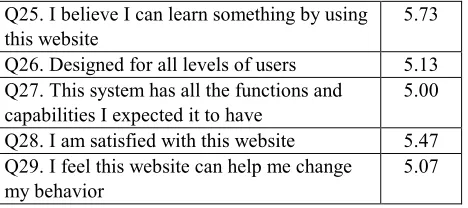
Q25. I believe I can learn something by using this website
5.73
Q26. Designed for all levels of users 5.13 Q27. This system has all the functions and
capabilities I expected it to have
5.00
Q28. I am satisfied with this website 5.47 Q29. I feel this website can help me change
my behavior
5.07
Based on the mean values shown in Table V, VI, VII and VIII, we can see that most of the mean values are greater than 5. This implies that the participants are satisfied with our system design. However, it was found that the mean for Q7 from Table V was below 4-point (neutral). Also, Q19’s mean score from Table VIII was just slightly above neutral. Thus, improvement in consistency of interface design and better information architecture is necessary to better improve the website’s usability.
The qualitative data collected from the survey is used to strengthen and provide justification for quantitative findings presented above. Some respondents did provide some feedback on the positive aspects of the system, as listed in Table IX.
TABLEIX.SUBJECTIVERESPONSESONTHEPOSITIVEASPECTS
Test Participant No. Details
04, 11, 12, 13, 14, 15, 16
Educational as it explains the effects of gaming and how to better manage lifestyle
03, 04, 14 Fun and interesting
10 Clear instructions and easy to follow content
08, 09 Good interface design 02, 03, 04, 06 Interactive
21, 07 Good music
As many test participants provided positive feedback in terms of the content of this website, it could become a platform for students to better know their gaming behavior and be in control of their lifestyle.
VI.CONCLUSION AND RECOMMENDATION
The use of web intervention for excessive gaming is another innovative idea of using the Web to disseminate useful information and prevent excessive gamers from becoming pathological gamers. To ensure the effectiveness of the website, Smart Gamers was designed based on learning theory, cognitive dissonance and Fogg behavioral model. The experiment is still ongoing and the next step is to implement field experiment to monitor sign of behavioral change on the gamers.
REFERENCES
[1] H. Mohamed, N. Y. Che Jan, N. M. Nik Daud, “Exposure of Computer Games among IHL Students in Malaysia: Case Study of Computer Science Students in UiTM Terengganu”. Computer and Information
Science Journal, vol. 3, no. 1, 144-151.
[2] J.S. Lemmens, P.M. Valkenburg and J. Peter, “The Effects of Pathological Gaming on Aggressive Behavior,” Journal of Youth
and Adolescent, vol. 40, no. 1, 38-47.
[3] Chiu, S., Lee, J., & Huang, D. (2004). Video game addiction in children and teenagers in Taiwan. CyberPsychology & Behavior, 7, 571–581.
[4] Griffiths, M. D., & Davies, M. N. O. (2005). Videogame addiction: Does it exist? In J. Goldstein & J. Raessens (Eds.), Handbook of
computer game studies (pp. 359–368). Boston: MIT Press.
[5] Davis, S., Abidi, S.S.R.: Adaptive Patient Education Framework Featuring Personalized Cardiovascular Risk Management Interventions. In: Wade VP, Ashman H, Smyth B, editors. Adaptive Hypermedia and Adaptive Web-Based Systems. Springer-Verlag Berlin/Heidelberg (2006).
[6] M. L. A. Lustria, J. Cortese, S. M. Noar and R. L. Glueckauf, “Computer-tailored health interventions delivered over the web: Review and analysis of key components”, Patient Education and
Counseling, vol. 74, pp. 156-173, 2009.
[7] S. Chatterjee, “Healthy Living with Persuasive Technologies: Framework, Issues, and Challenges”, Journal of the American Medical Informatics Association, vol. 16, no. 2, April 2009.
[8] Oinas-Kukkonen, Harri and Harjumaa, Marja (2009) "Persuasive Systems Design: Key Issues, Process Model, and System Features," Communications of the Association for Information Systems: Vol. 24, Article 28.
[9] Torning, K. and Oinas-Kukkonen, H., “Persuasive System Design: State of the Art and Future Directions”, Proceedings of the 4th International Conference on Persuasive Technology 2009, New York, USA.
[10] Chen, Y.Y., Sivapalan, S., Ganeson, K., Goh, K.N., Sugathan, S. and Akashah, E., “Design of Web Intervention to Influence Youth Behavior toward Online Gaming”, International Symposium in Information Technology 2010, Kuala Lumpur, Malaysia.
[11] Fogg, B.J., “A Behavior Model for Persuasive Design”, Proceedings of the 4th International Conference on Persuasive Technology 2009,
[image:6.612.50.284.50.154.2]