IOT Based Smart Air Purifier
Tazin Shaikh1, Sameer Pathan2, Sururahemad Shaikh3, Dr. J. N. Shinde4 1, 2, 3, 4
Al-Ameen College of Engineering
Abstract: Now days we hear about the diseases increasing due to the impure air. One of the problems, and that to a huge one is air pollution. India is one of the most polluted countries in the world are prone to air borne diseases like asthma, chronic obstructive pulmonary disease (COPD ) and these diseases causing mainly to the aged people who suffers through these diseases. In this we report the architecture of the air purifier which operates on low power so that the power consumption will be less. For the prevention of the air pollution this system Air purifier is the better option than the others. As we can carry this system everywhere as it’s portable for the people.
I. INTRODUCTION
A. Overview
In the 21st century due to the improvement in technology the pollutions have also increased to a greater extent, hence we had taken up the responsibility to create a pollution free environment. But reducing air pollution completely is impossible, hence something should be used so that we stay away from the diseases which we may face due to air pollution. IOT Based Smart Air Purifier is a great option to this. There were many existing air purifiers which were residential but the amount of air pollution outdoor is too much than the amount of indoor pollution hence we have designed a purifier which is portable.
B. Central Purposes of Air Purifiers
The air pollution increasing mainly due to the individuals spreads the large amount of pollution. So that our group took that responsibility of reducing the air pollution using the advancement of the technology.
1) Reduced Establishment Costs: First and important, establishment costs are completely decreased because cabling is not important. Wired arrangements require cabling, hence it becomes costly.
2) Adaptable System and Simple Augmentation: Designing a remote system has many advantages over the normal systems. It becomes very beneficial.
3) Portability: As it is wireless it helps to make the system completely portable, that means it can be carried anywhere and everywhere.
4) Integration of cell Phones: With remote systems, PDAs and Smart phones the system can be controlled by humans just at a click (as long as the gadget is in reach of the system).
II. RELATED WORK
A. Khalid A. Fakeeh, PhD King Abdullaziz University Jeddah, Saudi Arabia
This paper proposes a method to reduce the wastage of power in technical universities by the power distribution agencies across the world. The system consists of thermal sensing and IOT enabled microcontrollers for the working. The present IOT based power management systems using image processing is very costly, hence the paper proposes a cheap method to regulate the wastage of power. But the energy consumption is increasing rapidly, and the energy is not sufficient enough to meet the rising demand. Many of the countries have renewable energy source, but are not utilizing it. The usage of hydroelectric power which was the major source of energy in the twentieth century is now being replaced by nuclear energy. Since nuclear plants have many security issues. This increases the installation cost of the reactor.
B. EPA Technical Document Residential Air Cleaners
cockroach allergens from typical-size rooms. If the usual methods of dealing with indoor air pollutants are insufficient, air-cleaning devices may be useful. Air filters and other air-cleaning devices are designed to remove pollutants from indoor air. They can be installed in the ductwork of most home heating, ventilating, and air-conditioning (HVAC) systems to clean the air in the entire house, or the same technology can be used in portable air cleaners that clean the air in single rooms or specific areas. Most air-cleaning devices are designed to remove particles or gases, but some destroy contaminants that pass through them.
C. Kan Zheng1, (Senior Member, Ieee), Shaohang Zhao1, Zhe Yang1, Xiong Xiong1, And Wei Xiang2
In this paper a new method to implement the air quality monitoring system based on state-of-the-art Internet-of-Things (IoT) techniques has been proposed. In this system, portable sensors collect the air quality information timely, which is transmitted through a low power wide area network.
All air quality data are processed and analyzed in the IoT cloud. This paper proposes an air quality monitoring system based upon LPWA networks. Firstly, we briefly present the architecture of the proposed system. Then, the hardware and software designs are discussed in detail. The LPWA access point (AP) is implemented on an open-source soft-defined radio (SDR) platform.
The air quality monitoring node consists of sensors, microcontroller unit (MCU), battery and so on, which are developed by ourselves. In order to process and analyze the sensed data, the IoT cloud with different types of servers has been established. The users can access the air quality information either through a website or a mobile application (APP).
D. Barn PK, Elliott CT, Allen RW, Kosatsky T, Rideout K, Henderson
The main aim of this paper is to create portable air cleaners for wildfire smoke for complex mixture of air pollutants, including small particles that can cause irritation and inflammation when inhaled. Although wildfire smoke is generated outdoors, it can travel indoors through windows, doors, vents, and other openings in the building envelope. Smoke from wildfires poses a health risk to the public (Elliott, 2014).
While some communities in Yukon do have existing emergency measures plans which may include forest fire response elements, there is no plan in place on how to mitigate and prevent exposure to wildfire smoke for the general public. It is prudent to both advise the public of the potential health risk as well as provide resources on how the population can manage their individual health. The decision to order an evacuation or partial evacuation of a community should be considered a last resort measure, as there are less intrusive protective health measures that can be taken first.
Evacuation can have a significant psycho-social impact to evacuees and may create additional stressors when individuals are away from support systems and resources (Elliott, 2014).
Furthermore wildfire smoke can have impacts on health care facilities by increasing patient loads, to mitigate this stress on the health system well-planned communications and prevention strategies may reduce this potential burden.
III. FRAMEWORK ANALYSIS
A. Issue Definition
The main aim of building this project is to reduce the problems or diseases causing to human beings. So that we have built a project which is capable of doing it.
The project is designed in a manner which could be useful and very easy to operate from everywhere, this is one of the main advantage of the project is.
Here we have used Internet of Things which helps to make this system more advance with the use of this very less energy will be used as we can control it from anywhere, this makes it more convenient to use. Just with a click on your mobile phone the system can be controlled easily, hence this system proves to be a great work.
B. Implemented System Feature
The proposed framework is a conveyed air purifier framework, comprises of server, sensors. Through the internet we can control the on or off of the fan effortlessly.
IV. SYSTEM DESIGN AND IMPLEMENTATION
A. Implemented IOT Based Smart Air Purifier
Figure:-Proposed model of IOT Based Smart Air Purifier model
Nowadays use of IOT has been increasing day by day; the importance and usage is on tremendous demand. There is lots of research going into IOT based power management systems. The increase in power requirement has made the researchers and industrialist to design low power systems. The wastage of energy is a very serious issue; this paper proposes a method to reduce the wastage of power.
Power management is an important aspect towards the development of the nation. With the help of IOT in the purifier we can utilize the power efficiently and carrier it anywhere due to its portability.
B. Implemented Air Purifier system Functions
The working of IOT Based Smart AIR Purifier is discussed here. It basically consists of two modes and they are as follows:-
1) Automatic Mode: In Automatic mode of system continuously checks the surrounding temperature, humidity and Air Quality condition by the taking the values from DHT11 sensor and Air Quality sensor attached to the ESP8266. And triggers the Motor for fragrance purpose
2) IOT Mode: In IOT Mode user can set the particular time to trigger the System and makes system works without the sensors or by making the immediate trigger for motor control by a web based application.
C. Software Design
1) Front End Design: HTML is a format that defined a computer how to display a web page. The documents themselves are plain text files with special "tags" or codes that a web browser uses to interpret and display information on your computer screen. HTML stands for Hyper Text markup Language; an HTML file is a text file containing small markup tags. The markup tags tell the Web browser how to display the page. An HTML files must have an htm or html file extension.
D. Implementation Setup
Figure2:- Sequence of activation of IOT Based Smart Air Purifier
Figure 3:- Experimental setup for IOT Based Smart Air Purifier
[image:4.612.220.394.590.721.2]V. RESULTS
Figure 4:- Web server page
START
Connect to network
Read all sensor data
Send Data
Response
Response
Check
END
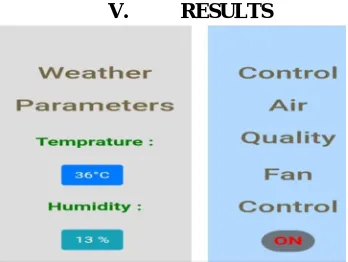
After the effective association with the server, the information of the web server are sent to the web server for checking of the framework. The figure 4 shows the web server page which will help us to control the purifier. By entering proper IP address this web page will be opened. The web server will give the data about the temperature and the quality of the air according to which we can ON/OFF the fan.
VI. COMPARISON WITH THE RELETE SYSTEM
Parameter System A
IOT Based smart Power Management System
System B
Design and
Implementation of
LPWA-based Air
Quality Monitoring
System
System C
Evaluating ozone spatial distribution in Portugal using passive samplers
System D
IOT Based Smart Air Purifier (Our System)
Using of Internet of thing
Yes No No Yes
Trainer kit Arduino Mega ADK ATMEGA128
Development Board Arduino Uno Development Board Communication Type Serial communication
Serial communication Serial
communication
Serial
communication
Controlling with the help of
android phone or tablet
android phone or
tablet
android phone or tablet
Android mobile or pc,
web link
Security High Low Medium High
Complexity Medium High Highest Low
Cost Medium High Very high Low
Special function It controls the
power of various equipments through
the IoT enabled
microcontroller
It depends on the
LPWA technology
which covers the
larger area for air quality monitoring.
Combination of
Active and passive monitoring system for the monitoring of air quality
It controls the air quality using IoT and web Link for ease of operation.
VII. COMPARISON RESULT WITH OTHER SYSTEM:
A. IOT Based smart Power Management System
In this system The Image Processing technology is used which is very costly so that the cost of the system will also increase while in our system of air purifier we uses Wi-Fi microcontroller module which operates on very low power so that the system we built is quite better than this system.
B. Design and Implementation of LPWA-based Air Quality Monitoring System
In this system LPWA (Low Power Wide Area) is used which means it works on a wide range of area like urban cities so the cost of this system is definitely higher than our system. As well as the performance of this system is better than our system as we have built a system which is suitable of small range of area.
C. Evaluating Ozone Spatial Distribution In Portugal Using Passive Samplers
VIII. CONCLUSION AND FUTURE WORK
A. Conclusion
The Air Purifier using Internet of Things has been experimentally proven to work satisfactorily by purifying the polluted air and it could be successfully controlled through internet. The designed system not only monitors the temperature, humidity and air quality but also actuates a process according to the requirement, for example we can give command of fan ON/OFF from anywhere just with a click. It also shows the sensor parameters on the internet. This will help the user to analyze the quality of the air.
B. Future Work
Utilizing this framework as structure, this framework can be extended to the choices like This Air Purifier will turn ON only in the presence of human being currently at the place otherwise it will be remained in OFF position. If the air quality is bad and there is no human is present there also at that time Air Purifier will be OFF. Due to this kind of scenario power consumption will be lesser. Just we have to add some of the sensors which should be able to detect the presence of the human beings.
IX. ACKNOWLEDGEMENT
We acknowledge the efforts and hard work by the experts who have contributed towards development of the different air purifiers. We also acknowledge the efforts of Dr. J.N.Shinde, Principal AAEMF,COE for his constant support, suggestions and modifications to improve the quality of the paper and to help prepare this paper.
REFERENCES
[1] Khalid A. Fakeeh, PhD King Abdullaziz University Jeddah, Saudi Arabia “An IOT based Smart Power Management System for Technical University”
International Journal of Computer Applications (0975 – 8887) Volume 149 - No.1, September 2016
[2] EPA technical document Residential Air Cleaners: A Summary of Available Information (Second Edition), EPA 402-F-08-005, May 2008.
[3] J. Monjardino, S. Mesquita, H. Tente, F. Ferreira, P. Gomes & N. Franco “Evaluating ozone spatial distribution in Portugal using passive samplers” WIT Transactions on Ecology and the Environment · April 2007
[4] KAN ZHENG1, (Senior Member, IEEE), SHAOHANG ZHAO1, ZHE YANG1, XIONG XIONG1, AND WEI XIANG2, (Senior Member, IEEE) “Design and
Implementation of LPWA-Based Air Quality Monito...ring System” July 7, 2016.
[5] Barn PK, Elliott CT, Allen RW, Kosatsky T, Ride out K, Henderson SB (2016). Portable air cleaners should be at the forefront of the public health response to