Stress Analysis using EEG signals
A Rafega Beham1, Thejaswini S2, Thanushree C M3, Vachan Neelkant Naik4, Sudarshan Naidu P5 1
Sr. Asst. Professor, 2,3,4,5Student, Information Science, New Horizon College of Engineering, Bangalore, Karnataka, India
Abstract: The biological response to stress originates in the brain that involves different biochemical and physiological effects. Numerous basic clinical strategies to survey pressure depend on the nearness of explicit hormones and on highlights separated from various signs, including electrocardiogram, circulatory strain, skin temperature, or galvanic skin reaction. To screen pressure, various strategies can be utilized. In this task for anxiety acknowledgment, Electroencephalogram (EEG) signal is utilized. EEG (Electroencephalogram) signal is a neuro-signal that is produced due the diverse electrical exercises in the mind. Various sorts of electrical exercises relate to various conditions of the mind. These signs can be caught and handled to get the helpful data that can be utilized in early location of some psychological state. In this proposed system, EEG signal dataset is pre-processed using Notch filter. ICA (Independent component analysis) is applied to pick the component with ocular effect. And then Hilbert Transform is applied for feature extraction. Classification of stress level is done by implementing SVM (Support-Vector Machine) algorithm which will provide the better accuracy.
Keywords: Stress analysis, EEG signals, Notch filter, Hilbert transformation, Ocular artifact, SVM.
I. INTRODUCTION
Stress is a sentiment of enthusiastic or physical strain. It can emerge out of any occasion or believed that makes you feel baffled, furious, or anxious. Stress is your body's response to a test or request. In short blasts, stress can be sure, for example, when it encourages you keep away from peril or comply with a time constraint. Be that as it may, when stress goes on for quite a while, it might hurt your well being. Body responds to worry by discharging hormones. These hormones make your cerebrum progressively alert, cause your muscles to tense, and increment your heartbeat. As indicates by the World Health Origination (WHO), stress is the serious issue of person and it has expansive impact on physical just as psychological well-being. The condition of passionate strain or mental coming about because of unfavourable or demanding conditions is called as stress. It very well may be encounters by every single individual in ordinary way of life because of employment, some family issues or other individual issues. Some sort of stress is significant for the finishing task yet a great deal pressure makes hurt the human well-being. Henceforth, presently days, distinguishing proof of anxiety is significant. Sundry conventional systems for stress analysis are accessible, however this paper proposes one of the straightforward procedure for the recognition of stress utilizing EEG signal analysis. In an individual, currents spreading through the head are produce by electrical action of neurons as voltage changes and magnetic fields, these currents compasses to the outside of the scalp. Voltage changes at the scalp is get measure and this type of signs are known as the electroencephalogram (EEG). These caught EEG signals got prepared for acquiring the helpful data to distinguish different mental ailments. Electroencephalography (EEG) is an ideal instrument as it is a non-obtrusive procedure. Also , it gets criticism from stress hormones; it can fill in as dependable device to gauge stress. These words related stressors are hard to adjust and deal with. On the off chance that they endure, incessant pressure sets in, this is a noteworthy worry for genuine sickness like heart assault. Stress can have a positive or negative impact on understudies. Positive pressure called eustress gives chance to development like improvement in scholarly execution. In the event that understudies keep on having pressure, it achieves an ideal point and moves toward becoming misery. It will negatively affect the body what's more, personality causing sleep deprivation, stifled invulnerability, visit diseases, and migraine [2]. Studies [3,5] have appeared high predominance of worry in scholarly circle. It influences understudies regardless of their foundation, culture, ethnic birthplace [6]. People experience stress because of the requests and desires set on them. It turns out to be more awful when they see the circumstance is overpowering and think that it’s hard to adapt up. Sometimes in case of students it even makes them to drop out from school [7]. A few methodologies utilize the temperature of the finger [15], human signals [16] and eye squint [17] as a methodology to identify stress. Late methods utilize warm imaging [18], physiological signals [19,20] for stress recognition. Identification of stress is a standout among the best research topic point for psychologists as well as engineers also. Essentially, there are three kinds of stress:
1) Acute Stress: This stress is for short time span in which some energy present and bring thrill. for example roller coaster ride.
2) Episodic Stress: This stress is for longer span of time in which individuals makes self-harm or having absurd demands or stressing.
Different techniques were created for the distinguishing proof of stress like Electroencephalography (EEG),Response of skin sensation alongside its temperature. Rate of breath Electromyography(EMG),Electrocardiography(ECG), level of blood pressure[4]. Mental pressure can be secured with the assistance of guiding treatment. Yet, for this treatment, dynamic interest of the patient is likewise significant. In any case, in some genuine cases it is unimaginable exceptionally when individual cannot ready to communicate to be perfectly honest, this may causes troublesome issue for the advisor .Hence, to conquer this issue recording and dissecting EEG signals is valuable. This system is the better path for the gathering of the voltage fluctuation of variation coming through the ionic current within the neurons of the human brain[8]. It is anything but difficult to work and specialists can ready to gather the flections close to patient's bed too. EEG signal get capture utilizing the EEG MindWave Neurosky headset and play out the examination in MATLAB programming. These signal get separated according to the recurrence ranges, to be specific delta(1-4 HZ), theta(4-8 Hz),alpha(8-13 Hz), beta (13-20 Hz) and gamma (generally >20Hz).Voltage fluctional of the scalp is somewhere in the range of 20 and 100uV[15].These EEG signals are captured utilizing various electrodes normally accessible in clinics. These electrodes are place on the scalp, utilizing 10:20 technique to catch flag. Primary aim of this undertaking is to build up a convenient and ease ongoing framework for gathering as well as analysing of the signal for the discovery of stress level of human.
The traditional stress recognition framework is based on physiological signs and outward appearance techniques. The real disadvantage is the vulnerability that ascents because of various outer variables like sweating, room temperature, anxiety. Some strategies like hormone investigation have a downside of obtrusive procedure. There is requirement for a strategy that is non-intrusive, precise, accurate and reliable. This research work expects to identify stress dependent on EEG as EEG shows a decent connection with stress. The results uncovered the productivity of the framework to recognize worry continuously.
II. LITERATURE SURVEY
Studies involving the stress analysis using EEG signals and implementing the techniques can be found in literature.
Instead of actualizing, the surveys based strategy, for example, Cohen's Perceived Stress Scale, Stress Response Stock and Hamilton Depression Rating Scale to distinguish the dimension of pressure, utilization of highlight extraction systems to remove required highlights from EEG flags likewise offers a decent option. For instance, Fast Fourier Transform (FFT), Discrete Wavelet Transform (DWT), Discrete Cosign Transform (DCT) and so on can be utilized for highlight extraction previously ordering the information. Sulaiman et al. [16] proposed a mix of EEG Asymmetry and Spectral Centroids strategies to distinguish one of a kind example of human pressure. Ghostly Centroids procedure was broadly utilized in discourse and sound acknowledgment as a result of its strength to perceive the prevailing recurrence [17-19]. Poulus et al. [20] utilized EEG phantom power and mean recurrence of Alpha band as a component to NN (Neural Network) so as to recognize individual's trademark. Additionally, kNN classifier was utilized to identify and group human identity and attributes from the EEG flag design when
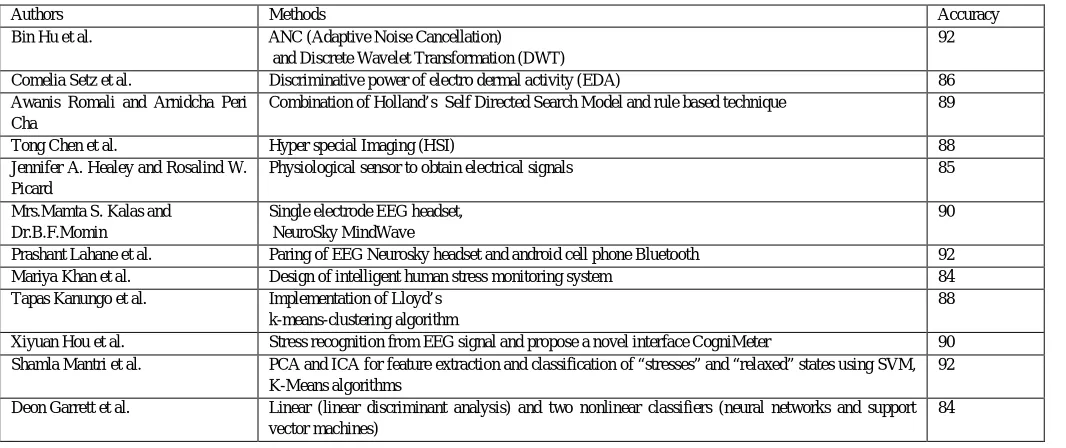
[image:2.612.45.578.513.737.2]tuning in to music [21-24].The study of various papers was done. Their various techniques along with accuracy of the result is depicted in the tabular format.
Table 1: Summary of various paper work
Authors Methods Accuracy
Bin Hu et al. ANC (Adaptive Noise Cancellation) and Discrete Wavelet Transformation (DWT)
92
Comelia Setz et al. Discriminative power of electro dermal activity (EDA) 86
Awanis Romali and Arnidcha Peri Cha
Combination of Holland’s Self Directed Search Model and rule based technique 89
Tong Chen et al. Hyper special Imaging (HSI) 88
Jennifer A. Healey and Rosalind W. Picard
Physiological sensor to obtain electrical signals 85
Mrs.Mamta S. Kalas and Dr.B.F.Momin
Single electrode EEG headset, NeuroSky MindWave
90
Prashant Lahane et al. Paring of EEG Neurosky headset and android cell phone Bluetooth 92
Mariya Khan et al. Design of intelligent human stress monitoring system 84
Tapas Kanungo et al. Implementation of Lloyd’s k-means-clustering algorithm
88
Xiyuan Hou et al. Stress recognition from EEG signal and propose a novel interface CogniMeter 90 Shamla Mantri et al. PCA and ICA for feature extraction and classification of “stresses” and “relaxed” states using SVM,
K-Means algorithms
92
A. EEG Device
Electroencephalography is a medicinal imaging strategy that peruses scalp electrical action produced by cerebrum structures. The electroencephalogram (EEG) is characterized as electrical movement of a substituting type recorded from the scalp surface in the wake of being grabbed by metal terminals and conductive media.
EEG signal comprises of various mind waves reflecting cerebrum electrical action as indicated by terminal positions and working in the neighbouring cerebrum areas. In this article, we will allude just to EEG estimated from the head surface.
Along these lines electroencephalographic perusing is a totally non-obtrusive strategy that can be connected more than once to patients, typical grown-ups, and kids with for all intents and purposes no hazard or restriction A remote EEG gadget, which is a head set was set by universal 10-20 framework.
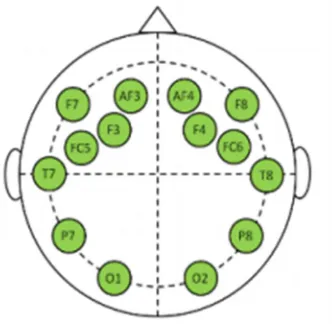
[image:3.612.224.390.227.389.2]The terminals were appended to the scalp at position AF3, F7, F3, FC5, T7, P7, O1, O2, P8, T8, FC6, F4, F8 and AF4 as appeared in Figure1.
Figure 1. Electrode placement on the scalp.
Constrained numerical inquiries with differing trouble were given and they were mentioned to explain inside a particular time limit. The EEG was recorded while endeavouring to fathom them. They self-report feeling of anxiety as per National Aeronautics and Space Administration Task Load Index (NASA-TLX) rating scale. The procured EEG signals were prepared at 512 Hz and
impedance was kept as low as 7 kΩ.
B. EEG Signals
A remote EEG gadget, Emotiv Epoch head set was set by worldwide 10-20 framework. The cathodes were joined to the scalp at position AF3, F7, F3, FC5, T7, P7, O1, O2, P8, T8, FC6, F4, F8 and AF4 as appeared in Figure 1. Cathode position on the scalp. Restricted numerical inquiries with fluctuating trouble were given and they were mentioned to illuminate inside a particular time limit. The EEG was recorded while endeavouring to explain them. They self-report feeling of anxiety as indicated by National Aeronautics and Space Administration Task Load Index (NASA-TLX) rating scale. As EEG has little adequacy, sifting through undesirable amplitude is a basic advance to remove helpful data.
We disposed of one essential commotion (ancient rarities), that is Ocular relic expulsion: The EEG rhythms lie in the recurrence scope of 0.3 Hz to 44 Hz. The visual relic happens at 0.1-16 Hz.
C. EEG Pre-Processing
Raw EEG is polluted with amplitude from various structure and sources. As EEG has exceptionally little amplitude, sifting through undesirable amplitude is a basic advance to extricate helpful data. We dispensed with visual relics that emerge because of body development.
D. ICA to pick the Component with Ocular
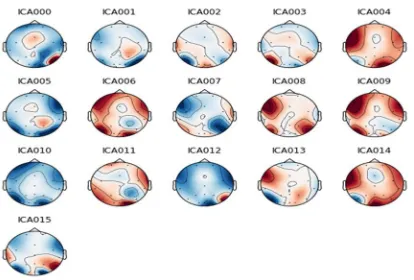
[image:4.612.203.410.133.273.2]1) Artifact:Independent Component Analysis is an amazing asset for wiping out a few significant kinds of non-cerebrum relics from EEG information. EEG LAB enables the client to dismiss numerous such curios in a proficient and easy to understand way. We can delineate the ICA part in the Figure 2.
Figure 2: ICA components
E. Ocular Artifact Removal
Eye advancements cause changes to the electric fields around the eyes, and accordingly over the scalp. As a result, EEG chronicles are normally basically misshaped, and their understanding hazardous. Different procedures have been proposed to beat this issue, stretching out from the rejection of data contrasting temporarily with huge eye advancements, to the departure of the assessed effect of visual development from the EEG. So we take out this amplitude from EEG signal.
F. Feature Extraction
The motivation behind this stage is to outline into the resulting pressure state. A versatile component extraction method Hilbert Transform was connected to separate pertinent highlights in time-recurrence area. It is the important way to deal with uncovers data covered up in the sign considering the non-stationary nature of the signal.
G. Classification
The classification is client independent, which implies information gained from all members are utilized for preparing the classifier. The element vector got through HTT is arranged into impartial or three dimensions of pressure (stress-low, stress-medium and stress-high). We picked Support Vector Machine (SVM) over different calculations for order for two reasons. Right off the bat, it is obtuse toward over fitting issue. Furthermore, its capacity for high speculation and exactness with smaller training sample.
SVMs can likewise be connected to relapse issues by the presentation of an elective misfortune work. The misfortune work must be altered to incorporate a separation measure. The relapse can be direct and non straight. Straight models mostly comprise of the accompanying misfortune capacities, e-escalated misfortune capacities, quadratic and Huber misfortune work.
Additionally to arrangement issues, a non-straight model is generally required to satisfactorily show information. In a similar way as the non-direct SVC approach, a non-straight mapping can be utilized to outline information into a high dimensional element space where straight relapse is performed.
SVM: The objectives of SVM are isolating the information with hyper plane and stretch out this to non-direct limits utilizing bit trap. For computing the SVM we see that the objective is to effectively arrange every one of the information.
[a] If Yi= +1;wxi +b>=1 [b] If Yi= - 1; wxi + b ≤ 1 [c] For all I; yi (wi + b) ≥ 1
III.PROPOSED SYSTEM
In this proposed system, EEG signal dataset is pre-processed using Notch filter. ICA (Independent component analysis) is applied to pick the component with ocular effect. And then Hilbert Transform is applied for feature extraction. Classification of stress level is done by implementing SVM (Support-Vector Machine) algorithm which will provide the better accuracy.
IV.CONCLUSION
Human stress estimation system may be better alternative in the field of well-being science. It catches the steady EEG flag and structures the total circle by demonstrating different characteristics as indicated by the fluction of electrical flag on the scalp. The benefit of framework is its insignificant exertion, compact, easy to use, basic securing database and essential application setup for different structure.
This study proposed an EEG-based pressure examination framework for the general population. We took the helpful data from the EEG flag, executed SVM as classifier, and got precision of 83.34%. The results revealed the feasibility of utilizing EEG for stress investigation, which is critical for clinical intercession and evasion of physical and mental prosperity issues.
REFERENCES
[1] Hu, B., Peng, H., Zhao, Q., Hu, B., Majoe, D., Zheng, F. and Moore, P. Signal Quality Assessment Model for Wearable EEG Sensor on Prediction of Mental Stress. IEEE Transactions on Nanobioscience 14 (5) (2015).
[2] Ursin H, Eriksen HR. The cognitive activation theory of stress. Psycho neuro endocrinol 2004; 30: 567-592. [3] Garret JB. Gender differences in college related stress. Undergr J psychol 2001;14: 5-9.
[4] Kalas, M.S. and Momin, B.F. Stress Detection and Reduction using EEG Signals. International Conference on Electrical, Electronics, and Optimization Techniques 12 (2016) 59-62.
[5] Dunkel SC, Lobel M. Stress among students. N Dir Student Serv 1990.
[6] Abouserie R. Sources and levels of stress in relation to locus of control and self-esteem in university students. Edu psychol 1994; 14: 323-330. [7] Hunt J, Eisenberg D. Mental health problems and helpseeking behaviour among college students. J Adol H 2010; 46: 3-10.
[8] Lahane, P., Vaidya, A., Umale, C., Shirude, S. and Raut, A. Real Time System to Detect Human Stress Using EEG Signals. International Journal of Innovative Research in Computer and Communication Engineering 4 (4) (2016).
[9] Begum S, Ahmed MU, Funk P, Xiong N, Scheele BV. Using calibration and fuzzification of cases for improved diagnosis and treatment of stress. Proc European workshop 2006; 113-122.
[10] Healey JA, Picard RW. Detecting stress during real-world driving tasks using physiological sensors. IEEE Trans Intel Transp Sys 2005; 6: 156-166. [11] Haak M, Bos S, Panic S, Rothkrantz LJ. Detecting stress using eye blinks and brain activity from EEG signals. Proc Interact Interf 2009: 35-60 [12] Pavlidis I, Dowdall J, Sun N, Puri C, Fei J, Garbey M. Interacting with human physiology. Comp Vis Imag Unders 2007; 108: 150-170.
[13] Poh MZ, McDuff DJ, Picard RW. Non-contact, automated cardiac pulse measurements using video imaging and blind source separation. Optics Express 2010; 18: 10762-10774.
[14] Fei J, Pavlidis I. Thermistor at a distance: unobtrusive measurement of breathing. IEEE Trans Biomed Eng 2010; 57: 988-998. [15] Kulkarni, S.P., Potale, S.B. and Bairagi, V.K. Brain Monitoring for Healthy Living. IEEE ICCSP, 2015.
[16] N. Sulaiman, M. N. Taib, S. A. Mohd Aris, N. H. Abdul Hamid, S. Lias and Z. H. Murat, “Stress features identification from EEG signals using EEG Asymmetry & Spectral Centroids Techniques,” in Proceedings of the IEEE EMBS on Biomedical Engineering and Science (IECBES), 2010, pp. 417-421. [17] K. K. Paliwal, “Spectral Subband Centroids Features for Speech Recognition,” in Proceedings of the International Conference on Acoustics, Speech and Signal
Processing (ICASSP), 1998, pp. 617- 620.
[18] J. S. Seo, M. Jin, S. Lee, D. Jang, S. Lee and C. D. Yoo, “Audio Fingerprinting Based on Normalized Spectral Subband Centroids,” in Proceedings of the International Conference on Acoustics, Speech and Signal Processing (ICASSP), 2005, pp. 213-216.
[19] M. L. Massar, M. Fickus, E. Bryan, D. T. Petkie and A. J. Terzuoli Jr., “Fast Computation of Spectral Centroids,” Journal of Advanced Computing Mathematics, vol. 35, no. 1, pp. 83-97, June 2010
[20] M. Poulos, M. Rangoussi, N. Alexandris and A. Evangelou, “On the use of EEG features towards person identification via neural networks,” in Proceedings of the International Conference on Acoustic, Speech and Signal Processing (ICASSP), 1999, pp. 1-35.
[21] S.Ito, Y. Mitsukura, K. Sato, S. Fujisawa and M. Fukumi, “Study on Relationship between Personality and Individual Characteristic of EEG for Personalized BCI,” in Proceedings of the IEEE International Conference on Computational Technology in Electrical and Electronics Engineering (SIBIRCON ), 2010, pp. 106-111.
[22] T. Lan, A. Adami, D. Erdogmus and M. Pavel, “Estimating Cognitive State using EEG signals,” Journal of Machine Learning, vol. 4, pp. 1261-1269, 2003. [23] R. Khosrowabadi, C.Q. Hiok, Abdul Wahab and K.A. Kai, “EEGbased emotion recognition using self-organizing map for boundary detection,” in Proceedings
of the International Conference on Pattern Recognition, 2010, pp. 4242-4245.