[ 271 ]
THE BEHAVIOUR OF MINNOWS IN RELATION TO
LIGHT INTENSITY
BY F. R. HARDEN JONES
Fisheries Laboratory, Lotoestoft, and Zoological Laboratory, University of Cambridge
{Received 17 October 1955)
INTRODUCTION
Many freshwater and marine animals appear to have an optimum range of light intensity. Under natural conditions pelagic species keep within their range by making a vertical migration from deep to shallow water during the evening and returning to deep water the next day. Reversed migrations are also known. While the pattern of migration can be correlated with changes of light intensity, the re-actions of individuals cannot be studied easily in the field, and there is the question as to how the animals find their optimum and remain within it as it moves up and down the water column. Cushing (1951) has reviewed the problem for the plank-tonic Crustacea, but so far little work has been done with fish. Observations were therefore made on the locomotory activity, shoaling and feeding behaviour of minnows in relation to light intensity to add to an understanding of the responses of fish to light.
MATERIAL
The minnows, Phoxinus phoxinus (Linn.), used in the experiments were caught in the River Cam and kept in a stock aquarium exposed to normal variations in light intensity. They were fed on chopped liver, living Tubifex and Daphnia. As judged from their lengths (Frost, 1943), they were in their second or third years and were sexually mature.
LOCOMOTORY ACTIVITY
recorder. In some experiments the water temperature was recorded continuously by a thermograph, and measurements of light intensity were made with an R.C.A. 931 A photo-multiplier (Jones, 1955).
Experiments were made with individuals or groups of two to eight fish and lasted from 2 to 10 days, and were carried out over a period of 18 months so as to cover the complete reproductive cycle. During each experiment food was usually provided by a stock of living Tubifex. Six series of experiments were made, the conditions of each being as follows:
(1) Cover available in the tank, provided by two small hollow bricks in which the fish could hide.
(2) No cover available.
(3) No cover at first, bricks added later.
(4) Cover available, tank later blacked out by light-proof box. (5) No cover, tank later blacked out by light-proof box. (6) Fish blinded by removal of eyes, no cover available.
Series 1. Four fish, cover available
Fig. i. The activity of minnows with and without cover in which they can hide.
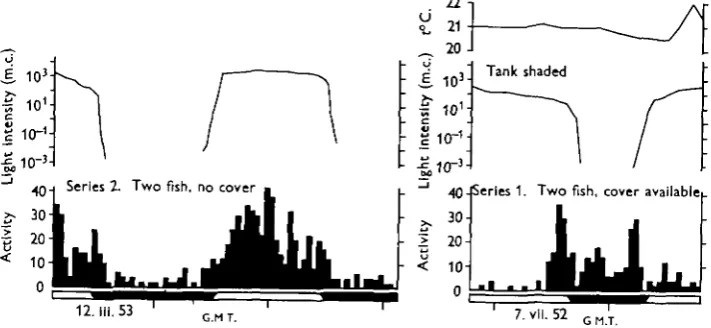
experiments is related to changes in light intensity (Fig. 2), while the third series (Fig. 3) shows that the pattern can be reversed by altering the experimental condi-tions. Individuals or groups gave the same results, and the presence or absence of food appeared to have no effect; experiments were not made with starved fish. From April to June, during the breeding season, the minnows failed to respond to the changes in light intensity. They never took to cover during the day when it was available, and their level of activity was generally very high. The fourth and fifth series of experiments (Fig. 4) failed to reveal any trace of an inherent or endogenous rhythm of locomotory activity. Similar negative results were obtained when fish were taken from the stock aquarium and kept in the dark in a sound-proof room for several days.
u
io-1
S- 30
I 20
< 10 0
Series 2. Two fish, no cover
12.111.53
40 -(Series 1. Two fish, cover available
[image:3.451.48.404.223.387.2]7. vii. 52
Fig. 2. The activity of minnows in relation to light intensity in the first two series of experiments.
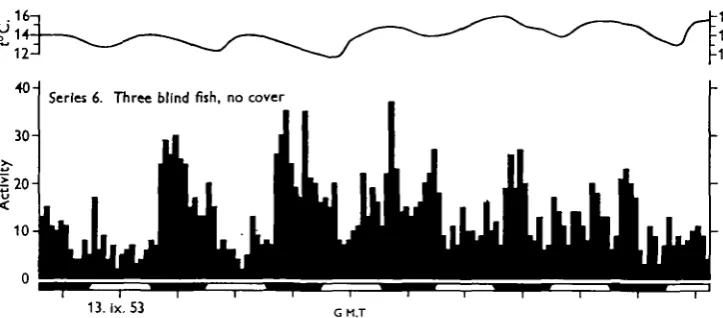
After sunset, the blind fish (Fig. 5) showed a great increase in activity, which declined during the night. There is a suggestion of an increase at dawn, after which the activity remained low throughout the day. The pattern of activity does not appear to bear any relation to temperature. In the record shown in Fig. 5 the rhythm weakened towards the end of the experiment. In two of the blind minnows the melanophores were expanded, as is usual, but in the third they were contracted and the fish was pale. When experiments were made with the fish individually, the pale fish gave the most clear and consistent records of low daytime activity followed by an increase at sunset, and possibly at sunrise, with a return to the day level.
When cover was available the minnows hid in the hollow bricks during the day. Sometimes they came out for a few minutes, but they only appeared to swim freely in the tank at night. Daytime observations showed that the fish usually remained just inside the bricks, occasionally moving forward until the head and eyes cleared the shade, pausing and then backing into cover again. The fish appeared to be making a comparison between the intensities in the brightly lit tank and the shade of the hollow bricks. Their emergence from cover at night and when the tank was blacked out (Fig. 4) suggests that they avoid bright light, and the peaks of activity at sunrise
and sunset may be in response to the rate of change of light intensity which is of the order of i log unit in 15 min. However, in one instance, shown in Fig. 2, the peak occurred before any rapid fall in intensity. In one experiment, measurements were made of the light intensity at which the minnows emerged from and retired to cover.
50—1 Series 3. Three fish, no cover
2. iv. 52 '
G M.T.
Fig. 3. The change in the pattern of activity when cover was put in the tank.
(J
Series 4. Four fish, cover available
30-ir-
20-1
So-0
6 Series 5.
1
L
y
ix. 53
Four fish, no cover 1
i L
Blacked out I
id
22. Xiil. 53 GMT
Fig. 4. The effect of constant darkness on the pattern of activity.
On three successive nights, intensities of i-8, 5 and 55 m.c. were recorded for emergence and 68, 78 and 4-6 m.c. for retiring.
mechanism to ensure that they reach cover of lower intensities. Once cover is reached, however, it seems likely that they would remain there by a comparison of intensities, provided the light-dark boundary or gradient was sharp enough.
While no inherent rhythm of locomotory activity was found in minnows kept in continuous darkness, Spencer (1939) found that goldfish had a diurnal activity rhythm which persisted, although weakening, for several days in continuous hght. On the other hand, Harder & Hempel (1954) found that the normal activity rhythm of plaice was broken by exposure to continuous light. While slight varia-tions in the melanophore index of minnows persist in the dark (Pauli, 1926), and the movements of the rods and cones of Ameiurus nebulosus can be detected for at least 2 days under similar conditions (Welsh & Osborn, 1937), melanophores and rods and cones remain in the light-adapted phase under continuous light. Clausen's (1936) results on the oxygen consumption of the black bass, Huro salmoides, are sometimes
Series 6. Three blind fish, no cover
[image:5.451.43.405.245.404.2]13.lx.53 G M.T
Fig. 5. The response of a group of three blind minnows to normal variations in light intensity.
quoted as demonstrating the persistence of metabolic activity under constant en-vironmental conditions. But as his fish were kept in chambers covered by a cloth 'loose enough around the upper end of the chamber to allow an inspection for air bubbles' it is possible that they could have been stimulated by variations in light intensity.
It was not surprising to find that blind minnows react to diurnal variations in hght intensity as their pineal organs and adjacent regions of the mid-brain are hght sensitive (von Frisch, 1911; Scharrer, 1928). Their reactions, however, are the reverse of the reactions of normal fish without cover, and it is interesting to note that while the response of naturally bund cave-dwelling characins is dependent on the degree to which the pineal area is exposed to hght, removal of the apparently functionless optic cysts makes them indifferent to hght (Breder & Rasquin, 1947). Removal of the eyes in minnows might reduce their overall sensitivity to hght, which would account for their low activity during the day, while the increase in activity at sunset, and perhaps at sunrise, suggests that the pineal complex is particularly sensitive to changes in hght intensity. If this were so, a fish whose melanophores
were contracted, so increasing the exposure of the pineal area, might be expected to respond better than a fish whose melanophores were dispersed, as was found to be the case. But clearly more experimental work is needed here.
REACTIONS AT A LIGHT-DARK BOUNDARY AND SHOALING BEHAVIOUR
The results of the experiments on locomotory activity suggested that minnows avoid high light intensities, and observations were therefore made on their reactions at a light-dark boundary to determine the value of the upper limit. A large aquarium tank, 120 cm. in length, 60 cm. wide and 45 cm. deep, filled with water to a depth of 15 cm., was used in these experiments, which were carried out in a sound-proof and light-proof room. Half the tank was roofed and curtained to the water surface. A 100 W. lamp, was suspended 1 m. above the middle of the tank and its intensity was varied by an autotransformer. Measurements of light intensity were made with a neon discharge tube photometer, similar to that described by Poole & Poole (1930). The photometer was calibrated against a uniplanar tungsten filament substandard lamp. Several experiments were made with five to six minnows in the tank which were provided with Tubifex as food.
In bright light the minnows remained in the shaded hah0 of the tank, up against the far wall, and never approached the light-dark boundary. When the light intensity was very slowly reduced, the fish swam, in a group, more freely in the shaded half of the tank, but were very hesitant on approaching the boundary and never crossed over while the intensity of the light falling on the water surface in the unshaded half of the tank was greater than 0-17-0-08 m.c. Even then there was some hesitation on approaching the boundary, and it was not until the light was reduced to 0-024 m-c- that they swam freely from one half to the other. At intensities of this order the minnows no longer shoaled together as they did in bright light and further observations were therefore made to determine the intensity at which the shoal broke up. For these experiments the roof and curtain were removed. Shoaling behaviour was clear at 0-08 m.c, but at lower intensities the fish became more and more independent of one another, and the shoal appeared to break up at intensities between 0-024 anc^ 0-0034 m.c. At lower intensities the minnows were very active and excited, breaking the surface as if feeding. They could be heard breaking the surface when the light was too low for observation, but after several minutes this stopped. When the light was turned up, the fish were seen to be resting, independ-ently of one another, on the bottom.
which, in the minnow and other fish which actively catch their food, could depend on vision and might be related to light intensity. Herring, for instance, are not filter feeders but catch their prey (Hardy, 1924) and are said to be able to feed at intensi-ties of the order of moonlight, but not by starlight or in the dark (Muzinid, 1931; Battle, Huntsman, Jeffers, Johnson & McNair, 1936; Johnson, 1939). Verheigen (1953) found that herring shoals break up gradually with decreasing light intensity, but that feeding continues at lower intensities; when feeding stops, the herrings are still able to avoid obstacles. To complete the picture for the minnow, experi-ments were therefore made to determine what effect light had on their feeding ability.
Neutral density
filter—--—__
- - * 1
Frosted glass \
,—-Feeding tube
Llght-proof box
Fig. 6. Apparatus used in the feeding experiments.
LIGHT INTENSITY AND FEEDING
Using the apparatus shown in Fig. 6, experiments were made to see how many of fifty living Daphma two minnows could catch in half an hour at different light intensities. The lower light intensities were obtained by using a torch bulb and neutral density niters and the highest by using a 60 W. lamp. Control experiments were made in the dark. The two minnows used in each experiment were drawn at random from a stock of fourteen fish which had been fed only a few Dapknia each day for a fortnight before the series commenced. After the minnows had been left in the light-proof box for half an hour to become adapted to the conditions of the particular experiment, fifty Daphnia were added through the feeding tube. Half an hour later the box was opened, the fish quickly removed and the remaining Daphnia recovered and counted.
Table i. Number of fifty Daphnia eaten by two minnows
at different light intensities
Light intensity in metre-candles
No. of experiments Mean number of Dapkma
eaten
Standard deviation
30
48
2-6 0-008
10 46
4-7
0*0007
10 40
89
0-00007 14
26
90
0-000007
9
as
7-3
Daik
9
20
8-6
50-
40-Q
•5
20-
10-1Cr5 10° 101
KT* 10~"3
1(T2
1CT1
Log light Intensity In metre-ondles
Fig. 7. Number of Daphnia eaten by two minnows adapted to various light intensities. Fifty Dapkma offered.
DISCUSSION
The results are summarized in Fig. 8, together with values of various light inten-sities found under natural conditions, and some results of other authors which fit in with the general picture. As judged by their behaviour in the light-dark boun-dary experiments, minnows avoid intensities greater than 0-17 m.c.; a shoal would break up at an intensity a little below that of moonlight, and they would just be able to feed by eye at the surface under starlight. The change from visual to 'dark' feeding between intensities of 0-0007 a n (i '00007 m-c- rDZY be related to the change from cone to rod vision, which Brunner (1935) concludes takes place at 0-008-0-002 m.c. But it should be noted that her results with the minnow differ from those of Wolf & Zerrahn-Wolf (1936) with the sunfish Lepomis. For this fish it appears that cone vision changes to rod vision at 0-4 m.c, which is about the same intensity at which the change takes place in man.
activity suggest that they also respond to light photokinetically. Evidence of a photokinesis in teleosts has been given by Shaw, Escobar & Baldwin (1938), who found that the swimming speed of goldfish fully adapted to intensities of 30 and 550 m.c. is about twice that observed when the fish are adapted to intensities less than 0 5 m.c. Similarly, Schlagel & Breder (1947) found that blind cave characins consume more oxygen in the light than the dark, and Woodhead & Woodhead (1955) have found a photokinesis in larval herring. As a comparison of intensities can only be made if the light-dark boundary is sharp enough, it would be interesting to see how minnows behave in a light gradient of gentle slope and whether they keep below their upper limit by a kinesis or a taxis under such conditions.
N o r limit tor pMudo-rheotropJc
rctpora« by
(CnuxHm, 1*32:
Minnow,
Ericjmbm toccata,
tt maximum paJlor at l o w Intvnftta (Brown. 1934)
Minnow, Pnttrina pttexma
Minnow,
000001 00001
Rod to con* vtekm \ / Upper (in* / / to optimum / /
" * • /
nwtam I
(Bfiinn«i-. 1935)1
u maximum dvtn*si K this tnd hjjhw
Inwraltta (Brown, 1»M)
Injurious
•fhctof hljh
Inururtfes on Ijpombf ( W o * « Ztrnhn-Wotf. IMt)
(Wolf « Z«rr«hn-Wolf. HM)
'I
1-0 10 100 1000
Ughc Intensity In metre-cmdles
TwS^ht, _ I - I I M . C
1
'I ' ' ' 'I
10,000 100,000
Dud dtjr. 2000 mx.
d«ar noon ik
la tumm*r,
100^00 mx.
Fig. 8. Diagram aummariiing the results obtained with Phoxinut with some values of natural light intensities and, for comparison, results of other authors with different species.
If minnows kept below their laboratory limit in the field, they would be expected to hide under stones or weeds during the day, and, if swimming over deep water, to keep below 30 m. during a summer day. In Windermere, Frost (1943) found that minnows live in the littoral zone, hiding during the winter months under stones at depths of i-5~2 m., and in the late spring, summer and autumn swimming pelagically in depths of 0-3-0-6 m. Under natural conditions then, large shoals of minnows appear to behave quite differently when compared with small groups in the labora-tory. However, minnows may not spend all their time in such shallow water as during the summer they mainly feed on cladocerans and copepods which migrate to deeper water during the day (Ullyott, 1938), and the minnows themselves are the principal food of perch over 16-5 cm. in length, which at this time of the year are most abundant at depths of 6-12 m. (Allen, 1935). But in shallow streams there is little doubt that minnows live under light intensities which, under laboratory con-ditions, they would avoid if cover were available. Under such conditions the min-nows would be expected to be very active throughout the day. In the laboratory, complete disregard for light intensity was only shown during the spawning season. Here, at least, is a measure of agreement between the experimental and field
SUMMARY
1. Minnows kept in a tank are active during the day and quiet at night. Their behaviour is reversed if they are given hollow bricks in which they take cover and so avoid bright light. When cover is available they are very active at sunrise and sunset.
2. Minnows have no inherent daily rhythm of locomotory activity.
3. Blind minnows respond to daily variations in light intensity, and are more active at night than during the day.
4. Minnows will not cross a light-dark boundary when the intensity on the light side is greater than 0-17-0-08 m.c.
5. A minnow shoal disperses between intensities of 0-024 a n (i 0-0034 m.c. 6. Minnows catch Dapknia better in bright light than in the dark. The change from visual to 'dark' feeding takes place between 0-0007 and 0-00007 m.c.
7. Minnows appear to avoid bright light by a comparison of intensities if the light-dark boundary is sharp, but they may also respond to light photokinetically. 8. It should be noted that these results, obtained in the laboratory, may not be true for minnows under natural conditions.
This work was carried out in the Zoological Laboratory, University of Cambridge, and I wish to thank Prof. Sir James Gray, F.R.S., for letting me work in his department. While the work was carried out I was in receipt of a grant from the Development Commission.
REFERENCES
AIXHN, K. R. (1935). The food and migration of the perch {Perca fluviatilu) in Windennere.
J. Arnrn. Ecol. 4, 264-73.
BATTLE, H. I., HUNTSMAN, A. C , JEFFHRS, G. W., JOHNSON, W. H. & MCNAIR, N. A. (1936).
Fatness, digestion and food of Passamaquoddy young herring. J. Biol. Bd Can. 3, 401-29. BRUNNHR, G. (1935). Uber die Sehscharfe der Elritze (Phoxinus laevis) bei verschiedenen
Hellig-keiten. Z. vergl. Physiol. 21, 296—316.
BROWN, F. A. (1936). Light intensity and melanophore response in the minnow Ericymba buccata Cope. Biol. Bull., Woods Hole, 70, 8-15.
CLARKE, G. L. (1936). On the depth at which fish can see. Ecology, 17, 452-6. CLAUSEN, R. G. (1936). Oxygen consumption in freshwater fishes. Ecology, 17, 216—26. CUSHING, D. H. (1951). The vertical migration of planktonic Crustacea. Biol. Rev. 26, 158-92. FRISCH, K. VON (1911). Beitrflge zur Physiologic der Pigmentzellen in der Fischhaut. PflUg. Arch.
get. Physiol. 138, 319-87.
FROST, W. E. (1943). The natural history of the minnow, Phoxinus phoxinus. J. Anim. Ecol. 13, 139-62.
GRUNDFEST, H. (1932). The sensibility of the sun-fish, Lepomis, to monochromatic radiations of low intensity. J. Gen. Physiol. 15, 307—28.
HARDER, W. & HEMPEL, G. (1954). Studien zur Tagesperiodik der Aktivitflt von Fischen. 1. Ver-suche an Plattfischen. Kurze Mitteilungen. Inst. Fischereibiologie Universitdt Hamburg, 5,
22-31.
HARDY, A. C. (1924). The herring in relation to its animate environment. Part. 1. The food and feeding habits of the herring with special reference to the east coast of England. Fish. Invest.,
Lond., Ser. 2, 7, no. 3.
JOHNSON, W. H. (1939). Feeding of the herring. J. Fish. Res. Bd. Can. 4,
39*~5-JONES, F. R. HARDEN (1955). Photokinesis in the ammocoete larva of the lamprey. J. Exp. Biol. 33, 492-503.
MORROW, J. E. (1948). Schooling behaviour in fishes. Quart. Rev. Biol. 23, 27-38.
PAULJ, W. (1926). Versuch tiber den phyBiologischen Farbenwechsel der Salamander larvae und der Pfrille. Z. wiss. Zool. 138, 431-508.
POOLE, J. H. J. & POOLE, H. H. (1930). The neon discharge tube photometer. Photo-Electric Cells
and their Applications, pp. 142-9. Published by Physical and Optical Soc., Lond., pp. 236.
SHAW, R. J., ESCOBAR, R. H. & BALDWIN, F. M. (1938). The influence of temperature and illumina-tion on the locomotor activity of Carassius auratus. Ecology, 19, 343—5.
SCHAHHBR, E. (1928.) Die Lichtempfindlichkeit blinder Elritzen. (Untersuchungen liber das Zwischenhirn der Fische. 1.) Z. vergl. Physiol. 7, 1-38.
SCHLAGEL, S. R. & BRBDER, C. M. (1947). A study of the oxygen consumption of blind and eyed cave characins in light and darkness. Zoologica, N.Y., 33, 17—27.
SPENCER, W. P. (1939). Diurnal activity in fresh-water fishes. Ohio J. Sci. 39, 119-32.
ULLYOTT, P. (1938). Die tflglichen Wanderungen der planktonischen Susswasser Crustaceen. Int.
Rev. Hydrobiol. 38, 262-84.
VERHEIOEN, F. J. (1953). Laboratory experiments with the herring, Clupea harengus. Experientia, 9,
193-WELSH, J. H. & OSBORN, C. M. (1937). Diurnal changes in the retina of the catfish Ameiurus
nebu-losus. J. Comp. Neurol. 66, 349-59.
WOODHKAD, P. M. J. & WOODHEAD, A. D. (1955). The reactions of herring larvae to light: a mechanism of vertical migration. Nature, Lond., 176, 349—50.