An End-to-End Chinese Discourse Parser
with Adaptation to Explicit and Non-explicit Relation Recognition
Xiaomian Kang1,2, Haoran Li1,2, Long Zhou1,2, Jiajun Zhang1,2, Chengqing Zong1,2,3
1National Laboratory of Pattern Recognition,
Institute of Automation, Chinese Academy of Sciences
2The University of Chinese Academy of Sciences, Beijing, China
3CAS Center for Excellence in Brain Science and Intelligence Technology
{xiaomian.kang,haoran.li,jjzhang,cqzong}@nlpr.ia.ac.cn
Abstract
This paper describes our end-to-end dis-course parser in the CoNLL-2016 Shared Task on Chinese Shallow Discourse Pars-ing. To adapt to the characteristics of Chi-nese, we implement a uniform framework for both explicit and non-explicit relation parsing. In this framework, we are the first to utilize a seed-expansion approach for the argument extraction subtask. In the official evaluation, our system achieves an F1 score of 26.90% in overall performance on the blind test set.
1 Introduction
Discourse parser analyzes the relations underlying text units to uncover abstractive structure informa-tion, which has a wide usage in different tasks in natural language processing, such as text summa-rization, question answering, information extrac-tion and machine translaextrac-tion.
Since the release of the Penn Discourse Tree-Bank (PDTB) (Prasad et al., 2008), discourse pars-ing has drawn more and more attention. The PDTB-style parser puts emphasis on shallow dis-course parsing, which annotates a piece of text with a set of discourse relations. The relations are divided into two types, explicit or non-explicit, depending on whether connectives exist or not. A complete discourse relation contains two dis-course units called Argument1 (Arg1) and Ar-gument2 (Arg2). An end-to-end parser usually consists of some components, such as discourse connective identification, argument extraction, ex-plicit sense classification and imex-plicit sense clas-sification.
Pitler and Nenkova (2009) used syntactic fea-tures to disambiguate explicit discourse connec-tives. For argument extraction, Lin et al. (2014) used a tree subtraction algorithm to extract ar-guments and Kong et al. (2014) proposed a
constituent-based approach to solve it. Recent re-searches mainly focus on the implicit sense clas-sification. In this subtask, Lin et al. (2009) and Rutherford and Xue (2014) explored rich features such as word-pairs, dependency rules, produc-tion rules and Brown cluster pairs. Some stud-ies (Rutherford and Xue, 2015) paid attention to the data expansion. Neural network approaches (Ji and Eisenstein, 2015; Zhang et al., 2015) were also applied to improve the classification perfor-mance. Lin et al. (2014) implemented a full end-to-end PDTB parser and Wang and Lan (2015) built a more refined system in the CoNLL-2015 Shared Task.
In contrast to English, there are limited studies on Chinese discourse parsing (Huang and Chen, 2011; Zong, 2013; Tu et al., 2014). One of the main reasons is the shortage of Chinese discourse corpus. Zhou and Xue (2012) annotated a PDTB-style Chinese Discourse TreeBank (CDTB), which is the data for Chinese shallow discourse parsing.
In this paper, we describe our approaches to implement the Chinese shallow discourse parser which is participated in the CoNLL-2016 Shared Task (Xue et al., 2016). In view of some typi-cal characteristics in CDTB (Section 2), we adopt and extend the state-of-the-art English parser in CoNLL-2015 (Wang and Lan, 2015). A unified framework for both explicit and non-explicit pars-ing is built and a seed-expansion approach is uti-lized for argument extraction. Some useful fea-tures are selected to train classifiers (Section 3). Our system achieves 40.89% and 26.90% in F1-measure on the test and blind data set respectively (Section 4).
We make the following main contributions in this work:
• We implement a complete end-to-end PDTB-style discourse parser for Chinese.
• We design a uniform framework to
nize both explicit and non-explicit relations together.
• We utilize an effective seed-expansion ap-proach to determine the exact span bound-aries in the argument extraction subtask.
2 Corpus and Resources
In addition to the PDTB-style annotation, there are many special phenomena in CDTB. We enumer-ate several characteristics in (Zhou and Xue, 2015) and phenomena from the training data set.
• In contrast to the 54.53% in PDTB, the pro-portion of non-explicit relations is 78.27% in CDTB training set. PDTB’s three-level sense hierarchy structure is replaced by 11 flat se-mantic types.
• Discourse connectives are flexible and the phenomenon of parallel connectives is obvi-ous in Chinese. In our experiment, we ex-tract 385 connectives from the training set as a connective dictionary.
• The span of an argument ranges from several words to sentences even to paragraphs. But in general, the span is in one sentence and the clauses split by punctuations can be regarded as the minimum constituent units.
• As shown in (Yang and Xue, 2012), punc-tuation marks play a significant role in Chi-nese discourse. Fortunately, CDTB has an-notated those punctuations that may indicate discourse relations.
Inspired by the above phenomena, we design our system by fully considering these Chinese characteristics.
Besides the training data, we simply use skip-gram neural word embeddings provided by the CoNLL-2016 organizers to replace words in some features.
3 System Architecture
Zhou and Xue (2015) pointed out that discourse connectives and punctuation marks in Chinese can serve as anchors, which are clues of discourse rela-tions. This opinion encourages us to treat explicit and non-explicit relations similarly. Therefore, the explicit and non-explicit parsers share the same
framework shown in figure 1. We divide the shal-low discourse parsing into four subtasks: anchor identification, argument extraction, sense classifi-cation and argument relabeling
Anchor Identification
Argument Extraction
Sense Classification
[image:2.595.319.510.134.170.2]Argument Relabeling
Figure 1: discourse parser framework
Anchor Identification. It is to recognize the anchors from candidates. For explicit parser, the connectives are important relation indicators. And the punctuations play the similar role in non-explicit parser.
Argument Extraction. It is to extract argu-ment pair according to the anchor. We use a seed-expansion approach, transforming this sub-task into argument boundary identification.
Sense Classification. It is to predict the type of relation sense between Arg1 and Arg2.
Argument Relabeling. It is to re-label the la-bels of two arguments. Although Arg1 is in front of Arg2 in most cases, the “Arg1” and “Arg2” la-bels for the argument pair are defined based on the semantics in CDTB (Zhou and Xue, 2012).
3.1 Anchor Identification
A full text is scanned to pick out the anchor can-didate set. Then, a binary classifier is designed to check whether each candidate is anchor or not. The explicit connective candidate set is gener-ated by matching the text with our connective dic-tionary. The non-explicit punctuation candidate set consists of all punctuations except for quotes, parentheses, and pause marks.
3.1.1 Connective Identification
A classifier is trained to recognize connectives. The features are chosen by referring to the best system in CoNLL-2015 (Wang and Lan, 2015). Zhou and Xue (2012) found that a discourse con-nective is almost always accompanied by punctu-ations, which help us to design the features.
The features we used are as follows:
previous/next punctuation, whether the previ-ous or next character is punctuation.
• Syntactic features: the parent of candidate’s node (the lowest node in the syntax tree that completely covers the candidate words), the left and right siblings of candidate’s node, the production rules of candidate, the path from the candidate’s node to root, whether the left sub-tree or right sub-tree contains VP or IP.
3.1.2 Punctuation Identification
According to their locations in sentences, punc-tuations are divided into two cases: MOS (mid-dle of sentence) and EOS (end of sentence). In the 56.18% of non-explicit relations in the train-ing data, Arg1 and Arg2 are in the same sentence. The anchor punctuation must be in the middle of the sentence in this case and we extract features from its left and right clauses. In another case that Arg1 and Arg2 is in different sentences, the anchor must be in the end of the sentence and we extract features from its left and right sentences. Since we cannot get the syntactic features from two differ-ent syntactic trees, the two classifiers’ features are designed respectively.
MOS Punctuation Classification. By referring to (Yang and Xue, 2012; Xu et al., 2012), we ex-tract features from the context clauses:
• Lexical features: embeddings of the first and last word in the context clauses, POS of the first and last word in the context clauses, punctuation itself.
• Syntactic features: the parent, left and right siblings of the punctuation’s node, the left and right clause’s node, the path from the punctuation’s node to the right clause’s node, whether the left sub-tree or the right sub-tree contains VP or IP, whether the leftmost sib-ling of punctuation’s parent node is PP, the number of IP in siblings of the punctuation’s parent node, whether the right sub-tree con-tains AD or CS if the leftmost sibling is IP.
EOS Punctuation Classification. We only use lexical features from the context sentences: punc-tuation itself, embeddings of the first and last three words in the context sentences, POS of the first and last three words in the context sentences.
3.2 Argument Extraction
Our approach is based on the following observa-tions. It should be noted that “Arg1” and “Arg2” are defined by semantics rather than location. But for convenient expression, we temporarily name the front argument as “Arg1” and the following ar-gument as “Arg2” before Arar-gument Relabeling1.
• Observation1: In most cases, Arg1 and Arg2 are in the same sentence or two adjacent sen-tences respectively.
• Observation2: An argument consists of one or several consecutive clauses.
• Observation3: Explicit Arg2 is located in the same sentence as its connective anchor.
• Observation 4: The span of Arg1 and the span of Arg2 are adjacent. There is no clause between them.
The anchor can provide useful location infor-mation to determine the span of the argument es-pecially in non-explicit relations. So after consid-ering the special characteristics of argument pairs in CDTB, we utilize a seed-expansion approach to extract Arg1 and Arg2 based on the anchor. Ac-cording toObservation2, we regard the clauses as the minimum argument units. A seed is a clause which contains or adjoins the anchor. We think the seed must be in the argument and provides a good starting point for argument extraction.
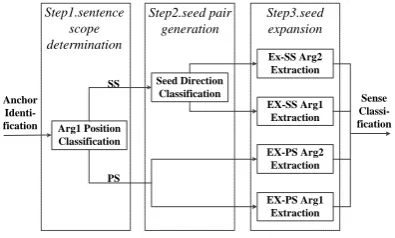
The approach contains three steps: sentence scope determination, seed pair generation and seed expansion. Figure 2 shows the detailed process in explicit argument extraction to vividly explain the approach.
Arg1 Position Classification
Seed Direction Classification
Ex-SS Arg2 Extraction
EX-SS Arg1 Extraction
EX-PS Arg2 Extraction
EX-PS Arg1 Extraction SS
PS Step1.sentence
scope determination
Step2.seed pair generation
Step3.seed expansion
Anchor Identi-fication
[image:3.595.317.515.583.702.2]Sense Classi-fication
Figure 2: the explicit argument extraction process
1In Section 3.3, for convenience, we still temporarily
First, according toObservation1, we determine the rough sentence-level scope of argument. Then according to Observation 4, we obtain a pair of adjacent clauses as the seed pair based on the an-chor. Finally, we expand the seed clause-by-clause to obtain the argument pair.
3.2.1 Sentence Scope Determination
We determine the sentence scope of the argument in this step.
Explicit: Observation3 has given the sentence scope of Arg2 in explicit relation. So we discuss the scope of Arg1. We divide the Arg1 into two cases: SS (Arg1 is in the same sentence as its con-nective anchor) and PS (Arg1 is in the previous sentence of the connective anchor). A classifier is trained to determine which case an Arg1 is.
For the Arg1 Position Classification, the fea-tures are about connective: connective itself, POS of the connective, the number of connective words, location of the connective in the sentence, whether the connective is in the first clause of the sentence, previous/next punctuation, the path from connective’s parent node to root.
Non-Explicit: In Section 3.1.2, the punctuation anchors have been divided into MOS and EOS, re-spectively correspond to SS (Arg1 is in the same sentence as Arg2) and PS (Arg1 is in the previ-ous sentence of the Arg2 sentence). So there is no need to take into account the sentence-level scope of non-explicit argument.
3.2.2 Seed Pair Generation
The seed pair is a pair of two adjacent clauses, which must be in Arg1 and Arg2 respectively.
Explicit: For SS case (Arg1 is in the same sen-tence as the connective), the current clause (clause contains the connective2) is a seed. Anther seed
is the clause adjacent to the current. But when the current clause is in the middle of sentence, a question comes up: is anther seed the previous or the next clause? The Seed Direction Classification helps us to answer it.
The features are as follows: connective itself, POS of the connective, whether there are co-occurrence of nouns, verbs and quantifiers be-tween current clause and previous/next clause, the
2If the connective is a parallel connective that spans clause
boundaries, we regard these clauses as a whole current clause.
parent of previous/next clause’s node, the punc-tuation between previous/next clause and current clause, the relationship of previous and current clause’s node (left, right, middle, contain, none).
For PS case (Arg1 is in the previous sentence of the connective), there is no need to judge the seed direction. We directly take the last clause of the previous sentence as the front seed and the clause contains the connective as the following seed.
Non-Explicit: No matter where the location of the punctuation anchor, we treat the nearest left and right clauses of the punctuation as the seed pair.
3.2.3 Seed Expansion
After obtaining the seed pair, we expand the seed to grow into argument. The front seed expands forward and the following seed expands backward. We expand the span of argument clause-by-clause, from the seed clause, toward a fixed direction (for-ward or back(for-ward) in the sentence scope to gener-ate candidgener-ate sets. So each candidgener-ate contains the seed clause. The current candidate has one clause more than the previous one. The classifiers decide whether the current candidate span is beyond of the argument boundary. We select the longest can-didate predicted OK as the argument.
There are four cases totally: explicit SS, ex-plicit PS, non-exex-plicit SS and non-exex-plicit PS. So we train eight classifiers for each case to extract Arg1 and Arg2 respectively. Each classifier uses the same feature template while Arg1 and Arg2 extraction have the opposite expansion direction. The features are as follows, and some are bor-rowed from (Lin et al., 2014; Wang and Lan, 2015).
• Lexical features are from the previous can-didate and the current clause: embeddings of the first/last three words of them, POS of the first/last word of them, punctuations be-tween them, whether there are co-occurrence of nouns/verbs between them, anchor itself.
• Others: whether the current clause is the start/end of sentence, the relative length of current clause and seed clause/previous can-didate (short, middle, long).
Through the above method, we can get the clause boundary of the argument pair. Finally, the post-processing is done: connectives and punctua-tions appear at the start or end of span are deleted.
3.3 Sense Classification
The sense of relation is decided after the anchor identification and argument extraction by a multi-class multi-classifier.
Explicit: The huge contribution of discourse connectives to the explicit sense classification makes it possible that a small amount of features about connectives will produce good enough re-sults.
• Lexical features: connective itself, POS of the connective, embedding of the connective, the previous and next punctuation of the con-nective.
• Syntactic features: the parent, left and right siblings of connective’s node, the Arg1’s node and Arg2’s node, the parent of Arg1’s node and Arg2’s node, the relationship of Arg1’s node and Arg2’s node.
Non-Explicit: In this work, we decided to only use the production rules of Arg1, Arg2 and co-occurrence after trying other features in our exper-iments. We choose from all the production rules whose frequency is over 5 and finally select the 100 ones by calculating the information gain.
3.4 Argument Relabeling
This component is to re-label the argument labels. The features are listed as follows:
• Lexical features: anchor itself, POS of previ-ous and next word of the anchor, location of the anchor in the sentence, whether there are co-occurrence of nouns, verbs and quantifiers between Arg1 and Arg2.
• Syntactic features are the same as the syn-tactic features in explicit sense classification (Section 3.3).
• Others: the relative length of Arg1 and Arg2, the relation sense.
4 Experiments and Results
Our end-to-end parser consists of 4 subtasks and 17 classifiers, trained on the corpora provided in the CoNLL-2016 Shared Task. All of the models are trained using the maximum entropy algorithm implemented in MALLET toolkit 3. The system
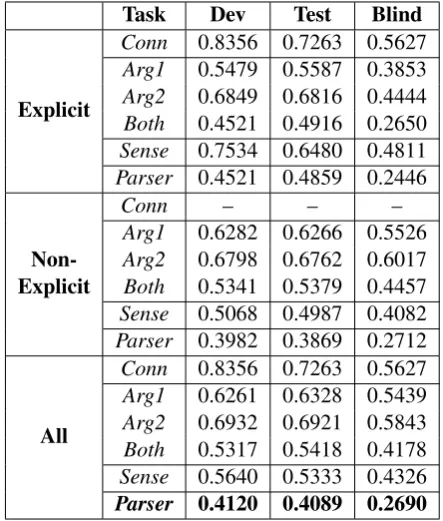
was evaluated on the TIRA evaluation platform (Potthast et al., 2014) on 3 data sets offered by CoNLL-2016: development set, test set and blind test set. Table 1 reported the official results of our parser.
Task Dev Test Blind
Explicit
Conn 0.8356 0.7263 0.5627
Arg1 0.5479 0.5587 0.3853
Arg2 0.6849 0.6816 0.4444
Both 0.4521 0.4916 0.2650
Sense 0.7534 0.6480 0.4811 Parser 0.4521 0.4859 0.2446
Non-Explicit
Conn – – –
Arg1 0.6282 0.6266 0.5526
Arg2 0.6798 0.6762 0.6017
Both 0.5341 0.5379 0.4457
Sense 0.5068 0.4987 0.4082 Parser 0.3982 0.3869 0.2712
All
Conn 0.8356 0.7263 0.5627
Arg1 0.6261 0.6328 0.5439
Arg2 0.6932 0.6921 0.5843
Both 0.5317 0.5418 0.4178
Sense 0.5640 0.5333 0.4326
[image:5.595.305.527.228.489.2]Parser 0.4120 0.4089 0.2690
Table 1: The official subtasks and overall F1-measures of the parser on the development, test and blind test sets for explicit, non-explicit and all relations.
We provide some analysis from the results:
• More than 20% sharp decrease of F1 in ex-plicit parser on the blind set is mainly due to the error propagation of connective identifi-cation. The error is mainly from two aspects. One is the flexible parallel connectives. An-other is the ambiguous definition of connec-tives, especially in the middle of the sentence.
• The seed-expansion method can get accept-able results for argument extraction. It is hard to determine whether a clause is in the span of argument when it plays a role of supple-ment or conjunction to the basic semantic.
This causes the main error. So more features about the span cohesion should be tried in fu-ture. The F1 of Arg1 and Arg2 individually is about 10% higher than jointly. Besides, the assumption that the span of argument is in one sentence is too strong.
5 Conclusion
We have built a PDTB-style end-to-end Chinese shallow discourse parser for the CoNLL-2016 Shared Task. Our system is adapted to the Chi-nese characteristics. A seed-expansion approach is proposed to extract the arguments correctly. On the official blind test set, we achieve the 26.90% in F1-measure.
Acknowledgments
The research work has been partially funded by the Natural Science Foundation of China under Grant No. 61333018 and No. 61303181 and supported by the Strategic Priority Research Program of the CAS (Grant XDB02070007).
References
Hen-Hsen Huang and Hsin-Hsi Chen. 2011. Chinese discourse relation recognition. In IJCNLP, pages 1442–1446.
Yangfeng Ji and Jacob Eisenstein. 2015. One vector is not enough: Entity-augmented distributed semantics for discourse relations. Transactions of the Associa-tion for ComputaAssocia-tional Linguistics, 3:329–344. Fang Kong, Hwee Tou Ng, and Guodong Zhou. 2014.
A constituent-based approach to argument label-ing with joint inference in discourse parslabel-ing. In
EMNLP, pages 68–77.
Ziheng Lin, Min-Yen Kan, and Hwee Tou Ng. 2009. Recognizing implicit discourse relations in the Penn Discourse Treebank. InProceedings of the EMNLP 2009, pages 343–351.
Ziheng Lin, Hwee Tou Ng, and Min-Yen Kan. 2014. A PDTB-styled end-to-end discourse parser. Natural Language Engineering, 20(02):151–184.
Emily Pitler and Ani Nenkova. 2009. Using syntax to disambiguate explicit discourse connectives in text. In Proceedings of the ACL-IJCNLP 2009 Confer-ence Short Papers, pages 13–16.
Martin Potthast, Tim Gollub, Francisco Rangel, Paolo Rosso, Efstathios Stamatatos, and Benno Stein. 2014. Improving the Reproducibility of PAN’s Shared Tasks: Plagiarism Detection, Author Iden-tification, and Author Profiling. In Evangelos
Kanoulas, Mihai Lupu, Paul Clough, Mark Sander-son, Mark Hall, Allan Hanbury, and Elaine Toms, editors, Information Access Evaluation meets Mul-tilinguality, Multimodality, and Visualization. 5th International Conference of the CLEF Initiative (CLEF 14), pages 268–299, Berlin Heidelberg New York, September. Springer.
Rashmi Prasad, Nikhil Dinesh, Alan Lee, Eleni Milt-sakaki, Livio Robaldo, Aravind K Joshi, and Bon-nie L Webber. 2008. The Penn Discourse TreeBank 2.0. InLREC. Citeseer.
Attapol Rutherford and Nianwen Xue. 2014. Dis-covering implicit discourse relations through brown cluster pair representation and coreference patterns. InEACL, volume 645, page 2014.
Attapol Rutherford and Nianwen Xue. 2015. Improv-ing the inference of implicit discourse relations via classifying explicit discourse connectives. In Pro-ceedings of the NAACL-HLT.
Mei Tu, Yu Zhou, and Chengqing Zong. 2014. Auto-matically parsing Chinese discourse based on max-imum entropy. Acta Scientiarum Naturalium Uni-versitatis Pekinensis, 50(1):125–132.
Jianxiang Wang and Man Lan. 2015. A refined end-to-end discourse parser. CoNLL 2015, page 17. Shengqin Xu, Fang Kong, Peifeng Li, and Qiaoming
Zhu. 2012. A Chinese sentence segmentation ap-proach based on comma. InChinese Lexical Seman-tics, pages 809–817. Springer.
Nianwen Xue, Hwee Tou Ng, Sameer Pradhan, Bon-nie Webber, Attapol Rutherford, Chuan Wang, and Hongmin Wang. 2016. The CoNLL-2016 Shared Task on multilingual shallow discourse parsing. In
Proceedings of the Twentieth Conference on Compu-tational Natural Language Learning - Shared Task, Berlin, Germany, August. Association for Computa-tional Linguistics.
Yaqin Yang and Nianwen Xue. 2012. Chinese comma disambiguation for discourse analysis. In Proceed-ings of the ACL 2012, pages 786–794.
Biao Zhang, Jinsong Su, Deyi Xiong, Yaojie Lu, Hong Duan, and Junfeng Yao. 2015. Shallow convolu-tional neural network for implicit discourse relation recognition. In Proceedings of the EMNLP 2015, pages 2230–2235.
Yuping Zhou and Nianwen Xue. 2012. PDTB-style discourse annotation of Chinese text. In Proceed-ings of the ACL 2012: Long Papers-Volume 1, pages 69–77.
Yuping Zhou and Nianwen Xue. 2015. The Chinese Discourse TreeBank: A Chinese corpus annotated with discourse relations. Language Resources and Evaluation, 49(2):397–431.