CoNLL’17
Learning What is Essential in Questions
Daniel Khashabi† Univ. of Pennsylvania [email protected]
Tushar Khot Ashish Sabharwal Allen Institute for AI
tushark,[email protected]
Dan Roth† Univ. of Pennsylvania [email protected]
Abstract
Question answering (QA) systems are eas-ily distracted by irrelevant or redundant words in questions, especially when faced with long or multi-sentence questions in difficult domains. This paper introduces
and studies the notion of essential
ques-tion terms with the goal of improving
such QA solvers. We illustrate the im-portance of essential question terms by showing that humans’ ability to answer questions drops significantly when essen-tial terms are eliminated from questions. We then develop a classifier that reliably (90% mean average precision) identifies and ranks essential terms in questions. Fi-nally, we use the classifier to demonstrate that the notion of question term essen-tiality allows state-of-the-art QA solvers for elementary-level science questions to make better and more informed decisions, improving performance by up to 5%. We also introduce a new dataset of over 2,200 crowd-sourced essential terms anno-tated science questions.
1 Introduction
Understanding what a question is really about is a fundamental challenge for question answering systems that operate with a natural language in-terface. In domains with multi-sentence ques-tions covering a wide array of subject areas, such as standardized tests for elementary level science,
the challenge is even more pronounced (Clark,
2015). Many QA systems in such domains
†Most of the work was done when the first and last authors were affiliated with the University of Illinois, Urbana-Champaign.
derive significant leverage from relatively shal-low Information Retrieval (IR) and statistical cor-relation techniques operating on large
unstruc-tured corpora (Kwok et al., 2001; Clark et al.,
2016). Inference based QA systems operating on
(semi-)structured knowledge formalisms have also demonstrated complementary strengths, by using optimization formalisms such as Semantic
Pars-ing (Yih et al., 2014), Integer Linear Program
(ILP) (Khashabi et al., 2016), and probabilistic
logic formalisms such as Markov Logic Networks (MLNs) (Khot et al.,2015).
These QA systems, however, often struggle with seemingly simple questions because they are unable to reliably identify which question words are redundant, irrelevant, or even intentionally dis-tracting. This reduces the systems’ precision and results in questionable “reasoning” even when the correct answer is selected among the given alter-natives. The variability of subject domain and question style makes identifying essential question words challenging. Further, essentiality is context dependent—a word like ‘animals’ can be critical for one question and distracting for another. Con-sider the following example:
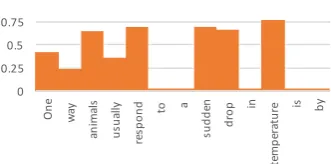
One way animals usually respond to a sudden drop in tem-perature is by (A) sweating (B) shivering (C) blinking (D) salivating.
A state-of-the-art optimization based QA system
called TableILP (Khashabi et al., 2016), which
performs reasoning by aligning the question to semi-structured knowledge, aligns only the word ‘animals’ when answering this question. Not sur-prisingly, it chooses an incorrect answer. The issue is that it does not recognize that “drop in tempera-ture” is an essential aspect of the question.
Towards this goal, we propose a system that can assign an essentiality score to each term in the question. For the above example, our system
0 0.25 0.5 0.75 1
On
e
wa
y
an
im
al
s
us
ua
lly
re
sp
on
d to a
su
dd
en
dr
op in
te
m
pe
ra
tu
re
is by
Chart Title
Figure 1: Essentiality scores generated by our system, which assigns high essentiality to “drop” and “temperature”.
erates the scores shown in Figure1, where more
weight is put on “temperature” and “sudden drop”. A QA system, when armed with such information, is expected to exhibit a more informed behavior.
We make the following contributions:
(A) We introduce the notion of question term
essentiality and release a new dataset of 2,223
crowd-sourced essential term annotated questions (total 19K annotated terms) that capture this
con-cept.1 We illustrate the importance of this
con-cept by demonstrating that humans become sub-stantially worse at QA when even a few essential question terms are dropped.
(B) We design a classifier that is effective at pre-dicting question term essentiality. The F1 (0.80) and per-sentence mean average precision (MAP, 0.90) scores of our classifier supercede the closest baselines by 3%-5%. Further, our classifier gener-alizes substantially better to unseen terms.
(C) We show that this classifier can be used to improve a surprisingly effective IR based QA
system (Clark et al., 2016) by 4%-5% on
previ-ously used question sets and by 1.2% on a larger question set. We also incorporate the classifier
in TableILP (Khashabi et al., 2016), resulting in
fewer errors when sufficient knowledge is present for questions to be meaningfully answerable.
1.1 Related Work
Our work can be viewed as the study of an inter-mediate layer in QA systems. Some systems im-plicitly model and learn it, often via indirect sig-nals from end-to-end training data. For instance,
Neural Networks based models (Wang et al.,2016;
Tymoshenko et al.,2016;Yin et al.,2016)
implic-itly compute some kind ofattention. While this is
intuitively meant to weigh key words in the ques-tion more heavily, this aspect hasn’t been
system-1 Annotated dataset and classifier available at https: //github.com/allenai/essential-terms
atically evaluated, in part due to the lack of ground truth annotations.
There is related work on extracting question
type information (Li and Roth, 2002; Li et al.,
2007) and applying it to the design and analysis of
end-to-end QA systems (Moldovan et al., 2003).
The concept of term essentiality studied in this work is different, and so is our supervised learn-ing approach compared to the typical rule-based systems for question type identification.
Another line of relevant work is sentence
com-pression (Clarke and Lapata, 2008), where the
goal is to minimize the content while maintain-ing grammatical soundness. These approaches typically build an internal importance assignment component to assign significance scores to various terms, which is often done using language models,
co-occurrence statistics, or their variants (Knight
and Marcu, 2002;Hori and Sadaoki, 2004). We compare against unsupervised baselines inspired by such importance assignment techniques.
In a similar spirit, Park and Croft (2015) use
translation models to extract key terms to prevent semantic drift in query expansion.
One key difference from general text summa-rization literature is that we operate on questions, which tend to have different essentiality charac-teristics than, say, paragraphs or news articles. As
we discuss in Section2.1, typical indicators of
es-sentiality such as being a proper noun or a verb (for event extraction) are much less informative for questions. Similarly, while the opening sentence of a Wikipedia article is often a good summary, it is the last sentence (in multi-sentence questions) that contains the most pertinent words.
In parallel to our effort,Jansen et al.(2017) re-cently introduced a science QA system that uses
the notion offocus words. Their rule-based system
incorporates grammatical structure, answer types, etc. We take a different approach by learning a supervised model using a new annotated dataset.
2 Essential Question Terms
In this section, we introduce the notion ofessential
question terms, present a dataset annotated with
these terms, and describe two experimental studies that illustrate the importance of this notion—we show that when dropping terms from questions, humans’ performance degrades significantly faster if the dropped terms are essential question terms.
[image:2.595.96.262.61.143.2]non-stopword token in q as a candidate for being an essential question term. Precisely defining what is essential and what isn’t is not an easy task and involves some level of inherent subjectivity. We
specified three broad criteria: 1) altering an
es-sential term should change the intended meaning
of q, 2) dropping non-essential terms should not
change the correct answer forq, and 3)
grammat-ical correctness is not important. We found that given these relatively simple criteria, human anno-tators had a surprisingly high agreement when an-notating elementary-level science questions. Next we discuss the specifics of the crowd-sourcing task and the resulting dataset.
2.1 Crowd-Sourced Essentiality Dataset
We collected 2,223 elementary school science exam questions for the annotation of essential terms. This set includes the questions used by
Clark et al.(2016)2 and additional ones obtained from other public resources such as the Internet or textbooks. For each of these questions, we
asked crowd workers3 to annotate essential
ques-tion terms based on the above criteria as well as a few examples of essential and non-essential terms.
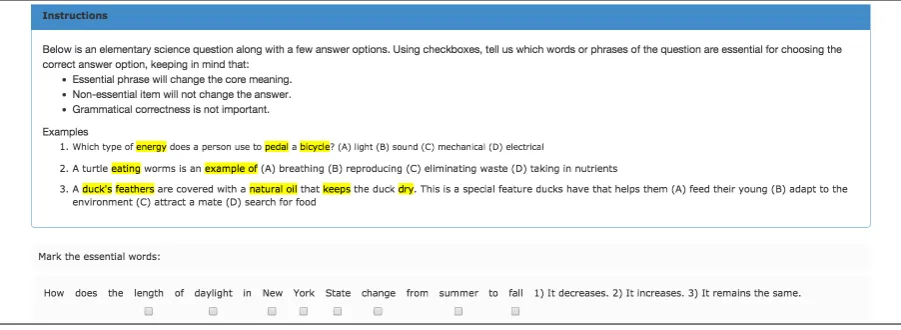
Figure2depicts the annotation interface.
The questions were annotated by 5 crowd
work-ers,4 and resulted in 19,380 annotated terms. The
Fleiss’ kappa statistic (Fleiss, 1971) for this task
wasκ= 0.58, indicating a level of inter-annotator
agreement very close to ‘substantial’. In particu-lar, all workers agreed on 36.5% of the terms and at least 4 agreed on 69.9% of the terms. We use the proportion of workers that marked a term as essential to be its annotated essentiality score.
On average, less than one-third (29.9%) of the terms in each question were marked as essential
(i.e., score >0.5). This shows the large
propor-tion of distractors in these science tests (as com-pared to traditional QA datasets), further showing the importance of this task. Next we provide some insights into these terms.
We found that part-of-speech (POS) tags are not a reliable predictor of essentiality, making it diffi-cult to hand-author POS tag based rules. Among
2These are the only publicly available state-level science exams. http://www.nysedregents.org/Grade4/Science/
3We use Amazon Mechanical Turk for crowd-sourcing. 4A few invalid annotations resulted in about 1% of the questions receiving fewer annotations. 2,199 questions re-ceived at least 5 annotations (79 rere-ceived 10 annotations due to unintended question repetition), 21 received 4 annotations, and 4 received 3 annotations.
the proper nouns (NNP, NNPS) mentioned in the questions, fewer than half (47.0%) were marked as essential. This is in contrast with domains such as news articles where proper nouns carry per-haps the most important information. Nearly two-thirds (65.3%) of the mentioned comparative ad-jectives (JJR) were marked as essential, whereas only a quarter of the mentioned superlative ad-jectives (JJS) were deemed essential. Verbs were marked essential less than a third (32.4%) of the time. This differs from domains such as math word problems where verbs have been found to play a key role (Hosseini et al.,2014).
The best single indicator of essential terms, not
surprisingly, was being a scientific term5 (such as
precipitation and gravity). 76.6% of such terms
occurring in questions were marked as essential. In summary, we have a term essentiality an-notated dataset of 2,223 questions. We split this into train/development/test subsets in a 70/9/21 ra-tio, resulting in 483 test sentences used for per-question evaluation.
We also derive from the above an annotated dataset of 19,380 terms by pooling together all terms across all questions. Each term in this larger dataset is annotated with an essentiality score in the context of the question it appears in. This results in 4,124 test instances (derived from the above 483 test questions). We use this dataset for per-term evaluation.
2.2 The Importance of Essential Terms
Here we report a second crowd-sourcing experi-ment that validates our hypothesis that the ques-tion terms marked above as essential are, in fact, essential for understanding and answering the
questions. Specifically, we ask: Is the question
still answerable by a human if a fraction of the
essential question terms are eliminated? For
in-stance, the sample question in the introduction is unanswerable when “drop” and “temperature” are
removed from the question:One way animals
usu-ally respond to a sudden * in * is by ?
To this end, we consider both the annotated es-sentiality scores as well as the score produced by our trained classifier (to be presented in Section
3). We first generate candidate sets of terms to
eliminate using these essentiality scores based on a thresholdξ ∈ {0,0.2, . . . ,1.0}: (a)essential set:
terms with score≥ξ; (b)non-essential set: terms
Figure 2: Crowd-sourcing interface for annotating essential terms in a question, including the criteria for essentiality and sample annotations.
Figure 3: Crowd-sourcing interface for verifying the validity of essentiality annotations generated by the first task. Annotators are asked to answer, if possible, questions with a group of terms dropped.
with score< ξ. We then ask crowd workers to try
to answer a question after replacing each candidate set of terms with “***”. In addition to four orig-inal answer options, we now also include “I don’t know. The information is not enough” (cf. Fig-ure3for the user interface).6 For each value ofξ,
we obtain5×269annotations for 269 questions.
We measure how often the workers feel there is sufficient information to attempt the question and, when they do attempt, how often do they choose the right answer.
Each value ofξresults in some fraction of terms
to be dropped from a question; the exact num-ber depends on the question and on whether we
6It is also possible to directly collect essential term groups using this task. However, collecting such sets of essential terms would be substantially more expensive, as one must iterate over exponentially many subsets rather than the linear number of terms used in our annotation scheme.
use annotated scores or our classifier’s scores. In
Figure 4, we plot the average fraction of terms
dropped on the horizontal axis and the correspond-ing fraction of questions attempted on the verti-cal axis. Solid lines indicate annotated scores and dashed lines indicate classifier scores. Blue lines (bottom left) illustrate the effect of eliminating es-sential sets while red lines (top right) reflect elim-inating non-essential sets.
drop-0 0.1 0.2 0.3 0.4 0.5 0.6 0.7 0.8 0.9 fraction of question terms dropped
0 0.2 0.4 0.6 0.8 1
fraction of questions attempted
[image:5.595.78.291.73.195.2]Annotation:drop-essentials-above-x Annotation:drop-essentials-below-x Classifier:drop-essentials-above-x Classifier:drop-essentials-below-x
Figure 4: The relationship between the
frac-tion of quesfrac-tion words dropped and the fracfrac-tion of the questions attempted (fraction of the ques-tions workers felt comfortable answering). Drop-ping most essential terms (blue lines) results in very few questions remaining answerable, while least essential terms (red lines) allows most ques-tions to still be answerable. Solid lines indicate human annotation scores while dashed lines indi-cate predicted scores.
ping 80% of such terms, 65% of the questions re-mained answerable.
Second, the dashed lines reflecting the results when using scores from our ET classifier are very close to the solid lines based on human annotation. This indicates that our classifier, to be described next, closely captures human intuition.
3 Essential Terms Classifier
Given the dataset of questions and their terms an-notated with essential scores, is it possible to learn the underlying concept? Towards this end, given a
questionq, answer optionsa, and a question term
ql, we seek a classifier that predicts whetherqlis
essential for answeringq. We also extend it to
pro-duce an essentiality scoreet(ql, q, a)∈[0,1].7 We
use the annotated dataset from Section 2, where real-valued essentiality scores are binarized to 1 if they are at least 0.5, and to 0 otherwise.
We train a linear SVM classifier (Joachims,
1998), henceforth referred to as ET classifier.
Given the complex nature of the task, the fea-tures of this classifier include syntactic (e.g., de-pendency parse based) and semantic (e.g., Brown
7The essentiality score may alternatively be defined as
et(ql, q), independent of the answer optionsa. This is more
suitable for non-multiple choice questions. Our system uses
aonly to compute PMI-based statistical association features for the classifier. In our experiments, dropping these features resulted in only a small drop in the classifier’s performance.
cluster representation of words (Brown et al.,
1992), a list of scientific words) properties of ques-tion words, as well as their combinaques-tions. In total,
we use 120 types of features (cf. Appendix?? of
our Extended edition (Khashabi et al.,2017)).
Baselines. To evaluate our approach, we devise a few simple yet relatively powerful baselines.
First, for our supervised baseline, given
(ql, q, a)as before, we ignoreq and compute how
often is ql annotated as essential in the entire
dataset. In other words, the score for ql is the
proportion of times it was marked as essential in the annotated dataset. If the instance is never ob-server in training, we choose an arbitrary label
as prediction. We refer to this baseline as
la-bel proportion baselineand create two variants of
it: PROPSURF based on surface string and PRO
-PLEM based on lemmatizing the surface string.
For unseenql, this baseline makes a random guess
with uniform distribution.
Our unsupervised baseline is inspired by work
on sentence compression (Clarke and Lapata,
2008) and the PMI solver ofClark et al. (2016),
which compute word importance based on co-occurrence statistics in a large corpus. In a
cor-pus C of 280 GB of plain text (5 × 10¹⁰
to-kens) extracted from Web pages,8 we identify
un-igrams, bun-igrams, trun-igrams, and skip-bigrams from
q and each answer option ai. For a pair (x, y)
of n-grams, their pointwise mutual information
(PMI) (Church and Hanks,1989) inC is defined
aslogpp(x(x,y)p()y) wherep(x, y) is the co-occurrence
frequency ofxandy(within some window) inC.
For a given wordx, we find all pairs of questionn
-grams and answer optionn-grams. MAXPMI and
SUMPMI score the importance of a word x by
max-ing or summing, resp., PMI scores p(x, y)
across all answer optionsy forq. A limitation of
this baseline is its dependence on the existence of answer options, while our system makes essential-ity predictions independent of the answer options. We note that all of the aforementioned baselines produce real-valued confidence scores (for each term in the question), which can be turned into bi-nary labels (essential and non-essential) by thresh-olding at a certain confidence value.
3.1 Evaluation
We consider two natural evaluation metrics for es-sentiality detection, first treating it as a binary pre-diction task at the level of individual terms and then as a task of ranking terms within each ques-tion by the degree of essentiality.
Binary Classification of Terms. We consider all question terms pooled together as described
in Section 2.1, resulting in a dataset of 19,380
terms annotated (in the context of the correspond-ing question) independently as essential or not. The ET classifier is trained on the train subset, and the threshold is tuned using the dev subset.
AUC Acc P R F1
MAXPMI† 0.74 0.67 0.88 0.65 0.75
SUMPMI† 0.74 0.67 0.88 0.65 0.75 PROPSURF 0.79 0.61 0.68 0.64 0.66 PROPLEM 0.80 0.63 0.76 0.64 0.69 ET Classifier 0.79 0.75 0.91 0.71 0.80
Table 1: Effectiveness of various methods for identifying essential question terms in the test set, including area under the PR curve (AUC), accu-racy (Acc), precision (P), recall (R), and F1 score. ET classifier substantially outperforms all
super-vised and unsupersuper-vised (denoted with†) baselines.
For each term in the corresponding test set of 4,124 instances, we use various methods to pre-dict whether the term is essential (for the
corre-sponding question) or not. Table 1 summarizes
the resulting performance. For the threshold-based scores, each method was tuned to maximize the F1 score based on the dev set. The ET classifier achieves an F1 score of 0.80, which is 5%-14% higher than the baselines. Its accuracy at 0.75 is statistically significantly better than all baselines
based on the Binomial9exact test (Howell,2012)
atp-value 0.05.
As noted earlier, each of these essentiality iden-tification methods are parameterized by a thresh-old for balancing precision and recall. This allows them to be tuned for end-to-end performance of the downstream task. We use this feature later when incorporating the ET classifier in QA
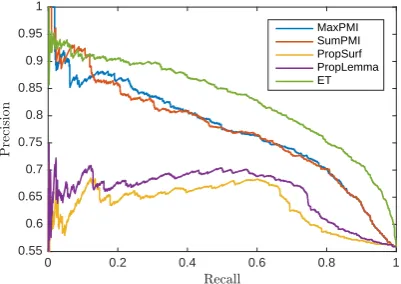
sys-tems. Figure 5 depicts the PR curves for
vari-ous methods as the threshold is varied, highlight-ing that the ET classifier performs reliably at var-ious recall points. Its precision, when tuned to optimize F1, is 0.91, which is very suitable for
9Each test term prediction is assumed to be a binomial.
0 0.2 0.4 0.6 0.8 1
Recall 0.55
0.6 0.65 0.7 0.75 0.8 0.85 0.9 0.95 1
P
re
ci
si
o
n
MaxPMI SumPMI PropSurf PropLemma ET
Figure 5: Precision-recall trade-off for various classifiers as the threshold is varied. ET classifier (green) is significantly better throughout.
AUC Acc P R F1
MAXPMI† 0.75 0.63 0.81 0.65 0.72
[image:6.595.310.511.62.204.2]SUMPMI† 0.75 0.63 0.80 0.66 0.72 PROPSURF 0.57 0.51 0.49 0.61 0.54 PROPLEM 0.58 0.49 0.50 0.59 0.54 ET Classifier 0.78 0.71 0.88 0.71 0.78
Table 2: Generalization to unseen terms: Effec-tiveness of various methods, using the same
met-rics as in Table1. As expected, supervised
meth-ods perform poorly, similar to a random baseline. Unsupervised methods generalize well, but the ET classifier again substantially outperforms them.
high-precision applications. It has a 5% higher AUC (area under the curve) and outperforms base-lines by roughly 5% throughout the precision-recall spectrum.
As a second study, we assess how well our
clas-sifiergeneralizes to unseen terms. For this, we
consider only the 559 test terms that do not appear
in the train set.10 Table 2 provides the resulting
performance metrics. We see that the frequency based supervised baselines, having never seen the test terms, stay close to the default precision of 0.5. The unsupervised baselines, by nature, gener-alize much better but are substantially dominated by our ET classifier, which achieves an F1 score of 78%. This is only 2% below its own F1 across all seen and unseen terms, and 6% higher than the second best baseline.
Ranking Question Terms by Essentiality.
Next, we investigate the performance of the ET classifier as a system that ranks all terms within a question in the order of essentiality. Thus,
[image:6.595.78.285.264.330.2] [image:6.595.310.520.267.333.2]System MAP MAXPMI† 0.87 SUMPMI† 0.85
PROPSURF 0.85 PROPLEM 0.86 ET Classifier 0.90
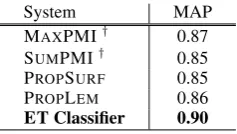
Table 3: Effectiveness of various methods for ranking the terms in a question by essentiality.
† indicates unsupervised method. Mean-Average
Precision (MAP) numbers reflect the mean (across all test set questions) of the average precision of the term ranking for each question. ET classifier again substantially outperforms all baselines.
unlike the previous evaluation that pools terms together across questions, we now consider each question as a unit. For the ranked list produced by each classifier for each question, we compute the
average precision (AP).11We then take the mean
of these AP values across questions to obtain the mean average precision (MAP) score for the classifier.
The results for the test set (483 questions) are
shown in Table 3. Our ET classifier achieves a
MAP of 90.2%, which is 3%-5% higher than the baselines, and demonstrates that one can learn to reliably identify essential question terms.
4 Using ET Classifier in QA Solvers
In order to assess the utility of our ET classifier, we investigate its impact on two end-to-end QA systems. We start with a brief description of the question sets.
Question Sets. We use three question sets of
4-way multiple choice questions.12 REGENTS and
AI2PUBLICare two publicly available elementary
school science question set. REGENTScomes with
127 training and 129 test questions; AI2PUBLIC
contains 432 training and 339 test questions that subsume the smaller question sets used previ-ously (Clark et al., 2016; Khashabi et al., 2016).
REGTSPERTD set, introduced byKhashabi et al.
(2016), has 1,080 questions obtained by
automat-ically perturbing incorrect answer choices for 108 New York Regents 4th grade science questions.
11We rank all terms within a question based on their es-sentiality scores. For any true positive instance at rankk, the precision atkis defined to be the number of positive instances with rank no more thank, divided byk. The average of all these precision values for the ranked list for the question is theaverage precision.
12Available athttp://allenai.org/data.html
We split this into 700 train and 380 test questions. For each question, a solver gets a score of 1 if it
chooses the correct answer and1/kif it reports a
k-way tie that includes the correct answer.
QA Systems. We investigate the impact of adding the ET classifier to two state-of-the-art QA systems for elementary level science
ques-tions. Let q be a multiple choice question with
answer options {ai}. TheIR Solver from Clark
et al.(2016) searches, for eachai, a large corpus
for a sentence that best matches the (q, ai) pair.
It then selects the answer option for which the match score is the highest. The inference based
TableILP Solver fromKhashabi et al.(2016), on
the other hand, performs QA by treating it as an optimization problem over a semi-structured knowledge base derived from text. It is designed to answer questions requiring multi-step inference and a combination of multiple facts.
For each multiple-choice question(q, a), we use
the ET classifier to obtain essential term scoressl
for each tokenqlinq;sl=et(ql, q, a). We will be
interested in the subsetωof all termsTqinqwith
essentiality score above a thresholdξ: ω(ξ;q) =
{l∈Tq|sl> ξ}. Letω(ξ;q) =Tq\ω(ξ;q). For
brevity, we will writeω(ξ)whenqis implicit.
4.1 IR solver + ET
To incorporate the ET classifier, we create a
pa-rameterized IR system called IR + ET(ξ) where,
instead of querying a (q, ai) pair, we query
(ω(ξ;q), ai).
While IR solvers are generally easy to imple-ment and are used in popular QA systems with surprisingly good performance, they are often also sensitive to the nature of the questions they
re-ceive. Khashabi et al. (2016) demonstrated that
a minor perturbation of the questions, as
embod-ied in the REGTSPERTDquestion set, dramatically
reduces the performance of IR solvers. Since the perturbation involved the introduction of distract-ing incorrect answer options, we hypothesize that a system with better knowledge of what’s impor-tant in the question will demonstrate increased ro-bustness to such perturbation.
Table 4 validates this hypothesis, showing the
result of incorporating ET in IR, as IR + ET(ξ =
0.36), whereξwas selected by optimizing
end-to-end performance on the training set. We observe a
5% boost in the score on REGTSPERTD, showing
[image:7.595.122.241.61.128.2]Dataset Basic IR IR + ET
REGENTS 59.11 60.85
AI2PUBLIC 57.90 59.10
REGTSPERTD 61.84 66.84
Table 4: Performance of the IR solver without (Basic IR) and with (IR + ET) essential terms. The numbers are solver scores (%) on the test sets of the three datasets.
the system more robust to perturbations.
Adding ET to IR also improves its performance
on standard test sets. On the larger AI2PUBLIC
question set, we see an improvement of 1.2%.
On the smaller REGENTS set, introducing ET
improves IRsolver’s score by 1.74%, bringing it close to the state-of-the-art solver, TableILP, which achieves a score of 61.5%. This demon-strates that the notion of essential terms can be fruitfully exploited to improve QA systems.
4.2 TableILP solver + ET
Our essentiality guided query filtering helped the IR solver find sentences that are more relevant to the question. However, for TableILP an added focus on essential terms is expected to help only when the requisite knowledge is present in its rel-atively small knowledge base. To remove con-founding factors, we focus on questions that are, in fact, answerable.
To this end, we consider three (implicit) require-ments for TableILP to demonstrate reliable behav-ior: (1) the existence of relevant knowledge, (2) correct alignment between the question and the knowledge, and (3) a valid reasoning chain con-necting the facts together. Judging this for a ques-tion, however, requires a significant manual effort and can only be done at a small scale.
Question Set. We consider questions for which the TableILP solver does have access to the req-uisite knowledge and, as judged by a human, a reasoning chain to arrive at the correct answer. To reduce manual effort, we collect such ques-tions by starting with the correct reasoning chains (‘support graphs’) provided by TableILP. A human annotator is then asked to paraphrase the corre-sponding questions or add distracting terms, while maintaining the general meaning of the question. Note that this is done independent of essentiality scores. For instance, the modified question below changes two words in the question without affect-ing its core intent:
Original question: Afoxgrows thickerfuras a season changes. This adaptation helps the fox to (A) find food(B) keep warmer(C) grow stronger(D) escape from predators Generated question: Ananimalgrows thickerhairas a season changes. This adaptation helps to (A) find food(B) keep warmer(C) grow stronger(D) escape from predators
While these generated questions should ar-guably remain correctly answerable by TableILP, we found that this is often not the case. To
in-vestigate this, we curate a small datasetQRwith
12 questions (cf. Appendix C of the extended ver-sion (Khashabi et al.,2017)) on each of which, de-spite having the required knowledge and a plausi-ble reasoning chain, Taplausi-bleILP fails.
Modified Solver. To incorporate question term essentiality in the TableILP solver while
maintain-ing high recall, we employ acascadesystem that
starts with a strong essentiality requirement and progressively weakens it.
Following the notation of Khashabi et al.
(2016), letx(ql)be a binary variable that denotes
whether or not thel-th term of the question is used
in the final reasoning graph. We enforce that terms
with essentiality score above a thresholdξmust be
used:x(ql) = 1,∀l∈ω(ξ). Let TableILP+ET(ξ)
denote the resulting system which can now be used in a cascading architecture.
TableILP+ET(ξ1) → TableILP+ET(ξ2) → ...
where ξ1 < ξ2 < . . . < ξk is a sequence of
thresholds. Questions unanswered by the first system are delegated to the second, and so on. The cascade has the same recall as TableILP, as long as the last system is the vanilla TableILP. We refer to this configuration as CASCADES(ξ1, ξ2, . . . , ξk).
This can be implemented via repeated calls to
TableILP+ET(ξj) with j increasing from 1 tok,
stopping if a solution is found. Alternatively, one can simulate the cascade via a single extended ILP
using knew binary variableszj with constraints:
|ω(ξj)| ∗zj ≤Pl∈ω(ξj)x(ql)forj ∈ {1, . . . , k},
and addingM∗Pkj=1zjto the objective function,
for a sufficiently large constantM.
We evaluate CASCADES(0.4,0.6,0.8,1.0) on
our question set, QR. By employing
essential-ity information provided by the ET classifier, CASCADES corrects 41.7% of the mistakes made
5 Conclusion
We introduced the concept of essential question terms and demonstrated its importance for ques-tion answering via two empirical findings: (a) humans becomes substantially worse at QA even when a few essential question terms are dropped, and (b) state-of-the-art QA systems can be im-proved by incorporating this notion. While text summarization has been studied before, questions have different characteristics, requiring new train-ing data to learn a reliable model of essentiality. We introduced such a dataset and showed that our classifier trained on this dataset substantially out-performs several baselines in identifying and rank-ing question terms by the degree of essentiality.
Acknowledgments
The authors would like to thank Peter Clark, Oyvind Tafjord, and Peter Turney for valuable dis-cussions and insights.
This work is supported by DARPA under agree-ment number FA8750-13-2-0008. The U.S. Gov-ernment is authorized to reproduce and distribute reprints for Governmental purposes notwithstand-ing any copyright notation thereon. The views and conclusions contained herein are those of the au-thors and should not be interpreted as necessarily representing the official policies or endorsements, either expressed or implied, of DARPA or the U.S. Government.
References
P. F. Brown, P. V. Desouza, R. L. Mercer, V. J. D. Pietra, and J. C. Lai. 1992. Class-based n-gram models of natural language. Computational linguis-tics18(4):467–479.
K. W. Church and P. Hanks. 1989. Word association norms, mutual information and lexicography. In
27th Annual Meeting of the Association for Compu-tational Linguistics. pages 76–83.
P. Clark. 2015. Elementary school science and math tests as a driver for AI: take the Aristo challenge! In
29th AAAI/IAAI. Austin, TX, pages 4019–4021. P. Clark, O. Etzioni, T. Khot, A. Sabharwal, O. Tafjord,
P. Turney, and D. Khashabi. 2016. Combining re-trieval, statistics, and inference to answer elemen-tary science questions. In30th AAAI.
J. Clarke and M. Lapata. 2008. Global inference for sentence compression: An integer linear program-ming approach. Journal of Artificial Intelligence Re-search31:399–429.
J. L. Fleiss. 1971. Measuring nominal scale agree-ment among many raters. Psychological bulletin
76(5):378.
C. Hori and F. Sadaoki. 2004. Speech summarization: an approach through word extraction and a method for evaluation. IEICE TRANSACTIONS on Informa-tion and Systems87(1):15–25.
Mohammad Javad Hosseini, Hannaneh Hajishirzi, Oren Etzioni, and Nate Kushman. 2014. Learning to solve arithmetic word problems with verb catego-rization. In2014 EMNLP. pages 523–533.
D. Howell. 2012. Statistical methods for psychology. Cengage Learning.
P. Jansen, R. Sharp, M. Surdeanu, and P. Clark. 2017. Framing qa as building and ranking intersentence answer justifications. Computational Linguistics.
T. Joachims. 1998. Text categorization with support vector machines: Learning with many relevant fea-tures.Machine learning: ECML-98pages 137–142.
D. Khashabi, T. Khot, A. Sabharwal, P. Clark, O. Et-zioni, and D. Roth. 2016. Question answering via integer programming over semi-structured knowl-edge (extended version). In Proc. 25th Int. Joint Conf. on Artificial Intelligence(IJCAI).
D. Khashabi, T. Khot, A. Sabharwal, and D. Roth. 2017. Learning what is essential in questions (ex-tended version).
T. Khot, N. Balasubramanian, E. Gribkoff, A. Sab-harwal, P. Clark, and O. Etzioni. 2015. Exploring Markov logic networks for question answering. In
2015 EMNLP. Lisbon, Portugal.
K. Knight and D. Marcu. 2002. Summarization be-yond sentence extraction: A probabilistic approach to sentence compression. Artificial Intelligence
139(1):91–107.
C. Kwok, O. Etzioni, and D. S. Weld. 2001. Scaling question answering to the web. InWWW.
F. Li, X. Zhang, J. Yuan, and X. Zhu. 2007. Classifying what-type questions by head noun tagging. InProc. 22nd Int. Conf. on Comput. Ling. (COLING).
X. Li and D. Roth. 2002. Learning question classi-fiers. InProceedings of the 19th International Con-ference on Computational Linguistics - Volume 1. Association for Computational Linguistics, Strouds-burg, PA, USA, COLING ’02, pages 1–7.
D. Moldovan, M. Pas¸ca, S. Harabagiu, and M. Sur-deanu. 2003. Performance issues and error analy-sis in an open-domain question answering system.
ACM Transactions on Information Systems (TOIS)
J. H. Park and W. B. Croft. 2015. Using key concepts in a translation model for retrieval. InProceedings of the 38th International ACM SIGIR Conference on Research and Development in Information Re-trieval. ACM, pages 927–930.
P. D. Turney. 2013. Distributional semantics beyond words: Supervised learning of analogy and para-phrase.TACL1:353–366.
Kateryna Tymoshenko, Daniele Bonadiman, and Alessandro Moschitti. 2016. Convolutional neural networks vs. convolution kernels: Feature engineer-ing for answer sentence rerankengineer-ing. InHLT-NAACL. B. Wang, K. Liu, and J. Zhao. 2016. Inner attention based recurrent neural networks for answer selec-tion. InACL.
W.-t. Yih, X. He, and C. Meek. 2014. Semantic pars-ing for spars-ingle-relation question answerpars-ing. InProc. 52nd Annual Meeting of the Ass. for Comp. Linguis-tics (ACL). pages 643–648.