Abstract—The paper presents a generalized mathematical model and load controller for minimizing the total operating cost of a processing industry subjected to the constraints. The work presented in this paper also deals with the results of application of Fuzzy Logic and Demand Side Management (DSM) techniques applied to a medium scale milk industrial consumer in India to achieve the improvement in load factor, reduction in Maximum Demand (MD) and also the consumer gets saving in the energy bill.
Index Terms—Demand Side Management (DSM), End Use Equipment Control (EUEC), Load Priority Technique (LPT), Maximum Demand (MD), Differential Tariff (DT)
I. INTRODUCTION
Among the various advancements in the power sector, Demand Side Management in power systems is the latest technology. The concept of DSM was developed in 1980s to meet the problems faced by both supplier as well as consumer. DSM is broader in scope than either Load management or Energy Conservation by including the alternative programs designed to build load as well as to reduce it. The main objective of the present work is to introduce the concept of DSM in an industry [1].
Driving force behind DSM:
The concept of Demand Side Management in Power Systems is gaining momentum world wide and presently it is developing very rapidly because:
x The rate of generation of electric power is not at all meeting the present day requirements.
x The continuous rise in the cost of electricity.
x Activities by consumers to gain more control of their electricity bills.
x Huge capital investment for building new generating plants.
II. DSM TECHNIQUES
Selection of the most appropriate DSM technique is perhaps a crucial question for both the supplier and the consumer. The following are the DSM techniques applied to the industrial consumer [1].
A. End Use Equipment Control. B. Load Priority Technique. C. Peak Clipping & Valley Filling. D. Differential Tariff.
A. Professor and HOD, EEE Dept, ACE College of engineering, Hyderabad, A.P, India, [email protected].
B. Student,, EEE Dept, Sree Nidhi Institute of Science and Technology, Hyderabad, A.P, India,[email protected]
A. End Use Equipment Control: EUEC deals with the
control operation of the various end use appliances for better utilization of available resources without affecting the production and quality of supply. This is one of the most active areas of DSM technology development. This is because some of the bulk industrial loads exhibit maximum peaks and valleys in their load curves. Due to the increased industrial activities, from most of the industrial consumption patterns it is found that the use of electrical power is exceeding beyond the permitted limits for some hours and very low for other hours of the day. So for these bulk industrial consumers here is more room for flattening these curves.
B. Load Priority Technique: In developing LPT, the
loads are classified into Non-interruptible and Interruptible loads. Non-interruptible loads are the high priority loads while the interruptible loads are low priority loads. The priorities are assigned to the loads in discussion with the respective section supervisors giving immense importance to the production schedule.
The success of LPT is totally dependent upon the development of various load priorities for operation, which will not disturb the production schedule, and gives enough scope of reduction of load demand. In order to achieve this, a close interaction between the various sections of the industry is required.
C. Peak Clipping & Valley Filling: Reduction of peak demands reduces the demand charges of the consumer. Peak Clipping can be done by Direct load control (DLC) through Load priority Technique (LPT). Peak clipping is used to reduce capital investment charges, operation charges and dependence on high cost critical fuels. The main objective of Peak Clipping is to match the available generating capacity with the demand without going in for additional generation, which means cost. The principle involved in valley filling is to build up load or consume power during light load periods of the supply system. This results in a more flat load curve as seen from the supply system. Hence the supplier’s equipment like generators, transformers, transmission lines, etc., are loaded to 80 to 90% of their rating instead of 15 to 20% during light loads, thus resulting in high efficiency and lower cost of operation because of improved load factor or energy efficiency of the system.
D. Differential Tariff: This technique has been introduced because of variable load on the supplier’s equipment. Usually the load curve of an industrial consumer will have some peaks and valleys. Hence the supplier must install his equipment which will be capable of supplying the peak load of the consumer. With this high capacity equipment, no doubt he will be able to supply the consumers peak but during the valley period, the equipment will be very much underutilized, thereby reducing the energy efficiency of the
equipment. Hence the supplier will insist or will try by all possible means that his equipment is utilized to its rated capacity for the entire duration whenever it is in the commissioned state. He will announce incentives (say, half of the normal load period tariff) for the consumer to consume more during his valley period and he will announce punishment (Maybe two times the normal tariff) if the consumer utilizes energy during the peak hours. With this type of tariff, the consumer will try to avoid energy consumption during supplier’s peak hours and try to consume more energy during supplier’s valley periods. To achieve this, he may have to reschedule his operation schedule. This is the basic principle of differential tariff.
III. MATHEMATICAL MODEL
A generalized mathematical Model is designed for the processing industries like milk industries which gives solution for minimizing the total operating cost of the industry subject to the constraints and also gives the optimal response for a given production capacity under specified electricity tariff rates. The mathematical model is entirely based on discrete time representation as a representation of the continuous loads under some sufficient conditions. The feature of this model is that it takes into account, the key characteristics of group process loads which include [2]:
1. The group time and group capacity
2. Material input (inflow) – time periods and quantity.
3. Material Output (outflow) – Time periods and quantity.
4. Power demand and its variations with time and quantity also type/quality of material for the group.
Initially, a day is divided into ‘M’ intervals with equal ‘t’ hours of time span.
Fig-1 represents the group-time sequence.
The operating parameters and the sequences of the process are considered with respect to group-time sequence.
Material inflow with quantity Ca to C(a+x) in litres from athtime to (a+x ) thtime and the outflow from
bth time to (b+y) th time with quantity Cb to C(b+y) respectively.
Power demand (in kW) from time‘d’ to (d+z) is Pd to P(d+z)
A decision variable ‘J’ is taken into consideration to indicate whether the equipment has started to process a new group in the particular interval or not, in order to produce a specific product.
The conditions for the decision variable are:
Jnil =1; the nthequipment starts a group for processing the ithproduct.
= 0; if the above condition is not satisfied.
The electrical power input ( in kW) to the equipment ‘n’ at any interval ‘l’ when it is processing ithproduct is given as follows:
P
nil{(
X
nu
Y
nil)
y
K
nil}
(1)Where
K
nil - Efficiency obtained from efficiency characteristics corresponding to the percentage loading. Xn - The rated capacity of the equipment ( in k W)Ynil – Utilization of the nth equipment at the interval ‘l’ when it is processing the ‘ithproduct.
Y – De-rating factor of the equipment. It is based on the loading conditions, site conditions and all the constraints.
nil- Efficiency of the equipment ‘n’ at the interval ‘l’
The energy consumed (kWh) by the equipment ‘n’ in the lth interval, when processing the product ‘i’ for the group started in the ethinterval is
t J P
E nil nie
d l
z d l e
nil
¦
u u
1
1 ) (
(2)
The industry is subjected to several constraints that are as follows:
1. Production Constraint :
Initially, a constraint called ‘production constraint’ is considered to keep the total production U i of a product ‘i’
¦ ¦
M u tl N
n
i nil
nil J U
C
1 1
(3)
Where,
N – The particular item of equipment
Cnil -- It is the production (outflow) in a group quantity for the machine ‘n’ for the product ‘i‘for the group started in ‘l th interval.
2. The condition for the total production of the plant ‘UT‘is given by
¦
I ti
T
i U
U
1
(4)
Where, ‘I’ – total number of products
PD= Power Demand
I= Input O= Output
3. The condition for the availability of raw material for production is:
¦ ¦
N u dn M
l
T nil
nil J G
G
1 1
(5)
Where, ‘N’ – The particular item of equipment
Gnil- The quantity of raw material required for the ‘n’ th equipment for the product ‘i ‘and for the group started in ‘l’ th interval
GT- Total raw material available
4. When a group process is being carried out in equipment, the equipment cannot be allocated to any other group or product.
The condition incorporated to prevent the allocation problems is
¦
d 1 1 m l l e nieJ (6)
5. Storage condition :
Process loads with storage space are modelled with maximum capacity limitations.
Net inflow into the storage for the interval ‘l’ is as follows
¦ ¦ ¦
N u¦ ¦ ¦
un M l b l y b l e G g M l j a l x a l e gie nie nil
l C J C J
S gij 1 1 1 1 ) ( 1 1 1 ) ( ]
[ (7)
In the above equation,
(a) Material inflow for the entire equipment ‘N’ giving outflow to the storage
(b) Material outflow for the entire equipment ‘G’ from the storage
For both, when processing the product ‘i ‘for the group started at the interval ‘e’ is considered.
Now, Storage constraint is given by
¦
d M j n j l S SS0 ( 1) (8)
Where,
So– Initial storage level
Sm – Maximum / final storage level (maximum capacity)
6. Operating Sequence:
This is the condition for the start of the nth unit at an interval ‘l’ after‘t’ intervals right from the start of (n-1) th unit is as follows :
¦
d
u
l t l enie
J
n ieJ
t
) 1
( (9)
7. Availability of the equipment:
The unavailability of the equipment ‘n’ during intervals from ‘e’ to ‘f’ is as follows:
‘l’= ‘e’ to ‘f’ for all products ‘I’ Jnil =0 for all intervals
Objective function to minimize the monthly operating cost: ] ) ( ) {( ]) } { ) [( (
1 1 1
¦¦¦
M u u u u u u l N n I i ACMD TOUT CMD NT x xl lnil R R J t W R MD R MD
E Min
(10)
The above function is subjected to production, storage and equipment constraints.
Here,
Rl– Cost of energy (charge per kWh) for the interval ‘l’
W- The number of working days in a month RNT – The MD charges per kVA
N – The particular item of equipment I- Total number of products
Rxl– cost of load management equipment Jx- selection variable
Jx = 1 if additional cost occurs due to load management actions
= 0 if the above condition fails.
MD CMD= Maximum demand at normal tariff RTOUT = Time of Use Tariff/Differential Tariff MD ACMD= load above maximum demand
The main objective of Peak load management is the minimization of the total operating cost, which consists of charges for energy consumed ( either a flat or TOU tariff), charges for the maximum demand (either normal M.D or TOU tariff charges) and additional operating costs due to shifting of loads.
IV. CASE STUDY
The industry selected for investigation is the Kurnool District Milk Producers Cooperative Union Limited, Vijaya Milk & Milk Products, Nandyal.
Fig-2 Electrical Layout of the industry.
A. Identification of the problem:
Term Used: The energy efficiency of the system and supplier equipment has been quantified in terms of Load Factor which is defined as Average Load divided by Maximum Load in a given period.
period given a in Load Maximum
Load Average Factor
Load
(11)
B. Solution Technique Adopted:
The DSM technique that has been considered for study is LPT. In consultation with the section superintendents and section supervisors, 12 sections of the industry were classified into Interruptible and Non-interruptible sections. Among them RMRD, Processing, Deep Freeze, Refrigeration, Powder, Boiling, Lighting & fans, and Colony, were classified as Non-interruptible sections while the remaining Butter, Ghee, Pre-Pac, and Water sections were classified as Interruptible sections.
The working hours of the Butter, Ghee and Pre-Pac are shifted as given below:
Butter : 6AM to 9AM and 5PM to 2PM
Ghee : 7AM to 10 AM and 6PM to 3PM
Pre-Pac: 8AM to 4AM and 5PM to 2PM Coming to the case of Water pumping Section, large HP motors are switched off during the peak hours and are turned on during the off-peak hours. However, this shifting of working hours is not necessary when industry is not producing Milk powder.
V. TARIFF STRUCTURE FOR ENERGY BILLING
1. MD charges: As per the rules of the Central Power Distribution Company of AP Limited (CPDCAPL), the existing Block Rate Tariff for MD charges is Rs. 175/-per KVA for the contracted 450 kVA and Rs. 350/- 175/-per kVA for the subsequent kVA consumed.
2. Differential Tariff:The DT for the load between the normal lead limits is between Rs.3.80 per kWh. For the load exceeding the normal load it is twice the normal load tariff that is Rs.7.60 per kWh and for the load consumed to fill the peaks, it is half the normal tariff, i.e. Rs.1.90 per kWh [6].
Load curves for a period of one month were collected from the industry. Typical load curve which recorded the maximum demand for that particular month is studied in this paper. The load curves before and after the application of DSM techniques is as shown. The details of the electricity bill of that particular day before and after DSM application is calculated below.
VI. FUZZY LOAD CONTROLLER
Fig-3 shows the block diagram of the proposed fuzzy controller which has 120 rules, two inputs and one output signal. A sample of its fuzzy rules is given later in the paper.
Fig-3 Fuzzy logic load Controller Block Diagram
The inputs and outputs of the above model shown in fig-3 are as follows:
Input1.Load:Observation of Peak and Off-peak load
Input2.Time: Represents the load condition.
Output.Power:Percentage of load with respect to time.
The controller takes the two crisp input values, fuzzifies them, and assigns a fuzzfied control signal to controller. The control signal is then converted to one crisp signals through defuzzification process [4].
VII. FUZZY MEMBERSHIP FUNCTIONS
Fuzzy membership functions are needed for all input and output variables in order to define linguistic rules that govern the relationships between them. Triangular membership functions were found to be most suitable for the fuzzy controller inputs, load, time and the output signals are Power [5]. These membership functions are shown in fig-4.
Fig-4 Fuzzy Membership Functions
VIII. FUZZY RULES
using one-twenty fuzzy rules, and a few of them are listed below.
Fuzzy
rules:-1.If (load is butter) and (time is 1) then (power is 0) 2.If (load is butter) and (time is 9) then (power is 20) 3.If (load is butter) and (time is 13) then (power is 0) 4.If (load is butter) and (time is 18) then (power is 0) 5.If (load is butter) and (time is 19) then (power is 0) 6.If (load is butter) and (time is 24) then (power is 0) 7.If (load is ghee) and (time is 1) then (power is 0) 8.If (load is ghee) and (time is 6) then (power is 0) 9.If (load is ghee) and (time is 7) then (power is 0) 10.If (load is ghee) and (time is 12) then (power is 20) 11.If (load is ghee) and (time is 13) then (power is 10) 12.If (load is ghee) and (time is 18) then (power is 0) 13.If (load is ghee) and (time is 19) then (power is 0) 14.If (load is ghee) and (time is 24) then (power is 0) 15.If (load is pre-pac) and (time is 1) then (power is 0) 16.If (load is pre-pac) and (time is 6) then (power is 0) 17.If (load is pre-pac) and (time is 7) then (power is 0) 18.If (load is water-section) and (time is 11) then (power is 20) 19.If (load is water-section) and (time is 12) then (power is 25)
IX. SIMULATION RESULTS
Fig-5 Average industrial load before and after DSM
Satisfactory control was achieved with 120 rules for fuzzy controller. The figure shows the controlled and uncontrolled load profiles. It is clear from this figure that the peaks of the load profile of the industry have been shifted to the desired time periods. The peaks have been reduced from 100% peak value to 90.84% peak value and shifted to low demand periods. Therefore, the proposed DSM strategy can be effective in leveling the industry load profile. The figure shows the average power load profile before and after DSM and also shows that the load factor is improved The load factor of the industrial load is calculated from graphs (From fig-5) before and after fuzzy logic. Table II illustrates the lowering of peak demand for the period of days studied.
The numerical calculations of case study are shown below:
Before application of DSM
Maximum Demand = 518.0 KVA MD charges = 450*175+ (518-450)*175*2 = Rs.1, 02,550 /- Load Factor = 316.2/ 466.2
= 0.67824
After application of DSM
Maximum Demand = 470.55556 KVA
MD charges = 450*175+ (470.55556-450)*175*2 = Rs.85, 944. 446
/-Load Factor = 316.2/ 423.5 = 0.74663
Net Savings for the industrial consumer due to the lowering of MD = Rs. (1, 02,550 – 85, 944. 446)
= Rs.16, 605.554 per month
X. CONCLUSIONS
This paper has presented a mathematical model and fuzzy load controller for processing industries like, milk industry in India to minimize the total operating cost of the industry, subjected to constraints. The paper also presents the results of the application of Fuzzy Logic and a few DSM techniques applied to an industrial consumer in Nandyal town, India. Calculations have established that the energy efficiency of the consumer has increased by the increase in the load factor and the consumer also gets a saving in the energy bill that is Rs. 16,606 /- per month.
ACKNOWLEDGMENTS
The authors would like to express there sincere gratitude to the authorities of Vijaya Milk and Milk Products Industry, Nandyal, ACE College of Engineering and Sreenidhi Institute of Science and Technology, Hyderabad for their kind cooperation and encouragement.
REFERENCES
[1] P.Ravi Babu, H.G. Gopal and K.Sreenivasul, 27thNational System Conference, “Energy management through Demand side management techniques - a case study”, p.p. 74-77, December 2003, India.
[2] P Ravi Babu and V.P. Sree Divya, “Mathematical modelling and ANN applied to a Milk Industry through DSM” Proceedings of the World Congress on Engineering and Computer Science 2009 Vol. I WCECS 2009, October 20-22, 2009, San Francisco, USA. [3] P Ravi Babu, , Rashmi Reddy et al, “DSM techniques and Fuzzy
logic application to Air conditioner - a case study” 8th WSEAS International Conference on POWER SYSTEMS (PS 2008), Santander, Cantabria, Spain, September 23-25, 2008 , pp.292-298.
[4] H. Salehfar, and P. J. No1, “Fuzzy Logic-Based Direct Load Control of Residential Electric Water Heaters and Air Conditioners Recognizing Customer Preferences in a Deregulated Environment”, 1999 IEEE.
[5] K. Bhattacharya, and M.L. Crow, “A Fuzzy Logic Based Approach to Direct Load Control,” IEEE Trans. On Power Systems. Vol. II, No. 2, May 1995.
[6] P. Ravi Babu and V.P. Sree Divya,”Mathematical modelling and DSM Techniques applied to a Medium Scale Milk Industry” Proceedings of the 9th WSEAS International Conference on POWER SYSTEMS, ISSN: 1790-5117, ISBN: 978-960-474-112-0, pp.33-39.
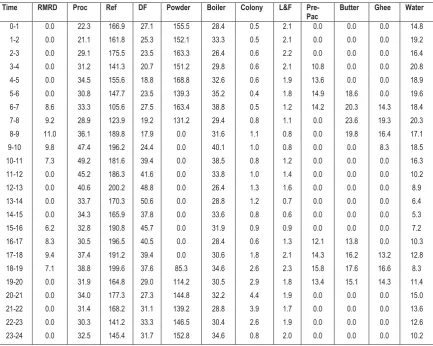
Before DSM
Table I: Load data in kWh of Milk Industry
[image:6.595.117.551.108.454.2]
Table II: Load details before and after Fuzzy logic
Time RMRD Proc Ref DF Powder Boiler Colony L&F Pre-Pac
Butter Ghee Water
0-1 0.0 22.3 166.9 27.1 155.5 28.4 0.5 2.1 0.0 0.0 0.0 14.8 1-2 0.0 21.1 161.8 25.3 152.1 33.3 0.5 2.1 0.0 0.0 0.0 19.2 2-3 0.0 29.1 175.5 23.5 163.3 26.4 0.6 2.2 0.0 0.0 0.0 16.4 3-4 0.0 31.2 141.3 20.7 151.2 29.8 0.6 2.1 10.8 0.0 0.0 20.8 4-5 0.0 34.5 155.6 18.8 168.8 32.6 0.6 1.9 13.6 0.0 0.0 18.9 5-6 0.0 30.8 147.7 23.5 139.3 35.2 0.4 1.8 14.9 18.6 0.0 19.6 6-7 8.6 33.3 105.6 27.5 163.4 38.8 0.5 1.2 14.2 20.3 14.3 18.4 7-8 9.2 28.9 123.9 19.2 131.2 29.4 0.8 1.1 0.0 23.6 19.3 20.3 8-9 11.0 36.1 189.8 17.9 0.0 31.6 1.1 0.8 0.0 19.8 16.4 17.1 9-10 9.8 47.4 196.2 24.4 0.0 40.1 1.0 0.8 0.0 0.0 8.3 18.5 10-11 7.3 49.2 181.6 39.4 0.0 38.5 0.8 1.2 0.0 0.0 0.0 16.3 11-12 0.0 45.2 186.3 41.6 0.0 33.8 1.0 1.4 0.0 0.0 0.0 10.2 12-13 0.0 40.6 200.2 48.8 0.0 26.4 1.3 1.6 0.0 0.0 0.0 8.9 13-14 0.0 33.7 170.3 50.6 0.0 28.8 1.2 0.7 0.0 0.0 0.0 6.4 14-15 0.0 34.3 165.9 37.8 0.0 33.6 0.8 0.6 0.0 0.0 0.0 5.3 15-16 6.2 32.8 190.8 45.7 0.0 31.9 0.9 0.9 0.0 0.0 0.0 7.2 16-17 8.3 30.5 196.5 40.5 0.0 28.4 0.6 1.3 12.1 13.8 0.0 10.3 17-18 9.4 37.4 191.2 39.4 0.0 30.6 1.8 2.1 14.3 16.2 13.2 12.8 18-19 7.1 38.8 199.6 37.6 85.3 34.6 2.6 2.3 15.8 17.6 16.6 8.3 19-20 0.0 31.9 164.8 29.0 114.2 30.5 2.9 1.8 13.4 15.1 14.3 11.4 20-21 0.0 34.0 177.3 27.3 144.8 32.2 4.4 1.9 0.0 0.0 0.0 15.0 21-22 0.0 31.4 168.2 31.1 139.2 28.8 3.9 1.7 0.0 0.0 0.0 13.6 22-23 0.0 30.3 141.2 33.3 146.5 30.4 2.6 1.9 0.0 0.0 0.0 12.6 23-24 0.0 32.5 145.4 31.7 152.8 34.6 0.8 2.0 0.0 0.0 0.0 10.2
Time Before the application of Fuzzy
logic After the application of Fuzzy logic Time
Before the application of Fuzzy
logic After the application of Fuzzy logic Load in KW
DT Billing in
Rs Load in KW DT Billing in Rs Load in KW
DT Billing in
Rs Load in KW DT Billing in Rs 1
417.6 1567.88 423.5 1567.88 13 327.8 1226.64 352.0 648.09 2
415.4 1559.52 393.0 1559.52 14 291.7 1089.46 320.0 612.94 3
437.0 3283.20 419.0 3207.20 15 278.3 1038.54 338.0 621.30 4
408.5 1533.30 388.5 1454.26 16 316.4 1183.32 397.0 705.66 5
445.3 3384.28 419.0 3204.92 17 342.3 1280.60 392.5 691.41 6
431.8 3243.68 384.0 1456.54 18 368.4 1380.92 338.5 1214.86 7
446.1 3352.36 384.0 1452.74 19 466.2 3505.12 419.0 1562.86 8
406.9 1527.22 352.0 1367.24 20 429.3 3224.68 388.5 1449.70 9
341.6 1279.08 324.5 631.94 21 436.9 3282.44 423.5 3282.44 10
346.5 1297.70 392.5 727.13 22 417.9 1561.42 423.5 1561.42 11
334.3 1251.34 397.0 731.16 23 398.8 1515.44 388.5 1515.44 12