Bottom–Up Tree Transducers
Daniel Gildea
∗ University of RochesterTree transducers are defined as relations between trees, but in syntax-based machine translation, we are ultimately concerned with the relations between the strings at the yields of the input and output trees. We examine the formal power of Multi Bottom-Up Tree Transducers from this point of view.
1. Introduction
Many current approaches to syntax-based statistical machine translation fall under the theoretical framework of synchronous tree substitution grammars (STSGs). Tree substitution grammars (TSGs) generalize context-free grammars (CFGs) in that each rule expands a nonterminal to produce an arbitrarily large tree fragment, rather than a fragment of depth one as in a CFG. Synchronous TSGs generate tree fragments in the source and target languages in parallel, with each rule producing a tree fragment in either language. Systems such as that of Galley et al. (2006) extract STSG rules from parallel bilingual text that has been automatically parsed in one language, and the STSG nonterminals correspond to nonterminals in these parse trees. Chiang’s (2007) Hiero system produces simpler STSGs with a single nonterminal.
STSGs have the advantage that they can naturally express many re-ordering and restructuring operations necessary for machine translation (MT). They have the dis-advantage, however, that they are not closed under composition (Maletti et al. 2009). Therefore, if one wishes to construct an MT system as a pipeline of STSG operations, the result may not be expressible as an STSG. Recently, Maletti (2010) has argued that multi bottom–up tree transducers (MBOTs) (Lilin 1981; Arnold and Dauchet 1982; Engelfriet, Lilin, and Maletti 2009) provide a useful representation for natural language processing applications because they generalize STSGs, but have the added advantage of being closed under composition. MBOTs generalize traditional bottom–up tree transducers in that they allow transducer states to pass more than one output subtree up to subsequent transducer operations. The number of subtrees taken by a state is called itsrank. MBOT s are linear and non-deleting; that is, operations cannot copy or delete arbitrarily large tree fragments.
Although STSGs and MBOTs both perform operations on trees, it is important to note that, in MT, we are primarily interested in translational relations between strings. Tree operations such as those provided by ST SGs are ultimately tools to translate a string
∗ Computer Science Department, University of Rochester, Rochester NY 14627. E-mail:[email protected].
in one natural language into a string in another. Whereas MBOTs originate in the tree transducer literature and are defined to take a tree as input, MTsystems such as those of Galley et al. (2006) and Chiang (2007) find a parse of the source language sentence as part of the translation process, and the decoding algorithm, introduced by Yamada and Knight (2002), has more in common with CYK parsing than with simulating a tree transducer.
In this article, we investigate the power of MBOTs, and of compositions of ST SGs in particular, in terms of the set of string translations that they generate. We relate MBOTs and compositions of ST SGs to existing grammatical formalisms defined on strings through five main results, which we outline subsequently. The first four results serve to situate general MBOTs among string formalisms, and the fifth result addresses MBOTs resulting from compositions of ST SGs in particular.
Our first result is that the translations produced by MBOTs are a subset of those produced by linear context-free rewriting systems (LCFRSs) (Vijay-Shankar, Weir, and Joshi 1987). LCFRS provides a very general framework that subsumes CFG, tree ad-joining grammar (TAG; Joshi, Levy, and Takahashi 1975; Joshi and Schabes 1997), and more complex systems, as well as synchronous context-free grammar (SCFG) (Aho and Ullman 1972) and synchronous tree adjoining grammar (STAG) (Shieber and Schabes 1990; Schabes and Shieber 1994) in the context of translation. LCFRS allows gram-mar nonterminals to generate more than one span in the final string; the number of spans produced by an LCFRS nonterminal corresponds to the rank of an MBOTstate. Our second result states that the translations produced by MBOTs are equivalent to a specific restricted form of LCFRS, which we call 1-m-LCFRS. From the construction relating MBOTs and 1-m-LCFRSs follow results about the source and target sides of the translations produced by MBOTs. In particular, our third result is that the translations produced by MBOTs are context-free within the source language, and hence are strictly less powerful than LCFRSs. This implies that MBOTs are not as general as STAGs, for example. Similarly, MBOTs are not as general as the generalized multitext grammars proposed for machine translation by Melamed (2003), which retain the full power of LCFRSs in each language (Melamed, Satta, and Wellington 2004). Our fourth result is that the output of an MBOT, when viewed as a string language, does retain the full power of LCFRSs. This fact is mentioned by Engelfriet, Lilin, and Maletti (2009, page 586), although no explicit construction is given.
Our final result specifically addresses the string translations that result from com-positions of STSGs, with the goal of better understanding the complexity of using such compositions in machine translation systems. We show that the translations produced by compositions of STSGs are more powerful than those produced by single STSGs, or, equivalently, by SCFGs. Although it is known that STSGs are not closed under composition, the proofs used previously in the literature rely on differences in tree structure, and do not generate string translations that cannot be generated by STSG. Our result implies that current approaches to machine translation decoding will need to be extended to handle arbitrary compositions of STSGs.
We now turn to give definitions of MBOTs and LCFRSs in the next section, before presenting our results on general MBOTs in Section 3, and our result on compositions of STSGs in Section 4.
2. Preliminaries
from ranked alphabetΣ. We use parentheses to write trees: for example,a(b,c,d) is an element ofTΣifais an element ofΣwith rank 3, andb,c, anddare elements ofΣwith rank 0. Similarly, given a ranked alphabetΣand a setX,Σ(X) denotes the set of trees consisting of a single symbol ofΣof rankkdominating a sequence ofkelements from X. We useTΣ(X) to denote the set of arbitrarily sized trees constructed from ranked alphabetΣhaving items from setXat some leaf positions. That is,TΣ(X) is the smallest set such thatX⊂TΣ(X) andσ(t1,. . .,tk)∈TΣ(X) ifσis an element ofΣwith rankk, and
t1,. . .,tk∈TΣ(X). Amulti bottom–up tree transducer(MBOT) (Lilin 1981; Arnold and
Dauchet 1982; Engelfriet, Lilin, and Maletti 2009; Maletti 2010) is a system (S,Σ,∆,F,R) where:
r
S,Σ, and∆are ranked alphabets of states, input symbols, and output symbols, respectively.r
F⊂Sis a set of accepting states.r
Ris a finite set of rulesl→rwhere, using a set of variablesX, l∈TΣ(S(X)), andr∈S(T∆(X)) such that:– everyx∈Xthat occurs inloccurs exactly once inrand vice versa, and
– l∈S(X) orr∈S(X).
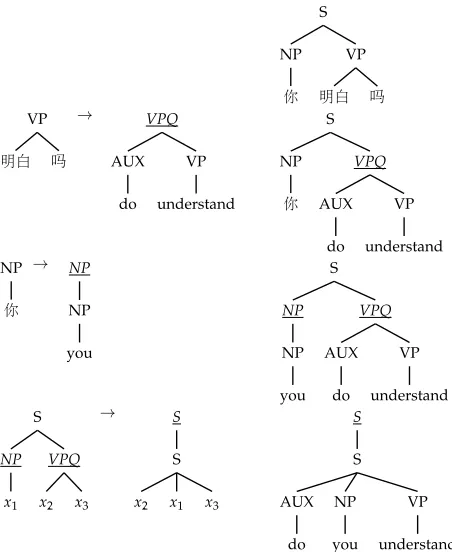
One step in an MBOTtransduction is performed by rewriting a local tree fragment as specified by one of the rules inR. We replace the fragmentlwithr, copying the subtree under each variable inlto the location of the corresponding variable inr. Transducer rules apply bottom–up from the leaves of the input tree, as shown in Figure 1, and must terminate in an accepting state. We use underlined symbols for the transducer states, in order to distinguish them from the symbols of the input and output alphabets.
We define atranslationto be a set of string pairs, and we define the yieldof an MBOTMto be the set of string pairs (s,t) such that there exist: a trees∈TΣhavings as its yield, a treet∈T∆ havingtas its yield, and a transduction fromstotthat is accepted byM. We refer tosas thesource sideandtas thetarget sideof the translation. We use the notation source(T) to denote the set of source strings of a translation T, source(T)={s|(s,t)∈T}, and we use the notation target(T) to denote the set of target strings. We use the notation yield(MBOT) to denote the set of translations produced by the set of all MBOTs.
A linear context-free rewriting system (LCFRS) is defined as a system (VN,VT,P,S), whereVNis a set of nonterminal symbols,VTis a set of terminal symbols,
Pis a set of productions, andS∈VN is a distinguished start symbol. Associated with
each nonterminalBis afan-outϕ(B), which tells how many spansBcovers in the final string. Productionsp∈Ptake the form:p:A→g(B1,B2,. . .,Br), whereA,B1,. . .,Br∈
VN, andgis a functiong: (VT∗)
ϕ(B1)× · · · ×(V∗
T)
ϕ(Br)→(V∗
T)
ϕ(A), which specifies how to assemble the ri=1ϕ(Bi) spans of the righthand side nonterminals into the ϕ(A)
spans of the lefthand side nonterminal. The functiongmust belinearandnon-erasing, which means that if we write
g(x1,1,. . .,x1,ϕ(B1),. . .,xr,1,. . .,xr,ϕ(Br))=t1,. . .,tϕ(A)
the tuple of stringst1,. . .,tϕ(A)on the right-hand side contains each variablexi,jfrom
the left-hand side exactly once, and may also contain terminals fromVT. The process
Figure 1
Step-by-step example of an MBOTtree transduction. The left column shows the transducer rule applied at each step; only the last rule contains variables, whereas the others contain alphabet symbols of rank zero at their leaves. StateVPQhas rank two, and statesNPandShave rank one.
associated with each production to build the string. We refer to the tree induced by top– down nonterminal expansions of an LCFRS as thederivation tree, or sometimes simply as a derivation.
As an example of how the LCFRS framework subsumes grammatical formalisms such as CFG, consider the following CFG:
S→A B
A→a
B→b
This grammar corresponds to the following grammar in LCFRS notation: S→gS(A,B) gS(sA,sB)=sAsB
A→gA() gA()=a
B→gB() gB()=b
the polynomial depends on the grammar. Parsing general LCFRS grammars, where the grammar is considered part of the input, is NP-complete (Satta 1992).
Following Melamed, Satta, and Wellington (2004), we represent translation in LCFRS by using a special symbol # to separate the strings of the two languages. Our LCFRS grammars will only generate strings of the forms#t, wheresandtare strings not containing the symbol #, and we will identifys as the source string andt as the target string. We use the notation trans(LCFRS) to denote the set of translations that can be produced by taking the string language of some LCFRS and splitting each string into a pair at the location of the # symbol.
3. Translations Produced by General MBOTs
In this section, we relate the yield of general MBOTs to string rewriting systems. To begin, we show that the translation produced by any MBOT is also produced by an LCFRS by giving a straightforward construction for converting MBOTrules to LCFRS rules.
We first consider MBOTrules having only variables, as opposed to alphabet symbols of rank zero, at their leaves. For an MBOTrule l→r with l∈TΣ(S(X)), let S1,S2,. . .,Skbe the sequence of states appearing from left to right immediately above the leaves ofl. Without loss of generality, we will name the variables such thatxi,jis the jth child of theith state,Si, and the sequence of variables at the leaves ofl, read from left to right, is: x1,1,. . .,x1,d(S1),. . .,xk,1,. . .,xk,d(S
k), whered(Si) is the rank of state Si.
LetS0 be the state symbol at the root of the right-hand-side (r.h.s.) tree r∈S(T∆(X)). Let π and µ be functions such that xπ(1),µ(1),xπ(2),µ(2),. . .,xπ(n),µ(n) is the sequence of variables at the leaves ofrread from left to right. We will call this sequence theyield ofr. Finally, letp(i) for 1≤i≤d(S0) be the position in the yield ofrof the rightmost leaf ofS0’sith child. Thus, for alli, 1≤p(i)≤n.
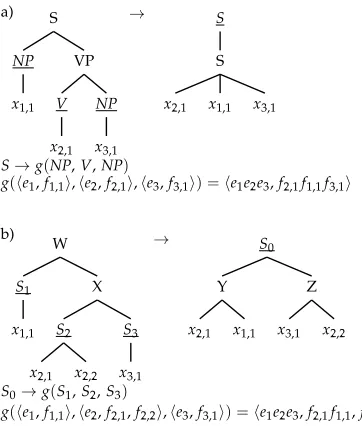
Given this notation, the LCFRS rule corresponding to the MBOTrule l→r is constructed as S0 →g(S1,S2,. . .,Sk). The LCFRS nonterminal Si has fan-out equal
to the corresponding MBOTstate’s rank plus one: ϕ(Si)=d(Si)+1. This is because
the LCFRS nonterminal has one span in the source language, and d(Si) spans in
the target language of the translation. The combination function for the LCFRS rule S0→g(S1,S2,. . .,Sk) is:
g(e1,f1,1,. . .,f1,d(S1),. . .,ek,fk,1,. . .,fk,d(Sk))=
e1· · ·ek, fπ(1),µ(1)· · ·fπ(p(1)),µ(p(1)), fπ(p(1)+1),µ(p(1)+1)· · ·fπ(p(2)),µ(p(2)),
. . .,
fπ(p(d(S0)−1)+1),µ(p(d(S0)−1)+1)· · ·fπ(p(d(S0))),µ(p(d(S0))
Here we useeifor the variables in the LCFRS rule corresponding to spans in the input
tree of the MBOT, andfi,jfor variables corresponding to the output tree. The pattern in
which these spans fit together is specified by the functionsπandµthat were read off of the MBOTrule.
rule, this means that every nonterminal in the grammar has fan-out 2, corresponding to one span in the source language string and one span in the target language string of the translation. This is what we would expect, given that, in terms of the translations produced, STSG is equivalent to SCFG (because the internal tree structure of the rules is irrelevant), and SCFG falls within the class of LCFRS grammars of fan-out 2. Figure 2b shows a more general example, where the states of the MBOTrule have rank>1.
Now we extend this construction to handle tree symbols of rank zero, which corre-spond to terminal symbols in the LCFRS. Letα0be the sequence of rank zero symbols appearing at the leaves oflto the left ofx1,1, and letαifor 1≤i≤kbe the sequence of rank zero symbols to the right ofxi,d(Si), and to the left ofxi+1,1if i<k. Letβi,jbe the sequence of symbols of rank zero at the leaves ofrappearing in the subtree under the ith child ofS0after thejth variable in this subtree and before thej+1th variable, with
βi,0being to the left of the first variable, andβi,p(i)being to the right of the last variable. We can add these sequences of terminal symbols to the LCFRS rule as follows:
g(e1,f1,1,. . .,f1,d(S1),. . .,ek,fk,1,. . .,fk,d(Sk))=
α0e1α1· · ·ekαk,
β1,0fπ(1),µ(1)β1,1· · ·fπ(p(1)),µ(p(1))β1,p(1),
β2,0fπ(p(1)+1),µ(p(1)+1)β2,1· · ·fπ(p(2)),µ(p(2))β2,p(2),
. . .,
βd(S
0),0fπ(p(d(S0)−1)+1),µ(p(d(S0)−1)+1)βd(S0),1· · ·fπ(p(d(S0))),µ(p(d(S0))βd(S0),p(d(S0))
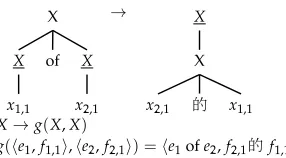
[image:6.486.50.231.421.634.2]An example of this conversion is shown in Figure 3. In this example,α1=of,β1,1=的, all otherαandβvalues are the empty string, andd(S0)=1. We refer to the LCFRS rule constructed from MBOTrulel→raspl→r.
Figure 2
Figure 3
Conversion of an MBOTrule with symbols of rank zero to an LCFRS production with terminals.
Finally, we add astart ruleruleS→g(Si),g(e,f)=e#ffor eachSi∈Fto
gener-ate all final stgener-atesSiof the MBOTfrom the start symbolSof the LCFRS.
We now show that the language of the LCFRS constructed from a given MBOTis identical to the yield of the MBOT. We represent MBOT transductions as derivation trees, where each node is labeled with an MBOTrule, and each node’s children are the rules used to produce the subtrees matched by any variables in the rule. We can construct an LCFRS derivation tree by simply relabeling each node with the LCFRS rule constructed from the node’s MBOTrule. Because, in the MBOTderivation tree, each node has children which produce the states required by the the MBOTrule’s left-hand side (l.h.s.), it also holds that, in the LCFRS derivation tree, each node has as its children rules which expand the set of nonterminals appearing in the parent’s r.h.s. Therefore the LCFRS tree constitutes a valid derivation.
Given the mapping from MBOTderivations to LCFRS derivations, the following lemma relates the strings produced by the derivations:
Lemma 1
LetTMBOT be an MBOTderivation tree withIas its input tree andOas its output tree,
and constructTLCFRS by mapping each nodenMBOT inTMBOT to a nodenLCFRSlabeled
with the LCFRS production constructed from the rule atnMBOT. Lett0,t1,. . .,tkbe the
string tuple returned by the LCFRS combination function at any nodenLCFRSinTLCFRS.
The stringt0contains the yield of the node ofIat which the MBOTrule at the node of TMBOTcorresponding tonLCFRSwas applied. Furthermore, the stringst1,. . .,tkcontain
thekyields of thekMBOToutput subtrees (subtrees ofO) that are found as children of the root (state symbol) of the MBOTrule’s right-hand side.
Proof
When we apply the LCFRS combination functions to build the string produced by the LCFRS derivation, the sequence of function applications corresponds exactly to the bottom–up application of MBOTrules to the input tree. Let us refer to the tuple returned by one LCFRS combination functiongast0,t1,. . .,tk. An MBOTrule applying at the
bottom of the input tree cannot contain any variables, and for MBOTrules of this type, our construction produces an LCFRS rule with a combination function of the form:
g()=α0,β1,0,. . .,βk,0
taking no arguments and returning string constants equal to the yield of the MBOT rule’s l.h.s, and the sequence of yields of theksubtrees under the r.h.s.’s root. Now we consider how further rules in the LCFRS derivation make use of the tuplet0,t1,. . .,tk.
tuple in order, adding any terminals present in the portion of the input tree matched by the MBOT’s l.h.s. Thus the combination functions maintain the property that the first element in the resulting tuple, t0, contains the yield of the subtree of the input tree where the corresponding MBOTrule applied. The combination functions combine the remaining elements in their input tuples in the same order given by the MBOT rule’s r.h.s., again adding any terminals added to the output tree by the MBOTrule. Thus, at each step, the strings t1,. . .,tk returned by LCFRS combination functions
contain thekyields of thekMBOToutput subtrees found as children of the root (state symbol) of the MBOTrule’s r.h.s. By induction, the lemma holds at each node in the derivation tree.
The correspondence between LCFRS string tuples and MBOT tree yields gives us our first result:
Theorem 1
yield(MBOT)⊂trans(LCFRS).
Proof
From a given MBOT, construct an LCFRS as described previously. For any transduction of the MBOT, from Lemma 1, there exists an LCFRS derivation which produces a string consisting of the yield of the MBOT’s input and output trees joined by the # symbol. In the other direction, we note that any valid derivation of the LCFRS corresponds to an MBOTtransduction on some input tree; this input tree can be constructed by assembling the left-hand sides of the MBOTrules from which the LCFRS rules of the LCFRS derivation were originally constructed. Because there is a one-to-one correspondence between LCFRS and MBOTderivations, the translation produced by the LCFRS and the yield of the MBOTare identical.
Because we can construct an LCFRS generating the same translation as the yield of any given MBOT, we see that yield(MBOT)⊂trans(LCFRS).
The translations produced by MBOTs are equivalent to the translations produced by a certain restricted class of LCFRS grammars, which we now specify precisely.
Theorem 2
The class of translations yield(MBOT) is equivalent to yield(LCFRS), where 1-m-LCFRS is defined to be the class of 1-m-LCFRS grammars where each rule either is a start rule of the formS→g(Si),g(e,f)=e#f, or meets both of the following conditions:
r
The combination function keeps the two sides of the translation separate. That is, it must be possible to writeg(e1,f1,1,. . .,f1,ϕ1,. . .,er,fr,1,. . .,fr,ϕr)
as
g1(e1,. . .,er)+g2(f1,1,. . .,f1,ϕ1,. . .,fr,1,. . .,fr,ϕr)
where+represents tuple concatenation, for some functionsg1andg2.
Proof
Our construction for transforming an MBOTto an LCFRS produces LCFRS grammars satisfying the given constraints, so yield(MBOT)⊂trans(1-m-LCFRS).
To show the other direction, we will construct an MBOT from a 1-m-LCFRS. For each 1-m-LCFRS rule of the form
S→g(B1,. . .,Br)
g(e1,f1,1,. . .,f1,ϕ1,. . .,er,fr,1,. . .,fr,ϕr)=
g1(e1,. . .,er)+g2(f1,1,. . .,f1,ϕ1,. . .,fr,1,. . .,fr,ϕr)
g1(e1,. . .,er)=α0e1· · ·αr−1erαr
g2(f1,1,. . .,f1,ϕ1,. . .,fr,1,. . .,fr,ϕr)=t1,1· · ·t1,n1,. . .,tm,1· · ·tm,nm
where eachαi is a string of terminals, and each symbolti,jis either a variablefi,j, or a
single terminal, we construct the MBOTrule:
S
α0 B1
f1,1 . . . f1,ϕ(B1)
· · · αr−1 Br
fr,1 . . . fr,ϕ(Br)
αr
→ S
S1 t1,1 · · · t1,n1
· · · Sm
tm,1 · · · tm,nm
By the same reasoning used for our construction of LCFRS grammars from MBOTs, there is a one-to-one correspondence between derivation trees of the 1-m-LCFRS and the constructed MBOT, and the yield strings also correspond at each node in the derivation trees. Therefore, yield(1-m-LCFRS)⊂yield(MBOT).
Because we have containment in both directions, yield(MBOT) = trans(1-m-LCFRS).
We now move on to consider the languages formed by the source and target projections of MBOTtranslations.
Grammars of the class 1-m-LCFRS have the property that, for any nonterminalA (other than the start symbolS) having fan-outϕ(A), one span is always realized in the source string (to the left of the # separator), and ϕ(A)−1 spans are always realized in the target language (to the right of the separator). This property is introduced by the start rulesS→g(Si),g(e,f)=e#fand is maintained by all further productions
because of the condition on 1-m-LCFRS that the combination function must keep the two sides of translation separate. For a 1-m-LCFRS rule constructed from an MBOT, we define the rule’s source language projection to be the rule obtained by discarding all the target language spans, as well as the separator symbol # in the case of the start productions. The definition of 1-m-LCFRS guarantees that the combination function returning a rule’s l.h.s. source span needs to have only the r.h.s. source spans available as arguments.
Lemma 2
For an LCFRSGconstructed from an MBOTMby the given construction,L(source(G))=
source(trans(M)), andL(target(G))=target(trans(M)).
Proof
There is a valid derivation tree in the source language projection for each valid deriva-tion tree in the full LCFRS, because for any expansion rewriting a nonterminal of fan-out ϕ(A) in the full grammar, we can apply the projected rule to the corresponding nonterminal of fan-out 1 in the projected derivation. In the other direction, for any expansion in a derivation of the source projection, a nonterminal of fan-out ϕ(A) will be available for expansion in the corresponding derivation of the full LCFRS. Because there is a one-to-one correspondence between derivations in the full LCFRS and its source projection, the language generated by the source projection is the source of the translation generated by the original LCFRS. By the same reasoning, there is a one-to-one correspondence between derivations in the target projection and the full LCFRS, and the language produced by the target projection is the target side of the translation of the full LCFRS.
Lemma 2 implies that it is safe to evaluate the power of the source and target projections of the LCFRS independently. This fact leads to our next result.
Theorem 3
yield(MBOT)trans(LCFRS).
Proof
In the LCFRS generated by our construction, all nonterminals have fan-out 1 in the source side of the translation. Therefore, the source side of the translation is a context-free language, and an MBOTcannot represent the following translation:
{(anbncndn, anbncndn)|n≥1}
which is produced by an STAG (Shieber and Schabes 1990; Schabes and Shieber 1994). Because STAG is a type of LCFRS, yield(MBOT)trans(LCFRS).
Although the source side of the translation produced by an MBOTmust be a context-free language, we now show that the target side can be any language produced by an LCFRS.
Theorem 4
target(yield(MBOT))=LCFRS
Proof
Given an input LCFRS, we can construct an MBOTwhose target side corresponds to the rules in the original LCFRS, and whose source simply accepts derivation trees of the LCFRS. To make this precise, given an LCFRS rule in the general form:
S→g(B1,. . .,Br)
where each symbolti,j is either some variable xi,j or a terminal from the alphabet of
the LCFRS, we construct the MBOTrule:
S B1
x1,1 . . . x1,ϕ(B1)
· · · Br
xr,1 . . . xr,ϕ(Br)
→ S
S1 t1,1 · · · t1,n1
· · · Sϕ(S)
tϕ(S),1 · · · tϕ(S),nϕ(S)
where the MBOT’s input alphabet contains a symbol S for each LCFRS nonterminalS, and the MBOT’s output alphabet containsϕ(S) symbols Sifor each LCFRS nontermi-nalS. This construction for converting an LCFRS to an MBOT shows that LCFRS ⊂ target(yield(MBOT)).
Given our earlier construction for generating the target projection of the LCFRS derived from an MBOT, we know that target(yield(MBOT))⊂LCFRS. Combining these two facts yields the theorem.
4. Composition of STSGs
Maletti et al. (2009) discuss the composition of extended top–down tree transducers, which are equivalent to STSGs, as shown by Maletti (2010). They show that this for-malism is not closed under composition in terms of the tree transformations that are possible. In this article, we focus on the string yields of the formalisms under discussion, and from this point of view we now examine the question of whether theyieldof the composition of two STSGs is itself the yield of an STSG in general. It is important to note that, although we focus on the yield of the composition, in our notion of STSG composition, the tree structure output by the first STSG still serves as input to the second STSG.
Maletti et al. (2009) give two tree transformations as counterexamples to the compo-sitionality of STSG, shown in Figure 4. From the point of view of string yield, both of the transformations are equivalent to an STSG rule that simply copies the three variables with no re-ordering. Thus, these counterexamples are not sufficient to show that the yield of the composition of two STSGs is not the yield of an STSG.
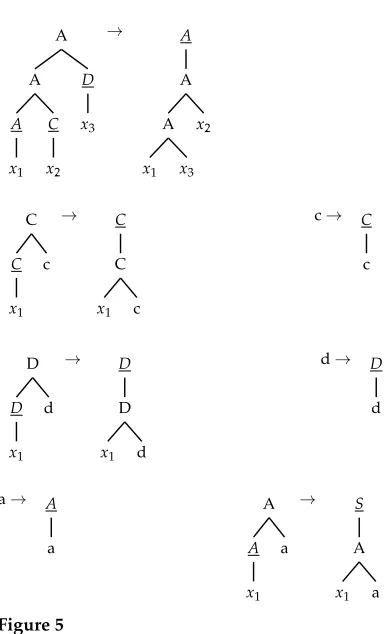
[image:11.486.59.441.106.171.2]We now present two STSGs, shown in MBOT notation in Figures 5 and 6, whose composition is not a translation produced by an STSG. The essence of this counterex-ample, explained in more detail subsequently, is that rules from the two STSGs apply in an overlapping manner to unboundedly long sequences, as in the example of Arnold
Figure 4
Figure 5
First MBOTin composition.
and Dauchet (1982, section 3.4). To this approach we add a re-ordering pattern which results in a translation that we will show not to be possible with STSG.
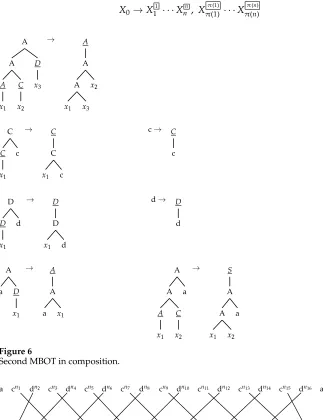
The heart of each MBOT is the first rule, which reverses the order of adjacent sequences of c’s and d’s. The MBOT of Figure 5 generates the translation:
{(a[cn2i−1dn2i]
i=1a, a[d
n2icn2i−1]
i=1a)|ni≥1,≥1}
whereis the number of times the first rule of the transducer is applied, and the notation [xi]ni=1indicates the string concatenationx1x2· · ·xn. Here we have 2repeated sequences
of characters c and d, each occurringnitimes, with each integernifor 1≤i≤2varying
freely.
The second MBOT reverses sequences of c’s and d’s in a pattern that is offset by one from the pattern of the first MBOT. It produces the translation:
{(adn1[cn2idn2i+1]−1 i=1c
n2a, adn1[dn2i+1cn2i]−1
i=1c
n2a)|n
i≥1,≥1}
When we compose the two MBOTs, the yield of the resulting transducer is the translation:
Tcrisscross= ∞
=1
where
Tcrisscross={(a[cn2i−1dn2i]
i=1a, ad
n2[dn2i+2cn2i−1]−1 i=1c
n2−1a)|n
i≥1} (2)
A visualization of the alignment pattern of this translation is shown in Figure 7. We will show thatTcrisscrosscannot be produced by any SCFG.
We define an SCFG to be a system (V,Σ,∆,P,S) whereVis a set of nonterminals,
Σ and ∆ are the terminal alphabets of the source and target language respectively, S∈Vis a distinguished start symbol, and Pis a set of productions of the following general form:
X0→X
1
1 · · ·X n
n , X π(1) π(1) · · ·X
[image:13.486.55.378.202.622.2]π(n) π(n)
Figure 6
[image:13.486.57.380.585.639.2]Second MBOTin composition.
Figure 7
where π is a permutation of lengthn, and the variables Xi for 0≤i≤n range over
nonterminal symbols (for example, X1 and X2 may both stand for nonterminal A). In SCFG productions, the l.h.s. nonterminal rewrites into a string of terminals and nonterminals in both the source and target languages, and pairs of r.h.s. nonterminals that are linked by the same superscript index must be further rewritten by the same rule.
In terms of string translations, STSGs and SCFGs are equivalent, because any SCFG is also an STSG with rules of depth 1, and any STSG can be converted to an SCFG with the same string translation by simply removing the internal tree nodes in each rule. We will adopt SCFG terminology for our proof because the internal structure of STSG rules is not relevant to our result.
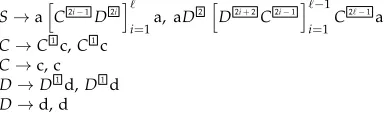
For a fixed value of , the translation Tcrisscross can be produced by an SCFG of rank 2, shown in Figure 8, because one rule can produce 2 nonterminals arranged in the permutation of Figure 7. (In the context of SCFGs, rank refers to the maxi-mum number of nonterminals on the r.h.s. of a rule.) We will show that strings of this form cannot be produced by any SCFG of rank less than 2. Intuitively, factoring the alignment pattern of Figure 7 into smaller SCFG rules would require identifying subsequences in the two languages that are consistently aligned to one another, and, as can be seen from the figure, no such subsequences exist. Becausecan be unboundedly large in our translation, the translation cannot be produced by any SCFG of fixed rank.
We will assume, without loss of generality, that any SCFG is written in a normal form such that each rule’s r.h.s. either contains only terminals in each language, or contains only nonterminals. An SCFG can be transformed into this normal form by applying the following procedure to each rule:
1. Associate each sequence of terminals with the preceding nonterminal, or the following nonterminal in the case of initial terminals.
2. Replace each group consisting of a nonterminal and its associated terminals with a fresh nonterminalA, and add a rule rewritingAas the group in source and target. (Nonterminals with no associated terminals may be left intact.)
3. In each rule created in the previous step, replace each sequence of
[image:14.486.50.244.575.635.2]terminals with another fresh nonterminalB, and add a rule rewritingBas the terminal sequence in source and target.
Figure 9 shows an example of this grammar transformation. Because we do not change the rank of existing rules, and we add rules of rank no greater than 3, the transformation does not increase the rank of any grammar having rank at least 3.
Figure 8
Figure 9
Conversion of grammar (a) to normal form (b) in which each rule has only nonterminals or only terminals on the r.h.s.
Figure 10
An SCFG derivation produced by applying each rule in Figure 9b once, in the order given in Figure 9b. Indices of linked nonterminals are renumbered after each step to be monotonically increasing in the English side of the derivation. The preterminal permutation of the derivation, (3,2,1), is the sequence of indices on the Chinese side in the last step before any terminals are produced.
In an SCFG derivation, nonterminals in either language are linked as shown in Fig-ure 10. We restrict derivations to apply rules producing terminals after applying all other rules. We refer to nonterminals at the last step in which the sentential form consists exclusively of nonterminals aspreterminals, and we refer to a pair of linked preterminals as analigned preterminal pair. Assuming that aligned preterminal pairs are indexed consecutively in the source side of the sentential form, we refer to the sequence of indices in the target side as thepreterminal permutationof a derivation. For example, the preterminal permutation of the derivation in Figure 10 is (3,2,1). The permutation of any sentential form of an SCFG of rankrcan be produced by composing permutations of length no greater thanr, by induction over the length of the derivation. Thus, while the permutation (3,2,1) of our example can be produced by composing permutations of length 2, the preterminal permutation (2,4,1,3) can never be produced by an SCFG of rank 2 (Wu 1997). In fact, this restriction also applies to subsequences of the preterminal permutation.
Lemma 3
Letπbe a preterminal permutation produced by an SCFG derivation containing rules of maximum rankr, and letπbe a permutation obtained fromπ by removing some elements and renumbering the remaining elements with a strictly increasing function. Thenπfalls within the class of compositions of permutations of lengthr.
Proof
From each rule in the derivation producing preterminal permutationπ, construct a new rule by removing any nonterminals whose indices were removed fromπ. The resulting sequence of rules produces preterminal permutationπ and contains rules of rank no greater thanr.
We will make use of another general fact about SCFGs, which we derive by ap-plying Ogden’s Lemma (Ogden 1968), a generalized pumping lemma for context-free languages, to the source language of an SCFG.
Lemma 4 (Ogden’s Lemma)
For each context-free grammar G=(V,Σ,P,S) there is an integerksuch that for any wordξinL(G), if anykor more distinct positions inξare designated as distinguished, then there is someAinVand there are wordsα,β,γ,δ, andµinΣ∗such that:
r
S⇒∗αAµ⇒∗αβAδµ⇒∗αβγδµ=ξ, and henceαβmγδmµ∈L(G)for allm≥0.
r
γcontains at least one of the distinguished positions.r
Eitherαandβboth contain distinguished positions, orδandµboth contain distinguished positions.r
βγδcontains at mostkdistinguished positions.Ogden’s lemma can be extended as follows to apply to SCFGs.
Lemma 5
For each SCFGG=(V,Σ,∆,P,S) having source alphabetΣand target alphabet∆, there is an integer k such that for any string pair (ξ,ξ) inL(G), if any kor more distinct positions inξare designated as distinguished, then there is someAinVand there are wordsα,β,γ,δ, andµinΣ∗andα,β,γ,δ, andµin∆∗such that:
r
(S1,S1)⇒∗(αA1µ,αA1µ)⇒∗(αβA1δµ,αβA1δµ)⇒∗(αβγδµ,αβγδµ)=(ξ,ξ), and hence
(αβmγδmµ,α(β)mγ(δ)mµ)∈L(G) for allm≥0.
r
γcontains at least one of the distinguished positions.r
Eitherαandβboth contain distinguished positions, orδandµboth contain distinguished positions.r
βγδcontains at mostkdistinguished positions.Note that there are no guarantees on the form ofα,β,γ,δ, andµ, and indeed these may all be the empty string.
Proof
There must exist some sequence of rules in the source projection ofGwhich licenses the derivation A⇒∗βAδ. If we write thejth rule in this sequence asAj→νj, there must
exist a synchronous rule inGof the formAj→νj,νj that rewrites the same
nontermi-nal. ThusGlicenses a synchronous derivation (A1,A1)⇒∗(βA1δ,βA1δ) for some
derivation (A1,A1)⇒∗(βA1δ,βA1δ) can be repeated any number of times, the string pairs
(αβmγδmµ, α(β)mγ(δ)mµ) (3) are generated by the SCFG for allm≥0. The further conditions onα,β,γ,δ, andµ
follow directly from Ogden’s Lemma.
We refer to a substring arising from a term cni or dni in the definition of T
crisscross
(Equation (2)) as arun. In order to distinguish runs, we refer the run arising from cni or
dni as theith run. We refer to the pair (cni, cni) or (dni, dni) consisting of theith run in
the source and target strings as theithaligned run. We now use Lemma 5 to show that aligned runs must be generated from aligned preterminal pairs.
Lemma 6
Assume that some SCFGGgenerates the translationTcrisscross for some fixed. There exists a constantksuch that, in any derivation of grammarGhaving eachni>k, for any
i, 1≤i≤2, there exists at least one aligned preterminal pair among the subsequences of source and target preterminals generating theith aligned run.
Proof
We consider a source string ξ, (ξ,ξ)∈Tcrisscross, such that the lengthni of each run
is greater than the constant k of Lemma 5. For a fixed i, 1≤i≤2, we consider the distinguished positions to be all and only the terminals in theith run. This implies that the run can be pumped to be arbitrarily long; indeed, this follows from the definition of the language itself.
Because our distinguished positions are within theith run, and because Lemma 5 guarantees that eitherα, β, andγ all contain distinguished positions or γ, δ, andµ
all contain distinguished positions, we are guaranteed that eitherβ orδlies entirely within theith run. Consider the case where βlies within the run. We must consider three possibilities for the location ofδin the string:
Case 1.The stringδalso lies entirely within theith run.
Case 2.The stringδcontains substrings of more than one run. This cannot occur, because pumped strings of the formαβmγδmµwould contain more than 2runs, which is not allowed under the definition ofTcrisscross.
Case 3.The stringδlies entirely within thejth run, wherej=i. The strings αβmγδmµ
and a substring of eitherαorµin the target. We apply Lemma 5 a second time, with all terminals of thekth run as the distinguished positions, to the derivation (A,A)⇒∗ (γ,γ) by takingAas the start symbol of the grammar. This implies that there exist ˆβ,
ˆ
γ, ˆδ, ˆβ, ˆγ, and ˆδsuch that
(ξ,ξ)=(αββˆγˆδδµˆ ,αββˆγˆδˆδµ) and all strings
(αβmβˆnγˆδˆnδmµ, α(β)m( ˆβ)nγˆ( ˆδ)n(δ)mµ)
are members of the translation Tcrisscross . Either ˆβ or ˆδis a substring of source side of the kth aligned run, so the kth aligned run can be pumped to be arbitrarily long in the source without changing its length in the target. This contradicts the definition of Tcrisscross. Similarly, the case where the kth aligned run lies between β and δ in the target leads to a contradiction. Thus the assumption thatj=imust be false.
Because Cases 2 and 3 are impossible,δmust lie entirely within theith run. Simi-larly, in the case whereδcontains distinguished positions,βmust lie within theith run. Thus bothβandδalways lie entirely within theith aligned run.
Because the βandδlie within theith aligned run, the stringsαβmγδmµhave the same form asαβγδµ, with the exception that theith run is extended from lengthnito
some greater lengthni. For the pairs of Equation (3) to be members of the translation,
βandδ must be substrings of theith aligned run in the target. Becauseβmγδm and (β)mγ(δ)m were derived from the same nonterminal, the two sequences of pretermi-nals generating these two strings consist of aligned preterminal pairs. Because both
βmγδm and (β)mγ(δ)m are substrings of the ith aligned run, we have at least one aligned preterminal pair among the source and target preterminal sequences generating theith aligned run.
Lemma 7
Assume that some SCFGGgenerates the translationTcrisscross for some fixed. There exists a constantksuch that, if (ξ,ξ) is a string pair generated byGhaving eachni>k,
any derivation of (ξ,ξ) with grammarGmust contain a rule of rank at least 2. Proof
Because the choice ofiin Lemma 6 was arbitrary, each aligned run must contain at least one aligned preterminal pair. If we select one such preterminal pair from each run, the associated permutation is that of Figure 7. This permutation cannot be decomposed, so, by Lemma 3, it cannot be generated by an SCFG derivation containing only rules of rank less than 2.
We will use one more general fact about SCFGs to prove our main result. Lemma 8
LetGbe an SCFG and letT=L(G) be the translation it produces. LetFbe a finite state machine, and letR=L(F) be the regular language it accepts. LetT be the translation derived by intersecting the source strings ofTwithR
Then there exists an SCFGGsuch thatT=L(G).
Proof
LetVbe the nonterminal set ofG, and letSbe the state set ofF. Construct the SCFGG with nonterminal setV×S×Sby applying the construction of Bar-Hillel, Perles, and Shamir (1961) for intersection of a CFG and finite state machine to the source side of each rule inG.
Now we are ready for our main result.
Theorem 5
SCFG=yield(STSG)yield(STSG;STSG), where the semicolon denotes composition.
Proof
Assume that some SCFGGgeneratesTcrisscross. Note thatTcrisscross is the result of
inter-secting the source ofTcrisscrosswith the regular language a[c+d+]a. By Lemma 8, we can
construct an SCFGGgeneratingTcrisscross . By Lemma 7, for each,Ghas rank at least 2. The intersection construction does not increase the rank of the grammar, soGhas rank at least 2. Becauseis unbounded in the definition ofTcrisscross, and because any
SCFG has a finite maximum rank,Tcrisscrosscannot be produced by any SCFG.
4.1 Implications for Machine Translation
The ability of MBOTs to represent the composition of STSGs is given as a motivation for the MBOTformalism by Maletti (2010), but this raises the issue of whether synchronous parsing and machine translation decoding can be undertaken efficiently for MBOTs resulting from the composition of STSGs.
In discussing the complexity of synchronous parsing problems, we distinguish the case where the grammar is considered part of the input, and the case where the grammar is fixed, and only the source and target strings are considered part of the input. For SCFGs, synchronous parsing is NP-complete when the grammar is considered part of the input and can have arbitrary rank. For any fixed grammar, however, synchronous parsing is possible in time polynomial in the lengths of the source and target strings, with the degree of the polynomial depending on the rank of the fixed SCFG (Satta and Peserico 2005). Because MBOTs subsume SCFGs, the problem of recognizing whether a string pair belongs to the translation produced by an arbitrary MBOT, when the MBOT is considered part of the input, is also NP-complete.
Given our construction for converting an MBOTto an LCFRS, we can use standard LCFRS tabular parsing techniques to determine whether a given string pair belongs to the translation defined by the yield of a fixed MBOT. As with arbitrary-rank SCFG, LCFRS parsing is polynomial in the length of the input string pair, but the degree of the polynomial depends on the complexity of the MBOT. To be precise, the degree of the polynomial for LCFRS parsing isri=0ϕ(Si) (Seki et al. 1991), which yields
r
i=0(1+ d(Si)) when applied to MBOTs.
can be binarized and synchronously parsed in timeO(n6), but tabular parsing for the LCFRS resulting from composition has higher complexity. Thus, composing STSGs generally increases the complexity of synchronous parsing.
The problem of language-model–integrated decoding with synchronous grammars is closely related to that of synchronous parsing; both problems can be seen as inter-secting the grammar with a fixed source-language string and a finite-state machine constraining the target-language string. The widely used decoding algorithms for SCFG (Yamada and Knight 2002; Zollmann and Venugopal 2006; Huang et al. 2009) search for the highest-scoring translation when combining scores from a weighted SCFG and a weighted finite-state language model. As with SCFG, language-model–integrated decoding for weighted MBOTs can be performed by adding n-gram language model state to each candidate target language span. This, as with synchronous parsing, gives an algorithm which is polynomial in the length of the input sentence for a fixed MBOT, but with an exponent that depends on the complexity of the MBOT. Furthermore, Theorem 5 indicates that SCFG-based decoding techniques cannot be applied off the shelf to compositions of STSGs, and that composition of STSGs in general increases decoding complexity.
Finally, we note that finding the highest-scoring translation without incorporating a language model is equivalent to parsing with the source or target projection of the MBOTused to model translation. For the source language of the MBOT, this implies time O(n3) because the problem reduces to CFG parsing. For the target language of the MBOT, this implies polynomial-time parsing, where the degree of the polynomial depends on the MBOT, as a result of Theorem 4.
5. Conclusion
MBOTs are desirable for natural language processing applications because they are closed under composition and can be used to represent sequences of transforma-tions of the type performed by STSGs. However, the string translatransforma-tions produced by MBOTs representing compositions of ST SGs are strictly more powerful than the string translations produced by STSGs, which are equivalent to the translations pro-duced by SCFGs. From the point of view of machine translation, because parsing with general LCFRS is NP-complete, restrictions on the power of MBOTs will be necessary in order to achieve polynomial–time algorithms for synchronous parsing and language-model–integrated decoding. Our result on the string translations pro-duced by compositions of STSGs implies that algorithms for SCFG-based synchronous parsing or language-model-integrated decoding cannot be applied directly to these problems, and that composing STSGs generally increases the complexity of these prob-lems. Developing parsing algorithms specific to compositions of STSGs, as well as possible restrictions on the STSGs to be composed, presents an interesting area for future work.
Acknowledgments
We are grateful for extensive feedback on earlier versions of this work from Giorgio Satta, Andreas Maletti, Adam Purtee, and three anonymous reviewers. This work was partially funded by NSF grant IIS-0910611.
References
Aho, Albert V. and Jeffery D. Ullman. 1972.
The Theory of Parsing, Translation, and Compiling, volume 1. Prentice-Hall, Englewood Cliffs, NJ.
d’arbres.Theoretical Computer Science, 20:33–93.
Bar-Hillel, Y., M. Perles, and E. Shamir. 1961. On formal properties of simple phrase structure grammars.Zeitschrift f ¨ur Phonetik, Sprachwissenschaft und Kommunikationsforschung, 14:143–172. Reprinted in Y. Bar-Hillel. 1964.Language and Information: Selected Essays on their Theory and Application, Addison-Wesley, Boston, MA, pages 116–150.
Chiang, David. 2007. Hierarchical phrase-based translation.Computational Linguistics, 33(2):201–228.
Engelfriet, J., E. Lilin, and A. Maletti. 2009. Extended multi bottom–up tree transducers.Acta Informatica, 46(8):561–590.
Galley, Michel, Jonathan Graehl, Kevin Knight, Daniel Marcu, Steve DeNeefe, Wei Wang, and Ignacio Thayer. 2006. Scalable inference and training of context-rich syntactic translation models. InProceedings of the International Conference on Computational Linguistics/Association for Computational Linguistics (COLING/ ACL-06), pages 961–968, Sydney. Huang, Liang, Hao Zhang, Daniel Gildea,
and Kevin Knight. 2009. Binarization of synchronous context-free grammars.
Computational Linguistics, 35(4):559–595. Joshi, A. K., L. S. Levy, and M. Takahashi.
1975. Tree adjunct grammars.Journal of Computer and System Sciences, 10:136–163. Joshi, A. K. and Y. Schabes. 1997.
Tree-adjoining grammars. In G. Rozenberg and A. Salomaa, editors,Handbook of Formal Languages, volume 3. Springer, Berlin, pages 69–124.
Lilin, Eric. 1981. Propri´et´es de cl ˆoture d’une extension de transducteurs d’arbres d´eterministes. InCAAP, volume 112 of LNCS.Springer, Berlin, pages 280–289. Maletti, Andreas. 2010. Why synchronous
tree substitution grammars? InProceedings of the 2010 Meeting of the North American Chapter of the Association for Computational Linguistics (NAACL-10), pages 876–884, Los Angeles, CA.
Maletti, Andreas, Jonathan Graehl, Mark Hopkins, and Kevin Knight. 2009. The power of extended top–down tree transducers.SIAM Journal on Computing, 39:410–430.
Melamed, I. Dan. 2003. Multitext grammars and synchronous parsers. InProceedings of the 2003 Meeting of the North American Chapter of the Association for Computational Linguistics (NAACL-03), pages 158–165, Edmonton.
Melamed, I. Dan, Giorgio Satta, and Ben Wellington. 2004. Generalized multitext grammars. InProceedings of the 42nd Annual Conference of the Association for Computational Linguistics (ACL-04), pages 661–668, Barcelona.
Ogden, William F. 1968. A helpful result for proving inherent ambiguity.Mathematical Systems Theory, 2(3):191–194.
Rambow, Owen and Giorgio Satta. 1999. Independent parallelism in finite copying parallel rewriting systems.Theoretical Computer Science, 223(1-2):87–120. Satta, Giorgio. 1992. Recognition of Linear
Context-Free Rewriting Systems. In
Proceedings of the 30th Annual Conference of the Association for Computational Linguistics (ACL-92), pages 89–95, Newark, DE. Satta, Giorgio and Enoch Peserico. 2005.
Some computational complexity results for synchronous context-free grammars. In
Proceedings of Human Language Technology Conference and Conference on Empirical Methods in Natural Language Processing (HLT/EMNLP), pages 803–810, Vancouver. Schabes, Yves and Stuart M. Shieber. 1994.
An alternative conception of tree-adjoining derivation.Computational Linguistics, 20:91–124.
Seki, H., T. Matsumura, M. Fujii, and T. Kasami. 1991. On multiple context-free grammars.Theoretical Computer Science, 88:191–229.
Shieber, Stuart and Yves Schabes. 1990. Synchronous tree-adjoining grammars. InProceedings of the 13th International Conference on Computational Linguistics (COLING-90), volume III, pages 253–258, Helsinki.
Vijay-Shankar, K., D. L. Weir, and A. K. Joshi. 1987. Characterizing structural descriptions produced by various grammatical formalisms. InProceedings of the 25th Annual Conference of the Association for Computational Linguistics (ACL-87), pages 104–111, Stanford, CA. Wu, Dekai. 1997. Stochastic inversion
transduction grammars and bilingual parsing of parallel corpora.Computational Linguistics, 23(3):377–403.
Yamada, Kenji and Kevin Knight. 2002. A decoder for syntax-based statistical MT. In
Proceedings of the 40th Annual Conference of the Association for Computational Linguistics (ACL-02), pages 303–310, Philadelphia, PA. Zollmann, Andreas and Ashish Venugopal.
2006. Syntax augmented machine