Abstract— Bundle branch blocks are very important for the
heart treatment immediately. Left and right bundle branch blocks represent an independent predictor in which underlying cardiac disease that needs to be treated. In this study, we presented a model of wavelet neural network for classification of bundle branch blocks. The proposed wavelet neural network was implemented using Morlet and Mexican hat wavelet functions as activation function in hidden layer. ECG data in this study were formed by taken from MIT-BIH ECG Arrhythmia Database. Training and test data consist of three different beat types, which are belong to ECG signal classes of normal, right bundle branch block and left bundle branch block. The performed experimental studies were demonstrated that wavelet neural network designed by Mexican hat wavelet was successful than other network which designed by Morlet wavelet.
Index Terms—Wavelet neural network, ECG, classification,
QRS detection
I. INTRODUCTION
HE electrocardiogram shows electrical activity of the heart. The electrocardiogram signal is widely utilized as the most important tool to assess heart state. The bundle branches are an important element of the cardiac electrical system, the system that organizes muscular contraction to ensure that the heart works efficiently as a pump. BBB stands when one of the bundle branches diseased or damaged, and obstructs conducting electrical impulses; that is, a bundle branch becomes “blocked.” Bundle branch block (BBB) is a relatively frequent finding on the electrocardiogram (ECG). Sometimes BBB is not serious medical problem, so no treatment is necessary; but sometimes presence of BBB may be an important sign underlying cardiac disease that needs to be treated [1]. So, classification of ECG beats is very important to detect arrhythmia in patients, especially, who bed into intensive care unit [2]. Computer-aided diagnostic system has been implemented during the last years [3]. Many algorithms have
Manuscript received June XX, 20XX; revised July XX, 20XX. This work was supported by the Coordinatorship Selcuk University’s Scientific Research Projects.
Rahime Ceylan is with the Electrical and Electronics Engineering Department, Selcuk University, Konya, 42075 TURKEY (phone: +90-332-2231991; fax: +90-332-2410635; e-mail: [email protected]).
Yüksel Özbay is with Electrical and Electronics Engineering Department, Mevlana University and Electrical and Electronics Engineering Department, Selcuk University, Konya, 42075 TURKEY (e-mail: [email protected]).
been developed for the classification of ECG signals [4]-[10]. These algorithms include statistical methods, neural network and hybrid approaches [2]-[7]. In literature, classification of ECG arrhythmias in hybrid approaches is executed on two stages. First stage is feature extraction using principal component analysis, independent component analysis, discrete wavelet transform, etc. Second stage consists of a classifier designed with neural network, fuzzy logic or genetic algorithm, etc. [11]-[13]
The selection of activation function is one of important parameters in achieving better performance of neural network. In neural network architectures realized for classification of ECG in literature, generally, logarithmic sigmoid and linear activation functions are used in hidden and output layer nodes, respectively. Here, the important point is the value interval of input samples that should be appropriate to description interval of activation function (for example, it is [0 1] for logarithmic sigmoid, but it is [-1 1] for tangent hyperbolic) and should not exceed this interval [14]. The chosen activation function must belong to some features: continuous, bounded, and differentiable [14]. So, due to reasons mentioned above, we proposed in this study that wavelet function is suitable for using as activation function.
In this study, we proposed a neural network using wavelet function as activation function in hidden layer nodes. The designed wavelet neural network (WNN) was adopted to classify bundle branch blocks. The ECG beat types used in this study are normal sinus rhythm (N), right bundle branch block (RBBB) and left bundle branch block (LBBB). The aim of the classifier with wavelet activation function was to separate three different beats types than each other. Two different wavelet function, “Morlet” wavelet and “Mexican hat” wavelet, were utilized in design of wavelet neural network.
The performed experimental studies showed that the wavelet neural network in which used Mexican hat wavelet as activation function in hidden layer is better than other for classification of ECG beats. The obtained results were presented in following sections, comparatively.
II. METHODS
This paper proposed a novel wavelet neural network model for classification of bundle branch blocks. The proposed WNN was employed using a wavelet function as activation function in hidden layer. In this study, first of all, ECG
Wavelet Neural Network for Classification of
Bundle Branch Blocks
Rahime Ceylan, Yüksel Özbay
signals, which taken from MIT-BIH ECG Arrhythmia Database, were filtered by low-pass and high-pass filters and R peaks in the filtered ECG signal were detected using QRS detector algorithm developed by Menard. Then, the extracted ECG beats using QRS detector, each of one is a RR interval, were presented to the WNN for classification. The QRS detection algorithm and the wavelet neural network were explained as detailed in following.
[image:2.595.55.288.219.261.2]The block diagram of the implemented system is shown in Fig.1.
Fig. 1. The block diagram of the implemented system
A. QRS Detection Algorithm
After preprocessing phase, QRS detection was realized on the filtered ECG signal using high-pass filter which has 0.09 Hz cut-off frequency and low-pass filter which has 28 Hz cut-off frequency.
The used QRS detection algorithm in this paper was adapted from one developed by Menard et.al [15]. The first derivative is calculated for each point of the ECG using (1) specified by Menard et.al.
( ) 2 ( 2) ( 1) ( 1) 2 ( 2) 3 1
Y n X n X n X n X n
n N
(1)
The slope threshold is calculated as a fraction of the maximum slope for the first derivative array [15].
Slope threshold 0.7 max Y n( ) 3 n N1 (2)
The first derivative array was searched for points which
exceed the slope threshold [15]. The first point that exceeds the slope threshold is taken as the onset of a QRS candidate:
( ) Slope threshold
Y i (3)
In this study, for precisely determining R point, this
following procedure is realized on filtered ECG signal: If ( ) Slope thresholdY i , then search maximum amplitude
on i20 i i 20
For example, sample point i5 that has maximum amplitude, i5 is real R point and (Y i5) is signal amplitude on R point.
Furthermore, in this study, the coefficient of slope threshold is taken as 0.45 instead of 0.7 to detect RR interval in all of ECG signal types recorded at Derivation II.
B. Wavelet Neural Network
The wavelet neural network (WNN) contains three layers: input layer, hidden layer and output layer. All the nodes in
each layer are connected to the nodes in the next layer [16]- [17]. The output layer consists of three nodes because of trying to classify three different beat types. Logarithmic sigmoid function was chosen as activation function of the output layer. If the number of output nodes is determined as “one”, activation function of output layer should be as “linear”.
According to general back-propagation algorithm [14], the training algorithm for a WNN is below:
1. Set all the weights and biases to small real random values
2. Present the input vector and
corresponding desired output , one pair at a time, where is the number of training patterns.
3. Use the (4) to calculate actual outputs of only one output node in forward computation of the WNN.
(4)
where is a number of hidden nodes, is a number of input nodes and is a number of output nodes ( ). is logarithmic sigmoid activation function, which is used in output layer node. is a mother wavelet function used in hidden layer nodes. In this study, we utilized “Morlet” and “Mexican hat” wavelet function as activation function of hidden nodes. Morlet wavelet function in the WNN is formulized by (5).
(5)
Mexican hat wavelet function is given in (6).
(6) After forward computation is employed according to (4), error is computed between desired output and actual output of the WNN as following equation.
(7)
4. Update by using and in
backward computation of the WNN.
(8) (9)
III. ECGBEATCLASSIFICATIONBYWNN
A. Training and Test Data
The ECG signals used in this study were taken from MIT-BIH ECG Arrhythmia Database. Table-1 shows information about these ECG records. These records were sampled at 360 Hz.
TABLEI
RECORDS AND NUMBER OF PATTERNS USED IN THIS STUDY
ECG beat class Record name Training Test
N 100, 101, 103, 105, 115, 122 658 100
RBBB 118,124, 212, 231 283 100
LBBB 109, 111, 207, 214 50 40
Total 991 240
As total, 1231 patterns were used in this study. Here, pattern means only one RR interval. In training phase, 991 patterns were used. After that, the performance of WNN was tested by remaining 240 patterns. As shown in Table I, patterns that are the different number for ECG signal class was mixed for both training and test
B. Preprocessing and QRS detection
The ECG signals were disturbed due to many noises. For example, electromyographic interference, power line interference, baseline shifting, respiration based noise, etc. So, ECG signal should be filtered to eliminate these noises.
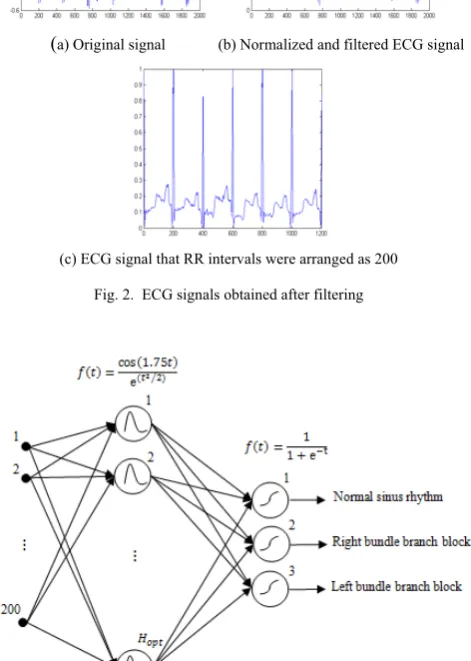
In this study, we filtered ECG signals using 28 Hz low-pass filter and 0.09 Hz high-low-pass filter. After filtering, QRS detection was realized on ECG signals. The obtained R points by QRS detection were used to extract RR intervals from ECG signals. Each one of the RR intervals means a pattern for classifier. QRS detection was performed using a well-known algorithm in literature developed by Menard et.al. Then, each RR interval was arranged as 200 samples by resampling because number of network’s input is fixed that is not different for each pattern, and each resampled RR interval was normalized between 0 and 1. The obtained signal after filtering and QRS detection, which is normal sinus rhythm, is shown in Fig.2.
C. Classification
After preprocessing phase, training and test set were formed by the extracted RR intervals. The number of patterns in these sets was shown in Table I. 991 patterns were used for training and 240 patterns were used to test the trained classifier. Both training and test sets contains three different ECG beat types.
In this study, wavelet neural network was adopted to ECG signal classification, especially classification of bundle branch blocks. Two different wavelet functions in hidden layer were utilized to obtain better performance with neural network. In the implemented wavelet neural network, Morlet and Mexican Hat wavelet functions were used for
comparison. In Fig. 3, a block diagram of the wavelet neural network is shown.
(a) Original signal (b) Normalized and filtered ECG signal
[image:3.595.314.541.126.335.2](c) ECG signal that RR intervals were arranged as 200
[image:3.595.309.545.204.535.2]Fig. 2. ECG signals obtained after filtering
Fig. 3. Block diagram of the implemented wavelet neural network (In Fig.3, Morlet wavelet function was used)
However the optimum learning rate was found as 0.07 in same way.
10 20 30 40 50 60 70 80 90 100
0 2 4 6 8 10 12
Number of hidden nodes
E
rro
r (
%
)
[image:4.595.73.271.132.269.2]Training error for WNN constructed using Mexican hat Test error for WNN constructed using Mexican hat Test error for WNN constructed using Morlet Training error for WNN constructed using Morlet
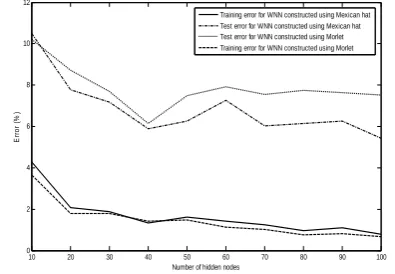
Fig. 4. Variation of training and test errors according to number of hidden nodes
Training errors were found as 0.58% and 0.47% for WNNs constructed using Morlet and Mexican hat wavelet functions, respectively. Test error was reached to 3.41% in WNN with Morlet wavelet function, when reaching to 3.58% test error in WNN with Mexican hat wavelet function. Training and test errors were computing in respect of (10).
(10)
where is desired output and is actual outputs of network. is number of ECG beat type, n is number of patterns in training or test sets.
The confusion matrix was presented in Table II according to results obtained by networks in which used two wavelet activation functions and conventional neural network for comparison.
TABLEII CONFUSION MATRIX FOR WNN
Morlet Mexican hat NN
N RBBB LBBB N RBBB LBBB N RBBB LBBB
N 100 0 0 100 0 0 100 0 0
RBBB 0 95 5 0 98 2 0 96 4
LBBB 0 0 40 0 0 40 0 1 39
According to test error values, the accuracy rates for WNNs built with Morlet and Mexican hat wavelet functions were calculated as 96.4% and 96.6%, respectively. But, as shown in Table II, network formed by Mexican hat wavelet is a better classifier when compare other networks. The classification results of the other presented network formed by Morlet wavelet is bad than conventional neural network.
IV. CONCLUSION
Researches represented that the most of human deaths in the world are due to heart diseases. The heart attacks loom large in heart diseases. Some bundle branch blocks include an important sign underlying heart attack or dangerous cardiac diseases. So, classification of bundle branch blocks, in other words, ECG signal classification is the most important for early diagnosis and treatment of cardiac diseases. The many studies in last decade exist about ECG signal classification. These studies consist of automatic classification system implemented by expert systems.
Due to reasons mentioned above, we proposed a wavelet neural network model to make neural network more efficient. The proposed WNN was implemented by using wavelet functions as hidden layer activation function. For comparison, structures built by two different wavelet functions (Morlet and Mexican hat) were adopted to classification of bundle branch blocks. Prepared training and test sets contained the three ECG beat type and it was investigated that whether structures could separate ECG beat types from each other. The results of experimental studies showed that usage of Mexican hat wavelet functions in hidden layer node given better accuracy rate in classification. The right classification rate is obtained as 97.9% and 99.2% in networks where used Morlet and Mexican hat wavelet functions, respectively. However, the right classification rate of conventional neural network is calculated as 97.9% using values in Table II.
The performance comparison of this study with [3] and [6] is shown in Table4. We hope that the performance of the method will be better, if the number of beats is increased for the training.
TABLEIII
COMPARISONOFTHISSTUDYWITHLITERATURE
Study Method
The number of ECG
signal class Accuracy(%)
[6] Neural network and ICA 5 98.7
[3] Probabilistic neural network and wavelet transform
6 99.65
This study Wavelet neural network 3 99.2
REFERENCES
[1] B. Karlık, Y.G. Sahin, T. Ercan, T. Tavlı, “Bundle branch blocks diagnosis using neural networks for telecardiology”, in Ukrainian Journal of Telemedicine and Medical Telematics, vol.4, no.1, 2006. [2] CN. Nowak, G. Fischer, L. Wieser, B.Tilg, HU. Strohmenger,
“Frequency spectrum of the intracardiac and body surface ECG during ventricular fibrillation-a computer model study”, Computers in Cardiology, vol.33, p.405-408, 2006.
[3] S.-N. Yu, Y.-H. Chen, “Electrocardiogram beat classification based on wavelet transformation and probabilistic neural network”, Pattern Recognition Letters, vol.28, p.1142-1150, 2007.
[4] S.-N. Yu, K.T. Chou, “Combining independent component analysis and back-propagation neural network for ECG beat classification”, Proceeding of the 28th IEEE EMS Annual International Conference,
[image:4.595.310.537.482.574.2][5] Y.P. Meau, F. Ibrahim, S.A.L. Naroinasamy, R.Omar, “Intelligent classification of electrocardiogram (ECG) signal using extended Kalman Filter (EKF) based neuro fuzzy system,” Elsevier Science Computer Methods and Programs in Biomedicine, vol.82, 157-168, 2006.
[6] S. N. Yu, K.T.Chou, “Integration of Independent Component Analysis and Neural Networks for ECG Beat Classification,” Elsevier Science Expert Systems with Applications, vol.34, Issue 4, p.610-617, July, 2008.
[7] R. Ceylan, Y. Özbay, B. Karlık, 2009, “A novel approach for classification of ECG arrhythmias: Type-2 fuzzy clustering neural network”, Expert Systems with Application, vol.36, 6721-6726. [8] I. Jouny, P. Hamilton, “Adaptive wavelet representation and
classification of ECG signals”, Engineering in Medicine and Biology Society, vol.2, p.1310-1311, 1994.
[9] S. Osowski, T. Markiewicz, L. T. Hoai, “Recognition and classification system of arrhythmia using ensemble of neural networks,” Elsevier Science Measurement, vol.41, Issue 6, p.610-617, July, 2008.
[10] H.G. Hosseini, D. Luo, K.J. Reynolds, “The comparison of different feed forward neural network architectures for ECG signal diagnosis,” Medical Engineering&Physics, 28, 372-378, 2006.
[11] H.Ocak, “Automatic Detection of Epileptic Seizures in EEG using Discrete Wavelet Transform and Approximate Entropy”, Elsevier Science Expert Systems with Applications, vol.36, Issue 2, part 1, 2027-2036, March-2009.
[12] İ. Türkoğlu, A. Arslan, E. İlkay, “An intelligent system for diagnosis of the heart valve diseases with wavelet packet neural networks”, Computers in Biology and Medicine, vol.33, p.319-331, 2003. [13] E. Avci, “An expert system based on wavelet neural
network-Adaptive norm entropy for scale invariant texture classification”, Expert Systems with Applications, vol.32, p.919-926, 2007.
[14]S. Haykin, Neural Networks: A Comprehensive Foundation. New York: Macmillan, 1994.
[15] G.M. Friesen, T.C. Jannett, M.A. Jadallah, S.L. Yates, S.R. Quint, H.T. Nagle, “A comparison of the noise sensitivity of nine QRS detection algorithms,” IEEE Transactions on Biomedical Engineering, vol.37, no.1, 85-98, 1990.
[16] Z. Dokur, T. Ölmez, “ECG beat classification by a novel hybrid neural network”, Computer Methods and Programs in Biomedicine, vol.66, 167-181, 2001.