A Semantic-Supported Knowledge Development
Conception
Eckhard Ammann, Ismael Navas-Delgado, and José F. Aldana-Montes
Abstract-- An approach for knowledge development is described in this paper. Knowledge development in an enterprise is about approaches, methods, techniques and tools, which will support the advancement of individual and organizational knowledge for the purpose of an improvement of businesses. This approach is based on a conception of knowledge, with the introduction of three knowledge dimensions and conversions between knowledge assets. This conception is implemented in the form of a knowledge ontology. Thus, we can take advantage of reasoning and rules processing, provided by a reasoner in combination with a rule engine. Important scenarios for knowledge development in a company are identified and it is shown how these scenarios can be supported by processing the developed rules. For example, knowledge requirements for a new or existing employee can be gained once the appropriate requirements for a planned project are known as well as the learning options in the company.
Index Terms—Knowledge representation, knowledge development, knowledge ontology, rule system, application scenarios.
I. INTRODUCTION
Knowledge development in an enterprise is about approaches, methods, techniques and tools, which will support the advancement of knowledge for the purpose of an improvement of businesses. This notion includes as well individual knowledge as group and organizational knowledge. It can be seen as integral part of knowledge management; see [1], [2] and [3] for a description of several existing approaches for knowledge management. One specific approach for enterprise knowledge development is EKD (Enterprise Knowledge Development), which aims at articulating, modeling and reasoning about knowledge, which supports the process of analyzing, planning, designing, and changing your business; see [4] and [5] for a description of EKD. EKD does not provide a conceptual description of knowledge and knowledge development. In this paper, we present a new conception of knowledge and knowledge development and describe an implementation of this conception based on a knowledge ontology, reasoning support and a rule system.
Manuscript received February 26, 2011. This work was supported in parts by TIN2008-04844 (Spanish Ministry of Education and Science).
Eckhard M. Ammann is with the Department of Business Informatics, School of Informatics, University of Reutlingen, Germany (phone: 0049-7121-2714026, fax: 0049-7121-2714032, e-mail: [email protected]).
Ismael Navas-Delgado and José F. Aldana-Montes are with the E.T.S.I. Informática, Computer Languages and Computer Science Department, University of Málaga, Spain (e-mail: {ismael, jfam}@lcc.uma.es).
For the conception part, there exists one well-known approach by Nonaka/Takeuchi [6], which is built on the distinction between tacit and explicit knowledge and on four knowledge conversions between the knowledge types (SECI-model). However, is explicit knowledge still bound to the human being, or already detached from him? Also the linear spiral model of knowledge development is limiting.
An approach for knowledge access and development in firms is given by Boisot [7]. Here, development scenarios of knowledge in the Information Space are provided.
Our conception of knowledge is represented by a three-dimensional model of knowledge with types, kinds and qualities. General knowledge conversions between the various knowledge variants are introduced as a model for knowledge dynamics in the enterprise. First a basic set of such conversions is defined. Building on this set, general knowledge conversions can be defined, which reflect knowledge transfers and development and do not suffer from the restrictions of the SECI-model.
Semantic support for knowledge development is provided with the help of a knowledge ontology and reasoning support in combination with a rule system. The knowledge ontology has been developed in the web ontology language OWL [8]. The reasoning support in combination with a rule system allows for a formal treatment of important knowledge development scenarios.
Application scenarios for knowledge development are classified and described in this paper. They can be represented by general knowledge conversions, which are subject to rule processing. A set of corresponding rules for addressing these scenarios and their representations has been developed and is described in this paper. Therefore, possible solutions for those scenarios can be gained.
The structure of the paper is as follows. After an introduction, section II will introduce the conceptions of knowledge and of knowledge dynamics, the latter one represented and modeled with basic and general knowledge conversions. Section III presents the semantic support for knowledge development in the form of a knowledge ontology and a corresponding rules system, while section IV discusses application scenarios for knowledge development together with the application of suitable rules. Finally, section V summarizes and concludes the paper.
II. A CONCEPTIONOF KNOWLEDGEAND
KNOWLEDGE DYNAMICS
A. Knowledge Conception
We provide a conception of knowledge with types, kinds and qualities. As our base notion, knowledge is understood as justified true belief (in the propositional kind), which is (normally) bound to the human being, with a dimension of purpose and intent, identifying patterns in its validity scope, brought to bear in action and with a generative capability of new information, see [3] and [9]. It is a perspective of “knowledge-in-use” [10] because of the importance for its utilization in companies and for knowledge management. In contrast, information is understood as data in relation with a semantic dimension, but without the pragmatic and pattern-oriented dimension, which characterizes knowledge.
1) Type Dimension of Knowledge
The type dimension is the most important for knowledge management in a company. It categorizes knowledge according to its presence and availability. Is it only available for the owning human being, or can it be communicated, applied or transferred to the outside, or is it externally available in the company’s organizational memory? It is crucial for the purposes of the company, and hence a main goal of knowledge management activities, to make as much as possible knowledge available, i.e. let it be converted from internal to more external types.
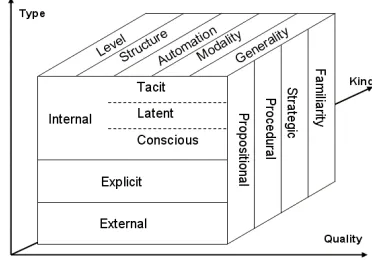
[image:2.595.50.289.543.691.2]Our conception for the type dimension of knowledge follows a distinction between the internal and external knowledge types, seen from the perspective of the human being. As third and intermediary type, explicit knowledge is seen as an interface for human interaction and for the purpose of knowledge externalization, the latter one ending up in external knowledge. Internal (or implicit) knowledge is bound to the human being. It is all that, what a person has “in its brain” due to experience, history, activities and learning. Explicit knowledge is “made explicit” to the outside world, e.g., through spoken language, but is still bound to the human being. External knowledge finally is detached from the human being and may be kept in appropriate storage media as part of the organizational memory. Fig. 1 depicts the different knowledge types.
Fig. 1. Conception of knowledge types
Internal knowledge can be further divided into tacit, latent and conscious knowledge, where those subtypes do partly overlap with each other; see [9]. Conscious knowledge is conscious and intentional, is cognitively available and may be made explicit easily. Latent
knowledge has been typically learning as a by-product and is not available consciously. It may be made explicit, for example in situations, which are similar to the original learning situation, however. Tacit knowledge is built up through experiences and (cultural) socialization situations, is specific in its context and based on intuition and perception.
2) Kind Dimension of Knowledge
In the second dimension of knowledge, four kinds of knowledge are distinguished: propositional, procedural and strategic knowledge, and familiarity. It resembles to a certain degree the type dimension as described in [10]. Propositional knowledge is knowledge about content, facts in a domain, semantic interrelationship and theories. Experience, practical knowledge and the knowledge on “how-to-do” constitute procedural knowledge. Strategic knowledge is meta-cognitive knowledge on optimal strategies for structuring a problem-solving approach. Finally, familiarity is acquaintance with certain situations and environments; it also resembles aspects of situational knowledge, i.e. knowledge about situations, which typically appear in particular domains.
3) Quality Dimension of Knowledge
The quality dimension introduces five characteristics of knowledge with an appropriate qualifying and is independent of the kind dimension; see [10]. The level characteristics aims at overview vs. deep knowledge, structure distinguishes isolated from structured knowledge.
The automation characteristic of knowledge can be step-by-step-doing by a beginner in a domain of work or automated fast acting by an expert.
Modality as the fourth quality of knowledge asks for the representation of it, be it words versus pictures in situational knowledge kinds, or propositions versus pictures in procedural knowledge kinds. Finally, generality differentiates general versus domain-specific knowledge. Knowledge qualities apply to each knowledge asset.
4) The Knowledge Cube
Bringing all three dimensions of knowledge together, we gain an overall picture of our knowledge conception. It can be represented by the knowledge cube as shown in Fig. 2.
Fig. 2. The knowledge cube
[image:2.595.339.525.584.720.2]sub-types), while in the quality dimension each of the given five characteristics are always present for each knowledge asset.
B. Knowledge Dynamics
Here we give a conception of knowledge conversions. The transitions between the different knowledge types, kind and qualities are responsible to a high degree for knowledge development in an organization. These general knowledge conversions are the building blocks to model knowledge dynamics, i.e., all of acquisition, conversion, transfer, development and usage of knowledge, in an enterprise.
Most important for knowledge management purposes are conversions between the knowledge types, especially those making individual and internal knowledge of employees usable for a company. The explicitation and externalization conversions described in this section achieve this. Implicitly, socializations between tacit knowledge of different people also contribute to this goal.
1) Basic Knowledge Conversions
Five basic knowledge conversions in the type dimension are distinguished here: socialization, explicitation, externalization, internalization and combination. Basic conversion means, that exactly one source knowledge asset is converted into exactly one destination knowledge asset and exactly one knowledge dimension (i.e. the type dimension in this case) is changed. More complex conversions may be easily gained by building on this set as described in the next sub-section. They will consist of n-to-m-conversions and include information assets in addition.
Socialization converts tacit knowledge of a person into tacit knowledge of another person. This may succeed by exchange of experience or in a learning-by-doing situation. Explicitation is the internal process of a person, to make internal knowledge of the latent or conscious type explicit, e.g. by articulation and formulation (in the conscious case) or by using metaphors, analogies and models (in the latent case). Externalization converts from explicit knowledge to external knowledge or information and leads to detached knowledge as seen from the perspective of the human being, which can be kept in organizational memory systems. Internalization converts either external or explicit knowledge into internal knowledge of the conscious or
Fig. 3. Knowledge conversions in the type dimension
latent types. It leads to an integration of experiences and competences in your own mental model. Finally, combination combines existing explicit or external knowledge in new forms. Basic knowledge conversions in the type dimension are shown in Fig. 3.
Basic knowledge conversions in the kind dimension of knowledge do not occur. Those in the quality dimension are mostly knowledge developments aiming at quality improvement. Examples are basic conversions changing the overview, structure and automation quality, respectively.
2) General Knowledge Conversions
Our conception allows the generalization of the basic five knowledge conversions described above. General knowledge conversions are modeled converting several source assets (possibly of different types, kinds and quality) to several destination assets (also possibly different in their knowledge dimensions). In addition, information assets are considered as possible contributing or generated parts of general knowledge conversions.
For example, in a supervised learning-by-doing situation seen as a complex knowledge conversion, a new employee may extend his tacit and conscious knowledge by working on and extending external knowledge in a general conversion, being assisted by the tacit and conscious knowledge of an experienced colleague. As a result of the conversion we have extended internal knowledge of the new employee and extended external knowledge.
III. SEMANTIC SUPPORT FOR KNOWLEDGE
DEVELOPMENT
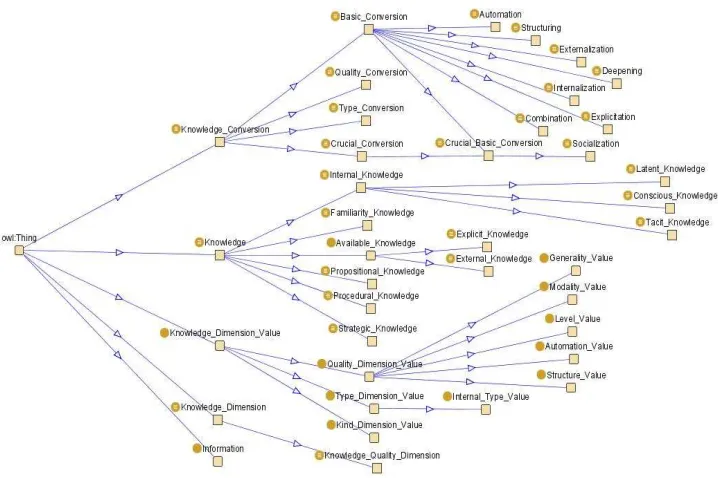
In this section we present the Knowledge Ontology, which implements the conception of knowledge and knowledge dynamics as described in section II. The knowledge ontology has been developed in the web ontology language OWL [8]. As one main goal the ontology will enable the discovery of the crucial knowledge conversions for a company. The ontology (as visually shown in Fig. 4) is divided in four core concepts: Knowledge, Information, Knowledge_Conversion and Knowledge_Dimension. The three different knowledge dimensions are represented as: Type_Dimension, Kind_Dimension and Quality-Dimension. Knowledge is defined according to these dimensions. Properties are used to model the relationships between Knowledge and Dimensions: hasType, hasKind and hasQuality. For example, Explicit_Knowledge is defined as every piece of knowledge, which is related to the instance Explicit_Type via the hasType property. In the same way, Knowledge in general must be related to every quality sub-dimension through the hasQuality property.
In the case of the type dimension of knowledge, we have defined disjoint axioms in order to make explicit the fact that a piece of knowledge cannot be simultaneously external and internal - except in the case of Latent, Conscious and Tacit Knowledge, which can actually overlap (compare with Fig. 1). There are also disjoint axioms for the kind dimension, since a propositional piece of knowledge cannot be Procedural, neither Strategic nor Familiarity.
Two properties have been defined to model the knowledge conversions: hasSource and hasDestination, with knowledge conversions as ranges, and pieces of knowledge and information as domains.
[image:3.595.51.288.567.696.2][image:4.595.116.475.61.300.2]
Fig. 4. Knowledge ontology hierarchy
the sense that they have only one source and only one destination. Eight basic conversions (five in the type dimension, three in the quality dimension) are defined in the ontology. The concept Crucial_Conversion gathers those conversions that contribute to the goal of making the knowledge available for the company.
A. Restrictions and Reasoning
Basic reasoning is based on subsumption mechanisms that deal with the ontology hierarchy. However, ontologies can contain more complex elements to enable advanced reasoning. In this way, the Knowledge Ontology has been extended with OWL restrictions to enable new ways of generating interesting new knowledge.
Here we will only describe some of the most interesting restrictions. Let us imagine that we have two pieces of knowledge in our company: knowledge1 and knowledge2. Both pieces of knowledge have as type Explicit (is related to the instance of Type_Dimension_Value called Explicit through the property hasTypeValue). Additionally we have defined Explicit_Knowledge as follows:
Available_Knowledge AND ∃hasTypeValue has Explicit
Thus, a reasoner will identify both pieces of knowledge as Explicit_Knowledge (and using subsumption also as Available_Knowledge).
We can consider two different conversions conversion1 and conversion2: one that converts knowledge1 in knowledge2 and vice versa. Then, we have defined a Crucial_Conversion as:
Knowledge_Conversion AND
∃hasDestination some Available_Knowledge
Thus, we can infer that conversion1 is a Crucial_Conversion for the company.
B. Rules
Ontology restrictions allow us to infer new characteristics of a given concept or instance. However, in some cases we could require to generate new instances in the ontology depending on certain situations. In this case we have used rules, so the knowledge ontology will be able to infer all the possible conversions given some pieces of knowledge. First, the rule engine will create basic conversions with all the possible source-destination pairs, and then, the same engine will characterize these conversions, inferring the changing dimension for each case.
SWRL [11] rules have been defined and the Jess rule engine [12] has been used for testing purposes. The main rule for our model is the one that creates new conversions for the knowledge assets that we have stored in our ontology:
Knowledge(?k1) ^ Knowledge(?k2) ^
hasDimensionValue(?k1, ?v1) ^ hasDimensionValue(?k2, ?v2) ^ differentFrom(?k1, ?k2) ^ differentFrom(?v1, ?v2) ^
swrlx:makeOWLThing(?c, ?k1, ?k2) →
Knowledge_Conversion(?c) ^ hasSource(?c, ?k1) ^
hasDestination(?c, ?k2)
Thus, this rule is activated when we have two different pieces of knowledge with different dimensions values. In this case, a new instance is created for providing a new knowledge conversion between both pieces of knowledge.
Then, we have six rules to infer the changing dimensions of each of the new discovered conversions: one for the type dimension and five for the quality ones. For example, the rule for the type dimension is as follows:
Knowledge(?k1) ^ Knowledge(?k2) ^ hasTypeValue(?k1, ?v1) ^ hasTypeValue(?k2, ?v2) ^ differentFrom(?v1, ?v2) ^ Knowledge_Conversion(?c1) ^ hasSource(?c, ?k1) ^
hasDestination(?c, ?k2) →
hasChangingDimension(?c,
Knowledge_Type_Dimension)
Suppose that we have two pieces of knowledge in our company (knowledge1 and knowledge2), which are related through the hasTypeValue property to Explicit and External, respectively. Both are related to the values Familiar and Step by step. Using the defined rules, new instances are produced. Thus, the rule engine has inferred two conversions, one for “knowledge1 → knowledge2”, and another for “knowledge2 → knowledge1”. Then, the reasoner can infer additional facts:
• About the pieces of knowledge:
- They are both Familiar_Knowledge.
- One of them is External_Knowledge, the other is Explicit_Knowledge.
- Both are Available_Knowledge.
• About the conversions:
- They are both Basic_Conversion.
- Both are Crucial_Knowledge (since they have Available_Knowledge as destination). - Both are Type Conversions (since they change the type dimension).
IV. APPLICATION SCENARIOS
Application scenarios for knowledge development in a company can be related with our model of knowledge dynamics. Two categories of scenarios exist. The first one is constructive and builds knowledge development chains (see [2] for a modeling approach). Here we focus on the second scenario category, which consists of analytic scenarios. They can be represented by general knowledge conversions and are subject to rule processing as described in section III. In these scenarios we face gaps in knowledge dynamics chains as provided by knowledge conversions. These gaps will be closed by applying appropriate rules to the relevant instances of knowledge assets and conversions, which have been instantiated in our knowledge ontology.
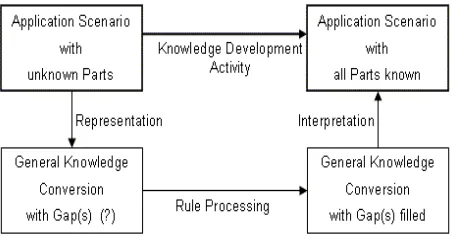
Fig. 5 explains our approach. The bold arrow in the first line indicates the knowledge development activity, which is needed in order to resolve an application scenario with unknown part. Our approach first represents the application scenario as a general knowledge conversion, applies an appropriate rule of our rule system to it, and finally interprets the completed knowledge conversion as solved application scenario.
[image:5.595.314.540.52.170.2]For example, the knowledge requirements for a project are known as well as the learning options in the company. From that, one would try to identify minimal knowledge requirements for a new employee, who should work in the project and should be able to fulfill the requirements at least after some learning efforts. Our representation of this
Fig. 5. Support of knowledge development scenarios
scenario is, that we know the result of a knowledge conversion as well as the conversion itself, but we do not know the source knowledge asset. A rule application should deliver the missing knowledge asset.
A. Analytic Application Scenarios and their Representation
Analytic application scenarios for knowledge development are characterized by gaps in the corresponding knowledge dynamics chains. Without restriction of generality, we focus on simple scenarios, which can be represented by a single general knowledge conversion. More complex scenarios should be composed of simple ones.
[image:5.595.311.545.472.615.2]A representation as a general knowledge conversion leads to a set of eight possible scenarios. In the conversion definition with sources, conversion and destinations we can apply zero or more question marks, i.e. gaps of unknown parts, to the conversion. Out of the eight possible scenarios, we do not further consider two of them. The case with no gap is a constructive scenario really, while the case without any known part is not a realistic one. The other six scenarios are outlined in the following and shown in Fig. 6.
Fig. 6. Application scenarios and representations
applying these options (Scenario 3). If no such options exist, the question of the scenario would be, which knowledge development activitiesshould be initiated and to which possible result in extended and new knowledge this could lead (Scenario 4). Finally, Scenario 6 assumes existing knowledge development options in the company, but incomplete sources and destinations parts. If only very few out of the sets of sources or destinations are unknown, this scenario can be partly handled with our approach also. Otherwise, especially in the case of completely exclusively unknown sources and destinations, no further treatment is possible.
B. Rules Application to Representations of Scenarios
As described in Section III, a rule system has been developed, which is applied to instances of knowledge and conversions introduced in the knowledge ontology.
Only rules for basic knowledge conversions in the type dimension with only one gap exist until now. We therefore are restricted currently to the corresponding 1-to-1 cases of scenarios 1, 3 and 5 as described before in Fig. 6. A rule for Scenario 5 case has been given in section III. For each of Scenarios 1 and 3, there exist five such 1-to-1 cases, because the known conversion part must be one of the five basic knowledge conversions in the type dimension. Here we analyze two cases and provide appropriate rules.
1) Scenario: Source Socialization ?
The following rule produces a new destination Tacit_Knowledge:
Knowledge(?k1) ^ Socialization(?s) ^ hasSource(?s, ?k1) ^
swrlx:makeOWLThing(?k2, ?k1) →
Tacit_Knowledge(?k2) ^ hasDestination(?s, ?k2)
2) Scenario: Source Explicitation ? The following rule produces a new destination Explicit_Knowledge:
Knowledge(?k1) ^ Explicitation(?e) ^ hasSource(?e, ?k1) ^
swrlx:makeOWLThing(?k2, ?k1) →
Explicit_Knowledge(?k2) ^ hasDestination(?e, ?k2)
3) Scenario: ? Combination Destination
The following rule produces a new source Available_Knowledge, it cannot decide on a specific type of Explicit_Knowledge or External_Knowledge:
Knowledge(?k2) ^ Combination(?c) ^ hasDestination(?c, ?k2) ^ swrlx:makeOWLThing(?k1, ?k2) →
Available_Knowledge(?k1) ^ hasSource(?c, ?k1)
V. SUMMARY AND OUTLOOK
A conception of knowledge development in an enterprise has been given. It is based on a concept of knowledge and knowledge dynamics. In order to implement this conception, a knowledge ontology has been built and described in this paper, together with reasoning support and in combination with a rule engine. This has opened the path, to solve open questions in application scenarios for knowledge development. With the help of representations, these scenarios can be mapped to general knowledge conversions, which are subject to rule processing in relation to the knowledge ontology. A final interpretation steps leads back to the solved scenario.
Until now only simple application scenarios and their representations are covered by the set of developed rules. In more complex scenarios, possible solutions are no longer unique. With the help of heuristics, which have to be developed, good or acceptable solutions may be identified.
REFERENCES
[1] Ammann, E.: A Meta-Model for Knowledge Management, In: 5th Int. Conf. on Intellectual Capital and Knowledge Management (ICICKM), New York 2008, pp 37-44. [2] Ammann, E.: The Knowledge Cube and Knowledge
Conversions, In: World Congress of Engineering, International Conference on Data Mining and Knowledge Engineering (ICDMKE), London, UK 2009, pp.319-324.
[3] Lehner, F.) Wissensmanagement (in German), 3rd ed., Hanser, München 2010.
[4] Bubenko, J.A., Jr., Brash, D., and Stirna, J.: EKD User Guide, Dept. of Computer and System Science, KTH and Stockholm University, Elektrum 212, S-16440, Sweden.
[5] EKD – Enterprise Knowledge Development,
ekd.dsv.su.se/home.html. Last access: August 16, 2010. [6] Nonaka, I. and Takeuchi, H. The Knowledge-Creating Company – How Japanese Companies Foster Creativity and Innovation for Competitive Advantage, Oxford University Press, London 1995.
[7] Boisot, M.H. “Knowledge Assets”, Oxford University Press, 1999.
[8] OWL Web Ontology Language Reference, http://www.w3.org/standards/history/owl-ref. Last access: August 16, 2010.
[9] Hasler Rumois, U. Studienbuch Wissensmanagement (in German), UTB orell fuessli, Zürich 2007.
[10] De Jong, T., Fergusson-Hessler, M.G.M. “Types and Qualities of Knowledge”, Educational Psychologist, 31(2), 1996, pp.105-113.
[11] SWRL: A Semantic Web Rule Language Combining OWL and RuleML, http://www.w3.org/Submission/SWRL/ . [12] Jess Rule Engine, http://www.jessrules.com.