A Phrase-Structured Grammatical Framework
for Transportable Natural Language Processing I
Bruce W . Ballard
A T & T Bell Laboratories
600 Mountain Avenue
Murray Hill, N.J. 07974
N a n c y L. T i n k h a m
Department of Computer Science
Duke University
Durham, N.C. 27706
We present methods of dealing with the syntactic problems that arise in the construction of natural language processors that seek to allow users, as opposed to computational linguists, to customize an interface to operate with a new domain of data. In particular, we describe a grammatical formalism, based on augmented phrase-structure rules, which allows a parser to perform many important domain-specific disambiguations by reference to a pre-defined grammar and a collection of auxiliary files produced during an initial knowledge acquisition session with the user. We illustrate the workings of this formalism with examples from the grammar developed for our Layered Domain Class (LDC) system, though similarly motivated systems ought also to benefit from our formalisms. In addition to showing the theoretical advantage of providing many of the fine-tuning capabilities of so-called seman- tic grammars within the context of a domain-independent grammar, we demonstrate several practical benefits to our approach. The results of three experiments with our grammar and parser are also given.
1. Introduction
As a result of advances in natural language processing, programs that provide practical English-language capabil- ities have begun to rival more conventional means of computer interactions for certain purposes, including data- base retrieval, online help facilities, and limited forms of office assistance. Although several prototype systems have provided customization facilities that allow users to specify synonyms, syntactic paraphrases, and the like, traditional approaches have resulted in systems wedded to a single domain of data. That is, users are unable to access novel types of data without acquiring ~ new or modified process- or specifically tailored to the new domain by the system designer(s). Not surprisingly, an important trend in
natural language system design is in allowing users them- selves to adapt an existing processor for a new domain. Accordingly, prototype systems that permit user customi- zations or rapid customizations by a designer have included REL, POL and ASK (Thompson and Thompson 1975, 1981, 1983), CONSUL (Mark 1981; Wilczynski 1981), IRUS (Bates and Bobrow 1983), KLAUS (Haas and Hendrix 1980), TEAM (Hendrix and Lewis 1981; Grosz 1983), a system developed at Bell Labs (Ginsparg 1983), and our own LDC system (Ballard 1982, 1984; Ballard and
1
This research was supported in part by the National Science Founda- tion under Grant N u m b e r s MCS-81-16607 and IST-83-01994 and in part by the Air Force Office of Scientific Research under Grant N u m b e r 81-0221.
Copyright 1984 by t~'z Association for Computational Linguistics. Permission to copy without fee all or part of this material is granted provided that the copies are not madc for direct commercial advantage and the C L reference and this copyright notice are included on the first page. To copy otherwise, or to republish, requires a fee a n d / o r spccific permission.
0362-613X/84/020081-16503.00
Bruce W. Ballard and Nancy L. Tinkham A Phrase-Structured Grammatical Framework for Transportable NLP
Lusth 1983, 1984; Ballard, Lusth and Tinkham 1984a, 1984b). Since the successful construction of a transport- able system requires sound methods of representing what is to be learned, the design of formalisms to be used in trans- portable natural language processors relates to the scien- tific, as well as the engineering, aspects of computational linguistics.
In this paper we present methods of dealing with the syntactic problems that have arisen in the construction of our LDC system. In particular, we shall describe a gram- matical formalism, based on augmented phrase-structure rules, which allows a parser to make domain-specific deci- sions by referring to a dictionary and other auxiliary files produced during an initial learning session with the user. We illustrate the workings of our grammatical formalism with examples from the existing LDC g r a m m a r , but we note that similarly motivated systems ought also to benefit from our formalisms. We will also include the results of some experiments with our existing g r a m m a r as applied to several domains.
In addition to showing the theoretical advantage of being able to provide many of the fine-tuning capabilities of so-called semantic grammars within the context of a domain-independent g r a m m a r , we demonstrate several practical benefits to our approach. For example, the conciseness of our formalism allows shorter g r a m m a r s than many previous formalisms would allow, at least for the intended class of retrieval applications. This offers not only added perspicuity but other benefits as well. For instance, we have been able to write simple (almost trivial) LISP routines that pre-process a g r a m m a r to construct the files used by the parser to increase efficiency and to perform valuable disambiguations.
2. O v e r v i e w o f S y n t a c t i c P r o c e s s i n g
The primary purpose of this paper is to introduce a gram- matical formalism that we have developed for use in speci- fying g r a m m a r s for a transportable natural language processor. As suggested by the term " f r a m e w o r k " in the title of the paper, however, we will touch upon certain related concepts in order to give a complete account of the language constructs that can be dealt with by our formal- ism. In total, then, we shall discuss
1. a phrase-structured grammatical formalism;
2. a required dictionary format and associated compatibil- ity file; and
3. an implied format for parse structures.
We begin with a brief indication of the ways in which these topics tie together in our existing and in other conceivable systems.
2.1 T h e p h r a s e - s t r u c t u r e g r a m m a r
The format we have developed to represent our g r a m m a r s is intended to capture the spirit of phrase-structure specifi-
cations such as the following, which specifies simple noun phrases.
the (Ord / Super) ( N u m ) (Super) Adj* N o u n = H e a d PP*
Parentheses denote optionality, * denotes the Kleene-star, and / denotes alternation. To distinguish between termi- nal symbols, parts-of-speech, and multiple-word g r a m m a t - ical categories, we have used the convention of no caps, initial cap, and all caps, respectively.
In deciding on a precise, internal representation for grammars, we decided to adopt a LISP-like prefix nota- tion. Thus, the actual specification of the expression shown above, assuming it intends to capture the structures of descriptive noun phrases (say, "NPdesrip"), is as follows. Note that we have included a context-sensitive augmentation, of a form to be discussed later, for the second Super.
(setq NPdescrip '(Seq (Quote the)
(Opt Alt (Get Ord) (Get Super)) (Opt Get N u m )
(Opt Get Super = (need not part Super)) (* Get Adj)
(Get Noun Head) (* Call PP)
))
Each of the seven command types illustrated here is described in detail in Section 3, together with examples of their idiomatic usage. The reader may notice that our grammatical formalism resembles both transition network and phrase-structure g r a m m a r s (Woods 1970, 1980; Heidorn 1975), and our later speaking of g r a m m a r rules as " c o m m a n d s " further reveals an affinity with ATNs. For the reasons given in Section 5.2, however, we prefer to view the grammars as collections of augmented phrase- structure rules, while certain aspects of the current top- down parser act very much like an ATN parser. The reader may also notice that the current utilization of the formalism has resulted in parse structures having the flavor of case grammars, especially the ways in which complex relative clauses and handled. On the other hand, the provision for associating a feature list with each phrase somewhat resembles the systemic structures of Winograd 1972.
2.2 T h e d i c t i o n a r y a n d c o m p a t i b i l i t y f i l e s
Our g r a m m a r rules assume that an input to be parsed will be presented as a sequence of sets of token candidates, where each token candidate corresponds roughly to a word or inflection of a word found in the system dictionary. Each dictionary listing for a word is made up of one or more meanings, where each meaning comprises
(a) the word itself;
(b) its part o f speech;
(c) the associated root word; and
Bruce W . Ballard and Nancy L. Tinkham A Phrase-Structured Grammatical Framework for Transportable NLP
(d)
more possible values. As an example, the entry
(offices Subtype office
1 2 3
says that 1.
zero or more associated features, each with one or
(nt room) (sp plur))
4 5
the word "offices" has been found or is being proposed for the current token candidate;
2. the word refers to some of the domain objects of some object type;
3. the root word is "office";
4. the objects being referred to are of type "room"; and 5. the word is a plural noun.
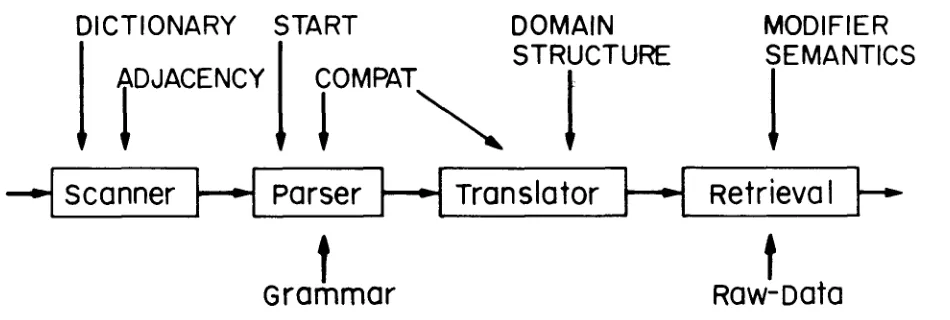
In addition to the "features" found in the dictionary, which provide for simple context dependencies, a compat- ibility file is assumed to be available which contains infor- mation on acceptable attachments for such units as prepositional phrases and relative clauses. An example of how this information can be used, together with a simple example of a possible set of prepositional triples, is found in Section 3.3.3.
2.3 Parse structures
Our g r a m m a r assumes that, during parsing, each non-a- tomic syntactic category will have associated with it a "parse structure" consisting of
(a) the name of the structure;
(b) a list of features giving possible values of various parameters (as illustrated shortly) associated with the phrase; and
(c) a list of labeled items, namely words and pointers to nested phrases.
For example, the parse structure
(NP (feats (nt person) (sp plur)) ( A d j . lousy)
(Head . advisor))
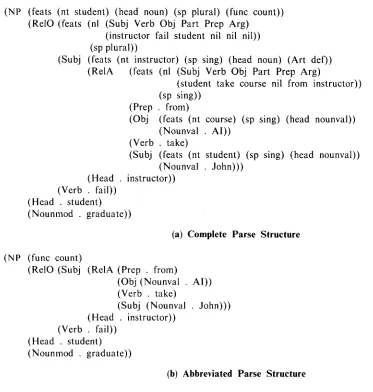
might correspond to the noun phrase "lousy advisors", where the features indicate that the phrase refers to domain objects of nountype (nt) person and is plural (plur), and the items indicate that the head noun is "advisor" and the adjective "lousy" is present. For the sake of completeness, and to help prepare the reader for the discussion that follows, Figure 1 gives both complete and "abbreviated" parse structures (i.e. a skeleton struc- ture without nountype and compatibility information) for the sentence
" H o w many graduate students were failed by the instructor that John took AI f r o m ? "
As shown in Section 6.2.2, our feature lists are reminiscent of the systemic structures given in Winograd (1972). In effect, they constitute a repository of information about words contained within a phrase (possibly nested within it) and allow information to be passed both up and down a
parse tree, thus enabling valuable context-sensitivities, both syntactic and semantic.
3. The Grammatical Formalism
Our grammatical formalism is built around seven types of syntax rules which we will often refer to as " c o m m a n d " types. The first three of these ("basic" commands) are used to specify words, parts of speech, and syntactic cate- gories, while the remaining four ("control" commands) provide facilities lor optionahty, possible repetition, alter- nation, and sequence. In addition to the primary tunction of each of the commands, through which the g r a m m a r writer (i.e. system designer) can specify any context-free g r a m m a r , each of the basic commands may be augmented
with information that enables the g r a m m a r writer to spec- ify certain context-sensitive constraints that (a) enable similar grammatical constructs to be collapsed into what would otherwise be an over-generating unit, and (b) allow the parser to perform useful disambiguations. The latter facility can be especially valuable in a transportable envi- ronment, where the system designer is unable to predict many of the syntactic, word sense, and other forms of ambiguity that will arise.
We now discuss each command type, after which we describe each of the augmentations allowed.
3.1 Basic c o m m a n d s
The three basic g r a m m a r commands are
Quote to specify a given word or set of words;
Get to specify a part of speech; and
Call to specify a syntactic category.
All g r a m m a r " c o m m a n d s " are processed by the parser (a LISP program) and should not be confused with operations in LISP or other programming languages. We will now briefly describe these commands. As described shortly, these commands may contain augmentations to assure proper agreement among syntactic components.
The Quote command instructs the parser to find one of a list of words in the next token slot of the input (i.e. as the next token). For example,
(Quote (a an))
says to pick up the next word if it is " a " or "an", otherwise fail. If the list of words contains just one word, the super- fluous parentheses may be dropped, for instance
(Quote the) = (Quote (the))
The default action of Quote is not to add to the parse structure being built up, but an optional label is provided for. Thus, if the article " a n " is seen by the command
(Quote (a an the) Art)
then the feature (Art . an) will be added to the parse structure. Our current g r a m m a r uses Quote sparingly, partly since few words are known in advance in our trans- portable environment. However, having a Quote facility is
Bruce W. Ballard and Nancy L. Tinkham A Phrase-Structured Grammatical Framework for Transportable NLP
(NP (feats (nt student) (head noun) (sp plural) (func count)) (RelO (feats (hi (Subj Verb Obj Part Prep Arg)
(instructor fail student nil nil nil)) (sp plural))
(Subj (feats (nt instructor) (sp sing) (head noun) (Art def)) (RelA (feats (nl (Subj Verb Obj Part Prep Arg)
(student take course nil from instructor)) (sp sing))
( P r e p . from)
(Obj (feats (nt course) (sp sing) (head nounval)) (Nounval . AI))
( V e r b . take)
(Subj (feats (nt student) (sp sing) (head nounval)) ( N o u n v a l . John)))
( H e a d . instructor)) ( V e r b . fail))
(Head . student) (Nounmod . graduate))
(a) Complete Parse Structure
(NP (func count)
(RelO (Subj (RelA (Prep . from)
(Obj (Nounval . AI)) ( V e r b . take)
(Subj ( N o u n v a l . John))) (Head . instructor))
( V e r b . fail)) (Head . student) (Nounmod . graduate))
[image:4.612.76.449.48.440.2](b) Abbreviated Parse Structure
Figure I. Complete and Abbreviated Parse Structures f o r the Sentence " H o w many graduate students were failed by the instructor that John took A l from.~'
useful in allowing the grammar writer to capture various "noise words" without having to define artificial grammat- ical category names or resort to a proliferation of features. Thus we feel quite comfortable in writing, at the appropri- ate place(s) in a grammar, the command
(Quote (whether if))
The Get command instructs the parser to find a word having one of a list of parts of speech. As with Quote, an abbreviation is permitted if only one part of speech is to be allowed (which is most often the case). Some examples are:
(Get (Ord Super)) (Get Noun)
When a Get command is processed, the word it picks up is incorporated into the current parse structure and labeled appropriately. The default label is the part-of-speech category but an optional second argument to Get may be used to specify any other label name. For instance,
(Get Noun Head)
says to pick up a noun and label it Head. This would be useful if several nouns occur within a given phrase and need to be distinguished. If it is desired to recognize a given part of speech without adding to the parse structure, the label "nil" may be given, thus
(Get Art nil)
would recognize an article without affecting the parse being built up. Finally, if one of several parts of speech is to be allowed, the dummy label " = " may be used to assure the default action. However, this is necessary only in situ- ations where augmentations (as discussed in Section 3.3) are present. For example,
(Get (Vpres Vpast) = (vtype intrans))
would cause the word being recognized to be labeled according to its dictionary specification.
The Call command instructs the parser to process an embedded constituent, such as a noun phrase, preposi- tional phrase, relative clause, and so forth, and so our Call is analogous to the "push" operation of conventional ATNs (Woods 1970). As with the Get command, whatever is
Bruce W . Ballard and Nancy L. Tinkham A Phrase-Structured Grammatical Framework for Transportable NLP
found will be labeled as specified or by default. Thus, the commands
(Call N P Arg)
(Call Relc)
call for a noun phrase (NP) to be labeled Arg and a rela- tive clause (Relc) to be labeled Relc.
Normally, each Call-ed routine, and also the top-level constituent S, will have a separate parse structure associ- ated with it. Thus, when a constituent phrase has been parsed using a Call command, it will be pointed to rather than having its components physically included in the parent phrase. In the LISP implementation, the associated structure is simply buried one additional level and assigned a feature list (to be discussed shortly) of its own. For example, if in recognizing the phrase "big houses" the adjective "big" is parsed directly by the grammar routine for noun phrases, it would be placed into the parse struc- ture as indicated by
(NP ((sp plur) (nt building)) ( H e a d . house) (Adj . big))
where the first set of nested parentheses give the feature list of the noun phrase as discussed in Sections 3.3. and 6.2.2. If on the other hand our grammar identified some potentially larger unit (say, adjective phrase) as a separate syntactic construct, and the word "big" was recognized as a constituent of it, we would have
(NP (feats (sp plur) (nt ...)) (Head . house)
(AdjPh (feats (nt ...)) (Adj . big)))
where the precise "nt" value would be determined by the augmentations present in the Call command.
In some instances, however, either for the sake of perspicuity or to avoid redundancy, it is useful to isolate and name a sequence of commands as a "macro" for which recognized items will be incorporated directly into the parent structure, i.e. the parse structure current when the Call command was encountered. This is handled by giving a label of nil when the macro interpretation is desired. For example, our noun phrase grammar includes the command
(Call Ordnum nil)
where Ordnum looks for ordinals, superlatives, and numbers.
3.2 Control commands
In addition to the three primitive commands just described, we provide commands to specify optionality, possible repetition, alternatives, and sequence.
The Opt command instructs the parser to attempt to process an arbitrary command, but Opt will succeed even if this attempt fails. Some example Opt commands are
(Opt Quote of)
(Opt Get Noun Head)
(Opt Call PP)
In addition to applying Opt to a basic command, as shown here, Opt may be applied to any of the remaining control commands discussed below. Since the scope of Opt, and also of * as discussed next, consists of a single command, we have avoided introducing a superfluous set of parenthe- ses surrounding its argument.
The Star command, or simply *, denotes the Kleene- star and says to perform the embedded command 0 or more times. Some examples are
(* Get Adj)
(* Call Relc)
During parsing, a * command is treated as an Opt that re-invokes itself upon each success.
The Alt command instructs the parser to perform exact- ly one of a set of commands, which it tries in the order they are given. Alt will fail if none of its arguments succeeds. Some examples are
(Alt (Get Noun) (Get Pron))
(Alt (Call PP) (Call Relc))
An interesting and frequent instance arises when one of several constructs is to be optionally recognized. We have found it pragmatically preferable in these instances, both visually and for the sake of efficiency, to code for an Alt of alternatives, and surround this Alt with an Opt, rather than apply Opt to each alternative with an Alt outside. That is, we would normally write
(Opt Alt (Call PP) (Call Relc))
rather than
(Alt (Opt Call PP) (Opt Call Relc))
As a second pragmatic remark related to Alt, we note that the command
(Alt (Get Noun) (Get Pron))
may function differently from
(Get (Noun Pron))
when the next word to be parsed has several parts of speech associated with it. In the former case, the noun reading will be taken if at all possible, while in the latter either a noun or pronoun reading is equally acceptable to the grammar, so the first grammatical category appearing in the scanner output will determine what is selected.
Bruce W. Ballard and Nancy L. Tinkham A Phrase-Structured Grammatical Framework for Transportable NLP
Since the problem of mis-recognitions is especially trouble- some in our projected voice-input environment (Biermann et al. 1983), this distinction can be important.
Finally, the Seq command instructs the parser to perform a list of commands in order. For example,
(Seq (Get Prep) (Call NP))
says to recognize a preposition, then call for a noun phrase. If any member of the list supplied to Seq fails, then the entire Seq command will fail. Before doing so, however, attempts will be made via the backtracking mechanisms of the parser to re-interpret what has already been parsed by previous commands of the Seq. Strictly speaking, Seq is redundant since its effect can be obtained by using a macro with a dummy name. However, we find it conven- ient to be able to code nameless sequences where they are used, somewhat analogous to the use of LAMBDA in LISP, or of BEGIN-END blocks in Algol.
3.3 A u g m e n t a t i o n s
The seven syntax commands described above provide the grammar writer with convenient means of specifying context-free rules for fragments of natural language (in fact, only four of the seven are required in order to do this). However, the inadequacies of a pure context-free formulation of natural language syntax are well recog- nized, and various treatments have been used to overcome them (Bobrow and Webber 1980; Heidorn 1975; Colmer- auer 1978; Kimball 1972; Marcus 1980; Pereira 1981; Pratt 1975; Rieger and Small 1979; Robinson 1982; Sager a n d G r i s h m a n 1975; and Woods 1970, 1980). Within our grammatical formalism, we have provided means of speci- fying several forms of useful "compatibilities" among the elements of a phrase or clause. As the reader may observe, most of our provisions for context-sensitive spec- ifications could in theory be done in a strictly context-free fashion, though not conveniently (e.g. a large and poten- tially exponential increase in the number of parts of speech might be required). A related use of augmentations is to "annotate" the parse structure with information that will be useful in its subsequent semantic processing.
Compatibility checking is done according to augmenta- tions which occur as optional parameters of Quote, Get and Call commands. With a few exceptions, augmenta- tions may be used in any combination. Thus, the general form of the three basic commands, wfiich we described in simplified form in Section 3.1, is
(Quote <literal word(s)> { <label> { < p l > ... <pN> } } )
(Get <part(s) of speech> {<label> { < p l > ... <pN>} })
(Call <routine name> {<label> {<pl> ... <pN>} })
where braces denote optionality and where each parameter (denoted by pi) has one of the forms we now describe.
3.3.1 Feature-value pairs and a not-local marker
The simplest type of augmentation, which applies to any of the three basic commands (i.e., Quote, Get, Call), consists of a feature-value pair that supplies information on, and thus restricts the allowable values for, some "feature" of the current phrase. Since dictionary listings also contain feature-value pairs, and words being incorporated into a phrase must have features compatible with those already in the phrase, a feature-value specification in the grammar may serve to restrict the set of legal words to be processed. That is, the information about a word about to be incorpo- rated creates an inconsistency, thus causing the command being considered to fail. As an example, the command
(Get Noun Head (sp sing))
contains the feature-value augmentation "(sp sing)" which says that the "sp" feature of the current phrase must have the value "sing". In essence, the command calls for a singular noun. The command
(Get Ved Verb (type past part))
gives an example of a feature-value pair that somewhat more liberally requires that the " t y p e " feature of the current phrase be one of two possible values.
Another use of feature-value pairs is to incorporate information into the phrase being processed that will be used to determine the acceptability of subsequent commands, as described in Section 3.3.4. For example, the command
(Opt Quote by nil (byfront))
might be used at the top of a grammar routine for passive relative clauses to indicate that the phrase actually began with the word " b y " as opposed to the word being found elsewhere. Note that, in situations such as this, an isolated feature name without associated values is sufficient and thus allowed by the formalism.
Still another use of feature labels is to annotate the parse structure being built up, as in
(Get (Aux = (func yesno))
Naturally, different uses of feature labels may occur in a single command. For instance, the word " m a n y " in the determining phrase "how many" might be coded as
(Quote many nil (func count) (sp plural))
where the "func" feature is an annotation and the "sp" feature assures that the subsequent head noun will be plural.
In some situations, it may be desirable to ignore feature-value pairs in the dictionary listing for a word and, in this event, a notlocal augmentation may be used. For example, the command
(Get Prep Part notlocal)
might be used to indicate that the features associated with a preposition are to be ignored when the word is being
Bruce W. Ballard and Nancy L. Tinkham A Phrase-Structured Grammatical Framework for Transportable NLP
used as a particle. By allowing an attachment of "notlocal", we avoid some of the need to associate multiple senses with all the words that some command is interested in recoghizing.
3 . 3 . 2 F e a t u r e l a b e l s
The second type of augmentation applies to Call commands and consists of a feature label specification similar to the feature-value pairs discussed above. The effect is to require some feature of the current phrase to agree with some possibly different feature of the child phrase about to be created. That is, the values of the two features are to be shared. If the parent and child phrase are to agree on the same feature label, this label is merely included at the end of the Call command. As an example, we might account for the first part of postnominal compar- ative phrases of the form "(which is) (not) <compar> than", where parentheses denote optionality and "<compar>" denotes a comparative such as "better" or "bigger", by
(Call CompPh Comp nt sp)
which assures that the top-level verb will agree in plurality (sp), and the relative pronoun in nountype (nt), with the head noun to be modified. In the event that every feature of the parent and child phrases should agree, the fictitious label all may be used. For example, our Adj routifie handles adjective and present participle modifiers, and also negated forms of these (e.g. "non failing"), and the latter are processed by a low-level NegAdj routine invoked by
(Call NegAdj neg all)
This allows the scope of the negation to be retained, since the modifier is nested inside a "neg" label to the noun phrase being built up, yet assures that the modifier is compatible with all features in the noun phrase just as though it were to be processed directly.
When parent and child phrases are to agree on different labels, we include an "agree" triple of the form
(agree <parent feature> <child feature>)
As an example, we might wish to associate two separate nountype features with argument-taking nouns like "classmate", one for the type of world object the word itself refers to and one for the type of world object associ- ated with its argument. In this case, the word "classmates" might receive the dictionary listing
(classmates Argnoun classmate
(nt student) (ntarg student) (sp plur))
and we might recognize the phrase "classmates of John" by
(Seq (Get Argnoun Head (head argnoun)) (Quote of)
(Call NP NounArg (agree ntarg nt)))
since at the time the Call command is encountered the parse structure will be
(NP (feats (head argnoun) (ntarg student) (nt student) (sp plur))
(Head . classmate))
3 . 3 . 3 N o n l o c a l f r a m e p a r a m e t e r s
Another form of augmentation associated with Call commands is the nonlocal frame parameter, which is simi- lar to, but more general than, what is available using a feature-value pair. It allows the grammar writer to enforce agreements between or among phrases, and has the form
((agreement type) { <labels> <feature> } )*
where {... }* indicates repetition of "..." 0 or more times. The required compatibility among the indicated constitu- ents is that an appropriate tuple be found in the set of tuples associated with the specified agreement type. Each label-feature pair tells what elements of the tuple have already been found, and which of their features contains the desired compatibility information. As indicated in Section 6.1, compatibility tuples are created during know- ledge acquisition and made available to our parser in parallel with the dictionary listings from the scanner. For example, prepositional compatibilities might be indicated by a set of triples such as
((Head Prep Arg) (book in table) (book on table) (book on chair) (chair on table))
so that the prepositional phrase "in the old table" would be allowed to attach to a phrase whose head noun has the nountype book but not to one having the nountype chair.
As an example, we might use the command
(Call PP PP ((Prepinfo) Head nt))
to require a 3-way agreement among the indicated compo- nent (Head) of the current phrase and remaining compo- nents (Prep and Arg) of the routine (PP) about to be invoked. The " n t " feature tells where in the current phrase and the remaining phrases the values for agreement are to be found. In our current grammar, the preposi- tional phrase (PP) routine locates a single word to fill the Prep slot and finds an NP phrase to fill the Arg slot. Thus, the 3-way compatibility in effect is to be found among
1. the nt feature of the current phrase, 2. the single word filler for the Prep slot, and
3. the nt feature for the phrase that fills the Arg slot.
As a second example of compatibility information, we currently maintain 6-tuples for verb phrases, where each position corresponds to a possible clause element as shown in Section 4.1, so that the tuples
Bruce W. Ballard and Nancy L. Tinkham A Phrase-Structured Grammatical Framework for Transportable NLP
((Subj Verb Obj Prep Arg Part) (student fail course nil nil nil)
(student take course from instructor nil) (student make grade in course nil) (instructor fail student nil nil nil) (instructor cross student nil nil up))
might be used to say that a student may take a course but not an instructor, an instructor may fail a student but not vice versa, an instructor may be said to have crossed up a student, and so forth.
In the implementation of our parser, compatibility information is maintained in only one place and all related structures point to this location. This means that compat- ibility information will be passed both up and down the parse structure under construction to aid in disambigua- tion and subsequent interpretation.
In the event that one or more of the clause elements associated with a nonlocal frame parameter is to be considered optional, a nonlocal frame parameter may be accompanied by an opt parameter to this effect, so that
(Call Passive Relc (Relinfo) Obj nt) (opt Subj))
calls for a passive relative clause in which the object (Obj) has been relativized and in which the subject (Subj) may be omitted, as in "the book given to Paul". As an example of when more than one element of a compatibility tuple will already have been found when tuple agreement is requested, suppose we wish to handle " d e e p " relativiza- tions, as in a "a book Smith wrote the last chapter of". (Although a linguist friend has recently told one of us that this is bad English, it occurs quite often in computational settings and is therefore sensible to inject into a realistic g r a m m a r . ) Here, the triple chapter-of-book is to be checked, so the preposition "of" is preceded by its argu- ment as well as by the noun it modifies. Thus, assuming "nt!" gives the nountype of " S m i t h " that has been passed down by the methods of Section 3.3.2, we might write
Call Prep PP-hole ((Prepinfo) Head nt Arg nt!))
to find a lone preposition with appropriate agreement.
3 . 3 . 4 T h e " n e e d f e a t u r e " p a r a m e t e r
Another form of augmentation, which enables the gram- mar writer to deal with situations where the presence of certain information enables rather than blocks another phrase, involves a need parameter that may occur with any of the three basic commands or, with a related effect, with an Opt command. The effect of this type of augmentation is to allow the associated g r a m m a r command to be used only if one of a specified list of features or items (parts of speech) is already present in the current phrase or, if desired, to enable a command only in the absence of previ- ous features or items. Ordinarily "need" will check for the presence of a feature, but optional "not", " p a r t " , and "tok" flags will cause its behavior to be modified appropri- ately. As an example usage of "need", assume that we
want to account for "ordinal modifiers", i.e. phrases such as "from the right", that may occur as postnominal modi- fiers when a prenominal ordinal has occurred. T h a t is, we wish to allow "second column from the right" yet disallow "columns from the right". This might be accomplished by using the command
(Call Ordmod = (need part Ord))
As a second example, we might use the c o m m a n d
(Get Noun Head (sp plur) (need part Art N u m ) )
to indicate that a plural noun is to be accepted only if either an article (Art) or number ( N u m ) has already appeared in the current phrase as a " p a r t " (of speech).
To check for a token feature, we use "tok". For exam- ple, to treat " m o r e interesting" but not " m o r e good" as a comparative (thus ruling out the anaphoric comparative reading of a sentence such as "we'll have more good things to talk about tomorrow"), we put a " p a r a p " feature in the dictionary listing for paraphrastic adjectives (i.e., those that take " m o r e " as opposed to " - e r " ) and then write
(Get Adj C o m p a r (need tok parap))
As an example of the complementary usage of "need", suppose we wish to allow a post-nominal comparative to occur with its associated " t h a n " phrase only if a pre-nomi- hal comparative has not been found. T h a t is, we want to allow "better student than J a c k " and "students better than J a c k " but not "better students better than Jack". In this situation we might check for a possible post-nominal comparative with the c o m m a n d
(Get Compar = (need not part Compar))
In the event that a c o m m a n d is to be treated as optional in some cases but is required in others, a "need" augmenta- tion may be used along with an Opt c o m m a n d and, in such situations, the c o m m a n d to be considered optional must be given inside parentheses (otherwise the "need" would be associated with the command itself and not with its option- ality). As an example, we might account for elliptical noun phrases such as "the seven" or "the last" via the command
(Opt (Get Noun Head) (need part Ord N u m ) )
which says that a Noun must appear unless the phrase being processed already has an ordinal (Ord) or a number (Num).
3.3.5 T h e " n e x t w o r d s " p a r a m e t e r
Finally, to allow a fixed g r a m m a r to be applicable to domains in which certain unpredicted idiomatic constructions arise, we provide a next p a r a m e t e r that indi- cates that the dictionary word being processed must be literally followed by one or more words. The "next" parameter is available for both Quote and Get commands and, more important, may also be contained within the dictionary listing of a word. As an example, we might
Bruce W . Ballard and Nancy L. Tinkham A Phrase-Structured Grammatical Framework for Transportable NLP
account for the idiom "to pick up on" by including the following as one of the senses for the word "picked"
(picked Ved pick-1 (next up))
and then indicate in the compatibility file that "on" acts as a particle for the verb whose root is "pick-l". To be more extreme, we might have
(kicking Ving kick-2 (next the bucket))
together with an indication that "kick-2" is an intransitive verb, to indicate that the phrase "to kick the bucket" is to be treated idiomatically. The "next" feature might also be used in the grammar as a simplification, allowing us to replace
(Seq (Quote at nil (quant leastmany)) (Quote least)
(Quote as) (Quote many))
with the simpler
(Quote at nil (next least as many) (quant leastmany))
4. Current Utilization of the Grammatical Formal- ism
We have indicated that the phrase-structure grammatical formalism discussed in this paper is being used in the context of LDC, a transportable natmal language process- or. We now describe briefly the nature of the parser and current grammar associated with this system, then give the results of some experiments with the grammar and parser.
4.1 The current LDC g r a m m a r
Most of the present LDC grammar comprises (a) a fairly elaborate noun phrase grammar, and
(b) a case-like specification of sentence-level and fairly complex relative clauses.
For example, we presently provide for relative clauses of many varieties (e.g. "by whom a book was given to Bill" as well as "who gave a book to Bill") having case frames of the form
Subj Verb {Object} {{Prep} Arg} {Particle}
where braces denote optionality. We also provide for many kinds of pre-nominal modifiers, including ordinals, superlatives, adjectives, and noun modifiers. Many forms of comparative phrases are also provided, including ellip- tical ones such as "a longer document than xletter" and "students making a better grade than Bill in CPS152". Our initial grammar was approximately six pages in length and yet, due to the consolidations made possible by our phrase-structure rules, contained almost all syntactic structures available in the original 20-page ATN grammar used by NLC from which it was adopted, and many other structures (notably, more elaborate comparative and rela- tive clause forms). However, this grammar provided for
only noun phrases, albeit complex ones. Our current grammar is eight pages in length and, due to consol- idations made possible by enhancements to the formalism, allows both wh- and yes-no questions, imperatives, passives, deep raisings, several forms of fronting, a few discontinuous constituents, and some exotic modifier types mentioned in Ballard (1984). The syntactic processing of a representative input for LDC was indicated in Figure 1, and information of the scope of the current syntactic and semantic coverage of LDC can be found in Ballard (1984).
As indicated below, some of the first domains that we used to test the modules of LDC were
(a) a final grades domain,
(b) a document preparation domain, and (c) the original matrix domain of NLC.
In the interest of assuring domain independence, only those constructs that arise in two or more of these domains (or others we have tested Prep with) appeared in the initial LDC grammar. This has caused us to temporarily discount certain features, especially (a) low-level syntax for domain-specific noun phrases, such as the optional indefinite article in "a B+" for the final grades domain and floating-point numbers for the matrix domain, and (b) certain unusual or idiomatic verb phrase forms.
4.2 The initial t o - d o w n parser
When designing a syntax processor for a class of formal or natural language grammars, one often begins with a top- down implementation, then uses this system to test and refine the formalism a n d / o r grammar(s) of interest, and only later contemplates a more efficient bottom-up, possi- bly table-driven, implementation. We have followed this practice in designing an initial top-down parser for LDC. Backtracking is used when a command fails because either the wrong type of input word has been encountered or an inconsistency has been created by compatibility informa- tion. Since semantic information is being used for disam- biguation during parsing, our parser returns the first (and only) fully acceptable structure if finds.
Our kernel parser, which deals with the seven command types but ignores augmentations, was designed, coded and tested by one person in fewer than 10 days and occupies less than four pages of lightly commented LISP code. The full repertoire of augmentations, on the other hand, required roughly six man-months of effort to design and implement and occupies about eight additional pages of code. This is partly due to the additions and refinements being made to the formalism as the parser developed. Detailed information on the construction of the initial LDC parser is given in Ballard and Tinkham (1983).
4.3. Experiments w i t h the LDC G r a m m a r and Parser
Having completed the parser and constructed a suitably broad grammar for use in several layered domains, we have begun to experiment with our parser in the manner of Slocum (1981) to see how significantly certain of our
Bruce W. Ballard and Nancy L. Tinkham A Phrase-Structured Grammatical Framework for Transportable NLP
pruning methods can reduce the time complexity of pars- ing. Some of the pruning techniques we have studied are I. the use of a Start file that tells what grammatical cate-
gories may begin each syntax routine,
2. the use of local compatibility checking Section 3.3.1), and
3. the use of non-local compatibility checking (Sections 3.3.2 and 3.3.3).
In addition to efficiency interests, the latter two tech- niques influence what parse structure is found for spurious or ambiguous inputs, which is also a concern worthy of study. However, we have postponed an investigation of parsing "accuracy" until we have begun to elicit actual inputs from realistic users. We now describe several experiments with the LDC g r a m m a r and parser.
4.3.1 U s e f u l n e s s of t h e " S t a r t " file
As an initial experiment with the LDC g r a m m a r and parser, we constructed representative inputs of varying lengths from each of the three domains mentioned above and ran the parser both with and without the pruning capability provided by the Start file. This file gives infor- mation analogous to that provided by the First relation of conventional LL(1) compiler theory, and is created auto- matically by an off-line process that traverses a g r a m m a r (see Section 6.1). The actual inputs that were used follow.
Document domain:
"the first two sentences"
"the longest sentence in the first p a r a g r a p h "
"the shortest sentence in the first paragraph containing a misspelled word"
Final Grades domain:
"the best student"
"the best undergraduate Ballard taught in A I " "the student with the highest grade in the course Mary
made a B+ in"
Matrix domain:
"the first two rows"
"the entries added up by command 7"
"the second entry the last four commands added five to that is positive in matrix 2"
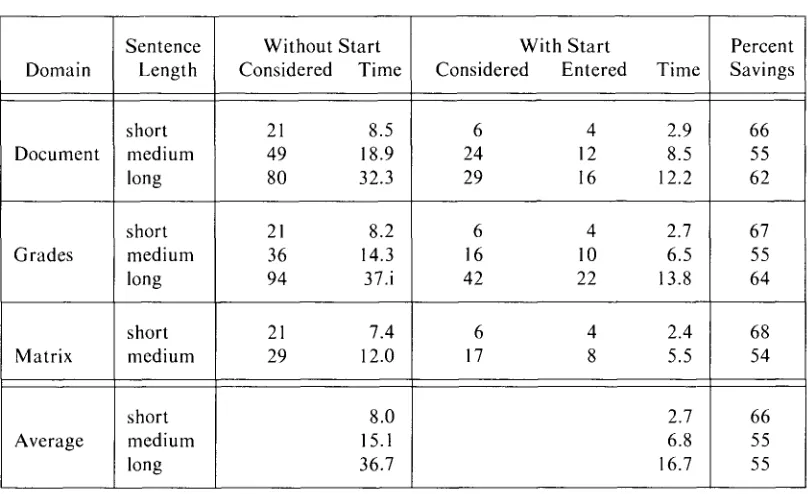
Statistics were gathered for both the number of g r a m m a r commands executed, and the actual running time. In particular, we had the parser keep track of the number of times an attempt was made to execute a Call command, and also how many times the test of whether to invoke the body of the Call succeeded. At the system level, we had UN IX 2 report the amount of time (in seconds) spent by the parser for each of the 18 runs (9 sentences each run with and without Start information). The results of this study are given in Table 1. As can be seen, the use of the Start
file led to a significant reduction both in the number of Call statements entered or executed and in the actual parsing time. In fact, for 8 of the 9 inputs, parse time was
reduced by more than half. An explanation for the fairly long parse times is given in Section 5.3.
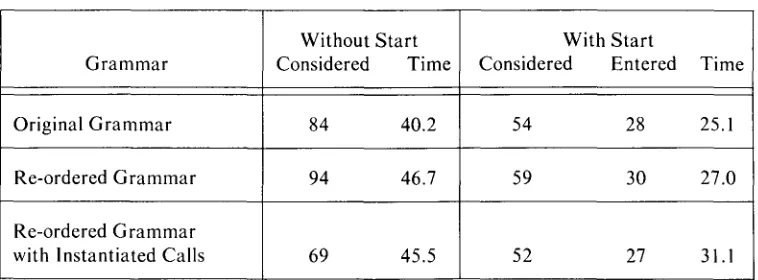
4.3.2 E x p e n s e of m a c r o - s t y l e S E Q c o m m a n d s After studying the results given above, we wondered how greatly the observed improvements were due to the pres- ence of unnecessary Call commands. In the g r a m m a r being tested we had, for the sake of clarity, included many Call commands that were invoked at only one place in the g r a m m a r , and we wondered what the results would be if these "superfluous" Call commands were replaced by their associated bodies. Since only Call commands have " S t a r t " lists associated with them, we conjectured that it would actually be an advantage to have m a n y Call commands, especially for a lengthy Alt (alternative) c o m m a n d that would do lots of superfluous work. To test this hypothesis we ran an experiment to compare the original g r a m m a r against a modification of it in which the bodies of several of the superfluous Call commands were instantiated at the point of call. For reasons not relevant to this discussion, it was first necessary to re-order some of the g r a m m a r rules in order to make a fair comparison. Thus, there were three g r a m m a r s to be tested. Each g r a m m a r was run both with and without the Start infor- mation for several of the sample inputs shown above. For the most complicated input, "the second entry the last four commands added five to that is positive in matrix 2", the results are given in Table 2, where the statistics for comparison are found in the second and third lines. Although the full significance of these preliminary results is not clear, it is apparent that the instantiations had (a) a small positive effect when Start information was
not being used, and
(b) a small negative effect when Start information was used.
These results lend credence to the hypothesis that intro- ducing convenient Call commands will not lead to an increase in parsing efficiency in the presence of the Start file.
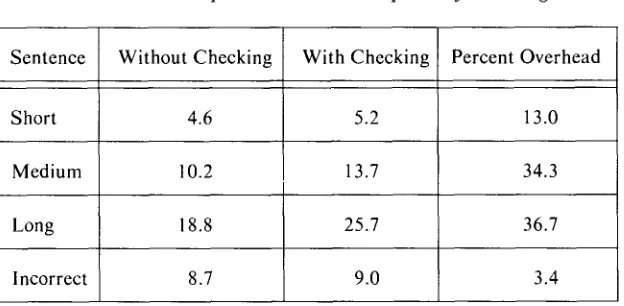
4.3.3 E x p e n s e of nonlocal c o m p a t i b i l i t y c h e c k i n g Upon noting the long parse times in the preceding exper- iments, we wondered how much of this time was being spent in nonlocal compatibility checking and whether this checking increased parse time, due to the extra work involved, or decreased it, by early pruning of erroneous potential parses. Accordingly, we considered two gram- mars, one with augmentations calling for nonlocal check- ing to be done, the other without such parameters, but identical otherwise, and compared the parsing times for each g r a m m a r for each of the four noun phrases
"the first class"
"the best undergraduate student Ballard taught in A I " "the name of the class the student the professor taught
liked"
2UN IX is a trademark of AT&T Bell Laboratories.
Bruce W. Ballard and Nancy L. Tinkbam A Phrase-Structured Grammatical Framework for Transportable NLP
Table 1. Reduction in Parsing Times by the Use o f the "Start" File
Sentence Without Start With Start Percent
Domain Length Considered Time Considered Entered Time Savings
short 21 8.5 6 4 2.9 66
Document medium 49 18.9 24 12 8.5 55
long 80 32.3 29 16 12.2 62
short 21 8.2 6 4 2.7 67
Grades medium 36 14.3 16 10 6.5 55
long 94 37.i 42 22 13.8 64
short 21 7.4 6 4 2.4 68
Matrix medium 29 12.0 17 8 5.5 54
short 8.0 2.7 66
Average medium 15.1 6.8 55
long 36.7 16.7 55
* "the four tallest classes"
where " * " denotes an unacceptable sentence. In each case both local compatibility checking and checking of Start information were done. The results appear in Table 3. As with the experiments discussed above, these measurements have limited statistical significance due to the small sample sizes of g r a m m a r s and of inputs. However, the preliminary indication is that checking for nonlocal compatibility adds more time to parsing than it saves. This suggests that the benefits of such nonlocal checking will be primarily in improved accuracy of disambiguations, rather than speed of parsing.
5. D i s c u s s i o n
We now summarize what we believe to be the most signif- icant aspects of our formalism, briefly comment on the relation of our g r a m m a r s to conventional ATN grammars, and finally mention some of the drawbacks to our approach.
5.1 S o m e a d v a n t a g e s o f o u r f o r m a l i s m
Our goals in developing the grammatical formalism discussed in this paper were, first, to prepare for transpor- tability and, second, to be able to specify g r a m m a r s in a simple, understandable, and succinct fashion. Concerning the first goal, we have seen how nountype, plurality, and various forms of compatibility information can be conven- iently passed up and down a parse structure under construction. This information can prove useful in disam- biguations and in subsequent semantic processing. In particular, our formalism allows us to state many restrictions of semantic g r a m m a r s within a general gram- mar, independent of the domain(s) at hand. This is possi-
ble because the files created during knowledge acquisition, namely the dictionary and associated compatibility file, contain many types of domain-specific information that is useful in making syntactic and semantic decisions during parsing. For instance, we can write a simple and relatively short set of syntax routines for relative clauses that over- generates (i.e. allows many spurious structures) since adequate restriction information is available in the pre- processed files. This is similar in spirit to the isolation of restriction information described in Sager and Grishman (1975).
Some of the features of our formalism which we consid- er desirable but not related directly to the goal of transpor- tability are the following.
1. Our Quote and Get commands represent a consol- idation over lower-level command types of the ATN form adopted for our previous NLC system. For instance, we use a single Get command to take the place of what would require three separate commands in the NLC grammar.
2. We have provided for default labels in the parse structures being built, which g r a m m a r writers can override if they choose.
3. We often allow for lists o f items where only one item would be expected. For instance, we may ask for one of several words or parts or speech, as in (Quote (that which who)) or (Get ( N u m Super)), or specify several compatibility-checking augmenta- tions in a single command.
4. We provide for arbitrary embeddings of commands
within any of the composite commands, similar to the nestings provided in LISP and a number of modern programming languages.
[image:11.612.96.500.84.331.2]Bruce W. Ballard and Nancy L. Tinkham A Phrase-Structured Grammatical Framework for Transportable NLP
Table 2. Effect of In-line Instantiation of Superfluous Call Commands
Without Start With Start
G r a m m a r Considered Time Considered Entered Time
Original G r a m m a r 84 40.2 54 28 25.1
Re-ordered G r a m m a r 94 46.7 59 30 27.0
Re-ordered G r a m m a r
with Instantiated Calls 69 45.5 52 27 31.1
5. Our g r a m m a r s do not require dummy node names,
such as those occurring in typical ATN grammars. 6. We handle most restriction specifications by a small
number of augmentations which cling to the seven command types. This implies the presence within our g r a m m a r s of an easily visible context-free skeleton grammar, which one can detect without having to trace through and ignore various testing commands. 7. Due to the crispness of our g r a m m a r commands,
presence of consolidations with appropriate defaults, and manner of embedding augmentations within commands, we are able to work with relatively compact grammars, which aids in their comprehen- sion and manipulation.
8. The crispness of our seven commands has also allowed for useful preprocessing of the grammar to create the Start and Adjacency files. This form of information has been found useful by several researchers, yet is often supplied directly from the human author of the g r a m m a r , and must be updated when the g r a m m a r changes. Our files are created automatically.
5.2 C o m p a r i s o n s w i t h A u g m e n t e d T r a n s i t i o n N e t w o r k F o r m a l i s m s
As remarked earlier, our grammatical formalism, which is based on what we regard as phrase-structure rules, bears some resemblance to ATN g r a m m a r s (Woods 1970, 1980), but there are important differences. First, the notion of a network node is almost entirely absent from our formal- ism. For example, in the following typical ATN node
(Q2 ( P U S H NP / T ( S E T R Subj *)
(TO Q3)))
we note the presence of both (a) the label Q2, and (b) the reference to the successor node Q3, neither of which has a counterpart in our grammars. By eliminating such node names, we reduce the space needed to specify g r a m m a r rules, which helps make our g r a m m a r s more readable. We also reduce the redundancy of the g r a m m a r represen- tation, which makes updates easier and less error-prone.
Actually, node names for ATN g r a m m a r s need not be given explicitly, but their elimination requires that networks be stored as linked structures that resist conven- ient manipulations with standard text editors. This was the alternative representation chosen for the ATN gram- mars of NLC. As a final point concerning readability of grammars, we note the common practice of conveying ATN g r a m m a r s by giving an actual network diagram, which by its non-linear nature cannot be so conveyed to the computer system.
A second departure of our formalism from conventional ATNs is that we have systematically avoided the tempta- tion to introduce opportunities for making arbitrary tests (a provision shared, evidently, with even more glee, in various logic grammars, e.g., Pereira 1981). Such opportunities are provided for in ATN g r a m m a r s by the TST node type, and also by allowing arbitrary LISP predicates at various points. As indicated in Section 4.3, we have taken pains to restrict the repertoire of conditions that may be checked, hoping that such restrictions will better direct the gram- mar writer to the salient features that need to be consid- ered. Our interest is more to provide a formalism that can be used easily and profitably than to provide something with formal Turing ability. Thus, we have sought to iden- tify a small but adequate number of easily understandable conditions to be checked when doing a Get, Call, and so forth. Another departure is that many of our augmenta- tions, most conspicuously that described in Section 3.3.3, amounts to setting up demons to monitor the process of a routine about to be called so that appropriate information passing will occur. This allows a routine to be written just once, yet lead to different sorts of compatibility checking based upon the context in which it is invoked. This philos- ophy appears to differ from that upon which the essential- ly bottom-up SEND mechanism of ATNs is based.
5.3 L i m i t a t i o n s o f o u r a p p r o a c h
We now mention some of the difficulties we have encount- ered with our approach to transportable parsing. Before doing so, we note that the excessive parse times suggested in Tables 1-3 are no longer a problem, since our parser now runs on a VAX in compiled LISP (and the tables were
[image:12.612.120.499.86.226.2]Bruce W. Ballard and Nancy L. Tinkham A Phrase-Structured Grammatical Framework for Transportable NLP
Table 3. Time Spent in Nonlocal Compatibility Checking
Sentence Without Checking With Checking Percent Overhead
Short 4.6 5.2 13.0
Medium 10.2 13.7 34.3
Long 18.8 25.7 36.7
Incorrect 8.7 9.0 3.4
created on a 16-bit PDP-11/70 running fully interpreted LISP without hash tables). At present, parse times are hovering at around one second.
First, we note that at present the noun positions in case frames and prepositional triples consist of object types of the domain at hand. Although this level of abstraction is somewhat more general than specific surface words, we are considering means whereby the user can make use of the hierarchical relationships among domain entities to reduce the redundancy of some case frame specifications. For example, "person" might be used to mean "either student or instructor", and in fact entire taxonomies might be introduced.
Second, we have observed a few places in our grammar, especially the treatment of quantifiers, determiners, and their allowable co-occurrences, where the old ATN formal- ism we used for the NLC grammar would result in more concise and not necessarily less perspicuous grammars. For instance, "all/each of the" is okay but not "every of the"; "every/each one of" is okay but not "all one of the"; and "all the" is okay but not "each/every the". In fact, we at times sketch out a new class of constructs to be incorporated into our grammar in a pidgin transition network form, then seek ways to linearize.
Finally, we note that several existing grammatical formalisms, such as string grammar and ATN grammar, have enjoyed more than a decade of refinement and have led to quite efficient parsing mechanisms. We expect the principles we have developed to undergo similar improve- ments during the course of our research. Though much of the current LDC grammar was derived from corresponding parts of the ATN grammar of NLC, there is no reason to doubt that we will be able to adopt relevant portions of other large grammars (e.g. Robinson 1982; Sager 1981), thus taking advantage of previous research directed more toward the linguistic versus domain-modeling aspects of natural language syntax.
6. A G l i m p s e at t h e O v e r a l l L D C E n v i r o n m e n t
The design of LDC began in 1981 with the goal of allowing a system designer to quickly create interfaces to new domains by supplying vocabulary and domain structure
information to a customizing module. However, LDC soon developed into a system where all information about a new domain is acquired from prospective users, as had been done for REL (Thompson and Thompson 1975) and KLAUS (Haas and Hendrix 1980). The system is loosely based upon strategies developed for our English-language programming system NLC (Ballard and Biermann 1979; Biermann and Ballard 1980; Sigmon 1981; Fink 1982; Geist, Kraines and Fink 1982; and Biermann, Ballard and Sigmon 1983), and has been designed to provide a natural language query capability for office domains whose data are stored on the computer as informally structured text- edited data files (Ballard and Lusth 1984). The system comprises
(a) a knowledge acquisition module called "Prep", (b) a highly-parameterized English-Language processor,
and
(c) a knowledge-based Retrieval module.
We now summarize the operation of the knowledge acqui- sition and English processing components, referring the reader to Ballard and Lusth (1984) for details concerning retrieval processing.
6.1 K n o w l e d g e a c q u i s i t i o n
The initial interaction between a user and LDC, which involves telling the system about a new domain, consists of a knowledge-acquisition session with the preprocessor, which we call "Prep". In particular Prep asks for
(1) the names of each type of "entity" (object) of the domain;
(2) the nature of the relationships among entities; (3) the English words that will be used as nouns, verbs,
and modifiers; and
(4) morphological and semantic properties of these new words.
For example, in describing a building organization domain, a user might supply to Prep the structural and language-related information that "room" is a primitive entity type; "large", "small", and "vacant" are adjective modifiers; "conference" is a noun modifier; "office" is a noun referring to some objects of type "room"; and that rooms have "wing" as a higher-level domain entity. At
[image:13.612.146.458.76.229.2]