
Abstract— The model of emotional masks is a newly developed AI paradigm based on Minsky’s model of emotional mind in his recent book “The emotion machine”. The model takes a resource management approach toward modeling the mind and views different processes of mind as resources that need to be managed. In the present work an intelligent controller (SCELIC) is developed based on the model of emotional masks. SCELIC is a model free controller which advantages from several learning tasks. Multiple learnings and adaptive structure make it a powerful adaptive and self-learning tool that performs the tasks of system identification and control in parallel. Although the test-bed considered here is a nonlinear SISO system, this controller can be used for MIMO systems as well.
Index Terms— Attention, Adaptive Control, Emotions, Intelligent Control, Learning
I. INTRODUCTION
here is a lot of time passing from the first usages of machines by humans. The advent of computers was surely a breakthrough in the development of machines as they became much more intelligent. As a result, the more intelligence we put in systems, the more adaptability is required in their control. Therefore, there is a strong relationship between the fields of Control and Artificial Intelligence (AI). AI is defined as "the study and design of intelligent agents” where an intelligent agent is a system that perceives its environment and takes actions that maximize its chances of success [1]. Along with the presence of some sorts of intelligence in machines, there it came the debate over the possibility and need for emotions in machines as well. The truth is that at the first glance, emotions in machines did not seem that sensible but more research in this field have showed that artificial emotions can be an efficient approach if the machine must have the ability of planning or if it faces unknown environments. This is the case of some kind of robots, artifacts, virtual agents, and specially, control algorithms.
There has been a vast research on the topic of emotions among academia, from philosophy to AI. Different theories and models for emotions have been proposed, among which is the very recent model of emotional masks that is based on the theory of an emotional mind. Emotional mind is a theory
Manuscript received December 22, 2010; revised January 19, 2011. H. R. Saghir is a master student of Mechatronics at sharif university of technology international campus, Kish Island, Iran;(e-mail: [email protected]).
S. B. Shouraki is with the electrical and computer science department of Sharif University of Technology, Tehran, Iran (e-mail: [email protected]).
put forward by the distinguished researcher Marvin Minsky in his recent book “the emotion machine”. This theory and model take a resource management approach toward modeling the mind and views different processes of mind as resources that are to be managed.
Resulting from the integration of AI into control theory is the field of intelligent control, a class of control techniques that use various AI computing approaches. Equipped with emotions, this field can produce some efficient methods to deal with various systems. The main idea in this research is to implement emotions in a specifically designed intelligent controller to get the benefits from both paradigms. Such a controller has the potential to present good adaptiveness due to its multiple learning tasks, and the potential to deal with large data and rule bases due to its attention control and emotional masking mechanisms [3].
II. CLOUDS OF RESOURCES AND EMOTIONAL MASKS In the book “The Emotion Machine” [2], Marvin Minsky puts forward a new theory and approach to emotions. To start the theory he introduces a typical brain as containing many parts that are called “resources.” Resources may be defined as any type of mental or physical activity. He believes that resources are any kind of structures or processes, which are from sensory devices to the thinking methods (figure 1).
Figure 1. Brain and Resources [2]
Minsky says:
“For example, the state called “Anger” appears to arouse resources that make us react with unusual speed and strength—while suppressing resources that we otherwise use to plan and act more prudently; thus Anger replaces your cautiousness with aggressiveness and trades your sympathy for hostility. Similarly, the condition called “Fear” would engage resources in ways that cause you to retreat [2].”
He takes a resource-based approach to the definition of emotions and says (figure 2):
“Each of our major “emotional states” results from turning certain resources on while turning certain others off—and thus changing some ways that our brains behave [2].”
Self Constructing Emotional Learning based
Intelligent Controller (SCELIC)
Saghir H. R., Shouraki S. B.
Figure 2. Emotions As Collections of Resources [2]
In [4 and 5], Harati et al. have presented a new computational model of emotions based on Minsky’s theory of clouds of resources. To do so they have introduced a model of emotions based on managing mental resources. They assume the mind as a collection of data and processes and an activation pattern that can perform the role of putting a subset of these resources in the working memory. Therefore, they consider an emotional state, nothing but a state of mind along with a feeling experience. They also justify their view as the fact that we encounter loads of situations during lifetime, we cannot memorize all these situations with details; but some of these conditions can be classified in some categories that are important and frequent or need immediate action. These categories or classes need to be memorized so that dealing with these situations can be done easily and in a timely fashion.
This model is divided into two parts:
1. An assessment and categorizing mechanism for activation of a proper combination of resources (emotional activation mechanism)
2. A collection of combination of resources among which the proper structure of mind for facing a situation is chosen.
The way LeDoux views emotions is adapted as the key to modeling the emotional mind of Minsky. LeDoux classifies the emotional processing in two categories: consciously and unconsciously. The unconscious part is in charge of activating emotions. This involves directing attention and activating the related knowledge and modifying the contents of the working memory.
In such way of modeling, in the presence of an emotion, certain resources are activated while other resources are inactive. Therefore, the authors argue that emotions have the role of management of resources available to the mind, and as a result performing a masking role regarding the resources. Active resources are specified based on the emotional state of the system, so emotions are somewhat like windows form which the system views its resources. Therefore, it is as if the mind is looking at its resources through a mask that changes as the emotion changes; The authors call their model the model of emotional masks. In simple intelligent systems, the resources available to the system consist of only inputs and probably a knowledge base, but in systems that are more complicated there are also goals, values, programs and needs. So emotional masks in simple systems may mask only inputs and the knowledge base, but they can also mask goals, values... in systems that are more complicated.
In another work [6] the same authors have argued that in the
differences between natural and artificial domain is ignored. They have mentioned four main problems existing due to the current method of definition of emotions as:
1. Human's emotional states are modeled based on high level concepts that are not definable in simple systems;
2. Usually the core of emotional system is defined directly by the designer, and usually the system is not able to learn or adjust these hardcode mechanisms;
3. The emotion mechanisms defined in such a way usually play the role of heuristic solutions for specific problems and therefore, are extremely dependent to the knowledge of the designer about the details of the problems that the system may face and their possible solutions;
4. Hardcode emotion definition prevents the systems from forming their own emotional identities and personalities.
In this work, we will try to solve these problems and introduce emotions into the control field without limiting them into these bounds.
III. SCELIC
The idea of emotional masks provides a system with a resource management mechanism. These masks should be learned by a system itself so that it could form its emotions through time and experience. From an attention control point of view these masks are actually different attentional states of the system.
The model of Emotional masks has argued that machines don’t need to have the same emotions as humans do in order to be called emotional, in fact, what machines need, is a mechanism that could let them form their own emotions. Therefore, providing a flexible learning mechanism with some special features, can probably solve the above-mentioned problems.
Based on the model of emotional masks, in a rule-based system, emotions are viewed as different parts of the same rule-base. This means that, in fact, emotions perform the role of attention controllers. They focus the attention of the whole system on some parts of the same rule-base based on the needs of the system.
In such a system, apart from the learning of dynamics, there is also another learning involved, which learns the attention control. So, there are basically two learnings involved. One takes place in one layer that learns to control the plant. The other one should take place in the attention controller that learns which parts of the rule-base should take part in the decision making process. To do that we took several steps:
SOANFIC:
Figure 3. SOANFIC Structure
Step1:
We partitioned the crude rule-based structure into some parts, therefore, partitioning their input spaces as well. They reason for that is to make it easier for the system to define the resources but this also can be a part of the learning process. Actually we used five ANFIS in the lower level of a SOANFIC controller (SOANFIC is separately explained in another upcoming paper), instead of only one (figure 4).
Figure4. SOANFIC With 5 ANFIS
The reason for that is to help the attention controller start the partitioning and decision making process with an easier job. Although this manual partitioning is just dividing the input space so that different masks could be built up, it may be omitted is future works to let the emotional system partition the input space by itself.
By fixating the premise parameters of the ANFISs and only letting the consequent parameters to be adaptive we can partition the input space. Therefore, if we use for example an initial set of 25 rules defined by a human expert, or even start from scratch, we may put every 5 rules in one ANFIS, i.e. partition the input space. Then these 25 rules can be built up based on the learning process. The lower level with this structure can be called the rule-layer or control-layer, because the control rules are learned here. These five resources learn in parallel to control the plant.
Step2:
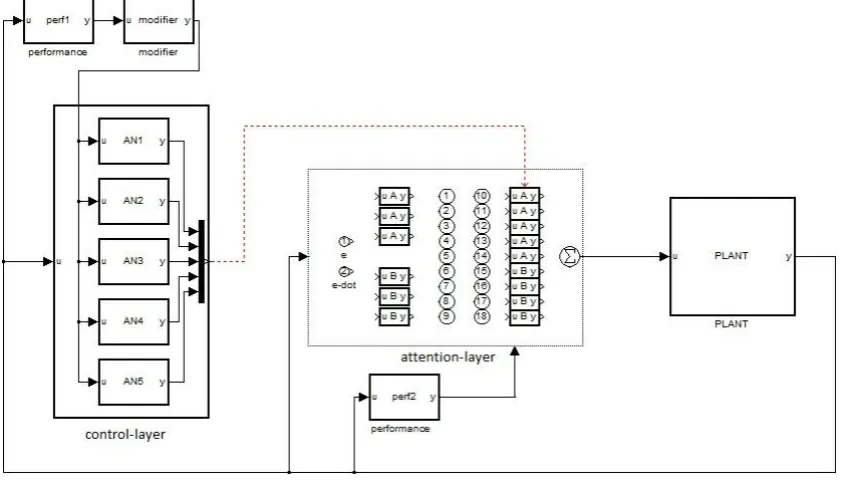
Now it is the time for providing the model with an attention controller. These five resources have five different beliefs about the control signal that should be sent to the plant. The attention controller performs the role of fusion of these beliefs based on situations, i.e. performing the role of emotional masking.
[image:3.595.84.505.505.745.2]This is done here, by adding another layer to the lower level of the previously explained SOANIFC. This second layer is called the attention layer which provides the model with emotional processing mechanism. The structure is shown in figure 5. This controller is called the Self- Constructing Emotional Learning-based Intelligent Controller or shortly SCELIC.
hierarchical levels as opposed to two hierarchical levels in a non-emotional version, including:
A.Performance layer B.Control layer
C.Attentional or emotional layer
A.
Performance layer:
A performance layer is a layer responsible for producing the reinforcement signals. In Self-Organizing controllers, it is usually a manually defined table which provides a local performance measure based on the knowledge of the error and change in error. Such a table is shown in figures 6.
Figure6. Procyk and Mamdani’s Perf. Table
The table in figure 6 is the one introduced by Procyk and Mamdani. There are also some other slightly different tables introduced by some other researchers in the literature. The original performance tables were built by hand, based on trial and error. Presumably, if the numbers in the tableare small, it will be necessary to do many updates to reach useful control rules; if the numbers are large, the convergence will be faster, but maybe also unstable.
The following analysis leads to a deeper understanding of the mechanism. It seems that the Procyk & Mamdani’ s table (Fig. 6) holds the zeros in a more or less diagonal band. Because the zeros indicate no penalty, those states must be admissible.
Focusing on the zero diagonal, it expresses the relation:
This is an ordinary differential equation, and can be solved as:
In other words, a first order exponential decay with a time constant GCE/GE; assuming e(0)=1 the error e will gradually die out, and after t=GCE/GE seconds it has dropped 0.63 units. To interpret, the modifier M in an original model based SOC tries to push the system towards a first order transient response.
Instead of a performance table a simple penalty equation can be used:
sample period. This penalty equation is an incremental one because the output is a change to an existing value. In order to keep the update rate independent of the choice of sample period the penalty equation is multiplied by .
B.
Control layer:
The control layer is responsible for the act of controlling the plant. The input space of this layer is partitioned to 5 parts, to provide the resources of the system, each of which is given to an ANFIS. So basically the 5 parts can be viewed as the resources of the emotional system. The control rules are built up here through ANFIS learning mechanism. These 5 parts learn in parallel how to control or stabilize the dynamics of the system based on the performance signal from pervious layer.
C.
Attention (Emotional) layer:
This layer is responsible for fusion of the beliefs of the resources from the control layer. It consists of an ANFIS-like mechanism but the output of this layer is a linear combination of the outputs of ANFIS 1 to 5, from the control layer. This layer also uses a performance signal to form its learning.
The difference between mechanism used in this layer and an ANFIS network is that in this network the output is a linear combination of the beliefs of the resources from the previous layer (control-layer), while in an ANFIS the outputs are linear combinations of the inputs of the network. The layers in the attention controller are as followed:
Layer 1: every node in this layer can be an adaptive one and with the node function:
With µ being the membership functions for example:
Or,
Layer 2: every node in this layer are fixed ones that multiply the inputs and send the output out or in other words each node output represents the firing strength of a rule:
Layer 5: the nodes in this layer are fixed ones that calculate the total outputs of the network as a linear combination of the beliefs of the control-layer:
IV. LEARNING IN SCELIC The learning process takes place in 2 stages:
A. Stage1:
In the first stage, there is only an active learning in the control layer and the learning in attention layer is inactive.
Input space is partitioned to 5 parts each of which is given to only one ANFIS.
The 5 ANFIS learn to stabilize the plant, based on the performance1 signal.
The beliefs of AN1 to AN5 is fused using a hard-coded attention mechanism.
B. Stage 2:
This stage starts as soon as the control layer learns to stabilize the plant, in this stage the learning mechanism in the control layer is off and the learning in the attention layer is activated.
AN1 to AN5 learning have converged and there is no more learning in the control layer.
Learning in attention layer starts based on performance2 signal.
V. INVERTED PENDULUM
The inverted pendulum [12, 13 and 14] system is a standard problem in the area of control systems. The system is nonlinear so it is useful in illustrating some ideas in the nonlinear control field.
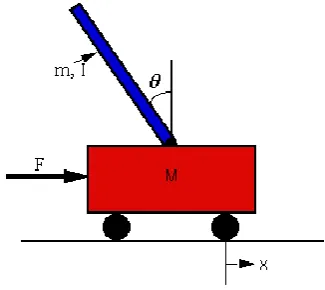
[image:5.595.351.514.52.197.2]The inverted pendulum system inherently has two equilibria, one of which is stable while the other is unstable. The stable equilibrium corresponds to a state in which the pendulum is pointing downwards. In the absence of any control force, the system will naturally return to this state. The stable equilibrium requires no control input to be achieved and, thus, is uninteresting from a control perspective. The unstable equilibrium corresponds to a state in which the pendulum points strictly upwards and, thus, requires a control force to maintain this position. The basic control objective of the inverted pendulum problem is to maintain the unstable equilibrium position when the pendulum initially starts in an upright position. A schematic of the inverted pendulum system is shown in figure 7.
Figure 7. Schematic of an Inverted Pendulum System
The parameter values are:
[image:5.595.315.527.388.505.2]By drawing the free body diagram of the system (figure 8) and doing a force and momentum analysis the system equation setup can be derived:
Figure 8. FBD of the System
Newton’s equations for the two degrees of freedom:
In the simulations, SCELIC is starting from scratch without any control rules. The first learning learns the control rules and the second learning learns how to fuse the beliefs of AN1 to AN5; i.e. learns the attention control process.
Figure 9.emotional controller with attention learning(5 ANFIS) – 47 epochs in stage 1 + 158 epochs in stage 2
[image:6.595.78.278.405.574.2]SCELIC seems to be able to present good damping response but however with some overshoot. Although the response of the controller is not an optimal one, it is satisfactory but however by changing the parameters and providing it with a better performance measure, it is possible to obtain a good result based on what the designer has is mind. The fusion factors during the simulation are also shown in the following figure.
Figure 10. the fusion parameters during learning in stage 2
As it can be seen from figure 10, AN2, AN3 and AN4 have the greatest effect on the control of the plant and AN1 and AN5 have a very small fusion factor. This means that the system can be controlled using only 3 of its 5 resources and fusion factors are learned through learning.
VII. CONCLUSION
In this work we presented the usage of clouds of resources and emotional masks in the field of control. This new approach provides a sensible mapping between what we know as emotions and what is present in machines. The model of emotional masks, views the mind as a collection of processes or resources which are managed using different masks that are learned over time. This models the whole brain structure for emotional thinking as opposed to other methods that model some parts of the brain.
that learns the attention control for the learned rule-base. Therefore, SCELIC is an intelligent and adaptive controller that performs the tasks of system identification and control in parallel. This controller is a model free and self-constructing one, this means that it can construct the controller from the scratch by itself while provided with a simply developable performance measure by the designer. An important factor about SCELIC is the learning of emotions, as opposed to hard-coded emotion definitions. Furthermore, to test the applicability of these ideas, the nonlinear model of an inverted pendulum was used as a test-bed. The formulation for an inverted pendulum was presented and emotional masks were implemented in the control field. As the tool was fuzzy logic, the resources were defined as the rules in the rule-bases.
It was also shown that it is possible to make a better use of the present computing power in a system while SCELIC is in use, because of its masking ability. So basically, SCELIC is a type of controller that can construct the control rules from scratch and furthermore, decide on which part of the rule-base should be attended. This means that in addition to being able to learn how to control the plant, it can learn how to make use of available resources in a more optimal manner, i.e. learn the emotions in a system.
REFERENCES
[1] Russell & Norvig, “Artificial Intelligence: a modern approach”,
Prentice Hall; 2nd edition, 2002
[2] Minsky, Marvin, “The emotion machine”, Simon & Schuster Publications (November 7th, 2006)
[3] Saghir H. R. , “Emotional Control”, MS Thesis, Sharif university of technology, 2010.
[4] Harati Zadeh, ”A Model for Generating Emotional Behavior”, PhD Thesis , Sharif University of Technology, 2008.
[5] Harati Zadeh, S., Bagheri Shouraki, S.,Halavati, R ,“Artificial Emotions for Artificial Systems”, Proceedings Of Association For The Advancement Of Artificial Intelligence (AAAI) Conference On
Spring/2008
[6] Harati Zadeh, S., Bagheri Shouraki, S.,Halavati, R., “Emotional Behavior: A Resource Management Approach”, International Journal Of Adaptive Behaviour, Vol. 14, No. 4, 357-380 (2006)
[7] Jantzen Jan, “The Self-Organising Fuzzy Controller”, Technical University of Denmark, Department of Automation, Bldg 326, DK-2800 Lyngby, DENMARK. Tech. report no 98-H 869 (soc), 19 Aug 1998.
[8] Procyk T J, Mamdani EH, “a Linguistic Self Organizing Process Controller”, Automatica, Vol.15, No.1, Pp. 15-30, 1979
[9] Jang J S R, “ANFIS: Adaptive Network Based Fuzzy Inference System”, IEEE Transactions, Man & Cybernetics 1991
[10] H. Rouhani, M. Jalili, B. N. Araabi, W. Eppler, C. Lucas, “Brain emotional learning based intelligent controller applied to neurofuzzy model of micro-heat exchanger,” in an International Journal Expert Systems with Applications, Science Direct, Elseviere, Vol. 32. Issue 3, pp. 911–918, Apr. 2007.
[11] M. A. Sharbafi, C. Lucas, A. T. Haghighat, O. A. Ghiasvand, and Omid Aghazade “Using Emotional Learning in Rescue Simulation Environment,” in Transactions on Engineering, Computing and Technology, World Enformatika Society, Vol. 13, pp. 333–337, May. 2006.
[12] R.J. Stonier, A.J. Stacey, C. Messom, “Learning fuzzy control laws
for the inverted pendulum”,ISCA 98
[13] Jan Jantzen, “Analysis Of A Pendulum Problem”, Technical
University of Denmark, Department of Automation, Bldg 326, DK-2800 Lyngby, DENMARK.Tech. report no 98-E 863 (cartball), 19 Aug 1998.
![Figure 2. Emotions As Collections of Resources [2]](https://thumb-us.123doks.com/thumbv2/123dok_us/1293462.658564/2.595.96.239.85.141/figure-emotions-collections-resources.webp)
![figure. [2] Minsky, Marvin, “The emotion machine”, Simon & Schuster Publications (November 7th, 2006)](https://thumb-us.123doks.com/thumbv2/123dok_us/1293462.658564/6.595.78.278.405.574/figure-minsky-marvin-emotion-machine-schuster-publications-november.webp)