463
How does Grammatical Gender Affect Noun Representations
in Gender-Marking Languages?
Hila Gonen1 Yova Kementchedjhieva2 Yoav Goldberg1,3 1Department of Computer Science, Bar-Ilan University
2University of Copenhagen 3Allen Institute for Artificial Intelligence
[email protected],[email protected],[email protected]
Abstract
Many natural languages assign grammatical gender also to inanimate nouns in the lan-guage. In such languages, words that relate to the gender-marked nouns are inflected to agree with the noun’s gender. We show that this affects the word representations of inani-mate nouns, resulting in nouns with the same gender being closer to each other than nouns with different gender. While “embedding de-biasing” methods fail to remove the effect, we demonstrate that a careful application of meth-ods that neutralize grammatical gender signals from the words’ context when training word embeddings is effective in removing it. Fix-ing the grammatical gender bias yields a posi-tive effect on the quality of the resulting word embeddings, both in monolingual and cross-lingual settings. We note that successfully re-moving gender signals, while achievable, is not trivial to do and that a language-specific morphological analyzer, together with careful usage of it, are essential for achieving good re-sults.
1 Introduction
Work on distributional word embeddings focuses almost exclusively on English, or on cross-lingual and language-agnostic techniques. However, lan-guages are diverse and different lanlan-guages ex-hibit different linguistic phenomena, which may interact with the English-centric embedding learn-ing algorithms. In this work we look into one such phenomenon—grammatical gender—and ex-amine its effect on the learned representation.
Many languages have rich grammatical sys-tems, that often include a complex gender system as well (Corbett,1991). Languages with grammat-ical gender assign and morphologgrammat-ically mark gen-der not only to animate nouns (which have biologi-cal sex, e.g. man, woman, mother, father), but also
to inanimate nouns (e.g. dream, book). This gram-matical gender assignment is mostly arbitrary: the same inanimate concept can have different gender in different languages. For example, a flower is masculine in Italian (fiore) and feminine in Ger-man (Blume).
Languages often maintain anagreement system
in which certain words agree on different morpho-logical features with other words they relate to. For example, English present-tense verbs are in-flected to agree with their nominal subject on the
numberfeature. In other languages the agreement system is more elaborate, and in particular verbs, adjectives, determiners and other functions agree with nouns on many features, including gender (Corbett,2006).1
Such grammatical agreement affects the distri-butional environment of nouns, as nouns of differ-ent gender become surrounded by differdiffer-ent word forms: feminine nouns co-occur more with the feminine forms of words, while masculine nouns with the masculine forms. For example, the Italian wordviaggio(“journey”-masc) will co-occur with
durato (“last”-masc) and lungo (“long”-masc), while the word gita (“trip”-fem) will co-occur withdurata(“last”-fem) andlunga(“long”-fem).
Such changes in the distributional environment may bias the learned distributional representations of inanimate nouns. Indeed, we see that the major-ity of the top-10 nearest neighbors of the wordgita
in Italian (“trip”-fem) are feminine words. Also, we notice that the wordviaggio(“journey”-masc) is not on the list, while in English, for comparison, we can find journeyin the top-10 nearest neigh-bors oftrip.
In this work, we are interested in investigating, demonstrating and quantifying this effect beyond
1As the gender of nouns is fixed, the other elements are
the anecdotal level. We also explore methods for removing such unwanted biases.
We demonstrate that both in Italian and in Ger-man, the grammatical gender affects similarities between word representations (using words from SimLex-999 (Hill et al., 2015; Leviant and Re-ichart,2015)): pairs of nouns with similar gender are closer to each other while pairs of nouns with different gender are farther apart.
After quantifying the effect, we explore several methods of reducing it. A popular choice would be to simply lemmatize all the words prior to feed-ing them to the embeddfeed-ing learnfeed-ing algorithm. However, full lemmatization can be destructive, in the sense that it will also remove morphological distinction that we may want to keep. We thus seek more surgical approaches. Interestingly, re-cent embedding debiasing approaches (Bolukbasi et al., 2016) do not work well. We instead look for methods that attempt to neutralize the gender signals from the training data. We find that such methods are effective in reducing the effect, but are also language specific and tricky to get right: we rely on language specific morphological ana-lyzers while carefully accounting for their pecu-liarities and adjusting our use for each language. We take this work as a reminder that (a) linguistic resources such as lexicons and morphological an-alyzers are still relevant and useful (cf. (Zalmout and Habash,2017)); (b) languages are diverse and different languages require different treatments; and (c) small details may matter a lot. In partic-ular, existing tools and resources, either learned or human curated, should not be trusted blindly, but be carefuly adapted for the problem.
Finally, we show that reducing the effect of grammatical agreement also has a positive ef-fect on the quality of the resulting word repre-sentations, both in monolingual and cross-lingual settings. We conclude that grammatical gen-der indeed has its imprints on the representa-tions of inanimate nouns, and that this should be taken into account when working with gender-marking languages. Our code and debiased em-beddings are available at https://github. com/gonenhila/grammatical_gender.
2 Background and Related Work
Word Embeddings Word embeddings have be-come an important component in many NLP mod-els and are widely used for a vast range of
down-stream tasks. These models are based on the dis-tributional hypothesis according to which words that occur in the same contexts tend to have sim-ilar meanings (Harris,1954). Indeed, they aim to create word representations that are derived from their shared contexts, where the context of a word is essentially the words in its proximity (be it ac-cording to linear order in the sentence or acac-cording to syntactic relations) (Mikolov et al.,2013; Pen-nington et al.,2014;Levy and Goldberg,2014).
Gender Biases in Word Embeddings Social gender bias was demonstrated to be consistent and pervasive across different word embeddings (Caliskan et al., 2017). Bolukbasi et al. (2016) show that using word embeddings for simple analogies surfaces many gender stereotypes. In addition, they define the gender bias of a word
w by its projection on the “gender direction”: −
→w ·(−he→−−→she), assuming all vectors are
normal-ized. Positive bias stands for male-bias. For ex-ample, the bias ofmanageris0.06, while the bias ofnurseis−0.102.
Recently, some work has been done to reduce social gender bias in word embeddings, both as a post-processing step (Bolukbasi et al., 2016) and as part of the training procedure (Zhao et al.,
2018). Bolukbasi et al. (2016) use a post-processing debiasing method. Given a word em-bedding matrix, they make changes to the word vectors in order to reduce the gender bias for all words that are not inherently gendered. They do that by zeroing the gender projection of each word on a predefined gender direction.3
In Zmigrod et al. (2019), the authors mitigate social gender bias in gender marking languages using counterfactual data augmentation. Gender-marking languages add several interesting dimen-sions to the story: words relating to animate con-cepts such as “nurse” or “cat” may have both mas-culine and feminine versions; the distributional environment of a word contains many more ex-plicit gender cues; and inanimate concepts are also assigned gender. All of these factors inter-act in complicated ways. In this work we focus on purely grammatical gender—the gender that is as-signed to inanimate nouns—and its effect on their resulting representations.
2
in English word2vec embeddings (Mikolov et al.,2013) trained on Wikipedia.
3The gender direction is chosen to be the top principal
Grammatical Gender Bias in Word Embed-dings Grammatical gender is manifested in a similar way to social bias. For example, when projected on the Italian gender direction−lui→−−lei→
(Italian equivalents of “he” and “she”), the word “secolo” (century, masculine) has positive bias of 0.073, while the word “zuppa” (soup, feminine) has negative bias of -0.079.4
We attribute this behavior to grammatical agree-ment. Since the context of different-gender nouns is expected to be very different because of the agreement of the surrounding words, and since the resulting representations are based on the con-text of the word, we expect grammatical gender to play a role in the representations—nouns with the same gender are expected to be closer together than nouns with different gender. For inanimate nouns, this behavior is undesired.
Word Embeddings and Morphology Word embeddings were shown to capture grammatical and morphological properties. Avraham and Gold-berg (2017) show that standard training of word embeddings in Hebrew captures also morpholog-ical properties and that using the lemmas when composing the representations helps to better cap-ture semantic similarities. Similarly, Basirat and Tang (2018) show that typical grammatical fea-tures are captured by Swedish word embeddings.
Cotterell et al. (2016) treat the sparsity problem of morphologically rich languages in word embed-ding. They present a Gaussian graphical model to smooth representations of observed words and ex-trapolate representations for unseen words using morphological resources. With similar motivation, Vuli´c et al. (2017) use morphological constraints in English in order to pull inflectional forms of the same word closer together and push deriva-tional antonyms farther apart. Finally, Salama et al. (2018) enhance Arabic word embeddings by incorporating morphological annotations.
3 Grammatical Gender Affects Word Representations
As a first step, we aim to verify that the repre-sentation of inanimate nouns in gender-marking languages is indeed affected by their grammatical gender. Since English does not have grammatical gender, a natural approach would be to use it as a reference when measuring this phenomenon.
4in Italian word2vec embeddings (Mikolov et al.,2013)
trained on Wikipedia.
3.1 Inanimate Noun Pairs from SimLex-999
We take the inanimate noun portion of the SimLex-999 dataset (Hill et al.,2015), a gold stan-dard resource for evaluating distributional seman-tic models. This dataset has an English version, and also German and Italian versions (Leviant and Reichart,2015), and includes both similar and dis-similar word pairs, with human-assigned dis- similar-ity judgments for each pair. This gives us 529 pairs of English words, along with high quality trans-lations to Italian and German. We manually as-sociate the Italian and German words with their grammatical gender.
3.2 Differences in Similarities
We divide the pairs in the gender-marking (GM) language (be it German or Italian) into two sets: (1) pairs of nouns that have the same gender in the GM language; (2) pairs of nouns that have differ-ent gender in the GM language. The respective English pairs are split in the same way, according to the gender of the nouns in the GM language. Thus, we end up with two sets of pairs in a GM language and their translations to English. Note that the English sets are different when used as a reference for German and Italian, since the split depends on the gender in the respective language. For each set we compute the average of the co-sine similarity of all word pairs within it. If gen-der plays a role in the representation of words, and indeed brings same-gender words closer to-gether while keeping different-gender words far-ther apart, we expect to see a significant differ-ence between the average similarity of the set of same-gender nouns and the set of different-gender nouns. As mentioned above, we compute these averages for English as a reference, where we ex-pect a low difference between the two sets. Ta-ble 1 shows the results for Italian and German, compared to English. Indeed, in both cases, the difference between the average of the two sets is much bigger.
3.3 Rank in Nearest Neighbor List
Italian En German En
Same Gender 0.442 0.424 0.491 0.446
Different Gender 0.385 0.415 0.415 0.403
[image:4.595.76.288.62.112.2]difference 0.057 0.009 0.076 0.043
Table 1: Averages of similarities of pairs with same gender vs. different gender, along with the respective averages in English. The last row (difference) is the difference between the averages of the two sets.
the list of nearest neighbors of “dizionario”. We then compare the average ranking in each set, with English as the reference. If the gen-der affects the similarities between words, we ex-pect same-gender pairs to have lower average than different-gender pairs (remember that the closest word is at the lowest rank: 1). Table2shows the results for Italian and German, compared to En-glish. As expected, the average ranking of same-gender pairs is significantly lower than that of different-gender pairs, both for German and Ital-ian, while the difference between the sets in En-glish is much smaller.
4 Debiasing Methods do not Work
As mentioned above, grammatical gender bias shares some aspects with social gender bias. Keeping that in mind we first turn to use these existing methods of gender-debiasing in English word embeddings.
Bolukbasi’s method (2016) requires sets of pairs that define the gender direction. For this we use their predefined pairs, since we target gram-matical gender bias, which we have demonstrated to be similar to social gender bias. In addition, a predefined set of inherently-neutral words is also needed: these are the words that will be debiased by the algorithm. As a first step, and in order to estimate the feasibility of using this method for re-ducing the grammatical gender bias, we use the set of the inanimate nouns from SimLex-999 as our set of inherently-neutral words.5
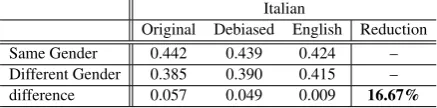
The algorithm worked well in the sense that the bias of all inanimate nouns, when measured by their projection on the gender dimension, be-came zero. However, it also failed: the similarities between the inanimate nouns themselves hardly changed. Table 3depicts the average similarities
5If this method doesn’t mitigate the bias we showed in
the previous section, then using inherently-neutral words ex-tracted from the vocabulary automatically cannot possibly work as well.
in Italian before and after debiasing.
This suggests that the information about the gender is deeply embedded in the representation and is not easy to remove in a post-processing phase. Specifically, zeroing the projection of a word’s vector on the gender direction is not enough in order to remove all gender informa-tion from the word’s representainforma-tion. The fact that similarities between words hardly change implies that the projection on the gender direction is not the only indication of gender. These results align with the findings discussed in Gonen and Gold-berg (2019).
We conclude that focusing on the projection of vectors on the gender direction is not the right way to go, and we opt to removing gender inflections from the context before training. We describe this in detail in the next section.
5 Removing Gender Inflection from the Context
As mentioned above, words in the surroundings of gender-marked nouns (e.g. articles, adjectives) are often inflected to agree with the gender of the noun they relate to. As we hypothesize that most of the effect shown in Section3is caused by this gender agreement, we try several schemes that aim to remove gender signals from the context.
A straight-forward approach would be to lem-matize all the words, which will remove all gender signals from the context of a word. However, this approach has two main downsides: 1) We would like to have a representation for all the words in the vocabulary, but changing also the target words will reduce the vocabulary size and result with missing words (we will no longer have different masculine and feminine forms for any word); 2) Lemmati-zation removes not only gender information, but also additional information (such as number and tense). While gender assignment is arguably arbi-trary, and does not translate to an actual physical property of inanimate nouns in reality, other prop-erties that agree with the noun, such as number, do hold in reality and signify actual properties of the target noun, which we prefer to preserve.
Italian German
Same-gender Diff-Gender difference Same-gender Diff-Gender difference
7–10
Og: 4884 Og: 12947 Og: 8063 Og: 5925 Og: 33604 Og: 27679 Db: 5523 Db: 7312 Db: 1789 Db: 7653 Db: 26071 Db: 18418 En: 6978 En: 2467 En: -4511 En: 4517 En: 8666 En: 4149
4–7
Og: 10954 Og: 15838 Og: 4884 Og: 19271 Og: 27256 Og: 7985 Db: 12037 Db: 12564 Db: 527 Db: 24845 Db: 22970 Db: -1875 En: 15891 En: 17782 En: 1891 En: 13282 En: 17649 En: 4367
0–4
[image:5.595.152.449.61.170.2]Og: 23314 Og: 35783 Og: 12469 Og: 50983 Og: 85263 Og: 34280 Db: 26386 Db: 28067 Db: 1681 Db: 60603 Db: 79081 Db: 18478 En: 57278 En: 53053 En: -4225 En: 41509 En: 62929 En: 21420
Table 2: Averages of rankings of the words in same-gender pairs vs. different-gender pairs for Italian and German, along with their differences.Ogstands for the original embeddings,Dbfor the debiased embeddings, andEnfor English. Each row presents the averages of pairs with the respective scores in SimLex-999 (0–4, 4–7, 7–10).
Italian
Original Debiased English Reduction
Same Gender 0.442 0.439 0.424 –
Different Gender 0.385 0.390 0.415 –
difference 0.057 0.049 0.009 16.67%
Table 3: Averages of similarities of pairs with same vs. different gender in Italian compared to the debiased version using Bolukbasi’s (2016) method. The last row is the difference between the averages of the two sets. “Reduction” stands for gap reduction after debiasing.
discussed above; 2) changing all the context words to the same gender, while keeping all other fea-tures of the words intact. Once the whole context is of the same gender, we essentially lose the gen-der information altogether as all nouns have simi-lar context, regardless their gender.6
5.1 The proposed approaches
We experiment with both lemmatization of context words and gender change of context words.
Lemmatization of Context Words When train-ing word2vec (Mikolov et al., 2013), we use a morphological analyzer to identify the lemmas of words, and replace context words, but not target words, with their lemmas.
Gender Change of Context Words When training word2vec, we choose a gender (for exam-ple, masculine) and change all context words to that gender: each word that is identified as being of a different gender (in Italian: feminine, in Ger-man: feminine or neutral), is changed to its mascu-line form. This is also done using a morphological
6
Context nouns are also kept unchanged since nouns do not agree with other nouns in their context, both in Italian and in German. Notably, in German, we lose the noun-ness information when we lowercase the corpus (as all nouns in German begin with an uppercase letter).
analyzer: when we identify a non-masculine anal-ysis, we search for a masculine one that shares the same lemma and features.
In general, we found Italian to work better with gender change, and German to work better with lemmatization. We report full results in Section6.
5.2 Challenges
While conceptually simple, fully neutralizing gen-der information is more challenging than it ini-tially appears, and requires careful attention to “get right”. We describe some cases in which gen-der information can leak.
Human Curator Choices The morphological analyzer sometimes assigns different lemmas to an opposite-gender pair, as a result of human curater design choices. For example, in Italian, “delle” is the feminine of “dei”, but they are assigned the lemmas “della” and “del”, respectively. Such cases leak gender signal in both cases of lemmati-zation and gender change: (1) When lemmatizing, each of the words gets a different lemma, mani-festing the gender. (2) When changing the gender, the opposite-gender form of the word is not iden-tified as these words do not share lemma, and the words stay unchanged.
This was very prominent in some high-frequency Italian words, and dealt with by fixing the analyzer: we identified all forms without a cor-responding gendered-pair, manually aligned them, and assigned each pair a shared and unique lemma. This fix dramatically improved results when using either lemmatization or gender change.
[image:5.595.74.293.242.296.2]Italian. First, many German words are ambigu-ous with respect to gender. For example, “eine” has a frequent feminine reading, but also a rare masculine one. When changing words to line, this word is identified as potentially mascu-line, and kept intact. The presence of the context word “eine” now leaks a feminine signal.7
Second, Italian has many cases of two words with a similar set of possible lemmas but with dif-ferent gender. For example, “usato” and “usata” are masculine and feminine, respectively, and both have “usare” and “usato” as possible lemmas. If we select a consistent lemma for each word type, and end up selecting a different lemma for each of “usato” and “usata”, we again leak signal regard-ing the original gender.
One solution would be to use context-sensitive lemmatization, that chooses the correct analysis in context. However, doing this accurately is still an open problem. Our proposed solution is to ran-domly sample a lemma per word token. This im-proved lemmatization results in Italian by 25%.
Multiple Opposite-gender Forms for a Word In some cases, a single word might have multi-ple forms in the opposite gender. For exammulti-ple, the Italian “delle” is the feminine form of both “dei” and “degli”, depending on the phonetic context. In this case, the former is much more common than the latter. A naive approach that chooses to convert “delle” to “degli” essentially keeps the feminine signal for these cases: every instance of “delle” changes to “delgli”, which marks masculine nouns in much less common cases, while most mascu-line nouns are usually accompanied with the more common word “dei”.
Ideally, when changing the gender of a word, we want to change a word by another word with a similar frequency, otherwise, the gender signal will be manifested in the frequency mismatch, as in the example above.
We deal with this issue using the following heuristic: when changing to masculine form (or any other gender form), for each word we first find all its possible masculine forms. Then, we check the frequency of the original word in the corpus, and choose the option with the closest frequency to it. This indeed yields better results: when not addressing the frequency issue in Italian, we are
7A possible solution would be to replace words with their
lemmas whenever we identify both feminine and masculine analyses. This did not improve results in practice.
able to reduce the effect only by 35.42% (com-pared to 91.67%, see Section6for more details).
6 Results
We experimented with different schemes for each language, measuring their success at removing gender bias of inanimate nouns with respect to En-glish.8
For German, we found lemmatization to work better than gender change. In Italian gender change got better results. Specifically, changing to feminine got much better results than changing to masculine, probably due to less ambiguity when changing to feminine in some very common arti-cles (see full manual mapping in the Appendix), resulting in fewer cases in which the gender sig-nal leaks through the frequencies of the changed words, as explained above. In addition, the man-ual fixes to the lemmatizer were crucial to get sat-isfying results for both methods.
While some of these findings depend on the spe-cific morphological analyzer in use, the challenges and issues we demonstrate are relevant in any case.
6.1 Reduction in Gender Bias
Differences in Similarities We repeat the exper-iment in Section 3.2—computing the average of pair similarities in each of the sets defined in Sec-tion 3, this time with the embeddings trained af-ter removing gender signal from the context (de-biasing). Table4shows the results for Italian and German, compared to English, both for the orig-inal and the debiased embeddings (for each lan-guage we show the results of the best performing debiased embeddings). As expected, in both lan-guages, the difference between the average of the two sets with the debiased embeddings is much lower. In Italian, we get a reduction of 91.67% of the gap with respect to English. In German, we get a reduction of 100%. Note that for both lan-guages, the main change is in the set of different-gender pairs, and not in the same-different-gender pairs. This makes sense as same-gender words have sim-ilar contexts both before and after our intervention, but different-gender words have different contexts before, but much more similar contexts after.
For comparison, in Italian we got 12.50% re-duction when using the lemmatization scheme,
8We used state-of-the-art morphological analyzers for
(a) (b)
Figure 1: The new rank of a word in the nearest neighbor list of its paired word. In cyan (+) – pairs with the same gender, in purple (·) – pairs with different gender. Most words with same-gender are located abovey =x(were drifted apart), while most words with different-gender are located below it (got closer together).
Italian German
Original Debiased English Reduction Original Debiased English Reduction
Same Gender 0.442 0.434 0.424 – 0.491 0.478 0.446 –
Different Gender 0.385 0.421 0.415 – 0.415 0.435 0.403 –
difference 0.057 0.013 0.009 91.67% 0.076 0.043 0.043 100%
Table 4: Averages of similarities of pairs with same vs. different gender in Italian and German compared to English. The last row is the difference between the averages of the two sets. “Reduction” stands for gap reduction when removing gender signals from the context.
and 68.75% reduction when lemmatizing with the addition of the manual mapping. For German, the best result using gender change was a reduction of 48.48%, achieved by changing to neutral.
Rank in Nearest Neighbor List We repeat the experiment shown in Section 3.3—for each pair we compute the rank of the second word in the nearest neighbor list of the first word and vice versa. Then we compare the average ranking in each of the defined sets. Table 2 shows the re-sults for Italian and German, both for the original and the debiased embeddings. As we expect, the difference between the average ranking of the two sets drops significantly for both languages.
In order to get a better picture of how the rank-ings of the different words change as a result of the gender signal removal, we take all pairs (and the inverted pairs). For each pair we plot the new rank of the second word in the nearest neighbors list of the first word as a function of its origi-nal rank before debiasing. Points above y = x
are of words that got a higher rank (lower in the list, farther from the first word), while points be-low this line are of words that got a be-lower rank (higher in the list, closer to the first word). Fig-ure 1 shows these plots for Italian and German. As expected, most words of same-gender pairs are
located above the line (were drifted apart), while most words of different-gender pairs are located below the line (got closer together).
6.2 Improvement in Word Similarities
Qualitative Evaluation As a qualitative evalu-ation, we take several words for SimLex-999 and look at their top-10 nearest neighbor lists, before and after applying our method. In Table 5 we show the top-10 lists for the words vaso (“jar ”-masculine) in Italian, andwelt(“world”-feminine) in German. It is evident that the words that are added to the list, are better correlated with the tar-get word than those that are removed. Two addi-tional words appear in the Appendix.
Evaluation on Simlex and WordSim-353 We evaluate the quality of the grammatical-gender-neutralized embeddings using two datasets for each language: SimLex-999 (Hill et al., 2015;
Leviant and Reichart, 2015) and WordSim-353 (Finkelstein et al., 2002; Leviant and Reichart,
2015). Table 6 shows the results for Italian and German for both datasets, compared to the orig-inal embeddings. In both cases, the new embed-dings perform better than the original ones.
[image:7.595.112.488.257.313.2]Italian German vaso(jar-masculine) welt(world-feminine)
Orig Debias Orig Debias
coccio vasi welt” europas
recipiente ciotola europas welt”
otre bacinella(basin) scheibenwelt scheibenwelt
cinerario recipiente h¨asslichsten universum(universe)
vasetto coccio erde(earth) menschheitsgeschichte(human history)
bacile(basin) cinerario weltgeschichte(world history) h¨asslichsten
kantharos otre kl¨ugste(wisest) menschheit(mankind)
vasi vasetto kl¨ugsten(wisest) schwarzafrikas
vassoio(tray) brocca(pitcher) schwarzafrikas parallelwelten(parallel worlds)
[image:8.595.116.486.63.206.2]coperchio(cover) scodella(bowl) lustigsten(funniest) ulldart
Table 5: Examples of top-10 nearest neighbor lists for words in Italian and in German, before and after debiasing. In red (italic) are words that were removed from the list, and in blue (underlined) are words that were added to it. Translations to English (Google Translate) for the changed words are in parenthesis, when different from source.
Italian German
Orig Debias Orig Debias SimLex 0.280 0.288 0.343 0.356 WordSim 0.548 0.577 0.547 0.553
Table 6: Results on SimLex-999 and WordSim-353, in Italian and German, before and after debiasing.
a common semantic space, regardless of their na-tive language (Youn et al., 2016). To the extent that embeddings capture the semantics of words, we can thus expect embedding spaces to have a similar structure across languages. Youn’s state-ment concerns concepts and not words, however, and concepts can surface in many different forms in language, which interferes with how well em-bedding spaces align across languages (Søgaard et al., 2018). Thus, we expect grammatical gen-der to have a negative impact on alignability.
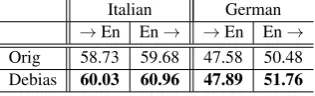
We explore this matter through the task of lingual embedding alignment, wherein a cross-lingual embedding space is learned through an alignment of independently pre-trained monolin-gual embeddings for a directed pair of languages. The quality of cross-lingual embeddings learned this way can be evaluated intrinsically on the task of bilingual dictionary induction (BDI). BDI queries the cross-lingual embedding space with a seed of words in one language, retrieves their counterparts among the words in the other lan-guage9and evaluates the precision of the produced translations against a set of gold standard targets. We carry out experiments using the supervised variant of the MUSE embedding alignment
sys-9This is done by minimizing a distance metric, most
com-monly, CSLS (Conneau et al.,2018).
Italian German
→En En→ →En En→
[image:8.595.338.496.276.324.2]Orig 58.73 59.68 47.58 50.48 Debias 60.03 60.96 47.89 51.76
Table 7: Cross-lingual embedding alignment in Italian and in German, before and after debiasing.
tem (Conneau et al., 2018) and report results on the inanimate portion of SimLex-999. We train a cross-lingual embedding alignment between En-glish and either German or Italian, using the orig-inal and the debiased embeddings for these two languages. The results reported in Table7 show that precision on BDI indeed increases as a result of the reduced effect of grammatical gender on the embeddings for German and Italian, i.e. that the embeddings spaces can be aligned better with the debiased embeddings.
7 Conclusion
We show that grammatical gender impacts word embeddings of inanimate nouns, both in Italian and in German, causing the similarities between words to change according to having same or dif-ferent gender: the representations of same-gender words are closer together than representations of different-gender words.
[image:8.595.94.271.276.323.2]to-gether with careful usage of it, are essential for achieving good results.10
In addition, this work serves as a reminder that languages other than English have different prop-erties that are rarely dealt with when processing English. These aspects should be taken into ac-count when dealing with morphologically reach languages, as not all models and algorithms for English can transfer directly to other languages.
8 Acknowledgements
The work was supported by the Israeli Science Foundation (grant number 1555/15) and by and the European Research Council (ERC Starting Grant iExtract 802774). We thank Valentina Py-atkin for the help with the Italian manual mapping.
References
Oded Avraham and Yoav Goldberg. 2017. The inter-play of semantics and morphology in word embed-dings. InProceedings of EACL.
Ali Basirat and Marc Tang. 2018. Lexical and morpho-syntactic features in word embeddings-a case study of nouns in swedish. InICAART.
Tolga Bolukbasi, Kai-Wei Chang, James Y Zou, Venkatesh Saligrama, and Adam T Kalai. 2016. Man is to computer programmer as woman is to
homemaker? debiasing word embeddings. In
Ad-vances in Neural Information Processing Systems.
Aylin Caliskan, Joanna J Bryson, and Arvind
Narayanan. 2017. Semantics derived automatically from language corpora contain human-like biases.
Science, 356(6334):183–186.
Alexis Conneau, Guillaume Lample, Marc’Aurelio Ranzato, Ludovic Denoyer, and Herv´e J´egou. 2018. Word Translation Without Parallel Data. In Pro-ceedings of ICLR 2018.
Greville G Corbett. 1991. Gender.
Greville G Corbett. 2006. Agreement. Cambridge Uni-versity Press.
Ryan Cotterell, Hinrich Sch¨utze, and Jason Eisner. 2016. Morphological smoothing and extrapolation of word embeddings. InProceedings of ACL.
Lev Finkelstein, Evgeniy Gabrilovich, Yossi Matias, Ehud Rivlin, Zach Solan, Gadi Wolfman, and Ey-tan Ruppin. 2002. Placing search in context: The
10
Indeed, before implementing the specific fixes described in Section5, the reduction compared to English when naively changing to masculine was substantially smaller, 35.42% re-duction compared to 91.67% in Italian, and 12.12% com-pared to 100.00% (with lemmatization) in German.
concept revisited. ACM Transactions on informa-tion systems.
Hila Gonen and Yoav Goldberg. 2019. Lipstick on a pig: Debiasing methods cover up systematic gender biases in word embeddings but do not remove them. InProceedings of NAACL-HLT.
Zellig S Harris. 1954. Distributional structure. Word, 10(2-3).
Felix Hill, Roi Reichart, and Anna Korhonen. 2015. Simlex-999: Evaluating semantic models with (gen-uine) similarity estimation. Computational Linguis-tics, 41(4).
Ira Leviant and Roi Reichart. 2015. Separated
by an un-common language: Towards
judg-ment language informed vector space modeling.
arXiv:1508.00106.
Omer Levy and Yoav Goldberg. 2014. Dependency-based word embeddings. InProceedings of ACL.
Tomas Mikolov, Kai Chen, Greg Corrado, and Jeffrey Dean. 2013. Efficient estimation of word represen-tations in vector space.arXiv:1301.3781.
Jeffrey Pennington, Richard Socher, and Christopher D Manning. 2014. Glove: Global vectors for word representation. InProceedings of EMNLP 2014.
Rana Aref Salama, Abdou Youssef, and Aly Fahmya. 2018. Morphological word embedding for arabic. InACLing.
Anders Søgaard, Sebastian Ruder, and Ivan Vuli´c. 2018. On the limitations of unsupervised bilingual dictionary induction. InProceedings of ACL.
Ivan Vuli´c, Nikola Mrkˇsi´c, Roi Reichart, Diarmuid ´O S´eaghdha, Steve Young, and Anna Korhonen. 2017. Morph-fitting: Fine-tuning word vector spaces with simple language-specific rules.arXiv:1706.00377.
Hyejin Youn, Logan Sutton, Eric Smith, Cristopher Moore, Jon F. Wilkins, Ian Maddieson, William
Croft, and Tanmoy Bhattacharya. 2016. On the
universal structure of human lexical semantics. In
NIPS.
Nasser Zalmout and Nizar Habash. 2017. Don’t throw those morphological analyzers away just yet: Neural morphological disambiguation for arabic. In Pro-ceedings of EMNLP. Association for Computational Linguistics.
Jieyu Zhao, Yichao Zhou, Zeyu Li, Wei Wang, and
Kai-Wei Chang. 2018. Learning gender-neutral word
embeddings. arXiv preprint arXiv:1809.01496.
Ran Zmigrod, Sebastian J Mielke, Hanna Wallach,
and Ryan Cotterell. 2019. Counterfactual data
augmentation for mitigating gender stereotypes in
languages with rich morphology. arXiv preprint