Proceedings of the CoNLL 2018 Shared Task: Multilingual Parsing from Raw Text to Universal Dependencies, pages 248–255 248
AntNLP at CoNLL 2018 Shared Task:
A Graph-based Parser for Universal Dependency Parsing
Tao Ji, Yufang Liu, Yijun Wang, Yuanbin Wu, Man Lan 1Department of Computer Science and Technology
2East China Normal University
{taoji, yfliu, yjwang}[email protected] {ybwu, mlan}@cs.ecnu.edu.cn
Abstract
We describe the graph-based dependency parser in our system (AntNLP) submitted to theCoNLL 2018 UD Shared Task. We use bidirectional lstm to get the word rep-resentation, then a bi-affine pointer net-works to compute scores of candidate de-pendency edges and the MST algorithm to get the final dependency tree.
From the official testing results, our sys-tem gets 70.90 LAS F1 score (rank 9/26), 55.92 MLAS (10/26) and 60.91 BLEX (8/26).
1 Introduction
The focus of the CoNLL 2018 UD Shared Task
is learning syntactic dependency parsers that can work over many typologically different languages, even low-resource languages for which there is lit-tle or no training data. The Universal Dependen-cies (Nivre et al.,2017a,b) treebank collection has 82 treebanks over 57 kinds of languages.
In this paper we describe our system (AntNLP) submitted to the CoNLL 2018 UD Shared Task. Our system is based on the deep biaffine neural dependency parser (Dozat and Manning, 2016). The system contains a BiLSTM feature extractor for getting context-aware word representation and two biaffine classifiers to predict the head token of each word and the label between a head and its dependent.
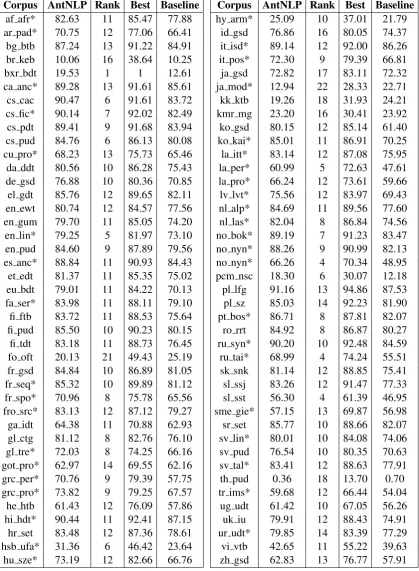
[image:1.595.317.515.217.481.2]There are three main metrics for this task, LAS (labeled attachment score), MLAS (morphology-aware labeled attachment score) and BLEX (bi-lexical dependency score). From the official testing results, our system gets 70.90 LAS F1 score (rank 9/26), 55.92 MLAS (10/26) and 60.91 BLEX (8/26). In a word, Our system is ranked top 10 according to the three metrics described above.
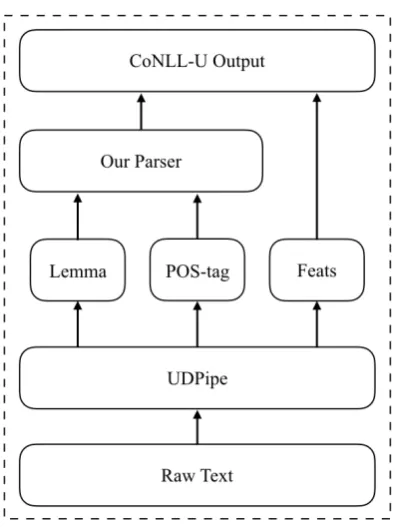
Figure 1: The structure of the entire system.
Additionally, in the categories of small treebanks, our system obtains the sixth place with a MLAS score of 63.73. Besides that, our system ranked tenth in the EPE 2018 campaign with a 55.71 F1 score.
The rest of this paper is organized as follows. Section 2 gives a brief description of our over-all system, including the system framework and parser architecture. In Section 3, 4 we describe our monolingual model and multilingual model. In Section 5, we briefly list our experimental re-sults.
2 System Overview
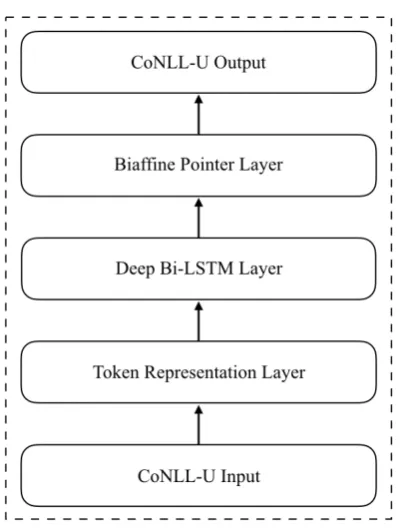
Figure 2: The architecture of our parser system.
the parsing model, but also preprocess systems of the sentence segmentation, tokenization, POS-tagging and morphological analysis. We use pre-processors from the official UDPipe tool in our submission. The structure of the entire system is shown in Figure1. Our main focus is on building a graph-based parser.
We implement a graph-based bi-affine parser followingDozat and Manning(2016). The parser architecture is shown in Figure2, which consists of the following components:
• Token representation, which produces the context independent representation of each token in the sentence.
• Deep Bi-LSTM Encoder, which produces the context-aware representation of each to-ken in the sentence based on context.
• Bi-affine Pointer Networks, which assign probabilities to all possible candidate edges.
We describe the three sub-modules in the follow-ing sections in detail.
2.1 Token representation
Recent studies on dependency parsing show that densely embedded word representation could help to improve empirical parser performance. For ex-ample:Chen and Manning(2014) map words and
POS tags to ad-dimensional vector space. Dozat and Manning (2016) use the pre-trained GloVe embeddings as an extra representation of the word.
Ma et al. (2018) use Convolutional Neural Net-works (CNNs) to encode character-level informa-tion of a word.
The token representation module of our parser also uses dense embedding representations. De-tails on token embeddings are given in the follow-ing.
• Word ew
i : The word embedding is ran-domly initialized from the normal distribu-tionN(0,1)(ewi ∈R100).
• Lemma eli: The lemma embedding is ran-domly initialized from the normal distribu-tionN(0,1)(eli∈R100).
• Pre-trained Wordepwi : The FastText pre-trained word embedding (epwi ∈ R300). We will not update epwi during the training pro-cess.
• UPOSeui: The UPOS-tag embedding is ran-domly initialized from the normal distribu-tionN(0,1)(eui ∈R100).
• XPOSexi: The XPOS-tag embedding is ran-domly initialized from the normal distribu-tionN(0,1)(exi ∈R100).
• Char eci: The character-level embedding is obtained by the character-level CNNs (eci ∈
R64).
Our parser uses two kinds of token represen-tations, one is a lexicalized representation of the monolingual model, another one is the delexical-ized representation of the multilingual model.
The lexicalized representationxli of tokenwiis
defined as:
xli= [ewi +eli;
| {z } word
eui +exi
| {z } P OS
; epwi ; eci] (1)
and the delexicalized representation xdi of token
wiis defined as:
xdi = [eui; exi; eci] (2)
In the following sections, we usesxi to represent
2.2 Deep Bi-LSTM Encoder
Generally, the token embeddings defined above are context independent, which means that the sentence-level information is ignored. In recent years, some work shows that the deep BiLSTM can effectively capture the contextual informa-tion of words (Dyer et al.,2015;Kiperwasser and Goldberg, 2016; Dozat and Manning, 2016; Ma et al.,2018).
In order to encode context features, we use a 3-layer sentence level BiLSTM on top ofx1:n:
~ht= LSTM(~ht−1, xi, ~θ)
~h
t= LSTM( t~h+1, xi, ~θ)
vi=~hi◦ i~h
~
θare the model parameters of the forward hidden sequence ~h. ~θ are the model parameters of the backward hidden sequence ~h. The vectorvi is our
final vector representation ofith token ins, which takes into account both the entire history~hi and
the entire future i~h by concatenating~hiand i~h.
2.3 Biaffine Pointer Networks
How to determine the probability of each depen-dency edge is an important part of the graph-based parser. The work of Dozat and Manning
(2016) shows that the biaffine pointer (attention) networks can calculate the probability of each de-pendency edge well. Here we used a similar bi-affine pointer network structure.
In order to better represent the direction of the dependency edges, we use multi-layer perceptron (MLP) networks to learn each word as the repre-sentation of head and dependent words, rather than simply exchanging feature vectors. And we also separate the predictions of dependent edges and their labels. First, for eachvi, we use two MLPs
to define two pointersharci andsarci , which is the representation of vi with respect to whether it is
seen as a head or a modifier of an candidate edge.
harci = MLP(headarc)(vi)
sarci = MLP(deparc)(vi)
Similarly, we usehrel
i andsrelto describexiwhen
determine the relation label of a candidate edge.
hreli = MLP(headrel)(vi)
sreli = MLP(deprel)(vi)
We first use the arc-biaffine pointer networks to predict the probability of a dependency edge be-tween any two words. For any two wordswi and
wj in a sentence, the probability p(iarc→j) that they
form a dependency edgewi→wj is as follows:
a(i→arcj)=harci ·W(arc)·sarcj +u(arc)·sarcj
p(i→arcj)= softmax(a(i→∗arc))[j]
whereθarc = {W(arc), u(arc)}are the model pa-rameters, a(i→arcj) is the computed score of the de-pendency edge. a(iarc→∗) is a vector, and the kth
dimension is the score of the dependency edge
ai(→arck). pi(→arcj) is thejth dimension of normaliza-tion of the vectora(i→∗arc), meaning the probability of dependency edgewi →wj.
We obtain a dependency tree representation T
of a complete graph p(∗→∗arc) using the maximum
spanning tree (MST) algorithm. The probability
p(rel)
i−→jr of the relation r of each dependency edge
wi→wj ∈T is then computed. The definition of
p(rel)
i−→jr is as follows:
a(rel)
i−→j∗ =h rel
i ·W(rel)·srelj
+ V(rel)·hreli + U(rel)·srelj
p(rel)
i−→jr = softmax(a
(rel)
i−→j∗ )[r]
where θrel = {W(rel),V(rel),U(rel)} are the model parameters,W(rel) is a 3-dimensional ten-sor.a(rel)
i−→j∗ is a vector, and thek
thdimension is the
score of the dependency edgewi −→k wj.
2.4 Training Details
We train our model by minimizing the negative log
likelihood of the gold standard(wi r(wi)
−−−→wh(wi)) arcs in all training sentences:
J(arc)=− 1 |τ|
X
S∈τ NS
X
i=1
logp(iarc→h)(wi)
J(rel)=− 1 |τ|
X
S∈τ NS
X
i=1
logp(rel)
i−−−→hr(wi) (wi)
J =J(arc)+J(rel)
whereτ is the training set,h(wi)andr(wi)iswi’s
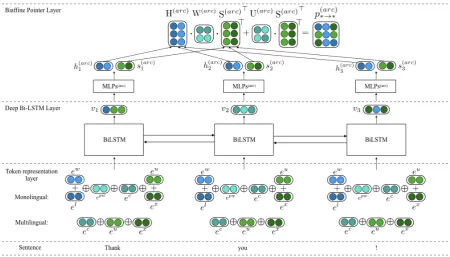
Figure 3: The architecture of our parser system.
3 Monolingual Model
There are 82 treebanks in the CoNLL 2018 UD Shared Task, including 61 big treebanks, 5 PUD treebanks (additional parallel test sets), 7 small treebanks and 9 low-resource language treebanks. There are several languages in which there are many treebanks, such as en ewt, en gum and
en lines in English. We combine training sets and development sets for multiple treebanks of the same language. And then just train a model for the language and make predictions on its different treebanks.
For each language of UD version 2.2 sets (Nivre et al.,2018;Zeman et al.,2018) with both a train-ing set and a development set, we train a parser using lexicalized token representation and only us-ing its monolus-ingual trainus-ing set (no cross-lus-ingual features)1 . The architecture of the monolingual model is shown in Figure3.
4 Multilingual Model
For 7 languages without a development set, we di-vide them into two classes based on the size of their training set, which can be fine-tuned (ga,
sme) and can not be fine-tuned (bxr, hsb, hy, kk,
kmr).
For each language of UD version 2.2 sets (Nivre
1In total, we trained 46 monolingual models.
et al.,2018;Zeman et al.,2018) with both a train-ing set and a development set, we train a parser us-ing delexicalized token representation as a cross-language model. The architecture of the multilin-gual model is shown in Figure 3. The training set of these 5 languages are then used as a de-velopment set to validate the performance of each cross-language model (see Table 1). We select the best performance model as a cross-language model for the corresponding language. For both
gaandsme, we manually divide the development set from the training set and fine-tune the cross-language model. Prediction and fine-tuning results are shown in the Table2.
5 Experimental Results
We trained our system based on a Nvidia GeForce GTX Titan X. We used the official TIRA (Potthast et al.,2014) to evaluate the system.
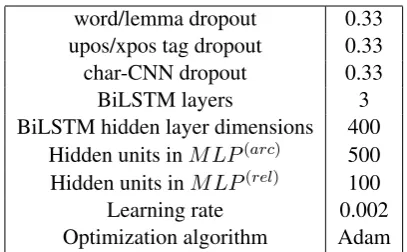
We used Dynet neural network library to build our system (Neubig et al., 2017). The hyper-parameters of the final system used for all the re-ported experiments are detailed in Table5.
5.1 Overall Results
Language #Train Cross language LAS
[image:5.595.158.440.86.170.2]Buryat (bxr) 19 Uyghur (ug) 27.45 Upper Sorbian (hsb) 23 Croatian (hr) 39.35 Armenian (hy) 50 Latvian (lv) 29.35 Kazakh (kk) 9 Turkish (tr) 23.44 Kurmanji (kmr) 19 Persian (fa) 26.03
Table 1: Corpus listed above are languages that don’t have development set and the training set size is too small to be fine-tuned. “#Train” means the number of sentences. “Cross Language” means the language with the highest LAS score for corresponding origin language in our delexicalized cross-language model.
Corpus #Total #Train #Dev Cross language LAS Fine-tune
Irish (ga) 566 476 90 Hebrew (he) 36.13 68.49 North Sami (sme) 2464 1948 516 Swedish (sv) 36.13 63.00
Table 2: Corpus listed above are languages that don’t have development set. Because the training set size is much bigger, we decide to divide the training set into two parts, one for training set and the other for development set.
Origin language language family Cross Language Language family
Buryat (bxr) Mongolic Uyghur (ug) Turkic Southeastern Upper Sorbian (hsb) IE Slavic Croatian (hr) IE Slavic Armenian (hy) IE Armenian Latvian (lv) IE Baltic Kazakh (kk) Turkic Northwestern Turkish (tr) Turkic Southwestern Kurmanji (kmr) IE Iranian Persian (fa) IE Iranian Irish (ga) IE Celtic Hebrew (he) Afro-Asiatic Semitic North Sami (sme) Uralic Sami Swedish (sv) IE Germanic
Table 3: language families and genera for origin language and cross language (IE = Indo-European).2
Corpus FLAS Baseline Rank MLAS Baseline Rank BLEX Baseline Rank
All treebanks(82) 70.90 65.80 9 55.92 52.42 10 60.91 55.80 8 Big treebanks(61) 79.61 74.14 12 65.43 61.27 11 70.34 64.67 9 PUD treebanks(5) 68.87 66.63 11 53.47 51.75 10 57.71 54.87 8 Small treebanks(7) 63.73 55.01 6 42.24 38.80 7 48.31 41.06 6 Low resource(9) 18.59 17.17 10 3.43 2.82 9 8.61 7.63 8
word/lemma dropout 0.33 upos/xpos tag dropout 0.33 char-CNN dropout 0.33 BiLSTM layers 3 BiLSTM hidden layer dimensions 400
Hidden units inM LP(arc) 500 Hidden units inM LP(rel) 100 Learning rate 0.002 Optimization algorithm Adam
Table 5: Hyper-parameter values used in shared task.
of 26 teams. Compared to the baseline obtained with UDPipe1.2 (Straka et al.,2016), our system gained 5.10 LAS improvement on average. Our system shows better results on 7 small treebanks. Performance improvement are more obvious when considering only small treebanks(for example, our system ranked fourth best onru taigaandsl sst). Besides that, our system ranked tenth in the EPE3 2018 campaign with a 55.71 F1 score.
5.2 Discussion on Multilingual Model
As described in section 4, we trained 46 cross-language models and selected the corresponding cross-language model for 7 languages that did not have a development set. Generally, cross-language models are trained in the language of the same family. However, apart from grammatical similar-ity, the language family division also considers the linguistic history, geographical location and other factors. We want to select a language’s cross-language model to consider only grammatical sim-ilarity. So we use a cross-language model to pre-dict the results in this language as a basis for se-lection.
In table3, the experimental results show that the Cross-language model with the best performance inhsb,hy,kk, andkmr languages comes from the same language family, while the Cross-language model with the best performance inbxr, ga, and
smeis not from the same language family. There-fore, constructing a cross-language model accord-ing to the language of the same family is only ap-plicable to some languages, not all of them. We’ve only chosen the best performing cross-language model at the moment. In the future, we will try to select the top-kcross-language model.
2
Information from http://universaldependencies.org.
3http://epe.nlpl.eu
6 Conclusions
In this paper, we present a graph-based depen-dency parsing system for the CoNLL 2018 UD Shared Task, which composed of a BiLSTMs fea-ture extractor and a bi-affine pointer networks. The results suggests that a deep BiLSTM extrac-tor and a bi-affine pointer networks is a way to achieve competitive parsing performances. We will continue to improve our system in our future work.
Acknowledgments
References
Danqi Chen and Christopher D Manning. 2014. A fast and accurate dependency parser using neural
net-works. InEmpirical Methods in Natural Language
Processing (EMNLP).
Timothy Dozat and Christopher D. Manning.
2016. Deep biaffine attention for neural
de-pendency parsing. CoRR abs/1611.01734.
http://arxiv.org/abs/1611.01734.
Chris Dyer, Miguel Ballesteros, Wang Ling, Austin
Matthews, and Noah A. Smith. 2015.
Transition-based dependency parsing with stack long
short-term memory. In Proceedings of the 53rd
An-nual Meeting of the Association for Computa-tional Linguistics and the 7th InternaComputa-tional Joint Conference on Natural Language Processing of the Asian Federation of Natural Language Pro-cessing, ACL 2015, July 26-31, 2015, Beijing, China, Volume 1: Long Papers. pages 334–343. http://aclweb.org/anthology/P/P15/P15-1033.pdf.
Eliyahu Kiperwasser and Yoav Goldberg.
2016. Simple and accurate dependency
parsing using bidirectional LSTM
fea-ture representations. TACL 4:313–327.
https://transacl.org/ojs/index.php/tacl/article/view/ 885.
Xuezhe Ma, Zecong Hu, Jingzhou Liu, Nanyun Peng,
Graham Neubig, and Eduard H. Hovy. 2018.
Stack-pointer networks for dependency parsing. CoRR
abs/1805.01087.http://arxiv.org/abs/1805.01087.
Graham Neubig, Chris Dyer, Yoav Goldberg, Austin Matthews, Waleed Ammar, Antonios Anastasopou-los, Miguel Ballesteros, David Chiang, Daniel Clothiaux, Trevor Cohn, Kevin Duh, Manaal Faruqui, Cynthia Gan, Dan Garrette, Yangfeng Ji, Lingpeng Kong, Adhiguna Kuncoro, Gaurav Ku-mar, Chaitanya Malaviya, Paul Michel, Yusuke Oda, Matthew Richardson, Naomi Saphra, Swabha
Swayamdipta, and Pengcheng Yin. 2017. Dynet:
The dynamic neural network toolkit. arXiv preprint
[image:6.595.79.283.60.186.2]Corpus AntNLP Rank Best Baseline
af afr* 82.63 11 85.47 77.88 ar pad* 70.75 12 77.06 66.41 bg btb 87.24 13 91.22 84.91 br keb 10.06 16 38.64 10.25 bxr bdt 19.53 1 1 12.61 ca anc* 89.28 13 91.61 85.61 cs cac 90.47 6 91.61 83.72 cs fic* 90.14 7 92.02 82.49 cs pdt 89.41 9 91.68 83.94 cs pud 84.76 6 86.13 80.08 cu pro* 68.23 13 75.73 65.46 da ddt 80.56 10 86.28 75.43 de gsd 76.88 10 80.36 70.85 el gdt 85.76 12 89.65 82.11 en ewt 80.74 12 84.57 77.56 en gum 79.70 11 85.05 74.20 en lin* 79.25 5 81.97 73.10 en pud 84.60 9 87.89 79.56 es anc* 88.84 11 90.93 84.43 et edt 81.37 11 85.35 75.02 eu bdt 79.01 11 84.22 70.13 fa ser* 83.98 11 88.11 79.10 fi ftb 83.72 11 88.53 75.64 fi pud 85.50 10 90.23 80.15 fi tdt 83.18 11 88.73 76.45 fo oft 20.13 21 49.43 25.19 fr gsd 84.84 10 86.89 81.05 fr seq* 85.32 10 89.89 81.12 fr spo* 70.96 8 75.78 65.56 fro src* 83.13 12 87.12 79.27 ga idt 64.38 11 70.88 62.93 gl ctg 81.12 8 82.76 76.10 gl tre* 72.03 8 74.25 66.16 got pro* 62.97 14 69.55 62.16 grc per* 70.76 9 79.39 57.75 grc pro* 73.82 9 79.25 67.57 he htb 61.43 12 76.09 57.86 hi hdt* 90.44 11 92.41 87.15 hr set 83.48 12 87.36 78.61 hsb ufa* 31.36 6 46.42 23.64 hu sze* 73.19 12 82.66 66.76
Corpus AntNLP Rank Best Baseline
hy arm* 25.09 10 37.01 21.79 id gsd 76.86 16 80.05 74.37 it isd* 89.14 12 92.00 86.26 it pos* 72.30 9 79.39 66.81 ja gsd 72.82 17 83.11 72.32 ja mod* 12.94 22 28.33 22.71 kk ktb 19.26 18 31.93 24.21 kmr mg 23.20 16 30.41 23.92 ko gsd 80.15 12 85.14 61.40 ko kai* 85.01 11 86.91 70.25 la itt* 83.14 12 87.08 75.95 la per* 60.99 5 72.63 47.61 la pro* 66.24 12 73.61 59.66 lv lvt* 75.56 12 83.97 69.43 nl alp* 84.69 11 89.56 77.60 nl las* 82.04 8 86.84 74.56 no bok* 89.19 7 91.23 83.47 no nyn* 88.26 9 90.99 82.13 no nyn* 66.26 4 70.34 48.95 pcm nsc 18.30 6 30.07 12.18 pl lfg 91.16 13 94.86 87.53 pl sz 85.03 14 92.23 81.90 pt bos* 86.71 8 87.81 82.07 ro rrt 84.92 8 86.87 80.27 ru syn* 90.20 10 92.48 84.59 ru tai* 68.99 4 74.24 55.51 sk snk 81.14 12 88.85 75.41 sl ssj 83.26 12 91.47 77.33 sl sst 56.30 4 61.39 46.95 sme gie* 57.15 13 69.87 56.98 sr set 85.77 10 88.66 82.07 sv lin* 80.01 10 84.08 74.06 sv pud 76.54 10 80.35 70.63 sv tal* 83.41 12 88.63 77.91 th pud 0.36 18 13.70 0.70 tr ims* 59.68 12 66.44 54.04
ug udt 61.42 10 67.05 56.26 uk iu 79.91 12 88.43 74.91 ur udt* 79.85 14 83.39 77.29 vi vtb 42.65 11 55.22 39.63 zh gsd 62.83 13 76.77 57.91
[image:7.595.104.524.112.684.2]Joakim Nivre et al. 2017a. Universal Dependencies 2.0. LINDAT/CLARIN digital library at the Insti-tute of Formal and Applied Linguistics, Charles
Uni-versity, Prague, http://hdl.handle.net/
11234/1-1983. http://hdl.handle.net/11234/1-1983.
Joakim Nivre et al. 2017b. Universal Dependencies
2.0 CoNLL 2017 shared task development and test data. LINDAT/CLARIN digital library at the Insti-tute of Formal and Applied Linguistics, Charles
Uni-versity, Prague, http://hdl.handle.net/
11234/1-2184. http://hdl.handle.net/11234/1-2184.
Joakim Nivre et al. 2018. Universal
Dependen-cies 2.2. LINDAT/CLARIN digital library
at the Institute of Formal and Applied
Lin-guistics, Charles University, Prague, http:
//hdl.handle.net/11234/1-1983xxx.
http://hdl.handle.net/11234/1-1983xxx.
Martin Potthast, Tim Gollub, Francisco Rangel, Paolo Rosso, Efstathios Stamatatos, and Benno Stein.
2014. Improving the reproducibility of PAN’s
shared tasks: Plagiarism detection, author
iden-tification, and author profiling. In Evangelos
Kanoulas, Mihai Lupu, Paul Clough, Mark Sander-son, Mark Hall, Allan Hanbury, and Elaine Toms,
editors, Information Access Evaluation meets
Mul-tilinguality, Multimodality, and Visualization. 5th International Conference of the CLEF Initiative (CLEF 14). Springer, Berlin Heidelberg New York,
pages 268–299.
https://doi.org/10.1007/978-3-319-11382-1 22.
Milan Straka, Jan Hajiˇc, and Jana Strakov´a. 2016. UD-Pipe: trainable pipeline for processing CoNLL-U files performing tokenization, morphological
anal-ysis, POS tagging and parsing. In Proceedings
of the 10th International Conference on Language Resources and Evaluation (LREC 2016). European Language Resources Association, Portoro, Slovenia.
Dan Zeman et al. 2018. Universal Dependencies
2.2 CoNLL 2018 shared task development and test data. LINDAT/CLARIN digital library at the Insti-tute of Formal and Applied Linguistics, Charles
Uni-versity, Prague, http://hdl.handle.net/