Bachelor thesis
Redirecting the purchasing process
through reassignment of purchasing
tasks
Report data
Name
N. Leijnse
Student number
S1431560
Study
Industrial
Engineering and
Management
University
University of Twente
Faculty
Behavioral,
Management and
Social Sciences
Supervisors
Sandor Löwik
Leo van der Wegen
1
Management summary
This thesis describes the research that has been carried out at the purchasing department of Company A. Company A is growing very fast as a company. In a time span of five years the company grew from 30 employees to over 2000 employees. During the interviews, the employees of the purchasing department indicated that the company is growing too fast to handle the increasing workload. Besides that, higher management indicated that they are too busy checking the work of the employees with lower functions to focus on their other responsibilities. The employees of the purchasing department are dissatisfied with the current situation, because they cannot handle the amount of tasks they are assigned to. Therefore, the core problem is as follows:
Employees are assigned to too many tasks to handle
In order to solve this problem, the current situation is examined, a literature research is conducted and purchasing directors of comparable organizations are interviewed. The current situation of Company A is compared to the theoretical and practical research in order to determine the deficiencies. The outcome of this research is that the task portfolios of Company A could really use some improvement on three levels:
Delegation; in the current situation higher management is too busy checking the work of employees
with lower functions that they do not have enough time to focus on their own responsibilities. In order to improve this, more tasks should be delegated to employees with lower functions and higher management should check the processes of the department by tracking key performance indicators.
Separation of operational and strategic tasks; in the current situation most employees are involved
with operational as wells as strategic tasks. These two types of tasks require different skills and therefore it is better to separate them. Besides that, there is quite some overlap in tasks between the different functions right now because of this mixture of operational and strategic tasks. A separation of operational and strategic tasks leads to more specialization of functions and efficiency of processes.
Separating sourcing and contracting from inventory management and planning; in the current
situation the employees within the purchasing department perform a combination of these tasks. Theoretical and practical research show that it is more efficient to separate these tasks, because these tasks require different skills. Besides that, the current distribution of these tasks requires a lot of communication between different functions which decreases the efficiency of the process. A change in the distribution of these tasks would greatly increase the efficiency of the department.
The solution to the core problem is to adjust the task portfolios of the different functions within the purchasing department of Company A. In order to do that the following steps must be taken:
1. List all tasks that are involved with purchasing at Company A
2. Determine the functions needed and specify their task portfolio for purchasing at Company A 3. Develop the RACI diagram and the responsibility assignment model by Sommerville et al.
(2007) to build the appropriate governance and check the workload of the task portfolios 4. Compare the new task portfolios to the old task portfolios and assign employees to these new
task portfolios
5. Inform the employees about their new task portfolio and provide training where needed 6. Evaluation and development
2
3
Preface
In front of you lies the bachelor thesis of Nikki Leijnse. The bachelor thesis serves as the final assignment to complete the bachelor Industrial Engineering and Management at the University of Twente. This thesis describes the research that has been carried out between April and August in the year 2016 for Company A.
This research was a great learning experience for me. The research started with a wonderful trip to the headquarters of the company, during which I met all the employees of the purchasing department. They were very welcoming and I could ask them all the questions I wanted. Back in the Netherlands, the research continued with best practice field research at companies with similar organizational structures. It was fantastic to meet all these people and to learn so much about the purchasing processes of the different companies I visited.
I would like to thank all the employees of the purchasing department of Company A for their input, especially the Vice President of Operations and the Director of Planning and Purchasing who answered all my remaining questions after my visit to the headquarters. Besides that, I would like to thank the Sourcing Director of Company C and the Planning Director of Company B for the interviews. The information they provided was of great use in this research. Furthermore, I would like to thank Sandor Löwik and Leo van der Wegen as my supervisors from the university for their feedback and support. Their ideas gave me new insights for my thesis and made this thesis as it is today.
4
Table of contents
Management summary ... 1
Preface ... 3
Chapter 1 - Introduction ... 6
1.1 The company ... 6
1.2 Motive ... 6
1.3 Problem identification ... 7
1.4 Core problem ... 8
1.5 Problem solving approach ... 8
1.6 Stakeholders of the core problem ... 10
1.7 Limitations of the research project ... 10
Chapter 2 – Current task assignment at Company A ... 12
2.1 Tasks performed by the purchasing department of Company A ... 12
2.2 Functions within the purchasing department of Company A ... 12
2.3 Task assignment within the purchasing department of Company A ... 15
Chapter 3 – Growth Position of Company A ... 16
3.1 Growth stage according to Greiner (1998)... 16
3.2 The growth stage of Company A ... 19
Chapter 4 – Theoretical approach to purchasing activities at Company A ... 22
4.1 Purchasing activities according to Muller (2001) ... 22
4.2 Job descriptions according to the Purchasing and Procurement Center (2012)... 23
4.3 Job profiles according to Mulder et al. (2005) ... 24
4.4 Application of the theory to Company A ... 25
Chapter 5 – Company insight on purchasing activities ... 28
5.1 Purchasing processes at Company B ... 28
5.2 Purchasing processes at Company C ... 31
5.3 Useful company insights for Company A... 33
Chapter 6 – Task assigning methods ... 35
6.1 RACI Responsibility Matrix ... 35
6.2 Responsibility assignment by Sommerville et al. (2007) ... 36
6.3 Task assigning at Company A ... 38
6.4 Comparison of RACI diagrams ... 39
6.5 Comparison of Sommerville et al. (2007) models ... 41
Chapter 7 – Solution to the core problem ... 45
7.1 Key insights from the literature studies and company visits ... 45
5
7.1.2 Separating sourcing and contracting from planning and inventory management ... 45
7.1.3 Delegating tasks and responsibilities to employees with lower functions ... 46
7.2 Solution... 46
Chapter 8 – Implementation plan ... 48
Chapter 9 – Conclusion and recommendations ... 56
References ... 57
Appendix A – Job description Purchasing Manager ... 58
Appendix B – Job description Vendor Manager ... 59
Appendix C – Job description Demand Planner ... 60
Appendix D – List of purchasing tasks by Muller (2001) ... 61
Appendix E – Job description Purchasing Clerk ... 64
Appendix F – List of tasks per function ... 65
Appendix G – Tasks of the Purchasing Manager and Vendor Manager ... 68
Appendix H – RACI diagram ... 70
6
Chapter 1 - Introduction
1.1 The company
Company A was founded in 2008 and its headquarters are located in the United States of America. The research for this bachelor thesis takes place within the purchasing department of Company A. In this research the focus is put on the purchasing of products from contract manufacturers and vendors.
These contract manufacturers receive resources from Company A as well as external parties. The involvement of Company A in providing resources to their contract manufacturers ranges from those to where Company A only provides one component and the manufacturer sources all the other resources, to those that Company A provides everything and the contract manufacturer only provides the service of making a finished product of the components. At the end of the process Company A orders the final products from these contract manufacturers.
The relationship between Company A and the vendors is different from the relationship with the contract manufacturers as Company A is not involved at all in the manufacturing process of the vendors. Company A only purchases finished goods from the vendors and the vendors are completely responsible for everything related to the production of the goods.
The purchasing department of Company A is responsible for all purchasing activities of the company. Therefore the department works very closely with the contract manufacturers and vendors. As the contract manufacturers also have Company A owned inventory, the purchasing department is responsible for keeping track of this inventory as well.
1.2 Motive
After a Skype call with the purchasing department and an email with questions regarding possible areas of improvement, the manager of the purchasing department indicated a couple of problems. One of the biggest problems he mentioned, is the lack of inventory data of inventories held at contract manufacturers. As the purchasing department needs the inventory data in order to decide on the order quantities, this problem leads to incorrect order quantities. This in turn leads to too high or too low inventory levels for some materials. According to him there could be two causes that lead to this problem. The first cause is that the contract manufacturers do not report the inventory levels consistently to the purchasing department. The second cause is that that there is no unified process within the purchasing department so some people are working outside the system. However, the latter should be solved by the implementation of SAP in the beginning of May 2016 according to him as the software of SAP makes sure that there is a unified process within the whole company.
7
In accordance with the aforementioned situation, research is done at Company A to solve the problems within the purchasing department.
1.3 Problem identification
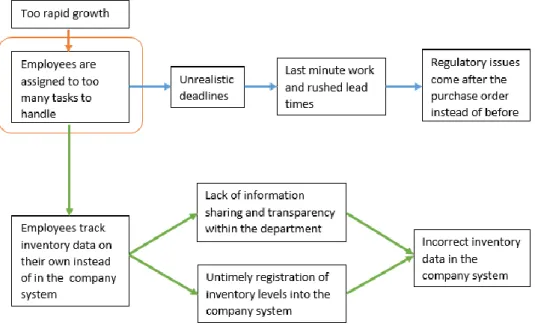
In this section the different problems that were mentioned in the interviews by the employees of the purchasing department are discussed. The problem cluster in Figure 1 gives a graphical representation of the causal relationships between those problems.
Figure 1: Problem cluster
Within the problem cluster two paths can be identified. The first path, the blue path, starts with too rapid growth and ends with regulatory issues that come after the purchase order instead of before. The problem with too rapid growth is that the workload grows faster than the number of employees can handle. This leads to the problem that employees are assigned to too many tasks to handle as a bigger workload must be carried by the same number of employees. This higher workload needs to be done in the same amount of time and therefore unrealistic deadlines are set for the projects. Because of these unrealistic deadlines, there is not enough time to finish every step as accurate as it should and a lot of work is done last minute. Besides that, people do not respect the lead times of products anymore but want everything to be finished sooner than possible. Normally, regulatory issues such as quality and price are thoroughly checked before a purchase order is sent to the supplier. Because of the unrealistic deadlines and rush, sometimes regulatory issues are only checked after the purchase order has already been sent. This is far too late as it is hard to go back and change what the supplier has signed up for.
8
and transparency within the purchasing department. Sometimes though, the information is put in the company system but then much later than it should be. The registration of the inventory levels in the company system is not in time and therefore not up to date. Because of the lack of information sharing and untimely registration of inventory levels, the inventory data in the company system is incorrect.
1.4 Core problem
According to the managerial problem solving approach by Heerkens (2012) there are a couple of rules that should be considered when choosing the core problem:
1. Only real problems that have a relation with other problems in the cluster should be included in the problem cluster.
2. The core problem should be a problem that has no other cause in the cluster. 3. If the problem cannot be solved, the problem cannot be the core problem. 4. The core problem should be the problem with the highest priority of solving it.
In the problem cluster all problems lead back to the problem of “Too rapid growth”. As the growth of a company cannot really be influenced that easily, this cannot be the core problem. The next problem in the cluster however, is a problem that could be solved. It has a high priority as it is the cause of many other problems. Therefore the core problem is as follows: “Employees are assigned to too many tasks
to handle”.
The norm of the core problem is that employees are assigned to the number of tasks they are able to handle. This means that all activities that come along with these tasks are executed well. The reality is that the employees are assigned to too many tasks to handle, which means that some activities that come along with those tasks are not completely finished or even left aside.
1.5 Problem solving approach
In order to solve the core problem, the managerial problem solving approach by Heerkens (2012) is used as a guideline. The first step of the approach by Heerkens (2012) is the identification of the action problem which is described in Sections 1.3 and 1.4 in this chapter. The second step of this approach is the problem solving approach, which is described in this section. The problem solving approach consists out of a list of the steps taken and the knowledge needed to take these steps. The remainder of this report describes the following steps:
1. Further analyze the current situation
2. Determine a solution that solves the core problem 3. Write an implementation plan for the company
These steps are based on the managerial problem solving approach by Heerkens (2012) but the execution of these steps is a bit different from how Heerkens (2012) suggests to execute the steps. Besides that, his approach includes one more step; the evaluation of the previous steps. Because of the time limit of this project, the real implementation and the evaluation must be done by the company itself.
In order to execute these steps, more information is needed. The first step requires information about the current situation. This information is gathered by answering the following empirical research questions:
1. Which tasks are performed by the purchasing department of Company A?
9
3. How are the tasks assigned to the different functions within the purchasing department of Company A?
The answers to these questions are gathered through interviews with the purchasing department of Company A and can be found in Chapter 2.
As the core problem is caused by the problem of too rapid growth, it is important to take this into consideration when analyzing the current situation further. The growth stage of a company plays a big role in how the organization is structured. This in turn has a big impact on the distribution and content of tasks. Therefore, information is needed on the growth stage of Company A and its purchasing department. The needed information is gathered by answering two theoretical research questions and one empirical research question:
1. What growth stages are there?
2. What are the characteristics of the different growth stages? 3. What growth stage does Company A belong to?
The answers to these questions are based on literature research on company growth and can be found in Chapter 3.
The second step requires information about the content and distribution of tasks within the purchasing department and how this should be done at Company A. The information needed for this step is split in two. First of all, information on the content of tasks is gathered by answering the following research questions:
1. Which tasks should be performed by the purchasing department? 2. What functions do there exist within Purchasing?
3. What tasks should be performed by which function?
The answers to these questions are based on empirical as well as theoretical research. In Chapter 4 literature research on tasks within purchasing and organizational structures within purchasing is used to provide a theoretical answer to the research questions mentioned above. Besides literature research, company visits at companies with organizational structures that are comparable to Company A are used as a source of information to provide an empirical answer to the same research questions. These empirical answers can be found in Chapter 5.
The second part of information needed is information about the distribution of tasks within the purchasing department. This information is gathered by answering the following theoretical research question: What is the best method to assign tasks to employees?
The answer to this question is based on a literature research on task assigning methods and can be found in Chapter 6.
The second step is to determine a solution that solves the core problem. As described above, Chapters 4 through 6 provide the information needed for this step. Chapter 7 combines this information and describes the solution to the core problem.
10
1.6 Stakeholders of the core problem
In the process of searching a solution for the core problem, a number of parties are involved. It is important to know who are involved with the problem, because this should be taken into account in order to get the most optimal solution for these parties.
The stakeholders of the core problem are the employees within the purchasing department of Company A. They are deeply involved in the problem as they are the people who are assigned to too many tasks to handle. Solving this problem means that their tasks and therefore their workload change.
The Director of Planning and Purchasing is a stakeholder as well. The employees within his department get too many tasks to handle which means that the department cannot function as good as he would like it to. Because of this, he is busy with making sure that everything is done correctly within the department rather than focusing on his other responsibilities.
The Vice President of Operations is also a stakeholder of the core problem. For him holds the same as for the Director of Planning and Purchasing. He is too busy with managing everything within the department that he does not have the time to focus on the things he should, such as long term strategy development.
Other stakeholders of the core problem are the contract manufacturers and vendors. Right now, the employees have so many tasks they have to handle that not everything can be done the way it should be done. One of the consequences is that the employees set unrealistic deadlines for their projects. This also affects the contract manufacturers and vendors as they play a big role in the projects as they need to manufacture and deliver the products. Therefore, the consequence is that the contract manufacturers and vendors are given tighter deadlines. Besides that, they sometimes already receive purchase orders before all the regulatory issues have been checked. Solving the core problem resolves these issues and improves the collaboration between Company A and their contract manufacturers and vendors.
1.7 Limitations of the research project
Because of the time limit of ten weeks, not all the steps of the managerial problem solving approach are completed. The evaluation step should be done by the company itself. The result is that the solution to the core problem indicated in this research project has not been assessed on its performance yet. Therefore, small adjustments might be made by the company after they have done an evaluation to make the solution fit better. In that case, the solution provided in this report differs from the final solution used by the company.
Besides that, this research project only provides an implementation plan. This means that this report explains all the steps that should be taken to solve the core problem but that the company has to take these steps itself. Therefore, the company might execute the steps a bit differently than intended as the company might interpret the steps differently. However, this report provides an example in which all the steps are executed. This example provides a basis for the company to work with and makes it more clear how the steps should be executed.
11
response. The result is that some details might be missing in the description of the current situation as it is easier to get those details when you observe the process yourself for a while instead of gaining all information through interviews with the people involved in the process. Besides that, an outsider might see other things than the employees themselves. Therefore, if more time was spent at the headquarters, the description of the current situation would most likely be more detailed.
12
Chapter 2 – Current task assignment at Company A
In this chapter the following research questions are answered:
1. Which tasks are performed by the purchasing department of Company A?
2. What are the job descriptions of the different functions within the purchasing department of Company A?
3. How are the tasks assigned to the different functions within the purchasing department of Company A?
The structure of this chapter is as follows. First, the general tasks of the purchasing department according to the Vice President of Operations and the Director of Planning and Purchasing are stated. Second, the organizational structure of the purchasing department is shown in a tree diagram to show who reports to whom. The tasks of the different functions are described one by one. These function descriptions are based on the interviews with the employees assigned to these functions and on job descriptions provided by the Director of Planning and Purchasing. The final section describes how the tasks are assigned to the different functions within the department.
2.1 Tasks performed by the purchasing department of Company A
According to the Vice President of Operations, the main task of the purchasing department is to develop and maintain relationships with third party manufacturers that enable:
1. Reductions to standard lead times 2. Meeting specifications
3. On time deliveries
4. Hitting target inventory levels for raw materials, packaging and finished goods 5. Accurate daily inventory reporting within SAP
6. Determination of yield or scrap rates 7. Competitive or reduced pricing
8. To determine foreign market oversight and management
According to the Director of Planning and Purchasing, the main task of the purchasing department is to purchase all materials needed and manage the suppliers of those materials. Management of suppliers includes management of delivery times and supplier inventory as well as relationship management and setting expectations.
2.2 Functions within the purchasing department of Company A
In Figure 2 on the next page, the organizational structure of the purchasing department is shown. The
13
Figure 2: Organizational structure of the purchasing department of Company A
CFO
The Chief Financial Officer (CFO) is the corporate officer who is responsible for managing all financial activities of the company. This includes tasks such as financial planning and record-keeping. This person is one of the founding executives of Company A and therefore also a member of the board of directors. He is the chief financial spokesperson of Company A and reports directly to the Chief Executive Officer (CEO) and the rest of the board on all strategic and tactical matters related to finance.
VP Operations
The task of the Vice President (VP) of Operations is to keep oversight on the operations side of the company. He has to keep oversight on and manage six different departments: planning and purchasing, manufacturing, strategic sourcing, quality, logistics and the product center. The directors of these departments report directly to him. Besides keeping oversight, he works together with the other Vice Presidents on long term companywide strategies.
Director Planning and Purchasing
The task of the Director of Planning and Purchasing is to keep oversight on the planning and purchasing activities. He determines the activities that need to be prioritized. Whenever a new project is introduced, he determines who will take on the project. The Purchasing Managers and the Planning Team report directly to him in order to keep him in the loop of the ongoing and finished projects.
Purchasing Manager
14
Vendor Manager
The person with the function Vendor Manager helps the Purchasing Manager with managing the vendors and contract manufacturers that supply products of a certain category. The tasks that are involved with this function are quite similar to the tasks of the Purchasing Manager and include: negotiating with vendors for goods and services, build and establish long term relationships with key suppliers, keeping track of inventory and sending purchase orders. A more detailed list of tasks can be found in Appendix B.
Sourcing Accessories
The person with the function Sourcing Accessories is involved in the following activities: 1. Sourcing accessory hard goods
2. Implementation of SAP 3. Convention
4. Design and sourcing for the holidays
The first activity includes the task of finding suppliers that can deliver the accessory hard goods. It is very important that the product of the supplier meets all the requirements of Company A and that the supplier is reliable.
The second activity includes the tasks of gathering the master data of the purchasing department from all the current systems that are used, cleansing the data, enriching the data where information is missing and making sure that all the data is loaded in SAP.
The third activity is done together with the events team. Convention is an event that takes place once a year at which all people working for Company A are thanked and new products for the coming season are announced. This person’s task is to source suppliers that can deliver the goods needed for convention.
In the fourth activity the task of this person is to find new suppliers for the products that are made especially for the holidays. Most of these suppliers are from China as the companies there offer the best prices.
All the sourcing tasks are in the form of project management. This person sources the suppliers and when everything is set and the suppliers are ready for purchase orders, the project is handed over to the Vendor Managers.
Planning Team
15
2.3 Task assignment within the purchasing department of Company A
The tasks of the purchasing department of Company A are assigned to the different functions by category. Every employee within the department is responsible for certain vendors and contract manufacturers within a product category. Every product category has a number of people who perform all purchasing tasks for the products in that category. It depends on the function of the person which tasks they are responsible for.
16
Chapter 3 – Growth Position of Company A
In this chapter the following research questions are answered:
1. What growth stages are there?
2. What are the characteristics of the different growth stages? 3. What growth stage does Company A belong to?
Company A is growing very fast as a company. Five years ago there were only 30 employees and right now there are over 2000 employees. This tremendous increase in number of employees changed a lot in the organizational structure and task assignment of the whole company.
The core problem that employees are assigned to too many tasks to handle, is closely related to company growth. When a company grows, the number of tasks and the content of these tasks change. If the number of tasks increases but the number of employees stays the same or does not grow in proportion to the number of tasks, the workload of the employees increases. Then, the employees are assigned to too many tasks to handle. Furthermore, if the content of the tasks changes, employees might be asked to do things they have not done before. It takes them more time to perform these tasks and therefore it feels as if their workload increases.
Besides that, if the number of employees increases, the structure of the organization changes. There are more people who are responsible for the tasks of the department. The tasks are redistributed over the different employees and their workload changes.
Moreover, when a company grows its strategy changes. If the strategy of the company changes, the processes and organizational structures within the company should change accordingly. This means that the departments are reorganized, people get different responsibilities and new people might be hired. The result is that the number of employees changes and that people are assigned to a different task portfolio than before.
In conclusion, the growth of a company has a big influence on the number of tasks and employees. These factors have a great influence on how the tasks are assigned to the different employees and what the organizational structure looks like. As this is closely related to the core problem, it is important to know what the growth position of Company A is.
The structure of this chapter is as follows. First, a literature study on growth stages is discussed in order to determine what growth stages exist and what their characteristics are. After that, this information is used to determine the growth stage Company A belongs to.
3.1 Growth stage according to Greiner (1998)
17
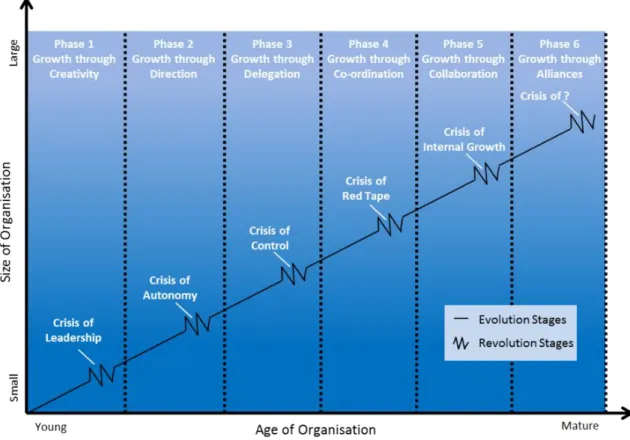
In Figure 3below, the six phases of growth according to Greiner (1998) can be found. Each evolutionary
stage shows the dominant management style used to achieve growth and each revolutionary stage shows the dominant management problem that must be solved to get to the next stage.
Figure 3: The six phases of growth (Greiner, 1998)
An important note to this model is that each phase is the result of the previous phase and a cause for the next phase. Besides that, the options are limited as a company stuck in a revolutionary stage cannot go back to the preceding evolutionary stage but must adopt a new management style in order to move forward.
In the creativity stage, when a company comes off the ground, the focus is put on creating both a product and a market. The founders of the company are mainly busy with making sure that the new product is made and sold. As the company is very small at this point, the communication between employees is frequent and informal. The decisions being made by management are based on the feedback of the marketplace. After the creativity stage comes the leadership crisis, which has to do with managerial problems. As the company grows, more people are hired. This increased number of employees needs professional management as informal communication does not work anymore. The founders of the company get more management responsibilities that they do not want. In order to get out of this crisis, a strong business manager should be hired who is fully accepted by the founders and who coordinates the organization.
18
Employees at lower levels have more knowledge about markets and machinery than their leaders but are not given the freedom to take initiative on their own. They are stuck with following procedures. Most companies solve this problem by moving toward more delegation. It is difficult for top management to give up responsibilities to lower level employees but this is needed in order to be able to put more focus on strategic decisions that have to be made.
The result of the previous revolution is phase three, the stage of delegation. In this stage the managers of plants and market territories are given much greater responsibility. The communication from top management is infrequent and usually by phone or brief visits. The organizational structure has become decentralized. This enables the company to expand because lower level managers can respond faster to the market and develop new products. The crisis that comes after this stage is the crisis of control. This is when top management seeks to regain control over the whole company and might even attempt to return to centralized management. It is important that top management finds a way to regain control through coordination techniques. The company cannot grow any further if top management decides to go back to a centralized structure. The company needs to act fast on the markets wishes and procedures take too long with centralized management to be able to do that.
In phase four, the coordination phase, top level management initiate and administer new formal systems in order to achieve greater coordination. The decentralized groups are turned into product groups. New staff is hired at the headquarters to initiate companywide programs of control and review for line managers. Data processing and other technical functions are centralized at the headquarters but daily decision-making remains decentralized. At the end of the coordination stage, a red-tape crisis occurs. In this crisis there is a lack of confidence between line managers and staff and between the headquarters and the field. The many systems that are introduced become useless as the organization has become too large and complex to be managed through these rigid systems.
Phase five in this model is the collaboration stage. In this stage the emphasis is put on interpersonal collaboration. The formal control is replaced by social control, self-discipline and spontaneity in management action through teams. Problem-solving is done by teams instead of managers and the teams are combined across functions to handle specific tasks. The appropriate teams are assigned to solve specific problems by a matrix-type structure. Further, the formal control systems are replaced by a single multipurpose system. Besides that, managers are trained in behavioral skills through educational programs to achieve better teamwork and real-time information systems are used for daily decision-making processes. At the end of this phase a crisis of internal growth emerges, which can only be overcome through developing partnerships with complementary organizations. The company cannot grow any further without the help of other companies as the company depends on them.
The final phase of this model is growth through extra-organizational solutions. Originally, Greiner proposed this model with five phases in 1972. He updated his original article in 1998 and added the sixth phase. This last phase suggests that mergers, outsourcing, networks and other solutions involving other companies can help the company to continue to grow.
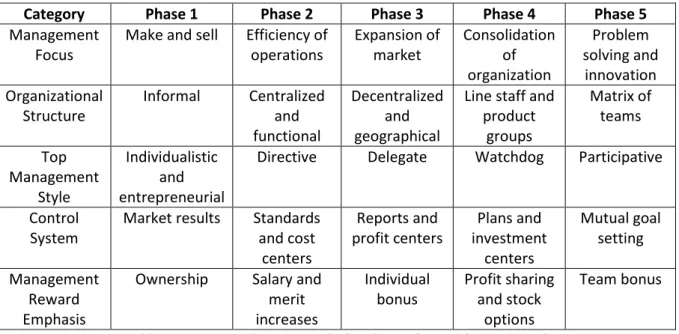
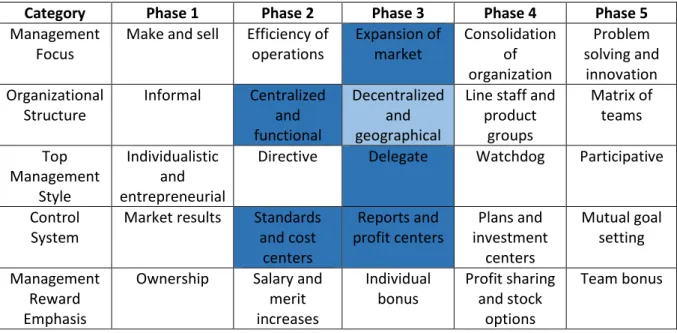
In the original article from 1972, Greiner presented a table that contains the specific management actions of the first five phases based on the characteristics of these phases and provides a summary of each phase. The table, called “Organizational practices in the five phases of growth”, can be found in
19
Category Phase 1 Phase 2 Phase 3 Phase 4 Phase 5
Management Focus
Make and sell Efficiency of operations Expansion of market Consolidation of organization Problem solving and innovation Organizational Structure
Informal Centralized
and functional
Decentralized and geographical
Line staff and product groups Matrix of teams Top Management Style Individualistic and entrepreneurial
Directive Delegate Watchdog Participative
Control System
Market results Standards and cost centers Reports and profit centers Plans and investment centers Mutual goal setting Management Reward Emphasis
Ownership Salary and
merit increases Individual bonus Profit sharing and stock options Team bonus
Table 1: Organizational practices in the five phases of growth (Greiner, 1998)
According to the study of Greiner (1998) the main management characteristics are roughly the same for every company in each phase. However, this does not mean that the characteristics are exactly the same for each company. The concept behind the characteristics may differ. Take for example the characteristic product groups. One company could have completely different product groups from another company as this depends on the product the company manufactures or sells. Another example is the characteristic expansion of market. For one company this could mean an expansion in the market the company already sells its products to and for another company this could mean that they attract new markets. In general, the characteristics as mentioned in Table 1 are the same for each company in every phase but the concepts behind these characteristics are different.
Overall, the characteristics in Table 1 can be used as a basis to determine the growth stage a company belongs to.
3.2 The growth stage of Company A
According to Greiner (1998) most organizations that have gone through a revolutionary period usually stay in the next evolutionary period for four to eight years. Looking at the table and the descriptions of the six phases of growth, the current state of Company A and taking into account the fact that Company A started in 2008, it seems that Company A is somewhere between phase two and three.
The characteristics of phase two are most comparable to the current state of Company A. A couple of years ago the marketing activities were separated from manufacturing. The organizational structure changed and job assignments became more specialized. These characteristics of phase two can be seen in the purchasing department in the number of employees and the distribution of tasks. First there was only one Purchasing Manager who had to carry out all purchasing tasks. He purchased everything needed for as well the operational as the marketing activities of the company. Right now, there are three Purchasing Managers and three Vendor Managers who each have their own specialized sector and purchase everything needed in that sector.
20
in the past few years. Therefore, the management focus of the company is on both efficiency of operations and expansion of the market, which is a mix of phase two and phase three.
The organizational structure is centralized and functional and the top management style is mainly directive, which corresponds to the characteristics of phase two. All employees have certain procedures they need to follow. The Purchasing Managers and Vendor Managers are the functional specialists and carry out all purchasing tasks within their sector. The Director of Planning and Purchasing has the task of instituting direction in the department and makes the final decisions. The Director of Planning and Purchasing tells the Purchasing Managers and Vendor Managers what they are expected to do and how to perform the expected tasks. After the tasks have been done, he is informed about it. Sometimes even the Vice President of Operations is informed about the tasks carried out by the Purchasing Managers and Vendor Managers.
The control system of the company is oriented towards standards and cost centers as the different projects are seen as cost centers rather than profit centers. Besides that, the Director of Planning and Purchasing uses standards and procedures to check whether the Purchasing Managers and Vendor Managers execute their tasks correctly. This corresponds to the characteristics of phase two.
Nonetheless, the company is working towards phase three in which the organizational structure is decentralized, the management style more delegating and the control system works with reports and profit centers. During the interviews, the Vice President of Operations and the Director of Planning and Purchasing mentioned that they would like to delegate more tasks and give more responsibility to the Purchasing Managers and Vendor Managers so they could focus more on their own tasks. For the Vice President of Operations this means that he could put more focus on long term strategic decision-making for the company together with the other Vice Presidents of the company. For the Director of Planning and Purchasing this means that he would spend less time on checking whether the Purchasing Managers and Vendor Managers do their job well and more time on making strategic decisions for the department. This would mean that the organizational structure becomes more decentralized and that the performance of the department is checked through reports that include key performance indicators.
Right now the company finds itself in the crisis of autonomy as employees need to report on everything they do and are not allowed to make decisions on their own without consulting or informing higher managers. They need to follow procedures and cannot really take initiative on their own. The result is that higher management is too busy checking the work of employees with lower functions that they do not have the time to focus on their own tasks. They have too many tasks to handle.
Besides that, the processes in the department are slowed down as everything has to be checked by multiple layers of management. If the lower functions are given more responsibility and are allowed to make more decisions on their own, this would greatly increase the efficiency and speed of the processes within the department.
21
problem in this research. As the company is already working towards delegation, the solution to the core problem probably lies in this process.
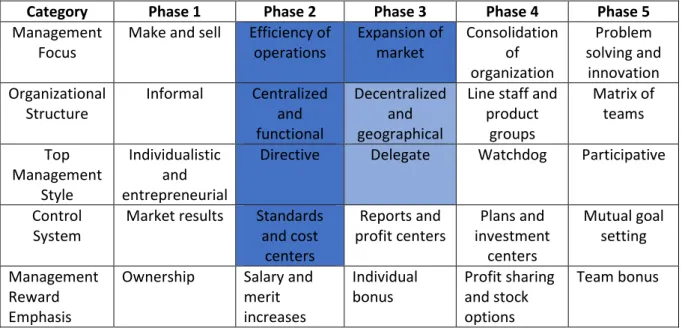
In Table 2: Organizational practices in the five phases of growth (Greiner, 1998) below, the growth
table of Greiner (1972) is given again to provide an overview of the current growth stage of Company A. In this table, the dark blue sections indicate the current state of the company and the light blue sections indicate what the company is working on as described above. All in all, it could be said that Company A is in phase two working towards phase three as the company possesses most of the characteristics of phase two and is working on elements of phase three.
Category Phase 1 Phase 2 Phase 3 Phase 4 Phase 5
Management Focus
Make and sell Efficiency of operations Expansion of market Consolidation of organization Problem solving and innovation Organizational Structure
Informal Centralized
and functional
Decentralized and geographical
Line staff and product groups Matrix of teams Top Management Style Individualistic and entrepreneurial
Directive Delegate Watchdog Participative
Control System
Market results Standards and cost centers Reports and profit centers Plans and investment centers Mutual goal setting Management Reward Emphasis
Ownership Salary and
merit increases Individual bonus Profit sharing and stock options Team bonus
Table 2: Organizational practices in the five phases of growth (Greiner, 1998)
22
Chapter 4 – Theoretical approach to purchasing activities at Company
A
In this chapter the following research questions are answered:
1. Which tasks should be performed by the purchasing department? 2. What functions do there exist within Purchasing?
3. What tasks should be performed by which function?
The structure of this chapter is as follows. First, the study of Muller (2001) is described which discusses what activities should be performed by purchasing departments. This information is used to answer the first question. In Sections 4.2 and 4.3 of this chapter two different studies on job descriptions are discussed in order to provide an answer to the last two questions. The final section of this chapter describes how this information can be applied to Company A.
4.1 Purchasing activities according to Muller (2001)
The study of Muller (2001) examines the tasks that should be performed by purchasers in seven different sectors. Within his study he analyzed and assessed the commonality across the following seven sectors:
1. Manufacturing
2. Government of the United States of America/ prime contractor 3. State and local government
4. Institutional 5. Service 6. Retail 7. Food
His research was conducted for the National Association of Purchasing Management (NAPM). The primary purpose of the study was to identify the crucial tasks performed by the purchasing department and the needed knowledge and skills for these tasks so the Certified Purchasing Manager (CPM) and Accredited Purchasing Practitioner (APP) programs could be updated and revised. The CPM and APP programs were designed “to maintain recognized professional standards in the field of purchasing and supply management, to enhance individual professional competence, and to provide employers with a means to identify qualified individuals within the field” (Muller, 2001, page 6).
23
first two. The examination exists out of 67 tasks in total distributed over 15 sections. The full list of tasks can be found in Appendix D.
Besides this new format for the examinations, Muller (2001) formulated job descriptions of purchasing managers and buyers which can be used as a guideline to determine to whom the examination programs are applicable. The definition for both functions is the same: “a purchasing manager/buyer is an individual who performs and/or has primary responsibility for the procurement of materials, equipment, or services for an organization” (Muller, 2001). The difference between the two functions is that the purchasing manager has a couple of additional responsibilities related to developing value enhancement strategies and managing the department. This can also be seen in the examination as these two topics are included in the last two modules which are only included in the CPM examination meant for purchasing managers.
4.2 Job descriptions according to the Purchasing and Procurement Center (2012)
According to the Purchasing and Procurement Center (2012) the main members of staff within the purchasing department are the Purchasing Manager, Purchasing Clerks and Administrative Assistants. The job descriptions of each of these key positions are given below.
Purchasing Manager
The Purchasing Manager is the person who controls the purchasing department and keeps oversight. In larger companies the Purchasing Manager may also be referred to as Purchasing Director, Vice President of Purchasing or Chief Procurement Officer. The nature of the job description is strategic and generally includes:
- Maintaining purchasing policies and making sure that all purchases comply with the policies. - Choosing the suppliers the company will work with and dealing with all legal interaction with
these suppliers.
- Managing all Service Level Agreements (SLA) and Master Agreements between the company and the supplier.
- Recruitment, training and management of staff.
- Communication with the accounting, manufacturing and stock departments.
- Budgeting, costing and cost saving based on the available management information. - Legal requirements, such as Health, Safety and Quality
- Supervise large procurement
Purchasing Clerks
The Purchasing Clerks engage in the normal day to day work. The nature of the job description is primarily operational and includes:
- Collect purchase orders and requests to order materials, goods and supplies. - Send purchase orders to the suppliers.
- Review inventories and purchase orders as required. - Communicate with the suppliers daily.
- Review deliveries of materials and goods against the purchase orders. - Track the status of outstanding purchase orders.
- Handle non supplied orders, under orders, over orders and damaged deliveries. - Make sure that all invoices are sent to the accounting department for payments. - Develop and maintain all reports involved with purchasing.
24
Purchasing Administrative Assistants
The Administrative Assistants are responsible for the more basic activities. Their job description includes:
- Undertake all required word processing. - Undertake all required filing.
- Maintain all diaries that are in the office.
- Arrange and attend meetings and take notes if necessary. - Help out with smaller purchases, reviews and inventory issues.
Besides these three key positions within purchasing, the Purchasing and Procurement Center (2012) also describes the job of Purchasing Agents. The Purchasing Agents are the staff who are responsible for the internal purchasing activities and buy the raw materials and contract services needed to maintain the operations of the company and its buildings. The contract services mainly include plant maintenance and cleaning services.
Purchasing Agents are more common in institutional companies but can also be found in large manufacturing companies and government offices.
4.3 Job profiles according to Mulder et al. (2005)
According to the research of Mulder et al. (2005) four jobs can be distinguished within the purchasing department: Purchasing Manager (PM), Senior Buyer (SB), Buyer (B) and Assistant Buyer (AB). The tasks that should be performed by these functions are divided into four categories: Purchasing Management, Information and Communication, Initial Purchasing and Operational Purchasing.
Purchasing Management involves the development of policies, organizational management and management of processes aimed at improving the organization. Information and Communication is involved with internal as well as external communication, information technology and globalization. Initial Purchasing is involved with the specification of needs, supplier selection and supplier contracting. Finally, Practical Purchasing is involved with purchase orders and the monitoring, follow-up, evaluation and administrative activities of the purchasing process.
Within these four categories Mulder et al. (2005) distinguished a total of 105 tasks. As the job descriptions are too exhaustive and rather unclear if all these tasks are described, he clustered the tasks. In Table 3 on the next page, the aggregated job profiles for the different purchasing professions can be found. The plus and minus indicate the weights of the task cluster for every job determined by the research of Mulder et al. (2005).
The scale of Table 3 is as follows: ++ = very important + = important
- = unimportant
25
PM SB B AB
Management
1. Developing purchasing policy ++ + - -
2. Managing the purchasing organization ++ + - -
3. Improving the purchasing organization ++ ++ + +
Information and Communication
1. Communication with internal sectors ++ + + +
2. Communication with external sectors + ++ + -
3. Information technology ++ + - +
4. Globalization ++ ++ - --
Initial Purchasing
1. Specifying the purchasing need - ++ - --
2. Selecting the suppliers - ++ + --
3. Contracting the suppliers - ++ + -
Practical Purchasing
1. Ordering goods and services -- - + ++
2. Monitoring the purchasing process -- - ++ ++
3. After-care, evaluation and administrative conclusion of the purchasing process
-- - + ++
Table 3: Aggregated job profiles for purchasing professionals (Mulder et al., 2005)
The overview in Table 3 indicates that the management activities are most important to the Purchasing Manager. However, these activities are also quite important to Senior Buyers but less than to the Purchasing Manager. Therefore, the main responsibility of these tasks should be taken by the Purchasing Manager. The same holds for the activities involved with Information and Communication. A difference here is that the second task cluster, communication with external sectors, should be the responsibility of the Senior Buyers as this task cluster is more important to them than to the Purchasing Manager. Initial Purchasing is very important to the Senior Buyers and also a little to the Buyers. This section is unimportant to the Purchasing Manager and therefore he should not be involved in these activities. The Senior Buyers should take the responsibility for these task clusters as these are more important to them. The Buyers could assist the Senior Buyers with these tasks. The final section, Practical Purchasing, is only important to the Buyers and especially to the Assistant Buyers. Therefore, these task clusters should be the main responsibility of the Assistant Buyers. However, the second task cluster should be the main responsibility of the Buyers as this task cluster is very important to them. All in all, the tasks of the Purchasing Manager are mainly on a strategic level, the Senior Buyer has both strategic and operational tasks and the tasks of the Buyers and Assistant Buyers are purely operational.
4.4 Application of the theory to Company A
A comparison between the study by Mulder et al. (2005) and the information provided by the Purchasing and Procurement Center (2012) and Company A leads to some interesting observations.
26
The job description of the Purchasing Manager provided by the Purchasing and Procurement Center (2012) and the one provided by Company A are quite similar and include primarily strategic tasks. However, Company A included two tasks in the job description of the Purchasing Manager which the Purchasing and Procurement Center (2012) did not include in their description. These tasks are resolving and managing any issues that may arise during production of goods and ensuring appropriate inventory levels of finished goods, raw materials, packaging components and other items where applicable. Looking at the other job descriptions provided by the Purchasing and Procurement Center (2012), these tasks can be found in the job description of the Purchasing Clerk. As these two tasks are operational tasks and the tasks of the Purchasing Clerk are mainly operational whereas the tasks of the Purchasing Manager are primarily strategic, it makes sense to assign these tasks to the Purchasing Clerk. Looking at the job description of the Vendor Manager provided by Company A, these tasks can also be found there. It might be better to only assign these tasks to the Vendor Manager so the Purchasing Manager has only strategic tasks.
Taking a closer look at the job description of the Vendor Manager provided by Company A, it can be seen that this job description includes a lot of strategic tasks that are also included in the job description of the Purchasing Manager provided by Company A. If these strategic tasks are left out, the job description of the Vendor Manager is similar to the job description of the Purchasing Clerk provided by the Purchasing and Procurement Center (2012). The tasks are then purely operational.
The Purchasing and Procurement Center (2012) also describe two other functions, namely the Purchasing Administrative Assistant and the Purchasing Agent. The tasks included in the job description of the Purchasing Administrative Assistant provided by the Purchasing and Procurement Center (2012) are done by the Vendor Managers and Purchasing Managers themselves at Company A. The job description of the Purchasing Agent provided by the Purchasing and Procurement Center (2012) is quite similar to the job description of the Purchasing Clerk by Company A which can be found in Appendix E. The job includes all tasks related to internal purchasing activities. However, the focus of this report is on external purchasing activities and therefore this function is not analyzed any further.
Another interesting point is that in the study by Mulder et al. (2005) the Senior Buyer has a lot of overlap with the Purchasing Manager. The Senior Buyer has a mix of strategic and operational tasks whereas the Purchasing and Procurement Center (2012) separated the strategic and operational tasks from each other and assigned these to different functions.
The tasks of the Buyers and the Assistant Buyers as described by Mulder et al. (2005) are most comparable to the tasks of the Purchasing Clerk as described by the Purchasing and Procurement Center (2012). At Company A these tasks are carried out by the Vendor Managers and some monitoring is also done by the Purchasing Managers.
All in all, looking at the different job descriptions provided by the Purchasing and Procurement Center (2012), only the Purchasing Manager and the Purchasing Clerk have tasks that involve external purchasing activities. The Purchasing Manager has the strategic tasks and the Purchasing Clerk the operational tasks. Besides that, the Purchasing Administrative Assistant provides support on an administrative level and the Purchasing Agent is responsible for all internal purchasing tasks.
27
Company A has only two functions that are involved with the external purchasing activities which is similar to the theory of the Purchasing and Procurement Center (2012). However, the tasks assigned to these functions are not completely the same. Right now, the Purchasing Manager of Company A also has some operational tasks and could be seen as a combination of the Purchasing Manager and the Senior Buyer as described by Mulder et al. (2005). The Vendor Manager of Company A also has some strategic tasks and could be seen as a combination of the Senior Buyer, Buyer and Assistant Buyer as described by Mulder et al. (2005).
Comparing these two studies to Company A, the most important point of thought is whether to separate operational tasks from strategic tasks or not. As strategic tasks require different skills than operational tasks, it might be better to separate these tasks from each other.
The studies of Mulder et al. (2005) and the Purchasing and Procurement Center (2012) both provide an answer to the question: What functions do there exist within Purchasing? Both studies can be used to determine the functions that are needed in the purchasing department and provide general job descriptions for these functions. However, Company A is working towards more delegation which means that the lower functions get more responsibilities and the involvement of higher management becomes less. Therefore, the study of the Purchasing and the Procurement Center (2012) seems to be more appropriate for the current growth state of Company A than the study by Mulder et al. (2005). The reason for this is that the functions described by Mulder et al. (2005) have quite some overlap whereas the functions described by the Purchasing and Procurement Center (2012) clearly have their own responsibilities.
However, a general job description is not enough as it does not include all the tasks that need to be carried out by that specific function. This is where the study by Muller (2001) can be helpful. The study provides a detailed list of tasks that should be carried out by the purchasing department and therefore answers the question: Which tasks should be performed by the purchasing department? Combining this with the studies of the Purchasing and Procurement Center (2012) and Mulder et al. (2005), enriched job descriptions which include a detailed tasks portfolio can be developed. These enriched job descriptions provide an answer to the final question of this chapter: What tasks should be
28
Chapter 5 – Company insight on purchasing activities
In this chapter the following research questions are answered:
1. Which tasks should be performed by the purchasing department? 2. What functions do there exist within purchasing?
3. What tasks should be performed by which function?
In this chapter the purchasing processes of Company B and Company C are described. These companies could be used as benchmarks for Company A. The reason for this is that the core business of these companies includes sourcing suppliers that produce finished goods and selling these goods to retailers or end customers. A difference here is the end customer of the companies but this has no influence on the purchasing process itself, only on details in contracts and requirements of suppliers.
In order to be able to compare these two companies to Company A, the information about the companies should match the information given about Company A. Therefore, the purchasing process, organizational structure and growth position are described for both companies. First Company B is discussed and then Company C. All information in the sections below is based on information provided by the Planning Director of Company B and the Sourcing Director of Company C.
5.1 Purchasing processes at Company B
Company B is a fast growing international company with more than 700 shops in the Netherlands, Belgium, Germany, France, Luxembourg and Austria. . The company was founded in 1993 and sells over 6000 different products right now. Company B does not produce any products itself. The company buys finished goods of suppliers and sells these products in their stores. Below in Figure 4 the process from supplier to customer can be found.
Figure 4: Process from supplier to customer
The purchasing process takes place between the suppliers and the distribution centers. Company B purchases finished goods from their suppliers which are then transported to their distribution centers. Then Company B makes sure that these goods are distributed to their stores where the products are sold to the customers.
Company B sells two types of product. The first type is a product that can be found in the stores at all times and the second type is a product that is only sold for a short period of time or for a certain promotion, such as Christmas goods. These two types of product require different supplier relationships. The first type involves long term supplier relationships. Company B works very closely with these suppliers as Company B depends on them to be able to sell the products all year round. A tight collaboration is crucial here. The second type involves short term supplier relationships. Negotiation activities are very important with these suppliers. If the price of the product is not low enough, Company B simply does not buy the product and searches for something else. This is similar to Company A as their main products are sold all year round and involve long term supplier relationships whereas their continuously changing promotional products are only sold during the holidays and special events and involve short term supplier relationships.
29
quantity and low pricing. Therefore, the quality requirements of Company A are more exhaustive than those of Company B. Second, Company A and Company B both provide two types of product but their main focus differs. At Company A the main products are sold all year round and at Company B the focus is put on changing the assortment continuously. This means that Company B and Company A search for both types of suppliers but that Company B puts the focus on short-term suppliers and Company A on long-term suppliers. The core of the purchasing processes is the same as the steps that need to be taken and the tasks that need to be performed are equal. The difference is that with short term purchasing everything is done faster and less detailed than with long term purchasing. This difference can be seen in details such as contracts and qualifications. The contracts for long-term relationships are more detailed than those for short-term relationships, because the agreement is made for a longer period of time.
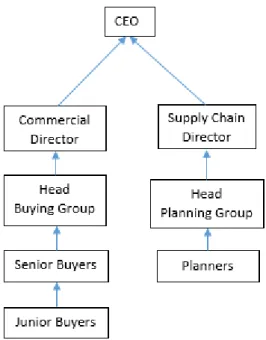
At Company B the purchasing process is as follows. The Buying Group which is put under supervision of the Commercial Director is responsible for sourcing and contracting suppliers. These contracts include the agreed prices and quantities for the different products sourced from the supplier. The information included in the contract is put into the company system by the buyer. Then the Planning Group is responsible for planning and sending the purchase orders for the different products. In Figure 5 below, a simplified version of the organizational structure of the parties involved with the purchasing process is shown. The blue arrows indicate who reports to whom.
Figure 5: Purchasing organizational structure of Company B
The purchasing process of Company B is divided into thirteen product categories. Each product category has its own Buyer and Planner who are responsible for all purchasing tasks in that category.
30
agree upon a price and a quantity which are included in the contract. Then the Buyer decides what the selling price will be and when the product will be launched. Finally, the Buyer puts all this information in the company system so the Planner can start sending purchase orders. The main tasks of the Planners at Company B are planning when the products need to be ordered based on the forecasts of the sales department, sending the purchase orders, keeping track of the inventories and administering all purchasing.
In Table 4 below, the growth table of Greiner (1972) is given. The Planning Director of Company B
described which characteristics match best with the current state of Company B. These characteristics are marked dark blue in the table. The light blue section indicates that the company is working on getting there. Beneath the table the description by the Planning Director of Company B is summarized.
Table 4: Organizational practices in the five phases of growth (Greiner, 1998)
The management focus of Company B is put mainly on expansion of the market. However, the company could still improve the efficiency of their operations a bit. The organizational structure is centralized and functional but it is becoming more decentralized as more distribution centers are opened in other countries in Europe. The style of top management is to delegate tasks to lower managers. These managers are given more responsibilities and every once in a while they need to report to top management on certain key performance indicators. The control system at Company B is a combination of Phase 2 and 3. They work with cost centers rather than profit centers and specific reports rather than standards. The employees report on certain key performance indicators and that is how higher management checks the performance of lower management. Overall, Company B belongs mainly to Phase 3 but still has some characteristics of Phase 2. Company A belongs mainly to Phase 2 and is working towards Phase 3. Therefore, on the growth level Company B is a bit more developed than Company A.
All in all, Company B could be used as a benchmark for Company A right now. The reason for that is that the purchasing process of Company B is similar to the purchasing process of Company A as they both purchase finished goods from suppliers for as well short term as long term products. A difference here is that the focus of Company A is on long term products and the focus of Company B on the short term products. As described above, this does not significantly influence the purchasing task portfolio. Furthermore, looking at the growth position, Company B is just a little more developed than Company A. This means that Company B already took some steps that Company A has to take right now and therefore Company A could learn from the steps taken by Company B.
Category Phase 1 Phase 2 Phase 3 Phase 4 Phase 5
Management Focus
Make and sell Efficiency of operations Expansion of market Consolidation of organization Problem solving and innovation Organizational Structure
Informal Centralized
and functional
Decentralized and geographical
Line staff and product groups Matrix of teams Top Management Style Individualistic and entrepreneurial
Directive Delegate Watchdog Participative
Control System
Market results Standards and cost centers Reports and profit centers Plans and investment centers Mutual goal setting Management Reward Emphasis
Ownership Salary and
31
5.2 Purchasing processes at Company C
Company C is a company specialized in the distribution and production of product X. The own production adds up to only 10% of all products the company distributes. They are a leading company in the European market and operate mainly in France, the Benelux, the UK and Germany. The company was founded in 1765 and has been through a lot of changes since then. About fifteen years ago the company started to change into the company it is now. Before, the company had a very wide assortment of products and had their own stores. Now, the company puts the focus on their core brands. They source products, do the marketing for these products and distribute the products to retailers. Below, Figure 6 provides a graphical representation of this process.
Figure 6: Process from supplier to retailer
The purchasing process takes place between the suppliers and Company C. Company C purchases finished goods from their suppliers which are then transported to their local distribution centers. From there the finished goods are distributed to the different retailers who are the end customers of Company C.
Similar to Company A and Company B, Company C sells short term and long term products. At Company C the focus is put on the long term products which is equal to Company A. The type of product Company C sells is different from Company A but the idea behind it is the same. Both companies put the main focus on high quality. Therefore, the qualifications of the suppliers both companies search for are more alike than compared to Company B. This means that the details in the purchasing process such as the contracts and requirements are also more alike.