Database programming made easier
Master thesis of Roland Balk
[email protected], 4-1-2016
University of Twente, Formal Methods & Tools group
[2]
Abstract
Relational databases take care of many problems, like storing digital information on a physical medium and providing search algorithms. However, programming relational databases can be improved a lot. One of the most discussed problems is the linguistic mismatch between the general purpose programming language (GPPL) and the relational database programming language, also known as the impedance mismatch. Since there exist a mismatch, we have explored concerns of programming relational databases from the GPPL side. For example, programming languages like Java, PHP and C# provide solutions to write SQL code in strings. Writing database code in strings increases the vulnerability for SQL injections. These concerns may not look crucial to solve and may already have a solution. But we don't expect that all found concerns have been solved by one solution. Therefore we propose a new database programming language, called SQLento, to solve these interfacing concerns.
These concerns have not been unnoticed and solutions have been proposed and developed to solve them. Ten different solutions have been summarized and compared to gain insights in the used concepts. For example, Microsoft LINQ embeds the declarative database language within the GPPL to prevent type and security concerns. But embedding the language results in a dependency with the general purpose programming language and its expressiveness. After comparing each solution we conclude that none of the solutions solve all concerns. Combining multiple solution does solve most of the concerns, but also increases the development complexity. We also realized that not all concerns can be solved by providing a new database programming language for relational databases. Thus we decided to design an architecture as well.
We propose an architectural solution to place the new database language, called SQLento, between the GPPL and the DBMS. We separate SQLento from the GPPL by providing a web service interface for the GPPL to execute database operations. Separating SQLento from the GPPL has two advantages: the architecture can optimize the database code and it makes the architecture more portable because it is not bound to any GPPL. The executable database code and the communication interfaces are produced by the compiler, which uses SQLento as input. GPPLs use the generated (web service) interface to call procedures and functions written in SQLento. When the architecture receives those calls, the corresponding database code is passed on towards the DBMS. Results of the DBMS are passed back to the GPPL and can be mapped to a nested data structure to prevent data model mismatches.
[3]
Acknowledgements
Discussions and conversations about game development with Lesley Wevers brought up the idea to do research in improving relational databases. Thanks to my supervisors, Marieke Huisman, Maurice van Keulen and Lesley Wevers, I was able to do this thesis in the first place. I therefore want to thank them gratefully for their feedback and personal support.
I also would like to thank Lesley Wevers and Stefan Blom for the lectures and discussions about compiler and language design. Without them it would have taken more time to develop a prototype. The discussions with Saeed Darabi also contributed to improving the syntax of the new database language.
[4]
Index
Abstract ... 2
Acknowledgements ... 3
1 Introduction... 6
1.1 Goals ... 6
1.2 Approach ... 7
1.3 Results ... 7
1.4 Contributions ... 9
2 Background... 10
2.1 Databases ... 10
2.2 Data models ... 10
2.3 Database management systems ... 11
2.4 Database transactions and reliability ... 11
2.5 SQL database language ... 12
3 Relational databases' concerns ... 16
3.1 Impedance mismatch ... 16
3.1.1 Source of trouble ... 17
3.2 Concerns ... 18
3.2.1 Relational database programming concerns ... 18
3.2.2 SQL concerns ... 23
3.3 Conclusion ... 25
4 Evaluation of existing work ... 26
4.1 Object Oriented database management systems ... 26
4.2 Object-Relational database management systems ... 27
4.3 NoSQL ... 28
4.4 Microsoft LINQ ... 28
4.5 Microsoft SQL Templates ... 29
4.6 Ferry... 29
4.7 Iris Programming Language ... 30
4.8 Middleware ... 30
4.9 Comparison of solutions ... 32
4.10 Conclusion ... 33
5 SQLento's architecture ... 34
[5]
5.2 Possible implementations ... 34
5.3 Proposed implementation ... 35
5.4 Solving architectural concerns ... 36
5.5 Compilers ... 36
5.6 Communication interface ... 38
5.7 Advantages and disadvantages ... 39
5.8 Conclusion ... 39
6 SQLento ... 41
6.1 Concepts ... 41
6.2 Introduction of SQLento's prototype ... 43
6.3 Relationship declarations ... 45
6.3.1 Foreign key generation ... 45
6.3.2 Join condition generation ... 46
6.3.3 Completeness ... 46
6.4 Nested queries ... 47
6.4.1 Limitations ... 47
6.4.2 Compiling a query to SQL ... 48
6.4.3 Completeness ... 50
6.5 Syntax ... 50
6.6 Translation ... 54
6.7 Advantages and disadvantages ... 57
6.8 Conclusion ... 58
7 Conclusion ... 59
7.1 Future work ... 60
8 Appendix ... 61
8.1 Code example 1 ... 61
8.2 Code example 2 ... 61
[6]
1
Introduction
Databases are used for storage of digital information, while taking care of aspects such as physical storage of data, security and concurrency. Developers don't even have to provide algorithms to search through the data structure. Instead developers can write declarative statements, in languages like SQL, to interact with the database. One of the most popular types of databases used today are relational databases [2, 10]. This type of database has a several advantages compared to the alternative solutions:
The declarative language, SQL, makes queries easy to express [18]
The mathematical expressiveness of SQL allows specifying relationships precisely [18, 24]
The investments of companies has lead to the development of solutions to concerns of relational databases [8, 24]
But one of the most discussed problems are mismatches between the general purpose programming languages (GPPL) and the programmable interface of relational databases. For example, a GPPL like Java uses the Object Oriented data model. SQL at the other hand is a domain specific language for relational database programming. Combining a general purpose programming language with SQL has its trade-offs. For example, there exists a solution where SQL expressions have to be written in a string format to allow execution in a GPPL [22, 30, 40]. Strings can contain any kind of data and therefore increases chances of having type mismatches and SQL injections. This shows it is useful to explore the difficulties of programming relational database and using the database language. We propose to develop a database programming language between the GPPL and the database management system (DBMS), to make programming relational databases easier.
1.1
Goals
Our goal is to develop a new database language to make database programming easier by solving concerns regarding to relational databases. To achieve the main goal, the following sub goals have to be achieved:
1. Explore concerns of relational databases 2. Evaluate the existing work for solving concerns 3. Provide concepts for an architectural solution
4. Provide a new database language to solve the concerns 5. Build a prototype of the database language
[7]
1.2
Approach
This thesis has been split-up into four sections to make the defined goals possible:
Background information (chapter 2)
Concerns of relational databases (chapter 3)
Evaluation of existing work (chapter 4)
Concepts for the architectural solution (chapter 5)
A prototype of the database language (chapter 6)
Before starting to work on a new database language, it is important to discuss background knowledge about data models, database management systems, database transactions, SQL and finally database programming. Each of these topics contribute to having knowledge about the current situation of relational databases and is not meant to answer any research question.
Exploring the concerns provides insights in the current situation of programming relational databases. The concerns have been divided up into two categories: relational database programming concerns and SQL concerns. For each category a number of concerns and its consequences are discussed.
Since relational databases exist for a while now, solutions have been developed to solve these concerns. A selection of solutions have been explored and compared to gain information about the used concepts and which concerns they target to solve.
The goal is to develop a new database language to solve the concerns, which requires an architectural solution. Instead of deepening out the implementation details, the concepts are discussed. The solution consists out of a several components, like providing a communication interface, which are described in detail.
Last not least is the prototype language we have designed, called SQLento, to write database programs. Information is provided to know what the concepts are, how it is mapped to SQL and what it can do.
1.3
Results
The exploration of concerns has shown a diverse set of possible improvements related to programming relational databases from a GPPL and the SQL interface language. For example, there exist solutions for various GPPLs to write SQL code in a string data format. This increases vulnerability to SQL injections and data type mismatches. Another concern is that SQL forces developers to write join conditions in queries and statements, even if the join condition has been provided before. Most of the found problems are not crucial to solve, but providing an all-in-one solution makes database programming easier.
[8] a subsection of them. It is possible to combine multiple solutions, although it may increase the development complexity. We also realized that separating the new database language from the GPPL would give us a few advantages: the language can be optimized for database programming and the solution can be more portable. But separating the languages is easier to achieve at architectural level. Therefore we propose to design an architecture first, before designing a new database language.
We propose to design an independent architecture to place the new database programming language (SQLento) between the GPPL and the DBMS. The architecture requires connection interfaces, compilers and a definition section. The connection interfaces take care of any connection between the GPPL, the architecture and the DBMS. The compilers are used to map SQLento to executable database code. The last part is the definition section, which keeps track of the executable database code for the web service. There are various of implementations possible for this concept, like using an Object-relational mapper in combination with a GPPL. But the Object-relational mapper is bound to a specific GPPL. This can be prevented by making a web service for the Object-relational mapper, but the developer has to provide the logic behind this. Instead we propose to develop a new database programming language which is separated from the GPPL by providing a web service for executing database operations. The code written in SQLento's language is compiled, by the compilers, to the executable database code and the web service interface. By making the solution independent of the GPPL, the database code can be optimized for database transactions, like user defined stored procedures for the RDBMS. Another advantage of this separation is making the solution more portable, since it can be connected to any GPPL and any DBMS of choice. For example, if developers decide to connect a Java application and a Python application to the architecture, only the communication interfaces have to be generated from the SQLento code. The GPPL uses the interface to call subroutines and sends it towards the web service component of the architecture. The received call is processed and executed on the DBMS, whereby the information returned can be processed to a nested data structure. The disadvantages of this architecture are performance, additional complexity, additional data storage and its optimization for RDBMSs.
[9] All goals have been reached, but far from complete. Much work can be done to compare other existing solutions, to add more specific features to the architecture and to make SQLento more complete.
1.4
Contributions
The thesis describes the following contributions:
a discussion and summary about concerns of programming relational databases and SQL
a discussion and comparison of existing work to solve the concerns
an architectural solution
a prototype of SQLento
[10]
2
Background
Before starting to dive into the issues of relational database programming and providing a new database language, it is important to know the background of databases and database programming. The database section describes data models, database management systems, database transactions and one specific database language called SQL. This database language in particular is important since this thesis focuses on solving issues of relational databases, which often use the SQL language.
2.1
Databases
A database is a structured collection of records of data that is stored in a computer system [53]. Any kind of data can be stored into the database, such as text or images. To manage a database, which includes storage, reliability and security, the database management system has been invented. Since the data model is a fundamental part of the database, the next section describes this further in detail.
2.2
Data models
A data model is a logical model to describe in an abstract way how data is organized in a database, which is independent of the used technology. Another fundamental part of the data model is describing the set of operations to be used for the data structure. For example, the relational model has been designed for declarative statements to specify queries and data based on relational algebra. This makes database management systems responsible for supporting these statements and executing them on the database, to protect users from having to know how the data is stored and bothering about its implementation. Currently there exists many models, which are for instance:
Relational model [12, 21] : using tables and relational algebra.
Object Oriented model [24]: using the object oriented paradigm to represent data.
XML model [35]: using an eXtensive Markup Language for data storage.
In this thesis we focus on the relational model.
E.F. Codd's relational model
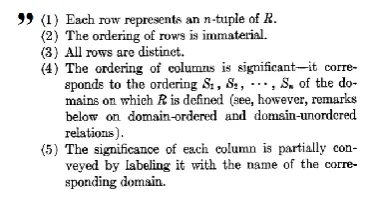
[image:10.595.344.530.606.707.2]The relational model has been designed to store information in N-dimensional tuples which are distinct from each other. These tuples are stored into tables with a unique key, known as the primary key, to allow the definition of relationships. Tuples stored in a table can refer to other primary keys. To make the model usable, relational algebra is used to allow reasoning over these tuples of data, like
[11] selections and joins. This concept was proposed by Edgar F. Codd, to prevent users from having to deal with how the data is organized [12] and dates back from the 1970's. E.F. Codd defined five properties for relational databases, shown in Figure 1.
UserID Name Address
1 Willem van Nassau Somewhere 34, Grou 2 Isabelle de Graaf Anywhere 9, Enschede
Figure 2 shows a simple bank system with two tables to explain how the relational model works. The first table keeps track of all registered users and the second table keeps track of all bank accounts. These tables are related to each other by the userID column (domain). The first table uses the UserID as a primary key to allow relationships. The other table, containing the bank account information, uses the UserID as a reference to the table of users. This kind of relation is called a one-to-one relation. There exists also an one-to-many relation, a many-to-one relation and a many-to-many relationship.
2.3
Database management systems
The database management system (DBMS) has been designed to prevent developers to invent ways to handle data storage, security, reliability and access. This makes the DBMS responsible for all state changes of the database. It provides a data (storage) model, a programmable interface [53, 21] and determines the number of supported features.
An example of an architectural solution with a DBMS is shown in Figure 3. It represents an abstraction of how components communicate, from users to data storage. Users do not interact with the database management system but use an application like a website instead, which is more user friendly. The (web) application takes care of
the communication with the DBMS to perform the required actions. The interaction between the applications and the DBMS is made possible by the introduction of a high-level database language. The language allows to specify and interact with the database, where the number of features depends on the DBMS.
2.4
Database transactions and reliability
The DBMS is responsible for defining and manipulating the database and there are many cases in which this could go wrong. An invalid database state can be reached when multiple users try to get data from the database while the information is being updated, or when a server stops working while inserting new data. Database transactions have been developed to prevent these invalid state transitions. A database transaction represents a unit of work, which is written in the database language, to be performed on a database. The DBMS provides a way to AccountID UserID Banknumber
19 1 546372
[image:11.595.87.534.127.172.2]54 2 734542
[image:11.595.323.536.434.529.2]Figure 2: Simple bank system
[12] isolate the application's request for database access and the database itself, to ensure no other execution can interfere with the state of the database. In case of problems, a database transaction is easy to recover. Most of the DBMS's guarantee the ACID properties [27] as a model for ensuring these reliability features. These properties are:
Atomicity: entities of work are fully executed or not at all.
Consistency: the database changes only from valid states to other valid states.
Isolation: insurance that concurrent execution of transactions achieves the same state as if executed serially.
Durability: if a transaction has been committed, the results remain visible even if events occur that causes the database to stop working.
Not all DBMS's guarantee this model and some allow to tweak how well this model can be guaranteed. For example, HBase [3] allows to trade off some guarantees for more performance.
2.5
SQL database language
SQL is one of the most used domain specific languages for relational databases, which is based on E.F. Codd's relational model. The language consists of six categories of statements [39]:
1. Data Definition Language 2. Data Manipulation Language 3. Transaction Control Statements 4. Session Control Statements 5. System Control Statement 6. Embedded SQL Statements.
In this section the data definition language (1), data manipulation language (2) and transaction statements (3) are discussed, because these contain the most fundamental statements to define and manipulate databases. After these three categories, this section continues with comparing E.F. Codd's relational model with SQL, describing the procedural language extension (PL/SQL) and finally describing the concepts used in SQL.
Data definition language
The data definition language, also known as DDL, allows to specify the structure and properties of the databases. It supports the following actions:
Create, alter, and drop schema objects
Grant and revoke privileges and roles
Analyze information on a table, index, or cluster
Establish auditing options
[13]
Figure 4: SQL DDL statements in Java code
The CREATE, ALTER and DROP statements are used for defining or modifying schema objects like databases, tables and its relationships. As you may expect, the create statement is meant for defining schema objects, the alter statement is used for modifying the schema object and the drop statement is for deleting the schema object. For example, the create statement can be used to define a new table as shown in Figure 4, which shows a specification of a table including the columns, uniqueness constraints and data types. Another important part of the CREATE, ALTER and DROP statements is the definition of indices. The SQL language also allows to enhance query performance by defining indices and by query optimizers. An index is a look-up table which contains values from specific columns of a table and a pointer towards row the data is stored in. Just like the index of a book, the location of the information can be found by searching for the information or keywords in the index. But keeping track of indices requires storage space as a trade-off. In the context of the user table example in Figure 2, queries could search faster for users with a specific name when an index is created for the name column.
The DDL supports statements for other purposes as well, like creating and declaring new privileges for database uses by using the GRANT statement or gaining knowledge in the statistics of the database by using the ANALYZE statement.
Data manipulation language
The data manipulation language, known as the DML, supports statements to adjust the state of the database by inserting new data for example [38]. It supports the following statements: CALL, DELETE, INSERT, SELECT, UPDATE, EXPLAIN PLAN, LOCK TABLE and MERGE. The call statement is used to execute a (user-defined) function or a stored procedure. The delete, insert, select and update allow developers to manipulate the stored information in the database. It can be used for inserting new rows or selecting information to be retrieved.
One may ask, why does the SELECT statement belong to the DML? Oracle has decided to put this statement to the DML because it allows operations on the data before returning the information or as Oracle states: "The SELECT statement is a limited form of DML statement in that it can only access data in the database. It cannot manipulate data in the database, although it can operate on the accessed data before returning the results of the query" [39].
The other statements, LOCK TABLE, CALL, EXPLAIN PLAN and LOCK TABLE, provide developers more control over tables, more insights in optimizations and allows merging expressions. For example, the lock table statement manually overrides the automatic locking mechanism in SQL to prevent data access or manipulation from other users.
Transaction Control statements
[14] expressions. The rollback statement is used in case of failure, to bring the database back to its previous state.
The save statement is used to store the current state of a database, usable for the rollback and set transaction statement. The set transaction statement allows the developer to specify the properties of a transaction more thoroughly. For example, the set transaction statement supports to specify to which state the database should be restored in case of a transaction failure.
SQL versus the relational model
Relational databases generally use a modified version of E.F. Codd's proposed relational model. There are a few properties of Codd's list, described in Figure 1, which do not match with the DBMS implementations. The first difference can be found in the second property: "The ordering of rows is immaterial". Relational databases often have options to order datasets, which can be useful for analytical purposes or scoreboards. Another difference can be found in the third rule, which defines that each row should be distinct, while the SQL specification allows to add duplicate data in a table. This can be achieved by creating a table with no constraints on the distinction of its values. There are still properties that do hold, like the first one: "Each row represents a N-tuple of R". Each row in a relational database still represents a tuple of data.
Extensions to SQL
The SQL language has been extended with procedural languages such as PL/SQL for Oracle's databases, Transact-SQL for Microsoft databases and PL/pgSQL for PostgreSQL databases. Each of these extensions allow developers to combine SQL statements with procedural language constructs, like functions, procedures, triggers, conditions and try-catch blocks [36]. A stored procedure is a group of SQL statements compiled into one execution entity. A trigger is comparable to a stored procedure but, as you may expect, is only executed or triggered under specified conditions. A function is similar to stored procedures except for a few properties: a function has to return a value and can't have side-effects like adjusting the state of a variable outside the function. By having this property, functions can't contain all the statements supported by the extension. For example, try and catch blocks can't be used within the function. These execution entities can be defined by using the "create" DDL statement [34, 37] and can be called by using the "call" statement of the DML. Many of the DBMSs support the procedural extension, but each of them differs in supported statements. For instance, SQLite doesn't support functions and stored procedures [50] while PostgreSQL does.
Programming paradigm of SQL
[16]
3
Relational databases' concerns
Programming relational databases can be improved a lot, and to prove this we have gathered concerns from different sources: papers, books and user experiences from websites like "stackoverflow". One of the most discussed problems is the impedance mismatch [2], which is a linguistic mismatch between the GPPL and the declarative relational database languages. Since there exists a mismatch between the languages, it is important to explore the concerns further. This chapter starts with explaining the impedance mismatch and the source of the problem. Then it continues with summarizing concerns from programming relational databases from a GPPL and from the SQL language itself. Each concern is explained by own created examples.
3.1
Impedance mismatch
When the relational model was invented, database languages have been optimized for taking care of data storage without bothering developers about how it is done. General purpose programming languages at the other hand have been developed to provide freedom of expressing how programs have to work by influencing the execution order and state changes of the program. Programming languages use a variety of paradigms and data models to provide this capability. These differences between general purpose programming languages and relational database languages causes a linguistic gap to appear which is known as the impedance mismatch [2, 19]. The term "impedance mismatch" does not point to one problem, but is used to address multiple problems. One of the most discussed problems is the mismatch between the object data model and the relational data model. Engineers and scientists found out that mapping objects to the relational model can be challenging, when objects and pointers have to be mapped to tables and relations [18]. Currently a variety of solutions are available like Object Oriented databases and Ferry, which are discussed in section 4.
Figure 5: Impedance mismatch example
[17]
3.1.1
Source of trouble
The impedance mismatch problem is caused by the difference in data models used for general purpose programming languages and relational databases. General purpose programming languages often use the Object data model or Object Oriented programming, which uses objects for data storage and uses one-to-one pointers to define relationships. The relational model uses tables for data storage and use primary and foreign keys to define relationships. There are ways to convert the relational model to the object oriented model [18], but the differences in structure complicates the mapping process. For example, objects containing complete user information about the name, address and bank information could be split up into three tables to contain the information, including the relationships. But it is also possible to store all information into one table.
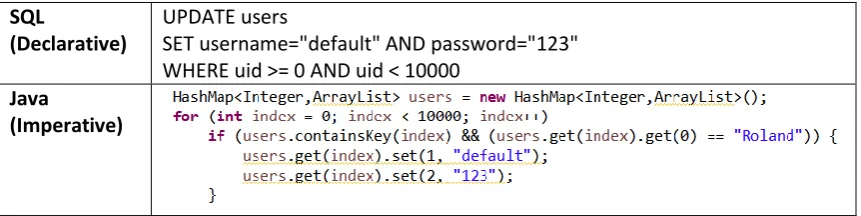
The difference in data model is mainly the source of the problem, but the inequality between the paradigms complicates the matter as well. As stated before, database languages like SQL are often described as declarative languages while it supports a limited imperative way of writing statements. Technically it is possible to make database languages fully imperative, but that wouldn't make sense at all. The DBMS has been designed to prevent developers from bothering how data is stored, how the reliability can be maintained and etcetera. By using the imperative paradigm the developer would have been forced to design algorithms for queries and other expressions to retrieve data. For SQL expressions it is easier to describe what has to be achieved rather than how. Another reason why the declarative paradigm works well for relational databases is the ability to optimize the expressions. For example, the SQL interpreter can decide to execute certain statements in a query parallel by using multiple threads to enhance the performance [6]. General purpose programming languages at the other hand can use a variety of data models and paradigms, since they have been designed to describe the behaviour of an application. The most popular are the imperative languages that use the Object Oriented data model, where developers can describe in detail how the program works and optimize it for specific tasks. These differences in paradigm have an impact on how well the languages can work together.
SQL
(Declarative)
UPDATE users
SET username="default" AND password="123" WHERE uid >= 0 AND uid < 10000
Java
[image:17.595.102.533.523.631.2](Imperative)
Figure 6: Declarative versus imperative
[18] database was able to know the Java code is going to execute many SQL statements sequentially, it could optimize it. But the database is unaware of what the application is going to execute, how many times and which commands. It just responds by its transactions as applications are responsible for communication with the database. This makes optimizations of external imperative programs rather difficult.
3.2
Concerns
In the previous section we have described linguistic mismatches between relational database languages and general purpose programming languages. Since there exist mismatches, we have gathered a selection of concerns divided over two categories:
Relational database programming concerns: issues related to programming a relational database from a GPPL.
SQL concerns: issues related to the relational database programming language.
Each of the found concerns have been explained with an example, written in Java or Python by using the JDBC and SQL connector library.
3.2.1
Relational database programming concerns
Programming databases from a GPPL or writing queries can be challenging, especially when solutions are provided to write database code in strings. We have found the following concerns:
1. Errors and safety concerns of mixing code
[19]
Figure 7: Method for inserting an unique user
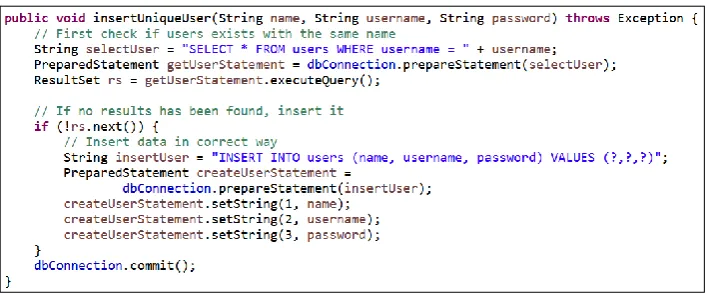
Another issue is the possibility of adjusting the string containing the SQL code, like shown in Figure 7. A variable has been added after the SQL code which contains information about the searched user. The variable could contain a username but also SQL injections. This leads to serious security vulnerabilities and unsecure program development if the developer is unaware of the problem. There are serious consequences if the "username" parameter contains the value shown in Figure 8.
Figure 8: SQL injection example
Execution of this statement would immediately lead to deleting the users table, which should be prevented. Currently there exists solutions to this problem like specifying which values belong to which value placeholder, as shown in the setString methods in Figure 7. The SQL statement should contain question marks to describe where values can be added. Each of these placeholders has a number, where number 1 is the first exclamation mark and so on. This methodology prevents SQL injections and is advised by many sources, like Oracle [40]. But developers can still be unaware of this solution and it introduces more complexity to the program code.
2. Types and values mismatches
[20] Program code:
Replaced by:
[image:20.595.100.528.65.276.2]Results in:
Figure 9: Code replacement
Typing mistakes with setting the wrong type of value can easily happen if the developer isn't notified, as shown in Figure 9, where the setInt is replaced by setBoolean. Some relational databases like MySQL will automatically convert the value to the other types, which results in storing a 1 or a 0 into the integer field. This is not the case for every data type because not every case is convertible. For example, storing Strings into columns that require integers would result into type-mismatch errors. If PostgreSQL is used instead of MySQL, the outcome of the result would be different because this DBMS doesn't try to convert the values automatically. It will return an error instead if type mismatches occur, as shown in Figure 10.
Figure 10: Type mismatch error in PostgreSQL
But for both SQL databases the mismatch is only noticeable when executing the statements and introduces additional complexity of setting values to value placeholders. Type checking at forehand could prevent issues before execution.
[image:20.595.107.392.694.735.2]One may argue that the increase of complexity is partly caused by the used programming language, since Java is a statically typed language. In a statically typed language the types have to be declared as well and users have to set the value types in the given example (setString method). By using a dynamically typed language the code complexity is indeed reduced as shown in Figure 11. The example shows Python code to insert a new user in the database and uses the "%s" tag instead of question marks, but it means exactly the same. In Python it is not required to use the set method to add values to the "%s" tag, which does reduce the code complexity. But it is still possible to insert the wrong value types and inject the wrong type of data. This problem is visible after executing the SQL code and therefore requires additional code to prevent this concern.
[21] This concern shows that programming languages and relational databases handle data types differently. A solution to this issue is to make the new database language responsible for the type checking and reporting mismatches. The advantages would be:
Specific error reporting: mismatches could be reported back to the user, dependent on the used DBMS.
Type checking as a separated concern: the new database language could take care of it, independent of which programming or scripting language.
There are consequences as well as the new language should be statically typed. It will force users to define the type used for any kind of data but also prevents mismatches.
3. Database connection handling Managing database connections from the GPPL side can be difficult when many connections have to be managed. Connections have to be set-up for every new database connection as shown in Figure 12. This methodology forces the user to be responsible for handling each
database connection correctly. This could be error prone since developers may accidently close a connection at the wrong moment. Efficiency is also an important concern because opening a new connection is an expensive operation. It takes time to set-up a new connection. Execution time can be a crucial factor for some cases, especially for websites. Currently there exists solutions to manage database connections and handle them efficiently by allowing to reuse existing database connections, called database or connection pooling. But it may require developers to use additional libraries to support this, like JDBC or DBCP [4]. It would be an advantage if developers do not have to be bothered with database connections and its optimizations because it would add extra complexity.
4. Database transactions
The auto commit option allows developers to execute database operations separately. When auto commit is disabled, developers can bundle database operations by providing the commit signal at the end [51]. General purpose programming languages use libraries or plug-ins to connect to databases, which allows developers to enable or disable this auto commit option. Those solutions also provide the "commit" and "rollback" methods to provide control over the database transactions. But placing the commit signal at the wrong section of the code or forgetting to place this signal, has a large influence on the behaviour. The program code shown in Figure 7 uses an SQL query to retrieve users with an username, checks whether users exist with such an username and inserts a new user if the username is unique. When auto commit is disabled, the user's uniqueness cannot be guaranteed. Another computer application may insert the same user somewhere between executing the "select" and the "insert" statements of the code. By placing the commit signal at the end and setting the auto commit to false, this can be prevented. But the developer can accidently place the
[22] commit signal after the "select" and the "insert" statement, which results in a different execution sequence compared to the expected behaviour.
We have found the following concerns to the auto commit option:
Auto commit handling: Enabling or disabling auto commit in the library or plug-in from the GPPL can be forgotten. This may result in a different execution behaviour.
Commit signals: When the auto commit option is disabled, developers have to provide the commit signal manually. The commit signal can easily be placed at the wrong location or even forgotten.
Database transactions: It could happen that a transaction suddenly fails because of an unstable internet connection or another type of intervention. A transaction is cancelled completely, while retrying may be useful in some cases. By cancelling, more communication traffic is required to retry the transaction.
First of all, disabling the auto commit option has consequences. Developers are forced to use the commit signal, which can be forgotten or misplaced. But disabling the auto commit allows to combine multiple database operations into one transaction and prevents data integrity issues. To have the advantage of bundling database operations and preventing misplaced commit signals, we could search for a solution to place the commit signal automatically. For example, the commit signal can be added at the end of the body of a function or stored procedure [47]. The consequences of this automated process requires more research. But automating this process reduces the freedom of the developers to decide where to use them and may even result in a suboptimal statement execution. The last issue, regarding to database transactions, can be solved by providing a retry option. When connection failure occurs, developers can choose to set an option to retry the database transaction. Developers therefore don't have to provide the logic for the GPPL to implement the retry option. But the use of the retry feature should be limited, because it is useless to retry a transaction when constraints are being violated.
5. Constraint checking
Constraint checks on values are often done at the GPPL side [22] before inserting it into the database, while it can be centralized at the database side. This creates a dependency between the GPPL and the database for managing data correctly. Another concern is that not all database management systems support constraints fully, like MySQL [33]. Making the DBMS responsible for constraint checking has a few advantages:
Shorter program code at GPPL: Constraints can be checked at the data storage side. It makes the database more responsible for handling the data.
Centralized responsibility: Applications are less responsible for data handling, which can be taken over by the database.
Error reporting: DBMSs often support database constraints already and therefore take care of constraint violation errors as well. Developers don't have to provide the logic behind it.
[23]
Reduced performance: Violation of constraints is detected at the DBMS side instead of preventing it at the GPPL side. A response has to be sent back from the DBMS to the application, which causes delays.
Increased complexity: Database code gets more complex if constraints are added to the database program. Therefore the complexity has moved from the GPPL to the DBMS.
Still the reduction in performance has to be measured to know how large the impact will be and the increase in complexity is not expected to be of a concern either.
3.2.2
SQL concerns
We discuss the possible improvements for SQL in the following subsections.
6. Syntactical improvements
SQL allows declaration of commands in a simple way as shown in Figure 13, but the syntax can be simplified. Queries could end up as long declarative statements, which can be written in shorter commands which are more comparable to programming languages.
Language Code
MySQL SELECT EXISTS(SELECT 1 FROM `users` WHERE username = 'Roland')
Possible syntax Users[username = "Roland"].exists Figure 13: SQL versus Java
The code shown in the example checks if a user with the name "Roland" exists in the database. The SQL statement is twice as long as the Java Hash Map operation. If the syntax is adjusted, it could lead to three improvements:
Shorter syntax: it is possible to shorten the syntax without sacrificing functionality or readability.
Decreased complexity: if the length is decreased, the overall readability of the code would increase.
Similarity with GPPL syntax: the syntax can be adjusted to match more closely with the GPPL to make it easier for software developers to program.
[24] 7. Database functions and procedures
Developers tend to design subroutines used for databases at the application side rather than the database side. For example, a log-in function for websites is often written in PHP instead of using user-defined functions of the PL/SQL extension [22]. One of the reasons may be the complexity of writing functions and procedures. We have found a several improvements to make development of database functions and procedures easier.
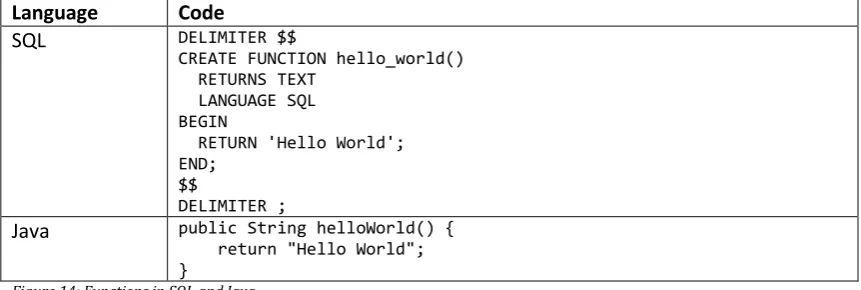
The first noticeable improvement is the simplification of the syntax of stored procedures and functions. General purpose programming languages like Java and Python allow the user to write a function in a shorter way, which lowers the amount of code as shown in Figure 14. By getting rid of information like the $$ sign or the "CREATE" statement, the code could already be reduced in length. Since the method in Java and the function in SQL share similarities, the syntax could even be mapped from one to another. They both have an identifier, parameter support, a body and the return type. By replacing syntactical elements no harm can be done to the SQL language. But in SQL there is a fundamental difference between stored procedures and functions. Stored procedures have more possibilities related to the error handling and feature support [39]. In particular, the body of user-defined functions can't contain try- and catch blocks for error handling because it isn't allowed to have any side effects.
Language Code
SQL DELIMITER $$
CREATE FUNCTION hello_world() RETURNS TEXT
LANGUAGE SQL BEGIN
RETURN 'Hello World'; END;
$$
DELIMITER ;
[image:24.595.101.532.368.513.2]Java public String helloWorld() { return "Hello World"; }
Figure 14: Functions in SQL and Java
The second issue is about not being able to add try-catch blocks to user-defined functions. This could be useful because developers may want to validate parameters of a user-defined function before using them. There exists a work-around to solve the issue, by returning numerical error messages in case of constraint violations [14]. Adding try-catch blocks support would make error reporting easier for developers.
8. Relationships and data model
[25] retrieve bank information from a user and to update the user's name with a certain bank account number. This means that the same relationships can be defined multiple times for different cases. A better solution would be to declare the relationship between tables and columns once after the table definitions, instead of declaring the relationships in statements and queries. Solving this concern results in less duplicate code.
Query SELECT b.*
FROM users u, bankaccounts b
WHERE u.uid = b.uid AND u.name = 'Roland'
Update UPDATE user u
INNER JOIN bankaccounts b on u.uid = b.uid
[image:25.595.98.536.157.243.2]SET u.name = 'Lesley' WHERE b.number = 123456 Figure 15: Query and update statement using relationships
3.3
Conclusion
One of the most discussed problems is the impedance mismatch, which is the linguistic difference between the GPPL and the declarative database language. GPPL's often use objects and pointers for their data structure, while relational databases use tables and relationships. When an object oriented GPPL has to access a relational database management system, concerns appear related to these linguistic mismatches. Writing database code in an imperative way would not be a good solution, since it ends up in many database operations, which can be written in one single SQL query.
We have gathered and explored eight different concerns from relational database programming from a GPPL and the SQL language. For example, the developer is forced to put the join conditions in queries when multiple tables are used, even if they have been provided before. But most of the problems are not crucial to solve, because each of the concerns may already have a solution. But providing a total solution for all concerns makes database programming a lot easier. Some concerns may be easier to fix by providing an architectural design. Using a database language within a GPPL could create security concerns and data type mismatches. One solution is to separate those languages, which is easier to do at architectural level. Therefore it may be useful to design an architecture first before designing a new database language.
[26]
4
Evaluation of existing work
The concerns described in section 3.2 are not unknown and many engineers and scientists have been working on the issues [1, 2]. Solutions have been developed to solve relational databases' shortcomings, like Google's BigTable [13] or Object-Relational databases [23]. Each solution provides a way to cope with the issues of relational databases and has its advantages and disadvantages. This section describes ten solutions of different kinds, from new database solutions to middleware technology. Each of these solutions are compared to gain insights in which concerns they address to solve.
4.1
Object Oriented database management systems
Object Oriented database management systems (OODBMS) are fundamentally different from relational database management systems, since they differ in the used models [1]. The relational databases are based on the Mathematical Relational model for expressing relations between data, while Object Oriented databases focuses on the aspects of the Object Oriented paradigm [23, 44]:
Inheritance: making subversions of a specific class which helps out factoring shared specifications.
Encapsulation: packing data into one class and hiding data.
Polymorphism: allows to create variations of a class.
These features allow us to specify the data structure more naturally compared to relational databases, as the data can be defined as classes, subtypes and relations. An OODBMS uses pointers in objects to refer to other objects to create relationships, which can be represented
as an interconnected graph. An instance of a class may refer to another instance of a class, which is visible in Figure 16. This example shows an object oriented design of Figure 2. Object Oriented databases have two advantages: the underlying data structures can be more complex since Object Oriented features are supported and the impedance mismatch has been solved since the data model matches with object oriented programming languages. How well the impedance mismatch has been solved, depends on the DBMS. Most OODBMSs use the Object Query Language (OQL), which is a variant of SQL for Object Oriented databases [44, 57]. OQL was designed to work more closely with programming languages like Java and C++ because it uses objects. There also exist newer solutions which use different way of expressing queries, like the Realm DBMS [45]. So it is hard to tell how well it solves the impedance mismatch because it depends on the solution. But for several reasons it didn't replace the relational databases yet:
Investments [24]: Object Oriented databases arrived when relational databases are up and running. Converting databases to a different type costs time and money. It could even create more complicated scenarios.
Performance [23, 44]: Companies haven't succeeded in developing a competing OODBMS in terms of performance and scale in comparison to RDBMS's.
[27]
Complexity [44]: Optimizing queries can be challenging, especially when the graph of object structures gets complex. A query can contain many classes and objects to query on, which generates a longer list of referred objects in the statement.
The complexity of queries and data structures may be the main issue because performance issues can be solved by improving the implementation. Also the costs should not be a major problem if these DBMSs are better than relational DBMS's. Even if this solution isn't the most popular choice, there are still design choices which can be reused. Inheritance and polymorphism can be useful for databases, as it can be useful to have data subtypes. For example, if you have different types of users you'll easily get a hierarchical structure of shared properties. In relational databases it would be useful to inherit tables with certain properties and make subtypes of a user. Encapsulation is less interesting because it wouldn't make sense to hide data or functionality, especially in databases.
4.2
Object-Relational database management systems
The Object-Relational database management system (ORDBMS) is a hybrid solution [8, 26] between the relational database management systems and object-relational mapping solutions. It uses the SQL language for database definition and manipulation, it uses the relational model for data storage and extends the data model with object oriented features [44]. To put it more simply, it is a RDBMS with OO features to extend the data model. Which features are supported to extend the data model depends on the ORDBMS, but the most common features are inheritance and object representation of relational information. By supporting user defined data types, it is possible to bring the data model closer to the data model used by the GPPL, just as shown in Figure 17, compared to relational databases.
CREATE TYPE paymentStatus AS ENUM ('new', 'open', 'closed');
CREATE TABLE payments ( id integer PRIMARY KEY, fromAccoutId integer, toAccoutId integer, description text, status paymentStatus );
Figure 17: User defined type to store payment status
These additional features lead to the possibility of writing more complex queries than the RDBMS allows to. A nested structure of objects and fields can be declared in a query for an ORDBMS [20, 48], while a query for RDBMS only requires direct references to tables and columns. Figure 18 shows an example query to retrieve users which are listed in the employee class. When this query is executed, the ORDBMS has to analyze the objects and has to map it to the relational data model as stored in the relational database. It is possible to retrieve a network of objects instead of rows of data as well, but this is optional.
stmt.executeQuery("SELECT u.name FROM Users u WHERE Employee(u.name) = 1"); Figure 18: An ORDBMS query written in Java
[28] related to ORDBMS's since the Java DataBase Connectivity plug-in is responsible for causing this concern. But the linguistic differences between the GPPL and the ORDBMS still exist, even if the data model mismatches are targeted to solve. But a bigger concern is the variety in support of features.
4.3
NoSQL
The NoSQL category databases are by no means attempts to get rid of the SQL language, but it stands for "Not Only SQL". It covers a wide range of data storage solutions that solve specific issues related with the relational databases today. For this reason NoSQL databases are not primarily meant to replace relational databases [25]. One example is Google's BigTable solution focusing on distributed data storage for handling large datasets more efficient than relational databases. It uses one big multi-dimensional sorted map as storage model, where data is sorted by row key, column key and a timestamp (3 dimensional). The data is stored as a key-value pair where multiple instances of the data can exist as long as the timestamp is unique [13]. There are many other examples, such as MongoDB (key-value storage) if more speed is required [32] and BaseX for document storage in the eXtensive Markup Language format [5]. Each of these NoSQL solutions are equal and vary greatly in which problem they solve. Although many tend to integrate relational features in their databases over time.
4.4
Microsoft LINQ
Microsoft has released LINQ [31] to make the gap between the GPPL and SQL smaller and focuses on solving the impedance mismatch. LINQ is a query language that allows developers to express queries in a general purpose programming language, where statements look similar to SQL statements. But LINQ also supports describing queries in a way comparable to Lambda expressions. Another key selling point is the length of the code, as Microsoft has shortened the expressions. But the declarative database code is mixed up with C# or Visual Basic code, and is therefore bound to specific GPPLs. An example of LINQ code is shown in Figure 19.
DatabaseContext context = new DatabaseContext(); // Create a new user
User newUser = new User(); newUser.name = "Roland";
newUser.username = "RolandBalk"; newUser.password = "test123";
context.users.InsertOnSubmit(newUser);
// Search for a user called Roland
var query = from a in context.users where a.name.Contains("Roland") select a; Figure 19: LINQ code example
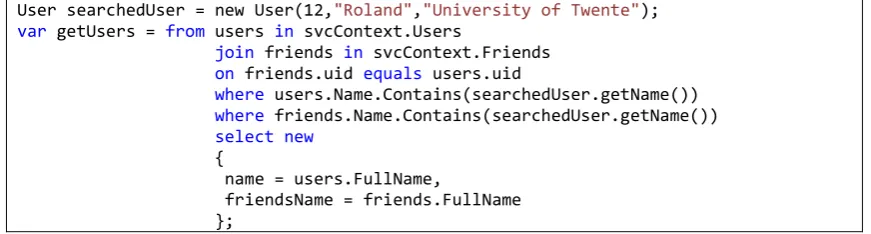
[29] in a variable which searches for a user called "Roland". This example shows that LINQ uses two kinds of language concepts to close the gap between relational databases and programming languages: the Object Oriented paradigm to represent new data and the declarative paradigm to describe queries. It is an improvement in a several ways: the chance of writing wrong statements has been lowered, the syntax has been shortened for queries and type mismatches are prevented. But LINQ is only compatible with Microsoft's programming languages and the written database statements are bound to the expressiveness of the programming language, especially the programming concepts. Since multiple paradigms are used, data objects can get mixed up with declarative queries and could result in less readable code and long queries as shown in Figure 20. This example creates a User object and calls the constructor. The getUsers contains the result of asking the database for users with the name "Roland" and with friends that share the same name.
User searchedUser = new User(12,"Roland","University of Twente"); var getUsers = from users in svcContext.Users
join friends in svcContext.Friends on friends.uid equals users.uid
where users.Name.Contains(searchedUser.getName()) where friends.Name.Contains(searchedUser.getName()) select new
{
name = users.FullName,
[image:29.595.91.527.267.384.2]friendsName = friends.FullName };
Figure 20: LINQ example of mixing up objects and methods with queries
4.5
Microsoft SQL Templates
Microsoft saw a chance to improve the reusability of code by using templates [28]. A template is a piece of reusable code in the form of a stored procedure. Microsoft's editing tool called Visual Studio, allows to create templates easily and helps with building up the basic structure. A template supports various SQL statements like queries, tables and if statements. Other database management systems like MySQL support stored procedures as well, but the name "template" is a bit misleading and can even be confusing because PostgreSQL uses templates to model databases [41]. It's a good idea to make development of stored procedures easier, as it may accelerate the development process.
4.6
Ferry
[30]
4.7
Iris Programming Language
Iris Programming Language (IPL) is a functional embedding of OSQL, which is a database programming language for the Iris OODBMS. The Iris language allows to write computational functions and procedures in a syntax comparable to GPPLs. The goal is to support more complex functions at the database side and to make them more reusable. Functions that have to be built at the GPPL side could be developed in IPL and is accessible from any GPPL. The syntax of the code is kept closely to C or Pascal to make it easier for developers to work with and the language uses an imperative syntax to write code. It supports basic features for defining and updating functions and defining queries. The language does also support recursion, conditions, iterations, sequences and variables. Therefore it is easier to define constraints as well. An interpreter is used to map the syntax to OSQL code to make it executable. Even though the solution looks quite promising, not much can be found about the language except the main paper, which dates from 1991 [17].
4.8
Middleware
Middleware is a software solution that acts as a layer between applications, like a web server which makes websites accessible for web browsers. There exists all kinds and forms of middleware, but we are mainly interested in database middleware. There exists solutions like:
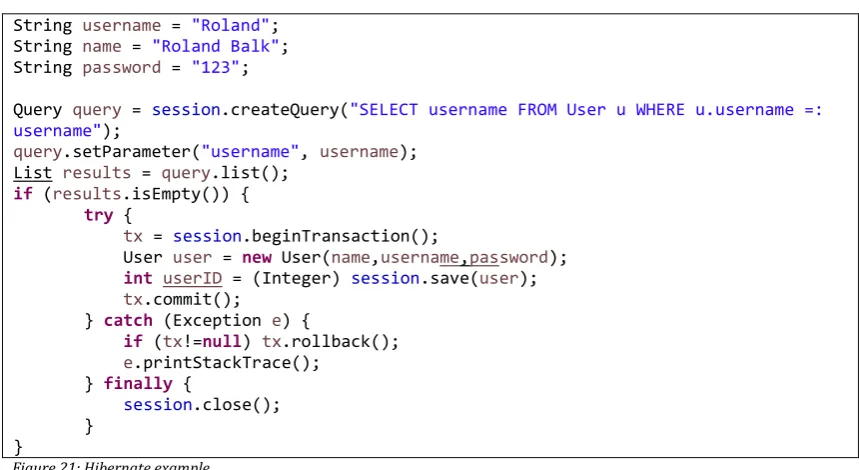
Hibernate [46]: is an object-relational mapping framework for Java to let the Object Oriented paradigm work together with relational databases. It partly solves the impedance mismatch by mapping Object Oriented data to relational databases. This solution is used in the GPPL, unlike the ORDBMS that solves the mapping process at the database side. Tables, columns and rows are written and accessed as objects as shown in Figure 21. If data needs to be retrieved, queries can still be written in a String data format [55], which may cause security and type issues. It does provide an alternative option to solve this concern, by working with data objects instead of tables and providing information how to map the data objects to relational information.
String username = "Roland"; String name = "Roland Balk"; String password = "123";
Query query = session.createQuery("SELECT username FROM User u WHERE u.username =: username");
query.setParameter("username", username); List results = query.list();
if (results.isEmpty()) {
try {
tx = session.beginTransaction();
User user = new User(name,username,password); int userID = (Integer) session.save(user); tx.commit();
} catch (Exception e) {
if (tx!=null) tx.rollback(); e.printStackTrace();
} finally {
session.close(); }
[image:30.595.93.523.528.763.2]}
[31] One of its advantages is that no new database management system is required to use this mapping and it can be connected to any existing RDBMS. But Hibernate is built for Java, because it merges the declarative database language with the GPPL. Hibernate is not fully bound to Java, because there exists a comparable solution for .NET languages known as N-Hibernate. For other programming languages you need to find alternatives like Django [11], which is meant for Python.
Java Object Oriented Querying [9] (JOOQ): is an object-relational mapping for Java, which is similar to Hibernate. But this solution only maps tables to objects, while the Object Relational Mapper is able to map tables and rows to Objects. It targets to make database programming easier for software developers. Queries are written as method calls, as shown in Figure 22. This design choice has led to type-safety for creating queries but reduces the compatibility to SQL databases only [7]. Another implication is that the solution is bound to the expressiveness of Java. This means that the syntax of JOOQ can't be optimized because a long list of method calls could get complicated to read.
Factory create = new Factory(connection, dialect); create.select(username)
.from(Users)
.where(Users.username.equal("Roland")); Figure 22: JOOQ query
[32]
4.9
Comparison of solutions
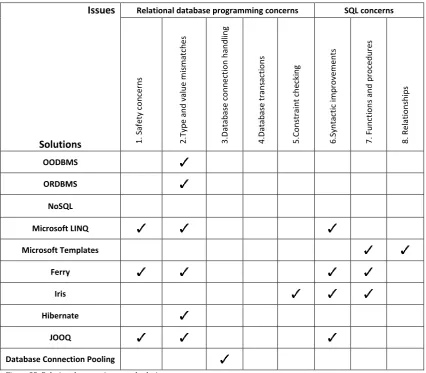
There exists a correlation between the concerns and the existing work and we decided to summarize it into a table, shown in Figure 23.
Issues
Solutions
Relational database programming concerns SQL concerns
OODBMS ORDBMS NoSQL Microsoft LINQ Microsoft Templates Ferry Iris Hibernate JOOQ
[image:32.595.94.521.128.501.2]Database Connection Pooling
Figure 23: Relations between issues and solutions
The table shows four results:
Impedance mismatch is the most solved concern
None of the solutions solve all concerns
Database management system optimizations are the least targeted issues to solve
Database transaction optimization and table abstractions have not been solved by the compared solutions
We aim to solve all concerns to make our solution unique compared to the existing work. But it is not possible to solve all concerns within the given time for this thesis. The open issues are discussed in section 7.1.
[33]
4.10
Conclusion
We summarized and compared 10 different solutions of different kinds. Each of these solutions provide concepts to make database programming easier by solving impedance mismatch concerns or providing new ways to program databases. Various kinds of databases have been developed, such as the Object Oriented database management system (OODBMS), which stores information in a network of objects and introduces Object Oriented features such as inheritance and polymorphism. But companies haven't succeeded in making a competitive OODBMS in terms of performance and scalability. The Object-Relational database management system is a relational database management system which introduces object oriented features to the relational data model. Mapping objects to relational information is carried out at the database side. Ferry's approach has shown that it is possible to map GPPL code to SQL, which shortens the syntax and makes database programming easier for software engineers. The last selection of solutions, middleware, has shown solutions which are dependent and independent from the GPPL. Hibernate and LINQ are bound to a specific programming language, which makes the solution less portable when developers decide to change from GPPL. Therefore it would be better to provide a language which is independent from any GPPL to make it portable and usable for any GPPL of choice.
[34]
5
SQLento's architecture
The previous chapters have shown possible ways to improve database programming and various solutions to solve them. But not all concerns can be solved by using one solution and some concerns are easier to solve by using architectural solutions. This chapter describes the concepts for the architecture, the implementation and some of the possible alternative solutions.
5.1
The concept
[image:34.595.95.527.372.498.2]We propose an architectural solution to place the new database programming language (SQLento) between the GPPL and the DBMS. In this way we can separate the new database language from any GPPL or DBMS and we can optimize our own language for relational databases mainly. The architectural solution consists out of compilers, communication interfaces for the GPPL and the DBMS and a definition section, as shown in Figure 24. The communication interfaces take care of communication between the GPPL, the architecture and the DBMS. The compilers are required to map the new database language to executable database code, like SQL. The definitions component keeps track of the executable database code. There exist many implementations for this architecture, where a few important ones are discussed in the next section.
Figure 24: Concept of SQLento
5.2
Possible implementations
[35]
Figure 25: Possible architectures
Instead of using an architectural solution, Object-relational DBMSs could be used as well. But the ORDBMS extends the RDBMS with object-oriented features and therefore could be supported at language level (SQLento).
5.3
Proposed implementation
We propose to make the database language (SQLento) independent from the GPPL by providing a web service interface for any kind of GPPL. A program written in SQLento is compiled to executable database code, like SQL, and a communication interface for the GPPL (see Figure 26). By generating the web service
interface for the GPPL, we can provide any kind of implementation for this communication interface, like Remote Procedure Calls, and we can optimize the database code for database transactions. The generated communication (web service) interface contains the logic to connect with the architecture and methods to call atomic database transactions, like user defined functions, which are written in SQLento.
[image:35.595.337.539.356.480.2]GPPLs use the generated communication (see Figure 27) interface to call executable database code, like database functions and procedures. When the web service component of the architecture receives these calls, the received information is checked in the definition component to decide which database code to execute and is mapped to executable database code. By using the database connection component the database code is executed on the DBMS. Results from the DBMS are communicated back via the architecture to the GPPL and can be mapped to a nested data model, just like an object-relational mapper, to prevent any data model mismatches. The architecture should be
Figure 26: SQLento's compilation products
[image:35.595.340.541.516.705.2]