University of Warwick institutional repository: http://go.warwick.ac.uk/wrap
This paper is made available online in accordance with
publisher policies. Please scroll down to view the document
itself. Please refer to the repository record for this item and our
policy information available from the repository home page for
further information.
To see the final version of this paper please visit the publisher’s website.
Access to the published version may require a subscription.
Author(s): D. Tsiklauri, T. D. Arber, V. M. Nakariakov
Article Title: A weakly nonlinear Alfvénic pulse in a transversely
inhomogeneous medium
Year of publication: 2001
Link to published article:
http://dx.doi.org/10.1051/0004-6361:20011415
Publisher statement: © ESO 2001. D. Tsiklauri et al. (2001).
A weakly nonlinear Alfvénic pulse in a transversely
DOI: 10.1051/0004-6361:20011415
c
ESO 2001
Astrophysics
&
A weakly nonlinear Alfv´
enic pulse in a transversely
inhomogeneous medium
D. Tsiklauri, T. D. Arber, and V. M. Nakariakov
Physics Department, University of Warwick, Coventry, CV4 7AL, UK
Received 31 July 2001 / Accepted 24 September 2001
Abstract.The interaction of a weakly nonlinear Alfv´enic pulse with an Alfv´en speed inhomogeneity in the direction perpendicular to the magnetic field is investigated. Identical to the phase mixing experienced by a harmonic Alfv´en wave, sharp transverse gradients are generated in the pulse by the inhomogeneity. In the initial stage of the evolution of an initially plane Alfv´enic pulse, the transverse gradients efficiently generate transversely propagating fast magnetoacoustic waves. However, high resolution full MHD numerical simulations of the developed stage of the pulse evolution show that the generation saturates due to destructive wave interference. It is shown that the weakly non-linear description of the generated fast magnetoacoustic wave is well described by the driven wave equation proposed in Nakariakov et al. (1997), and a simple numerical code (2D MacCromack), which solves it with minimal CPU resources, produces identical results to those obtained from the full MHD code (Lare2d, Arber et al. 2001). A parametric study of the phenomenon is undertaken, showing that, contrary to one’s expectations, steeper inhomogeneities of the Alfv´en speed do not produce higher saturation levels of the fast wave generation. There is a certain optimal gradient of the inhomogeneity that ensures the maximal efficiency of the fast wave generation.
Key words.magnetohydrodynamics (MHD) – waves – Sun: activity – Sun: corona
1. Introduction
Many astrophysical objects and space plasma systems are significantly influenced by magnetohydrodynamic (MHD) waves. MHD waves constitute the basis of many current theories of solar and stellar wind acceleration, the heating of solar and stellar coronae and the stability of molecular clouds, etc. In solar physics interest in MHD waves has in-creased significantly with the successful detection of MHD waves in coronal loops and plumes by recent observations from the SOHO and TRACE spacecrafts. This, in turn, has generated lively interest in MHD waves in the theo-retical solar physics community in the context of coronal plasma heating and solar wind acceleration (see Roberts 2000 for a review).
A significant aspect in MHD wave dynamics, which has attracted considerable attention recently, is the in-teraction of waves withplasma inhomogeneities. Because of the essentially anisotropic nature of MHD waves, they are affected by the inhomogeneities in many ways. In par-ticular, structuring of the medium leads to the appear-ance of long wave-length dispersion, the existence of local resonances associated with e.g. resonant absorption, and
Send offprint requests to: D. Tsiklauri, e-mail:[email protected]
Alfv´en wave phase mixing (see, e.g. Roberts 1991; Roberts & Ulmschneider 1997).
In the majority of astrophysical applications, almost incompressible Alfv´en waves are subject to very weak dis-sipation. Therefore, physical mechanisms which can create small scales in the waves, enhancing the dissipation, are very important. One of these mechanisms is phase mixing of Alfv´en waves interacting with a plasma inhomogeneity. When an initially plane Alfv´en wave propagates along a straight magnetic field, the presence of an Alfv´en speed inhomogeneity across the field leads to distortion of the wave front. In other words, each magnetic interface sup-ports Alfv´en waves propagating with its own local Alfv´en speed. After a while, the neighbouring magnetic interfaces are oscillating out of phase and the Alfv´en wave becomes “phase-mixed”. This phenomenon dramatically decreases the perpendicular wavelength and generates very sharp transverse gradients. In the presence of finite viscosity or resistivity, the short wavelengths are subject to en-hanced dissipation. Since this mechanism was proposed by Heyvaerts & Priest (1983) for heating the solar corona, the linear regime of Alfv´en wave phase mixing has been intensively investigated by many researchers, mainly in the coronal heating context (Abdelatif 1987; Browning 1991; Ireland & Priest 1997; see also the critical paper of Parker 1991), including investigation of Alfv´en wave
Tsiklauri et al.: A weakly nonlinear Alfv´enic pulse in a transversely inhomogeneous medium 1099
phase mixing in inhomogeneous steady flows (Ryutova & Habbal 1995; Nakariakov et al. 1998) and in two dimen-sional structures (Hood et al. 1997; Ruderman et al. 1998; Ruderman et al. 1999; De Moortel et al. 1999; De Moortel et al. 2000) and studies of secondary Kelvin–Helmholtz instabilities (Browning & Priest 1984). Possible manifes-tations of this effect in coronal observations have been discussed (Ireland 1996; De Moortel & Hood 2000) and numerical simulations of Alfv´en wave phase mixing have been undertaken in various astrophysical and geophysical contexts (Botha et al. 2000; Grappin et al. 2000; Malara et al. 1996; Ofman & Davila 1997).
In the linear regime of Alfv´en wave phase mixing, the wave does not interact with other wave modes, and the wave dissipation is enhanced due to the generation of small scales across the field. In the nonlinear regime, Alfv´en waves interact with, in particular, magnetoacous-tic waves. For the Alfv´en wave amplitudes expected in the lower corona of the Sun, the linear treatment of the pro-cess of phase mixing seemed to be justified (e.g. Sakurai & Granik 1984) as the Alfv´en waves are subject to cubic nonlinearity, not quadratic as for magnetoacoustic waves. The presence of structuring can dramatically affect the ef-ficiency of nonlinear processes. In coronal holes, outwardly propagating Alfv´en waves are amplified by stratification and, therefore, quickly reach the nonlinear regime (Ofman & Davila 1997; Nakariakov et al. 2000). In the presence of structuring across the field, phase mixing leads to nonlin-ear generation of transversely propagating fast magnetoa-coustic waves (Nakariakov et al. 1997, 1998).
The nonlinear generation of fast waves, based upon a combination of inhomogeneous and nonlinear effects, can provide new physical mechanisms for MHD wave dissipa-tion. In the linear regime of phase mixing, Alfv´en waves dissipate due to theshearcomponent of the viscosity ten-sor, while the fast magnetoacoustic waves dissipate due to the bulk viscosity. In the nearly collisionless coronal plasma the bulk viscosity is estimated to be 1010 times
larger than the shear viscosity. Thus, fast magnetoacous-tic waves that are generated by Alfv´en waves dissipate much more efficiently than the Alfv´en waves. This mech-anism can be regarded as the indirect heating of plasma by phase mixing.
In the corona of the Sun there is some evidence that the shear viscosity may actually be of the same order as the bulk viscosity (Nakariakov et al. 1999). In this case, the mechanism of indirect heating is still very important, because it provides a possibly of heat distribution across the magnetic field. Indeed, the transversely propagating fast waves carry the energy across the field and deposit it at some distance from the region of phase mixing. Regular thermal conduction is depressed in the perpendicular di-rection by the magnetic field. Thus, the mechanism of in-direct heating of astrophysical plasmas by Alfv´en wave phase mixing requires serious investigation.
Nakariakov et al. (1997), by applying a weakly nonlin-ear description for the dynamics of the generated fast mag-netoacoustic waves, pointed out that phase mixed Alfv´en
waves had to generate secularly growing fast waves (their Eq. (28)). This analytical result was successfully repro-duced in full-MHD numerical simulations of the initial
stage of the fast wave generation. Botha et al. (2000) un-dertook numerical simulations of this phenomenon over much longer times, investigating the efficiency of the indi-rect heating by consideringharmonicphase-mixed Alfv´en perturbations. They found that initially the amplitude of the generated fast magnetoacoustic waves grows but then saturates and does not reach a substantial fraction of the Alfv´en wave amplitude. They further postulated that this saturation was due to the nature of the source term for fast waves. For harmonic Alfv´en waves, as distinct from the single pulse considered in this paper, phase mixing leads to there being many fast wave sources in the direc-tion of the background inhomogeneity. Indeed, the number of such sources, and their spacing, changes in time and as a consequence the fast wave sources cannot remain coher-ent and destructive wave interference limits the growth of fast wave energy.
In this work, we simulate numerically the interaction of a linear Alfv´enic pulse with a one-dimensional, per-pendicular to the magnetic field, plasma inhomogeneity. The pulse phase mixes, leading to steep transverse gradi-ents. This leads to the generation of fast magnetoacous-tic waves. This work has three objectives: to investigate whether a phase-mixed Alfv´enic pulse, as opposed to Botha et al.’s (2000) harmonic Alfv´en wave, can efficiently generate fast magnetoacoustic waves; to check whether the rapid growth (in time) of the generated fast magnetoa-coustic waves still holds at the later stages and to clarify the role of the destructive wave interference for an isolated pulse.
We would like to emphasize that in this work we con-sider onlysmall amplitude(relative amplitude normalized to the unperturbed valueA= 0.001) Alfv´en waves in alow beta plasma. Such a physical situation is relevant to the lower corona of the Sun where the observed amplitudes of the Alfv´en waves are indeed small. The more general case of large amplitudes (A ∼ 1) and arbitrary plasma beta, which is relevant e.g. for the Alfv´en waves in the solar wind, will be reported elsewhere (Tsiklauri et al. 2001).
The paper is organized as follows: in Sect. 2 we outline the basic aspects of our model. Section 3 presents the re-sults of our numerical calculation. In Sect. 4 we close with a brief discussion of the main results of this paper.
2. The model
In our model we use equations of cold (zero plasma-β) ideal MHD
ρ∂V
∂t +ρ(V · ∇)V =− 1
4πB×curlB, (1) ∂B
∂t = curl(V ×B), (2)
∂ρ
∂t + div(ρV) = 0, (4)
whereBis the magnetic field,V is plasma velocity, andρ is plasma mass density.
We consider Eqs. (1)–(4) in Cartesian coordinates (x, y, z) and for simplicity assume that there is no vari-ation in they-direction, i.e. (∂/∂y= 0). The equilibrium state is taken to be an inhomogeneous plasma of density ρ0(x) and a uniform magnetic fieldB0 in thez-direction.
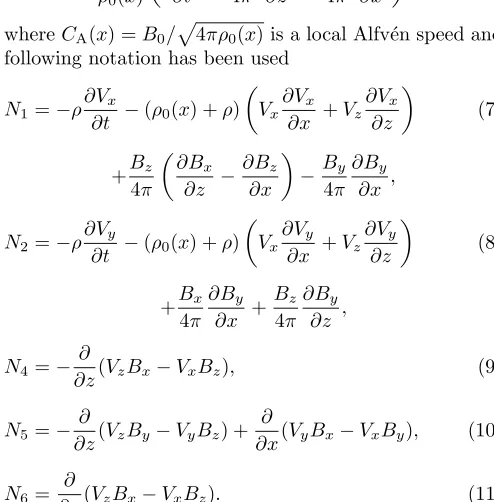
Nakariakov et al. (1997) have obtained a set of govern-ing equations for the finite amplitude perturbations for the above formulated physical system (see, also, Nocera et al. 1986), and for brevity we do not repeat their derivation here. However, we quote their final analytic result, which is two coupled, linear wave equations describing non-linear coupling of Alfv´en and fast magnetoacoustic waves ∂2Vy
∂t2 −C 2 A(x)
∂2Vy
∂z2 =
1 ρ0(x)
∂N2 ∂t + B0 4π ∂N5 ∂z , (5)
∂2V
x
∂t2 −C 2 A(x)
∂2V
x
∂x2 +
∂2V
x
∂z2
= (6)
1 ρ0(x)
∂N1 ∂t + B0 4π ∂N4 ∂z − B0 4π ∂N6 ∂x ,
where CA(x) =B0/
p
4πρ0(x) is a local Alfv´en speed and
following notation has been used
N1=−ρ
∂Vx
∂t −(ρ0(x) +ρ)
Vx
∂Vx
∂x +Vz ∂Vx
∂z
(7)
+Bz 4π ∂Bx ∂z − ∂Bz ∂x
−By
4π ∂By
∂x ,
N2=−ρ
∂Vy
∂t −(ρ0(x) +ρ)
Vx
∂Vy
∂x +Vz ∂Vy
∂z
(8)
+Bx 4π ∂By ∂x + Bz 4π ∂By ∂z ,
N4=−
∂
∂z(VzBx−VxBz), (9)
N5=−
∂
∂z(VzBy−VyBz) + ∂
∂x(VyBx−VxBy), (10)
N6=
∂
∂x(VzBx−VxBz). (11) As noted in Nakariakov et al. 1997, the non-linear dynam-ics of Alfv´en waves is described by Eq. (5). Equation (6) is the governing equation for the non-linear dynamics of finite amplitude fast magnetoacoustic waves. In the lin-ear limit when the right-hand-side terms in the Eqs. (5) and (6) tend to zero, Alfv´en and fast magnetoacoustic waves propagate along the applied magnetic field inde-pendently. Therefore, in this case Eq. (5) describes phase-mixed Alfv´en waves, which propagate along z-axis per-turbing physical quantities in thexOzplane. Equation (6) describes either trapped or leaking fast magnetoacoustic
waves (depending whether there is a maximum or mini-mum in the density profileρ0(x)).
We consider the physical situation when initially fast magnetoacoustic perturbations are absent and the initial amplitude of the Alfv´en wave is small. In this case, if the Alfv´en wave is initially a plane wave, the subsequent evolu-tion of the wave, due to the difference in local Alfv´en speed across thex-coordinate, leads to the distortion of the wave front. Hence the appearance of transverse (with respect to the applied magnetic field) gradients, which grow linearly with time. Therefore the leading non-linear term on the right-hand-side of Eq. (6) is the transverse gradient of the magnetic pressure perturbation, i.e. to a fairly good accu-racy (which is substantiated by our numerical calculations presented below) the dynamics of the fast magnetoacous-tic waves can be described by an approximate equation (Nakariakov et al. 1997)
∂2V
x
∂t2 −C 2 A(x)
∂2V
x
∂x2 +
∂2V
x
∂z2
= (12)
− 1
4πρ0(x)
∂ ∂t By ∂By ∂x ·
3. Numerical results
As in the work of Botha et al. (2000), we have used the following background density profile
ρ0(x) = 3−2 tanh(λx). (13)
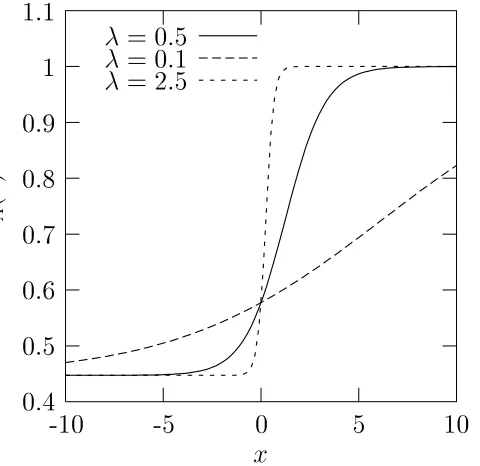
Here,λis a free parameter which controls the steepness of the density profile gradient. In our normalization, which is the same as that of Botha et al. (2000), the local Alfv´en speed is CA(x) = 1/
p
[image:4.595.55.302.383.634.2]3−2 tanh(λx), and we plot it in Fig. 1 for the parameters used in our numerical simula-tions (see below). As can be seen from the plot, the local Alfv´en speed has a gradient atx= 0 and its value is con-trolled by the λ-parameter. Full numerical calculation of the non-linear set of MHD Eqs. (1)–(4), in the abovemen-tioned geometry, has been performed usingLare2d(Arber et al. 2001). Lare2d is a numerical code which operates by taking a Lagrangian predictor-corrector time step and after each Lagrangian step all variables are conservatively re-mapped back onto the original Eulerian grid using Van Leer gradient limiters. This code was also used to produce the results in Botha et al. (2000).
We set up the code in such a way that initially fast magnetoacoustic perturbations are absent and the initial amplitude of the Alfv´en pulse is small, i.e.A= 0.001. In all our numerical runs plasmaβ was fixed at 0.001. In the numerical simulations the Alfv´en perturbation is initially a plane (with respect to thex-coordinate) pulse, which has a Gaussian structure in the z-coordinate, and is moving at the local Alfv´en speedCA(x):
By(x, z, t) =Aexp
−(z−CA(x)t)2
δ
· (14)
Tsiklauri et al.: A weakly nonlinear Alfv´enic pulse in a transversely inhomogeneous medium 1101
=2:5 =0:1 =0:5
x
C
A
(
x
)
10 5
0 -5
-10 1.1
1
0.9
0.8
0.7
0.6
0.5
[image:5.595.39.279.86.319.2]0.4
Fig. 1.Dimensionless Alfv´en speedCA(x) versusxforλ= 0.5
solid line,λ= 0.1 long dashed line,λ= 2.5 short dashed line.
set by the limits−17.5< x <17.5 and−27.5< z <27.5 and the pulse starts to move from point z = −25.0 to-wards the positivez’s. We have performed calculation on various resolutions in order to achieve convergence of the results. The graphical results presented here are for the spatial resolution 4400×1400, which refers to number of grid points inz andxdirections respectively. In Fig. 2 we show how the initial pulse (By) has evolved by t = 10.
It can be seen from the graph that because of the differ-ence in local Alfv´en speeds (recall from Fig. 1 that for x <0,CA(x) = 1/
√
5 and forx >0,CA(x) = 1) the
ini-tially flat (with respect to x-coordinate) Gaussian pulse has been distorted along thex= 0 axis. This distortion of the pulse front creates a transverse gradient (∂By/∂x)
which according to Eq. (12) is a driving force for the gen-eration of a fast magnetoacoustic wave (Vx). At timet= 0
the fast magnetoacoustic wave was absent from the sys-tem. While at time t = 10 we see from Fig. 3 that Vx
has grown to the square of the initial Alfv´en perturbation amplitude i.e. 10−6.
Figure 4 presents a contour plot ofBy at timet= 50.
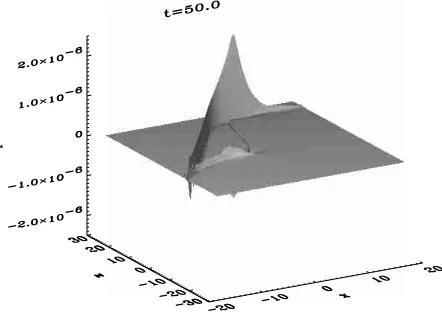
We observe that the Alfv´en pulse has been distorted even further, thus creating even stronger transverse gradients which drive the growth of fast magnetoacoustic waves. In Fig. 5 we plot the generated Vx at the same time, and
we observe that its maximal value has grown further to 1.78×10⁻⁶.
We have kept track of the maximal value of generated fast magnetoacoustic wave,Va
x(t) = max(|Vx(x, z, t)|), as
[image:5.595.293.534.88.269.2]the simulation progresses. The results are presented by the thick solid line in Fig. 6. As we mentioned above, at the early stages of evolution, the dynamics of the generated fast magnetoacoustic wave is governed by Eq. (12). In or-der to prove this, we have written a code which, instead of solving the fully non-linear set of MHD Eqs. (1)–(4), solves
[image:5.595.292.535.323.497.2]Fig. 2. Solution of the full MHD Eqs. (1)–(4) using Lare2d code,By, att= 10.
Fig. 3. Solution of the full MHD Eqs. (1)–(4) using Lare2d code,Vx, att= 10.
[image:5.595.290.534.546.736.2]Fig. 5. Solution of the full MHD Eqs. (1)–(4) using Lare2d code,Vx, att= 50.
the weakly non-linear Eq. (12) directly, using a second or-der MacCormak scheme, for the driver given by Eq. (14). This driver can be easily written by substituting Eq. (14) into Eq. (12):
D(x, z, t) =−2A
2
δ C
2 A(x)
dCA(x)
dx
4
δ(z−CA(x)t)
2×
(15)
CA(x)t+ (z−2CA(x)t)
×exp
−2(z−CA(x)t)2
δ
,
whereD(x, z, t) is the right hand side of Eq. (12). We have solved Eq. (12) on a simulation box −30< x < 30 and
−30 < z <30 using different spatial resolution. The re-sults for theVa
x(t) are plotted in Fig. 6. We observe that
for 4000×4000 resolution (thin solid line) the behavior of the maximal value of generated fast magnetoacoustic wave is quite similar to the results produced by the fully non-linearLare2dcode. In Fig. 7 we plot the generatedVxat
time instancet= 50 obtained by the 2D MacCormak code which solves Eq. (12). The similarity with Fig. 5 is obvi-ous, which validates our earlier statement that Eq. (12) describes the dynamics of the generated fast magnetoa-coustic wave to a sufficient accuracyeven at later times.
As can be seen from Eq. (15) the driver of Eq. (12) contains a third order polynomial in time. Thus, one would expect continuous secular growth of Vxa(t). However, as
can be seen from Fig. 6, Va
x(t) at the later stages grows
more slowly than initially. The situation is quite similar to observed by Botha et al. (2000). Namely, in spite of a secularly growing driver, the solution of Eq. (12) saturates. Botha et al. (2000) have speculated that the saturation of fast magnetoacoustic wave is due to the destructive wave interference effect. Thus, in order to bring clarity into the situation, following Botha et al. (2000), we also calculated the 1D analog of Eq. (12). We have solved equation ∂2Vx
∂t2 −C 2 A(x)
∂2Vx
∂x2 =D1(x, t), (16)
M4000 M1200 M600 Lare2d
t
v
a
x
(
t
)
10
,
6
50 45 40 35 30 25 20 15 10 5 0 2.5
2.0
1.5
1.0
0.5
[image:6.595.59.299.88.258.2]0
Fig. 6.Maximal value of the generated fast magnetoacoustic wave,Va
x(t), versus time. Thick solid curve represents the so-lution of the full MHD Eqs. (1)–(4) using Lare2d code. Thin solid, long dashed and short dashed curves represent solutions of the Eq. (12) using 2D MacCormak code on 4000×4000, 1200×1200 and 600×600 spatial resolution accordingly.
Fig. 7. Solution of the Eq. (12) using 2D MacCormak code with 4000×4000 spatial resolution,Vx, att= 50.
whereD1(x, t) =D(x,(CA(+∞)−CA(−∞))t, t). In other
words we put z → (CA(+∞)−CA(−∞))t, which
phys-ically means that we reduce a 2D problem into a 1D problem by making a transformation to the frame which moves with the mid-point of phase mixed Alfv´en pulse moving with velocity (CA(+∞)−CA(−∞))t. We solved
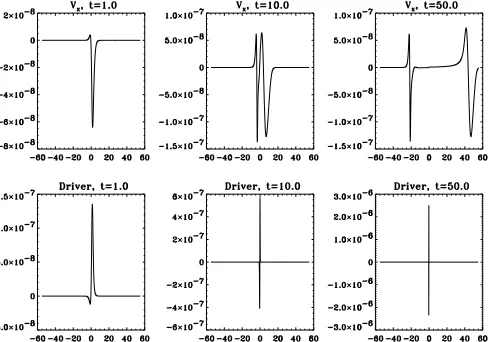
Eq. (16) with various spatial resolutions to make sure that the results converge. In Fig. 8 we plot the solution of Eq. (16) on the simulation interval −55 < x < 55 us-ing 20 000 grid points. At timet= 0 Vx is zero. The top
row showsVx at time instancest= 1,10,50. We see that
the solution comprises two pulses moving out into positive and negative directions at speedsCA(x) = 1/
√
5 forx <0 andCA(x) = 1 forx >0. The bottom row contains plots
of the driver,D1(x, t), at the same instances. Interestingly,
[image:6.595.324.545.330.489.2]Tsiklauri et al.: A weakly nonlinear Alfv´enic pulse in a transversely inhomogeneous medium 1103
the fast magnetoacoustic waves generated by such a driver will saturate because the positive and negative parts of the driver, which get closer as time progresses, cancel each other due to destructive wave interference. The use of the phrase “destructive wave interference” is motivated by the following reason: from wave theory we know that for two waves to compensate (to destroy) each other via interference at a given point in space, they should be π radians out of phase. In our case the equally sized posi-tive and negaposi-tive parts of the driver move progressively closer and the waves they generate become out of phase. This interference suppresses further generation of the fast magnetoacoustic waves. The difference between our re-sults and the ones by Botha et al. (2000) is that since we have considered a single Gaussian pulse (hoping that a single pulse will not trigger a destructive wave interfer-ence effect) we have a single symmetric driver. Botha et al. (2000) considered a harmonic initial Alfv´en perturbation, and thus obtained a driver with a number of symmetric peaks, whose number grows in time (see Fig. 6 in Botha et al. 2000 for comparison). We have kept track of the maximal value of generated fast magnetoacoustic wave, Va
x(t), as our 1D code progressed in time. The results for
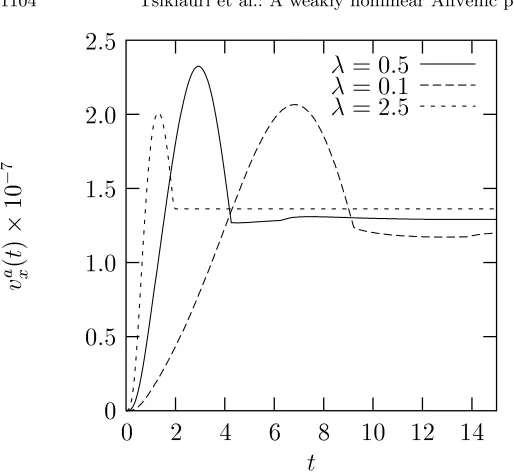
the three values ofλare presented in Fig. 9. It should be noted that there is a difference between 2D (Fig. 6) and 1D (Fig. 9) results. In 2D, as opposed to 1D, we do not observe clear saturation of Vxa(t). We can only conclude
from Fig. 6 that at the later stages Vxa(t) grows much
slower than initially. This can be explained by the fact that in 1D, we define Va
x(t) as a maximal value of the
generated fast magnetoacoustic wave in the framewhich moves with the mid-pointof phase-mixed Alfv´en pulse hav-ing the velocity (CA(+∞)−CA(−∞))t. Therefore in 2D
the quantity that would be more appropriate to compare to Va
x(t) from 1D results is the maximal value of
gen-erated fast magnetoacoustic wave in 1D slices along x -coordinate which are taken atz= (CA(+∞)−CA(−∞))t
as the 2D MacCormak code progress in time. We de-note the latter quantity by Vm
x (t) = max(|Vx(x, z =
(CA(+∞)−CA(−∞))t, t)|). In Fig. 10 we plotVxm(t) for
three values ofλ= 0.1,0.5,2.5. These are the same values as are used in Fig. 1. Theλ-parameter controls strength of the transversal gradient. The noteworthy features that can be observed from the plot are as following: stronger trans-verse gradients (largerλ’s) cause an earlier start of the fast magnetoacoustic waves saturation process, and in turn, yield lower saturation levels. Weaker gradients (smaller λ’s) result in later onset of the saturation, and in turn, higher saturation levels. This result, actually, validates our explanation of the fast magnetoacoustic wave saturation by the destructive wave interference effect, namely, larger λmeans a steeper transverse gradient, i.e. narrower driver acting from thebeginning. Therefore, destructive wave in-terference effect starts to a play role earlier, yielding faster shutdown in the growth of Vx. For the weaker gradients,
[image:7.595.293.537.87.258.2]i.e. small λ, the opposite is true. This result is in agree-ment with that obtained by Botha et al. (2000) (see Fig. 3 in Botha et al. 2000 for comparison). Another important
Fig. 8. Top row: solution of Eq. (16) using 1D MacCormak code on 20 000 spatial resolution, Vx, at times t = 1,10,50; bottom row: driver of Eq. (16),D1(x, t), at timest= 1,10,50.
observation from Fig. 10 is that the saturation ofVxm(t) is
similar to that from 1D results (Fig. 9). This differs from the results shown in Fig. 6 in which the amplitude of Vx
continues to grow albeit not at the rapid initial phase from t= 0 to t = 5. The discrepancy between the 1D and 2D results can be understood from the form of the 2D solu-tion in Fig. 5. Here it is clear that the maximum Vx in
the box is not on the xline used to produce Fig. 10 but is located at regions where the background density levels off to a constant value. At these locations the xgradient ofB2
y remains small but does not contract inxas rapidly
as in the centre of the phase-mixing region. Thus these regions are a source of continued secular growth inVxafor
longer times.
Following Botha et al. (2000) we have performed a study of parameter space, by investigating the dependence of the fast magnetoacoustic wave saturation levels upon the two free parameters in our problem, namely,λandδ, using the 2D MacCormak code. In Fig. 11 we plotVxa(t)
for three values of λ = 0.1,0.5,2.5. Again, the notewor-thy features are: stronger transverse gradients (largerλ’s) cause earlier start of the fast magnetoacoustic waves sat-uration process, and in turn, yield lower satsat-uration lev-els. Weaker gradients (smaller λ’s) result in later onset of the saturation, and in turn, higher saturation levels. It is worthwhile to note that the 1D results (Fig. 9) of the variation of λ-parameter show a similar trend, i.e. start of the saturation process earlier for larger λ’s. However, as in the 1D results of Botha et al. (2000) (see p. 1191 in their paper for the discussion) the scaling of the satura-tion amplitudes with λ is not the same as in 2D or full MHD simulations.
=2:5 =0:1 =0:5 t v a x ( t ) 10 , 7 14 12 10 8 6 4 2 0 2.5 2.0 1.5 1.0 0.5 0
Fig. 9.Maximal value of the generated fast magnetoacoustic wave,Va
x(t), versus time. Solid, long dashed and short dashed curves represent solutions of Eq. (16) using 1D MacCormak code on 20 000 spatial resolution for λ = 0.5,0.1,2.5 accordingly. =2:5 =0:1 =0:5 t v
m x(
t ) 10 , 6 50 45 40 35 30 25 20 15 10 5 0 1.2 1.0 0.8 0.6 0.4 0.2 0
Fig. 10.Maximal value of the generated fast magnetoacoustic wave,Vm
x (t), in 1D slices alongx-coordinate which are taken atz= (CA(+∞)−CA(−∞))tversus time. Solid, long dashed
and short dashed curves represent solutions of Eq. (12) using 2D MacCormak code on 4000×4000 spatial resolution forλ= 0.5,0.1,2.5 accordingly.
saturation levels of the generated fast magnetoacoustic waves increase and vice versa.
Finally, we would like to comment on the choice of the upper bound of our simulation time, which we have set to t= 50.0. DeMoortel et al. (1999) have found that in linear phase-mixing (with the dissipation effects in-cluded) shear viscosity dissipation reaches its maximum when the harmonic Alfv´en wave is 10 wavelengths out of phase. Assuming that this result holds for the traveling Gaussian Alfv´en pulse, we can estimate the time, t∗, it takes for the classic shear viscosity to become significant.
[image:8.595.325.567.88.233.2]=2:5 =0:1 =0:5 t v a x ( t ) 10 , 6 50 45 40 35 30 25 20 15 10 5 0 3.5 3.0 2.5 2.0 1.5 1.0 0.5 0
Fig. 11.Maximal value of the generated fast magnetoacoustic wave,Va
x(t), versus time. Solid, long dashed and short dashed curves represent solutions of Eq. (12) using 2D MacCormak code on 4000×4000 spatial resolution for λ = 0.5,0.1,2.5 accordingly. =0:5 =0:005 =0:1 t v a x ( t ) 10 , 6 50 45 40 35 30 25 20 15 10 5 0 3.0 2.5 2.0 1.5 1.0 0.5 0
Fig. 12.Maximal value of the generated fast magnetoacoustic wave,Va
x(t), versus time. Solid, long dashed and short dashed curves represent solutions of Eq. (12) using 2D MacCormak code on 4000×4000 spatial resolution for δ = 0.1,0.005,0.5 accordingly.
The distance between the wings of the distorted phase mixed Alfv´en pulse (see Fig. 4) is (CA(+∞)−CA(−∞))t∗.
If we use the pulse width, 2√δ, instead of wavelength in the original DeMoortel et al. (1999) estimate, we can write (CA(+∞)−CA(−∞))t∗= 10×(2
√
δ). Inserting our val-ues for the asymptotic Alfv´en speeds andδ = 0.1 in the latter equality, we deducet∗≈11. Therefore, there is lit-tle point running the present model for t > t∗, because as shown by DeMoortel et al. (1999), viscosity would be significant for such later times and this is excluded from our current model.
4. Discussion
[image:8.595.321.567.322.469.2] [image:8.595.57.303.392.539.2]Tsiklauri et al.: A weakly nonlinear Alfv´enic pulse in a transversely inhomogeneous medium 1105
phase-mixed Gaussian Alfv´en pulse behaves in the same way. Secondly, we wanted to test the validity of the weakly non-linear analytic description of Nakariakov et al. (1997) for large times. Thirdly, we wanted to check whether the rapid growth (in time) of the generated fast magnetoa-coustic waves still holds at the later stages.
Our present analysis has clearly demonstrated that:
– Small-amplitude, phase-mixed, single Alfv´en pulses do not generate fast magnetoacoustic waves with large amplitudes. The saturation is due to the destructive wave interference.
– We have confirmed that the weakly non-linear ana-lytic description of Nakariakov et al. (1997) (Eq. (12)) is valid and produces results that are entirely consis-tent with the simulation results from fully non-linear MHD Eqs. (1)–(4) at all stages, provided the initial amplitude of the Alfv´en perturbation is small.
– We have found that the fast magnetoacoustic wave, generated by the phase-mixed single Alfv´en pulse, at the later stages grows much slower than at earlier times, due to the destructive wave interference. We have also established that the stronger transverse gradients (larger λ’s) cause an earlier start of the fast magnetoacoustic waves saturation process, and in turn, yield lower saturation levels. However, weaker gradients (smallerλ’s) result in later onset of the saturation, and in turn, higher saturation levels. This result, actually, vali-dates our explanation of the fast magnetoacoustic wave saturation by the destructive wave interference effect. Namely, larger λ means steeper transverse gradient, i.e. narrower driver, acting from thebeginning. Therefore, the destructive wave interference effect starts to a play role earlier yielding faster shutdown in the growth ofVx. For
the weaker gradients, i.e. smallλ, exactly the opposite is true. This result is in agreements with that obtained by Botha et al. 2000 for a harmonic Alfv´en wave (see Fig. 3 in Botha et al. 2000 for comparison). It is worth men-tioning, however, that contrary to the one’s expectations, steeper inhomogeneities of the Alfv´en speed do not pro-vide higher saturation levels of the fast wave generation. In other words, with the increase of λ, saturation levels decrease. On the other hand, in the homogeneous plasma (λ= 0) there is no generation of the fast magnetoacous-tic wave by a plane (with respect tox-coordinate) Alfv´en wave at all, i.e.Va
x(t)→0 whenλ→0. Therefore, there is
a certain optimal value of the gradient of the inhomogene-ity for which the fast wave saturation level is maximal. At this stage we have not performed a full parametric study in order to determine the optimal value of λdue to the huge requirements for CPU time.
The mechanism of indirect plasma heating by the fast magnetoacoustic waves that are non-linearly generated by the phase-mixed Alfv´en perturbation, discussed in this pa-per, is certainly applicable for the coronal heating problem through dissipation of fast magnetoacoustic waves in open (e.g. plumes) and closed (loops) coronal plasma structures.
We found that the proposed mechanism, in the consid-ered set up, is limited by the destructive wave interfer-ence. Thus, further work is needed to find possible ways around the encountered difficulty. Possible cures might be to consider 2D density inhomogeneity profiles that would prevent the driver of Eq. (12) from becoming too narrow, and/or inclusion of the dissipation into our model, that would prevent the transverse scale collapse, which all ul-timately will lead to the decrease of the destructive wave interference.
Acknowledgements. Numerical calculations of this work were done using the PPARC funded Compaq MHD Cluster in St. Andrews. DT acknowledges financial support from PPARC Postdoctoral Fellowship.
References
Abdelatif, T. E. 1987, ApJ, 322, 494
Arber, T. D., Longbottom, A. W., Gerrard, C. L., & Milne, A. M. 2001, J. Comput. Phys., 171, 151
Botha, G. J. J., Arber, T. D., Nakariakov, V. M., & Keenan, F. P. 2000, A&A, 363, 1186
Browning, P. K. 1991, Plasm. Phys. Contr. Nucl. Fus., 33, 539 Browning, P. K., & Priest, E. R. 1984, A&A, 131, 283 De Moortel, I., & Hood, A. W. 2000, A&A, 363, 269
DeMoortel, I., Hood, A. W., Ireland, J., & Arber, T. D. 1999, A&A, 346, 641
De Moortel, I., Hood, A. W., & Arber, T. D. 2000, A&A, 354, 334
Grappin, R., Leorat, J., & Buttighoffer, A. 2000, A&A, 362, 342
Heyvaerts, J., & Priest, E. R. 1983, A&A, 117, 220
Hood, A. W., Ireland, J., & Priest, E. R. 1997, A&A, 318, 957 Ireland, J. 1996, Ann. Geophysic., 14, 485
Ireland, J., & Priest, E. R. 1997, Sol. Phys., 173, 31 Malara, F., Primavera, L., & Veltri, P. 1996, ApJ, 459, 347 Nakariakov, V. M., Ofman, L., & Arber, T. D. 2000, A&A,
353, 741
Nakariakov, V. M., Ofman, L., DeLuca, E. E., Roberts, B., & Davila, J. M. 1999, Science, 285, 862,
Nakariakov, V. M., Roberts, B., & Murawski, K. 1997, Sol. Phys., 175, 93
Nakariakov, V. M., Roberts, B., & Murawski, K. 1998, A&A, 332, 795
Nocera, L., Priest, E. R., & Hollweg, J. V. 1986, Geoph. Astrophys. Fluid Dyn., 35, 111
Ofman, L., & Davila, J. M. 1997, ApJ, 476, 357 Parker, E. N. 1991, ApJ, 376, 355
Roberts, B. 2000, Sol. Phys., 193, 139
Roberts, B. 1991, in Advances in Solar System Magnetohydrodynamics, ed. E. R. Priest, & A. W. Hood (Cambridge Univ. Press)
Roberts, B., & Ulmschneider, P. 1997, in Solar and Heliospheric Plasma Physics, ed. G. Simnett et al. (Springer)
Ruderman, M. S., Goldstein, M. L., Roberts, D. A., Deane, A., & Ofman, L. 1999, JGR, 104, 17057
Ruderman, M. S., Nakariakov, V. M., & Roberts, B. 1998, A&A, 338, 1118
Ryutova, M. P., & Habbal, S. R. 1995, ApJ, 451, 381 Sakurai, T., & Granik, A. 1984, ApJ, 277, 404