Original citation:
Brown, Alan, (Alan John) 1950-. (2011) Problems with national qualifications frameworks
in practice. The English case. Magazin Erwachsenenbildung.at, Volume 14 (Number
12). Article number 4.
Permanent WRAP url:
http://wrap.warwick.ac.uk/68706
Copyright and reuse:
The Warwick Research Archive Portal (WRAP) makes this work of researchers of the
University of Warwick available open access under the following conditions.
This article is made available under the Creative Commons Attribution- 3.0 Unported
(CC BY NC ND 3.0) license and may be reused according to the conditions of the
license. For more details
http://creativecommons.org/licenses/by-nc-nd/3.0/
A note on versions:
The version presented in WRAP is the published version, or, version of record, and may
be cited as it appears here.
Brown, Alan
Problems with National Qualifications Frameworks in practice. The English
case
Magazin Erwachsenenbildung.at (2011) 14, 12 S.
urn:nbn:de:0111-opus-74399
in Kooperation mit / in cooperation with:
http://www.erwachsenenbildung.at
Nutzungsbedingungen / conditions of use
Dieses Dokument steht unter folgender Creative Commons-Lizenz: http://creativecommons.org/licenses/by-nc-nd/3.0/de/deed - Sie dürfen das Werk bzw. den Inhalt unter folgenden Bedingungen vervielfältigen, verbreiten und öffentlich zugänglich machen: Sie müssen den Namen des Autors/Rechteinhabers in der von ihm festgelegten Weise nennen. Dieses Werk bzw. dieser Inhalt darf nicht für kommerzielle Zwecke verwendet werden und es darf nicht bearbeitet, abgewandelt oder in anderer Weise verändert werden.
This document is published under following Creative Commons-License: http://creativecommons.org/licenses/by-nc-nd/3.0/de/deed.en - You may copy, distribute and transmit, adapt or exhibit the work in the public as long as you attribute the work in the manner specified by the author or licensor. You are not allowed to make commercial use of the work or its contents. You are not allowed to alter, transform, or change this work in any other way.
Mit der Verwendung dieses Dokuments erkennen Sie die Nutzungsbedingungen an. By using this particular document, you accept the above-stated conditions of use.
Kontakt / Contact:
pe
DOCSDeutsches Institut für Internationale Pädagogische Forschung (DIPF) Mitglied der Leibniz-Gemeinschaft
Informationszentrum (IZ) Bildung
Schloßstr. 29, D-60486 Frankfurt am Main E-Mail: [email protected]
erwachsenenbildung.at
Das Fachmedium für Forschung, Praxis und Diskurs
www.erwachsenenbildung.at/magazin
Problems with National Qualifications
Frameworks in practice
Magazin
Ausgabe 14, 2011
Alan Brown
The English case
Nationaler Qualifikationsrahmen
04
Brown, Alan (2011): Problems with National Qualifications Frameworks in practice.The English case.
In: Austrian Open Access Journal of Adult Education. Issue 14, 2011. Vienna.
Online: http://www.erwachsenenbildung.at/magazin/11-14/meb11-14.pdf. Print Version: Books on Demand GmbH: Norderstedt.
Key Words: qualifications frameworks, learning outcomes, developmental approach, expertise development
Problems with National Qualifications
Frameworks in practice
The English case
Alan Brown
Abstract
Alan Brown
The intention of this article is to facilitate policy discussion about NQF
design by outlining some of the particular problems encountered, and
pitfalls for other countries to avoid, in the English experience of designing
an NQF based on the exclusively on learning outcomes.
Introduction
Qualifications frameworks which map qualifications in a similar way according to the specification of learning outcomes have proved very attractive to policy makers and Europe has adopted a European Qualifications Framework (EQF). This development has acted as a spur for many countries to consider implementing a National Qualifications Framework (NQF). So it is perhaps instructive to look at the policy failure of an NQF based exclusively on learning outcomes in England and address the broader question of whether a focus on competence, mapping qualifications, levels and outcomes can become a policy distraction from the much harder goal of improving the quality of teaching and learning. Shifting attention to a developmental approach to developing skills and expertise may be an alternative way to drive moves towards a more knowledge-based society, replacing an essentially binary conception of competence at the heart of a hierarchical system of levels (Brown 2009).
The intention of this article is to facilitate policy discussion about NQF design by outlining some of the particular problems encountered, and pitfalls for other countries to avoid, in the English experience of designing an NQF based on the
exclusively on learning outcomes. Often policy learning is focused on policy development and by the time it is realized that policy implementation in the original case has been unsuccessful too much momentum has already been established behind the new development. The author is well placed to provide an overarching commentary on the English NQF policy failure having participated in five major national and European projects, over the past twenty-five years, which have reviewed the implications of the introduction of competence-based curricula (Haffenden/Brown 1989), the need to design learning programmes to promote a broader occupational competence (Brown 1998) and the limitations of levels, learning outcomes and qualifications as drivers towards a more knowledge-based society (Brown 2008). Overall, the lesson from the English experience is clear that an emphasis on qualifications development needs to be balanced with equal concern about how learning and development will be facilitated in practice.
Context: European Qualifications
Framework
In September 2006, the European Commission adopted a proposal to establish a European
Problems with National Qualifications
Frameworks in practice
3
04-Qualifications Framework for lifelong learning (Commission of the European Communities 2006). The aim was to relate all education and training awards in Europe and provide a common language to describe qualifications across the European Union’s diverse education and training systems. However, the development of national frameworks of qualifications remains an area of national responsibility, and the EQF is a referencing tool or translation device against which national frameworks can be compared, rather than an entity into which National Qualifications Frameworks have to fit. The EQF provided momentum for member states to consider introducing NQFs, although decisions about the value, development and implementation of a NQF are also framed by wider national discussions about priorities in the field of education, training and qualifications. The idea of having greater transparency between
qualifications across Europe is widely accepted as an aspirational goal, but whether it is a good idea for all qualifications to be expressed in a similar way is partly an empirical question of whether the benefits outweigh the considerable transaction costs, but it is also a pedagogical issue concerned with the most appropriate forms of teaching, learning and assessment required to meet particular educational goals.
One core element of the EQF is a set of eight reference levels describing what a learner knows, understands and is able to do – their “learning outcomes” – regardless of the system where a particular qualification was acquired (European Commission 2008). The EQF reference levels are intended to support a better match between the needs of the labour market (for knowledge, skills and competences) and education and training provision; facilitate the validation of non-formal and informal learning; and facilitate the use of qualifications across different education and training systems. The EQF covers general and adult education, as well as Vocational Education and Training (VET) and Higher Education (HE). The eight levels are intended to cover all qualifications from those achieved at school to those awarded at the highest level of academic, professional or VET. The role of the EQF was intended to function as a translation device to make relationships between qualifications and different systems clearer, to make education and
training more transparent and to adapt both to the demands of the knowledge society and to the need for an improved level and quality of employment. Now increased transparency is a worthwhile goal in its own right, but a more highly qualified workforce does not necessarily equate to a more highly skilled and more knowledgeable workforce.
The focus on levels, qualifications and learning outcomes can be comforting because it gives the illusion of progress, but a much more sophisticated model of skill development and expertise is required to underpin meaningful movement towards a knowledge society. However, first, it may be instructive to examine the reasons behind the policy failure of an NQF based exclusively on learning outcomes in England.
Example of a policy failure of an NQF
based exclusively on learning outcomes
The starting point for any analysis of English policy in the area of vocational qualifications was the almost complete failure of the attempted reformation of VET through the introduction of outcomes-based National Vocational Qualifications (NVQs) in the decade following 1986 (Williams 1999). The standards of occupational competence upon which the NVQs were based were too narrow; employers were reluctant to use the new qualifications; and the introduction of NVQs exacerbated, rather than mitigated, the “jungle” of vocational qualifications. In the mid-1990s unsuccessful attempts were made to restructure NVQs following a series of highly critical reports (Beaumont 1996; Dearing 1996; Hyland 1998), but the National Council for Vocational Qualifications (NCVQ) and associated agencies continued to market the system overseas, without acknowledging the failings of NVQs and the competence-based education and training outcomes-driven system. Hyland (1998) highlighted how this was a strange case of exporting policy failure. The model was held up as promising reform even though it had not worked in practice in England.
replaced by the Qualifications and Curriculum Development Authority (QCDA), which had responsibility for the development of a National Qualifications Framework. However, the whole area of qualifications reform remained a policy failure and the decision was taken to replace the NQF with a Qualifications and Credit Framework (QCF) and when a new government came to power in 2010 they announced they would abolish the QCDA. In opposition they had used the QCDA as their prime example of abolishing of how a quasi-governmental organisation could be abolished without any ill effects whatsoever.
The reason for the move away from an exclusive focus on NQF outcomes, levels and qualifications were that they were too prescriptive – they excluded too many valuable qualifications, the system was too inflexible, did not support progression very well and “level” was not a very good discriminator of the value of a qualification. The QCF uses volume as well as level so that the system of credits can operate across units as well as whole qualifications. The credit based system recognises qualification size and represents a pragmatic and modest attempt at qualifications reform, and that the NQF development was the culmination of a major policy failure is now universally acknowledged. A realistic appraisal of the reasons for failure of the NQF could help other countries avoid similar mistakes. The most obvious lesson is not to treat particular
qualification design features as in some way inherently better than others and seek to apply them universally, even if this leads to a certain degree of tension with EQF developments, which also tend to promote “one best way.” The “pure” English outcomes-based NQF was inflexible and unhelpful in practice, and although the new QCF system aligns less well with the recommendations for qualifications framework development associated with the EQF, it was still possible to reference the QCF against the EQF.
The English Qualifications and Credit
Framework
The key point about the QCF is that it is a pragmatic attempt to improve learner mobility, transferability
and progression. The introduction of the QCF has been low key, recognising that earlier grand schemes based around a major reformation of vocational qualifications through NVQs and the NQF have been failures. Underpinning this change is the belated recognition that it is the quality of teaching, learning and skill development associated with qualifications that is key to whether they help individuals in processes of upskilling, reskilling and progression, not the imagined benefits of having qualifications of a particular type. There is now recognition that qualifications are an inadequate proxy for skill development and that qualifications reform plays a much smaller role in improving the quality of VET than more direct measures to improve the quality of teaching, learning and skill development and that for much of the past 25 years qualifications reform has actually been drawing resources away from improving the quality of the teaching, learning and the inter-relationship between the two (Nash et al. 2008).
There is also an implicit recognition that the pragmatic evolution of the Scottish VET system over the last twenty five years, whereby each development built incrementally on a previous reform, has been much more successful in practice than the more radical attempts at reform of processes of qualifications design that have failed in England (Raffe 2011). The development of the Scottish Credit and Qualifications Framework (SCQF) had been consolidated with other attempts to improve VET and the SCQF has performed a valuable, but relatively minor role in improving the communications function associated with attempts to relate and compare qualifications which went alongside other aspects of VET reform. As a consequence the SCQF, operating as a communicative framework for all levels of qualifications in Scotland, has gained widespread acceptance in practice (Raffe 2011).
5
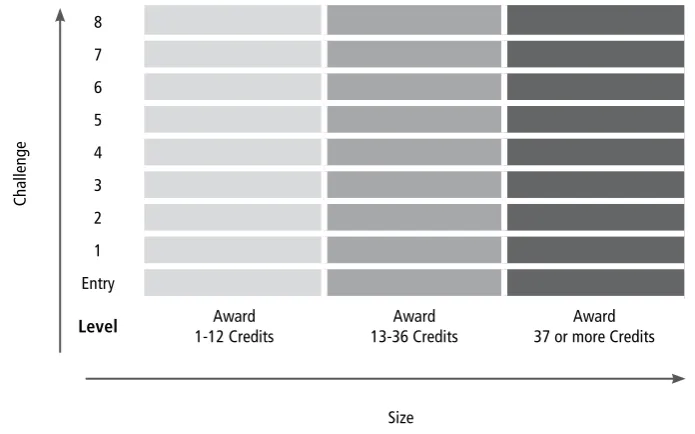
04-smaller steps of achievement, and QCF units and qualifications have now replaced NQF qualifications. The QCF qualifications cover the same levels of the NQF: Entry Level to Level 8, but qualifications are now split into three groups according to size – Awards, Certificates and Diplomas (QCA 2009). Qualifications in the QCF consist of a number of designated units, each of which has an approved credit value. These credit values represent the number of credits a learner will be awarded for successfully completing the unit. One credit is awarded for those learning outcomes notionally achievable in 10 hours of learning time. These changes were introduced to overcome the problems of having very different types of qualifications appear at the same level within a qualifications framework. An alternative approach may be just to exclude certain small qualifications from a NQF and keep the NQF just as a means of mapping the most important qualifications of a country in a way which could encourage progression within or across different pathways.
An Award may have between 1-12 credits, a Certificate 13-36 credits and a Diploma over 36 credits. This approach introduced a more flexible way of recognising achievement by awarding credit
for qualifications and units (small steps of learning) and allowing learners to gain qualifications at their own pace along flexible routes (along similar lines to the Scottish system) (Ofqual 2008). One major problem with the NQF had been that relying on level alone led to major inconsistencies whereby a small vocational qualification aimed at senior managers might be considered to be at the same level (7 or 8) as a post-graduate degree, although the former could be completed after perhaps 40 hours of learning and development, while the latter could extend over a number of years.
[image:8.595.120.468.518.735.2]All QCF units have a credit level and credit value. The level signifies the level of challenge or difficulty, whereas the value indicates the amount of “notional” learning time required, on average, for a learner to achieve a unit. Notional learning includes activities that learners need to do while supervised in order to complete their qualification, such as classes, tutorials, practical work and assessments. In addition notional learning time includes non-supervised activities such as homework, independent research, unsupervised rehearsals and work experience. The role of learning processes is now acknowledged as key to achievement of learning outcomes. The QCF is represented in the following diagram (Fig.1).
Fig. 1: Qualifications and Credit Framework (QCF)
Source: OCN Northern Ireland (2009) (adapted by editor) 8
7 6 5 4 3 2 1 Entry
Level 1-12 CreditsAward 13-36 CreditsAward 37 or more CreditsAward
Challenge
Because the QCF is a unit-based system the use of awards and certificates means that quite small amounts of learning, assembled into units in a specific area (such as Health and Safety) can be recognized and accredited either as a small award or linked with successful completion of other units to make a more substantive qualification (a certificate or diploma). For example, a Level 2 Award in Administration (Business Professional) is a bite-sized qualification that has been developed to recognise learners’ understanding of key administrative functions and activities. It accredits learners’ abilities to carry out a range of administrative tasks autonomously and has been designed to accredit their achievements in a modern, practical way that is relevant to the work context. It is seen as a starter qualification to which further units may be added later as a progression route to other Level 2 or Level 3 qualifications. In practice, such small qualifications have no labour market value and only become meaningful insofar as they lead to other more valued qualifications.
Underpinning any referencing process are implicit assumptions about the scope of qualifications in terms of breadth and depth and certain typical progression paths in terms of age, learning and institutions, periods of learning and volume of learning. In practice in England there are much larger differences in terms of achievement between qualifications at the same level than sometimes between qualifications at different levels. For example, a person with a level 2 NVQ may nevertheless have some problems with basic skills, especially with writing, and they may need to embark on a two year full-time learning programme in order to complete a more demanding learning programme leading to achievement of a level 2 in general education. This type of issue has now been covered in the QCF by inclusion of a volume of learning measure.
The aim of the QCF is to offer more flexibility, freedom, choice and opportunities for learners than was available under the NQF through a simple yet flexible structure that allows for the continuing development of a qualifications system that is inclusive, responsive, accessible and non-bureaucratic (Ofqual 2008). This approach acknowledged that the development of NVQs
(and the NQF) had led to a situation where many qualifications from this route within the NQF were exclusive, bureaucratic (concerned with form, specification of learning outcomes etc.), not easily understood and did not meet the needs of many employers and learners. The scepticism about the value of the NQF was also linked to the fact that over the preceding two decades many qualifications that were valued by employers and learners, were widely recognised and resulted in clear learner development and progression had remained outside the framework, largely because they did not follow the prescribed format. The QCF allows achievements to be recognised through the award of credits and qualifications and supports the accumulation and transfer of credits for purposes of progression. There is still room for debate about the value of this credit-based approach compared to offering more integrated (larger) qualifications, but what is not in doubt is that the system is more flexible than the rigid prescriptive NQF which it has replaced.
7
04-coach with a narrow specialist qualification at level 7 may take five years of further study before they would be qualified to act as a counsellor in a wider range of settings as say an occupational or educational psychologist. Leaving aside the issue of whether the QCF itself is now too complex for many users to understand, this example highlights four fundamental issues that can never be resolved by a simple comparison within an NQF or EQF: • there is no reason why skills, knowledge and
competence being developed and deployed in different education, training or employment settings should be at a similar level and frequently they are not;
• large integrated programmes of learning and development have a much wider range of social, educational and developmental purposes than short focused qualifications – the volume of learning being just one obvious difference; • age, prior experience and purpose are
inter-related and many people and their careers may not fit a basically linear model of moving (upwards) through levels which seems to underpin the EQF and NQFs;
• skills, knowledge and competences all change over time depending upon degree of use or non-use following qualification – even if exact equivalences could be applied at the moment of qualification, individual paths can and frequently do diverge sharply thereafter.
A focus on developing expertise rather
than just checking competence may be
a more effective driver of VET
The English case of NVQ and then NQF development highlights the weakness of using qualifications development as an almost exclusive policy lever to try to bring about reform in VET. The need for greater attention to be played to the challenges of policy implementation and the central importance of improving the quality of teaching and learning have been clearly demonstrated. However, there is also a more fundamental philosophical question about the purposes of education and training and whether a competence-based approach to VET is the most effective driver of VET in the current labour market and, crucially in terms of aspiration, for
moving towards a more knowledge-based society. An alternative approach could involve a change in direction away from a focus upon competence development based upon a hierarchy of skills levels towards a developmental perspective on skill development across the life-course. Such a shift may be a more effective way to drive moves towards a more knowledge-based society, replacing an essentially binary conception of competence at the heart of a hierarchical system of levels (Brown 2009).
A more developmental view of skills development would imply, rather than the focus being on individuals being viewed as competent to perform current tasks at a particular level, that people could still develop in a number of ways (at a range of “levels”) in order to improve their own performance,
contribute to a team or enhance the effectiveness of the organisation. From this perspective it would be helpful if national policy also stopped thinking in terms of levels as being indicative of some overall level of skills, knowledge and understanding of individuals (irrespective of context or content) (Brown 2009).
The contention is that the way to move towards a more knowledge-based society is for as many people as possible, whatever their supposed highest overall “level” of skills, knowledge and competence, to believe that they should seek to develop their skills, knowledge and competence at a number of levels (including those below as well as above their current highest “level”). Interestingly, this approach has already been adopted by many companies, as when they distinguish between employees who: • are technically able to perform a task but have
very limited practical experience of actually doing so;
• have successfully performed the task on a number of occasions;
• have performed the task many times and under a variety of conditions (i.e. experienced worker standard);
• have substantial experience but are also able to support the learning of others (i.e. can perform a coaching or mentoring role);
• could be considered “world class”, those who are able to think through and, if necessary, bring about changes in the ways that tasks are tackled. Adopting such an approach in VET would help alignment between education and work, as crucially under this model everyone would expect individuals completing their initial vocational education and training to be still some way from “experienced worker standard”. This approach could also provide the conditions in which a commitment to continuous improvement could flourish, as not only would most people believe that they needed to develop in a number of ways (at a range of “levels”) in order to improve their performance, but also the “working coaches” so critical to supporting the learning of others would increasingly be in place (Brown 2009).
The lessons from the English case are that the development of NVQs and a “hard” National Qualifications Framework, with tight rules upon how learning outcomes, competence and levels are described, and which sought to be comprehensive by incorporating all qualifications, was that the system was inflexible and bureaucratic. However, the heart of the policy failure was that at all levels
it was so consuming of time and other resources which were drawn away from much simpler and more productive ways to improve teaching, learning, skill development and organisational performance. Again and again over the last 25 years qualification reform and movement towards an NQF has been aspirational – it should lead to increased co-ordination; smoother access, transfer and progression; better accountability and control; improved quality assurance; and supply of learning being more responsive to demand. In practice, even the most ardent supporters would say the benefits were minimal given the massive investment of resources. The English NQF has been quietly replaced, with no-one wishing to draw attention to just how ineffective it has been. Indeed a prominent politician, speaking at a EQF conference in the UK in 2010, pointed to qualifications design needing a period when it was more or less invisible – a support in the background, but no longer a process that was absorbing large amounts of resource that could be more usefully employed in supporting learning and development more directly.
9
04-The importance of breadth
and balance in VET
The argument made above is a subtle one – it is not saying that competence, learning outcomes and qualifications are not important, but rather that there are dangers in focusing on these too much, especially as drivers of education and training, which should have broader purposes. Education should be about the development of character as well as the intellect; helping individuals develop the emotional, social and intellectual capacities to participate fully in society (Brown 2010). If this leads to a sense that we need to reform aspects of our learning systems then this reform should be driven by clear purposes. Reform could be influenced by objectives such as young people feeling connected with the world, engaged with learning, valuing and respecting difference and wanting to be active citizens. Once we are clearer on educational purposes, then we can look to the pedagogic means to achieve those goals – for example, strategies might be put in place to develop greater resilience (Dweck 1999); improve informal reasoning (Perkins 1985); or help individuals develop a wider range of approaches to learning, as these are all things we do not do very well in many current approaches to education. Promoting learning and development in VET which is values driven, uses appropriate pedagogies, is technologically enhanced and underpinned by research and development looks like a balanced and sustainable approach to educational development. The research of Jephcote and Salisbury (2007) revealed a complex picture of students’ “learning journeys”, the interplay between college and their wider lives and how post-compulsory education and training also contributed to the “wider benefits of learning”. Students gain more benefits from college life than qualifications, important though these are. Gallacher et al. (2007) also point to the significance of social relationships in learning cultures in community-based Further Education (FE) and practices that increase students’ re-engagement with learning.
Once the importance of wider purposes, including the social and affective dimension of learning, in VET is acknowledged then it is important to increase the scope for professional judgment of tutors: they need more room to decide “what works” in particular
circumstances. James and Biesta (2007) argue that, at its best, education builds on these learning cultures to encourage and challenge students to go beyond their existing dispositions and undergo personal change as well as acquiring knowledge. But such change is rarely recognised by a system in which success is measured by qualifications. Treating education as a simple mechanical process risks diminishing its transformative power, as teachers and managers need room to manoeuvre and exercise their professional judgment if they are to get the best out of the situation to benefit their students. Tutors are a key feature of any learning culture, and James and Biesta (2007) argue that the sector needs to be managed on a more flexible basis that allows room for professionals to act according to their own judgment of the local situations, within a set of national principles. These principles are that learning is about more than gaining qualifications; professionals should be able to choose systems and procedures that work together and support each other rather than undermining learning; they should also be able to decide “what works” for their own situation and not be confined to rigid procedures; there needs to be space for more localised judgment and creativity; and improvement in learning requires critical refection at all levels; government, college, tutor and student.
More recently, the problems associated with targets and the audit culture have been recognised by policy makers, yet considerable changes are still needed to give tutors the intellectual space, capacity and freedom to do a wider job of educating the whole person. Nash et al. (2007) point to a limited understanding of learning by government agencies and policy makers, who often see it simply as a process of acquisition of knowledge and skills. This narrow approach does not link with knowledge of effective pedagogy nor to the idea that learners are often engaged in a process of constructing identities for learning and work. The question is whether VET is about acquiring knowledge and skills alone, or is it also about learning which changes the learner by engaging them in the process. From this perspective, VET is about learning how to become a learner and how to develop an identity across education, training and employment. It is about learners changing aspects of their lives and also the way they relate to the world.
Conclusion
In conclusion in the context of European goals for the development of a more knowledge-based society there is a temptation to focus upon the targets (percentage of people receiving qualifications at a particular level) rather than the goal itself. The focus upon outcomes and levels may exacerbate the problem whereby people think that a qualification marks a significant end to the learning process, rather than simply being a marker for a change of focus of learning. The political commitment to goals and targets means that qualifications frameworks, specification of learning outcomes
and hierarchical levels are likely to be retained, but we can at least remember that these are proxies for the real goal and not devote too many resources to what is a second order issue. Shifting attention to the need for a developmental approach to expertise, highlighting the importance of processes of learning, the need to support the development of expansive learning environments in education, training and employment may be a more promising way forward.
Developing an NQF which maps the broad pathways and major qualifications in a country, however they are described, and offers a “loose coupling” to the EQF is probably sufficient to support the role of the EQF as a translation device to make relationships between qualifications and different national systems clearer. In that respect the lesson from the demise of a pure outcomes-based NQF in England is unequivocal: the drive for comprehensiveness and standardization in a qualifications framework consumed vast amounts of resources, was unworkable in practice and produced a whole array of qualifications which were not fit for purpose and were inferior to the qualifications they replaced when judged against the criterion of whether they supported continuing learning and development. In the field of NQFs less is more! It is a common trap to think that a more highly qualified workforce equates to a more highly skilled and more knowledgeable workforce. Indeed the focus on levels, qualifications and learning outcomes can be comforting because it gives the illusion of progress, but a much more sophisticated model of skill development and expertise is required to underpin a more meaningful movement towards a knowledge society.
References
Beaumont, G. (1996): Review of 100 NVQs and SVQs. London: Department for Education and Employment.
Brown, A. (1998): Designing effective learning programmes for the development of a broad occupational competence. In: Nijhof, W./ Streumer, J. (eds.): Key qualifications in work and education. Dordrdecht: Kluwer Press.
11
04-Brown, A. (2009): Developing expertise – moving beyond a focus on workplace competence, assessment and qualifications. Beyond Current Horizons report. London: DCSF/Futurelab.
Brown, A. (2010): Fresh directions for teaching and learning in Further Education. In: Dolphin, T./Clifton J. (eds.): Colleges 2020. London: IPPR.
Commission of the European Communities (2006): Implementing the Community Lisbon Programme: Proposal for a
recommendation of the European Parliament and of the Council on the establishment of the European Qualifications Framework for lifelong learning (presented by the Commission). Brussels, 5.9.2006, COM(2006) 479 final 2006/0163 (COD). Online: http://ec.europa.eu/education/policies/educ/eqf/com_2006_0479_en.pdf [last access: 2011-11-14].
Dearing, R. (1996): Review of Qualifications for 16-19 Year Olds: Full Report. London: SCAA.
Dweck, C. S. (1999): Self-theories: Their role in motivation, personality and development. Philadelphia: Taylor and Francis/Psychology Press.
Ecclestone, K. (2007): Commitment, compliance and comfort zones: the effects of formative assessment on vocational education students“ learning careers. In: Assessment in Education 14. Issue 3, pp. 315-333.
Edward, S./Coffield, F./Steer, R./Gregson, M. (2007): Endless change in the learning and skills sector: the impact on teaching staff. In: Journal of Vocational Education & Training, 59. Issue 2, pp. 155-173.
European Communities (2008): The European Qualifications Framework for Lifelong Learning. Luxembourg: Office for Official Publications of the European Communities. Online: http://ec.europa.eu/education/pub/pdf/general/eqf/broch_en.pdf [last access: 2011-11-14].
Eraut, M./Maillardet, F./Miller, C./Steadman, S./Ali, A./Blackman, C./Furner, J. (2004): Learning in the Professional Workplace: Relationships between Learning Factors and Contextual Factors. San Diego: AERA Conference Paper.
Gallacher, J./Crossan, B./Mayes, T./Cleary, P./Smith, L./Watson, D. (2007): Expanding our understanding of the learning cultures in community-based Further Education. In: Educational Review, 59. Issue 4, pp. 501-517.
Haffenden, I./Brown, A. (1989): Implications of Competence-based Curricula. London: FEU.
Hyland, T. (1998): Exporting Failure: the strange case of NVQs and overseas markets. In: Educational Studies, 24. Issue 3, pp. 369-380.
James, D./Biesta, G. (2007): Improving Learning Cultures in Further Education. Abingdon: Routledge.
Jephcote, M./Salisbury, J. (2007): The Long Shadow of Incorporation: the further education sector in devolved Wales. In: The Welsh Journal of Education, 14, Issue 1, pp. 93-109.
Nash, I., Jones, S., Ecclestone, K. and Brown, A. (eds.) (2008): Challenge and change in Further Education. London: TLRP.
OCN Northern Ireland (2009): OCN NI welcomes the new Qualifications and Credit Framework (QCF). News 24-05-09. Online: http://www.ocnni.org.uk/newsindividual.asp?id=28 [11-11-11].
Ofqual (2008): Regulatory arrangements for the Qualifications and Credit Framework. Coventry: Ofqual.
Perkins, D. N. (1985): Post-primary education has little impact on informal reasoning. In: Journal of Educational Psychology, 77. Issue 5, pp. 562-571.
QCA (2009): The Qualifications and Credit Framework: an introduction for information, advice and guidance practitioners. London: QCA.
Raffe, D. (2011): Are “communications frameworks“ more successful? Policy learning from the Scottish Credit and Qualifications Framework. In: Journal of Education and Work, 24. Issue 3-4, pp.283-302.
Steer, R./Spours, K./Hodgson, A./Finlay, I./Coffield, F./Edward S./Gregson, M. (2007): “Modernisation“ and the role of policy levers in the learning and skills sector. In: Journal of Vocational Education & Training, 59. Issue 2, pp. 175-192.
Foto:
K.K.
Alan Brown is a Professorial Fellow at the University of Warwick Institute for Employment Research. His current research, which has a strong international orientation, focuses mainly upon changing occupational identities, continuing vocational training, qualifications development, skill formation, organisational performance, and supporting knowledge sharing and development and learning in professional communities of practice. He has been involved in the development of knowledge-sharing sites on research and practice in careers guidance.
Prof. Alan Brown
[email protected] http://www2.warwick.ac.uk +44 (0)2476 523512
Probleme mit Nationalen Qualifikationsrahmen in
der Praxis
England als Fallbeispiel
Kurzzusammenfassung
www.erwachsenenbildung.at/magazin
Impressum/Offenlegung
Magazin erwachsenenbildung.at Das Fachmedium für Forschung, Praxis und Diskurs Gefördert aus Mitteln des ESF und des BMUKK Projektträger: Bundesinstitut für Erwachsenenbildung
Koordination u. Redaktion: Institut EDUCON – Mag. Wilfried Hackl erscheint 3 x jährlich online, mit Parallelausgabe im Druck Online: www.erwachsenenbildung.at/magazin
Herstellung und Verlag der Druck-Version: Books on Demand GmbH, Norderstedt ISSN: 1993-6818 (Online)
ISSN: 2076-2879 (Druck) ISSN-L: 1993-6818 ISBN: 9783844806168
Medieninhaber
Bundesministerium für Unterricht, Kunst und Kultur
Minoritenplatz 5 A-1014 Wien
Bundesinstitut für Erwachsenenbildung Bürglstein 1-7
A-5360 St. Wolfgang
Herausgeber der Ausgabe 14, 2011 Dr. Lorenz Lassnigg (Institut für höhere Studien)
HerausgeberInnen des
Magazin erwachsenenbildung.at
Mag.a Regina Rosc (Bundesministerium für Unterricht, Kunst und Kultur)
Dr.in Margarete Wallmann (Bundesinstitut für Erwachsenenbildung)
Mag. Wilfried Hackl (Geschäftsführender Hrsg., Institut EDUCON)
Fachredaktion
Mag.a Barbara Daser (ORF Radio Ö1, Wissenschaft/Bildung)
Univ.-Prof.in Dr.in Elke Gruber (Universität Klagenfurt)
Dr. Christian Kloyber (Bundesinstitut für Erwachsenenbildung) Dr. Lorenz Lassnigg (Institut für höhere Studien)
Dr. Arthur Schneeberger (Institut für Bildungsforschung der Wirtschaft) Dr. Stefan Vater (Verband Österreichischer Volkshochschulen)
Online-Redaktion, Satz Mag.a Bianca Friesenbichler (Institut EDUCON)
Andreas Brandstätter ( /andereseiten / grafik.layout)
Lektorat
Mag.a Laura R. Rosinger (Textconsult)
Übersetzung
Übersetzungsbüro Mag.a Andrea Kraus
Design
Karin Klier (tür 3))) DESIGN)
Website
wukonig.com | Wukonig & Partner OEG
Medienlinie
Das „Magazin erwachsenenbildung.at. Das Fachmedium für Forschung, Praxis und Diskurs“ enthält Fachbeiträge von AutorInnen aus Wissenschaft und Praxis und wird redaktionell betrieben. Es richtet sich an Personen, die in der Erwachsenenbildung und verwandten Feldern tätig sind, sowie an BildungsforscherInnen und Studierende. Jede Ausgabe widmet sich einem spezifischen Thema. Ziele des Magazin erwachsenenbildung.at sind die Widerspiegelung und Förderung der Auseinandersetzung über Erwachse-nenbildung seitens Wissenschaft, Praxis und Bildungspolitik. Weiters soll durch das Magazin der Wissenstransfer aus Forschung und innovativer Projektlandschaft unterstützt werden. Die eingelangten Beiträge werden einem Review der Fachredaktion unterzogen. Zur Veröffentlichung ausge-wählte Artikel werden lektoriert und redaktionell bearbeitet. Namentlich ausgewiesene Inhalte entsprechen nicht zwingend der Meinung der HerausgeberInnen oder der Redaktion. Die HerausgeberInnen übernehmen keine Verantwortung für die Inhalte verlinkter Seiten und distanzieren sich insbesondere von rassistischen, sexistischen oder sonstwie diskriminieren-den Äußerungen oder rechtswidrigen Inhalten.
Als Online-Medium konzipiert und als solches weitergeführt, ist das Magazin erwachsenenbildung.at beginnend mit der Ausgabe 7/8, 2009 zu-sätzlich in Druckform erhältlich.
Urheberrecht und Lizenzierung
Wenn nicht anders angegeben, erscheinen die Artikel des „Magazin erwachsenenbildung.at“ unter der „Creative Commons Lizenz“. BenutzerInnen dürfen den Inhalt zu den folgenden Bedingungen vervielfäl-tigen, verbreiten und öffentlich aufführen:
• Namensnennung und Quellenverweis. Sie müssen den Namen des/der AutorIn nennen und die Quell-URL angeben.
• Keine kommerzielle Nutzung. Dieser Inhalt darf nicht für kommerzielle Zwecke verwendet werden.
• Keine Bearbeitung. Der Inhalt darf nicht bearbeitet oder in anderer Weise verändert werden.
• Nennung der Lizenzbedingungen. Im Falle einer Verbreitung müssen Sie anderen die Lizenzbedingungen, unter die dieser Inhalt fällt, mitteilen. • Aufhebung. Jede dieser Bedingungen kann nach schriftlicher
Einwilligung des Rechtsinhabers aufgehoben werden.
Die gesetzlichen Schranken des Urheberrechts bleiben hiervon unberührt. Nähere Informationen unter www.creativecommons.at.
Im Falle der Wiederveröffentlichung oder Bereitstellung auf Ihrer Website senden Sie bitte die URL und/oder ein Belegexemplar elektronisch an [email protected] oder postalisch an die angegebene Kontaktadresse.
Kontakt und Hersteller Magazin erwachsenenbildung.at
Das Fachmedium für Forschung, Praxis und Diskurs p.A. Institut EDUCON
Bürgergasse 8-10 A-8010 Graz