1
Effect of Futuring
To increase Resilience:
An effect Study
Author:
Max Spitzer
Bachelor thesis
Faculty of behavioral science
Supervision:
Jochem Goldberg
Dr. Anneke Sools
University of Twente
2 Abstract
3 Samenvatting
In de hedendaagse wereld wordt de identiteit van individuen gevormd door sociale crisis en de snelle overgangen. Om beter met deze crisis om te kunnen gaan, hebben individuen en verhoging van veerkracht nodig. Dit studie onderzoekt het effect van de Best possible Self (BPS)
manipulatie "Brieven van de toekomst" op het begrip veerkracht. Daarom behandelt dit effect studie het invloed van toekomst verbeelding op veerkracht van de deelnemers met betrekking tot verschillende factoren. Om dit te onderzoeken worden deelnemers onderverdeeld in drie groepen gedurende een twee weken interventie. De eerste groep bestaat uit deelnemers die vier "brieven van de toekomst" moeten schrijven. Dit gebeurde op verschillende tijdstippen. De tweede groep bestaat uit deelnemers die een "brief van de toekomst" hebben geschreven. De derde groep is een controle groep waarin de deelnemers over gebeurtenissen uit het verleden hebben geschreven. In totaal hebben 33 Nederlands sprekende mensen in de leeftijd van 19 tot 60 m 26,85 ecu, SD 11,859) geparticipeerd aan dit onderzoek. De resultaten van deze studie tonen aan dat het effect van de interventie onafhankelijk is van de persoonlijke eigenschappen neuroticism, extraversie en optimisme. Significante resultaten op een verhoging van de veerkracht door de “brieven van de toekomst” zijn niet gevonden worden. Echter kan dit worden toegeschreven aan de
beperkingen van dit onderzoek. Ander onderzoek heeft namelijk de effectiviteit van BPS manipulaties aangetoond. Desondanks worden in dit onderzoek ideeën voor een
1
Table of Content
1. Introduction 1
2. Methods 6
2.1 Design 6
2.2 Participants 6
2.3 Procedur 6
2.4 Measures 8
2.5 Analysis 8
3. Results 9
3.1 Hypothesis 1 9
3.2 Hypothesis 2 10
3.3 Hypothesis 3 11
4. Discussion 12
4.1 Discussion of Results 12
4.2 Strengths and Limitations 13
4.3 Ideal Follow-Up Study 14
4.4 Final Conclusion 15
1
1. Introduction
In the current world the identity of individuals is shaped by social crisis and rapidly transitions (Bohlmeijer, 2007). Individuals may cope better with this transitory nature of contemporary life by engaging in repeated anticipatory actions such as future imagination. Therefore this article investigates if a imagining the future manipulation has a positive influence on the resilience of participants with regard to different moderating factors. In this introduction first the theoretical background about the need for future imagination is discussed. Second the development of BPS (best possible self) manipulations, which is the kind of future imagination manipulation under investigation, are reviewed. In a third step the concept of resilience will be defined and linked to the current research at the University of Twente which is concerned with the effect of BPS manipulations on resilience. This relation has not been previously investigated.
Imagining the future manipulations are based on the two continuum model which is part of the positive psychology movement. When the absence of pathologies or mental illnesses is generally seen as mental health (Westerhof, G. J., & Keyes, C. L., 2010) the two continua model makes a clear distinction between the existence of mental health and pathology. More precisely there is a distinction between the pathogenic and the salutogenic approaches which are focusing on the mental illness and mental health respectively, which are connected but exist on different dimensions (Westerhof & Keyes, 2010). Therefore it is an important part of positive psychology to focus on the improvement of life quality and prevent “the pathologies that arise when life is barren and meaningless” instead of the “healing” of pathology (Seligman & Csikszentmihalyi, 2014) . This field is about positive personal traits like “the capacity for love and vocation, courage, interpersonal skill, aesthetic sensibility, perseverance, forgiveness, originality, future mindedness, spirituality, high talent, and wisdom.” (Seligman & Csikszentmihalyi, 2014).
2 (Meevissen et al., 2011) as it seems to correlate with higher levels of self-esteem, positive mood, more resilience to stressful or negative events and a better recovery from illness (Meevissen et al., 2011). Further optimists have the tendency to link negative events to external factors and perceive them as being unstable and short lasting, pessimists seem to link this reversed and perceive negative events as longer lasting (Peterson et al., 1982). Therefore more optimistic people have a general tendency to expect a more positive future for themselves and optimism is a personal trait which is desirable. Since this paper tries to investigate the manipulation of
resilience and resilience seems to correlate with optimism a technique is needed that can manipulate those traits. However there is currently no research which shows a correlation of resilience and BPS manipulations. Therefore the following section will mainly discuss research with the purpose of increasing optimism. But as optimism correlates with resilience that research can be a useful basis for a manipulation with the purpose to increase resilience. This can be done by futuring or imagining a positive future which is based on the expectancy-value model.
According to this model, a person will get more positive affects, as it is making progress towards an ambition. Through this process the individual can evaluate a more positive result (Carver & Scheier, 2001). This process is important in imagining the future manipulations because an imagination of the future can lead to similar positive evaluations and affections towards an ambition as actual behaviour towards a positive result (Carver & Scheier, 2001).
One of the first studies that manipulate optimism with the help of positive future imagination was conducted by King (2001). In this study participants imagined or write about their best possible self (BPS) (King, 2001). This technique “requires people to envision
3 work of King (2001) Meevissen (2011) “investigated whether daily BPS exercises are effective in boosting optimism over a period of two weeks” (Meevissen et al., 2011). In this study participants were asked to do a BPS exercise every day for 5 minutes over a period of two weeks. The results of this study suggest that the best possible self technique can boost optimism of participants. According to Meevissen (2011) this correlation was independent of the mood effect. This results were also supported through similar findings by Peters (2010) which also suggest the positive effects of BPS manipulations.
However optimism can also be correlated to different attributes. As reported by Nes, Segerstrom & Sephton (2005) optimism is also connected to “better psychological and physiological adjustment to stressors” (Nes, Segerstrom & Sephton, 2005). Further they suggested that optimism leads to a higher level of resilience to stressors like for example
negative events. This relation is also suggested in a study by Kivimäki (2005) in which the health of people after a negative event (illness or death in the family) was examined. It was observed that the amount of sickness absence days, which were the indicator for health in this study, was smaller for highly optimistic individuals. “These findings suggest that optimism may reduce the risk of health problems and may be related to a faster recovery after a major life event”
(Kivimäki, 2005). This leads to the question if there is an underlying concept that can be promoted by BPS and leads to a higher level in optimism as optimism correlates with different attributes like higher self-esteem, positive mood or resilience (Meevissen et al., 2011). As optimism seems to correlate with resilience and optimism can be manipulated by BPS, this seems to be an efficient approach to manipulate resilience. Additionally there is currently a lack in literature that investigates this effect empirically as will be shown in the following section.
According to a literature review on the research of resilience by Liebenberg (2009) “there remains a need for research that can validate the advantages of initiatives that build the capacity rather than those that alleviate disorders.” While earlier research on resilience focused on the emergence of resilience (Maste, 2001; Ungar, 2005), a new approach of investigating and manipulating resilience was developed at the University of Twente. In this approach an
4 resilience as the ability to overcome negative life events and to use resources that improve well-being. Sools & Mooren (2012) also point out the importance of research on resilience because through the expansion of globalization, humans have to cope with fast developments and social change.Second humans can experience “loss of the Grand Recits, as well the extent to which people are capable of imagining the future, further impinges on the capacity and need for
resilience” (Sools & Mooren, 2012). From a psychological perspective resilience is considered as “one important way of negotiating social change” (Sools & Mooren, 2012). In addition, Sools & Mooren hypothesized that “Narrative imagination could provide a powerful way of becoming resilient in this sense” (Sools & Mooren, 2012). Hence this manipulation form deserves more research to investigate the possibility to make people more resilient and thus let them function better in the modern and globalized world or as Sools & Mooren formulated “as the sense of vulnerability increases, the need for certainty might increase as well” (Sools & Mooren, 2012).
Narrative imagination of the future is an alternative form of the BPS in which participants are asked to write aletter from their future self. Through this exercise reflection on the own identity can be stimulated (Sools & Mooren, 2012) more than in the pure imagination on the future manipulation which was used by Meevissen (2011). More accurately participants are asked in this method to “imagine a particular situation at a particular moment in the future, in which something positive has been realised” (Sools & Mooren, 2012). The advantages of this method are that once the participant knows how to do this task can do it without the presence of a researcher and they are rather short compared to other related methods like life story interviews (Sools & Mooren, 2012). This makes it possible for the participant to do the task spontaneously and at a point of a day where he or she is motivated and has enough time for the task. But as shown above there is currently a lack in quantitative studies which investigate the relation of resilience and narrative Imagination as a form of BPS. Thus this study addresses the need in this research field of investigating the effect of a BPS narrative Imagination intervention on the concept of resilience.
Additionally other factors should be taken into account, as the effect of the intervention might possibly be moderated by character traits of the participants. According to Sools & Moren “an important question for future empirical research is if and how people with different personal, social, and cultural resources can become more skilled at narrative futuring as one way of
5 resources or personal traits are taken into account as it has been done in other empirical BPS studies. In the effect study by Meevissen (2011) optimism as moderating factor was taken into account as it might be possible that people that are already high in optimism might not benefit as much from the intervention as people who are low in optimism. However results of the study indicated “that initial levels of dispositional optimism did not moderate the intervention effects” (Meevissen, 2011). Therefore participants who scored higher in optimism did not benefit less from the BPS intervention and optimism had no moderating effect in this study. Nonetheless the moderating effect of optimism on the concept of resilience within a BPS intervention was not yet investigated and should therefore be part of this research. For explanatory reasons two other possible moderating factors can be taken into account. These factors are neuroticism and extraversion. These traits were already tested as a moderating factor for a BPS manipulation by Peters (2010) but this research tested the effect of BPS on future expectancies and mood.
Therefore it is necessary to take them again into account, as the moderating effect of those traits was not yet tested on the concept of resilience during a BPS manipulation.
In sum, three hypotheses are tested:
1. The BPS manipulation in which participants write one or four letters leads to an increase in resilience compared to the control group in which participants write about past events.
2. The effects of the intervention in which participants write four letters will lead to a significant higher increase in resilience compared to the group in which
participants write one letter. Confirmation of this hypothesis can lead to the conclusion that a more intensive manipulation is also more effective. 3. The effect of the BPS manipulation is not moderated by the traits optimism,
6
2. Methods
2.1 Design
As mentioned above a total amount of three different conditions were used in this study. The study took place over a period of two weeks or 14 days (18.4.2016-2.5.2016), therefore references to specific days of the study are named as the number of days of the study. For example the study begun on day 1 which was the 18.4.2016 and ended on day 14 which is the 2.5.2016. All participants had to fill in the same questionnaires on day 1 and 14 of this research. Participants who were assigned to experimental group 1 wrote 4 letters from the future on the days 3, 6, 9 and 12 of the study. Additionally they filed in the questionnaires on day 1 and 14. Participants who were assigned to experimental group 2 were asked to write a letter from the future as form of a BPS manipulation on day 7. Additionally they filed in the questionnaires on day 1 and 14. The instructions for the letter from the future can be found in the attachments. Participants who were assigned to the control group had to write a letter about events of the past on day 7 of the study after they filed in the questionnaire on day 1. The instructions for the letter from the past can be found in the attachments.
2.2 Participants
This study was conducted with a total amount of three conditions to which the participants were randomly assigned after the beginning of the study. This paper will refer to these conditions as control condition, experimental condition 1 and experimental condition 2. A total of 33 Dutch-speaking participants with ages ranging from 19 to 60 (M 26,85, SD 11,859) was used as pool. From this pool 8 participants were male and 25 female. Through random distribution 10 participants were assigned to group 1, 11 participants were assigned to group 2 and 12
participants were assigned to group 3. Participants were selected through convenience sampling. Therefore participants were mostly psychology students from the University of Twente.
2.3 Procedure
7 started participants got instructions about the research via an email. All instructions that the participants received can be found in the attachments at the end of this paper. Participants were informed about the procedure of the research and got the instruction about how to write a letter from the future and the past. One the first day of the research participants received another email with the link to the study and again the instructions of the research as attachment on this email. By opening the link the participants were transferred to the Qualtrics survey, where the whole study takes place. At first the participants had to fill in the informed consent and afterwards they filled in different questionnaires. As this research was conducted by different researchers who measured different construct, this report will only approach the constructs which are used for the purpose of this research.
The three questionnaires which are important for this study were the Brief resilience scale, the Life orientation test and the FFI-NEO. More information about these measurements can be found in section 2.4Measures. Finishing these questionnaires took the participants between 15 and 30 minutes. After the participants finished the questionnaires they were randomly assigned to the control group, experimental group 1 or experimental group 2. More information about the different conditions of these groups can be found in section 2.2.
8 2.4 Measures
To measure results of the study three different measures were used: The Brief resilience scale, the Life orientation test and the FFI NEO.
First the Dutch version of the Life orientation test was used to “measure the level of dispositional optimism of participants” (Peters, 2010). The LOT has 14 items that are rated on a six-point scale (elke dag-nooit). According to a research concerned with the accuracy of the LOT “item parameter estimates and the test information function showed that each item and the global scale satisfactorily measured the latent trait” (Chiesi et. al., 2013). The internal consistency of this scale is α= 0.65 which is seen as acceptable.
Second parts of the Dutch version of the FFI NEO were used to measure the character traits extraversion and neuroticism. These parts consist of two times 12 statements that are rated through the participants on a 5 point scale (Helemaal oneens- Helemaal eens). The internal consistency for the extraversion scale is α= 0.74 and for the neuroticism scale α= 0.78. These scores are seen as acceptable.
Further this scale was evaluated through COTAN. According to this evaluation the scales were rated as good or sufficient.
Last the Brief Resilience scale was used to measure the effect of the manipulation on the concept of resilience. The BRS has 18 statements that are rated through the participants on a four point scale (sterk mee oneens- sterk mee eens). The internal consistency of this scale is α=0.755 which is seen as acceptable. According to Smith et. al. (2008) this scale is valid and reliable. Further the BRS “measured as a unitary construct” (Smith, 2008).
2.5 Analysis
9 The second hypothesis presumed that participants who wrote 4 letters from the future scored significantly higher on the BRS scale than participants who wrote one letter. To test this hypothesis an ANOVA was conducted that compared the score differences of the pre-, and the posttest depending on the condition of the participant (experimental group 1, experimental group 2).
The third hypothesis presumed that the effect of the manipulation were not moderated by the traits optimism, neuroticism or extraversion. In order to test this hypothesis a moderator analysis was conducted. Therefore the centralized scores of the independent variable and the possible moderating variables were tested for a linear regression with the dependent variable.
3. Results
3.1 Hypothesis 1
Unlike the expected outcome the comparison of the differences of the pre-, and posttest showed that there was no significant higher score on the BRS for participants who did an BPS exercise F(α)=0,264. These results can be found in Table 1. Moreover the participants in the control condition did have a larger difference between the pre-, and the posttest (0,250) than the
experimental conditions (0,103). The results can be found in Table 2. Thus hypotheses 1 needs to be rejected. A total amount of 21 participants who received a BPS manipulation were used and a total amount of 12 participants who were in the control condition were used for this analysis.
Table 1
Comparison Effect of Treatment
Treatment Mean Std. Deviation N Letters from the future 0.1032 0.311 21 Control Group 0.25 0.399 12
Total 0.1566 0.358 33
10 3.2 Hypothesis 2
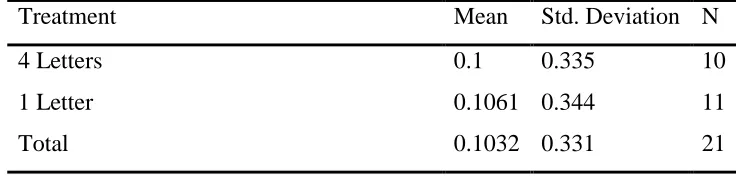
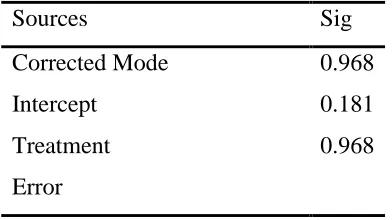
[image:14.612.63.431.602.690.2]Unlike the expected outcome the comparison of the differences of the pre, - and the posttest showed that there was no significant higher score for the participants who were in experimental group 1 F (α) =0,968 than group 2. This result can be found in Table 3. The participants in the experimental group 1 had a slightly smaller mean differences (0, 1) than participants in the experimental group 2 (0, 1061). Therefore Hypotheses 2 needs to be rejected too.
Table 3
Comparison Between Experimental groups
Treatment Mean Std. Deviation N
4 Letters 0.1 0.335 10
1 Letter 0.1061 0.344 11
Total 0.1032 0.331 21
*p<0.05 Table 2
Effect of Treatment Sources Sig Corrected Mode 0.264 Intercept 0.01 Treatment 0.264 Error
11
Table 4
Between experimental groups Sources Sig Corrected Mode 0.968 Intercept 0.181 Treatment 0.968 Error
*p<0,05
3.3 Hypothesis 3
Like expected the three character traits extraversion, neuroticism and optimism had no
moderating effect on the effect of the manipulation. The statistical significance of the moderating effect can be found in Table 5 (Neuroticism F (α) =0,825; Extraversion F (α) =0,087; Optimism F (α) =0,437). Therefore the last hypothesis will not be rejected.
Tabel 5
Moderator Analysis
Unstandardized Coefficients Standardized Coefficients Models B Std. Error Beta t Sig. Constant 0.157 0.05 3.104 0.04 FFI Neuroticism -0.031 0.141 -0.051 -0.223 0.825 FFI Extraversion -0.324 0.183 -0.331 -1.774 0.087 LOT Optimism 1.08 0.137 0.151 0.788 0.437
[image:15.612.67.517.513.644.2]12
4. Discussion
4.1 Discussion of Results
This study showed no increase of resilience of participants in the BPS manipulation “a letter to the future”. First the effect of this manipulation was compared to a control group, writing about an event of the past. The BPS manipulation had no significant influence on resilience compared to the control group. Related results can be found in one of the first BPS studies by King (2001). In his research the effect of writing about the future was compared to writing about traumatic events of the past as an intervention to increase participant’s wellbeing. According to this
research writing about the future and past had similar increasing effects on wellbeing, it was just that writing about the past was more emotionally challenging for participants. Therefore
participants in this study could have also benefited from the control condition as they wrote about past events as their mean score of resilience also increased. This would make it impossible to measure significant results. However the possible emotionally challenging effect by the writing tasks were not included in this study thus there can be made no statements about this possible factor.
Secondly the effect of the manipulation on resilience of the two different experimental groups was compared because “Future research should examine whether the effects can be
enhanced when the manipulation is extended, i.e. instead of a singlewriting and imagery session, repeated sessions are offered” (Peters, 2010). But the extended manipulation in which the participants had to write four letters did not have a significant larger effect on resilience than the short variant. Therefore it can be concluded that repeated sessions of this manipulations with the same tasks are not useful.
13 account. This is an advantage against manipulations that need to be done with regards to personal traits of participants.
4.2 Strengths and Limitations
The limitation which had probably the biggest influence on the results was the sample size. At the beginning of the study a total amount of 120 participants had assigned to this online study. But the use of the survey program Qualtrics lead to different errors. Depending on which browser the participants used the program was not able to save information of all the
participants. This lead to the problem that many participants could not finish their study and hence their data needed to be rejected. Another part of the data was not usable because
participants did not read or did not understand the instructions for the “letter to the future” and performed the task not as they were asked. This data could also not be included in the results. However only data from 33 respondents could be used for analyzing the effect of the
intervention. This reduction of the sample can have a significant influence on the results,
especially because this relatively small group was divided into smaller groups for each condition. Through the split of the participants over three conditions of which two were experimental conditions there are also differences in the amount of participants in the relevant conditions for these hypothesis.
Future research which wants to investigate the effect of “letters to the future” on
resilience should use another research design. The pre-, and posttest can still be done online with a survey software like Qualtrics. However the pre, - and posttest should be done in two different online surveys to avoid the problems that occurred due to saving problems. It is also possible to invite participants to two meetings where they can fill in the surveys to avoid the online
surrounding. These meetings could also have the advantage that the researcher can give the instructions for the task. Participants would have the opportunity to ask questions and misunderstandings and ignoring the instructions by participants can be avoided.
14 decrease in honesty in the writing of the letters due to social desirability. But this limitations also give the possibility to give recommendations to future research which will be discussed in the following section.The “letters from the future” should be excluded from the online environment to avoid this problem. Participants could write the letters at home with pen and pencil and hand them in afterwards. By using participant numbers these letters can be kept anonymous to avoid the effect of social desirability. However participants still need to be reminded via e-mail that they have to fill in the letters or attend to the pre-, and posttest.
4.3 Ideal Follow-Up Study
An ideal follow-up study should include some new aspects as the pure extension of the “letters from the future” manipulation seems to have no significant advantage. According to Riskindet et al. (1996) an extended BPS manipulation could be more useful if writing about various life domains are systematically stimulated. As mentioned by Sools & Mooren (2012) BPS
manipulations give participants the opportunity to get enhanced insight in their own possibilities and their own values. By including different aspects to write about participants might get insight about more aspects of their life. This could increase the effect of the manipulation on resilience. Therefore an extension of the “letters from the future” could not only include more written letters but a stimulation to write about different aspects of life.
This aspect could be included by using again three groups to which the participants are randomly assigned. One group should be the control group with a writing task about past events. The second group should write one “letter from the future” to have the normal effect of this intervention. The third group should have an extended manipulation with three letters that will stimulate the participants to write about different domains in life. These domains could be 1) social future situation, 2) professional or work related future situation and a 3) romantic or relationship future situation. However a fourth group with an extended “letters from the future” manipulation as used in this study is not necessary as the results of this study suggest no
15 effect, it would indicate an advantage of the “letters from the future” compared to the writing about the past even if both manipulations had the same effect on resilience. However including this aspect into a follow up study could be done by measuring how emotional challenged participants are after finishing the tasks by a short scale.
Additionally there is another reason that follow-up research on “letters from the future” can be seen as necessary at the University of Twente due to the possibility to increase resilience. As Peter Gray mentions in his book “Freedom to learn” there is a decline in student’s resilience leading to larger fear of bad grading and struggle with everyday life. This can lead to serious breakdowns of these students or the need for counselling (Gray, 2015). However with the changes in university policy more grading and exams are included. Therefore the need for
students to be more resilient could increase. If more future research suggest the effectiveness of “letters from the future” on resilience this could be a powerful tool to make students more resilient and cause a decrease in students breakdowns and need for counselling. Because according to Gray (2015) these issues are caused by a decline in student’s resilience. By doing further research on “letters from the future” with samples consisting of students a win-win situation could be achieved. On the one hand there is the possibility to conduct more knowledge about this manipulation form and the connection to resilience, on the other hand resilience of students could be increased and could therefore lead to less breakdowns and less need for counselling.
4.4 Final Conclusion
17
5. References
Armstrong, M. I., et al. (2005). "Pathways between social support, family well being, quality of parenting, and child resilience: What we know." Journal of child and family studies 14(2): 269-281.
Bohlmeijer, E. (2007). "De verhalen die we leven. Narratieve psychology als methode."
Carver, C. S. and M. F. Scheier (2001). "Optimism, pessimism, and self-regulation."
Chiesi, F., et al. (2013). "The Accuracy of the Life Orientation Test–Revised (LOT–R) in Measuring Dispositional Optimism: Evidence From Item Response Theory Analyses." Journal of personality assessment 95(5): 523-529.
Gray, P. (2015). Free to learn: Why unleashing the instinct to play will make our children happier, more self-reliant, and better students for life. United States: The Perseus Books Group.
King, L. A. (2001). "The health benefits of writing about life goals." Personality and Social Psychology Bulletin 27(7): 798-807.
Kivimäki, M., et al. (2005). "Optimism and pessimism as predictors of change in health after death or onset of severe illness in family." Health Psychology 24(4): 413.
Liebenberg, L. (2009). Researching resilience, University of Toronto Press.
Masten, A. S. (2001). "Ordinary magic: Resilience processes in development." American psychologist 56(3): 227.
Meevissen, Y. M., et al. (2011). "Become more optimistic by imagining a best possible self: Effects of a two week intervention." Journal of behavior therapy and experimental psychiatry 42(3): 371-378.
18 Nes, L. S., et al. (2005). "Engagement and arousal: Optimism’s effects during a brief stressor."
Personality and Social Psychology Bulletin 31(1): 111-120.
Peters, M. L., et al. (2010). "Manipulating optimism: Can imagining a best possible self be used to increase positive future expectancies?" The Journal of Positive Psychology 5(3): 204-211.
Riskind, J. H., et al. (1996). "For every malady a sovereign cure: Optimism training." Journal of Cognitive Psychotherapy 10(2): 105-117.
Scheier, M. E. and C. S. Carver (1987). "Dispositional optimism and physical well‐ being: The influence of generalized outcome expectancies on health." Journal of personality 55(2): 169-210.
Seligman, M. E. and M. Csikszentmihalyi (2014). Positive psychology: An introduction, Springer.
Smith, B. W., et al. (2008). "The brief resilience scale: assessing the ability to bounce back." International journal of behavioral medicine 15(3): 194-200.
Sools, A. and J. Mooren (2012). "Towards narrative futuring in psychology: Becoming resilient by imagining the future." Graduate journal of social science 9(2): 203-226.
Peterson, C., Semmel, A., von Baeyer, C., Abramson, L. Y., Metalsky, G. I., & Seligman, M. E. P. (1982). The attributional style questionnaire. Cognitive Therapy and Research, 6, 287e 299.