The complexity of
interfunctional coordination
when serving different market
segments
AREND SIKKENS
MASTER THESIS BUSINESS ADMINISTRATION
The complexity of interfunctional
coordination when serving different
market segments
Master thesis Business Administration
Date:
21-06-2017
Author:
Arend Sikkens
S0215732
Supervisors:
Dr. R.P.A. (Raymond) Loohuis MBA
K. (Kasia) Zalewska-Kurek PhD
Programme:
Business Administration
Acknowledgement
In front of you lies my thesis “The complexity of interfunctional coordination when serving different market segments”. This thesis is written to graduate from the master Business Administration, Innovation and Entrepreneurship at the University of Twente.
Together with my supervisor, Dr. Raymond Loohuis, we came up with the possibilities to conduct the research for my thesis within my own organisation. After the first session we came up with the idea to investigate how interfunctional coordination within an organisation becomes more complex when this organisation serves multiple segments of customers.
I would like to thank my supervisor, Dr. Raymond Loohuis, for his feedback and most of all for his patience and flexibility. One could say that starting your own business and graduating at the same time is not the most ideal match when it comes to available time. I would also like to thank Dr. Kasia Zalewska-Kurek for her feedback given on this thesis. And last I would like to thank my family, friends and girlfriend for the support they given me, the believe they had in me and the interest they
showed during the entire period I was working on this thesis.
I hope you enjoy reading this thesis.
Management summery
This thesis focuses on interfunctional coordination. More specifically this thesis focuses on the potential increase of the complexity of interfunctional coordination within an organisation when an organisation serves multiple segments of customers with different desires. Although throughout the years market orientation literature has made a lot of progress, to my knowledge, no studies have been conducted that explores the influence of serving multiple customer segments with different customer values on solely interfunctional coordination.
Interfunctional coordination can be defined as the facilitation of sharing information between the different departments within an organisation and the integration of resources to create superior value for the customer (Narver & Slater, 1990). It’s a way in which the expectations of the market can be communicated throughout the entire organisation (Moenaert et al., 1994; Auh & Menguec, 2005).
Within this thesis multiple potential barriers to interfunctional coordination from existing literature are identified. These barriers are top management and culture (Narver & Slater, 1990; Day 1994), interdepartmental connectedness and conflict (Kennedy, Goolsby and Arnould, 2003; Jaworski and Kohli, 1993) and organisational structure (Kirca, Jayachandran and Bearden, 2005). For
operationalisation purposes the above mentioned barriers are linked to the infrastructural pillar of the business model canvas by Osterwalder (2004).
The research is first aimed at a literature review, after this the theories from the literature research are tested via an ethnographic case study. The data is gathered via interviews, observations and via my own experience within the organisation. I tried to find out as much as possible about the
organisation, the employees and their routines on the job. Second I started with collecting the actual data for this thesis. This was done by observing the employees while they were performing their tasks as well as via conversations with the employees. The third and final step was to analyse all the obtained data via ethnographic case study.
After the data analysis the potential barriers of interfunctional coordination within this thesis are categorized in three categories. These categories are low problematic, moderate problematic and high problematic. The results obtained by the data analysis shows that the barriers top management and culture are low problematic, the barrier organisational structure is moderate problematic and the barrier interdepartmental connectedness and conflict are high problematic.
Table of contents
Acknowledgement ... iii
Management summery ...iv
List of tables and figures...vii
Tables ...vii
Figures ...vii
Chapter 1. Introduction ...1
1.1 Background/Phenomenon ...1
1.2 Research gap ...1
1.3 Purpose of this study ...2
1.4 Theoretical positioning ...2
1.5 Research strategy and data ...2
1.6 Expected contribution (value) of the study ...2
1.7 The outline of the thesis...2
Chapter 2. Literature review ...3
2.1 Interfunctional coordination ...3
2.2 Potential barriers of interfunctional coordination ...6
2.2.1 Top management and culture ...6
2.2.2 Interdepartmental connectedness and conflict ...7
2.2.3 Organizational structure ...7
2.3 Conceptual model ...7
Chapter 3. Methodology ... 10
3.1 Type of research ... 10
3.2 Research strategy ... 10
3.3 Research method ... 11
3.3.1 Interviews ... 11
3.3.2 Data analysis ... 12
Chapter 4. Data analysis ... 13
4.1 Organisational structure ... 13
4.2 Results ... 13
Chapter 5. Results ... 15
5.1 Main findings ... 15
5.2 Low problematic barriers ... 16
5.4 High problematic barriers... 19
5.5 Summarizing conclusion of the categories... 21
5.6 Overcoming the barrier... 21
5.6.1 Overcoming the low problematic barriers ... 21
5.6.2 Overcoming the moderate problematic barriers ... 22
5.6.3 Overcoming the high problematic barriers ... 22
Chapter 6: Discussion ... 23
6.1 Managerial contribution ... 25
6.2 Directions for future research... 25
6.3 Conclusion ... 25
List of tables and figures
Tables
Table 1: Barriers and their corresponding building blocks. ...8
Table 2. Number of interviews. ... 13
Table 3. Number of observations, with whom and the occasion. ... 13
Table 4. Barriers of interfunctional coordination, the potential problems and the key informants.... 14
Table 5. Main finding. ... 15
Table 6. Categorization of barriers of interfunctional coordination. ... 21
Table 7. Overcoming the barriers. ... 21
Chapter 1. Introduction
1.1 Background/Phenomenon
Mobile Grocery Store Inc. is an organisation founded in May 2014. Mobile Grocery Store Inc. is an organisation that nowadays delivers groceries to companies as well as consumers. Delivering groceries to companies as well as consumers was not the intended idea. Mobile Grocery Store Inc. was first thought out to deliver groceries to the elderly and disabled. Only after a few weeks of being operational the first companies called with the question whether or not they could get their weekly groceries delivered as well. Delivering everyday groceries to consumers as well as to companies was seen as a huge opportunity. Mobile Grocery Store Inc. decided to also deliver groceries to a variety of companies. This meant that Mobile Grocery Store Inc. needed to expand its focus from the business-to-consumer market to also the business-to-business market. Soon it was noticed that the needs of companies were significantly different from that of consumers. This thesis tries to find an answer to how an organisation interfunctional coordination within an organisation is complicated when an organisation serves multiple segments of customers and how this can be overcome.
1.2 Research gap
Over the years the concept market orientation has made a lot of progress. Since the year 1990 more and more studies about the concept market orientation were conducted. These studies mostly focused on what market orientation really is and what is consists of. Consensus was sought about a clear definition of market orientation (Webster, 1988; Narver & Slater, 1990; Day, 1990; Dickson, 1992). These studies established that companies who were better equipped to respond to the changing requirements of the market would enjoy longer lasting competitive advantages and higher profitability. The notion that market orientation can improve competitive advantage and thus organisations profitability was supported by a growing number of studies that suggests that market orientation is positively associated with an organisations superior performance over its competitors (Narver and Slater, 1990; Ruekert, 1992; Jaworski and Kohli, 1992; Deshpande, Farley, and Webster, 1993). Day (1994) suggested that although this was established literature gave managers little guidance on how to improve external orientation of their organisation towards the market. Day (1994) combined the results of former studies with the capabilities approach to total quality management and strategy to come up with a comprehensive change program for managers. Van Egeren and O’Conner (1998) conducted a study that studied, among other hypothesis, the influence of heterogeneity within top management on an organisations market orientation. Their results shown that cohesiveness within top management team has a positive influence on market
1.3 Purpose of this study
The overall purpose of this study is to examine how serving multiple different customers segments can complicate interfunctional orientation and how this can be overcome by an organisation. The research question this thesis tends to answer is two folded:
How to deal with the complexity of interfuctional coordination of serving two different market segments?
How can companies overcome such complexities?
1.4 Theoretical positioning
This thesis is theoretically positioned within market orientation literature of Narver & Slater (1990). The core theoretical domains this thesis contributes to is interfunctional coordination.
1.5 Research strategy and data
Earlier conducted research concluded that higher competitive advantage and higher profitability is associated with an organisations market orientation. The data for this thesis will be gathered within the organisation Mobile Grocery Store Inc.. The data will be gathered from two and a half years of own experiences at Mobile Grocery Store Inc.. Dealing with everyday problems and actively
contributing to all the activities undertaken by Mobile Grocery Store Inc.. Also data will be generated via interviews with employees of Mobile Grocery Store Inc..
1.6 Expected contribution (value) of the study
The theoretical relevance of this thesis is as follows. Although a fair amount of literature has been written about market orientation and how organisations can become more market orientated this thesis will try to contribute to market orientation literature by combining existing literature to find out if existing literature is also applicable to organisations who serve two significantly different segments of customers and via this contribute to existing literature.
The practical relevance of this thesis is as follows. This thesis will try to give organizations an insight into how they can overcome the complications for interfunctional coordination when serving multiple segments of customers.
1.7 The outline of the thesis
Chapter 2: Literature review. In this chapter the basic principles and existing work in the field of interfunctional coordination will be discussed in more depth.
Chapter 3: Methodology. In this chapter will be discussed how the data that will be analysed in this thesis was gathered.
Chapter 4: Data analysis. In the data analysis chapter the data gathered for this thesis will be analysed so that conclusions can be drawn from it.
Chapter 5: Results. In the results chapter the results gained from the data analysis will be given and discussed.
Chapter 2. Literature review
An organisation can chose to serve multiple customer segments. When an organisation decides to deliver their products or services to multiple customer segments this organisation has a
differentiation strategy. An organisation that wants to serve two or more segments of customers is destined to face some organisational problems when the segments of customers hav e different desires and values. For example one segment of customers desires low pricing while the other segment of customers does not desire low pricing but wants excellent service. This can result in the organisation trying to fulfil all the desires of both segments of customers with one strategy which means the organisations ends up with not completely fulfilling the desires of either segment and via this is not able to attain customers for a longer period of time (Narver & Slater, 1990). In this chapter interfunctional coordination will be discussed in more depth. What are the challenges an
organisation faces with interfunctional coordination when this organisation serves two or more segments of customers? Finally this chapter will end with drafting up a framework via which the data for the thesis will be gathered.
2.1 Interfunctional coordination
Interfunctional coordination is hypothesized as the third component of market orientation by Narver and Slater (1990). The other two components of market orientation are customer orientation and market orientation (Narver & Slater, 1990). Interfunctional coordination facilitates the sharing of information between the different departments within an organisation and the integration of resources to create superior value for the customer (Narver & Slater, 1990). Interfunctional
coordination is the specific structure of an organisation that facilitates the communication within the organisation between the different departments of an organisation (Gatignon & Xuereb, 1997). It is hypothesized in this thesis that interfunctional coordination can become problematic for an
organisation that serves two or more segments of customers. In this paragraph a deeper insight will be given into interfunctional coordination.
respond to the ever changing conditions of the market this organisation needs to be market driven. In a market driven organisation to processing of information is more systematic then in an
organisation that is internally driven. This means to organisation can more quickly respond to the changes in the market (Day, 1994). A market driven organisation distinguishes itself from an internal driven organisation by its ability to see trends and changes in the market before its competitors do. These organisations are more able to quickly respond and take action to changes and via this retain or attract customers. A market driven organisation can quickly act on new information because the assumptions about the market are broadly shared throughout the entire organisation. The capability to quickly anticipate to changes in the market is based on superiority in each step of the process within the organisation (Day, 1990). Within the existing literature of Damanpour (1991) it is stated that greater interfunctional coordination leads to more organisational innovation. Damanpour (1991) found a positive relation between an organisations interfunctional coordination and an organisations cross-functional communication.
Interfunctional coordination assures that all the departments within an organisation participate in the creation of additional value for the targeted customer (Porter, 1985). Interfunctional
coordination facilitates the sharing of information between the different departments within an organisation and the integration of resources to create superior value for the customer. It’s a way in which the expectations of the market can be communicated throughout the entire organisation (Moenaert et al., 1994; Auh & Menguec, 2005). Following Im and Workman (2004) interfunctional coordination reflects the level of communication, interaction and sharing of information within an organisation. The sharing of market information throughout the organisation is crucial for
interfunctional coordination (Im & Workman, 2004). Additional customer value can be created throughout the entire value chain of the customer, this means that it is important that all the departments of an organisation work together. Because an individual within any department of an organisation can create additional value for the customer (Narver & Slater, 1990). The departments of the organisation need to be integrated with each other. The focus within the departments needs to be towards the entire organisation instead of towards their own departments, only then within every department value can be created towards the customer.
For an organisation that serves two segments of customers interfunctional coordination can become challenging. Especially when the wants, desires and needs of the two segments of customers are very different from each other. This can result in a lot of noise within the communication and integration between the different departments of the organisation. Because of the scope and complexity of sharing information throughout an entire organisation, managing interfunctional coordination by itself is very challenging (Auh & Menguec, 2005). It might be wise for an organisation that services multiple segments of customers to differentiate internally. This means for example that an
organisation has different marketing departments of different segments of customers. For
interfunctional coordination it is very important that all the departments within the organisation are extremely sensitive and responsive towards the needs of other departments within the organisation (Narver & Slater, 1990) only then all departments can contribute to creating superior customer value.
comprehensive change program. The emerging capabilities approach to strategy gives an
organisation a valuable insight into how to achieve and sustain market orientation. It is mentioned that on the one hand the difficult to imitate capabilities of an organisation can be an important source of competitive advantages and on the other hand also the strategic positioning of the organisation is still very important. This means that an organisation should not only look for distinct capabilities within the organisation, but the organisation also needs to have a shared organisational wide understanding of the structure of the market, the needs of the targeted customer segments en the trends in the environment of the market. Superior performance of an organisation over its competitors can come from an internal focus on operational excellence and an external focus on customer satisfaction (Day, 1994).
It is important that the external realities such as the needs of the target customer segment and the trends in the environment are brought to the attention of the organisation. Day (1994) found two distinct capabilities that are extremely important in bringing these external realities to the attention of the organisation. The first is the market sensing capability and the second is the customer linking capability.
Menguc and Auh (2006) look at interfunctional coordination from a social capital perspective. Menguc and Auh (2006) suggest that interfunctional coordination is a key form of internal social capital. Social capital theory states that networks within an organisation generate value for the organisation by providing the different departments of an organisation access to social resources (Nahapiet & Ghoshal, 1998). An organisations social capital can be divided into three di mensions. These dimensions are structural, relational and cognitive. The structural dimension can be explained as the patterns of connections between the different departments of an organisation. The relational dimension can be explained as the interaction between the different departments of on
organisation. The last dimension, the cognitive dimension, can be explained as the resources of an organisation that contribute to a shared believe and interpretation between the departments of an organisation (Menguc and Auh, 2006).
Menguc and Auh (2006) suggest that interfunctional coordination reflects all of the above mentioned dimensions of social capital. This indicates that interfunctional coordination can also be understood as mechanism within an organisation for enhancing common goal within the organisation. This suggests that interfunctional coordination can be seen as a way to better an organisations
communication and collaboration between the different departments of an organisation ( Menguc and Auh, 2006).
As shown in the above mentioned literature, interfunctional coordination is looked at from different perspectives by different authors. Kohli and Jaworski (1990) and Naver and Slater (1990) look at interfunctional coordination from a behavioural point of view. Opposite to the taken behavioural point of view as suggested by Kohli and Jaworski (1990) and Naver and Slater (1990), Day (1994) suggested that by looking at market orientation and thus interfunctional coordination with the use of the emerging capabilities approach to strategy a valuable insight into an organisation market
2.2 Potential barriers of interfunctional coordination
Interfunctional coordination is defined by Narver and Slater (1990) as the “integration and collaboration of various functional departments within an organisation as a way of enhancing communication and information to better meet the organisation’s goals”. Interfunctional coordination describes the ability of a firms different departments to better the organisation by putting aside the different views of the departments and by working around the conflicts between the departments (Auh & Menguc, 2004). Han, Kim and Srivastava (1989) state that the extent of interfunctional coordination can be coordinated through a variety of integration mechanisms. These integrations mechanisms are the frequency of committee meetings, the number of face -to-face contacts in vertical and horizontal meetings and the degree of decision making sharing between departments.
But how can interfunctional coordination be complicated within an organisation? This paragraph will give an insight into the barriers of interfunctional coordination derived from previously done
research.
2.2.1 Top management and culture
The top management of an organisation shape the organisations values and orientations (Webster, 1988). This indicates that the emphasis of top management towards market orientation and thus interfunctional coordination has a positive impact on the level of an organisation its market orientation (Narver & Slater, 1990; Day 1994).
For organisations to have an effective interfunctional coordination the culture of the organisation needs to provide the necessary norms for behaviours towards to organisational development and the responsiveness towards market information (Narver & Slater, 1995). A market based culture within an organisation is crucial for an organisation and the importance of this cultural perspective is strongly supported within previous literature (Day, 1994, Narver & Slater, 1990; Deshpande et al., 1993, Lafferty & Hult, 2001). It is important for an organisation to place high priority on delivering the highest customer value while considering all the interest of the other key stakeholders of the
organisation (Narver & Slater, 1995).
Market orientation within an organisation provides strong norms for the sharing of information between the departments of an organisation to reach consensus about the meaning of the gained information (Day, 1994). When done correctly the business can adequately respond to the
developing needs of current and potential customers (Narver & Slater, 1995).
within the organisation and combines this with entrepreneurship and the appropriate organisational climate can only achieve maximum effectiveness (Narver & Slater, 1995).
2.2.2 Interdepartmental connectedness and conflict
Interdepartmental connectedness can be seen as the formal and informal contact that employees have with one another within an organisation across the various departments within the organisation (Kennedy, Goolsby and Arnould, 2003). Interdepartmental connectedness can positively influence market orientation and thus interfunctional coordination because i t leads the greater sharing and use of information (Kennedy, Goolsby and Arnould, 2003). Openness in de communication between the employees of different departments within an organisation is positively associated with a quick responsiveness to the desires of customers (Han et al, 1998). When the communication across different departments within an organisation becomes integrated with each other the problem solving capabilities of the employees are enhanced by working towards a common goal (Zaltman, Duncan & Holbek, 1973).
A problem arises when employees within different departments do not open up towards one another, this will result in departments falling back on their routines for problem solving. This will reduce creativeness and risk taking within the departments (Zaltman, Duncan & Holbek, 1973). Information sharing between departments can be complicated when conflict between the different departments within an organisation arises. Interdepartmental conflict can arise between
departments when the goals that departments pursue are different from each other. This will lead to departments pursuing different needs of the market and not collaborating with each other ( Jaworski and Kohli, 1993).
2.2.3 Organizational structure
Formalization and centralization are two variables of organizational structure that can influence market orientation of an organization and thus interfunctional coordination (Kirca, Jayachandran and Bearden, 2005).
Formalization with an organization refers to the degree of clear definition of the roles of employees within an organisation, set procedures and rules. This can have a negative effect on interfunctional coordination with an organisation because it complicates the sharing of information with
organisations which can cause an organisation to not effectively respond to changes within the market (Jaworski and Kohli, 1993).
Centralization within an organisation refers to the degree of delegation of authority throughout the organisation. Centralization limits the number of employees within an organisation who are
authorized to make decisions. This can have a negative effect on interfunctional coordination because it complicates the utilization and dissemination of information throughout the organisation (Matsuno, Mentzer, and Ozsomer 2002).
2.3 Conceptual model
For the purpose of this thesis the infrastructural pillar of the business model canvas by Osterwalder (2004) is combined with the above mentioned barriers of interfunctional coordination. With the use of the business model canvas of Osterwalder (2004) the problem areas of interfunctional
The infrastructural pillar as mentioned by Osterwalder (2004) describes the way in which organisations deliver value for its customers. Its shows what is necessary for an organisation to deliver value for its customers. The infrastructural side of the business model canvas as invented by Osterwalder (2004) consist of three so called building blocks. These building blocks are key resources, key activities and key partners. These three building blocks can be found on the left hand side of the business model canvas as invented by Osterwalder (2009).
In the business model canvas of Osterwalder (2009) the key resources building block describes the most important assets of an organisation to create value for its customers. The building block key activities describe the most important things an organisation must do in order to make the business model work. And the third building block of infrastructural management, key partnerships, describes the network of suppliers and partner of an organisation that make the business model work
(Osterwalder, 2009).
Within this thesis the barrier culture is combined with the building blocks key resources and partnerships. Within the organisation a culture needs to be created which contribute to an organisations interfunctional coordination. (Narver & Slater, 1995). The barrier organizational structure is also combined within the building block key resources. The structure of an organisation can contribute to an organisations interfunctional coordination (Kirca, Jayachandran and Bearden, 2005). The barrier top management and interdepartmental connectedness are combined within the building block key activities. Top management as well as the interdepartmental connectedness between departments within an organisation can contribute to an organisations better
interfunctional coordination within the organisation (Webster, 1988; Jaworski and Kohli, 1993). The third building block as mentioned by Osterwalder (2004) is key partnerships, vital information for an organisation can be obtained not only via an organisation customers and competitors but also via an organisations suppliers (Narver & Slater, 1995). The following table shows the barrier of
interfunctional coordination with their corresponding building block.
Barriers of interfunctional coordination Building block
Top management Key activities
Culture Key resources / Partnerships
Interdepartmental connectedness and conflict Key activities
Organisation structure Key resources
Ta bl e 1:Barriers and their corresponding building blocks.
[image:15.596.69.525.488.599.2]an organisation and thus on the profitability of an organisation (Narver & Slater, 1990; Osterwalder, 2004). But is effective and efficient interfunctional coordination still possible in an organisation that serves multiple segments of customers with different needs and desires?
An organisation needs to have specific capabilities or key resources in order to provide value for the customer (Osterwalder, 2004). These capabilities are depended upon the assets and the resources of a specific organisation. It is important to look at the infrastructure that creates delivers and captures value. Within the key resources pillar it is shown which assets are indispensable within the
organisation. The key activities simply show which activities the organisations needs to be able to perform well. And the key partnership shows who can help an organisation leverage the business model because an organisation will not be able to have all the key resources within the organisation (Osterwalder, 2009). But what if the desired value of the customers differs between the different segments of customers. For the purpose of this thesis it is important to take a closer look at the internal activities of an organisation that help to create the desired value for the customer.
When the customer values low costs an organisation must create the supply chain in such an
efficient way that that it drives down costs. But when the other segment of customers does not value low cost but values high service. These are two completely different views on value and to de liver the highest possible service higher cost are associated with this. This means the price of the product or service will go up and the segment of customers that desire low cost will probably go to a competitor that delivers lower service but also lower costs for the product or service. This is only one example of conflict that can arise within an organisation when an organisation serves multiple segments of customers and these segments value different things.
It is stated in the above mentioned literature that interfunctional coordination as well as
infrastructural management can positive contribute to the value creation for the customer and can help to create a sustainable higher value for the customer (Narver & Slater, 1990; Osterwalder, 2004). Based on the above mentioned literature it can be hypothesized that when an organisation serves different segments of customers with different value perspectives interfunctional
coordination becomes very challenging for an organisation. To deliver the highest possible value for an organisation, an organisation has to allocate its resources in such a way that this can be
Via literature research multiple variables have been identified and their relation to interfunctional coordination. The framework shown in figure 1 gives a conceptual model.
Different customer segment
High difference regarding customer value
Different key activities Different key
Resources
Different parnerships
Problematic interfunction coordination
Internal differentiation
Fi gure 1. Conceptual model.
Chapter 3. Methodology
This chapter will discuss how an answer to the research question will be generated from an empirical point of view. The research was first aimed at the literature review, after this the theories from the literature research will be tested via an ethnographic case study. The data is gathered via interviews and via my own experience in the organisation.
3.1 Type of research
The type of research in this thesis is qualitative. Qualitative research is interpretive and subjective. It is not about the facts and numbers but more about the how and why question (Maxwell, 2008). Qualitative research can be described as ‘qualitative research is a means for exploring and
understanding the meaning individuals or groups ascribe to a social or human problem’ (Creswell, 2009). The existing literature in the field of study is combined with each other (Narver & Slater, 1990; Osterwalder, 2004, Day, 1994, Porter, 1985). It is explored to what extend and why the barriers of interfunctional coordination combined in Osterwalder’s (2004) infrastructural management block can have a negative effect on effective and efficient interfunctional coordination when an organisation serves multiple segments of customers. The effect of interfunctional coordination and infrastructural management on value creation towards customers have been investigated separately (Narver & Slater, 1990; Osterwalder, 2004). The effect of infrastructural management on interfunctional coordination when an organisation serves multiple customers has, to my knowledge, not yet been investigated in existing literature.
3.2 Research strategy
[image:17.596.74.538.137.326.2]specific characteristics of these organisations it is unlikely that the results of this research can be generalized towards other markets.
The research will be based upon my own experience as owner of the organisation in dealing with the everyday processes within the organisation Mobile Grocery Store Inc. as well on interviews.
Interviews are commonly used within qualitative research (Creswell, 2009). The interviews were held face-to face with employees of the organisation Mobile Grocery Store Inc.. These are all employees that either work from the start of Mobile Grocery Store Inc. at the organisation or now work for more than a year at the organisation. This type of data gathering is called ethnographic research. Ethnographic research is a type a qualitative research were a combination is made between face-to-face interviews and own experiences (Visconti, 2010). Ethnographic research is about obtaining information as well as analysing the obtained information (Rosen, 1991). The questions for the interview are asked without the awareness of the interviewee. The questions from the interview are asked throughout normal conversation between the researcher and the interviewee (Visconti, 2010). The goal is to generate data based on existing literature as well as from the interviews and my own experience to see if interfunctional coordination becomes challenging for an organisation that serves multiple customers with different needs and values.
The respondents for the interviews were selected on the basis of experience in the organisation Mobile Grocery Store Inc.. Only employees who worked for more than a year at the organisation were interviewed.
3.3 Research method
The research started with an extensive literature research towards market orientation, and primarily towards interfunctional coordination. In existing literature the relationship between interfunctional coordination and customer value was sought out. The literature review also consisted of identifying barriers that that have an effect on interfunctional coordination within an organisation.
The respondents for the interviews were selected based on a few criteria. The respondents are all employees of the organisation Mobile Grocery Store Inc. who at least worked for more than one year at the organisation. For the interviews the give different insights the employees who are interviewed all preform different tasks within the organisation. Because of the size of the organisation there was a lot of overlap between the tasks the employees performed.
3.3.1 Interviews
Data for this thesis was obtained via an ethnographic case study. This indicates that the sample of interviewees had to be chosen in such a way that the most competent employees for the interviews were chosen (Visconti, 2010). This to obtain the most valuable and relevant information (Visconti, 2010). The sample also needed to be varied and contrasted to maximize the chances of obtaining a variety of interpretations (Visconti, 2010).
interviewer to obtain more detailed information about an answer to a question so the interviewer really obtained to most relevant answers to the questions (Collis & Hussey, 2009).
Because of the researchers everyday participation within the organisation the gap between the interviewees and the researcher was reduced. This meant that a higher potential for more relevant and reliable data was established (Visconti, 2010). A higher potential for relevant and reliable data was obtain by this because boundary’s between the researcher and the interviewees was blurred which meant the interviewees became more honest and open with their answers because they did not had the feeling that they were being interviewed (Visconti, 2010).
The interview was structured in such a way that the question asked during the conversations with employees were related to the barriers of interfunctional coordination as well as to complexity. After the interviews were conducted the obtained data was written down and analysed.
During the conversations with the employees of Mobile Grocery Store Inc. questions were asked about the barriers of interfunctional coordination and dealing with complexity within an organisation that serves multiple segments of customers. For example, the interviewer asked an order picker if he or she ever gained some interesting information from a supplier and how this order picker dealt with this information.
Although guidelines for questions where though out on forehand because of the everyday
participation within the organisation it could not be anticipated which obtained data would be most relevant. This meant that almost everything had to be observed and recorded (Visconti, 2010).This meant that data was obtained via interviews as well as via observation (Van Maanen, 1979). For example I observed an order picker (someone who collects all the needed groceries for an order and makes them ready to be delivered) doing his job early in the morning and went with a deliverer on his route to deliver the groceries. Also I attended formal meetings with the organisations accountant. When data would only be generated via observation this data would have little meaning because the researchers had no access to perceptions, values and beliefs of the interviewees (Visconti, 2010).
3.3.2 Data analysis
Within ethnographic research it is important that the researcher gives alternative interpretations about the obtained data and argues in favour of it as well as against it. This so the credibility increases (Visconti, 2010). After the interviews were conducted a summary was made of the most important answers given during the interviews. First of all the answered gained from the interview were all written down right after the interview. Within ethnographic research the data analysis stage is an interpretative process (Visconti, 2010). Via iterative data analysis consensus about the obtained data can be generated. The interpretation of the data from the researchers can hereby be shared by the interviewee (Visconti, 2010). This was done within this thesis by discussing interpretations of the answers given by the interviewee to see whether or not the answers were interpreted by the researchers as they were intended by the interviewee. By doing this the relevance of the obtained data was increased (Visconti, 2010). Because the questions in the interviews were related to complexity of serving multiple customer segments and the barriers of interfunctional coordination the final answers given by the interviewees, after making sure the interpretation of the given
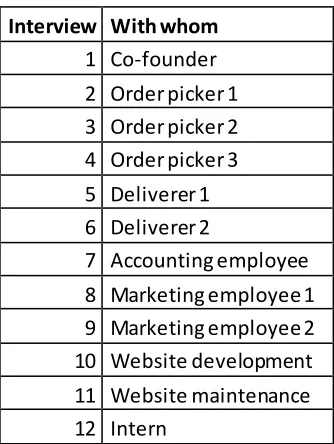
Interview With whom
1 Co-founder 2 Order picker 1 3 Order picker 2 4 Order picker 3 5 Deliverer 1 6 Deliverer 2
7 Accounting employee 8 Marketing employee 1 9 Marketing employee 2 10 Website development 11 Website maintenance 12 Intern
Ta bl e 2. Number of interviews.
Observations With whom Occasions
1 Marketing employees / website development employees Ad hoc meeting
2 Marketing employees / accounting employee Ad hoc meeting
3 Owners / order pickers Ad hoc meeting
4 Accounting employee / marketing employees / owners Formal meeting
5 Supplier / owners Formal meeting
6 Owners / all employees Formal meeting
Ta bl e 3. Number of observations, with whom and the occasion.
Chapter 4. Data analysis
This chapter will first discuss the structure of the organisation Mobile Grocery Store Inc. were the data for this thesis was obtained. Second this chapter will discuss how the data for this thesis was obtained and how the data for this thesis was analysed.
4.1 Organisational structure
For this thesis I examined how interfunctional coordination within the organisation Mobile Grocery Store Inc. can be complicated when an organisation serves multiple segments of customers and how this is overcome by Mobile Grocery Store Inc.. Mobile Grocery Store Inc. is a privately owned
company located in the eastern part of the Netherlands. Mobile Grocery Store Inc. is an organisation that delivers everyday groceries to consumers as well as other organisation such as day -cares and small and medium sized enterprises. Within the organisation it was noticed that the demands of consumers and organisations were different from each other.
4.2 Results
[image:20.596.71.510.60.439.2] [image:20.596.70.237.68.290.2]setting of the employees. This meant getting to know the employees and participating in the daily routines of the employees (Visconti, 2010). Here my approach followed Feldman (2000). I tried to find out as much as possible about the organisation Mobile Grocery Store Inc., the employees and their routines on the job. Second I started with collecting the actual data for this thesis. This was done by observing the employees while they were performing their tasks as well as via conversations with the employees. In total I have studied the nine potential problems associated with the four above mentioned barriers of interfunctional coordination. Key words with regard to the barriers o interfunctional coordination from the conversations with the employees were written down. The keywords from the conversations were linked to the barriers of interfunctional coordination as found in existing literature(Narver & Slater, 1990; Day 1994; Narver & Slater, 1995; Deshpande et al., 1993, Lafferty & Hult, 2001; Kennedy, Goolsby and Arnould, 2003; Han et al, 1998; Zaltman, Duncan & Holbek, 1973 Jaworski and Kohli, 1993; Kirca, Jayachandran and Bearden, 2005; Matsuno, Mentzer, and Ozsomer 2002) and also which employee mentioned it was written down. After this the obtained data was analysed via iterative data analysis (Visconti, 2010). The data as interpreted by me was shared with the employee. This was done so that consensus about the obtained d ata was generated (Visconti, 2010). The third step in analysing the data was to compare the obtained data with the theories found in existing literature. This was done to see whether the relationships as mentioned in existing theory also where found in my observations and conversations with the employees. Finally the results obtained from my observation and from the conversations with the employees where written down.
Table 4 shows the observed potential problems that can arise at the organisation Mobile Grocery Store Inc. with regard to interfunctional coordination and the key informants associated with this.
Barriers of interfunctional coordination
Potential Problems Key informant
Top management Emphasis towards market orientation (1)
Co-founders / owners
Culture Norms for communication (2) Co-founders / owners, order pickers, deliverers, accounting personnel, marketing personnel, website maintenance personnel Collection of information about
customers (3)
Use of other sources of information (4)
Interdepartmental
connectedness and conflict
Openness in communication (5) Co-founders / owners, order pickers, deliverers, accounting personnel, marketing personnel, website maintenance personnel, intern
Integrated communication between departments (6) Common goals of departments (7)
Organisation structure Clear definition of goals (formalization) (8)
Co-founders / owners, order pickers, deliverers, accounting personnel, marketing personnel, website maintenance personnel Employees authorized to make
decisions (centralization) (9)
Chapter 5. Results
5.1 Main findings
In this chapter the results obtained via the data analysis will be shown and discussed. The potential barriers of interfunctional coordination are categorized in three categories. These categories are low problematic, moderate problematic and high problematic. Table 5 shows the potential barriers categorized in one of the three categories (low, moderate or high problematic) and how the problem is experienced within the. After this the three categories (low, moderate and high problematic) will be discussed in more depth.
Experience of the barrier
Low problematic (1, 2, 3 & 4)
Within the organisation Mobile Grocery Store Inc. these potential barriers of interfunctional coordination are experienced as low problematic. The problems that do arise are easily overcome. For example about what information gained is relevant for which segment of customers.
Moderate problematic (8 & 9)
Within the organisation these potential barriers were experienced as moderate problematic. The employees were given clear
definitions of their goals but these goals were different for the different segments of customers and for each department. Which sometimes caused confusion and discussion within departments and between departments. This let to everybody within the organisation being busy with their own tasks which complicated the sharing of information between the departments. Employees always had to check with the owners when a decision had to be made. This was experienced by the employees as slowing them down when doing their job.
High problematic (5, 6 & 7)
These barriers of interfunctional coordination were experienced as highly problematic within the organisation. Although a lot of information is shared within the organisation it was not always clear to which segment of customers the information was intended. Communication between the departments was made more easily by implementing a database were information was shared. But although this database was implemented the goals within a department and between departments shifted a lot. An employee always needed to keep in mind with which segment of customers they were dealing with at the moment. This also led to different departments working on different goals at the same time which caused confusion and friction within the organisation.
[image:22.596.65.529.220.629.2]5.2 Low problematic barriers
The barriers that were experienced as low problematic with the organisation Mobile Grocery Store Inc. were the emphasis towards market orientation, the norms for communication, the col lection of information about customers and the use of other sources of information.
These four potential barriers for interfunctional coordination were experienced in the organisation as low problematic. While I was talking about the emphasis of the organisation towards market
orientation the co-founder started talking about how they always wanted to obtain as much information as possible about customers, competitors and suppliers. And that this was done via talking with suppliers and customers. Information was also gained via the news and internet, but when I asked him what was done with this information the answer was rather short,
“we discuss the information that we gain with all the people within this organisation in the sense that we tell them about it, I guess not much else is done with it besides that, we don’t have a database or something were we store information although this might be wise to implement at some time” (co-founder).
My experience when talking with the order pickers and the deliverers was quite the same. One order picker said to me the following,
“When I am working at six in the morning the suppliers start delivering their products here one by one. Sometimes I hear something about a new development at one of the suppliers which might benefit us too, but I don’t have something where I can write it down and then a few hours later I forgot about it and don’t tell it to anyone (order picker 1).
A deliverer said something to me that was quite the same,
“when I deliver the groceries to the customers I always hear a lot suggestions from the customers about how we might be able to upgrade our service to that it will better suit the wants of the customer, but there is no place where I can write this down and when I am done with my deliveries most of the time I already forgot about it and go home without telling anybody (deliverer2). Another problem came to light when I asked if he knew with whom he should share the obtained information and if he needed to share information about consumers and business customers with different employees throughout the organisation. He stated the following,
“I don’t know with whom I need to share information I gained from the different types of customers, this also made it harder for me to share it and often lead to me not telling anybody about it”
(deliverer 2).
The co-founder and me discussed this with each other and sought a way to make it easier for the workforce to share the data and also to make sure important information obtained throughout the day was written down instead of forgotten and lost. Eventually the solution was rather easily found. We implemented a database that was accessible for everyone within the organisation at any
moment in time. With this we standardized the flow of information within the organisation. When I asked the same order picker about his thought about the database he shared with me the following ,
“now when I obtain information from a supplier and I think this might be relevant for management I write it down in short in the database and know that the management will take a look at is, this gives me the feeling that something is really done with the information I pass on to management and makes it a lot easier to share information throughout the organisation” (order picker 2).
The solution to overcome the above mentioned barriers were rather easily found. A database that is accessible to every employee within the organisation was implemented. After only a week it became feasible how much information the order pickers and deliverers obtained while doing their daily jobs. The amount of data within the database started to grow week by week. The only thing necessary for the organisation to overcome this barrier was standardizing the way information was communicated throughout the organisation. Because of this, the above mentioned barriers are indicated as low problematic. The low problematic barriers are related to all the three pillars of Osterwalder (2004) as mentioned in the conceptual model, this indicates that the low problematic barriers influences an organisations key resources area, key activities area and partnerships.
5.3 Moderate problematic barriers
The barriers that were experienced as moderate problematic with the organisation Mobile Grocery Store Inc. were a clear definition of goals and an employee’s authorization to make decisions.
These two barriers for interfunctional coordination were experienced within the organisation as moderate problematic. Within the organisation the employees knew quit well what their
assignments were. But while they knew what their own assignments were they actually had no idea who to contact from another department when important or sometimes even crucial information needed to be passed on. While I was obtaining my data for this thesis Mobile Grocery Store Inc. was working on a new website to improve the shopping experience for both the consumer as well as the business customers. At one time one of the employees from the marketing team had a great idea how to give both the consumer as well as the business customer the shopping experience he or she desired. Although this change from the original design was quite small it took a lot of time before the marketing employee contacted the right person from the website development team to see if his idea was possible to implement. He stated the following to me,
Another frustrating remark came from a website developer who noticed the following,
“When our team working on the website we often split up the work, for example we first implement the suggestion to better the website for consumers and after this we start with the implementation for the business customers. But will we were working on the consumer experience we would get a lot of suggestions and feedback that might increase the shop experience for business customers. This often lead to a whole lot of distraction and slowed down the work immensely” (website maintenance employee).
When I heard about this I together with the other co-founder started looking for a solution to this problem. Not only did this took up way too much time, also the costs increased with it every day because the website development team continued working on a design that was already slightly altered by the marketing employee. Eventually the solution was assigning employees from different departments into interdepartmental teams. This made sure employees knew from the start of an assignment who was also working on the assignment within another department and who to contact when necessary. When I later asked the website development employee about how the potential improvements that came with working in interdepartmental teams he stated the following,
“I enjoy working in teams now because is speeds up the flow of information, in the earlier days sometimes information was passed on the me that was not helpful to me what so ever. But because I also had no idea for who it might be helpful I did not act on it what so ever” (Website development employee).
So not only did this change improved the flow of information, another problem, of which the founders had no idea, came to light and was overcome by implementing interdepartmental teams.
The other barrier, employees’ authorization to make decisions, came to light will talking to one of the deliverers. He stated the following,
“It is annoying that for every decision I want to make I first have to check with one of the owners whether or not the decision is the right one. An example is when I hear via the WhatsApp groupapp that I delivered the wrong crate of groceries at the wrong company. At that time I know enough and know that I need to solve it, and don’t need Arend or Lars calling me with the same announcement. I know that that is my own fault, but I also know how to solve the problem as quickly as possible. It would speed up to process if I could decide on my own how to solve the problem (deliverer 1).
With this we saw that it was not necessary for us (the co-founders) to be involved in everything. Instead of first sharing the information with us, so that we can call the deliver to seek the right solution, the employees showed to be capable to share the information with each other and also come up with the right solution. Another deliverer shed light on another issue within the
organisation. He stated,
“I have the feeling that we have more freedom in making our own decisions when it comes to problem solving when I deliver groceries to an consumer instead of a business customer, this something works really confusing” (deliverer 2).
The solution to the above mentioned barriers was not very easily found by the organisation.
into interdepartmental teams in implication of this solution was not as easy as one might think. People who did not work together at all were put into teams with each other and where not always able to cooperatively together from the start. Employees had questions why they were assigned to a specific team or one employee did not want to be in a team with another employee because they did not like the other employee. It took some time from the management team to explain why these changes were made and why they would eventually benefit the entire organisation. This is why these barriers of interfunctional coordination are remarked as moderate problematic. The moderate problematic barriers are related to the key resources pillar of Osterwalder (2004). This means the moderate problematic barriers influence an organisation key resources area.
5.4 High problematic barriers
The barriers that were experienced as high problematic with the organisation Mobile Grocery Store Inc. were the openness in communication, the integrated communication between departments and the common goals of departments.
When I started collecting data for this thesis I first noticed that the different departments did not really talked with each other what so ever. When I asked an employee from the marketing department why the department did not share any information with each other he stated the following,
“We used to talk with other departments a lot, but when we started delivering to consumers as well as businesses this stopped rather quickly. Departments where either working on issues involving consumers or issues involving business customers. I never knew who at what time was focusing on what segment of customers. You can understand that after a while it becomes rather annoying when you are focusing on business customers and someone from another department starts talking to you about consumers. I guess that’s why it stopped over time” (marketing employee 1).
Another great example of how two different segments of customers can lead to confusing between departments came from an employee working at the accounting department. He stated the
following:
“A great example about friction within the organisation can be found between marketing and accounting. Marketing was working on a plan to generate more traffic towards the website and namely more business customers , accounting was asked to see what amount of money was available for this. When marketing asked the accounting department about this a few weeks later the answer was non because the budget for consumer marketing was already spend” (Accountant employee).
“Although I sometimes know somebody could use my help because I can shed a different perspective on their problem I choose not to act on it because I am being held accountable for my own tasks” (website maintenance employee).
Eventually a solution to these problems arose. Would it help the employees from different
departments to have a direct supervisor who monitors the work done within different departments and makes sure the goal pursued by the employees in the different departments is the same? Employees from different departments were put together in interdepartmental teams and these teams got a direct supervisor with whom they could share ideas and talk to when problems arose. By combining employees from multiple departments in teams it was also made sure that these
employees were all working on the same goal and that they knew who to talk to. How this helped the process was well stated by an intern who stated,
“When I just started my internship at this organisation I thought it was all very quiet, nobody was talking with one another and everybody was working on their own tasks. I also noticed that people found it annoying when I asked a question that was not related to the work they were doing at the moment. But I did not know who to contact. Now we work in teams and have somebody assigned to us for supervision. I know who is working on the same issue as me and we pursue the same goals, and even when we do not agree on something we can contact the supervisor the smooth thing out”
(intern).
5.5 Summarizing conclusion of the categories
The following table shows a short summary of the three problematic categories, the associated barrier of interfunctional coordination and the pillar of Osterwalder (2004) they belong to.
Categorie Barrier of interfunctional coordination Pillar
Low problematic
Emphasis towards market orientation Key activities
Norms for communication Culture
Collection of information about customers Culture
Use of other sources of information Partnerships
Moderate problematic Clear definition of goals (formalization) Key resources
Employees authorized to make decisions (centralization) Key resources
High problematic
Openness in communication Key activities
Integrated communication between departments Key activities
Common goals of departments Key activities
[image:28.596.72.532.129.298.2]Ta bl e 6. Categorization of barriers of interfunctional coordination.
Table 7 shows the barriers of interfunctional coordination, how they were dealt with and how they were overcome within the organisation Mobile Grocery Store Inc..
Barrier of interfunctional coordination Solution
Emphasis towards market orientation
Standardization in communication
Norms for communication
Collection of information about customers Use of other sources of information Clear definition of goals (formalization)
Interdepartmental teams
Employees authorized to make decisions (centralization)
Openness in communication
Direct supervision
Integrated communication between departments
Common goals of departments
Ta bl e 7. Overcoming the barriers.
5.6 Overcoming the barrier
This paragraph discusses how the barriers of interfunctional coordination were overcome within the organisation Mobile Grocery Store Inc..
5.6.1 Overcoming the low problematic barriers
[image:28.596.59.533.356.546.2] [image:28.596.68.528.358.546.2]the organisation. A pitfall for an organisation can be that the external focus of the organisation becomes too narrow. Information is collected about existing markets and competitors thus ignoring potential emerging new competitors and customers (Narver & Slater, 1995). Another pitfall can come from the fact that information is only acquired about an organisation competitors and customers and other valuable sources of information are overlooked. Additional sources of information can be an organisation suppliers or universities (Narver & Slater, 1995). To overcome the low barriers to interfunctional coordination this thesis stated that the communication within the organisation for sharing information should be standardised. Although this was established existing literature stated some other ways to overcome the low problematic barriers. For an organisation to truly make use of all the possible sources of information an organisation should become a learning organisation (Narver & Slater, 1995). This indicates that information should be generated from all stakeholders and constituencies that have the potential to generate information that can positively influence the superior customer value or is a threat to the competitive advantages of the organisation (Naver & Slater, 1995).
5.6.2 Overcoming the moderate problematic barriers
These barriers were overcome by assigning employees who were working on the some goal or problem into interdepartmental teams. The employees now know with whom they should seek contact within another department and with whom they should share their information. This led to a better flow of information between the departments and less discussion. Although this thesis found that a solution to the moderate problematic barriers was to assign employees to interdepartmental teams, existing literature found some other alternatives for overcoming these barriers. Tomaskova (2009) found that to overcome the moderate barriers of this thesis an organisation should search for highly qualified employees with a natural sense for teamwork. The organisation should also make sure that the employees are very satisfied with their jobs (Tomaskova, 2009).
5.6.3 Overcoming the high problematic barriers
Chapter 6: Discussion
This chapter will discuss the answers to the research questions as stated in this thesis by relating or confronting it with existing literature on interfunctional coordination. Furthermore this chapter will discuss theoretical and managerial contribution of this thesis’ findings, followed by directions for future research and end with a final conclusion.
The aim of this thesis was to find out how interfunctional coordination is complicated within an organisation when this organisation serves multiple segments of customers. Second this thesis was aimed at how these complications that arise when serving multiple segments of customers can be overcome by an organisation.
Via ethnographic research the data for this thesis was obtained. This meant that the data for this thesis was obtained via the observation of the employees of the organisation and via interaction with the employees of the organisation. First of all it was assumed in this thesis the two segments of customers of the organisation Mobile Grocery Store Inc. differed in customer value. Via my
interaction with the employees of the organisation it became clear that serving multiple segments of customers lead to a variety of problems within the organisation. But how did this complicated interfunctional coordination within the organisation?
Via interaction with the employees of the organisation it became clear that serving multiple segments of customers lead to a lot of confusion within the organisation. For example employees were confused about who to talk to when they had a specific problem related to one of the segments of customers. It also led to a lot of irritation and discussion between the employees of the
organisation. When an employee working on an issue related to consumers asked a question about an issue to someone from another department who was working on an issue related to business customers this led to irritation with both the employees. The employee who asked the question was not easily able to come in contact with the right employee from another department while the employee who was questioned did not want to be bothered by his colleague and did not feel the need to help the colleague any further. Eventually this led to an organisation were all the employees were working on their own tasked and not a lot of teamwork and sharing of information was done.
Existing literature mentioned multiple barriers that can have a negative influence on interfunctional coordination within an organisation. Within existing literature nine potential barriers of
interfunctional coordination were found. These potential barriers of interfunctional coordination where emphasis of top management towards market orientation, norms for communication, collection of information about customers, use of other sources of information, openness in communication, integrated communication between departments, common goals of departments, clear definition of goals and employees authorization to make decisions. Not all barriers were experienced as problematic in the same way, some barriers where more problematic for the organisation then others. The barriers were categorized in three categories based on how problematic they were for the organisation.
Interfunctional coordination within the organisation was mostly complicated by the barriers