Influence of cognitive abilities on laparoscopic
simulator trainer performance
Author: Stefan Huijser Std. Nr: s1595652
Master Thesis “Validation Twente Endoscopic Skills Test” Department of Cognitive Psychology and Ergonomics (CPE) July 2015
Abstract
Objective: In practice, but also in research, it became noticed that there are large differences in the learning speed and capacity of surgical trainees in laparoscopic surgery. In an effort to predict these differences, researchers have studied the relationship between cognitive ability and learning to per-form laparoscopic surgery, however the results were mixed. The aim of this study was to provide more insight in how cognitive ability is related to learning to perform laparoscopic surgery by considering three aspects of learning: speed of learning, maximum attainable performance, and total observed learning during the study period. It was hypothesized that high visual-spatial ability (VSA) is predic-tive of a high maximum performance. Furthermore, it was expected that high spatial memory (SM) would predict a great learning speed.
Method: The study was divided in two parts. In the first study, a factor analysis was performed on an existing battery of cognitive ability tests in order to retrieve valid factors/abilities for experimentation. For this analysis, data from the Groenier et al. (2014) study was used. In total 98 students from two cohorts (2011 and 2012) participated in their study. In the follow-up study, the retrieved abilities were investigated in relation to laparoscopic simulator performance. Nineteen novice participants completed 12 attempts across three sessions of one hour (three hours in total) on a laparoscopic VR simulator task. Furthermore, cognitive ability tests for the retrieved abilities were conducted at the start of each session.
Results: The results showed no predictive relationships for VSA and maximum performance and for SM and learning speed. However, high SM was found to be predictive of good initial performance. This initial advantage diminished quickly with practice on the simulator task.
Conclusion: In this study, it was found that VSA does not influence learning to perform laparoscopy. Given the mixed results in the literature, it is not recommended to use this ability for selection and/or assessment. Regarding to spatial memory our results showed that a better initial performance was pre-dicted by a high spatial memory capacity. This advantage however diminished quickly with practice. Although this does provide insight in how cognitive ability influences the learning curve for laparos-copy, it is not interesting for assessment or selection as it only applies to early learning. Therefore, more research is needed before cognitive abilities may be of particular use in laparoscopic training programs.
Samenvatting
Doel: Vanuit de praktijk, maar ook uit onderzoek, werd het duidelijk dat er grote verschillen bestaan in de leersnelheid en capaciteit van chirurgen in opleiding. Met als bedoeling om deze individuele verschillen te voorspellen, hebben onderzoekers de relatie tussen cognitieve vaardigheden en het leren uitvoeren van laparoscopie onderzocht. De resultaten waren echter niet consistent. Het doel van deze studie was om meer inzicht te geven in hoe cognitieve vaardigheden gerelateerd zijn aan het leren uitvoeren van laparoscopie door het bekijken van drie leeraspecten: de leersnelheid, leercapaciteit, en totaal geobserveerde leren tijdens de studie. Het werd verwacht dat een hoge visueel-spatiële vaardig-heid (VSA) een grote leercapaciteit voorspeld. Daarnaast werd verwacht dat een groot ruimtelijk ge-heugen (SM) gerelateerd is aan een hoge leersnelheid.
Methode: Deze studie was onderverdeeld in twee delen. In het eerste onderzoek werd een factor ana-lyse uitgevoerd op een bestaande testbatterij om valide factoren/vaardigheden te verkrijgen. Voor deze analyse werd gebruik gemaakt van data uit de studie van Groenier et al. (2014). In totaal deden 94 proefpersonen mee aan die studie uit twee verschillende cohorten (2011 en 2012). Na deze analyse werd een vervolgonderzoek uitgevoerd waarin de relatie tussen de verkregen vaardigheden en laparo-scopische simulator taakprestatie. In totaal voltooiden negentien onervaren proefpersonen drie sessies van één uur (drie uur in totaal) op de simulator. Daarnaast werden aan het begin van elke sessie cogni-tieve vaardigheden testen afgenomen voor de verkregen vaardigheden.
Resultaten: Uit de resultaten bleek dat er geen voorspellende relatie is voor VSA en leercapaciteit en SM en leersnelheid. Echter, het was gevonden dat een hoge SM een betere initiële prestatie voorspeld. Dit voordeel nam echter snel af met oefening op de simulator.
Conclusie: In deze studie was gevonden dat VSA geen invloed heeft op het leren uitvoeren van lapa-roscopie. Gegeven de inconsistente resultaten in de literatuur is het ook niet aanbevolen om deze vaar-digheid in selectie en beoordeling te gebruiken. Voor ruimtelijk geheugen lieten de resultaten zien dat een betere initiële prestatie voorspelt kan worden door een groot ruimtelijk geheugen. Dit voordeel verdween echter snel. Ondanks dat deze bevinding onze inzicht vergroot, is deze vaardigheid niet toepasbaar voor beoordeling en selectie aangezien het alleen een vroege leerfase betreft. Daarom is meer onderzoek nodig voordat cognitieve vaardigheden gebruikt kunnen worden in trainingspro-gramma’s voor laparoscopie.
Table of Content
1 General Introduction ... 6
1.1
Constraints of laparoscopy ... 6
1.2 Training – from apprenticeship to VR simulation ... 8
1.3 Learning & Assessment ... 8
1.3.1 Research into learning of laparoscopic procedures ... 8
1.3.2 Assessment of trainees - innate abilities and learning laparoscopy ... 9
1.4 Overview of this thesis ... 11
2 Pilot Study ... 12
2.1
Introduction ... 12
2.2 Methods and Materials ... 12
2.2.1 Participants ... 12
2.2.2 Apparatus ... 13
2.2.3 Material ... 13
2.2.4 Procedure ... 13
2.2.5 Analysis ... 14
2.3
Results ... 14
2.3.1 Correlations and reliability ... 14
2.3.2 Exploratory Factor Analysis ... 15
2.4 Discussion ... 15
3 Experimental Study ... 17
3.1 Introduction ... 17
3.2
Methods and Materials ... 17
3.2.1 Participants ... 17
3.2.2 Apparatus ... 18
3.2.3 Materials ... 18
3.3
Results ... 22
3.3.1 Correlation of cognitive ability with learning rate, asymptote, and amplitude ... 22
3.3.2 Motion Efficiency ... 22
3.3.3 Duration ... 23
3.4 Discussion ... 25
4
General Discussion ... 29
5 References ... 33
6
Appendix ... 40
6.1.1 Mental Rotation Test ... 40
6.1.2 Paper Folding test ... 40
6.1.3 Corsi Block-Tapping Task ... 40
6.1.4 Identical Pictures ... 41
6.1.5 Raven Advanced Progressive Matrices ... 41
6.1.6 Number Comparison test ... 42
6.1.7 Rotational Shapes test ... 42
6.1.8 Surface Development test ... 42
6.1.9 Matrijzen ... 42
6.2 Model Code ... 43
6.2.1 Random Effects Model ... 43
1
General Introduction
Throughout the last century, the surgical field has made great advances with minimal invasive surgery (MIS) being described as the most important change in the development of surgical techniques (Darzi & Mackay, 2007). One of the earliest and most performed MIS procedures is called laparoscopy. Lap-aroscopy is a surgical procedure of the abdomen in which the patient is operated with (long) endo-scopic tools inserted through incisions in the abdominal wall (see Cao, Mackenzie, & Payendeh, 1996). This procedure contrasts with conventional surgery, where the surgical field is exposed to al-low direct contact and view on the respective tissue. Despite this difference, MIS has made procedures possible that otherwise could not be performed due to anatomical, physiological, and mechanical con-siderations (Rosser, Rosser, & Savalgi, 1997). Moreover, it has shown to have many advantages such as reduced pain after surgery, smaller incisions and wounds, and faster recovery (Ponsky, 1991). Alt-hough the advantages are clear, it has been noticed that large differences exist in the learning progress among surgical trainees (Buckley et al., 2014; e.g. Grantcharov & Funch-Jensen, 2009). Surgery times with MIS procedures are also longer compared to open surgery and complication rates are relatively high during the early learning phase (Fuchs, 2002; Wherry, Marohn, Malanoski, Hetz, & Rich, 1996). These findings suggest that MIS procedures are more difficult to master than open surgery.
The main goal of this thesis is to provide insight in how individual differences among trainees’ influence learning to perform laparoscopy. The characteristics of individual learning progress will be examined and certain cognitive (innate) abilities (more on this below) will be related to their progress. If predictive relationships between cognitive ability and characteristics of learning progress could be found, this might be of great potential in the selection and assessment of surgical trainees in current simulation programs (see Carroll, Kennedy, Traynor, & Gallagher, 2009). In the following sections a more thorough introduction will be given about the constraints of laparoscopy, the training methods that are and have been used, and the research into learning and assessment of surgical trainees.
1.1 Constraints of laparoscopy
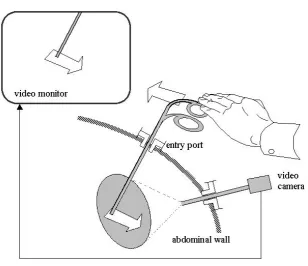
on a monitor from one camera. As the monitor only displays 2D information, there are no clues of depth. Therefore, seeing depth through binocular vision is not possible. Furthermore, surgeons indi-cated that they experienced physiologic discomfort and extra visual strain when such 3D technology was applied (Hanna, Shimi, & Cuschieri, 1998; Hanna & Cuschieri, 2000). Another perceptual prob-lem is that the visual information displayed on the monitor is magnified and degraded in quality in comparison to the experience of an open operation, resulting in scaling difficulties (Gallagher & Smith, 2003). Another constraint according to the researchers is psychomotor in nature: the fulcrum effect (Gallagher, McClure, McGuigan, Ritchie, & Sheehy, 1998). The fulcrum effect occurs when there is a visual discordance between what the surgeon sees and the information from the propriocep-tive system (stimuli in relation to the position and movement of the body). In other words, the endo-scopic instrument endpoints move in the opposite direction to the surgeon’s hands due to the pivot point, which makes this motor skill non-intuitive (see Figure 1 below). All the constraints described above place a higher demand on the perceptual and visual-spatial abilities of the surgeon (Way et al., 2003).
1.2
Training – from apprenticeship to VR simulation
Considering these difficulties with laparoscopy, it is important that surgeons in education receive proper training in order to cope with these. A successful laparoscopic procedure requires surgeons to be ambidextrous (being equally competent in handling the instruments with both hands), have good hand-eye coordination, and depth perception (Derossis et al., 1998). Furthermore, non-technical skills such as situation awareness, decision making, and communication have proven to be important for successful procedures (e.g. Mishra, Catchpole, Dale, & McCulloch, 2008; Yule, Flin, Paterson-Brown, & Maran, 2006). Since the beginning of the last century, the apprentice model for skill acquisition has been the dominant training model (Cameron, 1997). This method for acquiring surgical skills in the operating room (OR) is very risky, time consuming, stressful, and costly. Moreover, it does not pro-vide standardized and objective performance measures (Livingstone & Thomas, 1996; Wanzel, Ward, & Reznick, 2002). Therefore, it is nowadays believed that virtual reality (VR) simulators have great potential in the surgical field (Feldman, Sherman, & Fried, 2004).VR simulators provide the ad-vantage that particular skills, especially motor skills (see Grantcharov & Funch-Jensen, 2009), can be trained multiple times on different difficulty levels in a safe environment. Furthermore, it is possible to give immediate objective feedback. Research has indicated that error rates are reduced by VR simula-tor training prior to performing real laparoscopic procedures (Ahlberg et al., 2007; Schijven, Jakimowicz, Broeders, & Tseng, 2005).
1.3 Learning & Assessment
1.3.1 Research into learning of laparoscopic procedures
1.3.2 Assessment of trainees - innate abilities and learning laparoscopy
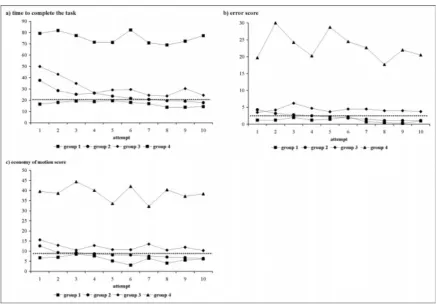
[image:9.595.79.517.243.551.2]The observation of differences in learning progress led to a great body of research investigating why these differences occur and if the individual curves of surgeons could be predicted. Researchers have investigated the relationship between multiple cognitive abilities and the performance of laparoscopic tasks with the underlying rationale that the differences in learning are due to differences in cognitive aptitude (e.g. Buckley et al., 2013; Groenier, Schraagen, Miedema, & Broeders, 2014; Keehner et al., 2004a). If such a relationship could be found, this could be of great potential in the assessment and selection of surgical trainees (see Carroll et al., 2009).
Figure 2: Learning curves from (a) time to complete the task, (b) error score, and (c) economy of movement. This figure is adapted from the study of Grantcharov and Fuch-Jensen (2009)
al., 1996). Alongside visual-spatial abilities, psychomotor abilities have also found to be related to performance on laparoscopic VR simulators (see Gallagher & Smith, 2003).
As already described above, Grantcharov and Funch-Jensen (2009) found that a small group (5.1 % of the sample; group 4 in Figure 2) had excellent psychomotor skills from the start. However, an approximately similar sized group (8.1 %; group 1 in Figure 2) underperformed from the start and showed no signs of improvement. The researchers conclude that this evidence might be interesting for selection procedures. In the study of Buckley et al. (2014), the researchers were able to replicate the learning curve patterns found by Grantcharov and Funch-Jensen (2009). Instead of only measuring psychomotor ability, they also measured depth perception and visual-spatial ability. The researchers concluded that cognitive abilities have great potential in selection.
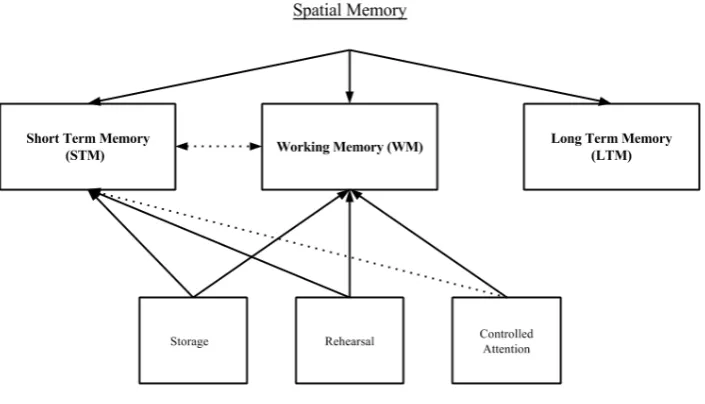
Alongside depth perception and visual-spatial ability, also other cognitive abilities such as spatial memory, reasoning, and perceptual speed have received attention from researchers (see e.g. Keehner et al., 2006, Luursema, 2010). Spatial memory is the ability to hold information from the environment and spatial relations in memory (Carroll, 1993), and has representations in short-term memory (STM), working memory (WM), and long-term memory (LTM; Conway, Kane, & Al, 2005; see Figure 3). Although the LTM component of spatial memory (also known as spatial navigation, see General Discussion for more on this) has received very little attention from researchers, the STM and WM component have and are seen as an indicator of the ability to learn the procedural aspects of lapa-roscopic tasks. Both STM and WM reflect memory span/capacity with WM putting more emphasis on filtering possible distracting information (i.e. controlled attention; Engle, 2002). Although some searchers claim that STM and WM are distinct (e.g. Engle, 2002; Jones et al., 1995) substantial re-search has indicated that controlled (executive) attention is important for both memory systems in the spatial domain (see e.g. Ang et al., 2008; Vandierendonck, 2004; Miyake, Friedman, Shah, Rettinger, & Hegarty, 2001). Research into the relationship between spatial memory and learning to perform laparoscopy have found that memory is primarily important in the early learning phase (Keehner et al., 2006; Luursema, 2010). A comparable relationship was found for reasoning ability. A study of Keehner et al. (2006) found its influence was especially great in the early learning phase of laparosco-py and attenuated with practice. Moreover, another ability that has proven to be related to procedural aspects of laparoscopy, in particular with tasks that demand high speed and accuracy, is perceptual speed (see e.g. Ackerman & Beier, 2007). Its influence on motion efficiency has been shown by work of Luursema (2010).
ex-perts, reflecting that these abilities might become less important with increasing experience in laparo-scopic surgery (Keehner et al., 2004b; Wanzel et al., 2003). The researchers concluded that the learn-ing curve for laparoscopy seems to be related to multiple innate (cognitive) abilities dependlearn-ing on the nature of the chosen tasks, the VR simulator used, the type innate ability as well as the learning phase.
Figure 3: Overview of spatial memory containing three components: short-term memory, long-term memory, and working memory (Conway et al., 2005). The dotted lines mean that the relationship between the two components is suggested by research, however only in the spatial domain.
1.4 Overview of this thesis
2
Pilot Study
2.1
Introduction
The observation of differences in learning progress among surgeons has led to a great deal of research examining whether these differences could be predicted by cognitive aptitude. An important step in all of these studies was to decide which cognitive abilities will be investigated and how they would be measured. In this pilot study, a closer look is taken at the cognitive ability tests used in these studies, in particular the work of Groenier and colleagues (2014).
In the study of Groenier et al. (2014) study, a battery of nine cognitive ability tests was used to measure four cognitive abilities: visual-spatial ability, spatial memory, reasoning, and perceptual speed (see 2.2.3 Material for a list of the tests). Although these tests have been validated in the past, adaptations of the original tests were used, in part to make them suitable for conducting on personal computers (see Appendix 6.1 for a detailed description per test). However, this created some prob-lems. For instance, there are concerns regarding the construct validity of the Identical Pictures test and the Number Comparison test that were used to measure perceptual speed. The original tests are paper-and-pencil tests and require the participants to make quick judgments. In the experiment of Groenier et al. (2014), the tests were modified to work on a computer with a mouse as input device. However, checking boxes with a mouse requires different operations compared to with a pen/pencil. Indeed, a meta-analysis by Mead and Drasgow (1993) showed that speed tests (processing speed tests based on reaction time) suffer more in reliability and validity from conversion than power tests (such as reason-ing ability).
In the present study we would like to take another look at the work of Groenier et al. (2014) by examining the inner structure of the test battery that they used. Given the problems that are named above, the adequacy of assumptive factor divisions will be examined with an exploratory factor analy-sis. The retrieved factors will be coined and used in an empirical study later on.
2.2
Methods and Materials
2.2.1 Participants
In this analysis, data from the Groenier et al. (2014) study was used. In total 98 students from two cohorts (2011 and 2012) participated in their study (46 male; Mage= 22.7 years, SDage = 1.3 years). Nine
2.2.2 Apparatus
The participants were tested at the Experimental Centre of Technical Medicine (ECTM) at the Univer-sity of Twente. The cognitive aptitude tests were administered on a personal computer running Win-dows XP and were fully programmed in E-prime (Psychology Software Tools, Pittsburgh, PA). The laparoscopic simulator training was performed on the LapSim© virtual reality simulator using the
Vir-tual Laparoscopic Interface (VLI) hardware and the LapSim© Basic Skills v3.0 as training software.
The simulator interfaced a computer running Windows XP and an 18” TFT-monitor.
2.2.3 Material
Cognitive Aptitude Tests
Four factors were measured in the study of Groenier et al. (2014): visual-spatial ability, spatial memory, perceptual speed, and reasoning. Visual-spatial ability was derived by aggregating the results of the Mental Rotation Test (Vanderberg & Kuse, 1978), the Surface Development test (Ekstrom, French, & Harman, 1976), the Paper Folding test (Ekstrom et al., 1976), and the Rotating Shapes test (cf. Cooper, 1975). Spatial memory was derived from an adapted version of the Corsi Block-Tapping Task (Corsi, 1973). Perceptual speed was measured by aggregating the results of the Identical Pictures test and the Number Comparison test (Ekstrom et al., 1976). Reasoning was measured with the Raven Advanced Progressive Matrices test (Raven, 1965) and the verbal reasoning test from the Groningen Intelligence Test (Luteijn & Van der Ploeg, 1983). The Corsi Block-Tapping Task, the Raven test, and the Matrijzen test were split in half in order to reduce fatigue on the participants and to calculate their respective reliability.
2.2.4 Procedure
Prior to the simulator training, the participants were invited in two group sessions to a computer lab for cognitive aptitude assessment. During the first session, tests for visual-spatial ability, perceptual speed, spatial memory, and reasoning were conducted. Furthermore, a basic demographics survey was administered during this session with questions about gender, age, nationality, and handedness. During the second session, the same cognitive aptitudes were measures with different tests. Each session last-ed around 45 minutes.
After the assessments, the participants were invited in groups of two to the simulator lab. Here, two LapSim© virtual reality simulators were available for training. From the training program,
The simulator training sessions took place over a total time span of two months. The partici-pants had weekly training sessions of 30 minutes. As the training was proficiency based the total amount of training sessions differed among participants. When participants reached proficiency for both tasks, the training was terminated. In addition, when participants had not reached proficiency within seven training sessions, the training was terminated as well.
2.2.5 Analysis
Exploratory Factor Analysis
At first, an Exploratory Factor Analysis (EFA) on test level was performed in order to investigate the structure of the cognitive aptitude data. Prior to the EFA, the data was checked if the sample size (n = 98), and the correlations between the cognitive aptitude tests were high enough to perform factor anal-ysis. Results from the Kaiser-Meyer-Olkin (KMO) Index showed an index of .696. This is above the cut-off of .5 defined by, implying that an adequate estimation of factors is possible with this sample size (Kaiser, 1974). Also Bartlett’s test of Sphericity indicated adequate correlations (X2 = 244.849, p
< .001).
To determine the number of factors that should be extracted from the EFA, a parallel analysis method was used based on bootstrapping (see Hayton, Allen, & Scarpello, 2004 for more details about this method). It was chosen to use this extraction method above the more common Kaiser’s criterion of eigenvalues because the Kaiser criterion tends to overestimate the amount of factors that should be extracted. The parallel analysis resulted in two factors. Finally, an Oblimin rotation was used on the resulting factors.
All the test data were transformed to z-scores before the analysis, in order to make the scores between the tests comparable. Moreover, with a z-score transformation differences in means and vari-ances are retained. The entire analysis was done with the R programming language (R Core Team, 2013).
2.3
Results
2.3.1 Correlations and reliability
2.3.2 Exploratory Factor Analysis
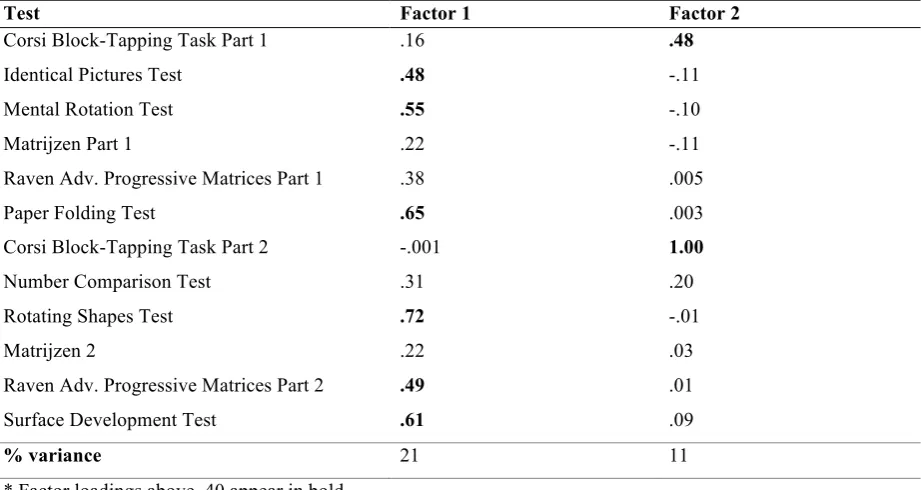
In Table 1, the results of the Oblimin rotation are shown.
Test Factor 1 Factor 2
Corsi Block-Tapping Task Part 1 .16 .48
Identical Pictures Test .48 -.11
Mental Rotation Test .55 -.10
Matrijzen Part 1 .22 -.11
Raven Adv. Progressive Matrices Part 1 .38 .005
Paper Folding Test .65 .003
Corsi Block-Tapping Task Part 2 -.001 1.00
Number Comparison Test .31 .20
Rotating Shapes Test .72 -.01
Matrijzen 2 .22 .03
Raven Adv. Progressive Matrices Part 2 .49 .01
Surface Development Test .61 .09
% variance 21 11
[image:15.595.69.530.132.377.2]* Factor loadings above .40 appear in bold
Table 1: Overview of the factor loadings from the exploratory factor analysis after rotation.
All four tests measuring visual-spatial ability were found to load strongly on Factor 1. Moreover, the second half of the Raven Advanced Progressive Matrices test (reasoning ability) and the Identical Pictures Test (perceptual speed ability) also loaded on the first factor. Both halves of the Corsi-Block Tapping Task (spatial memory) were found to load on Factor 2. Apart from these no other tests had significant loadings on the second factor. With regard to the remaining tests in the battery, the load-ings were less strong (loadload-ings <.40). For example, for both halves of the Matrijzen Test (reasoning ability) there were no strong loadings on each of the factors. This was also true for the Number Com-parison Test (perceptual speed ability) and the second halve of the Raven, which had low loadings on both factors.
2.4
Discussion
The second factor found in the EFA proved easy to define: both parts from the Corsi Block-Tapping Task were found to load on the second factor, therefore it is certain that the second factor represents spatial memory. Defining the first factor is however more complicated. Tests that loaded strongly on this factor are related to spatial visualization (Mental Rotation Test and the Surface Devel-opment test) or spatial relations (Paper Folding test and Rotating Shapes test). Both constructs repre-sent the ability to mentally transform and manipulate 2D/3D objects in space, however spatial rela-tions requires only mental rotation of the (whole) object, whereas in visualization also serial opera-tions are needed (Carroll, 1974). Ekstrom et al. (1976) defines spatial orientation as follows “the abil-ity to perceive spatial patterns or maintain orientation with respect to objects in space” (p. 149). It has been suggested by three studies that spatial orientation represents a difficult or less practiced aspect of perceptual speed (Werdelin & Stjernberg, 1969, 1971; Zimmerman, 1954). This relationship might explain why Identical Pictures, which measures perceptual speed, also loads on Factor 1.
The last test that was found to load strongly on Factor 1 is the second half of the Raven Pro-gressive Matrices Advanced. This test measures reasoning ability, or the g-factor coined by Spearman, (1923). The results on the Raven test however were unreliable, as both halves did not correlate signifi-cantly with each other (r = .18, p = .06). Despite this fact, it seems intuitive to think that general intel-ligence is related to complex mental transformations of objects in space. Furthermore, previous re-search has shown that reasoning tests share variance with spatial ability tests (e.g. Keehner et al., 2006; Lohman, 1996; Marshalek, Lohman & Snow, 1983). In conclusion, it is likely that Factor 1 represents spatial visualization or orientation. For this analysis, we will use the term visual-spatial ability as this is the most commonly used (e.g. Buckley et al., 2014; Groenier et al., 2014; Luursema, 2010; etc.).
We concluded that the following factors were found in the EFA:
v Visual-Spatial Ability (incl. Mental Rotation Test, Surface Development test, Paper Folding test, and the Rotating Shapes test)
v Spatial Memory (incl. Corsi Block-Tapping Task Part 1 and Part 2)
3
Experimental Study
3.1
Introduction
In the previous study, it was found that the cognitive ability test battery supports two different abili-ties: visual-spatial ability and spatial memory. In this follow-up study, the retrieved abilities will be investigated in relation to performance on a laparoscopic simulator task. An individual differences approach will be followed with predictions for individual learning curves. This study will be different from previous research by considering three aspects of learning: maximum learning capacity ( asymp-tote), learning speed (rate), and maximum observed learning during the study period (amplitude). It was chosen to look at these different learning aspects because it might increase our understanding in how cognitive abilities, with in particular spatial abilities, are related to different characteristics of learning to perform laparoscopy.
It is expected that high visual-spatial ability is related to a greater asymptote. Research has shown that visual-spatial ability stays important despite practice (Keehner et al., 2006). Therefore, it is likely that high visual-spatial ability will predict a high maximum learning capacity. With regard to spatial memory, it is hypothesized that a high ability is related to a high learning rate. Contrary to vis-ual-spatial ability, studies have shown that spatial memory is primarily important during early learning (Luursema, 2010). Furthermore, people with a better spatial memory have a greater ability to learn the procedural aspects of laparoscopic tasks due to higher capacity for spatial information and have better executive control (i.e. controlled attention). It is expected that in early learning people that can hold spatial information in memory will have an advantage first due to their greater capacity and better executive control, but this advantage diminishes as more knowledge is gained about the procedure. Therefore, surgical trainees with a high spatial memory will learn faster, though the asymptote might not differ much from lower ability trainees. No specific expectations are set for the amplitude, as it is highly dependent on the value for the rate and asymptote. However, one might expect that initial task performance (asymptote – amplitude) is better for high ability trainees.
3.2
Methods and Materials
3.2.1 Participants
with cognitive ability testing (n = 15, 79% of total). All the participants were recruited from the Uni-versity of Twente and were given course credits in exchange for their participation.
3.2.2 Apparatus
The participants were tested individually in a simulator room at the Experimental Centre of Technical Medicine (ECTM) at the University of Twente. The cognitive aptitude tests were administered on a personal computer running Windows 7 and were fully programmed in E-Prime (Psychology Software Tools, Pittsburgh, PA). The surgical simulator task was administered with the LapSim© virtual reality
simulator using the Virtual Laparoscopic Interface (VLI) hardware. The VLI interfaced a computer running Windows XP with an 18 inch TFT-monitor. The simulator ran the LapSim© Basic Skills v3.0
as training software.
3.2.3 Materials
Performance variables
The LapSim© virtual reality simulator logs multiple different performance measures over a range of
modalities (such as number of tissue damage, instrument path length, angular path length, etc.). A study by Van Dongen et al. (2011) has found construct validity for three compound performance vari-ables: Damage (DA), Motion Efficiency (ME), and Duration (DU). All three variables were derived from various performance variables from the LapSim (see Table 2).
In this study, the three compound performance variables were obtained by aggregating the concerning performance measures in Table 2. All the performance data was transformed to z-scores as the performance measures were of different modalities. The advantage of using a z-score transfor-mation is that differences in mean and variance across sessions is retained.
Damage Motion Efficiency Duration
Tissue Damage (#) Left Instrument Path Length (m) Left Instrument Time (s)
Maximum Damage (mm) Right Instrument Path Length (m) Right Instrument Time (s)
Left Instrument Angular Path (⁰)
[image:18.595.69.523.533.619.2]Right Instrument Angular Path (⁰)
Table 2: The three composite variables (Damage, Motion Efficiency, Duration) with the performance measures of which they are derived.
3.2.5 Design
Memory. Visual-spatial ability was derived by aggregating the results of the Mental Rotation Test (Vandenberg & Kuse, 1978), Paper Folding test (Ekstrom et al., 1976), the Rotational Shapes test (cf. Cooper, 1975), and the Surface Development test (Ekstrom et al., 1976) for every participant. Spatial Memory was formed by averaging two equal parts of the Corsi Block-tapping task (Corsi, 1973).
3.2.5 Procedure
Before the start of the experiment, the participants were invited to a simulator room at the Experi-mental Center for Technical Medicine. Here, the participants were first instructed about the procedure of the experiment. Furthermore, an information leaflet about the purpose of the study and background information about laparoscopy was given to the participants prior to the study. The experiment started when the informed consent was signed.
The experiment was divided into three sessions of one hour (in total 3 hours) to prevent fa-tigue. In the first session, the participants completed the Mental Rotation Test and the Corsi Block-Tapping test first. Furthermore, a small demographics questionnaire was administered with questions about gender, age, handedness, normal/corrected vision, and gaming habits. During the second session the Paper Folding test and the Surface Development test was administered. In the third and last session the participants were asked to fill in the Rotating Shapes test and the last part of the Corsi Block-Tapping task. After completing the test(s), the participants were invited to the simulator and were giv-en instruction about the usage of the LapSim© virtual reality simulator and the nature of the task. The
selected task was the Lifting and Grasping task from the LapSim© Basic Skills Set v3.0. The purpose
of this task is to train aspirant surgeons to handle two instruments at the same time. During each at-tempt, the participants were asked to grasp a needle and move it to the target area while lifting a box shaped object overlying the needle. The object and target location varied during the task. The partici-pants did 4 repetitions of the simulator task per session (12 repetitions in total).
3.2.6 Statistical Analysis
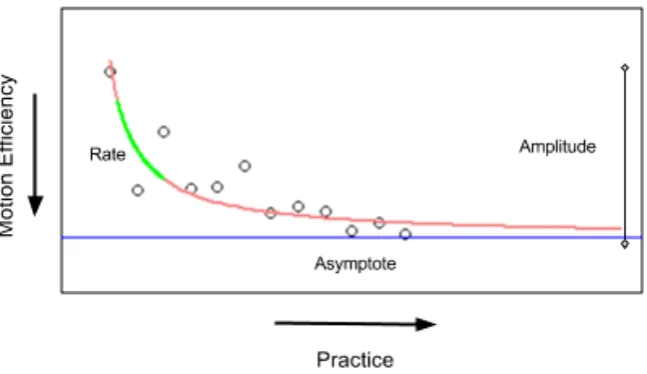
In order examine the results, a Bayesian analysis approach was followed to investigate the influence of cognitive ability on three learning parameters: asymptote, amplitude, and rate (see Figure 3 below). All the data was analyzed by using the R programming language (R Core Team, 2013). See for a more detailed description of parameter estimation and analysis below.
Parameter Estimation
A learning curve can be defined by the following power function (see Schmettow, 2015):
𝑝𝑜𝑤! =𝑦! =𝑎𝑠𝑦𝑚!+ 𝑎𝑚𝑝𝑙!∗ 𝑥!!"#$!
This function implies that performance 𝑦!" decreases (which is better in this case) with a certain rate
for every 𝑥!. The shape of the curve is furthermore influenced by the total observed increase in per-formance across 𝑥! (𝑎𝑚𝑝𝑙!) and is constrained by the maximum predicted performance 𝑎𝑠𝑦𝑚!. See Figure 3 for a graphical description of the three parameters.
These parameters were estimated for every participant with a Gibbs sampler (see Casella & George, 1992) , which is a Markov Chain Monte Carlo (MCMC) algorithm that is often used to infer expected values of variables of interest (in this case the three parameters). The basic idea behind the sampling procedure is that an estimation of the distribution of the variables of interest is given prior to the sampling, also known as the prior distribution. This distribution is updated on every iteration with the observed data, resulting in the posterior distribution. The mode of the posterior distribution (max-imum a posteriori (MAP) estimate) is the point estimate of the respective parameter, consistent with the maximum-likelihood estimator (MLE). In this analysis, the 𝜇! prior distribution for the three pa-rameters was estimated at a normal distribution with 𝜇=0 and 𝜎 =10. As the rate parameter is bound to an interval [0, 1] and the linearity assumption holds infinite bounds, an inverse logit trans-formation was used to spread the interval to [-∞, ∞]. The standard deviation of the prior distribution was estimated at a uniform distribution ranging from 𝑎=0 to 𝑏=100. This resulted in the following random effects (= intercept only) model:
𝑦!𝑗=𝑝𝑜𝑤 𝑗,𝑎𝑠𝑦𝑚!,𝑎𝑚𝑝𝑙!,𝑖𝑙𝑜𝑔𝑖𝑡 𝑟𝑎𝑡𝑒!
𝑎𝑠𝑦𝑚! ~ 𝑁 𝜇!"#$,𝜎!"#! 𝑎𝑚𝑝𝑙! ~ 𝑁 𝜇!"#$,𝜎!"#$
𝑟𝑎𝑡𝑒! ~ 𝑁(𝜇!"#$,𝜎!"#$)
Model 1: Random Effects Model specification
Note that this model does not include any fixed effects for visual-spatial ability and/or spatial memory. However, it was used here to explore the linear relationship between VSA and SM and the three pa-rameters by correlation, without the need of running multiple simulations for fixed effect models (for information about fixed effect models, see below). The Gibbs sampler was run in 3 chains with 20000 samples and a burn-in period of 5000 samples. Convergence of the MCMC simulation was checked by trace plots. See Appendix 6.2.1 for the model code.
Analysis of the predictors
esti-mating a linear term η of each parameter 𝑖 for every participant 𝑗. This term is linearly dependent on a predictor 𝑥 (VSA and/or SM) with linear parameters 𝛽 (see Function 2).
Figure 4: A learning curve with observed data (dots) and the predicted curve (pink line). The three parameters of interest are illustrated in the graph.
η!"# = 𝛽!"+ 𝑥!"∗ 𝛽!"#
Function 2: Extension of the previous model by the addition of linear predictors for VSA and SM.
To implement the linear term in the model, the grand mean 𝜇! was replaced by a linear term η!"# for every participant in the data. The 𝛽!" and 𝛽!"# prior distributions for the three parameters were esti-mated at a normal distribution with 𝜇 =0 and 𝜎=10. Like the random effects model, an inverse logit transformation was used on the rate parameter to spread the interval to [-∞, ∞]. The standard deviation of the prior distribution for the random effects was estimated at a uniform distribution ranging from 0 to 100. This resulted in the model below:
𝑦!"𝑘=𝑝𝑜𝑤 𝑘,𝑎𝑠𝑦𝑚!",𝑎𝑚𝑝𝑙!",𝑖𝑙𝑜𝑔𝑖𝑡 𝑟𝑎𝑡𝑒!"
𝑎𝑠𝑦𝑚!" ~ 𝑁 η!",!"#$,𝜎!"#$ 𝑎𝑚𝑝𝑙!"~ 𝑁 η!",!"#$,𝜎!"#$
𝑎𝑠𝑦𝑚!" ~ 𝑁 η!",!"#$,𝜎!"#$
The model wan run at 3 chains with 50 000 samples, an adapt period of 10 000, and a burn-in period of 10 000 samples. Given the fact that more samples were needed compared to the random effects model, and that samples in Markov chains are correlated with nearby samples, only every 15th value was taken. Convergence was checked with trace plots. See Appendix 6.2.2 for the model code’.
3.3 Results
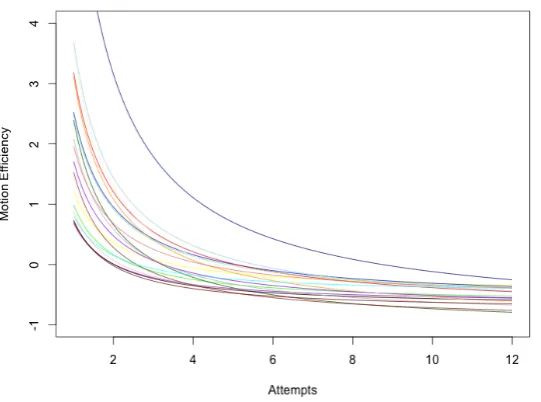
Throughout the experiment, all the participants improved on motion efficiency, duration, and damage (see Figure 5, 6, and 7). All except for one participant completed twelve attempts on the simulator (attempts = 10). 58 percent (n = 11) of the participants reached proficiency within twelve attempts. Proficiency was achieved when participants reached expert level performance on motion efficiency, duration, and damage. Expert values were determined in a study by Van Dongen et al. (2011). Visual-spatial ability and Visual-spatial memory did not significantly correlate with the amount of attempts needed to reach proficiency.
All the results for the effects of cognitive ability on the learning rate, asymptote, and/or ampli-tude on motion efficiency, duration, and damage can be found in Table 3.
3.3.1 Correlation of cognitive ability with learning rate, asymptote, and amplitude
In order to explore the linear relationship between cognitive ability and the three learning parameters, the individual ability scores were correlated with the individual learning parameters. Results showed that visual-spatial ability did not significantly correlated with any of the learning parameters for all the three performance measurements. Likewise, no significant relationships were found between spatial memory and the learning rate and asymptote. However, a significant strong negative correlation was found between spatial memory and the learning amplitude (rME= -.659; rDU= -.525; rDA = -.767). See Table 4 below for a summary of all the correlations and significance tests.
3.3.2 Motion Efficiency
Figure 5: Predictedindividual learning curves for all the participants on motion efficiency. Lower motion efficiency means better performance.
3.3.3 Duration
As with motion efficiency, a significant predictive relationship was expected between visual-spatial ability and the asymptote, and spatial memory and learning rate. However, results showed that there was no prove for such a relationship. Unlike the correlation results would have suggested, the fixed effect model revealed no predictive relationship between spatial memory and the amplitude for dura-tion (𝑀𝑜= -0.982; 95% CI [ -1.904; 0.019]).
[image:23.595.158.428.521.721.2]Figure 7: Predicted individual learning curves for all the participants on damage. Lower damage means better performance.
Mo β [95 CI]
Motion Efficiency Duration Damage
Visual-Spatial Ability
Asymptote 0.055 [-0.139: 0.269] 0.073 [-0.182: 0.327] 0.101 [-0.129: 0.103]
Spatial Memory
Rate -6.674 [-44.562: 29.556] -2.923 [-41.573: 29.849] -3.068 [-40.582: 29.580]
[image:24.595.80.518.342.466.2]Amplitude -1.731 [-2.923: -0.587] -0.982 [-1.904: 0.019] -2.094 [-3.112: -1.041]
Table 3: Overview of the results from the fixed effects model. Values for the linear parameters were obtained with Bayesian inference analysis. All values in the table are z-scores.
Motion Efficiency Duration Damage
Asym Ampl Rate Asym Ampl Rate Asym Ampl Rate
VSA 0.156 -0.36 -0.085 -0.381 0.153 -0.03 0.222 -0.399 -0.087
SM 0.164 -.659* -0.389 -0.07 -.525* 0.139 0.449 -.767* -0.145
* Significant correlation (p< .05)
3.4 Discussion
In this study, the influence of spatial ability on a basic laparoscopic simulator task was investigated. Different aspects of learning were taken into consideration: maximum learning capacity (asymptote), observed learning throughout the study period (amplitude), and the speed of learning (rate). It was expected that people with relatively high spatial memory ability would show a faster learning rate. Furthermore, it was hypothesized that high visual-spatial ability would predict a relative high maxi-mum learning performance.
Across the study, all participants improved on a basic laparoscopic simulator task on motion efficiency, duration, and damage. Although not every participant reached task proficiency within twelve attempts, even the participants with bad initial performance showed great improvement across attempts. This contradicts the findings of Grantcharov and Fuch-Jensen (2009), who claimed that some people show almost no learning on laparoscopic tasks. However, our results are consistent with other studies (see e.g. Groenier et al., 2014; Keehner et al., 2009). In these studies, all participants showed significant improvement with practice. Although it is difficult to pin point why there is incon-sistency in results, the differences might be explained by how the learning curves are defined. In the study of Grantcharov and Fuch-Jensen, the researchers defined four types of learning curves based on the individual performance of the participants on a laparoscopic simulator task. It is not explained how this clustering was done, though one might expect that averaging individual learning curves flattens the resulting curve. The lack of improvement claimed by the researchers might therefore very well be exaggerated. Furthermore, the participants used in their study already had experience with laparoscop-ic procedures in the operation room (median = 2 cholecystectomies, range = [0, 10]). Because of this previous experience, it is possible that they did not measure early learning, where in our study the most learning was achieved (see the first 6 attempts in Figure a, b, and c).
suturing task was used. Suturing is considered to be one of the most difficult basic skills in laparosco-py (Cao & MacKenzie, 1996). These researchers were able to find a predictive relationship between visual-spatial ability and laparoscopic task performance. However, our results are consistent with the study of Groenier and colleagues (2014). The researchers examined the relationship between visual-spatial ability, visual-spatial memory, perceptual speed, reasoning ability and the performance on basic lapa-roscopic simulator tasks. Like our study, no or a weak relationship was found between VSA, SM, and laparoscopic task performance. They also considered looking at the learning rate, however without success.
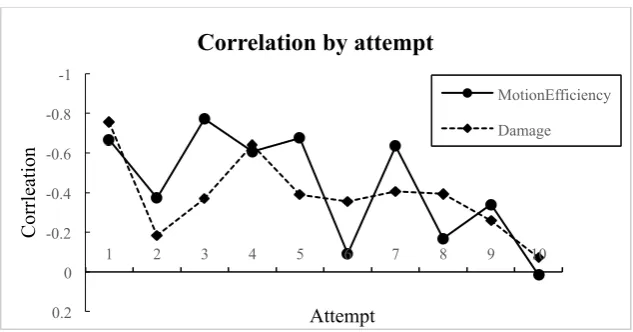
Unlike the results described above, a significant relationship was found for the amplitude and spatial memory. Although not hypothesized, a higher spatial memory predicted a smaller amplitude for motion efficiency as well as damage. This result at first seems counterintuitive. For sure a greater memory capacity for objects in space would lead to greater learning in a highly spatial task such as laparoscopy. However, this can be explained. As can be seen in Figure 5 and 7, there is a great differ-ence in performance in the first attempt; however, this differdiffer-ence diminishes after practice. In other words, the lower amplitude for high spatial memory reflects a better initial performance. Therefore, our results suggest that people who can hold more spatial information in their memory, have an initial advantage in performing laparoscopic tasks. However, this advantage attenuates with practice (see also Figure 7). Although not in a way that was expected, this result supports our hypothesis that spatial memory is especially important in the early learning phase.
[image:26.595.138.455.563.729.2]A limitation of the current study is that within our sample, there were no large differences in spatial ability among participants. For spatial memory, only three participants had a score lower than 1 SD compared to the sample mean. No participants had a score higher than 1 SD. For visual-spatial ability the same was found with only two participants scoring lower than 1 SD and one participant scoring higher than 1 SD. The small differences in cognitive aptitude in this sample may explain why we could not find significant results for the asymptote and learning rate.
Figure 8: Correlation by attempt of motion efficiency (solid line with circles) and damage (striped line with diamonds).
-1 -0.8 -0.6 -0.4 -0.2 0 0.2
1 2 3 4 5 6 7 8 9 10
Corrl
ea
ti
on
Attempt
Correlation by attempt
MotionEfficiency
A second limitation of this study is the dependence between the learning parameters. When the learning speed is high, the asymptote and amplitude will likely be high too. However, when the amplitude is small due to high initial performance, a person is unlikely to have a high learning rate as this would result in an unrealistically high asymptote. This dependency becomes especially clear when you look at the average correlation between the parameters (rasym-ampl = -.53; rasym-rate= -.38; rampl-rate = .32). In the future, it might be interesting to look for different parameterizations that do not show this interdependence. For instance, instead of including the amplitude parameter, one could also use previ-ous experience which represents virtual training sessions before the first real session (see Schmettow, 2015; see Function 3).
𝑝𝑜𝑤! =𝑦! =𝑎𝑠𝑦𝑚!+(1+𝑝𝑒𝑥𝑝!+ 𝑥)!!"#$!
Function 3: Learning curve function with alternative parameterization. y = performance, x = attempt number, i = participant number
As can be seen in the alternative power function above, when previous experience with the task or related tasks is high, the curve horizontally shifts to the left. Although this still leaves the moderate correlation between the asymptote and the rate, the correlation between previous experience and the asymptote and rate is assumed to be much smaller. Furthermore, it offers the opportunity to compare participants with different previous experiences. For example, the measured gaming habits in this study might have been good candidate for representing previous experience as gaming habits have shown to be related to laparoscopic simulator performance (see e.g. Adams, Margaron, & Kaplan, 2012; Badurdeen et al., 2010; Millard, Ralph, Constable, & Freeman, 2014).
Another important limitation of this study is that the influence of spatial ability on performing laparoscopy was not measured in the operation room (OR). The ultimate goal of studying the influ-ence of cognitive abilities in the context of laparoscopy is to predict performance in the OR based on measurable innate ability. However, generalization of results cannot be guaranteed if the transfer is not investigated.
naviga-tion. The weak relationships found for visual-spatial ability in our study and Groenier et al. (2014) study might also indicate that the measured ability in itself is not complex enough to capture the spa-tial complexity of performing laparoscopy (see 4 General Discussion for more on this). Therefore, examining the influence of more complex spatial abilities on laparoscopic task performance might give interesting new insights in how spatial cognition is involved in laparoscopy.
4
General Discussion
In this two-part study, the influence of cognitive ability on performing laparoscopy was investigated. The ultimate aim was to provide more insight in how cognitive ability affects learning to perform lap-aroscopy. This knowledge could be used in predicting how trainees will perform during training and possibly select those that are predicted to show little improvement. In the following sections, the re-sults of these studies will be discussed briefly. Moreover, the implications of this study for our main goal and theoretical understanding of cognitive processes in laparoscopy will be evaluated and rec-ommendations for future research will be given.
In the first (pilot) study, an exploratory factor analysis was performed on an existing battery of cognitive ability tests in order to retrieve valid factors/abilities for experimentation (see Groenier et al., 2014 and Appendix 6.1 for a full overview). This battery contained tests assumed to measure four dif-ferent cognitive abilities: visual-spatial ability, spatial memory, perceptual speed, and reasoning. After analysis, it was found that only two factors were supported by the battery and were interpreted as: visual-spatial ability (VSA)and spatial memory (SM). VSA is the ability to mentally transform ob-jects in space and is usually measured with small-scale spatial tasks such as the Mental Rotations Test (Vanderberg & Kuse, 1978). This ability is intuitively relevant for performing laparoscopy as surgeons have to image human tissue from different perspectives (Cao et al., 1996). The other ability SM, the capacity to maintain spatial relations of objects in memory, is also important. When the capacity of maintaining spatial information is larger, one is more able to learn the procedural aspects of laparo-scopic tasks.
Both abilities from the factor analysis were investigated in relation to laparoscopic simulator performance in a follow-up study. Unlike many other studies on this topic (see e.g. Buckley et al., 2014; Keehner et al., 2004b; Luursema et al., 2010), three different aspects of learning were consid-ered in this study: maximum attainable performance (asymptote), speed of learning (rate), and the total amount of learning observed across the study sessions (amplitude). It was hypothesized that a higher memory capacity for spatial information would lead to a greater speed of learning. Further-more, a higher maximum performance was predicted for high VSA. The results showed no evidence for both hypotheses, however it was found that a higher spatial memory capacity predicted a better initial performance at the simulator task.
Implications results on predicting learning curves
assessment and selection tools. For visual-spatial ability, no significant predictive relationships were found for one of the learning parameters. Therefore, VSA is unlikely to be important for learning to perform basic laparoscopic skills. This raises the question why some other studies were able to find significant predictions for VSA. Although, the reason for this inconsistency in results is hard to pin point as studies differ greatly in their design. In the literature we find: prior selection for ability test scores (see e.g. Buckley et al., 2014), augmented reality (AR) and virtual reality (VR) simulators (see for AR Wanzel et al., 2003; for VR see e.g. Ahlberg et al. 2007), complex tasks (see e.g. Buckely et al. 2014) and less complex tasks (Groenier et al., 2014; Keehner et al., 2006), different types of cognitive abilities (Luursema, 2010), different interpretations of learning curves (Grantcharov & Fuch-Jensen, 2009; vs. e.g. Groenier et al., 2014; see also Wanzel et al., 2002 for a discussion on this), and the list goes on. Therefore, based on our results and the inconsistency in the literature it is concluded that it is unadvisable to use VSA in assessment and/selection tools.
Theoretical implications of the results
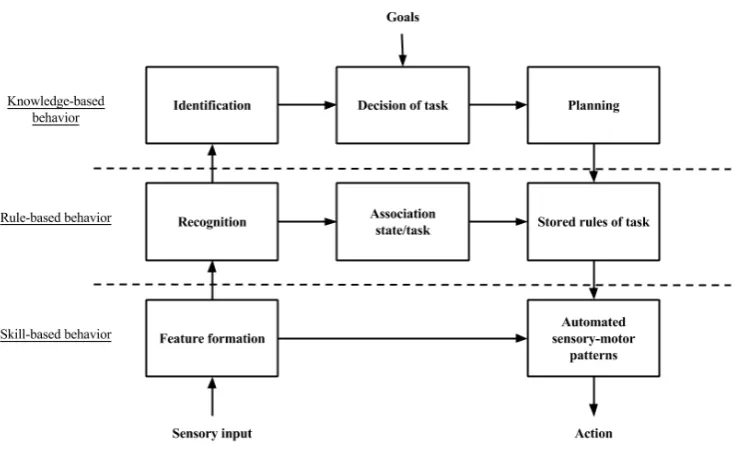
[image:30.595.111.479.496.725.2]Alongside evaluating the influence of cognitive ability on learning to perform laparoscopy, it is also interesting to discuss what is learned on the cognitive processes during learning to perform laparosco-py. An important characteristic of the data is that performance in the end did not differ much among participants and that all participants showed great improvement throughout the study. It is therefore very propable that the task used in this study became automated quickly. A good model to explain this process of automation is the skill, rule, and knowledge (SRK) model cognitive control by Rasmussen (1983; see Figure 9).
According to this model, unfamiliar tasks require conscious planning and decision making in order to deal with an uncommon problem faced in a task. This ‘behavior’ is called knowledge-based behavior (KBB) and requires a high amount of cognitive control. Concerning our study, KBB applies well to the first training attempts on the simulator. Here, the task was still unfamiliar and participants needed to identify the important objects, make decisions related to the procedure of the task, and plan their actions. All these behaviors are executive processes that require controlled attention. In consequence, this might explain why spatial memory predicted different initial performance as the STM and in par-ticular the WM component of spatial memory involve controlled attention. Therefore, it is likely that participants with higher spatial memory had better initial performance, because they were better at focusing their attention at important parts of the task. Hence, they were faster at learning the procedur-al aspects of the task. This initiprocedur-al advantage attenuated; because the task becomes more familiar and less controlled attention was needed. Eventually, aspects the task became automatized and could be completed with almost no conscious attention. In the model of Rasmussen (1983), this behavior is called skill-based behavior (SBB) and is reasonably common among expert surgeons in basic laparo-scopic skills such as suturing (Wentink et al., 2005). The emergence of SBB in the last training at-tempts during this study most probably explains the absence of difference in maximum performance among participants.
With regard to visual-spatial ability (VSA), it is a little bit more complicated to explain our results with cognitive processes. VSA involves mental transformations of objects that are being pro-cessed in working memory (WM; see e.g. Beschin, Denis, Logie, & Della Sala, 2005). Because WM involves controlled attention, the same explanation given for spatial memory (SM) for maximum per-formance may also apply here. However, the work of Keehner et al. (2006) predicted that VSA stays important despite practice. In their study the participants also reached SBB, therefore one might con-clude based on their results that controlled attention may not be as important for VSA as in SM. Also, the absence of a predictive relationship for VSA at all in this study might imply that the task did not involve much mental transformations and/or that the importance of mental transformations in laparos-copy is too small and uncertain to give high ability participants an advantage. Therefore, the question of ‘where’ and ‘when’ object transformation processes are important still remains.
Future research recommendations
de-veloping better teaching methods. A meta-analysis might very well provide this understanding and give directions for new research.
Another recommendation that we would like to give here is rather different than the previous. Many of the studies described in this paper administered cognitive ability tests for spatial abilities that only focused on small-scale tasks such as mental rotations and surface development. However, per-forming laparoscopic surgery does not only involve mentally transper-forming objects, but also navigating through the abdomen to reach the surgical field. Unlike the object-based spatial abilities (i.e. visual-spatial abilities) described here and in other studies, navigation also requires estimations of self-position and orientation that complements an internal representation of the environment (Wolbers & Hegarty, 2010). As laparoscopy is a surgical technique with various perceptual and spatial constraints, navigation might be a difficult task. For instance, due to scaling difficulties in laparoscopy (Greco, Regehr, & Okrainec, 2010) there is a discordance in what is seen and what is expected given the action performed. In order to estimate and update ones’ position and orientation, the surgeons have to learn to cope with this discordance. The same is true for the fulcrum effect. Both impair estimating self-position and orientation.
All in all, it is not unlikely that the mixed results can be explained by the fact that spatial abil-ity as measured in the literature covers only little of the true (spatial) complexabil-ity of performing laparo-scopic surgery (see also Luursema, 2010 for a discussion about this). Therefore, it is recommended that navigation should also be considered in relation to performing laparoscopy. Of particular interest is exploring what it ‘means’ to navigate in laparoscopy. It is currently unknown how surgical experts navigate and orient during laparoscopic surgery and how different strategies in navigation affect per-formance. In the future, knowledge of what strategies work and not work might be used to improve teaching programs by training surgeons to use certain strategies.
Conclusion
In conclusion, no insight was gained in this study about the influence of visual-spatial ability on learn-ing to perform laparoscopy. Given the mixed results in the literature for this ability, it is not recom-mended to use this ability for selection and/or assessment. For spatial memory our results showed that a better initial performance was predicted by a high spatial memory capacity. This advantage however diminished quickly with practice. Although this does increase our understanding in how cognitive ability influences the learning curve for laparoscopy, it is not interesting for assessment or selection as it only applies to early learning. Therefore, more research is needed before cognitive abilities may be of particular use in laparoscopic training programs.
5
References
Ackerman, P. L., & Beier, M. E. (2007). Further explorations of perceptual speed abilities in the context of assessment methods, cognitive abilities, and individual differences during skill acquisition. Journal of Experimental Psychology. Applied, 13(4), 249–272.
http://doi.org/10.1037/1076-898X.13.4.249
Adams, B. J., Margaron, F., & Kaplan, B. J. (2012). Comparing video games and laparoscopic simulators in the development of laparoscopic skills in surgical residents. In Journal of Surgical Education (Vol. 69, pp. 714–717). http://doi.org/10.1016/j.jsurg.2012.06.006
Ahlberg, G., Enochsson, L., Gallagher, A. G., Hedman, L., Hogman, C., McClusky, D. A., … Arvidsson, D. (2007). Proficiency-based virtual reality training significantly reduces the error rate for residents during their first 10 laparoscopic cholecystectomies. American Journal of Surgery, 193, 797–804. http://doi.org/10.1016/j.amjsurg.2006.06.050
Anastakis, D. J., Hamstra, S. J., & Matsumoto, E. D. (2000). Visual-spatial abilities in surgical training. The American Journal of Surgery, 179(6), 469–471. http://doi.org/10.1016/S0002-9610(00)00397-4
Ang, S. Y., & Lee, K. (2008). Central executive involvement in children's spatial memory. Memory,
16(8), 918-933.
Badurdeen, S., Abdul-Samad, O., Story, G., Wilson, C., Down, S., & Harris, A. (2010). Nintendo Wii video-gaming ability predicts laparoscopic skill. Surgical Endoscopy and Other Interventional Techniques, 24(8), 1824–1828. http://doi.org/10.1007/s00464-009-0862-z
Buckley, C. E., Kavanagh, D. O., Gallagher, T. K., Conroy, R. M., Traynor, O. J., & Neary, P. C. (2013). Does aptitude influence the rate at which proficiency is achieved for laparoscopic appendectomy? Journal of the American College of Surgeons, 217(6), 1020–7.
http://doi.org/10.1016/j.jamcollsurg.2013.07.405
Beschin, N., Denis, M., Logie, R. H., & Della Sala, S. (2003). Dissociating mental transformations and visuo-‐spatial storage in working memory: Evidence from representational neglect. Memory, 13(3-4), 430-434.
Cameron, J. L. (1997). William Stewart Halsted. Our surgical heritage. Annals of Surgery, 225(5), 445–458. http://doi.org/10.1097/00000658-199705000-00002
Cao, C., Mackenzie, C. L., & Payendeh, S. (1996). Task and motion analysis in endscopic surgery. In Proceedings asme dynamic systems and control division (pp. 583–590). Retrieved from
http://citeseerx.ist.psu.edu/viewdoc/download?doi=10.1.1.48.2894&rep=rep1&type=pdf
Carroll, J. B. (1974). Psychometric tests as cognitive tasks: A new “structure of intellect.” Princeton, N. J.: Educational Testing Service.
Carroll, J. B. (1993). Human cognitive abilities: A survey of factor analysis studies. Cambridge University Press.
Carroll, S. M., Kennedy, A. M., Traynor, O., & Gallagher, A. G. (2009). Objective assessment of surgical performance and its impact on a national selection programme of candidates for higher surgical training in plastic surgery. Journal of Plastic, Reconstructive & Aesthetic Surgery : JPRAS, 62(12), 1543–9. http://doi.org/10.1016/j.bjps.2008.06.054
Casella, G., & George, E. I. (1992). Explaining the Gibbs Sampler. The American Statistician, 46(3), 167–174. http://doi.org/10.2307/2685208
Conway, A. R., Kane, M. J., Bunting, M. F., Hambrick, D. Z., Wilhelm, O., & Engle, R. W. (2005). Working memory span tasks: A methodological review and user’s guide. Psychonomic bulletin & review, 12(5), 769-786.
Cooper, L. A. (1975). Mental Rotation of Random Two-Dimensional Shapes. Cognitive Psychology, 7, 20–43.
Corsi, P. M. (1973). Human memory and the medial temporal region of the brain. Dissertatopm Abstracts International, 34, 891.
Ekstrom, R. B., French, J. W., & Harman, H. H. (1976). Manual for Kit of Factor-Referenced Cognitive Tests. Princeton, N. J.: Educational Testing Service.
Engle, R. W. (2002). Working memory capacity as executive attention. Current directions in psycho-logical science, 11(1), 19-23.
Feldman, L. S., Sherman, V., & Fried, G. M. (2004). Using simulators to assess laparoscopic competence: ready for widespread use? Surgery, 135(1), 28–42. http://doi.org/10.1016/S0039-6060(03)00155-7
Fried, M. P. (2004). Identifying and reducing errors with surgical simulation. Quality and Safety in Health Care, 13(suppl_1), i19–i26. http://doi.org/10.1136/qshc.2004.009969
Fuchs, K. H. (2002). Minimally invasive surgery. Endoscopy, 34(2), 154–159. Retrieved from http://cat.inist.fr/?aModele=afficheN&cpsidt=13510497
Gallagher, A. G., & Smith, C. D. (2003). Human-Factors Lessons Learned from the Minimally Invasive Surgery Revolution. Surgical Innovation, 10(3), 127–139.
http://doi.org/10.1177/107155170301000306
Gallagher, A. G., McClure, N., McGuigan, J., Ritchie, K., & Sheehy, N. P. (1998). An ergonomic analysis of the fulcrum effect in the acquisition of endoscopic skills.Endoscopy (Vol. 30).
Grantcharov, T. P., & Funch-Jensen, P. (2009). Can everyone achieve proficiency with the
laparoscopic technique? Learning curve patterns in technical skills acquisition. American Journal of Surgery, 197(4), 447–9. http://doi.org/10.1016/j.amjsurg.2008.01.024
Greco, E. F., Regehr, G., & Okrainec, A. (2010). Identifying and Classifying Problem Areas in Laparoscopic Acquisition: Can Simulators Help? Academic Medicine, 85(10), S5–S8. Retrieved from
http://journals.lww.com/academicmedicine/Abstract/2010/10001/Identifying_and_Classifying_P roblem_Areas_in.5.aspx
Hanna, G. B., & Cuschieri, A. (2000). Influence of two-dimensional and three-dimensional imaging on endoscopic bowel suturing. World Journal of Surgery, 24, 444–449.
http://doi.org/10.1007/s002689910070
Hanna, G. B., Shimi, S. M., & Cuschieri, A. (1998). Randomised study of influence of
two-dimensional versus three-two-dimensional imaging on performance of laparoscopic cholecystectomy. Lancet (Vol. 351).
Hayton, J. C., Allen, D. G., & Scarpello, V. (2004). Factor Retention Decisions in Exploratory Factor Analysis: a Tutorial on Parallel Analysis. Organizational Research Methods.
http://doi.org/10.1177/1094428104263675
Hedman, L., Ström, P., Andersson, P., Kjellin, A., Wredmark, T., & Felländer-Tsai, L. (2006). High-level visual-spatial ability for novices correlates with performance in a visual-spatial complex surgical simulator task. Surgical Endoscopy, 20(8), 1275–80. http://doi.org/10.1007/s00464-005-0036-6
Jeannerod, M. (1984). The timing of natural prehension movements. Journal of Motor Behavior, 16, 235–254. http://doi.org/10.1080/00222895.1984.10735319
Jones, D., Farrand, P., Stuart, G., & Morris, N. (1995). Functional equivalence of verbal and spatial information in serial short-term memory. Journal of Experimental Psychology: Learning, Memory, and Cognition, 21(4), 1008.
Kaiser, H. F. (1974). An index of factorial simplicity. Psychometrika, 39(1), 31-36.
Keehner, M., Lippa, Y., Montello, D. R., Tendick, F., & Hegarty, M. (2006). Learning a spatial skill for surgery: how the contributions of abilities change with practice. Applied Cognitive
Psychology, 20(4), 487–503. http://doi.org/10.1002/acp.1198
Keehner, M. M., Tendick, F., Meng, M. V, Anwar, H. P., Hegarty, M., Stoller, M. L., & Duh, Q.-Y. (2004a). Spatial ability, experience, and skill in laparoscopic surgery. American Journal of Surgery, 188(1), 71–5. http://doi.org/10.1016/j.amjsurg.2003.12.059