University of Warwick institutional repository: http://go.warwick.ac.uk/wrap
A Thesis Submitted for the Degree of PhD at the University of Warwick
http://go.warwick.ac.uk/wrap/2799
This thesis is made available online and is protected by original copyright.
Please scroll down to view the document itself.
An Agent-Based Model of Energy
in Social Networks
by
Christopher John Watts
A thesis submitted in partial fulfilment of the requirements for the
degree of
PhD from the University of Warwick
University of Warwick, Warwick Business School
Contents
Contents i
List of figures x
List of tables xiv
Acknowledgements xv
Thesis Summary xvi
Abbreviations xvii
Chapter 1 Understanding how work really gets done in organisations 1
1.1 Introduction: Models of agents with energy 1
1.2 Understanding organisations: the role of Operational Research and simulation 3
1.3 Groups, boundaries and the take-up of innovations 8
1.3.1 Ethnography 8
1.3.2 Social Network Analysis 9
1.3.3 Computer models 12
1.4 Cross and Parker’s three claims about energisers 13
1.5 Other approaches 17
1.6 The aim and organisation of the thesis 19
Chapter 2 What is “energy”? 23
2.1 Introduction and context 23
2.2 What energy is not: Physics and Physiology 26
2.3 A unified concept?: feelings of energy 28
2.4 Intrinsic motivation 30
2.5 Emotional Energy in Interaction Rituals 31
2.7 How to measure energy? 36
2.8 Summary 41
Chapter 3 How might we model energy? 43
3.1 Introduction 43
3.2 Network models 49
3.3 Models of contagion and social learning 53
3.4 Models of Groups and Culture 58
3.4.1 Homophily & Small Worlds 58
3.4.2 Homophily & Imitation 60
3.4.3 Polarisation and Alliance Formation 61
3.4.4 Altruism, Tags and Ethnic Conflict 62
3.5 Models of Work Performance 65
3.6 Models of Human Agents 69
3.6.1 BDI: Rational decision making and action 69
3.6.2 Reinforcement Learning, adaptive agents and SOAR 71
3.6.3 The PECS framework: Emotion and social status 72
3.7 Summary 75
Chapter 4 The Baker-Quinn Model: a Critique 77
4.1 Introduction 77
4.2 Positives 77
4.3 Questions about the model design 79
4.4 Is it a model of energy? 83
4.5 Is it a model of information? 84
4.6 An attempt at model replication 86
4.8 Conclusions about the Baker-Quinn Model 91
Chapter 5 Justifying the use of agent-based simulation modelling 93
5.1 The Research Objectives 93
5.2 Introduction to our methodology 94
5.3 Why use simulation modelling? 94
5.4 Two paradigms for simulation modelling 97
5.5 Science as coalition formation 105
5.6 Which simulations make for good coalitions? 113
5.7 Comparing simulation approaches 115
5.8 Summary 117
Chapter 6 A family of energy models 119
6.1 Introduction 119
6.2 Starting with the Axelrod Cultural Model (ACM) 121
6.2.1 Why build from the ACM? 121
6.2.2 The ACM as a model of Interaction Rituals 125
6.3 The base model: a version of the ACM 128
6.4 Introducing Energy 134
6.5 The Interaction Ritual Memory 140
6.5.1 Base Model 141
6.5.2 The Agent-Energy Model (AgentE) 141
6.5.3 The Feature-Energy Model (FeatureE) 145
6.5.4 The Interaction Ritual Memory (IRM) 147
6.6 The A, B and C of Energy Payoffs 159
6.7 Energisers and De-energisers 164
Chapter 7 Testing Cross & Parker’s Claims 173
7.1 Introduction 173
7.2 Testing Cross & Parker’s Claims 174
7.3 Experimental Design 179
7.3.1 Population size, network structure and energising parameter values 180
7.3.2 Payoff functions 180
7.3.3 Decay rates and half lives 181
7.3.4 Features, traits and memory sizes 183
7.3.5 Simulation initialisation, iterations and replications 184
7.4 Technical Issues 187
7.4.1 Coding a simulation model 187
7.4.2 Random number generation 188
7.4.3 Data processing 189
7.5 Seeing and Believing in an Agent-Based Model 189
7.6 Summary 196
Chapter 8 Energy applied to agents 197
8.1 Introduction 197
8.2 Relating the energy model to the ACM 197
8.3 Claim 1: The take up of ideas 200
8.4 Claim 2: The size of an agent's region 208
8.5 Claim 3: Improvement in fitness 210
8.6 Summary for the agent-energy model 212
Chapter 9 Energy applied to features 215
9.1 Introduction 215
9.3 Testing the claims in the feature-energy and agent-energy models 223
9.4 Summary for the feature-energy model 224
Chapter 10 Energy applied to IR Memories 226
10.1 Introduction 226
10.2 Testing the claims 227
10.3 How the IRAM behaves 230
10.4 Increasing the size of the IR Memory 234
10.5 Analysis of Entropy in the Interaction Ritual Agents Model (IRAM) 240
10.5.1 Tests on entropy measures 247
10.5.2 Further research from the entropy metrics 252
10.6 Summary for models with multi-item IR Memory 252
Chapter 11 Mavericks and Boundary Spanners 255
11.1 Introduction 255
11.2 The Maverick Scenario 256
11.3 The Boundary Spanner Scenario 258
11.4 The Experiments 259
11.5 Results for the Agent-Energy Model 259
11.6 Further Models 262
11.7 Discussion 265
Chapter 12 Discussion 267
12.1 Introduction 267
12.2 Models of agents with energy 268
12.3 Experiments on “energisers” 274
12.4 Strengths and Limitations 280
12.5.1 Further factors 283
12.5.2 Docking with other models 286
12.5.3 Problem solving in the world of homo sociologicus 288
12.5.4 Further questions about culture 289
12.5.5 Energy, autonomy and self-determination 290
12.5.6 Energy, attention and stratification 291
12.5.7 Energy and creativity 293
12.5.8 Summary of further research 294
12.6 Concluding remarks 294
Appendix A System Dynamics models 296
A.1 Introduction 296
A.2 The Axelrod Cultural Model as stocks and flows 296
A.3 The behaviour of the system dynamics ACM 299
A.4 Towards a system dynamics agent-energy model 302
A.5 Conclusions regarding system dynamics models 304
Appendix B Results with the agent-energy model (AgentE) 306
B.1 Introduction 306
B.2 Agent-energy behaviour 307
B.2.1 Payoff: Belongingness; Energising: Belongingness (B=E) 308
B.2.2 Payoff: Autonomy; Energising: Autonomy (A=E) 309
B.2.3 Payoff: Autonomy & Belongingness; Energising: Autonomy (A=E, B=1)
310
B.2.4 Payoff: Belongingness & Autonomy; Energising: Belongingness (B=E,
B.2.5 Payoff: Belongingness & Competence; Energising: Belongingness (B=E,
C=1) 312
B.2.6 Payoff: Competence; Energising: Competence (C=E) 313
B.2.7 Payoff: Competence & Belongingness; Energising: Competence (C=E,
B=1) 314
B.2.8 Payoff: Belongingness; Energising: Belongingness; Population = 10 (B=E,
N=10) 315
B.3 Claims Tests 316
B.3.1 Claim 1: Based on Frequency of being imitated 317
B.3.2 Other claims tests 317
Appendix C Results with the feature-energy model (FeatureE) 319
C.1 Introduction 319
C.2 Feature-energy model behaviour 320
C.2.1 Payoff: Belongingness; Energising: Belongingness (B=E) 321
C.2.2 Payoff: Belongingness & Competence; Energising: Belongingness (B=E,
C=1) 322
C.2.3 Payoff: Competence; Energising: Competence (C=E) 323
C.2.4 Payoff: Competence & Belongingness; Energising: Competence (C=E,
B=1) 324
C.3 Claims Tests 325
C.3.1 Claim 1: Based on Frequency of being imitated 325
C.3.2 Other claims tests 325
Appendix D Results with the Interaction Ritual Agents Model (IRAM) 326
D.1 Introduction 326
D.2.1 Payoff: Belongingness; Energising: Belongingness (B=E) 328
D.2.2 Payoff: Belongingness & Competence; Energising: Belongingness (B=E,
C=1) 329
D.3 Claims Tests 330
D.3.1 Claim 1: Based on Frequency of being imitated 330
D.3.2 Other claims tests 330
Appendix E Results with the IR Memory Model (IRM model) 332
E.1 Introduction 332
E.2 IRM model behaviour 332
E.2.1 Frequency of being imitated - by memory size (m) 333
E.2.2 Size of agent’s region - by memory size (m) 334
E.2.3 Frequency of being imitated - by half life 335
E.2.4 Size of agent’s region - by half life 336
E.2.5 Frequency of being imitated - by (q / F) 337
E.2.6 Size of agent’s region - by (q / F) 338
E.3 Claims Tests 339
E.3.1 Claim 1: Based on Frequency of being imitated 339
E.3.2 Claim 2: Based on Size of agent’s region 340
Appendix F The world of “Homo Sociologicus” 341
F.1 Introduction 341
F.2 Social interaction and agent memory 342
F.3 Energy decay, Expected Gain and innovation 345
F.4 Autonomy, dominance and stratification 346
F.5 Groups and Belongingness 347
F.7 Benchmark problems 351
F.8 Conclusions 353
List of figures
Figure 1 The formation of interaction ritual chains 47 Figure 2 A population of “hawks” and “doves” reaches an evolutionarily stable strategy
(ESS) 56
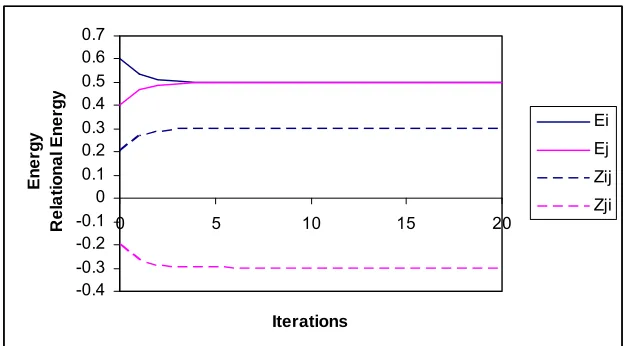
Figure 3 Equations 1 and 2 from the Baker-Quinn Model 80 Figure 4 Energy levels and Relational Energy in the basic version of the Baker-Quinn Model
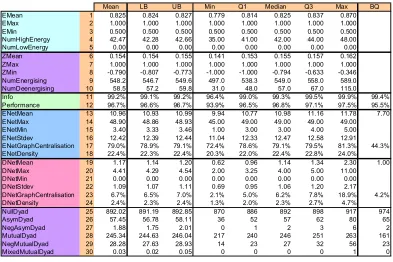
82 Figure 5 Aggregate statistics of 500 replications of our reconstruction of the Baker-Quinn
Hierarchy Model 87
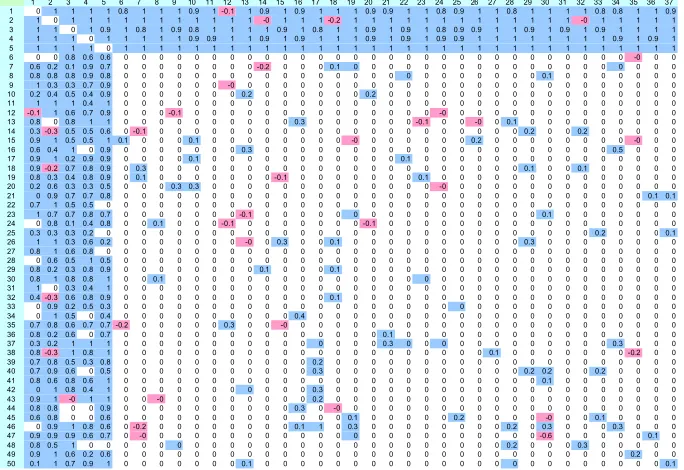
Figure 6 Illustrative aggregate statistics of the Baker-Quinn Hierarchy Model 89 Figure 7 The matrix of relational energy values 90 Figure 8 Example of a linear, positivist approach to understanding simulation modelling 100 Figure 9 Example of an interpretivist approach to understanding simulation modelling 102 Figure 10 Recognition of the fact that the modelling process has costs determined by extrinsic
factors 104
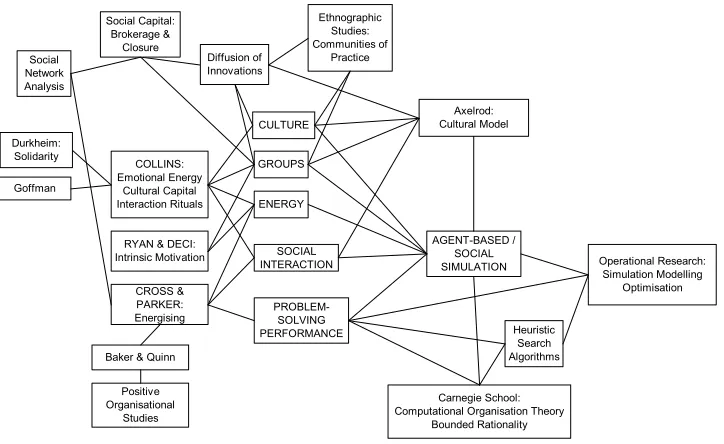
Figure 11 A coalition of concepts 107
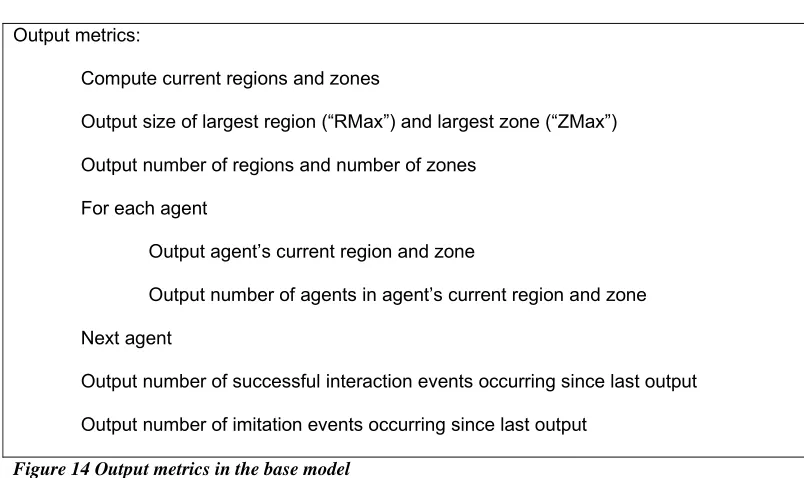
Figure 12 The basic structure of our base model – a version of the Axelrod Cultural Model 128 Figure 13 Simulation initialisation in the base model 129
Figure 14 Output metrics in the base model 131
Figure 15 A simulation iteration in the base model 133 Figure 16 One agent’s attributes in the Base model – based on the Axelrod Cultural Model
141
Figure 17 The agent-energy model (AgentE) 143
Figure 19 Turning the feature-energy model on its side 148
Figure 20 The IR Memory 149
Figure 21 A model with IR Memory 150
Figure 22 The full Interaction Ritual Agents Model (IRAM) 152 Figure 23 Method for updating IR Memory with the details of a new IR event 159
Figure 24 Payoffs pre- and post-energising 169
Figure 25 Payoffs post-energising for prior payoffs of 0, 0.5 and 1 169 Figure 26 Post energising/de-energising payoff as a function of the energising parameter 170 Figure 27 Two grid displays from an agent-energy model 191
Figure 28 Output showing simulation evolution 192
Figure 29 The simulation’s iterations displayed individually 194
Figure 30 Depictions of “culture space” 195
Figure 31 Comparing the agent-energy model to the Axelrod Cultural Model 198 Figure 32 Cultural diversity measures plotted against q / F 199 Figure 33 Frequency of being imitated, given by q / F and half life, for the agent-energy
model 201
Figure 34 Difference in frequency of being imitated between Energiser (E=1/6) and the mean
of the non-energiser agents 203
Figure 35 Difference in frequency of being imitated between the mean of the non-de-energiser
agents and a De-energiser (E=6) 204
Figure 36 Comparing the 1 energiser/de-energiser with the other 19 agents, for Frequency of
being imitated 205
Figure 37 Results from systematic searches for Frequency of being imitated 207 Figure 38 Size of agent's region, given by q / F and half life, for the agent-energy model 210 Figure 39 Comparing the feature-energy model (“FeatureE”) to the agent-energy model
(“AgentE”) for Frequency of being imitated 216
Figure 40 Comparing the feature-energy model (“FeatureE”) to the agent-energy model
Figure 41 % difference between the feature-energy model (“FeatureE”) and the agent-energy
model (“AgentE”) 217
Figure 42 Energy charges due to Belongingness in the feature-energy model (“FeatureE”)
and the agent-energy model (“AgentE”) 218
Figure 43 Expected initial probabilities for successful IRs 221 Figure 44 Probability of a feature decaying from 0.5 being selected ahead of one decaying
from 1 222
Figure 45 Test scores using Frequency of being imitated for the feature-energy model (“FeatureE”) and the agent-energy model (“AgentE”) 224 Figure 46 Test scores using Frequency of being imitated for the IRAM 228 Figure 47 Test scores using Size of agent’s region for the IRAM 228 Figure 48 Test scores for the IRAM with 138 simulation replications 229 Figure 49 Test scores for an IRAM with payoff function based on Belongingness and
Competence (B=E, C=1) 229
Figure 50 Test scores for claim 3 for an IRAM 230
Figure 51 Comparing the IRAM with m=8 memory size to the agent-energy model
(“AgentE”) for Frequency of being imitated 231
Figure 52 Comparing the IRAM with m=8 memory size to the agent-energy model
(“AgentE”) for Size of agent’s region 232
Figure 53 Comparing the IRAM with m=8 memory size to the agent-energy model
(“AgentE”) for Fitness Improvement 233
Figure 54 Frequency of being imitated for IRAM and AgentE –with payoff function based on
Belongingness and Competence (B=E, C=1) 234
Figure 55 Size of agent’s region for IRAM and AgentE with payoff function based on
Belongingness and Competence (B=E, C=1) 234
Figure 56 Frequency of being imitated for the IRM model with values of memory size m from
Figure 57 Size of agent’s region for the IRM model with values of memory size m from 1 to 8 237 Figure 58 Representative runs of the IRM model 238 Figure 59 Test scores for claims 1 and 2 for the IRM with m=8 memory size 239
Figure 60 Outputs from IRM with (q/F) = 2 240
Figure 61 Entropy metrics compared for two payoff functions 244
Figure 62 Tests on entropy measures 248
Figure 63 The information content contributed to InitiatorEntropy by one agent 249 Figure 64 Total entropy given one agent with probability of selection x, and the other 19
agents with even probability 251
Figure 65 The Maverick Scenario illustrated 257
Figure 66 The Boundary Spanner Scenario illustrated 258 Figure 67 Results of Maverick and Boundary Spanner Scenarios for the agent-energy model
260 Figure 68 Results of Boundary Spanner Scenarios for a model with AgentE and the
feature-energy model 263
Figure 69 Results of Boundary Spanner Scenarios for a model with IR Memory and the IRAM 264 Figure 70 Comparing the 1 energiser/de-energiser with the other 19 agents 275 Figure 71 Data on kills by German World War II flying aces 293 Figure 72 The Axelrod Cultural Model under a system-dynamics approach 298 Figure 73 The Axelrod Cultural Model (q=2) under a system-dynamics approach, with stochastic imbalance between directions of imitation 300 Figure 74 Another SD ACM (q=4) with stochastic element 300 Figure 75 Output from a version of the Axelrod Cultural Model as agent-based model and
List of tables
Table 1 Empirical sources for our energy concepts 97
Table 2 Energy Payoff calculations explained 163
Table 3 Tests scoring for Claims 1 and 2 206
Table 4 Tests scoring for Claim 3 211
Table 5 Approximate parameter ranges where claims tests held 213 Table 6 Initial Probabilities of Interaction Outcomes 220 Table 7 Approximate parameter ranges where claims tests held 225
Table 8 Entropy metrics explained 241
Table 9 IRAM scenarios explained 242
Table 10 Approximate parameter ranges where claims tests held (IRAM and IR Memory
model) 253
Table 11 Approximate parameter ranges where claims tests held 275 Table 12 Strengths and limitations of the models and experiments 281 Table 13 Agent-energy model scenarios explained 306
Table 14 Scoring for tests of claims 1 and 2 316
Table 15 Scoring for tests of claim 3 318
Table 16 Feature-energy model scenarios explained 319
Acknowledgements
This PhD could not have been attempted without financial support: a scholarship and
bursary from Warwick Business School; another bursary from the ORMS group at
Warwick; and assistance in the final few months from my parents. Also vital in
getting me to this stage were the various people whose references helped me into the
next step of my career: Jenny Teichman, Douglas Hedley and Fraser Watts at
Cambridge; Minhaj; and Paul Harper and Chris Potts at Southampton.
Within WBS various members of the doctoral programme provided sounding boards
for ideas or just sympathy when needed, including Elvira, Blair, Antuela, Audrey,
Sophie, Cristiana, Anni, Thanos, Claudia, Christina, Stavrianna, Charoula, Arben and
Michael. Among the staff Katy Hoad, Kathy Kotiadis, Yasmin Merali and, of course,
my supervisors, Professors Stewart Robinson and Ruth Davies, played important
parts. During the PhD, presentations were given to the WBS Simulation Seminar, the
OR Society Simulation Special Interest Group, the OR Society Conference 49, UK
Social Networks Conferences 2007 and 2008, and the Spring Doctoral Conferences at
Judge Business School, Cambridge and WBS. I am grateful for the responses from
these various audiences, as I am for the comments from the examiners, Dr Duncan
Robertson and Professor Jim Moffat.
In view of the work that is about to follow, I feel particularly aware of how much one
Thesis Summary
We present a family of simulation models of agents with energy from social interactions. We take the concept of “energy” from social network analysts Cross & Parker, from Collins’s micro-sociology of interaction rituals, and from the social psychologists Ryan & Deci’s studies on intrinsic motivation. We use simulation models as “tools for thinking” about what energy is, and how it relates to the take up of ideas, the formation of cultural groups and the performance of work. Our models also provide insight into phenomena from studies of “communities of practice”, social capital and computer models of networks. Baker & Quinn have also developed simulations of agents with energy, and so we offer a critique of those.
We develop our models as extensions of the Axelrod Cultural Model. Our family of energy models include those that ascribe “emotional energy” variously to individual agents, to agents’ individual attributes, and to agents’ memories of interactions rituals. Agents obtain energy payoffs from interactions based variously on their sense of autonomy, belongingness and competence.
Abbreviations
ACM - Axelrod Cultural Model
AgentE - Agent-energy model
FeatureE - Feature-energy model
IRAM - Interaction Ritual Agents Model
Chapter 1 Understanding how work really gets done in
organisations
“In every branch of life - action, philosophy, organisation, technology - there
was an extraordinary outpouring of energy, an intensification of existence.
Popes, emperors, kings, bishops, saints, scholars, philosophers were all larger
than life, and the incidents of history… are great heroic dramas, or symbolic
acts, that still stir our hearts. The evidence of this heroic energy, this
confidence, this strength of will and intellect, is still visible to us.”
(Clark, K, 1969, p.33)
1.1 Introduction: Models of agents with energy
Energy can be a part of understanding how work gets done in organisations. Not
physical energy, the phenomenon measured in calories, but something recognised and
studied by sociologists and psychologists, and appearing often enough in everyday
language for us to feel confident invoking it here. As we will describe in Chapter 2,
psychologists record the concept as “feelings of energy”, “vitality”, and “energetic
arousal”, and they relate it to one’s sense of autonomy, belongingness and
competence, and one’s level of motivation or disposition to activity. Sociologists
theorise about “emotional energy”, or “human energy” – “the basic stuff of social
interaction”, and relate it to feelings of group solidarity. It still needs clarification,
organisations. This thesis argues that experiments with computer simulation models
can be used to perform these tasks. In particular, we will extend a well-known
simulation model - the Axelrod Cultural Model (Axelrod, 1997a, chapter 7; 1997b) -
with “energy” concepts drawn from the sociology and social psychology of
interactions.
What the experiments will show are relations between energy on the one hand, and,
on various other hands, the take up of new ideas or innovations, the formation of
groups, and performance in the search for materially better (cheaper, fitter) ideas. Via
such phenomena, it is argued, the theoretical construct of energy explains how ideas
spread and motivate individual workers’ actions within organisations, and thereby
helps explain the behaviour and performance of the organisations as wholes.
The way in which simulations are able to do this is as follows. We take a theory of the
behaviour of certain entities – individual, human workers. Call this the micro-level
theory. We reduce this behaviour to a few simple principles; then model it in
computational terms. In particular, we model interactions between agents. What
interactions occur depends on the attributes of the agents, including their energy
levels. In the light of the interactions the attributes of those agents are updated by the
computer. Aggregate properties of the population of agents are noted over the
simulation run, including metrics that represent the relata mentioned in the previous
paragraph: the take up of ideas; the formation of groups; the performance of a search
for fitness. Variation in the aggregate properties is related back to variation in the
on empirical observation of real social organisations. In this way, theories of energy
and organisation are tested for coherence.
In the rest of this chapter, we describe the background to studying organisations, we
give the motivation for studying a concept called “energy”, and we indicate what is to
follow in the remaining chapters of the thesis.
1.2 Understanding organisations: the role of Operational
Research and simulation
Definitions of organisations vary (see, for example, Scott, 1981, chapter 1), but one
textbook’s take on them would be that they involve at least four elements (Daft,
1998). They are:
• social;
• bounded;
• structured, and;
• goal-directed.
They involve people’s capabilities, activities and interactions. They have members, or
participants, distinct from non-members and membership must be recognised and
maintained. The members are structured in various ways, both normatively – in terms
of departments and teams, rules and regulations, and roles and reporting relations –
interact with (Scott, 1981, p.14). Structuring people’s activities seems almost a
synonym for “organising”. That organisations are goal-directed is a little more
controversial. Individual people have personal goals, but an organisation is not a
person. One response to this would be to say we adopt an “intentional stance”
(Dennett, 1987) – in trying to explain human activity we postulate there are human
agents and ascribe to them intentions, including goals. In similar manner, if it be
feasible and useful to ascribe goals to some active entity called an organisation, then
that is all we need. The appearance of goal-directed behaviour by the organisation
may well be the emergent result of interactions between individuals with their own
goals (Cyert & March, 1963/1992, p. 28). Suffice to say that organisations involve
goals.
Recognition of these four elements guides us towards some of the main issues within
organisations:
• social interaction;
• membership;
• structuring, and;
• coordination.
This thesis touches upon theories of how social interaction causes individuals to act
like they are members, to maintain particular roles and social structures, to develop
and disseminate new ideas and practices, and to perform work collectively to a level
greater than that they might perform in isolation from each other or without
There are other issues for organisations – such as resource allocation, and decisions
concerning the consumption and production of goods and services – but the social
aspect – human resources and the impact of their interactions – stands out as the most
important.
In so far as managers can make decisions about organisations – about their structure,
regulations, resource allocation, size, etc. – we may seek advanced analytical methods
to help in this process. According to the Institute for Operations Research and the
Management Sciences, “operations research (O.R.) is the discipline of applying
advanced analytical methods to help make better decisions” (INFORMS, n.d.). Two
areas related to studying organisations have been identified within management
science (Burton & Obel, 2001). In the first, organisational theory, it is a descriptive or
positive science, aiming at explanations of the structure, behaviour and effectiveness
of an organisation. In the second, organisational design, the aim is a prescriptive
science, creating and constructing more effective and efficient organisations. In
Chapter 5 we will argue for an “interpretivist” or hermeneutic paradigm of OR based
on facilitating group discussion and promoting understanding - so-called “Soft OR”
(Dando & Bennett, 1981; Mingers, 1992; Robinson, 2001). For now we can accept
that, either way, the study of organisations belongs within a management scientist’s
remit.
The foundations of this subject are mostly provided by three texts - (Simon,
1948/1976); (March & Simon, 1958); and (Cyert & March, 1963/1992) – originally
School”, after the authors’ then affiliation. Collectively, these texts have proved their
importance through inspiring a variety of development paths (Argote & Greve, 2007;
Augier & March, 2008) and being cited many times, including by other well-cited
papers (Gavetti et al, 2007). Against the convention by economists of the time of
treating human agents as being perfectly rational in their decision making, March &
Simon (1958) argued that agents have bounds on their rationality, brought about by
the limited capacity of humans to process information and the limited information
available to them to support those decisions. Instead of attempting to maximise their
expected utility, boundedly rational agents satisfice, or seek only the first solution that
satisfies some criterion. In addition, such searches for solutions are not the main type
of activity. Most activity in organisation is routine following of “performance
programs” (March & Simon, 1958, p.141) or “standard operating procedures” (Cyert
& March, 1963/1992). Through comparisons with past experiences and those outside
the organisation, agents maintain sets of aspirations and expectations. When those are
suddenly no longer being met, searches are initiated for new solutions. Routines exist
for performing these searches – heuristics – while the resulting solutions may become
routine themselves through repeated use.
In responding to exceptional events and performing searches organisations are
processing information. The greater the complexity of their environment, the more
information will need to be processed. As Galbraith (1974) pointed out, variations in
organisational form can be traced to differences in the level of task complexity, and
differences in the ways organisations have chosen to respond to their processing
needs. The bounded rationality of agents means that improvements on the individual’s
focus on the organisational structure and the ways in which conflicts between
individuals’ goals are resolved. This had led to the study of organisation in the light of
theories of cognition (Lant & Shapira, 2001), and computation (Burton & Obel, 1995
eds.; 2001), as well as supporting interest in the role of social interactions. The
working hypothesis is that some organisational designs (structures and practices),
through their information-processing capabilities, are more efficient and effective and
make for longer-lasting, more robust organisations.
The Carnegie School also made contributions to the methodology behind studying
organisations. If organisations consisted in processes – the routine programs
performed by human agents – then organisations could be studied via the empirical
observation of those processes. This contrasted with treating the organisation as an
agent in itself. Cyert & March (1963/1992) “aimed to open up the ‘black box’ of the
internal workings of organisations” (Argote & Greve, 2007, p.344). Through this
focus it helped legitimise qualitative research on what people actually do within
organisations (Argote & Greve, 2007). A process-oriented view also encouraged the
use of simulation models to study organisations – the first example of which appeared
in Cyert & March (1963/1992). It took until the 1980s for this approach to take off
(Carley & Wallace, 1995) – presumably contingent on the availability of computer
resources – but today there are journals dedicated to formal models of sociological
phenomena and organisations, including Computational & Mathematical
Organization Theory, the Journal of Mathematical Sociology, and the Journal of
Artificial Societies & Social Simulation. Thus from the Carnegie School’s works
they relate to each other became part of studying organisations. This thesis builds
upon the fruits of both approaches.
1.3 Groups, boundaries and the take-up of innovations
Since the work of the Carnegie School, it has been accepted that organisations process
information. They innovate, or seek solutions to new problems, and having been
discovered, the solutions then must diffuse through the organisation to where they are
needed. Three distinct approaches to the study of organisations – ethnography, social
network analysis and simulation modelling – have revealed that the effectiveness of
innovation and diffusion are greatly influenced by social groups and human factors in
motivation and the take up of new ideas.
1.3.1 Ethnography
Perhaps the most significant of the three approaches so far has been ethnography. It is
sometimes claimed that ethnography reveals a view of the organisation – as an
interpretive system – contrary to the computational one assumed by other researchers
(Lant & Shapira, 2001, p.2-6). The latter focuses on information as abstract, but
communicable in textual documentation, whether on paper or electronic. The
ethnographic studies at Xerox summarised by Brown and Duguid (1991; 2000)
highlighted that official training initiatives assumed just such a view of information.
Problem solving was also reduced to abstract form as the mechanical following
by a lone technician or representative. The reality, however, was that problem solving
occurred after social interaction, especially when reps working together engaged in
story-telling. Through repeated attempts to describe a problem (in Xerox’s case, a
client’s faulty photocopier) two co-workers converged on an interpretative narrative
that led to a solution. A successful story then formed conversational capital when reps
socialised back in the corporate canteen. Training, in the sense of building up the
capital for future problem-solving narratives, occurred either on the job or through
these social interactions, such as over the canteen breakfast table. The social group of
reps represented a “community of practice”, united by their engaging in the social
practices of a rep rather than by knowledge of some abstract list of statements learnt
in training or as a job description. Induction into the community of practice required
becoming socially accepted, including observing and negotiating social status
relations. Social relations built up this way with people across the company could then
be tapped for assistance when reps were on the client’s site. Thus ethnographic studies
brought to managerial attention the dependence of the information-processing
organisation on informal social life, especially social groups.
1.3.2 Social Network Analysis
Following a quantitative approach to research social network analysis (SNA) can also
reveal a counter-intuitive view of “how work really gets done in organisations” (Cross
& Parker, 2004b, chapter 1). Using questionnaires, and supporting them with
interviews, analysts gather data on who really talks to whom or works with whom.
Such tacit relations can be quite distinct from official reporting relations, and the
figure 1-1). Network concepts have been applied to organisations for decades (Tichy
et al, 1979), and a variety of statistical techniques developed to interpret the results
(Wasserman & Faust, 1994; Borgatti & Jones, 1998; Scott, 2000; Carrington et al,
2005). The number of social links a person has (“degree centrality”) indicates whether
the person is a social hub or a peripheral figure in the organisation. Geodesics, or the
shortest path of links separating two nodes, indicate the minimum number of
connections required to convey information from the one person to the other
(“degrees of separation”). A low average across a person’s degrees of separation may
indicate a person is well-connected for information transfer within the organisation
(high “closeness centrality”), while a low average across all pairs of nodes in the
organisation suggests easy flow of information for everyone. Another centrality
measure – “betweenness centrality” indicates how many geodesics include a
particular node. If some people are only connected via a particular node, that node can
perform the role of a gatekeeper, controlling who has access to which resources or
information. Such individuals appear in networks that are clustered, in which
subgroups of the nodes can be identified. Within clusters connections are relatively
dense, but between clusters there are few connections. Such clustering may indicate
divisions by department, hierarchical level, job type, geographic location, or just
informal social cliques.
Clustering plays an important role in innovation and the spread of information. Within
clusters the high level of transitivity in relations – that is, the large number of relations
connecting nodes who are already connected indirectly by a common neighbour –
results in a high degree of sharing of information. Ideas and practices known to one
detected by neighbours and a return to the consensus encouraged. Following Coleman
(1990) some argue that individuals within a cluster enjoy a high degree of social
capital, since they can trust those around them to share their values and behave in
expected ways (Putnam, 2000). But innovators within the cluster will see little reward
from their peers for deviating from convention, and their innovations have little
chance of being taken up by the group. New ideas typically enter the group via people
who belong to more than one group (“boundary spanners”) and can broker
information flow between the clusters. Organisational performance through
innovation depends on the “structural holes” between groups being filled by these
brokers (Burt, 1992; 2005). Granovetter’s pioneering research demonstrated that
information for job seeking typically arrived via relatively weak social ties from other
social cliques (Granovetter, 1974).
Gaps have also been identified between communities of practice in qualitative
research. Studies in the healthcare sector noted knowledge failed to spread between
people of different professions, a problem likely to affect other multi-professional
organisations (Ferlie et al, 2005; Dopson & Fitzgerald eds, 2005, chapter 6), or any
organisation where researchers and practitioners are distinct (Dopson & Fitzgerald
eds, 2005, chapter 3). This is the problem of “stickiness” (Brown & Duguid, 2001).
Knowledge “sticks where practice is not shared”. A firm’s competitive advantage lies
in coordinating the knowledge produced by its distinct communities. Working
side-by-side and having common organisational values help knowledge transfer between
professional groups (Tagliaventi & Mattarelli, 2006). But knowledge “leaks in the
direction of shared practice” (Brown & Duguid, 2001) – even if the people sharing
organisation may fail to be taken up within that organisation, yet go on to be adopted
by competitors. With “networks of practice” crossing organisational boundaries some
have found it “ever more difficult to think of ‘organisations’ as stable entities with
defined boundaries” (Easterby-Smith et al, 2000). For the manager they present a
need for trade-offs between on the one hand promoting the learning of practices that
comes through social relations with those sharing practices, and on the other hand
promoting innovation.
1.3.3 Computer models
Evidence from computer models also supports the idea of trade offs. March’s model
of organisational learning (March, 1991) demonstrated the need for a trade off
between exploration for new ideas and exploitation of current beliefs in maximising
organisational knowledge. Heuristic search algorithms such as Genetic Algorithms
(Mitchell, 1996) require a decision about the innovation - or mutation - rate for a
given problem. Too much mutation and good solutions will be corrupted before they
can spread. Too little and there will be no new solutions. Social network evolution
models also include tuneable parameters, such as a number of randomly rewired links,
and the preference when linking for similar others (homophily) or others affiliated to
the same cultural groups (Watts, 2004). These parameters can influence the average
path length between nodes, the degrees of clustering and modularity, and the
searchability of the network. Carley’s simulation models of organisational decision
making have tested different organisation structures containing decision makers of
various levels of cognition (Carley, 1996; Carley & Lin, 1997). It would seem that
We will examine more examples in Chapter 3. For now we note computer simulation
models join a number of research approaches indicating that groups interact with
innovation processes and transmission or diffusion processes to determine
problem-solving performance in organisations and social networks. In the cases of preference
for similarity, and rates of exploration and exploitation there can be too much or too
little. Can there be a common medium in which processes of group formation,
innovation and motivation are traded off and an optimal balance sought? This thesis
explores the possibility that the missing component is something called “energy”.
1.4 Cross and Parker’s three claims about energisers
In recent work on “how work really gets done in organisations”, Rob Cross and
Andrew Parker discuss a new concept in social network analysis (Cross & Parker,
2004b). In addition to collecting data on information flow and who collaborates with
whom (Cross & Parker, 2004b, chapter 2), and who is aware of who knows what and
who has access to help from whom (Cross & Parker, 2004b, chapter 3), they started
collecting a new type of relation data, roughly, who energises whom and who
de-energises whom (Cross & Parker, 2004b, chapter 4; Cross & Parker, 2004a).
This concept of energy links in with innovation and its take up. One of their case
studies yielded the following quote:
“The surest way an innovation or any good idea will die here is if it is
fired up about an idea and then getting others enthused about and supportive of
their plan… no matter how good or technically right the idea might be. If you
can’t generate energy for a new idea nothing of substance ever really
happens.” (Director R&D, Consumer Products Organisation. Quoted in Linder
et al, 2006, p.26)
That is, being a good idea is not enough. For the idea to become action the innovator
must become excited by it, and must be able to communicate not just the idea, but that
excitement to others. Some people are better than others at generating this enthusiasm,
or energy.
Other people sap it. Confronted with a new proposal they “tend to be more negative,
focussing on all the reasons why you can’t do something” (Baker, 2004). We dread
meeting with these people, avoid them when possible, spend time rehearsing how to
cope when avoidance is not possible, and seek out others afterwards to whom we can
vent our feelings or get recharged by. Thus, the presence of de-energisers affects even
those they are not directly connected to. Every organisation has people who are
energisers or de-energisers of others (Cross et al, 2003a).
Working with other researchers, especially Wayne Baker, Cross and Parker conducted
interviews to find out what creates energy in an interaction. They list behaviour
during the interaction (such as the responses to proposed ideas mentioned above), the
characteristics of the participants and the relationship between them (for example,
interactions with an mistrusted person de-energise) (Cross et al, 2003a), and inspiring
• a compelling vision;
• a meaningful contribution;
• full engagement in the interaction (as evidenced by body language or how easily one lets oneself be distracted);
• a sense of progress;
• belief in the goal.
Such things might seem desirable in an organisational setting. Using the data collected
on energising and de-energising relations, Baker et al (2003) compared in-degree
centrality in the energy networks - that is, the number of respondents claiming one
energised them - with annual human-resource performance ratings. Energisers were
better performers, “even after controlling for information processing variables,
structural holes, and other variables” (Baker et al, 2003, p.339).
A number of claims are made to explain this association with performance (Cross et
al, 2003a, p.52-3). Firstly, motivation and the take up of ideas: energisers are “more
likely to have their ideas considered and put into action. They motivate others to
act…” Energisers “get more from those around them… [P]eople devote themselves
more fully to interactions with an energiser, giving undivided attention in a meeting or
problem-solving session. They are also more likely to devote discretionary time to an
energiser’s concerns.” Energisers gain reputations, and people are more likely to seek
interaction with and information from an energiser than a de-energiser. This may
account for the performance of those strongly connected to energisers being better as
untapped, and in frustration their repeated attempts to gain attention can disrupt a
group. A plausible model of energy in organisations should be able to verify some of
these claims.
In their summary, then, “energy in organisation matters for performance, morale,
innovation and learning – people understand this intuitively and our research confirms
it.” (Cross et al, 2003a, p.56). But they also admit - as did one of their interviewees -
that the “energy” concept sounds “like a New Age idea” (Cross & Parker, 2004a, p.3;
2004b, p.49). They have grounded it in their empirical research, but how seriously
might other researchers take it? As well as the book (Cross & Parker, 2004b), their
energy work has appeared in book chapters (Baker et al, 2003), non-journal reports
(Cross et al, 2003b; 2006), and the Sloan Management Review (Cross et al, 2003a),
Business Strategy Review (Linder et al, 2006) and the Journal of Organizational
Excellence (Cross & Parker, 2004a). For better connection to the rest of organisational
studies we must follow some of their references. In particular, they refer us to
energy-like concepts in sociology (e.g. Collins, 1993), social psychology (Ryan & Frederick,
1997) and psychology (Thayer, 1989), as well as “Positive Organisational
Scholarship” (Quinn & Dutton, 2005). Chapter 2 examines this literature to tackle the
question of what energy is. In particular, Randall Collins’s sociological theory of
interaction ritual chains will link a sociologist’s concept, “emotional energy”, to social
interaction, group membership and the performance of routine cultural practices or
rituals.
While the social network analysis of energising relations may be relatively new, the
grounded in their respective fields. Sociologist Randall Collins’s work draws upon the
theories and methods of Durkheim, Weber, Goffman and Garfinkel, as well as more
recent literature on the sociology of intellectuals, the family, and violence, among
other topics (Collins, 1998; 1992; 2004; 2008). As well as having an extensive
command of secondary literature, he surveys data on so-called micro-situations –
occurrences of social interaction rituals, as recorded in photographs, videos, first-hand
accounts, and frequency counts of events. His research is now cited by other
sociologists (e.g. Fuchs, 1993), social network analysts (Burt, 2004) and in
organisational studies (Goss, 2007; 2008). Social psychologists Edward L. Deci and
Richard M. Ryan base their research into “intrinsic motivation” primarily on
psychological laboratory experiments, as well as observations made in classrooms and
workplaces (Ryan & Deci, 2000; Deci & Flaste, 1996). Their concepts and methods
are now part of a flourishing field, self-determination theory (Deci & Ryan, 2002).
Cross and Parker themselves have collaborators working with the “energiser” or
“energy” concepts, and the way is open for other researchers to perform social
network analyses based on energising relations, as Reinke (2005) does.
1.5 Other approaches
“Energy”, of course, is not the only way to study the phenomena of motivation, social
interactions and groups in work organisations, so a few remarks are called for on why
we choose not to focus attention on other approaches. Instead of measuring
interactions between people, many psychometric tests record personality traits. An
instrument such as the Myers-Briggs Type Indicator is then employed in “managing
of teams, training for management and staff, conflict resolution, motivation, executive
coaching, diversity, recognition and rewards, and change management.” (The Myers
& Briggs Foundation, 2009) But the common assumption behind these that people
can be categorised into one of a small number of personality types which change
neither with time nor with context is questionable, yet carries a lot of importance in
view of recruitment and team selection decisions being made using the instruments.
By contrast, we will focus on cultural attributes of people, which may change with
social interaction and learning. The value of expressing these attributes in actions will
vary with people’s social environment.
What a person can acquire from a social situation is stressed by the well-regarded
social psychological theory of self categorisation (Turner, 1991). According to this, a
person chooses between group memberships as part of the process of constructing his
or her self identity. Because of this, group identities become one of the main forms of
social influence on people. Collins also stresses the social process of constructing a
self, and future research should try to match up his sociological theory to the social
psychological one. We cannot cover self categorisation theory in this thesis alongside
the work on energising, but we will present models of social influence in which a
human agent acquires the culture of a group.
We also neglect the phenomenon of group or team formation through conscious
selection of participants by some decision maker, such as to pursue some task or goal.
Such intentional group formation raises the tricky question of whether the individuals
are really pursuing the group’s official purpose rather than their own, varied
different relations, without there being some attribute that they all have in common to
designate this group by. The situation is complicated further by the phenomenon of
surreptitious disobedience: workers may pay lip service to their supervisors’ orders in
public, while agreeing amongst themselves to subvert those orders once supervision is
over. We suspect that such a mixture of “frontstage” and “backstage” performances
(Goffman, 1959) would make for a rather ambitious model at this stage.
Also difficult for the modeller may be the reproduction of the phenomena of group
dynamics. Some researchers have identified different stages in the behaviour of
groups. Tuckman (1965) proposed a well-known set: “forming”, “storming”,
“norming” and “performing”. We do not try to identify stages in the behaviour of our
models, but their behaviour certainly evolves and future research may try to match
this up with that of real groups, in which case the micro-level theories of social
interaction underpinning the models would offer explanation of the emergent,
group-level phenomena.
Our focus is on processes of social emergence (Sawyer, 2005) – the evolution of
groups through the social interaction, action and cultural evolution of their members,
who in turn react to the changing social environment. Energy will form a part of this
dynamic system. We think computer simulation models can serve to develop this
concept, something that might be more difficult with some of the alternative
approaches listed above.
The aim of this thesis is to develop models of energy from social interaction,
including explaining what energisers are. We have seen in this chapter how
organisational studies pursued via ethnography, social network analysis and computer
modelling have pointed to social interaction being critical to motivation and the
take-up of ideas, to grotake-up formation and to work performance in organisations. We
propose simulation modelling of energy and energisers as a means to clarify and unify
how these concepts relate to each other.
The literature review falls into two parts. In Chapter 2 we discuss what might be
meant by “energy”. Various psychological and sociological studies involve
energy-like concepts, and we find it hard to equate them. However, Collins’s “emotional
energy” serves our purposes well, given our desire to relate energy to motivation and
groups, and Deci and Ryan’s work on intrinsic motivation and the need for autonomy,
belongingness and competence can be construed in such a way that it fits in with
Collins’s theory. Having indicated what we would like to model, Chapter 3 examines
previous approaches to modelling social agents, including their attributes,
environment and interactions. With one exception, no one has attempted to base a
comparable model on Collins’s or Deci & Ryan’s work.
The one exception is discussed in Chapter 4 – Baker & Quinn’s model of agents with
energy and information (Baker & Quinn, 2007). We take issue with features of the
model and with their use of it, but the resulting discussion illustrates important points
on methodology. In Chapter 5 we argue for our own methodological paradigm, and
explain why simulation modelling can serve it, and how agent-based modelling is
Chapter 6 introduces the model – or family of models, for we build up our model in
stages, with Axelrod’s model of cultural influence (Axelrod, 1997a, chapter 7; 1997b)
as a baseline, giving us roughly three main groups of models. A payoff function based
on autonomy, belongingness and competence is explained, as is the representation of
what we need to test three claims derived from Cross and Parker’s work: the take-up
of ideas, the formation of groups, and some sort of problem-solving performance
measure. Finally we describe the series of experiments performed with the various
models, and some of the visual displays produced by the models that help with
building credibility for the models (Chapter 7).
The next three chapters present the results of experiments on the respective types of
model: those applying energy to agents (Chapter 8); those applying to agents’ cultural
features (Chapter 9), or attributes, and; those applying it to agents’ memories of
complete interaction events (Chapter 10). Then in Chapter 11 we relate our models to
the spread of ideas, via experiments that compare energisers with the concept of
“boundary spanners” from the social capital literature.
Chapter 12 reviews our experiences in modelling and experimentation to conclude on
the extent to which we have clarified and unified the concepts of energy and
energisers. Strengths and weaknesses of the modelling approach are detailed, and
suggestions made for further research.
Appendix A reflects on the possibility of using system dynamics modelling instead of
assumes knowledge of the agent-energy model described in Chapter 6 and its
behaviour shown in Chapter 8. The next four appendices collate for convenience
experimental results discussed in Chapter 8, Chapter 9 and Chapter 10, the last of
these chapters covering sufficient results for two appendices. Appendix F is a much
extended version of a discussion from section 12.5.3, in which we draw analogies
between the energy models and various heuristic search algorithms used for
optimisation problems. In particular, it is asked whether the problem-solving
properties of such models may tell us anything about what it is for real-world agents
to solve problems socially.
Agent-based simulation models cannot represent the real world in all its detail - but
we argue they can shape our thinking about the sociological phenomena of
motivation, the dissemination of ideas, culture, group formation and problem solving
in organisations. By focussing on a unifying concept - that of energy - this thesis is
Chapter 2 What is “energy”?
2.1 Introduction and context
In Chapter 1 we saw how Cross and Parker have introduced a notion of energy from
social interactions, and have made certain claims about “energisers” and
“de-energisers” in organisations. In this chapter we explore the concept of energy in the
literature. Both Cross & Parker’s work (Cross & Parker, 2004b) and that of
collaborators Wayne Baker and Ryan Quinn (Baker & Quinn, 2007, p.5; Quinn, 2007,
p.73) refer readers to works by psychologists, social psychologists and sociologists to
support the concept of energy. We examine the support for treating all these authors
as if they are working on the same concept, before identifying reasons for
distinguishing between them. There seems scope for conflict between studies of an
energy concept derived from psychology and sociologists’ explanations involving
“emotional energy”. Such theorists’ conflicts have implications for attempts to
employ one or more of these concepts. We conclude with a proposed model that
incorporates some of the best ideas from the literature in such a way that Cross and
Parker’s claims about energisers can be explored further. In particular we bring
together social psychologists Deci and Ryan’s emphasis on feelings of autonomy,
belongingness and competence during social interactions (Ryan & Deci, 2000) with
sociologist Randall Collins’s theory of interaction ritual chains (Collins, 2004).
It is worth remarking on the context of the work by Cross, Parker, Baker and Quinn.
research programme, “Positive Organisational Scholarship” (Cameron et al, 2003),
itself an attempt to apply results from “Positive Psychology” to organisational studies.
Attempts to link psychology to work and organisation, especially via motivation, have
a long history (Vroom & Deci, 1992). But the last few decades have seen growing
interest in so-called “positive” phenomena, such as happiness, wisdom and
psychological health or well-being – in contrast to the post-world-war-two focus on
mental disorders, pathologies or malfunctioning (Peterson & Seligman, 2003,
p.14-16). Key features of this programme for those interested in a concept of energy
include the measurement of feelings or moods using self-report questionnaires
(section 2.7), and the notion of intrinsic motivation – in contrast to the application of
extrinsic, reward-and-punishment motivation. Extrinsic rewards can raise activity
levels while they are being applied, but once removed the disposition to perform the
activity falls below the level shown before the extrinsic motivation was applied. That
is, use of extrinsic motivation reduces intrinsic motivation, the motivation to perform
an activity for its own sake. (Deci & Flaste, 1996) In the case of intrinsic motivation
one commentator (Kohn, 1993, appendix 3) finds the worlds of management and
education to be particularly resistant to the new thinking. There is still considerable
attachment to the idea of raising people’s motivation – and thereby their production –
by bribing them, a throwback to Skinner’s behaviourist psychology (Kohn, 1993,
chapter 1), but also to the machine-like image of human workers underlying Taylor’s
“scientific management” (Grey, 2005, p.34-42). If common-sense thinking on
motivation can be revised, however, the implications for day-to-day actions on the
part of managers and teachers could be considerable. We might summarise the
position thus: the question “how do I motivate my employees?” is misguided; instead
organisational performance can be best raised by facilitating the linking up of
members’ interests (as they see them, not as the manager imagines them) to members’
circumstances (that is, what opportunities the environment provides). Models of “how
work really gets done in organisations”, then, would seem to need to incorporate this
distinction between intrinsic and extrinsic motivation. A very recent survey suggests
economists are now aware of this distinction (Bowles, 2008, p.1607), though we
might wonder why it has taken so long.
The other major reference point for Cross, Parker, Baker and Quinn is Collins’s
theoretical sociology and its notion of “emotional energy”. This has its origins in
Durkheim’s work on rituals and the sociology of religion, and in Goffman’s work on
interaction rituals (Collins, 2004, chapter 1), but it also refers to the fruits of
Garfinkel’s ethnomethodology and Weberian conflict theory. The overall impression
is of an attempt to depict a very inclusive body of sociological theory, building up
over a century and a half. Collins has applied his theory in explanations of patterns in
the social networks of philosophers and intellectuals (Collins, 1998), violence in battle
and in the streets (Collins, 2008), crime (Collins, 1992, chapter 4), education (Collins,
1979), sexual behaviour, political stratification and smoking behaviour (Collins, 2004,
chapters 6, 7, 8 respectively). With such a background and such applications, it would
be highly desirable to link up with this theory.
We find below, however, that equating such theorists’ concepts as “intrinsic
2.2 What energy is not: Physics and Physiology
A science-literate readership may be wondering whether there is a connection, or at
least an analogy, to the concept of energy found in natural sciences, such as what one
has when running (kinetic energy), or what one obtains from eating carbohydrates
(chemical energy). The pioneers of statistical mechanics were both inspired by social
scientists such as Adam Smith and Henry Thomas Buckle, and in turn inspired the
pioneers of calculus-based methods in economics (Ball, 2002; 2006; Heilbroner,
1992), but we find no useful analogies between, say, kinetic energy and the
psychologists and sociologists’ concepts described below. Physicists had to
distinguish kinetic and potential energy from related concepts, including force, power
and momentum. To draw analogy with one of these concepts is to invite demands for
psychological or sociological analogues to the others. Without such relata, it is hard to
see how an analogy with physical energy helps elucidate the concept we are interested
in.
One principle emerging from physics is that energy cannot be created or destroyed.
Instead it is converted between different forms. By contrast Marks’s survey of the
sociological uses of “human energy” identified two images: the “scarcity” and
“expansion” approaches. (Marks, 1977, p.921) In the former, energy is something that
can be used up when we act, and being a scarce resource must be allocated to
competing roles, such as family and work, or Freud’s pair of “civilisation-building”
and “erotic” activity. The expansion approach, stemming from Durkheim, sees energy
neither approach by sociologists, then, is there the idea that human energy is being
converted to or from other forms, or being conserved.
The Greek origins of the word - “energeia” - refer to “activity”, “act” or “functioning”
(Peters, 1967, p.55-56). Autonomous, or self-caused, motion is what demarks matter
as having a soul or life (see “Psyche” in Peters, 1967), so energeia – via activity - is
related to vitality. In contrast with “kinesis”, however, “energeia” was not directed
towards some goal or end. For modern psychologists of work, energy is still related to
activity, but is combined with goals, or objectives, to make up motivation, and form
the correlate of levels of activity (Vroom & Deci, 1992). As Marks points out (Marks,
1977, p.925-6), human activity does consume an energy-related resource. Adenosine
triphosphate (ATP) is consumed when muscle fibres contract. But the production of
ATP is stimulated by the body through ATP-consuming muscle contractions. Activity
thus both requires a source of (chemical) energy, and is necessary to stabilise
production of this energy. “[E]ven while we are spending it we are also converting
more of it for later use.” Under normal conditions of daily activity, when humans are
well-nourished and relatively free from stress, “the energy potential of the body at any
given moment is physiologically abundant rather than scarce.” (Marks, 1977, p.926)
So the facts of physiology will not ground the scarcity approach to energy.
It seems better, then, to accept that any similarities in the past to application of
energy-words in physical and physiological explanations are no longer of help to us.
Our sources are intending something distinct, and it is time to examine how
2.3 A unified concept?: feelings of energy
In psychology-inspired literature “energy” is related to feeling and to action - often a
feeling about action. For example, Quinn and Dutton define energy as “the feeling
that one is eager to act and capable of acting” (Quinn & Dutton, 2005, p.36). We find,
however, some authors do not repeat this formula.
Cross and Parker describe being introduced to the concept of “energy” by a
“managing partner at a strategy consulting firm” (Cross and Parker, 2004a, p.3). It
was “buzz” and an “enthusiasm for things”. “Buzz” is firstly something one hears -
perhaps because a positive impression on people has led them to want to comment
about it amongst themselves - but it can also be described as something one feels.
“Enthusiasm” likewise is more commonly shown rather than felt. Given their past
collaboration with Baker, and Baker’s collaboration with Quinn, it seems unlikely that
they intend distinct concepts here. It is just a feature of (English) language that we
refer to private experiences, or feelings, by using words with connotations to publicly
observable manifestations of those private experiences.
More confusing, however, is the language of mood or affect in psychology, which
seems to distinguish what is felt from what is manifested in action. Quinn defines
energy as “a dimension of affective experience” (Quinn, 2007, p.73), where “affect is
a label for subjective physiological experiences people have, including short-term,
targeted emotions; longer-term, less targeted moods; and enduring dispositions”. This
would tally with Thayer’s notion of “energetic arousal” as a mood system “extending