THE IMPACT OF THE SERVICES OF AN
INCUBATOR ON THE DEVELOPMENT OF
THE TENANTS
A THESIS BY KIMON TOUSMANOF
Date:
04.08.15
Supervisors:
Student Number:
s0195294
DR. R. (Rainer) Harms 1st Supervisor University of Twente
DR. Efthymios Constantinides 2nd Supervisor University of Twente
Foreword and Acknowledgements
This thesis was completed in the context of the Business Administration Master’s Program of the University of Twente, with Innovation & Entrepreneurship being the specialization track. The subject of this thesis, the impact of the services of an incubator on the development of its tenants, falls within the scope of this master’s field, since the focus is shed on the new venture creation process within an incubator context, an environment which is meant to foster Innovation and promote Entrepreneurship. For this research, I spent 6 months at Orange Grove, a business incubator initiated by the Royal Dutch Embassy in Athens, Greece. During these months I learned a lot, not only about the scientific part of entrepreneurship and new venture creation, but also about the start-up ecosystem in general, the struggles of having an own startup and what the life of an entrepreneur looks like. I would like to thank the entrepreneurs, the staff and the other individuals of Orange Grove for the valuable time they spent on helping me with the data collection and my thesis in general. Also, I would like to thank my
Abstract
This study focused on the impact of the provided services of a business incubator on the development of its tenants. A single-case study design with embedded units of analysis was used, with a business incubator in Greece serving as the case study. The shared space and resources, the business support services and the access to the networks were identified as the main shared provided services of business incubators, while activity-based models containing gestation activities were used to capture the development of the tenants during their incubation period.
Documents, interviews and direct observation were used as sources of data for the empirical part of the study. The tenants of the incubator and certain selected individuals closely related to the operations of the incubator formed the research sample, where the latter were used to validate the data obtained by the entrepreneurs about whether and how the incubator contributed to the completion of the gestation activities. The two data sets were analyzed in two different ways, providing a more holistic answer to the main research question. These were the analysis per startup and the analysis per activity. The first analysis aimed at pointing out which provided service contributed the most, while the second one was used to identify which gestation activities were mainly completed with the direct or indirect support of the services provided by the incubator.
Table of Contents
1. Introduction ... 1
2. Theoretical background ... 2
2.1 Incubators ... 3
2.1.1 Definition and typology of incubators ... 3
2.1.2 Shared Incubator services ... 4
2.2 Added value of incubators ... 6
2.2.1 The 4s model ... 6
2.3 New venture creation: Stage based vs Activity based models ... 11
2.3.1 Stage based models... 11
2.3.2 Activity based models ... 11
3. Methodology ... 13
3.1 Research method ... 13
3.1.1 Case study methodology: Definition ... 13
3.1.2 Why Case Study Methodology ... 13
3.1.3 Units & Level of analysis ... 13
3.1.4 Type of case study ... 14
3.1.5 Data collection methods ... 14
3.2 Research sample ... 14
3.2.1 Entrepreneurs ... 14
3.2.2 Key individuals ... 15
3.3 Data collection ... 16
3.3.1 Documents ... 16
3.3.2 Interviews ... 16
3.2.3 Direct observation ... 18
3.4 Data analysis ... 19
3.4.1 Data analysis per startup ... 19
3.4.2 Data analysis per activity ... 19
4. The case: Orange Grove ... 21
4.1 Description of Orange Grove ... 21
4.2 Provided services ... 21
4.3 Added value Orange Grove ... 23
5.1 Analysis per startup ... 25
5.2 Analysis per activity ... 28
5.2.1 The entrepreneur’s perspective ... 28
5.2.2 The incubator’s perspective ... 32
6. Discussion ... 38
6.1 Analysis per startup findings ... 38
6.2 Analysis per activity findings ... 39
7. Conclusions ... 41
7.1 Contributions to the field ... 41
7.2 Conclusions ... 41
7.3 Managerial implications... 43
7.4 Limitations ... 43
7.5 Further research ... 43
References ... 45
Appendix A ... 49
Appendix B... 50
Appendix C ... 51
Appendix D ... 55
1
1. Introduction
In the entrepreneurship literature domain, an incubator is an entity that ’hatches’ new ideas by providing physical resources and support to nurture the growth of new business ventures which can be an independent start-up or an internal corporate venture (Allen & McCluskey, 1990). The role of the incubator in the entrepreneurial process has changed from being just a business center with office facilities to one offering training, networking and consulting in all areas of expertise to startup firms (Peters, Rice, & Sundadarajan, 2004), studies have documented that legitimate incubators increase their tenant companies’ likelihood of success to 80–90% (compared with 20% in general) (Nowak & Grantham, 2000). In this thesis, the role of the incubator in the entrepreneurial process is studied, by examining how the provided services of an incubator influence the development of its tenants.
Incubator performance has been widely discussed in the literature. In the systematic review of business incubator research by Hackett & Dilts (2004), there is one study that addresses the question ‘’does the operationalized incubator-incubation concept make any difference in the survival rates of incubatees?’’. This was the study of Allen & McCluskey (1990) which embodied the relationships between incubator structure, services and policies and incubatee survival. The measures used for this study were occupancy, jobs created and firms graduated. Similarly, in the same year, when the focus of the incubator-incubation research started being on the impact of this phenomenon (Hackett & Dilts, 2004), Udell, (1990) pointed out that the number/rate of new start-ups created, the number/rate of corporate start-ups created, and the number/rate of new jobs created are also measures for incubators-incubation impacts. This is in line with the study of Bergek & Norrman (2008), who stated that incubator assessment literature until now has tended to emphasize the measurement of incubator outcomes. Hackett & Dilts, (2004) confirmed this by stating that to justify a renewal of funding arrangements for the incubator, most incubation industry stakeholders prepare annual incubation performance reports where the incubator is often the unit of analysis. Though, according to these authors, there is a running count of incubation outcomes measured in terms of incubatee job growth, incubatee financial performance, and incubatee developmental advances at the time of incubator exit that can also be used as measures of the incubator’s performance. Measures like these are used in more recent studies like Chan & Lau (2005) who researched this from a venture creation and development process perspective and Ratinho, Harms, & Groen (2009), who looked into the extent to which incubators help their tenants overcome their developmental problems.
2
developmental advances of individual ventures so as to examine the impact of the incubators incubation on the incubatees, like proposed by Hackett & Dilts (2004).
In order to capture these developmental advances, activity-based models that describe entrepreneurial activities of nascent entrepreneurs are used. The incubatees of Orange Grove are the units of analysis in this study, a business incubator that was founded by the Dutch Embassy in Athens, Greece in 2013. The following research questions were formulated for this study:
How do the services offered by a business incubator impact the development of its tenants?
Which of the provided services of an incubator contributes the most to its tenants?
Which gestation activities are mainly completed with the support of the incubator?
2. Theoretical background
The main goal of this research is to examine how the services provided by an incubator influence the development of its tenants along the entrepreneurial process. This translates to linking the services provided to the development of the incubated firms. Though, first the added value of an incubator in general should be analyzed, to explain why this link should exist in the first place. Like depicted in the above figure, the services provided by an incubator, form the basis of the value added for its tenants. The way in which this leads to the development of the tenants is what is examined, linking the 2nd and 3rd box in figure 1.
There exist different definitions and descriptions of what is needed for something to qualify as a ‘theory’ (Davidsson, 2005). Though, two of the elements that are usually required are 1) a set of well-defined, abstracted concepts and 2) a set of well-specified relationships among these concepts. In this study, each of the 3 blocks that can be found in the above figure constitute a set of well-defined abstracted concepts, embodying the first element of this theory according to (Davidsson, 2005). The main theories and models of each one of these concepts are analyzed in this section, forming the basis of the theoretical background of this study. Meanwhile, the link created between these theories, creates a set of well-specified relationships among the 3 depicted concepts. This way both the elements by Davidsson (2005) that can be found above are fulfilled.
Added value incubator Development of tenants
Business incubator services
3
2.1 Incubators
2.1.1 Definition and typology of incubators
The term ‘incubator’ is relatively new in scientific literature, so there is no dominant definition. Yet, many scholars have tried to define what an incubator is and classify incubators based on some criteria. According to Hackett & Dilts (2004), a business incubator is a shared office space facility that seeks to provide its incubatees (i.e. ‘‘portfolio-’’ or ‘‘client-’’ or ‘‘tenant-companies’’) with a strategic, value-adding intervention system (i.e. business incubation) of monitoring and business assistance. This system controls and links resources with the objective of facilitating the successful new venture development of the incubatees while simultaneously containing the cost of their potential failure.
When it comes to the typology of incubators, many scholars have classified them in their studies. Although the general goal of incubators is to develop firms and stimulate entrepreneurship, different incubators have different priorities. When looking at the body of literature on incubators in general and their typology, it becomes evident that most relevant models use the institutional mission (e.g for profit or non-profit) or their main objective as criteria to categorize them. Though, even among incubators of similar models, there are differences between their operations and goals (Bøllingtoft & Ulhøi, 2005). Allen & McCluskey, (1990), who based their work on Brooks (1986), identified four types of incubators that are distributed along a value adding continuum, focusing on their primary and secondary objectives. From least value-adding to most value-adding, these incubator types are: for-profit Property Development Incubators, non-profit Development Corporation Incubators, academic Incubators, and for-profit Seed Capital Incubators. Similarly, but based on their primary philosophy (what they are mainly dealing with) and main objective, Aerhoudt (2004) argued that there exist five different types of incubators. According to this study, mixed incubators are mainly dealing with the business gap and try to create startups, economic development incubators deal with regional or local disparity gaps and have the regional development as their main objective, while technology incubators try to create entrepreneurship while focusing on the entrepreneurial gap. On a different note, social incubators have the integration of social categories as their main purpose while dealing with the social gap. At last, basic research incubators focus on Bleu-Sky research by dealing with the discovery gap. In similar fashion, Peters et al. (2004), in their study about the role of the business incubator in the entrepreneurial process, identified three types of incubators based on their governance structures and business models. These are the (a) Non-profits focused on diversifying the local economy—like small business incubators, (b) incubators linked to universities, and (c) for-profit incubators—like private organizations.
4 Model 1 Model 2
BICs UBIs CPIs IPIs
[image:9.612.73.297.139.238.2]
Figure 2 Incubator spectrum, taken from Grimaldi & Grandi (2005)
According to the authors, at the one hand of the spectrum there are BICs and regional public incubators that offer services that are more oriented towards the provision of tangible assets and market commodities. Their activities and services fit in quite well with the requirements of companies operating in traditional sectors. On the other hand, private incubators ( CPIs and IPIs) , who offer services that are oriented towards the provision of finance and more intangible and high-value assets, with a short time orientation are placed. Apart from funding, private incubators also offer access to sources of technological and economic/management expertise that they have both in-house and not, making the networking attitude a distinguishing characteristic of incubators that conform to model 2. Due to their revenue model, UBIs are hard to place in one of these two models. Their incubating model is similar to that of BICs, since they rely on incubatees’ fees and on public subsidies. Their main objective is to provide knowledge-based companies with continuous access to advanced technological knowledge, academic infrastructures (laboratories and facilities) and academic networking.
2.1.2 Shared Incubator services
In order for an incubator to function properly and fulfill the needs of its tenants, a set of services should be developed which can be offered (Hackett & Dilts, 2004). As stated above in the previous section on the typology of incubators in general, there is a wide range of services that an incubator provides to its tenants, depending on many factors. ‘’When discussing the incubator, it is important to keep in mind the totality of the incubator. Specifically, much as a firm is not just an office building, infrastructure and articles of incorporation, the incubator is not simply a shared-space office facility, infrastructure and mission statement’’ (Hackett & Dilts, 2004, p.57) .The authors state that an incubator is also a network of individuals and organizations including the incubator manager and staff, incubator advisory board, incubatee companies and employees, local universities and university community members, industry contacts, and professional services providers such as lawyers, accountants, consultants, marketing specialists, venture capitalists, angel investors, and volunteers. The incubator is not simply a facility that offers shared office space and infrastructure but includes a network of organizations and individuals, although the boundaries of this network can vary (Scillitoe & Chakrabarti, 2010).
5
the incubators. The three shared services that were found were labeled as (i) infrastructure, (ii) coaching and (iii) networking. Similar to Peters et al. (2004), Carayannis & von Zedtwitz (2005) proposed an overarching incubator model that synthesizes elements and best practices from the five incubator archetypes that were empirically identified. Despite the fact that these empirical results are very similar to the findings of Peters et al. (2004), five services instead of three were identified as central to incubation. These were the access to physical resources, office support, the access to financial resources, the entrepreneurial startup support and the provision of professional services. In general, the provided services of incubators have been central in many incubation related papers and have been examined by many previous scholars (e.g. Allen & McCluskey 1990; Chan & Lau, 2005; Peters et al., 2004; Carayannis & von Zedtwitz, 2005; Bøllingtoft & Ulhøi, 2005). Bergek & Norrman (2008) created a ‘best practice framework’ that can serve as a basis for identifying best practice incubator models and for more rigorous evaluations of incubator performance. In their article, they pointed out four components which have received particular attention in the most important prevailing scientific articles when it comes to the services of an incubator. A similar review was also done by Ratinho et al. (2009), resulting in the same four components. These four are: the shared office space and shared resources, the business support services and the access to networks. Taking the theoretical background and the date of publishing into account, the four aforementioned components identified by Bergek & Norrman (2008) and Ratinho et al. (2009) form the basis in this case.
The Shared office space & Resources includes the rental spaces, equipment and the administrative facilities like fax, phone and internet lines (Chan & Lau, 2005; Peters et al., 2004). In certain cases labs and conference facilities are also offered by the incubators (Peters et al., 2004). In general, all amenities that are related to infrastructure and real estate (Carayannis & von Zedtwitz, 2005) are a part of this service. Besides the physical space and the aforementioned physical resources, the maintenance of the efficient operation of basic office support such as secretarial and reception services, mail handling, fax and copying services, computer network support and book-keeping is also included here (Carayannis & von Zedtwitz, 2005). This is also in line with Chan & Lau (2005) who stated that administrative support is a part of the physical resources provided by the incubator. The importance of the shared localities is pointed out by Bergek & Norrman (2008), emphasizing on the opportunities for knowledge transfer and experience sharing between the incubatees.
6
At last, the Access to networks refer to all the networking services. These are described as the access available to the tenants of the incubator to managers, administrative, management, financial, legal, insurance consultants (Peters et al., 2004) as well as to suppliers, subcontractors (Chan & Lau, 2005) and prospective customers( Chan & Lau, 2005; Peters et al., 2004). Through these service incubatees are given the chance to identify and leverage key individuals for the success of their startup (Carayannis & von Zedtwitz, 2005). Incubatees can utilize two kinds of networks: internal and external networks (Bøllingtoft & Ulhøi, 2005). Lyons, (as cited in Bøllingtoft & Ulhøi, 2005) states that they are both equally important and also points out that the most important service offered by the incubator is the opportunity for networking among its tenants. This is in line with the study of Chan & Lau (2005), who argue that knowledge sharing of technology firms in the same field is another advantage that each firm in the incubator could gain.
2.2 Added value of incubators
The role and different functions of incubators, in terms of adding value, have been central in many different studies, examining this value on the entrepreneurial process of entrepreneurs as well as on a national economy level. In this study, the added value of incubators are analyzed and mapped so as to give this study a purpose, a logical explanation why the services of an incubator should help its tenants’ develop in the first place. In order to examine the relation between the services of an incubator and the development of its tenants, first it has to be proven that incubators actually can contribute.
In the 1960s and 70s incubation programs diffused slowly as government sponsored responses to the need for economic revitalization (Hackett & Dilts, 2004). The importance attached to incubators as mechanisms for enhancing the economic and technological development was also pointed out by Grimaldi & Grandi (2005), who stated that over the last 20 years before their study, promoting the rise of promising entrepreneurial ideas and encouraging the growth of newly established companies was how incubators succeeded in remaining as important for economic boost. Perhaps the most compelling evidence of the added value of incubators, is that the major source of systematic job expansion is found among new firms. Indeed, there is a net loss of jobs among establishments of any age greater than one year, as jobs destroyed by establishment contractions and terminations outnumber those created by expansions (Acs & Armington, 2004). So, this indicates that without a steady influx of new firms creating new jobs the total number of jobs would decline.
Apart from their importance on a national level, incubators and their added value have also been recognized as significant during the entrepreneurial process by many scholars. Bøllingtoft & Ulhøi (2005) stated that the access to administrative support and reduction of early-stage operational costs, such as rent, service fees, etc., are typical critical barriers which many ‘new infants’ have difficulty in overcoming, indicating the added value of incubators during the startup phase of new ventures.
2.2.1 The 4s model
7
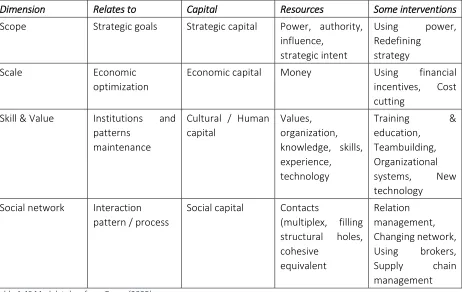
Each of these mechanisms produces its own type of processes, within those processes its own type of capital, and for each of those processes specific methods of intervention (Groen, 2005). The four types of capital are the strategic capital, the economic capital, the cultural / human capital and the social capital. In table 1, an overview can be found of this framework. The mechanisms of action for each of the dimensions are described, also the most important resources leading to such capital are mentioned. Last, but not least, some intervention methods, which fit within this dimension of action, are mentioned. These mechanisms provide a four-dimensional space for analyzing the entrepreneur’s development starting with opportunity recognition, consequently developing a business concept and bringing it into a value creation process leading to some level of growth. The central hypothesis is that on each of those four dimensions entrepreneurs, within network embedded enterprises, will need sufficient capital in each of the dimensions to create sustainable enterprises (Groen, 2005). So, business incubators, whose role is to provide a support environment for startup and fledging companies (Peters et al., 2004), should offer support in all four dimensions, so that, as intended, after the incubating period, the graduated ventures will become independent, self-sustaining businesses (Grimaldi & Grandi, 2005). Since the goal of this study is to capture the development of entrepreneurs along the entrepreneurial process, and examine how the services of an incubator can contribute, these four dimensions are used to examine how an incubator can add value for these dimensions and act as a supporting environment. These four dimensions are discussed below, combined with the role that an incubator can have in each of these 4 dimensions.
Dimension Relates to Capital Resources Some interventions
Scope Strategic goals Strategic capital Power, authority, influence,
strategic intent
Using power, Redefining
strategy
Scale Economic
optimization
Economic capital Money Using financial incentives, Cost cutting
Skill & Value Institutions and patterns
maintenance
Cultural / Human capital
Values, organization, knowledge, skills, experience, technology
Training & education,
Teambuilding, Organizational systems, New technology
Social network Interaction pattern / process
Social capital Contacts
(multiplex, filling structural holes, cohesive
equivalent
[image:12.612.78.540.349.641.2]Relation management, Changing network, Using brokers, Supply chain management
Table 1 4S Model, taken from Groen (2005)
8
Goal orientation is reflected in entrepreneurial strategies aiming at creating certain possibilities and exploiting them successfully. The entrepreneurial orientation of the entrepreneur determines the ambition level and scope of entrepreneurial action (Groen, 2005). A typical example of strategic capital is power, which, when exercised, enables an actor exactly to achieve this (Groen et al., 2008). Like seen in table 1, related examples are authority and status.
Business incubators nurture young firms, helping them to survive and grow during the start-up period when they are most vulnerable (Aerhoudt, 2004), so using power and redefining strategy, which here are seen as the possible interventions, are provided by the supporting environment of the entrepreneur, so that he can develop along this dimension. Like discussed in the previous part of the theoretical framework, mentoring and coaching is one of the support services provided by incubators. The role of the mentor, according to Sullivan (2000) is, among others, to enable the entrepreneur to reflect on actions and, perhaps, to modify future actions as a result; it is about enabling behavioral and attitudinal change. This is aligned with the findings of St-Jean & Audet (2012), who looked into the role of mentoring in the learning development of the novice entrepreneur, based on the fact that arguing that learning outcomes can be divided into three general categories: Cognitive, skill-based and affective learning. This division of learning outcomes was firstly introduced by Kraiger, Ford, & Salas (1993). According to the authors, through discussions with a mentor, a mentee takes the time to figure out which direction to take, which not only helps clarify but also develop one’s vision and find new avenues to explore. Moreover, discussions with a mentor allow an entrepreneur to develop his ability to select the best problem-solving strategy and by being paired with another entrepreneur, a mentee can find common characteristics with his mentor thereby validating his own status as an entrepreneur. Similarly, Clarysse & Bruneel (2007), in their study about the role of policy in nurturing and growing innovative startups, make a distinction between active and passive coaching. In this dimension, the role of passive coaching is applicable, since passive coaching represents the sounding board function each start-up needs (Clarysse & Bruneel, 2007), supporting and advising the start-up in strategic planning rather than assisting the company in daily organizational decision making (Stiles, 2001). The role of active coaching will be discussed in the cultural/human capital dimension, since it addresses different needs that are not aligned with the goal orientation scope. Economic capital is defined as the set of mobile resources that are potentially usable in exchange relationships between the actor and its environment in processes of acquisition, disposal or selling (Groen et al., 2008). The degree of efficiency when it comes to the exchange of goods and services is the central process in this dimension (Groen, 2005), with money being seen as the general medium of exchange. The use of financial incentives and cost cutting are seen as the main potential interventions, like depicted in table 1.
9
to procure their own services at competitive rates, entrepreneurial teams still face large opportunity costs in the form of hours spent finding, negotiating, and contracting for such services.
Next to cost cutting, access to capital is another way that the support of an incubator can contribute in this dimension. The difficulties small firms face to find and attract financial means has been widely studied in the literature. Most entrepreneurs do not have sufficient financial means to start-up a business. Clarysse & Bruneel (2007), argue that the demanding financial needs of new firms are even higher than in other businesses due to necessary investments for technological developments. This makes obtaining a bank loan very hard, leaving the venture capital community as the final source of capital for startups. Business incubators build networks with early stage investors such as business angel networks and venture capitalists, which reduce the search costs for tenants companies (Bruneel et al., 2012), contributing to this dimension and making it easier for the tenants to attract venture capital, which few succeed in doing despite the fact that it seems to be the perfect match for these firms (Clarysse & Bruneel, 2007) .
The Cultural / Human capital is ‘the set of values, norms, beliefs, assumptions, symbols, rule sets, behaviors and artefacts that define the actor in relation to other actors and environment’ (Groen et al., 2008). This definition of this capital translates in the following resources according to table 1: values, organization, knowledge, skills, experience and technology. Accordingly, training & education, team building, organizational systems and new technology are the corresponding interventions proposed by Groen (2005).
Individuals contemplating entrepreneurship might benefit from high levels of cultural capital; obtaining key business skills, especially tacit knowledge, occurs most easily through direct exposure to an entrepreneurial environment (Kim, Aldrich, & Keister, 2006) This implies the need of incubators to respond to this need so that their tenants can develop along this dimension. In fact, nascent technology-intensive companies typically lack business experience and marketing skills and therefore may have limited chances for survival (Bruneel et al., 2012). Similarly, Carayannis & von Zedtwitz (2005), highlighted that entrepreneurs may be strong in technology and perhaps business vision, but usually lack organizational, management and legal skills.
Regarding the human capital, previous research tends to support the existence of a positive relationship between human capital and entrepreneurial activity (Davidsson & Honig, 2003). In order to increase this kind of capital, the venture will need to professionalize its management and hire qualified personnel to enhance their entrepreneurial skills (Ratinho et al., 2009). Formal education is one component of human capital that may assist in the accumulation of explicit knowledge that may provide skills useful to entrepreneurs (Davidsson & Honig, 2003) According to this study, human capital is not only the result of formal education, but includes experience and practical learning that takes place on the job, as well as non-formal education, such as specific training courses that are not a part of traditional formal educational structures.
10
make a distinction between active and passive coaching. In the case of the cultural/human capital, active coaching is relevant, since it implies a basic support towards the start-up in the field of financial, human, technological and organizational resources. Similarly, Sullivan (2000) argued that one of the developmental functions of mentors in an entrepreneurial mentor-mentee relationships is the career function that enhances the learning of skills and knowledge including the political and social skills required to succeed in an organization or own business. St-Jean & Audet (2012), confirmed this learning of skills in their empirical study by stating that some mentees recall working on very specific skills pertaining to the management of their business with their mentor. The example given was the involvement in financial management, which requires not only knowledge but competences as well. In essence, incubators guide entrepreneurs through the necessary steps a newly founded company must take, sometimes even helping define the business plan, but more often providing professional services such as accounting, legal advice for incorporation and taxation issues, and formulating ownership and employee option plan structures (Carayannis & von Zedtwitz, 2005).
Social capital relates to the network connections of an actor that directly or indirectly give access to other actors (Groen et al., 2008). Due to the broad definition of this capital, and the fact that this capital overlaps the other capitals of this model, the authors restrict the term social capital to the network of relations that give access to resources of others. So, with the resources excluded to make a clear distinction between social capital and the other capitals, social capital is defined here as ‘the set of network relations through which actors can utilize, employ, or enjoy the benefits of capital that is controlled or owned by other actors’ (Groen et al., 2008). The importance of social capital, in all stages of the entrepreneurial process has been highlighted by many studies in the past. Like argued previous in this study, in the shared services section, there are two dominant ways in which tenants of an incubator can utilize networks offered by an incubator and develop along this dimension.
11
either the active incorporation of knowledge into the existing operations of incumbent firms or the founding of new ventures established specifically to exploit such knowledge (Acs & Plummer, 2005). With the help of such an incubator, start-ups can network to obtain resources and partner with others quickly, allowing them to establish themselves in the marketplace ahead of competitors (Hansen et al., 2000).
2.3 New venture creation: Stage based vs Activity based models
The last building block of figure 1, depicting the relationships between the main concepts of the theoretical background of this study, is the one about the development of the entrepreneurs along the entrepreneurial process. Here, the main prevailing models and theories on how the new venture creation process can be mapped are analyzed, so as to find an appropriate way to capture the development of the tenants of the incubator in this study.
Categorizing small organizations and startups based on their progress seems like a hopeless task due to the fact that there is a significant differences in size, markets, growth potential etc. Though, many scholars have tried to develop models that actually capture every stage an organization goes through when going from small to large and from young to mature, since during every stage of development common problems show up. Liao, Welsch, & Tan (2005) pointed out that, in general, two main literature streams of venture creation process research can be identified. These are the developmental process models and the activity based models of new venture creation. The first category refers to studies that have identified general stages of development that new ventures are likely to encounter, while the latter embodies all studies examining frequency of occurrence and temporal sequencing of activities/events.
2.3.1 Stage based models
Regarding the stage-based models of venture creation, Churchill & Lewis, (1983) ,who prepared the ground for most startup and startup stages research chose a rather organizational lens on firm development but did not explicitly distinguish between small businesses and startups. The identified phases were existence, survival, success, take-off and resource maturity. Similarly, many business researchers have developed a number of models over the last years that seek to delineate stages of corporate growth, similar to these authors. The most recent and relevant process based model study for new venture creation was by Baron and Shane(2003), who explain that the entrepreneurial process unfolds over time and moves through a number of different phases. According to the authors these phases are: (1) the idea for new product or service and/or opportunity recognition, (2) initial decision to proceed, (3) assembling the required resources, (4) actual launch of the new venture, and (5) building a successful business and finally harvesting the rewards.
2.3.2 Activity based models
12
examined 14 activities in a sample of 71 nascent entrepreneurs, having as main objective to explore the kind, the amount and the timing of the undertaken activities, indicated that the sequence that the events are undertaken do matter, as do the kinds of activities and the number of activities. This is not exactly confirmed by Liao et al. (2005), the most recent study about entrepreneurial activities in the gestation period, whose results suggested that the venture creation processes are more complex and fluid than expected.
13
3. Methodology
In this chapter the methodology of this study is analyzed. In the first part the chosen research methods are discussed. Following, the research sample criteria are analyzed, leading to the data collection methods. How the data collected is analyzed and presented forms the last part of this chapter, completing the methodology.
3.1 Research method
Finding how a business incubator contributes to the development of its tenants along the entrepreneurial process through the services provided, is what is researched. In order to find out the answer to this question, a literature study is conducted in the previous chapter, forming the basis for the qualitative research approach that is used to conduct the empirical part.
3.1.1 Case study methodology: Definition
Although no single definition of the case study exists, case study research has long had a prominent place in many disciplines and professions, ranging from psychology, anthropology, sociology, and political science to education, clinical science, social work, and administrative science. One of the mostly used definitions in recent studies that use case study methodologies is the following.
An empirical inquiry about a contemporary phenomenon (e.g., a “case”), set within its real-world context— especially when the boundaries between phenomenon and context are not clearly evident.
(Yin, 2009, p.18)
3.1.2 Why Case Study Methodology
There are some characteristics of the entrepreneurship domain, which point at a need for qualitative research (Davidsson, 2005) . The two main characteristics pointed out by the author are the relative youth of the field and the heterogeneity of the phenomenon. Especially the latter is of great interest in this case as it explains why qualitative research is the best option in this research setting. The following quote perfectly captures the necessity for qualitative research and case study methodology, also because the nascent entrepreneurs of a business incubator are the units of analysis in this case.
‘’If we only did research at arms-length distance there are the risks that because the relationships are different for different parts of the heterogeneous population we would either come out with only weak results, or results that are true on average but not for most individual cases (Davidsson, 2005, p. 56).’’
The type of research question in this case is aligned with the nature of research questions that should be answered with case study research methods, according to Yin (2011). Descriptive and explanatory questions are appropriate in these cases, so mainly questions that answer ‘why’ and ‘how’ research questions. Also, case study is an ideal methodology when a holistic, in-depth investigation is needed (Feagin, Orum, & Sjoberg, 1991) and when there is a desire to derive a(n) (up-)close or otherwise in-depth understanding of a single or small number of “cases,” set in their real-world contexts (Bromley, 1986).
3.1.3 Units & Level of analysis
14
(group/firm) level, Incubator (firm) level, Community (local) level and Incubation industry (industry) level. Specifying the unit of analysis is critical for creating any research design. The range of potential units of analysis in incubator-incubation research includes (a) the community in which the incubator operates, (b) the incubator as enterprise, (c) incubator manager, (d) incubatee firms, (e) incubatee management teams, and (f) the innovations being incubated.
In this study, research was done on an incubator level and the tenants of this incubator were used to examine the impact of the services provided by this incubator on their development. This implies that the incubatee firms form the units of analysis for this research.
3.1.4 Type of case study
According to Yin (2011), the next step in case study methodology is choosing which one of four types of case study designs better fits the research setting. Whether the case study consists of a single case or multiple cases (single- or multiple-case study) and the choice between a holistic case and having embedded subcases, result in a two-by-two matrix with four different case study designs. This matrix can be found in appendix A. In this case, research is done in a business incubator context, so as to find how it contributes to the development of its tenants. So, the incubator forms the research domain and acts as a case study. The incubated firms are the units of analysis, examining those firms leads to an answer to the main research question. As a result, these ventures function as embedded subcases, resulting in a single case design with multiple embedded subcases.
3.1.5 Data collection methods
Case study research is not limited to a single source of data, as in the use of questionnaires for carrying out a survey. In fact, good case studies benefit from having multiple sources of evidence (Yin, 2011). In the second table of Appendix A, a table can be found with an overview of all the possible sources of data that can be used while doing a case study. Each of these may require different skills from the researcher and not all sources are essential in every study. The importance of multiple sources of data to the reliability of the study is well established (Yin, 1994). The six sources identified by Yin (1994) are: documentation, archival records, interviews, direct observation, participant observation and physical artifacts. Later in this chapter, the sources of data that were used for this study are furtherly analyzed.
3.2 Research sample
Defining the research sample is the next step. The research sample of this study consists of two groups: the tenants of the incubator and individuals that are closely related to the incubator. Regarding the first group, every tenant is an entrepreneur responsible for a new venture, and the data obtained from them forms the basis for the outcomes of this research. The data obtained from the second group, the individuals related to the incubator, was used to verify the data derived from the tenants.
3.2.1 Entrepreneurs
15
The tenants examined in this study can be defined as nascent entrepreneurs. The term ‘nascent entrepreneur’ has been used in many entrepreneurship studies and many different ways have been used to separate them from other entrepreneurs. According to the PSED II, an active nascent entrepreneur was defined as a person who (a) considered themselves in the firm creation process; (b) had been engaged in some behavior to implement a new firm — such as having sought a bank loan, prepared a business plan, looked for a business location, or taken other similar actions; (c) expected to own part of the new venture; and (d) the new venture had not yet become an operating business. Due to the high scientific importance of the PSED database and the fact that the PSED studies are considered to have the highest number of participating nascent entrepreneurs, these criteria are also used in this study.
The aforementioned criteria are combined with more specific criteria that apply to the research sample of Orange Grove, completing the criteria used for this study. The program offered by Orange Grove to the tenants is supposed to last one year, with an evaluation every 6 months. After the one year, the tenants will have had the chance to acquire enough information and knowledge in order to make a significant progress and leave the program, since the program is set up in such a way. After the one year, the startups can still make use of the services at a reduced rate. As a result, only nascent entrepreneurs who have been in the program for at least 10-12 months and have been given the chance to fully use the provided services qualify for this study. To sum up, nascent entrepreneurs that qualify for this study are the ones that:
1. consider themselves in the firm creation process (PSED) 2. are engaged in some behavior to implement a new firm (PSED) 3. expect to own part of the new venture (PSED)
4. the new venture is not yet an operating business (PSED)
5. have been a part of the incubation program of Orange Grove for at least 10-12 months 6. Were selected for the program during the 1st, 2nd or 3rd application round.
Orange Grove has hired 64 startups in 15 months from which the 72% is still in the program. The background of these new ventures varies from agro-food to app-building. In total, 20 startups that were selected in the first three application rounds are still in the program, and fit the aforementioned requirements for this study. From these 20 cases, 16 are being used for an interview.
3.2.2 Key individuals
Individuals that are closely related to this incubator are also interviewed. In the following chapters, they will be referred to as ‘key individuals’, due to their key position in the incubator. The aim of the use of this secondary data is to cross check the data derived from these individuals, with the answers of the entrepreneurs.
The selected individuals are shortly presented below, together with their role within the incubator. 1. Individual A; Dutch Ambassador in Greece - one of the people that took initiative for Orange Grove
- chairing the selection committee and the advisory board.
2. Individual B; Political advisor of the Dutch Embassy in Greece - part of the team that set up Orange Grove - coordinated the whole educational program, the mentoring system, the selection features - member of the selection committee.
16
4. Individual D; Lawyer specialized in venture capital and private equity - helps Orange Grove and its tenants with legal issues by providing legal services and advice - mentor at Orange Grove - member of the selection committee.
5. Individual E; Consultant- Cost Engineer - wrote the business plan of Orange Grove - mentor at Orange Grove - gives seminars and workshops about accounting and costing - provides accounting services for the startups - member of the selection committee.
The individuals above share their view on the general contribution that an incubator can have on the development of its incubated ventures, based on their knowledge and their experience with the startups. Their key role, which points out the direct involvement with this incubator, combined with the fact that they represent all the 3 shared incubator services highlighted by the literature (2.1.2), makes them appropriate for this setting.
3.3 Data collection
Like discussed in the research method section, the six sources of data identified by Yin (1994) are: documentation, archival records, interviews, direct observation, participant observation and physical artifacts. Not all sources are essential in every case study, but the importance of multiple sources of data to the reliability of the study is well established (Yin, 1994). In this study, documents, interviews and direct observation were used as sources of data, enhancing the reliability of the data obtained.
3.3.1 Documents
According to Yin (1994), one of the most important uses of documents is to corroborate evidence gathered from other sources. When startups apply for Orange Grove, they have to hand in a canvas model that is based on Osterwalder & Pigneur (2010) and an application form in which they have to describe their business. The documents in this case are the canvas models and application forms of the selected startups that participate in the research. These are analyzed so as to define the amount of entrepreneurial activities that had been completed before joining Orange Grove.
3.3.2 Interviews
17
As mentioned earlier in the theoretical background, activity based models are used to capture the development of the nascent entrepreneurs along the entrepreneurial process. Regarding the activities that are used to capture this development during the interviews, these are based on the PSED I and PSED II dataset. In 2008, Reynolds and Curtin, did an extensive assessment on the results of the PSED II dataset. Comparing the startup activities of PSED I and PSED II was also done in this report, an overview of this table can be found in Appendix B. The most recent and important study using the PSED gestation activities was the one by Liao et al. (2005). As a result, the activities used in their study form the basis of the structure of the interviews (Appendix C). From the 26 activities that were identified in the study of Liao et al. (2005), some were excluded. After conversations, brainstorm sessions with the staff of Orange Grove and some startup teams and after conducting some test interviews, it was concluded that three activities are irrelevant. These three activities were about paying the state unemployment insurance tax, paying federal security taxes and listing with Dun & Bradstreet. The low average of entrepreneurs that stated to having completed these three during PSED I and PSED II, as pointed out by Reynolds & Curtin, (2008) (Appendix B), confirms this as being a right decision. During the PSED II, several methodological procedures implemented were designed to expand the “capture” of nascent enterprises (Reynolds & Curtin, 2008), leading to another 13 new questions about startup activities. From these, all but one were also used in this study. The one excluded (Acquired federal Employer Identification Number (EIN)), was considered as being irrelevant in the specific research setting, since it only applies to the U.S laws and procedures. Furthermore, it should be mentioned, that questions about 2 activities were rephrased in order to capture the contribution of Orange Grove while not changing the essence of the startup activity. These were the questions about hiring a lawyer and hiring an accountant (Appendix B). A potential outcome of these questions would not capture the contribution of the incubator if formulated this way. Also, for the same reason, 2 other questions were adjusted after being tested in test interviews (follow-up questions were asked when an entrepreneur stated not to having completed that activity, to find out whether participating in the Orange Grove program was the main reason). This concerns questions 11 and 31 of the interview template (Appendix C).
18
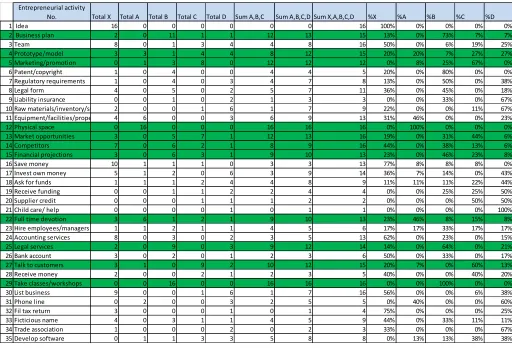
1 Spend time thinking about the business idea. 18 Ask financial institutions or other people for funds.
2 Prepare the business plan. 19 Receive outside funding.
3 Organize startup team. 20 Establish credit with a supplier.
4 Develop models, prototypes of the service/product. 21 Arrange child care or household help to allow more time on business.
5 Initiate marketing and promotional efforts. 22 Devote full time to the business.
6 Apply for a patent/copyright/trademark. 23 Hire any employees/managers.
7 Determine the regulatory requirements. 24 Hire an accountant, or use accounting services for the startup.
8 Register legal form of business. 25 Hire a lawyer, or use legal services for the startup.
9 Obtain liability insurance. 26 Open a bank account exclusively for this business.
10 Purchase raw materials, inventory or supplies. 27 Begin talking to customers.
11 Purchase/lease/rent any equipment/facilities/property. 28 Receive money for the sales of goods/services.
12 Use physical space. 29 Take classes/workshops on starting a business.
13 Define market opportunities. 30 List new business in the phone book or the Internet.
14 Begin collecting information on competitors. 31 Install a separate phone line for business.
15 Develop projected financial statements. 32 Fill a federal tax return.
16 Begin saving money to invest in the business. 33 File for fictitious name.
17 Invest own money in the business. 34 Join a trade association.
35 Fully develop proprietary software.
After composing the sample and formulating the interviews, the data collection began. The interviews with the entrepreneurs were conducted between the 12th of February 2015 and the 11th of March 2015. The interviewees were contacted through email, while a follow up email was sent when there was no direct response. From the 16 interviews, 10 were conducted face to face while the remaining 6 were done through Skype. The interviews with the key individuals took place between the 24th of March 2015 and the 9th of April 2015 and were all done face to face. Before each interview, a short introduction was made to the topic and the purpose of the research, but not to the aim of the specific interview. This was done intentionally, so as to avoid potential bias.
3.2.3 Direct observation
19
3.4 Data analysis
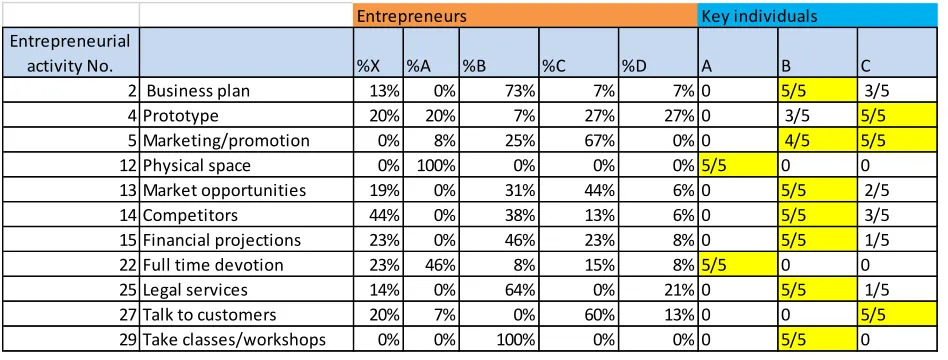
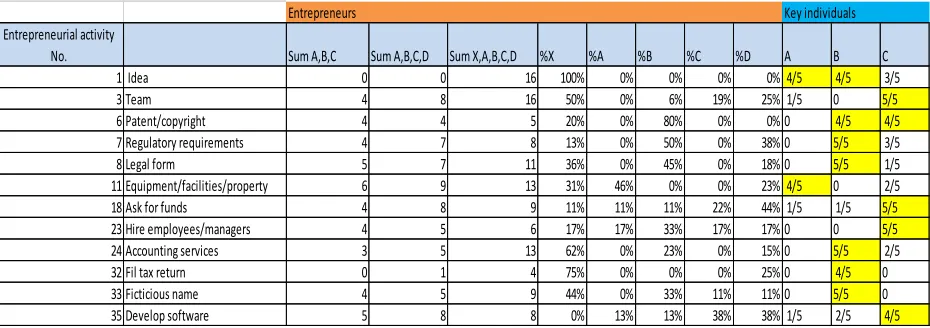
After the data collection, the results were analyzed in two different ways; (i) per startup (amount of activities completed and how) and (ii) per activity (amount of startups that completed an activity and how), in order to better understand the contribution of an incubator in the entrepreneurial process. In the second case, also the data of the interviews with the key individuals was used, so as to find potential overlap or significant differences between how a tenant and how somebody representing Orange Grove believe that the incubation program contributes. Two different ‘perspectives’ were generated, which were analyzed and compared: the ‘Entrepreneur’s perspective’ and the ‘Incubator’s perspective’.
3.4.1 Data analysis per startup
Regarding the first way of analyzing the data, and like mentioned earlier in the methodology section, during the interviews the selected entrepreneurs were asked about their development after one year of incubation by answering whether they had completed the entrepreneurial activities discussed earlier. If that was the case, whether and how Orange Grove contributed significantly to the completion of each activity was the next point of interest. After every interview, a transcript was made. If answers could be linked to components of the three identified provided services, then the conclusion was drawn that Orange Grove contributed in the completion of that activity. The answers were coded and labelled as following:
(X): Activity completed before Orange Grove (t0)
(Y, A): Activity completed after one year of incubation, due to Shared space and resources of Orange Grove (Y, B): Activity completed after one year of incubation, due to Business support services of Orange Grove (Y, C): Activity completed after one year of incubation, due to Access to networks of Orange Grove (Y, D): Activity completed after one year of incubation, but not because of services provided by the incubator
So, after every transcript of the interview with an entrepreneur was coded, two main things became clear. Firstly, the development of each startup was captured, since the amount of activities that were completed before joining Orange Grove (t0) and the amount after having been part of the program for approximately a year (t1) pointed out how much a startup had progressed. Secondly, with the above coding, the way in which the incubator contributed in completing an activity, and whether that was the case in the first place, formed the basis for the overall contribution of Orange Grove to its tenants.
3.4.2 Data analysis per activity
20
(A): Orange Grove can or has contributed in completing this activity through the Shared space and resources
21
4. The case: Orange Grove
In this chapter, the specific incubator is analyzed, based on the theoretical framework. So, first it is described according to the typology of incubators by prevailing scientific theories, the first part of the theoretical framework. The actual services provided are then classified based on the shared services highlighted by the literature. Lastly, the 4s model is used to analyze the added value of Orange Grove along the entrepreneurial process.
4.1 Description of Orange Grove
Orange Grove is a business incubator started by the Dutch Embassy in Athens in September 2013. It is sponsored by a number of Greek and Dutch corporations and universities and besides the flexible workspace it also provides networking events, mentoring programs, educational programs and legal/accounting services to its tenants. (About Orange Grove, 2015)
From a literature perspective, according to Peters et al. (2004), Orange Grove could be classified as a non-profit incubator focused on diversifying the local economy. The initial purpose of Orange Grove was to boost the Greek economy and fight the brain drain effect, which was a result of the financial crisis that hit the country. Creating jobs through new ventures is considered to be the best way to do this. So, according to Aerhoudt (2004), Orange Grove can be classified as an economic development incubator, since the main objective of this incubator is the regional development by dealing with the regional disparity gaps. Though, since this is done by creating startups, a mixed incubator profile is also applicable but the fact that the main purpose initially was (and still is) to contribute to the economic climate in Greece, the regional development profile seems to be the best choice. Regarding the business model of Orange Grove, it is funded by Dutch and Greek corporations for the biggest part and receives a small amount of money from its tenants as a fee. So, according to the model of Grimaldi & Grandi (2005), this specific incubator would be positioned somewhere between model 1 and model 2, like the UBI’s. Like discussed above in the theoretical framework, the incubating model of the UBI’s is similar to that of BICs, since they rely on the fees of the incubated firms and on public subsidies.
Model 1 Model 2
BICs UBIs CPIs IPIs
OG
4.2 Provided services
The provided services of Orange Grove are categorized according to the three shared services categories that were illustrated in the theoretical framework of this study.
22
Also, the maintenance of the efficient operation of basic office support like mentioned by Carayannis and von Zedtwitz (2003) is available at Orange Grove. Secretarial support, copying services, computer network support and book keeping are all part of the Orange Grove service package and complete this section of services. This is done by the project manager, the assistant project manager, the secretary and an intern. These form the permanent staff of the incubator, also providing advice and guidance to startups for daily issues.
Various Business support services are offered by this specific incubator to support and educate the tenants. A boot camp organized by Orange Grove in cooperation with the knowledge partners of the incubator. Moreover there are many seminars on a weekly basis in order to educate the tenants. In general, Orange Grove also hosts many events that are related to entrepreneurship and the startup scene like the Startup Safary Athens 2014 that was hosted by the most important Athenian incubators.
After a startup is accepted, it is matched with a mentor and sometimes a coach if the tenants wishes so. The choice of the matches are based on the needs of the startup and the professional background of the mentors. Orange Grove also has links with legal, accounting and consultancy firms that offer their services to the tenants of the incubator on a discount.
Lastly, the access to financial resources like mentioned by Carayannis and Zedtwitz (2003), complete the business support services of Orange Grove. Due to its nature, Orange Grove attracts many investors that attend seminars or give speeches during big events. Staring from December 2014, a quarterly pitch competition with money prizes donated by Greek foundations for the best two startups is also offered. At last, the Access to networks are a crucial part of Orange Grove. Many networking events take place at Orange Grove. The tenants are given the chance to access key individuals for the success of their startup during big events or seminars. Also, networking among the tenants can take place since they all have access to the same shared facilities, enhancing the collaboration among them.
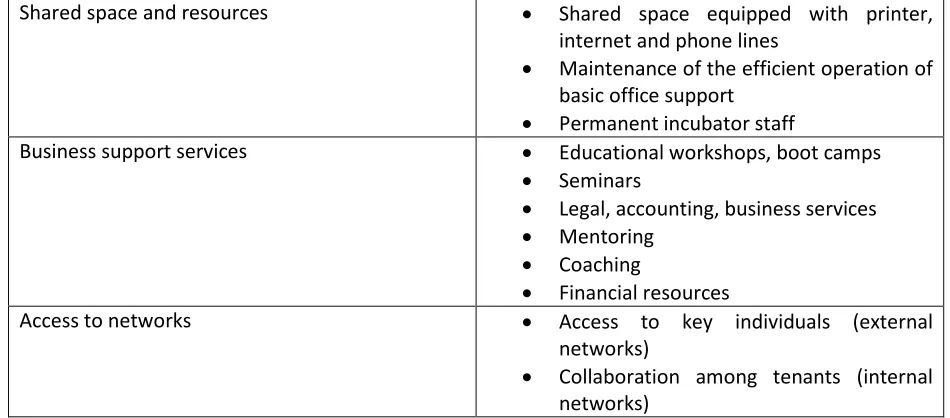
Shaped by the literature about the shared incubator services and combined with how Orange Grove aims at helping its tenants, the next framework was constructed. This framework was used to code the answers given during the interviews with the entrepreneurs and the key individuals.
Shared space and resources Shared space equipped with printer, internet and phone lines
Maintenance of the efficient operation of basic office support
Permanent incubator staff
Business support services Educational workshops, boot camps
Seminars
Legal, accounting, business services
Mentoring
Coaching
Financial resources
Access to networks Access to key individuals (external
networks)
[image:27.612.68.543.498.707.2] Collaboration among tenants (internal networks)
23
4.3 Added value Orange Grove
The 4s model by Groen (2005) is used to map the added value that Orange Grove can offer to its tenants through the aforementioned provided services.
Regarding the strategic capital dimension, the mentor and/or coach of every startup can help the entrepreneur develop. Most startups meet with their mentors or coaches on a weekly basis, but communication also takes place through phone or e-mail. Mentors are mainly involved in the business strategy issues while the coaches can help the entrepreneurs manage their stress, gain more self-confidence, learn how to better negotiate with potential suppliers or customers and enhance their public speaking skills. Orange Grove has a wide network of mentors and coaches with varying backgrounds so as to be able to guide startups with different needs.
From an economic capital perspective, Orange Grove contributes in two ways, like discussed in the theoretical background of this study. Firstly, the tenants of Orange Grove can use the flexible workspace with all the resources and all the support services that can be found in the table above, for a small fee, profiting of economies of scale. Also, due to its nature, Orange Grove attracts potential investors, pointing out that next to cost cutting, access to capital is the second way in which Orange Grove can contribute in this dimension. Moreover, like stated above, staring from December 2014, a quarterly pitch competition with money prizes donated by Greek foundations for the best two startups is also a part of the program, offering direct access to capital.
Incubated firms of Orange Grove are also offered a wide range of business support services, helping them develop along the cultural/human capital dimension. Apart from the strategy redefining role that fits the strategic capital dimension, the dedicated mentor offered by Orange Grove, can also contribute in the enhancement and development of financial, human, technological and organizational skills. The entrepreneur can also attend lectures for free on subjects such as flexible working, branding, market research, personal accounting, procedures & legislation, intellectual rights, business ethics / integrity and receive help in drawing up or improving the business plan. Moreover, Orange Grove offers the possibility to its tenants to ask for legal or accounting advice at a set time and day. If the entrepreneur needs more extensive support in these areas, Orange Grove offers a list of cooperating lawyers and accountants, who offer their services at special rates. Also, after every application round, the startups that are accepted are offered a 2-4 day educational program organized by University incubators like the University of Wageningen (StartLife) or by the Universities of Amsterdam (Amsterdam Centre for Entrepreneurship) and DeLft (YES!Delft).
24
tenants of the incubator. Lastly, since its opening Orange Grove has drawn significant publicity attention, since it has been featured in international press (Bloomberg, Reuters, The New York Times, The Wall Street Journal) and has had the honor to welcome H.M. King Willem-Alexander and H.M. Queen Máxima, President Karolos Papoulias, EU Commissioner Neelie Kroes, and more prominent figures. This media attention helps to draw attention to the startup scene in general but mainly to the startups of Orange Grove.
25
5. Analysis and Results
In this section the results of the empirical part of this study are presented. For this study a total of 16 entrepreneurs, representing 16 different startups, and 5 individuals that have key positions in Orange Grove were interviewed. The purpose of this study was to examine how the provided services of an incubator influence the development of a startup along the entrepreneurial process.
5.1
Analysis per startup
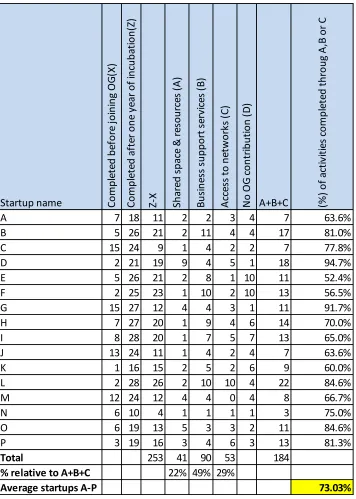
In the first part of the result section, the main purpose is to find out which of the 3 main services of Orange Grove had the most significant impact on the development of the selected tenants. In the table below, an overview of the data with the entrepreneurs can be found. First, an explanation of the different variables that represent each column of this table can be found.
X= Amount of activities completed before joining Orange Grove (t0)
Z= Total amount of activities completed after one year in Orange Grove (t1)
Z-X= The difference between these two points out how many activities were completed in one year of incubation (t1-t0)
A= Amount of activities completed due to the ‘Shared space and resources’ of Orange Grove
B= Amount of activities completed due to the ‘Business support services’ of Orange Grove
C= Amount of activities completed due to the ‘Access to Networks’ of Orange Grove
D= Amount of activities completed without the contribution of Orange Grove
A+B+C= Total amount of activities completed with the contribution of Orange Grove
26
Table 3 Overview of data from interviews with entrepreneurs
In general we see that in average, Orange Grove contributes to the entrepreneurial development of its tenants, since the average percentage of the total amount of activities completed with the contribution of Orange Grove (A+B+C), in relation to the total amount of activities completed after one year in Orange Grove (t1) (Z), per startup, is around 73%.
The general contribution of the incubator was also reflected in the statements of the entrepreneurs during their interviews .The next quotes sum up what the majority of the research sample argued about the general contribution of Orange Grove, not specifically about how a specific service potentially contributed to the completion of a specific activity.
Startup name Comp
le te d b ef o re jo in in g O G (X ) Co mp le te d a fte r o n e ye ar o f in cu b ati o n (Z) Z-X Sh ar ed s p ac e & r es o u rc es ( A ) B u si n es s su p p o rt se rv ic es ( B ) A cc es s to n etw o rk s (C) N o O G c o n tr ib u ti o n ( D )
A+B+C (%)
o f ac ti vi ti es c o mp le te d th ro u g A ,B o r C
A 7 18 11 2 2 3 4 7 63.6%
B 5 26 21 2 11 4 4 17 81.0%
C 15 24 9 1 4 2 2 7 77.8%
D 2 21 19 9 4 5 1 18 94.7%
E 5 26 21 2 8 1 10 11 52.4%
F 2 25 23 1 10 2 10 13 56.5%
G 15 27 12 4 4 3 1 11 91.7%
H 7 27 20 1 9 4 6 14 70.0%
I 8 28 20 1 7 5 7 13 65.0%
J 13 24 11 1 4 2 4 7 63.6%
K 1 16 15 2 5 2 6 9 60.0%
L 2 28 26 2 10 10 4 22 84.6%
M 12 24 12 4 4 0 4 8 66.7%
N 6 10 4 1 1 1 1 3 75.0%
O 6 19 13 5 3 3 2 11 84.6%
P 3 19 16 3 4 6 3 13 81.3%
Total 253 41 90 53 184
% relative to A+B+C 22% 49% 29%