University of Warwick institutional repository: http://go.warwick.ac.uk/wrap
A Thesis Submitted for the Degree of PhD at the University of Warwick
http://go.warwick.ac.uk/wrap/36254
This thesis is made available online and is protected by original copyright. Please scroll down to view the document itself.
THE BRITISH STUDENT MOVEMENT 1965-1972
Thomas Nicholas Thomas
Submitted in part fulfilment for the degree of Ph.D. in Social History at the
SUMMARY
This thesis outlines the development of the protests by students which took place in Britain from 1965 to 1972, and investigates the reasons for the occurrence of these protests at that particular time. This inquiry has used national and student newspapers, extensive archive material, secondary sources, and oral history interviews to carry out these aims.
CONTENTS
Summary i
Contents ii
Acknowledgements iv
Abbreviations vi
Introduction 1
1 Changes in Higher Education and student protest before 1965 16
2 Student protest form 1965 to 1972 47
3 The student movement 88
4 The far left and the student movement 113
5 The pre-conditions for protest 148
6 Public opinion, the press, and the student movement 175
7 An international student movement? 201
Epilogue 228
Conclusion 243
Appendices
1 Tables 254
2 The manifesto of the Radical Student Alliance 259
3 Surveys 263
4 Questionnaire 269
5 The manifesto of the RSSF 282
Chronology 285
ACKNOWLEDGEMENTS
It is difficult to thank everyone who has provided me with assistance during the course of this work, and the efforts of anyone who has been left out of these acknowledgements have not been ignored, but are rather the victim of having to call a halt somewhere.
First I must thank my parents, Mary and Keith Thomas, and my brother, Philip Thomas, for their unstinting support, both financial and moral. I could not have done this work without them.
I am also indebted to my Supervisors, Professor Carolyn Steedman, Professor Nick Tiratsoo, and Professor Gwynne Lewis for their helpful advise and support throughout this Ph.D..
I am grateful for the many hours of laborious proof reading which has been carried out by Gaby Neher and Richard Temple, and for their numerous constructive comments, while Dr. Joan Lane deserves special mention, both for her continued support for my teaching on her course which has provided me with valuable experience and financial security, and for her constant friendship and advice.
provided me with sometimes crucial advice, as well as valuable employment within their archives.
I must also recognise the importance of the faith which John Cunnington, the Warden of Rootes Residences at the University of Warwick, has shown in me over the three years of my employment within the residences, as well as the camaraderie and friendship which has been displayed to me by many fellow resident tutors, notably Ian Martin, Graham Wright, Julie Bourne, Tim Noakes, Charlotte Griffiths, Dawood Alarn, Ming Yu Ho, and Richard Temple.
ABBREVIATIONS
A.U.T. Association of University Teachers
B.C.P.V. British Campaign (sometimes Council) for Peace in Vietnam
B.L.P.E.S. British Library of Political and Economic Science C.A.T. College of Advanced Technology
C.I.A. Central Intelligence Agency
C.N.D. Campaign for Nuclear Disarmament C.P.G.B. Communist Party of Great Britain D.E.S. Department of Education and Science E.G.M. Extraordinary General Meeting I.M.G. International Marxist Group I.S. International Socialism
J.C.R. Jeunesse Communiste Revolutionnaire L.S.E. London School of Economics
M.R.C. Modern Records Centre, University of Warwick N.A.L.S.O. National Association of Labour Student Organisations N.L.F. National Liberation Front (Vietnam).
N.S.A. (U.S.A.) National Student Association of the United States of America
N.U.S. National Union of Students R.S.A. Radical Student Alliance
R.S.S.F. Revolutionary Student Socialist Federation S.D.S. Students for a Democratic Society
S.N.C.C. Student Non-violent (later National) Co-ordinating Committee
T.U.C. Trades Union Congress U.G.C. University Grants Committee U.G.M. Union General Meeting
Speaking against the American military intervention in Vietnam, in New York on 4 April 1967, Martin Luther King acknowledged that
even when pressed by the demands of inner truth, men do not easily assume the task of
opposing their government's policy. ..Nor does the human spirit move without great
difficulty against all the apathy of conformist thought within one's own bosom and in the
surrounding world. Moreover, when the issues at hand seem as perplexed as they often do
in the case of this dreadful conflict we are always on the verge of being mesmerized by
uncertainty; but we must move on.'
Dr. King's words have particular relevance to this study, since it will aim to explain why large numbers of British students took part in acts of protest in the late 1960s, both against the policies of their national and university governments. From 1965 onward, increasing numbers of British students took part in a variety of protests, notably against the American military intervention in Vietnam (see chapters 2 and 6). In March 1967 students at the London School of Economics decided to hold a sit-down demonstration in the entrance hall of the School, and resolved to stay there until the School's authorities changed their decision to suspend two students from the School. This was the first 'sit-in' to take place at a British educational institution. More protests. including sit-ins, took place around Britain in the subsequent year, reaching a peak in frequency and size in 1968, and then declining from that point onward. These protests were a new phenomenon.
chapters which follow will establish the details of what happened during the protests which took place in Britain, and the reasons for their occurrence.
The protests which took place in Britain in the 1960s were the subject of sometimes intense contemporary speculation as to their origins, especially by the press, as will be discussed, particularly in chapter 6. While a crisis in education and in social values was highlighted and condemned by many, others gloried in and glorified the rebellion of so many young people (see chapters 4 and 6). These two opposing outlooks have now become the main schools of thought within the battle which has blighted attempts to interpret the events of the 1960s. Whether accurately or not, the decade has been identified as a period of profound change in British society. As early as 1967 Philip Larkin expressed his feeling that 'sexual intercourse began in nineteen sixty-three' and that
Up until then there'd only been A sort of bargaining,
A wrangle for a ring,
A shame that started at sixteen, And spread to everything?
the majority of the numerous investigations into the events of the 1960s. It is within this context that the student protest which took place in Britain has been examined, although even these texts have only given limited attention to the subject. Fleeting mention of these protests is often made in accounts of the events of the decade, or particular aspects of the decade, but few studies have been devoted to student protest in particular. 4 These latter accounts have either taken the form of outlines of the protest which took place around the world, or protests in individual countries such as France and America (see chapter 7). Yet while studies of events in individual countries have been carried out, there had not been a detailed examination of the British student movement in its own right until the inception of this thesis.
This study will be the first such account of the student movement and its origins. This may be surprising, especially in the light of the existence of numerous works on events in other countries, and the identification of British student protests as forming a part of the Identity' of the decade. In 1993, for example, one participant in the December 1968 sit-in at Bristol University described 1968 as 'the year of the Beatles' White Album and Technicolor clothes, but it was also the year of the Vietnam demo, the Che Guevara poster...[sic] and the student sit-in'. 5 Christopher Booker, in his study of the
Ehrlich on the relationship between the Leninist organisations and the student movement is the nearest that any previous work has come to providing an account of the student protest of the 1960s, • and Ehrlich suggested that the creation of a history devoted to the student movement alone would probably prove to be impossible for any historian because of the scale of the task. 7 The following chapters will provide such a history, including the first detailed consideration of the development of the anti-Vietnam War Campaign in Britain.
A number of flaws have affected the interpretation of events in those few general accounts of international student protest which touch upon the student protest which took place in Britain in the 1960s. The works of Ronald Fraser and of David Caute have become the two standard texts in student protest, for example, and there is a striking lack of detail, and understanding of detail, in both of these pieces. 8 This is perhaps understandable in the context of studies of protest movements in a variety of countries, but British student votests have not been examined in the light of the peculiarities of British society, and the changes which were taking place within that society. Rather, they have been seen as examples of a world-wide phenomenon with approximately similar origins. Not only does this form of study lead to a lack of consideration for local differences, but it does not allow for a detailed investigation. These studies are therefore usually based upon reference to limited sources: Ronald Fraser's work is dominated by oral history, while national newspapers provide the overwhelming majority of the references for David Caute. This failure to use a variety of sources
This has led to the use of assumptions, and the attendant inaccuracies have led to fundamental flaws in the conclusions which have been reached about the origins of student protest in Britain in the 1960s. This use of assumptions has also had a negative effect upon other attempts to explain student protest, notably those made by contemporary journalists. Indeed, the media construct of the 1960s in general, which was begun in the 1960s, has had a profound influence upon subsequent attempts to understand that decade. It has been argued that 'when asked about the sixties, there seems to be a qualitative difference in people's response - they seem to be confused about what really happened [to them] and what the media had said was happening. This kind of conceptualising seems true across the social board. Most people under forty, in describing the sixties, at least defer to the media sixties'.9 Not only did assumptions rather than investigation inform the conclusions reached by the media in the 1960s, then, but these conclusions have since become accepted in subsequent works as being grounded upon fact or common sense.
Group conformity has also been identified as an influence, as well as the copying of the example of the young people who engaged in protests in other countries (see chapter 7). All of these viewpoints will be discussed in the following chapters, and it will be demonstrated that they are inaccurate, that they are based upon assumption instead of investigation, and that they are patronising in their denial that individual students took part in protests because they felt strongly about the issues which had prompted their protest.
Moreover, it will be argued that student protest can wily be DT) tierstood in
the light of changes in attitudes to authority. This consideration has not been completely ignored in the past: Ronald Fraser, for example. has indicated that new attitudes to authority should be noted when attempting to locate the origins
This will be made possible by the detailed study and use of a number of sources. Extensive use will be made of archive material, much of which has never been used before, notably the large deposit which has been made by the National Union of Students (N.U.S.) at the Modern Records Centre (M.R.C.) at the University of Warwick. The contents of this archive were effectively unavailable for use by researchers until it was catalogued by the aithor in 1994. The newspapers of the Students' Unions of 11 universities have been consulted in detail, and this is the first time that these newspapers have been used as a source for an account of the student protest which took place in Britain in the 1960s. Other sources which will be used to provide both information and contemporary opinions include periodicals, national newspapers, and a number of contemporary publications. Subsequent accounts, academic texts, and oral interviews, will also be used. A survey of academic staff at the University of Warwick which was carried out by the authoi in 1994 and 1995 will be used extensively in chapter 3.
Before embarking upon the writing of this history, however, it is first necessary to establish a number of parameters, and to define key terms. For example, the year 1965 has been chosen as the starting point because before that date student protests were rare, while they escalated in terms of frequency and in the numbers of students involved from 1965 onward. The period before 1965 will be discussed in the next chapter. AI:r 1972 stuctent protest declined, although it did not disappear. This period will be outlined in the epilogue.
students do appear to have played a role in the escalation of the conflict in that province in the late 1960s, it would be impossible to give the appropriate attention either to Northern Ireland or to the rest of the United Kingdom if the events which took place in Northern Ireland were also discussed here. Moreover, the issues which prompted such protest in Northern Ireland were fundamentally different to those about which students in the rest of the United Kingdom protested. It would be possible to devote an entirely separate study to student protest in Northern Ireland alone. For these reasons, the discussions which will take place in the following chapters will concentrate upon events in England, Scotland, and Wales.
in their attempts to establish what was wrong with the 'youth of today' and why traditional norms of behaviour at these institutions were being ignored or transformed.
Among all of the terms which will be used in this thesis, perhaps the most difficult to define is 'student movement'. It has had a number of meanings. In Eric Ashby and Mary Anderson's account of the Rtse of the Student Estate in Britain, for example, the term is used with unclear meaning. They use it most
often with regard to the 1930s and seem to be referring to the awakening of a 'social conscience' among students. This is open to interpretation, however, since they could be referring to the student body as a whole. Even in the 1960s it did not have a clear meaning; the editor of the Liverpool student newspaper Guild
Gazette wrote in 1968 that 'we are a mass movement - 400,000 of us' and made
series of actions and endeavours on the part of a body of persons, moving or tending more or less continuously towards some special end', then in many respects the application of the name 'student movement' to the student protest of the 1960s is inaccurate." The student movement consisted of a number of different protest movements, and student protest was often localised, without common national objectives, or a national organisation. Student participation in these protests was also often limited and transitory. It could be argued, then, that in this study the term 'student movement' has been somewhat arbitrarily applied as an umbrella term. Yet this protest did have the common factors of being carried out by students, or mainly by students, as well as usually being based upon the desire to change the opinions or policies of members of the older generation. In this sense the use of the term 'student movement' is not the result of the necessity for a tidy and all-inclusive term, but it refers to a genuine movement among students, i.e.. the use of protest to challenge decisions, and to gain a voice in decision making processes.
public', it can take the form of opposition to an action, decision or belief, while also promoting alternatives. I2 It can be aimed at changing decisions, or at converting and attracting supporters. It can also take the form of a statement or action of opposition, with public disassociation as its sole aim. Whatever its aims, protest is an attempt to place a check upon those in authority, and it is a means of influencing decisions and thereby playing a role in government. Protests by students in the 1960s usually took the form of statements or actions in opposition to the actions or decisions of university or national governments. In this sense, protests can refer simply to oral protestations of opposition, but this study will concern itself with something which was more militant, such as protest in the form of the lobbying of MPs, rallies, demonstrations, and sit-ins, etc., because these were new phenomena of student behaviour in the 1960s. They were also attempts to play a role in democratic government by voicing opinions and objections. In the case of sit-ins, these were often prompted by student desires to play a recognised and formal role within university governments. It will be the central thesis of this work therefore that these protests could only take place when young people felt that C.-ley could chIllenge those in Lhority, just as Martin Luther King noted in the speech which was quoted at the beginning of this introduction and that this was a new development. The student protest of the
1960s can only be understood in the light of this change.
'A Time to Break Silence', quoted in James Melvin Washington (ed), A Testament of Hope:The Essential Writings of Marting Luther King, Jr. (HarperCollins, 1986), P. 231.
2 Philip Larkin, 'Annus Mirabilis' in Collected Poems (Faber and Faber, 1988), p. 167.
3 Jonathon Green, Days in the Life: Voices from the English Underground 1961-1971 (Heinemann, 1988), p. vii.
4 For a general history of the 1960s see Bernard Levin, The Pendulum Years: Britain and the 60s (Spectre, 1989, first published by Jonathan Cape, 1970). David Martin (ed), Anarchy and Culture: The Problem of the Contemporary University (Routledge and Kegan Paul, 1969)
devotes several chapters to the student protest in the 1960s, while Margaret Anne Rooke, Anarchy
and Apathy: Student Unrest 1968-1970 (Hamish Hamilton, 1971) provides an extreme example
of an irrational polemic against student protests which is not based upon research and which is fundamentally inaccurate.
5 Guardian Education, 7 December 199:„ p. 5.
6 Christopher Booker, The Neophiliacs: The Revolution in English Life in the fifties and sixties (Pimlico. 1992), p. 7.
7
See the Introduction to A. Z. Ehrlich, 'The Leninist Organisations in Britain and the Student Movement 1966 - 1972' (Unpublished Ph.D. thesis, University of London, 1981).
8
Ronald Fraser, 1968: A Student Generation in Revolt (Chatto and Windus, 1988), and David Caute, Sixty-Eight: The Year of the Barricades (Hamisn Hamilton, 1988).
9
Quoted in Robert Murphy„Vixties British Cinema (British Film Institute, 1988), p. 1 from Peter York, 'Recycling the Sixties', reprinted in Style Wars (Sidgewick and Jackson, 1980), p. 182. See also Christopher Booker, Tlw Neophiliacs (Pimlico, 1992), for an attempt at attacking the myths about the 1960s.
10 'The National Union of Students: The Problems that Face Us', March 1969, M.R.C., MSS 280, box 142/M1, tile 9.
II Oxford English Dictionary, Second Edition, vol. X (Clarendon Press. 1989), p. 35.
CHAPTER 1
This chapter will place the student movement within its historical context. Such an exercise will also introduce information which will be necessary to the discussions in subsequent chapters. In particular, the development of higher education, university government, and student protest in Britain before 1965 will be outlined, and their impact upon the student movement will be assessed.
become a university in 1967. Between 1960 and 1970, then, the number of universities doubled, from twenty to forty.
financial burden of attending university, to take advantage of the changes resulting from the Robbins Report.
The Robbins Committee was established in 1961 in response to the increased demand, both actual and predicted, for higher education.4 Among the stated reasons for its establishment were the needs of industry, the need for competitiveness with other countries, and improvements in further education, such as at C.A.T.s, which prompted the need for a re-appraisal of the status of some institutions. The increased quantity of public money which was being used to fund universities also made improvements in higher education a matter of public interest (see below). 5 Indeed, the expectations of common standards of education for all, and access to education for all, which informed and were confirmed by the Education Act of 1944, may also have played a role.° Yet perhaps the most important consideration was the predicted increase in the numbers of those who were qualified to attend university. After the 1944 Education Act the numbers of people remaining in full time education until the age of 17 rose from 4 per cent in 1938 to 15 per cent in 1962. Moreover, the proportion of those people who attained the minimum university entrance
qualification of two 'A' levels rose from 4.3 per cent of the age group up to the age of 19 in 1954, to 6.9 per cent in 1961. This would have resulted in an increase in the numbers, both absolute and as a proportion of the age group, who wanted to attend university, even if the birth rate had remained constant. Yet the rise in the birth rate which took place toward the end of the Second World War resulted in a predicted increase in the number of 18-year olds from 642,000 in
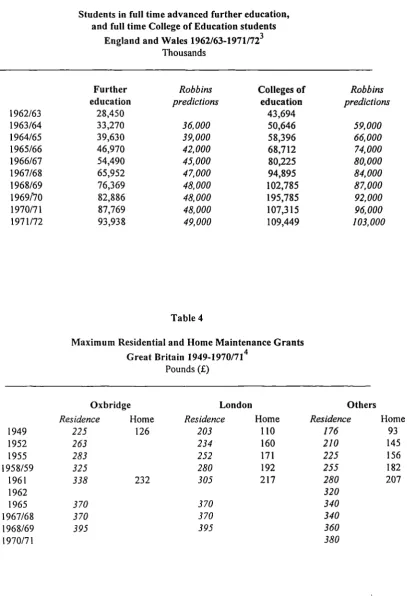
increase in the number of people who would be qualified to attend university in the 1960s.7 The Robbins Committee was therefore given the task of providing recommendations for the future of higher education in Britain in the light both of the needs of the nation, and those of future, prospective, students. It rejected the possibility of maintaining student numbers as they were, which would have restricted access to higher education for the growing number of people with the necessary qualifications. Instead, it favoured the belief that 'courses of higher education should be available for all those who are qualified by ability and attainment to pursue them and who wish to do so'.8 As a result, it was recognised that a rapid expansion of higher education would be necessary in order to cope with the increased demand for places: the Committee predicted an increase in the number of students from 142,000 in 1963-64, to 200,000 by 1968-69 (see table 2, appendix 1) and recommended a corresponding increase in the number of places available at universities. When the recommendations of the Report were implemented, however, student numbers rose spectacularly from 119,004 in 1962-63, to 211,294 in 1968-69, and to 227,956 in 1970-71 (see table 2, appendix 1). 9 The number of female students nearly tripled, rising from 26,269 in 1960-61 to 69,707 in 1971-72. The upgrading of C.A.T.s to university status was also carried out as a result of the Report's recommendations, though, as has been noted, the creation of other universities in the 1960s was carried out independently of the Report's recommendations.
With the increase in the number of universities, and the increase in the
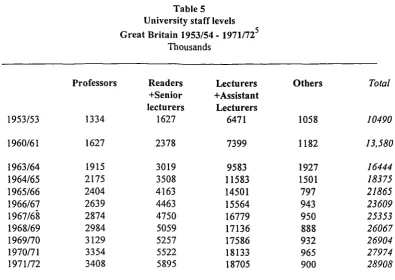
10,490 in 1953-54, to 13,580 in 1960-61, in response to the gradual expansion of higher education at that time. By 1970-71, however, this figure had more than doubled, to 27,974, with dramatic increases in the numbers of staff of all grades. A further development was the increase in the numbers of students, both absolutely and as a proportion of the total student body, who lived away from home, in halls of residence or in lodgings. In 1960-61 there were 23,611 full time students in Britain who lived at home, and this number had only increased to 36,590 by 1970. 1 ° In contrast, the numbers of those living in halls of residence increased over the same period from 29,474 to 88,761, while those living in lodgings increased in number from 54,614 to 100,786.
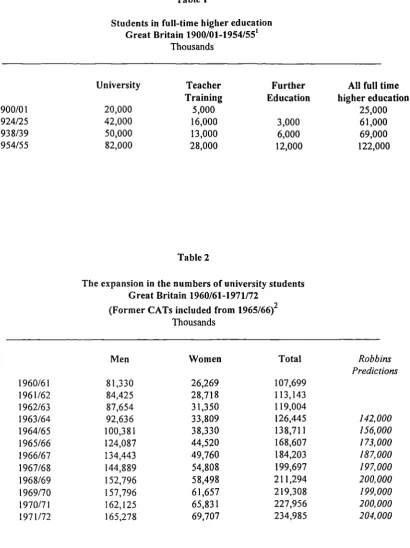
Finally, there was a similar expansion in the numbers attending Colleges of Education and further education, along with the creation of a 'binary system' of education. Colleges of Education, which became the new name for Teacher Training Colleges following the recommendation of the Robbins Report, gained the ability to grant degrees in the form of the B. Ed., and also increased their student numbers rapidly in the 1960s following a steady development throughout the century. From their 1962-63 total of 43,694 students, they more than doubled in size, having reached a total of 107,315 students in 1970-71 (see table 3, appendix 1). The numbers of students in further education also increased steadily throughout the century (see table 1, appendix 1), and then expanded swiftly in the
1960s. By 1962-63, there were 28,450 students in further education (see table 3, appendix 1), and by 1970-71 this figure had more than tripled to 87,769. This increase was accompanied, after April 1965, by the creation of a 'binary system'
disparate colleges of further education by uniting them in the form of polytechnics." This created a 'two-tier' system of education (though such a description was vehemently denied at the time) in which degrees could be gained from universities or polytechnics. Yet unlike universities (see below), these latter institutions were to receive their funding, and therefore their source of developmental control, directly from the government.
This spectacular expansion in higher education was significant for a number of reasons. Higher education gained a new place of importance both in society and in the economy: the Robbins Report was the third most popular government report ever in terms of sales, after the Beveridge Report on social insurance and Lord Denning 's Report on the Profumo affair, and in recognition of the growing importance of education, the Ministry of Education became the Department of Education and Science in 1964, with a Secretary of State at its head. The growing role of the government, particularly in providing finance for higher education, had been one of the motivating factors behind the formation of the Robbins Committee, and this role continued to grow in proportionate, and particularly absolute terms, while universities expanded in the 1960s. In 1935-6, for example, the government had provided £2,076,791, or 34.3 per cent of the total higher education funding. By 1960-61 this had risen to £49,037,000, or 72.7
Grants Committee (U.G.C.) described universities as 'independent, self-governing institutions', for which it acted as the intermediary to 'enable public funds to flow into the universities without direct governmental intervention', the government attached conditions to U.G.C. allocations of money on the basis of 'the demand of students for university places, national needs for qualified graduates and the likely availability of resources'. 15 This led, later in the decade, to allegations by the far left that the university expansion, students' needs, educational requirements, and university development, were being subordinated to the demands of the modern economy, and this was named by commentators as a cause of student protest. This, and its implications for the student movement, will be discussed in Chapter 5.
Yet perhaps most importantly, the very expansion of student numbers was blamed later in the decade for causing student protests. It was argued that the expansion had encouraged working class students to attend universities and that student protest was a result of these students, and other students whose parents had not attended university, not knowing how to behave once they were there. This will be discussed in Chapter 4, as will the suggestion that the expansion caused protests because of overcrowded facilities and poor staff-student ratios which had failed to keep up with the expansion of student numbers.
Nonetheless, there was no standard governmental structure for all universities: individual universities evolved their own systems according to their own circumstances. 16 Yet by 1965, despite differences in detail at each university, the governments of most universities had developed common structures. These were organised around a combination of statute and convention, and were founded upon the guiding principle of preserving the authority of academic staff over the government of the university. By the 1960s the university governmental system had developed into a two-tier structure, based upon the Senate and the Council. The former body dealt with academic policy within the individual university, and was constituted from members of the academic staff of that university. The latter body, the Council, dealt with non-academic matters such as finance and building, and included both academic and non-academic members, such as members of the local community, local government, and local industry. Convention usually dictated that a Council rarely challenged decisions of the Senate. Above these bodies in the university government was the Court which, although it was the supreme governing body of the university, was usually a rubber-stamp body. It usually met only once a year to approve the decisions of the Senate and Council, and rarely challenged the decisions of these bodies. Uniting this structure was the vice-chancellor, who acted as chair to many of the central committees, including Senate and Council, and who also usually acted as the representative of the university with the national government. A registrar acted as the head of the administrative structure.
attempt to locate the centre of a university's authority. Within this system a highly consultative and complex structure of committees and sub-committees which included, in theory, the representatives of all interested parties, acted to ensure that the best interests of the academic community as a whole were served at all levels, from department, to faculty, and ultimately to university-wide levels. Committees, which included those on discipline, library facilities, buildings, finance, etc., were able to make decisions on the areas which were exclusive to their interests, as well as being able to work within the wider structure, so that a
committee or interest group could make recommendations or representations to other committees or bodies which dealt with wider or different areas of interest. Interest groups and committees were therefore able, via their representatives, to make demands upon the resources which were under the control of other committees or bodies. Such a system, then, allowed for decisions to be made autonomously and democratically by those individuals or groups whom such decisions affected, as well as allowing members of the academic community to contribute to the wider government of the university as a whole. It was, supposedly, a system which helped to preserve academic freedom by relying upon an all-inclusive participatory form of democracy instead of taking the form of commandments from a small group at the head of a pyramidal hierarchy.
students had been excluded from consideration as members of an academic community, university government, which was dominated by professorial staff, was, perhaps, a representative system. By 1965, when the nature of the academic community had changed, and university government had failed to keep pace with this change, the system of government was no longer representative of the academic community as a whole. For example, table 5, appendix 1, makes it clear that, by 1965, non-professorial staff were the largest group of academic staff. As well as professorial staff, academics were divided in status into
lecturers, senior lecturers, and readers, as a result of evolution over time. Yet, although they campaigned for representation within university governments, non-professorial academics were usually only given access to representation up to faculty level. Where they did gain representation on higher levels, such as Senate, they were usually not given representation in numbers which were in proportion to their numbers in the academic community. The Robbins Committee therefore noted that 'in English civic universities, in Wales and in Scotland, professors outnumber other academic staff on the senate in all cases where we have information and often by five or even ten to one'. 17 Professorial staff sought to maintain their position of power within the university system of government, despite the contradiction with the ethos of democratic university administration which this established. In 1965 the Association of University Teachers (A.U.T.) published a report on University Government and Organisation which argued
influence in contradiction to that spirit'. Moreover, the evolution of departments, which were rarely mentioned in university statutes or charters, and the evolution of the role of the professor as the head of department, meant that 'in default of any provision within charter or statute the formal position is normally that one professor, as head of department, and only he, can make decisions on behalf of the department. Such decisions may be one-sided and out of touch with the living experience of the department'. 18 Two years previously the Robbins Committee had noted that 'both on questions of major policy and in the more intimate running of faculties and departments, the non-professorial members of staff of such universities are said to feel that they have an inadequate share in determining the evolution of the society of which they are members' •19
Nonetheless, non-professorial staff seem to have had more success in gaining representation within university governments than students. The age of majority remained at 21 until it was reduced to 18 in 1970, meaning that students did not have the right to vote in parliamentary elections, and their universities acted in loco parentis (see chapter 5), which affected their ability to gain access to representation within universities. For example, in 1966 the National Union of
Students (N.U.S.) produced a pamphlet on Student Participation in College
Government which provides a detailed description of student representation in
Disciplinary Committees only at Salford University, Sunderland College, and the University of Wales Institute of Science and Technology (U.W.I.S.T.), while only University College Bangor and Liverpool University deemed it necessary for students to be represented upon their Student Welfare Committees. In contrast, student representation upon more peripheral committees was relatively common: thirteen universities allowed student representatives on their Athletics Committees. Even where representation seemed to exist, it appears that it usually took the form of consultation rather than active representation and participation within the decision making process. Furthermore, as one student of the 1960s,
Colin Crouch, complained
the length of time taken by decision making in a university is often a safeguard of the freedom of the academic staff, but the result of it as it faces the student in a large university is something like Kafka's castle. One is never certain what is going to happen or why it happens. As soon as a student learns that a committee in the college is prepared to take a certain step, he learns of a plethora of groups who will probably prevent it ever occurring for reasons of whose excellence he is assured, but of whose precise contents he is never informed.2I
twenty years after the it was first raised as an issue by students. 22 In 1966, Bill Savage, the President of the N.U.S. at the time, suggested that
the concept of the student as being a member of an adult academic community is, in many cases, meaningless in practice. Every week examples are reported to the National Union of Students of petty interference with the activities of the student body and decisions directly affecting students being taken without any consultation and of the arbitrary dismissal of students for "offences" which have nothing to do with academic performance.23
In the same year the President of the Guild at Liverpool University complained that 'while students do not learn of decisions until they are made, basic mistakes...will continue to be made'. 24 These issues will be discussed further in the next chapter.
Yet such accusations, particularly of interference with the activities of students, were not new. For example, in 1933 the Oxford Union passed a motion 'that this house will in no circumstances fight for its King and Country', and although this motion was subsequently debated by students at numerous universities and colleges throughout the country, the authorities at University College Nottingham and Sheffield University intervened to prevent debates on it from taking place. 25 At Cambridge University in 1932 the President of the Union was 'advised' by the Senior Proctor to cancel a debate on the motion 'that the sexual morality of Christian Civilisation is unscientific and harmful'. A letter in
amounted to a destruction of both. "Not at all" replied the Senior Proctor, "it is to protect your freedom of speech that we are asking you to drop this debate"!' .26 The actions of the Senior Proctor went unchallenged, but at this time students were beginning to become involved in political activism which resulted in direct confrontation with university authorities, though in the 1930s students demanded
better consultation rather than active representation. Prior to the 1930s, most students appear to have been conservative in outlook. In 1926, for example, most students acted as strike-breakers during the General Strike: nearly two thousand Oxford University students volunteered to work as 'dockers, busmen, or special constables in London and the provincial cities' in the place of striking workers.27
By the 1930s, however, this situation had changed, and students had begun to become involved in more radical political activity, particularly over issues such as anti-fascism and pacifism (which were often related) and these activities sometimes provoked conflict with university authorities. 28 For example, in January 1934, the Student Anti-War Council outlined, in a letter to the University of London Union, 'some of the ways in which the freedom of speech and action of students have been suppressed in London during the last term', and added that 'we think it is quite clear that the general policy of the authorities of the University of London directly conflicts with student freedom'. 29 The authors of the letter allege that at University College, London, the Provost had refused to recognise the Anti-War Committee, and that he prevented its members 'from distributing leaflets outside the college'. He refused a request for a consultation
and Regent Street Polytechnic are also included in the letter. While it is difficult to assess the accuracy of the letter, and the extent to which the motives of its authors distorted the representation of the facts, the letter does make it clear that some students did object to the attitudes and behaviour of some university authorities. Moreover, its discussion of events at Oxford University is corroborated by the press, where a debate on the banning of the Labour and October (Communist) Clubs took place. 3° This ban occurred after the Anti-War Council had urged students not to join the Officer Training Corps (0.T.C.) at the University. The ban meant that 'not only might no criticism of the O.T.C. be made in a public meeting, but even an open letter to all students on this question could not be allowed. A Free Speech meeting would be banned. This meeting being held, penalties were inflicted on those attending'. The subsequent struggle between the students and the university authorities included the submission of a petition of 1,000 names to the proctors, and eventually resulted in the rescinding
of the disciplinary measures.
These challenges to university authorities were, however, limited in scope and number, and the period during which such challenges took place was short. During the 1940s and 1950s student activism aimed at improving students' position within university government was limited. When it did take place, such
a protest against 'a Minister of the Crown' at Oxford University, argued that 'no such thing could have possibly occurred.. .twenty years ago.. .first, because very few of us cared enough about politics; secondly, because we would have regarded such behaviour as a breach of hospitality; thirdly, because we were disposed to be courteous to our elders, even when we despised them; and finally, because in any case at all we should have had more amusing and profitable things
to do'.32 Whether this was an accurate portrayal of the attitudes of students in the 1940s and 1950s is, of course, debatable. Nonetheless, the relative lack of student activism in that period prompted the Guardian, in March 1968, to ask, after a sit-in had taken place at Essex University, 'are students a different breed from the tweed-jacketed conformists of 10 years ago...?' .33
The policy objectives of the main student body, the N.U.S., were also limited, and both reflected, and arguably contributed to, the lack of student political activism in the 1940s and 1950s. This body was founded in 1921 as a federation of the students' unions at each institution. These students' unions usually provided a social space and political forum (the Union General Meeting) for students, along with such facilities as political and sporting clubs. They had their own constitutions and their own elected officers, such as a president, treasurer, etc., who usually became the union's representatives in negotiations
For the inter-war period its resources were therefore directed mainly to providing students with access to cheap travel opportunities. This restricted outlook with regard to the potential political strength of the N.U.S. was reflected in Clause 3
of its Constitution which stated that the objects of the N.U.S. were to
maintain and promote their co-operation with the students of other countries and to
promote the educational, social and general interests of students and to all such other
things which are incidental or conducive to the above objects or any of them. The objects
shall be pursued in entire independence of all political and religious groups or
propaganda. Matters which are essential to the full consideration of educational issues
may be included in discussion but it shall not be the role of the National Union to provide
a general forum.35
This Clause was not changed until 1969 so that the policy objectives of the N.U.S. remained restricted and its campaigning methods were confined to the use of negotiation with government without the 'leverage' of the threat of direct
action. Although the N.U.S. collaborated with the A.U.T. in the late 1930s over the issue of the establishment of staff-student committees in universities, even this limited objective was replaced in 1947 by a four-point policy which requested 'the abolition of all fees, maintenance grants for all students,
for all, and favourable educational conditions for students, as the two issues with which it was most concerned.37
It was not until the 1960s that frustration with the limited aims and successes of the N.U.S. on student issues such as grants and accommodation, the on-going failure of universities to consult with students when making decisions which affected them, as well as changes in the position of young people in society, led to calls from students for recognition as equal members of the academic community, with the representation which would accompany such a position. In 1969, Jack Straw, the President of the N.U.S., noted that 'it should never be forgotten that the same kind of demands which Vice Chancellors have recently conceded to were made many years ago by student union presidents'.38
A year later, therefore, the President of Keele University Students' Union argued, after a long campaign for representation which included the use of direct action, that 'for years now, students have been getting more and more frustrated as request after request has failed. The concessions we have gained have been fought for [sic] such a period of time and with such toil that it hardly seemed
worth it' 39. This frustration led to calls for the use of direct action in order to gain representation in university government which was, by 1965, seen as the only way in which students would be able to gain an effective role in the decision making process in universities. Moreover, frustration with the consistent failure
Yet this desire for a position of equality and participation in the academic community also reflected changes in the attitudes of young people toward their position in society. This meant that by the 1960s many young people not only desired a place in democratic processes, both in university and parliamentary government, but that in the case of universities, they were willing to challenge university authorities in order to attain that position of equality. This will be discussed further below, as well as in greater detail in Chapter 5.
These changes in the attitudes of young people toward their position in society, particularly in relation to authority, seem to have begun in the 1950s. Although the above discussion may give the impression that students did not take part in protest in the 1950s, they do appear to have engaged in limited protest on a number of issues in which the values of older generations were questioned. The issues which prompted these protests were particularly those which were of an international nature, so that in November and December 1956, for example, students across the country protested about the Soviet invasion of Hungary, and the Suez crisis.40 In 1958 the N.U.S. organised a rally and demonstration in
London against apartheid in South Africa which was attended by 8 - 10,000 students.41 Such protests were few in number and frequency, however, and it is
difficult to provide more than a handful of examples.
Instead, it was the Campaign for Nuclear Disarmament (C.N.D.) which attracted most support from students in the late 1950s and the early 1960s.
C.N.D. was formed in February 1958 in the wake of British atom bomb tests and
so that in 1958 a Youth C.N.D. (Y.C.N.D.) and Colleges and Universities C.N.D. (C.U.C.N.D.) were created. According to Peggy Duff, the campaign secretary, these two sections became 'the largest and most dominant', while the C.N.D. societies which were formed at almost every university 'were soon the biggest
political societies'.43 In 1958, for example, 60 per cent of students at Leicester University supported a referendum which suggested that 'Britain should take a moral lead in nuclear disarmament', while in 1959, in a random survey of 630 students at University College Cardiff, 527 students said that they felt that Britain
should press for agreement on nuclear weapons, though only 309 supported unilateral disarmament by Britain.44 Indeed C.N.D. has been described, albeit from the biased perspective of an active C.N.D. member, John Slater, as 'the biggest political stimulus in the universities' in the 'late fifties and early sixties'.45 With its commitment to unilateral nuclear disarmament by Britain, it received an idealistic response from students: one Leicester University student wrote in 1958 that 'at last students haVe broken out from what appeared to be apathy. They have realised that this issue has gone beyond the bounds of politics. Politics cease to matter; in fact, they seem impotent, for what is at stake is
Humanity'. 46 Not only did students take part in demonstrations which were organised by C.U.C.N.D. and the national C.N.D., but they also took part in demonstrations organised by the Committee of 100. 47 University C.N.D. societies also organised demonstrations. At University College Cardiff, for
which 200 of the 700 demonstrators were students from the University. 48 At the Aldermaston march of 1959 (the march at Easter from London to Aldermaston, or vice versa, was the largest annual C.N.D. demonstration, which was begun in 1958) a survey which took a 10 per cent sample of the march found that 41 per cent of marchers were under 21, and that students represented the largest single occupational grouping within the march as a whole.49
Nonetheless, it is difficult to assess the importance of C.N.D. to the student movement of the late 1960s. It has been suggested, for example, that in
,I.
the early 1960s C.N.D. provided a 'training ground' for many of the radical students of the late 1960s. This is the view taken by Ronald Fraser, while Richard Taylor has suggested that the C.N.D. student groups 'exercised considerable influence in the New Left and they produced many of the most creative thinkers and policy makers that were to emerge in C.N.D.s later years'.5° Frank Parkin has argued that C.N.D. was a 'transmission belt into radical politics of a wider kind for some young people who otherwise would have held aloof .51 This may have been the case for some students, but it will be noted in chapters 3 and 4 that radical students who placed themselves on the far left were not representative of the majority of students who participated in protests in the 1960s. Moreover, by the late 1960s C.N.D. had declined as a political force, having reached the peak of its support in the first years of the decade: Richard Taylor places the peak at around 1961, with a slow, but accelerating decline
had it reached the peak of its support in (for the sake of speculation) 1968, instead of 1961. It did become involved in the anti-Vietnam War Campaign (see next chapter) after 1965, and a survey of the 100,000 strong anti-Vietnam War demonstration in London on 27 October 1968 found that 37 per cent of the people attending who were under the age of 24 had belonged to, or actively supported C.N.D.. It was noted, however, that 'more of the over-24s, inevitably, were C.N.D. supporters because C.N.D. is now moribund'.52 A Gallup Poll survey on student protest which was carried out at Sussex and Cambridge Universities in May 1968 also found that 10 per cent of students had taken part in a protest by C.N.D., or some other form of protest against nuclear weapons, within 'the past two or three years', though this was second only to protests against the Vietnam War, which 17 per cent of students had attended. 53 C.N.D. may have been, then, a radicalising 'training ground' for some students, but not for the majority of those students who took part in protests in the late 1960s. Indeed, while the American historian Meredith Veldman has noted that 'CND was more than a protest against nuclear weapons; it embraced a social and cultural critique of the whole of technological civilisation', and that this critique
was profoundly anti-technology and anti-materialist, such a critique does not seem to have informed the motives of the majority of those students who protested in the late 1960s, though it appears to have done so among those students on the far left (see chapter 4).54
quoting the argument suggested by Richard Taylor at length since it provides a
valuable summary of this possible influence. Taylor argues that C.N.D. and the peace movement of the 1950s and early 1960s
was part of a process that broke the post-war consensus and took politics and political concerns outside the exclusive confines of Westminster and the professional politicians. For the first time since the 1930s a mass extra-parliamentary movement emerged onto the political scene. And the rapidity of that growth, the size of the Movement, and the intensity of feeling on the issues involved was something quite new. This whole ethos of involvement and concern - and of ordinary people's right to be heard on centrally important issues - has been a continuing theme in British politics (and indeed in Western politics generally) ever since. In particular, the concepts and practices of NVDA [non-violent direct action], whilst not widely adopted in their 'pure' forms, have become almost commonplace techniques of protest in campaigns ranging from the parochial to the international.55
He goes on to argue, furthermore, that 'the youthful radicalism.. .was an important part of the Movement. And it was the first time in post-war Britain that a new generation had rejected the politics and questioned the morality of its elders'. 56 Students of the late 1960s followed on from this example of the use of protest while campaigning for a place in university governments, as well as during campaigns aimed at changing the policy of the parliamentary government, such as policy on the Vietnam War. The change in the attitudes toward authority among young people will, as has already been suggested, be discussed further in
'The six ancient universities were Oxford (founded c. 1167, though this is an approximation at best), Cambridge (c. 1229), St. Andrews (1412), Glasgow (1451), Aberdeen (1494), and Edinburgh (1583). Those founded in the nineteenth century were London (1826), Durham (1832), and Manchester (1880). The twentieth century foundations included Birmingham (1900), Liverpool (1903), Leeds (1904), Sheffield (1905), Bristol (1909), Reading (1926), Nottingham (1948), Southampton (1952), Hull (1954), Exeter (1955), and Leicester (1957).
2
See University Grants Committee, University Development, Interim Report on the years 1957 to 1961, presented April 1962, Cmnd. 1691, p. 7, for details of the plans for the creation of these
_ universities. 3
See Grants to students, Report of the Committee appointed by the Minister of Education and the Secretary of State for Scotland in June 1958, under the Chairmanship of Sir Colin Anderson,
presented May 1960, Cmnd. 1051, pp. 1-3 and 10-17. See appendix 1, table 3 for grant figures. 4
Higher Education, Report of the Committee appointed by the Prime Minister under the
Chairmanship of Lord Robbins 1961-1963, presented October 1963, Cmnd. 2154, Parliamentary
Papers xi-xiv 1962-63. See also John Carswell, Government and the Universities in Britain (Cambridge University Press, 1985) for a discussion of the membership of the Committee, its deliberations, and its findings.
5 Higher Education, pp. 4-5.
6 See Education Act 1944, 7 & 8 Geo 6, Chapter 31, 3 August 1944, p. 5, which states that education should be aimed at the 'ages, abilities and aptitudes' of different children. See also Peter Gosden, The Education System Since 1944 (Martin Robertson, 1983), p. 1. Gosden argues that the Act's measures to make sure that 'every child would go to secondary school' was 'perhaps the main achievement' of the Act.
7 Higher Education, ibid., pp. 11-12.
8
Higher Education, ibid., p. 8.
9
Culture: The Problem of the Contemporary University (Routledge and Kegan Paul, 1969), pp.
13-36.
10 • •
University Grants Committee, Returns from Universities and University Colleges in Receipt of Treasury Grant, Academic Year 1960-61, presented November 1962, Cmnd. 1855, table 1, p. 12.
See also University Grants Committee, Statistics of Education, Universities, 1970, vol. 6 (H.M.S.O., 1973), table 6, p. 16.
11
By November 1969 only eight polytechnics had been designated. These were the polytechnics of Bristol, Hatfield, City of Leicester, Newcastle-upon-Tyne, Portsmouth, Sheffield, Sunderland, and Wolverhampton. These were followed in 1970 by Brighton, Huddersfield, Lanchester, Leeds, Liverpool, City of London, North East London, Central London, South Bank, Thames, Kingston, Manchester, North Staffordshire, Oxford, Plymouth, Teeside, Trent, and Glamorgan. In 1971 City of Birmingham, Middlesex, and Preston were designated, and North London Polytechnic was designated in 1973.
12
See University Development from 1935 to 1947, Being the Report of the University Grants Committee (H.M.S.O., 1948), appendix Ilia, p. 89. See also University Grants Committee,
University Development, Interim Report on the years 1957 to 1961, Cmnd. 1691, presented 1962,
table x, p. 13.
13 • •
University Grants Committee, University Development 1962-1967, presented November 1968, Cmnd. 3829, table 19, p. 38.
14 Higher Education, p. 4. 15
University Grants Committee, Annual Survey, Academic Year 1968-69, presented January 1970, Cmnd. 4261, pp. 37-38. See pp. 36-40 for a description of the role of the U.G.C..
16
18
Association of University Teachers, University Government and Organisation, January 1965, M.R.C., MSS 280, N.U.S. archive, box 137/MI, file 4.
19 Higher Education, p. 219.
29 National Union of Students, Student Participation in College Government, October 1966, M.R.C., MSS 280, box 129.
21 Quoted by Jack Straw in his Granada Guildhall Lecture, 'Student Participation in Higher Education: "Education for Democracy and Technology", 6 October 1969, M.R.C., MSS 280,
box 138/MI, file 6, p. 9. Straw was President of the N.U.S. at the time. 22 Redbrick, 1 March 1967, p. 1.
23 National Union of Students, Student Participation. 24 Guild Gazette, 8 February 1966, p. 1.
25
See the paper entitled 'Oxford" Resolution. Results from the Universities', M.R.C., MSS 280, box 53/KC, file 1, which provides a list of the institutions where the motion was debated and, in most cases, gives details of the votes, which were all in favour of the motion or variations upon it. This box contains extensive material relating to the 'King and Country' issue.
26
New Statesman and Nation, 23 December 1933.
27
See A. H. Halsey and Stephen Marks, 'British student politics', Daedalus, vol. 97, 1 (Winter 1968), p. 121.
28
See M.R.C., MSS 280, box 53/KC for details of student involvement in pacifist and anti-fascist campaigns, including press cuttings which give details of protests, and pamphlets produced by student groups.
29 See letter dated 7 January 1934, M.R.C., MSS 280, box 53/KC, file 5.
30
See, for example, cuttings from New Statesman and Nation, 11 November 1933, the Manchester Guardian, 15 November 1933, and the Evening Standard, 28 November 1933,
among others, M.R.C., MSS 280, box 53/KC, file 6. See also Ashby and Anderson, The Rise of the Student Estate (MacMillan, 1970), pp. 83-87 for a discussion of other arbitrary actions by
31 Ripple, 28 February 1958, p. 1. 32 Spectator, 19 April 1968, p. 521. 33 Guardian, 7 March 1968, p. 7.
34 See Ashby and Anderson, Rise, pp. 61-90 for a description of the formation and early years of the N.U.S..
35 NUS Yearbook 1969, p. 69, M.R.C., MSS 280, box 145/MI, file 3.
36 National Union of Students, Twenty Years of NUS: 1922 - 1943, M.R.C., MSS 280, box 144/MI, file 8, and National Union of Students, The First Forty Years, 1922 - 1962, M.R.C., MSS 280, box 144/MI, file 7.
37
Memorandum to the Committee on Higher Education under the Chairmanship of Lord
Robbins, appointed by the Prime Minister, June 1961, M.R.C., MSS 280, box 144/MI, file 4, p.
3. For the activities of the N.U.S. in the 1950s see NUS Yearbooks, M.R.C., MSS 280, box 145/MI, file 7. These make it clear that the N.U.S. had limited objectives throughout the decade. See also Ashby and Anderson, Rise, pp. 90-108.
38
Jack Straw, Granada Guildhall Lecture.
39
Concourse, 15 May 1970, p. 3. See Ashby and Anderson, Rise, pp. 1-60 for examples of the
struggle for student representation throughout the nineteenth century.
40
See The Times, 8 November 1956, p. 8; 9 November 1956, p. 5; 12 November 1956, p. 4 for details of demonstrations on the Soviet invasion of Hungary. See Broadsheet, 5 December 1956, p. 1, and p. 3, for details of demonstration on Hungary and Suez.
41 NUS Yearbook 1960, M.R.C., MSS 280, box 146.
42 The definitive and exhaustive account of the early years of C.N.D. is Richard Taylor, Against the Bomb: the British Peace Movement 1958-1965 (Oxford University Press, 1988). Other useful
accounts are C. Driver, The Disarmers (Hodder and Stoughton, 1964), John Minnion and Philip Bolsover (eds), The CND Story: The First 25 Years of CND In The Words Of The People Involved (Allison and Busby, 1983), Paul Mercer, 'Peace of the Dead: The Truth Behind the
(Hutchison Radius, 1989) and Peggy Duff, Left, Left, Left (Allison and Busby, 1971), pp. 113-257.
43 Duff, Left, p. 160.
44 Ripple, 24 March 1958, p. 1; Broadsheet, 29 January 1959, p. 1. See also the survey of students at Aberdeen, Leicester, Nottingham and St. Andrews Universities, Kings College Durham, University College Cardiff, and North Staffordshire College which was carried out by C.N.D. in November and December 1960. See C.N.D. archive, B.L.P.E.S., box 9/2. This archive contains extensive information on both Y.C.N.D. and C.U.C.N.D.. Further C.N.D. archive material is held at the M.R.C., MSS 181, including a complete run of Sanity, the C.N.D. newspaper.
45 Duff, Left, p. 161.
46 Ripple, 24 March 1958, p.1.
47
The Committee of 100 had its origins in the Direct Action Committee (D.A.C.) which was established in 1957 by Bertrand Russell with the aim of using civil disobedience in protests against nuclear proliferation. The D.A.C. was incorporated into C.N.D. in 1958, but disagreements over the use of civil disobedience led to a split in 1960, when the Committee of 100 was formed. Links and co-operation between the two organisations continued, but were strained. See Taylor, Against the Bomb, for a detailed discussion. See also Bertrand Russell, Autobiography (3 vols., George Allen and Unwin, 1969), vol. III, 1944-1967.
48 Broadsheet, 29 January 1959, p. 1 and 18 January 1962, p. 5.
49
Driver, Disarmers, pp. 59-60. For studies of the membership of C.N.D. see Frank Parkin, Middle Class Radicalism (Manchester University Press, 1968), and John Mattausch, A
Commitment to Campaign: a Sociological Study of CND (Manchester University Press, 1989).
50
See Ronald Fraser, 1968: A Student Generation in Revolt (Chatto and Windus, 1988), pp. 30-32, and Taylor, Against the Bomb, p. 32.
51
Parkin, Middle Class Radicalism, p. 163. 52 New Society, 31 October 1969, pp. 631-634.
53
54
Meredith Veldman, Fantasy, the Bomb, and the Greening of Britain: Romantic protest /945-/980 (Cambridge University press, 1994), p. 115. See pp. 115-204 for a discussion of C.N.D..
55
CHAPTER 2
In contrast to the period before 1965, student protest became a regular occurrence after that date, reaching a peak in 1968. This chapter will provide an outline of the development of that protest, and will endeavour to demonstrate the ways in which protests were used by students to challenge those in positions of authority and to change the relationship between students and those in authority. The account in this chapter is not completely comprehensive, of course. Rather than providing exhaustive detail of every protest which was carried out by students, it will provide a descriptions of both large and small protests of various types. It will also provide the reader with a basic understanding of the trends in the evolution of the student movement. The reader is referred to the chronology which has been inserted at the end of this thesis.
It will be argued consistently throughout this work that student protests were prompted when students perceived that an injustice had been committed and they felt sufficiently strongly about the issue concerned to proclaim this opposition in public. More particularly, student protest in the 1960s was the result of transgressions of student notions of 'justice' and the ways in which
university authorities, governments, or members of society should behave. When such transgressions took place, students challenged the decisions of those in authority, and by so doing, they laid claim to that authority and played a role in government. Whether their protests were effective or not, they were still able to
by universities which they had previously suffered and which often prompted protests in the 1960s. For the first time students used forceful methods to claim a place in the academic community and to play a role in the policy decisions of both university and national governments. Yet while students took part in protests in the 1960s, they were not regular occurrences before that time. The difference in the 1960s was that for the first time students felt that they had a right to be heard as equals with adults, and that their opinions mattered and should be taken into account. Therefore, not only did protest represent a challenge to the opinions of those in authority, but it represented a change in the position of young people in society, and of the relationship of young people with those in authority, from one of subservience to one of critical equality. This will be highlighted in the examples of student protest discussed in this chapter.
The first issue which prompted students to engage in protest on a regular basis was the American military intervention in Vietnam. Although there was a development toward the use of protests on campuses from 1965 onward, culminating in its use at the end of 1966, it was protest away from campuses in which students began to participate regularly from 1965, notably over the Vietnam War. This is not to suggest that students had not engaged in protest, both on and off campuses, before 1965. The examination of student involvement in C.N.D. which took place in the last chapter indicated that they did take part in
participated in protest against apartheid, while demonstrations on other issues, such as those against the declaration of independence by the white supremacist government of Rhodesia in November 1965, or against Enoch Powell after his 'rivers of blood' speech in April 1968, were sporadic. 2 Instead, it was the campaign against the Vietnam War which was the first to be supported consistently by students in ever increasing numbers from 1965 onward, reaching a peak of support in late 1968. More students protested, and more protests took place against the Vietnam War than on any other issue in the late 1960s. It would seem appropriate, then, to begin an account of the development of student protest in the 1960s with an examination of the growth of the anti-Vietnam War campaign from 1965 onward. Moreover, this account will be the first detailed outline of the anti-Vietnam War campaign in Britain which has ever been written, and in the discussions which will take place in subsequent chapters it
will help in challenging many of the assumptions which have been made about the student movement. It will also provide a number of valuable examples of the ways in which student protest represented a challenge to authority.
An understanding of the origins of the Vietnam War will help in assessing the challenge to authority which student protest on Vietnam represented. This will also aid an understanding of the aims of the various groups who protested against the Vietnam War. Brief details of the development of the War itself are provided in the chronology at the end of this thesis, and a discussion of a number of the factors which contributed to making the war so
necessary to look only as far as the Geneva Agreements of 1954.3 These were reached after the defeat of the French colonial regime in Vietnam (which was then known as Indochina) by communist forces under the leadership of Ho Chi Minh. The agreements created a temporary division of Vietnam along a demilitarized zone (D.M.Z.) at the 17th parallel, into North (communist) and South Vietnam. The troops of both sides were to withdraw to their respective sides of the D.M.Z. so that the peace which was necessary to the holding of democratic elections in 1956 could be achieved. The likelihood of a communist victory in such elections, however, prompted the American government to support the refusal of the South Vietnamese government to hold the elections, and to claim independence from the North. The Geneva Agreements were therefore never implemented, and instead America provided financial and military support to successive corrupt and oppressive regimes in the South. In 1960, when it had become clear that the Geneva Agreements would not be implemented, Ho Chi Minh established the National Liberation Front (N.L.F.), which was also known as the Viet Cong (V.C.), which used military insurgency in South Vietnam to take effective control of large areas of the country and to
destabilise the South Vietnamese regime, with the ultimate goal of 'liberating' the South and uniting Vietnam. By 1965 the conflict in the South had escalated, so that when the Americans became involved in direct military intervention in March 1965 with the aim of defeating the communist threat to the South,
Vietnam was already engulfed in a large and bloody civil war. The British government, under the Labour Prime Minister Harold Wilson, followed a policy
peace negotiations between the two sides. The protests by British students against the war therefore took the form of direct opposition to the policy of the British government, though the details of this opposition differed between groups.
Indeed, the campaign against the war was not united in its aims, and it did not come under the direction of any central organisation. Instead, a number of national and local organisations organised a variety of protests with widely differing aims. The British Council for Peace in Vietnam (B.C.P.V.) and the Vietnam Solidarity Campaign (V.S.C.) are representative of the two main stances which were taken by protesters against the war. If the anti-Vietnam War campaign was a challenge to authority in the form of a direct confrontation with government over its policy and stated objectives, then it will be necessary to understand the ways in which government was perceived to have taken wrong decisions, and the ways in which protesters against the Vietnam War wanted government policy, whether British or American, to change. It would therefore seem appropriate to examine the details of the aims of the B.C.P.V. and the V.S.C.
The B.C.P.V. was the largest organisation within the anti-Vietnam War campaign to represent the pacifist line. It was founded in May 1965 and was sponsored by a wide variety of organisations, including C.N.D., Y.C.N.D., C.U.C.N.D., the Committee of 100, church groups, and trade unions, among others. 4 The sponsorship of these various groups is notable in indicating that