Munich Personal RePEc Archive
Endowment effect and the gap between
WTP and WTA
Qin, Botao
Xi’an Jiaotong University
August 2019
Online at
https://mpra.ub.uni-muenchen.de/95764/
Endowment effect and the gap between WTP
and WTA
∗
Botao Qin
†Jinhe Center for Economic Research
Xi’an Jiaotong University
No. 8 West Xianning Road, Xian, Shaanxi, China, 710049
August 29, 2019
Abstract
I used an auction experiment in China and confirmed that there is a WTP-WTA gap. I used the solemn oath commitment device and found that it reduces the gap in the long possession treatment. How-ever, the gap still exists in the short possession treatment. The evi-dence suggests that taking an oath to tell the truth with an incentive-compatible mechanism could mitigate the WTP-WTA gap.
Key Words: Endowment effect; WTP-WTA gap; Oath JEL Codes: C91, D46
∗I’d like to thank Kuoping Chang for the helpful discussions on this paper. I would also like to express my appreciation to Nan Zhang and Xuelu Wei for their help with the experi-ments. Haoyan Chen provided excellent research assistance for the data analysis. Funding for this project was provided by China’s Postdoctoral Science Fund # 2017M613089.
1
Introduction
The disparity between willingness to pay (WTP) and willingness to accept (WTA) is a controversial topic in economics. The minimum WTA is often found to be larger than the maximum WTP. When a consumer has a smooth preference and there is little wealth effect present, WTP and WTA should theoretically be equivalent (Willig (1976)). However, many empirical studies have found that there is a large disparity between WTP and WTA standards (Knetsch and Sinden (1984); Horowitz and McConnell (2002); Tunel and Hammitt (2014)). Tunel and Hammitt (2014) uses a meta-analysis on WTP and WTA and finds that the disparity is especially large for public goods and non-market environmental goods. They also find that disparity decreases with the participants’ market experiences.
Two main theories could explain the disparity between WTP and WTA. The first one is the endowment effect, which suggests that people value goods more when they possess it. This is also called loss aversion, which denotes that losses are deemed to be more painful than gains. To give up something, people tend to require more compensation (WTA) than the amount they would be willing to pay to get it (Kahneman and Tversky (1979)). The endowment effect has been tested and finds supports for this claim(Knetsch and Sinden (1984);Boyce et al. (1992);Kahneman et al. (1990) ). The other theory is the substitution effect, which was proposed by Hanemann (1991). If there are fewer substitutes, people will want to get more compensation to give up some goods as compared to the amount they are willing to pay for the goods. This is true for environmental goods, such as clean air and water as there are few substitutes. Some empirical studies which have utilized candy bar and sandwich auctions in the lab have found support for this theory (Shogren et al. (1994);Shogren et al. (2001)). A more comprehensive review of other possible theories for the disparity between WTP and WTA can be seen in Marzilli Ericson and Fuster (2014).
experiences. Plott and Zeiler (2005) argues that the gap is artificial and is created by the subjects’ misunderstandings of the experiment protocols. Isoni et al. (2011) repeats Plott and Zeiler (2005)’s experiment and finds similar results for the mug experiment. However, the gap between WTP and WTA was still found to exist for the lottery experiment, even after repeated market transactions. Kszegi and Rabin (2006) proposes an expectation-based reference point theory, and this theory can explain List (2003)’s findings well, as dealers do not expect to own sports cards and do not experience endowment effect. Some studies have also tested Kszegi and Rabin (2006)’s theory through the use of lab experiments and have found mixed evidence both for and against it. (Marzilli Ericson and Fuster (2011);Heffetz and List (2014)).
the effect of the oath is also related to the participants’ socio-demographic characteristics, such as education and income.
Previous literature, such as Plott and Zeiler (2005), argue that the pref-erence elicitation format can be the source of the disparity between WTP and WTA. Many previous studies regarding the WTP and WTA gap use a hypothetical survey (Kahneman et al. (1990), while other studies use an incentive-compatible mechanism, such as BDM. However, Cason and Plott (2014) has shown that misperception of the experiment can lead to biased results. They find the BDM mechanism of eliciting preferences is not reliable, as subjects can mistake the second price auction incentives of the BDM for the first-price auction. They argue the disparity of WTP and WTA can come from the misconception of the form of the game rather than their preference. More training and experience with the game would thus help reduce the gap (Plott and Zeiler (2005); Engelmann and Hollard (2010)).
I use the oath device to test if it can eliminate the WTP and WTA gap. The oath can increase the subjects’ cognitive efforts and help avoid the mis-conception of the game form. In addition, I have two training rounds to allow subjects to understand the incentive-compatibility of the BDM. The real bidding is sectioned into four rounds to give the subjects more experi-ences. In addition, I follow Plott and Zeiler (2005)’s instructions to avoid giving the subjects any misconceptions with regards to the instructions.
My results show there is a significant gap between WTP and WTA among the four groups, except one. Taking an oath eliminates the gap in the long possession group, while the oath does not eliminate the gap in the no-possession group. I find the no-no-possession group has a stronger endowment effect than the long possession group. The result is different from Knetsch and Wong (2009). As such, the findings can contribute to the literature on the robustness of the WTP-WTA gap.
2
Experiment Design
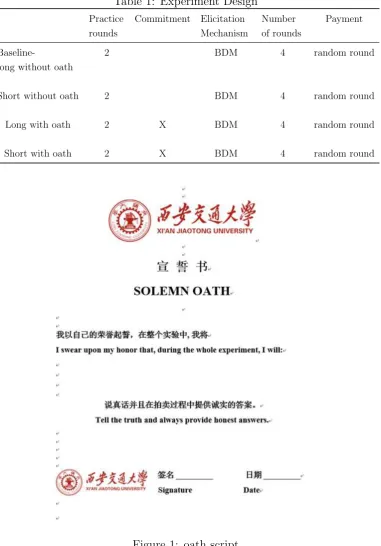
The experiment was carried out at Xi’an Jiaotong University, China. I place a bulletin board on campus to recruit participants. The baseline is a long possession without the oath. The other three treatments are long possession with an oath, short possession without an oath, and short possession with an oath. The experiment design is in table 1. Plott and Zeiler (2005) argues that the misconception of the experimental procedure can lead to the WTP-WTA gap. It is thus essential to follow the best practice to address these potential misconceptions. I followed Plott and Zeiler (2005)’s procedure and used the following procedures to ensure that there was no misconception of the game: 1) randomization for the buyer and seller of the candy bar; 2) using incentive-compatible mechanism BDM to elicit the subjects’ preferences; 3) explanation of the optimal response with numerical values; 4) using a market environment with some incentives; 5) measuring the gap directly by using valuations; 6) providing practice rounds.
not be in their best interests. After the training, subjects participate in the real experiment. Sellers of candy bars are asked to state their minimum WTA to sell the candy bars and buyers are asked to state their maximum WTP to buy the candy bars. There are four rounds. After each round, a random number that is between 1 to 15 is drawn and the market price is determined. Sellers whose WTA is lower than this price have to sell candy bars at this price. Buyers whose WTP is larger than this price have to pay this amount to buy candy bars. After four rounds, a random number between 1 to 4 is drawn to determine which round is binding. Socioeconomic data was then collected after the experiment. Subjects receive 30 Yuan as the participation fee. An on-campus job in Xi’an is usually paid 8 Yuan /hour. If they sell the candy bar as sellers, their earnings would be equal to the participation fee plus the market price. If they buy the candy bar as buyers, their earnings equal the participation fee minus the market price. Subjects are paid through electronic transfer to their bank accounts after the completion of the experiment.
The subjects with oath treatments are the same as those without oath treatment, with the exception of the subjects being asked to sign an oath script before the commencement of the experiment. The oath script is pre-sented in Figure 1. In the possession treatments, subjects are allowed to keep the candy bar during the experiment. However, in the without-possession treatment, subjects do not physically possess the candy bar at the time of decision. At the beginning of the experiment, a few candy bars are passed around for subjects to inspect before the candy bars are collected again. As such, the subjects do not physically possess the candy bar at the time of decision. In all treatments, the sellers own the candy bar.
3
Data and Results
3.1
Summary Statistics
Table 1: Experiment Design
Practice rounds
Commitment Elicitation Mechanism
Number of rounds
Payment
Baseline-long without oath
2 BDM 4 random round
Short without oath 2 BDM 4 random round
Long with oath 2 X BDM 4 random round
Short with oath 2 X BDM 4 random round
[image:8.595.102.492.158.314.2]Yuan, respectively; and the average WTA is 7.8, 6.4, 8.25 Yuan, respectively. The summary statistics are in table 2.
Table 2: Summary statistics
Baseline non-possession without oath possession with oath non-possession with Oath wtp wta wtp wta wtp wta wtp wta Mean 6.14 7.40 5.93 7.80 5.30 6.41 5.48 8.25 Median 5.75 7.75 5.75 8.00 4.50 7.00 5.75 9.00 Standard Deviation 2.05 2.51 2.25 2.07 2.16 3.00 1.34 3.03
n 31 23 22 15 15 17 15 20
3.2
Results
Result 1 There is a disparity between WTA and WTP, and WTA is
signif-icantly greater than WTP.
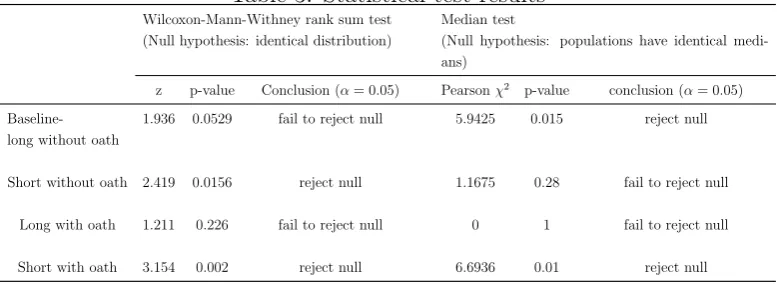
Support. From table 2 we see WTA is larger than WTP in each treat-ment. From Figure 1-4, we can see in each treatment that the WTA dis-tribution strictly dominates the WTP disdis-tribution. The Wilcoxon rank-sum test rejects the null hypothesis that WTP and WTA are drawn from the same population in both the baseline and short-without oath treatment (z = 1.936, p = 0.0529, and z = 2.419, p = 0.0156, respectively). The
median test also rejects the null hypothesis that the medians are drawn from two populations that have identical medians for the baseline (Pearson
χ2 = 5.9425, p = 0.015). However, it fails to reject the null for the short
treatment without an oath (Pearson χ2 = 1.1675, p= 0.280).
Result 2. With a solemn oath, the disparity between WTP and WTA in the
long possession group disappears. However, it persists in the short possession group.
Support. In the long with oath treatment, I find that the gap between WTP and WTA is statistically insignificant. Using the Wilcoxon rank-sum test, I fail to reject the null hypothesis that WTP and WTA are drawn from an identical population (z = 1.211, p = 0.226). The median test fails to reject
the null hypothesis that the two independent samples are drawn from pop-ulations with the same medians (χ2 = 0.000, p = 1.000). In the short-with
The Wilcoxon rank-sum test rejects the null hypothesis that the WTP and WTA are drawn from the identical population (z = 3.154, p= 0.002). The
median test rejects the null hypothesis that the two independent samples are drawn from populations with the same medians (χ2 = 6.6936, p= 0.010).
Result 3. The short possession endowment increases the disparity between
the WTP and WTA.
Support. I calculate the gap in each round by using the average WTA minus the average WTP. In the baseline, the gaps in the four rounds are {1.228, 1.228, 1.228, 1.088}. The gaps in the four rounds of short- without oath treatment are {2.142, 1.996, 1.372, 1.960}. The gaps in the long-with oath treatment are {1.282, 1.270, 0.909, 0.984}. The gaps in the short-with oath treatment are {2.583, 2.65, 2.883, 2.95}. I pool the two treatments with short possession and the two treatments with the long possession. Using the Wilcoxon signed rank test, I reject the null hypothesis that the two independent samples are drawn from identical populations (z =−2.380, p=
0.0173).
[image:10.595.103.492.469.611.2]I also use individual round data and find the same results. The subjects’ bids are relatively stable across four rounds.
Table 3: Statistical test results
Wilcoxon-Mann-Withney rank sum test (Null hypothesis: identical distribution)
Median test
(Null hypothesis: populations have identical medi-ans)
z p-value Conclusion (α= 0.05) Pearsonχ2 p-value conclusion (α= 0.05)
Baseline-long without oath
1.936 0.0529 fail to reject null 5.9425 0.015 reject null
Short without oath 2.419 0.0156 reject null 1.1675 0.28 fail to reject null
Long with oath 1.211 0.226 fail to reject null 0 1 fail to reject null
Figure 2: Empirical Distribution Functions of bids: treat1–baseline; treat2– short without oath; treat3–long with oath; treat4–short with oath
4
Discussion and Conclusion
respond differently to a solemn oath in a CVM study. Ehmke et al. (2008) tests the hypothetical bias in different continents and finds that there are differences across cultures. As such, many other experimental studies use a broader subject pool to study the universal effect of behavioral bias (Henrich et al. (2001)). Apicella et al. (2014) studies isolated hunter-gathers group living in Northern Tanzania and found they do not show the endowment ef-fect. The same population living in areas that are more exposed to modern society do not show the endowment effect. My evidence in China thus lends support to the universal effect of the endowment effect.
My study has some limitations. For one, I had a relatively small sam-ple size. I also used student subjects in the lab to increase the control of the experiment. An avenue for future research can be in the study of the endowment effect in a field setting that has a more diversified subject pool.
References
Apicella, C. L., Azevedo, E. M., Fowler, J. H., and Christakis, N. A. (2014). Evolutionary origins of the endowment effect: Evidence from hunter-gatherers. American Economic Review, 104(6):1793–1805.
Boyce, R. R., Brown, T. C., McClelland, G. H., Peterson, G. L., and Schulze, W. D. (1992). An experimental examination of intrinsic values as a source of the wta-wtp disparity. The American Economic Review, 82(5):1366– 1373.
Carlsson, F., Kataria, M., Krupnick, A., Lampi, E., L¨ofgren, ˚A., Qin, P., and Sterner, T. (2013). The truth, the whole truth, and nothing but the trutha multiple country test of an oath script. Journal of Economic Behavior & Organization, 89:105–121.
Cason, T. N. and Plott, C. (2014). Misconceptions and game form recogni-tion: Challenges to theories of revealed preference and framing. Journal of Political Economy, 122:1235–1270.
effectiveness of the oath script in reducing the hypothetical bias in the contingent valuation method. 62:378–384.
de Magistris, T. and Pascucci, S. (2014). The effect of the solemn oath script in hypothetical choice experiment survey: A pilot study. Economics Letters, 123(2):252–255.
Ehmke, M. D., Lusk, J. L., and List, J. A. (2008). Is hypothetical bias a universal phenomenon? a multinational investigation. Land economics, 84(3):489–500.
Engelmann, D. and Hollard, G. (2010). Reconsidering the effect of market experience on the ”endowment effect”. Econometrica, 78(6):2005–2019.
Hanemann, M. W. (1991). Willingness to pay and willingness to accept: how much can they differ? The American Economic Review, 81(3):635–647.
Heffetz, O. and List, J. A. (2014). Is the endowment effect an expectations effect? Journal of the European Economic Association, 12(5):1396–1422.
Henrich, J., Boyd, R., Bowles, S., Camerer, C., Fehr, E., Gintis, H., and Mcelreath, R. (2001). In search of homo economicus: Behavioral experi-ments in 15 small-scale societies. American Economic Review, 91(2):73–78.
Horowitz, J. K. and McConnell, K. E. (2002). A review of wta/wtp studies.
Journal of Environmental Economics and Management, 44(3):426 – 447.
Isoni, A., Loomes, G., and Sugden, R. (2011). The willingness to paywill-ingness to accept gap, the” endowment effect,” subject misconceptions, and experimental procedures for eliciting valuations: Comment. American Economic Review, 101(2):991–1011.
Jacquemet, N., James, A., Luchini, S., and Shogren, J. F. (2017). Referenda under oath. Environmental and Resource Economics, 67(3):479–504.
Jacquemet, N., Luchini, S., Shogren, J. F., and Zylbersztejn, A. (2015). Coordination with communication under oath. Experimental Economics, 2011(2011):1–23.
Kahneman, D., Knetsch, J. L., and Thaler, R. H. (1990). Experimental tests of the endowment effect and the coase theorem. Journal of political Economy, 98(6):1325–1348.
Kahneman, D. and Tversky, A. (1979). Prospect theory: An analysis of decision under risk. Econometrica : journal of the Econometric Society., 47(2).
Knetsch, J. L. and Sinden, J. A. (1984). Willingness to pay and compensation demanded: Experimental evidence of an unexpected disparity in measures of value. The Quarterly Journal of Economics, 99(3):507–521.
Knetsch, J. L. and Wong, W. (2009). The endowment effect and the reference state: Evidence and manipulations. Journal of Economic Behavior and Organization, 71(2):407–413.
Kszegi, B. and Rabin, M. (2006). A Model of Reference-Dependent Prefer-ences. The Quarterly Journal of Economics, 121(4):1133–1165.
List, J. A. (2003). Does market experience eliminate market anomalies? The Quarterly Journal of Economics, 118(1):41–71.
Marzilli Ericson, K. M. and Fuster, A. (2011). Expectations as endowments: Evidence on reference-dependent preferences from exchange and valuation experiments. The Quarterly Journal of Economics, 126(4):1879–1907.
Marzilli Ericson, K. M. and Fuster, A. (2014). The endowment effect. Annu. Rev. Econ., 6(1):555–579.
Shogren, J., Shin, S. Y., Hayes, D., and Kliebenstein, J. B. (1994). Resolv-ing differences in willResolv-ingness to pay and willResolv-ingness to accept. American Economic Review, 84(1):255–70.
Shogren, J. F., Cho, S., Koo, C., List, J., Park, C., Polo, P., and Wilhelmi, R. (2001). Auction mechanisms and the measurement of wtp and wta.
Resource and Energy Economics, 23(2):97–109.
Stevens, T. H., Tabatabaei, M., and Lass, D. (2013). Oaths and hypothetical bias. Journal of Environmental Management, 127(127C):135–141.
Tunel, T. and Hammitt, J. (2014). A new meta-analysis on the wtp/wta dis-parity. Journal of Environmental Economics and Management, 68(1):175– 187.