Munich Personal RePEc Archive
Predicting inflation in the Kingdom of
Bahrain using ARIMA models
NYONI, THABANI
University of Zimbabwe
19 February 2019
Online at
https://mpra.ub.uni-muenchen.de/92452/
Predicting Inflation in the Kingdom of Bahrain using ARIMA Models
Nyoni, Thabani
Department of Economics
University of Zimbabwe
Harare, Zimbabwe
Email: [email protected]
ABSTRACT
This research uses annual time series data on inflation rates in the Kingdom of Bahrain from 1966 to 2017, to model and forecast inflation using ARIMA models. Diagnostic tests indicate that Bahrain inflation series is I(1). The study presents the ARIMA (0, 1, 1). The diagnostic tests further imply that the presented optimal ARIMA (0, 1, 1) model is stable and acceptable for predicting inflation in the Kingdom of Bahrain. The results of the study apparently show that predicted inflation will be approximately 1.5% by 2020. Policy makers and the business community in the Kingdom of Bahrain are expected to take advantage of the anticipated stable inflation rates over the next decade.
Key Words: Bahrain, Forecasting, Inflation
JEL Codes: C53, E31, E37, E47
INTRODUCTION
Inflation is the sustained increase in the general level of prices and services over time (Blanchard, 2000). The negative effects of inflation are widely recognized (Fenira, 2014). Inflation is one of the central terms in macroeconomics (Enke & Mehdiyev, 2014) as it harms the stability of the acquisition power of the national currency, affects economic growth because investment projects become riskier, distorts consuming and saving decisions, causes unequal income distribution and also results in difficulties in financial intervention (Hurtado et al, 2013). Average consumer price inflation in the Kingdom of Bahrain is so moderate and it was found 2.8% in 2012. The largest weights and the main drivers of inflationary trends in the country were housing and food (Al-Ezzee, 2016). The country’s inflation is likely to remain the lowest in the Gulf region, with projections of upward pressures in the future period, due to its economic diversification. Bahrain’s susceptibility to inflation is petroleum-driven due to the Central Bank policies, which are tied to oil revenues as well as the strong inter-relation of the country’s economy with the Kingdom of Saudi Arabia (Ghassan, 2014).
industrialized economies is mandated to maintain price stability over the medium term (Buelens, 2012). Economic agents, private and public alike; monitor closely the evolution of prices in the economy, in order to make decisions that allow them to optimize the use of their resources (Hector & Valle, 2002). Decision-makers hence need to have a view of the likely future path of inflation when taking measures that are necessary to reach their objective (Buelens, 2012). To avoid adjusting policy and models by not using an inflation rate prediction can result in imprecise investment and saving decisions, potentially leading to economic instability (Enke & Mehdiyev, 2014). In this study, we seek to model and forecast inflation in Bahrain using ARIMA models.
LITERATURE REVIEW
Kock & Terasvirta (2013) forecasted Finnish consumer price inflation using Artificial Neural Network models with a data set ranging over the period March 1960 – December 2009 and established that direct forecasts are more accurate then their recursive counterparts. Kharimah et al (2015) analyzed the CPI in Malaysia using ARIMA models with a data set ranging over the period January 2009 to December 2013 and revealed that the ARIMA (1, 1, 0) was the best model to forecast CPI in Malaysia. Nyoni (2018) studied inflation in Zimbabwe using GARCH models with a data set ranging over the period July 2009 to July 2018 and established that there is evidence of volatility persistence for Zimbabwe’s monthly inflation data. Nyoni (2018) modeled inflation in Kenya using ARIMA and GARCH models and relied on annual time series data over the period 1960 – 2017 and found out that the ARIMA (2, 2, 1) model, the ARIMA (1, 2, 0) model and the AR (1) – GARCH (1, 1) model are good models that can be used to forecast inflation in Kenya. Nyoni & Nathaniel (2019), based on ARMA, ARIMA and GARCH models; studied inflation in Nigeria using time series data on inflation rates from 1960 to 2016 and found out that the ARMA (1, 0, 2) model is the best model for forecasting inflation rates in Nigeria.
MATERIALS & METHODS
One of the methods that are commonly used for forecasting time series data is the Autoregressive Integrated Moving Average (ARIMA) (Box & Jenkins, 1976; Brocwell & Davis, 2002; Chatfield, 2004; Wei, 2006; Cryer & Chan, 2008). For the purpose of forecasting inflation rate in Bahrain, ARIMA models were specified and estimated. If the sequence ∆dBt satisfies an ARMA (p, q) process; then the sequence of Bt also satisfies the ARIMA (p, d, q) process such that:
∆𝑑𝐵
𝑡= ∑ 𝛽𝑖∆𝑑𝐵𝑡−𝑖+ 𝑝
𝑖=1
∑ 𝛼𝑖𝜇𝑡−𝑖 𝑞
𝑖=1
+ 𝜇𝑡… … … . … … … … . … … . [1]
which we can also re – write as:
∆𝑑𝐵
𝑡 = ∑ 𝛽𝑖∆𝑑𝐿𝑖𝐵𝑡 𝑝
𝑖=1
+ ∑ 𝛼𝑖𝐿𝑖𝜇𝑡 𝑞
𝑖=1
+ 𝜇𝑡… … … . . … … … . … … … [2]
where ∆ is the difference operator, vector β ϵⱤp and ɑ ϵⱤq.
The first step towards model selection is to difference the series in order to achieve stationarity. Once this process is over, the researcher will then examine the correlogram in order to decide on the appropriate orders of the AR and MA components. It is important to highlight the fact that this procedure (of choosing the AR and MA components) is biased towards the use of personal judgement because there are no clear – cut rules on how to decide on the appropriate AR and MA components. Therefore, experience plays a pivotal role in this regard. The next step is the estimation of the tentative model, after which diagnostic testing shall follow. Diagnostic checking is usually done by generating the set of residuals and testing whether they satisfy the characteristics of a white noise process. If not, there would be need for model re – specification and repetition of the same process; this time from the second stage. The process may go on and on until an appropriate model is identified (Nyoni, 2018).
Data Collection
This study is based on a data set of annual rates of inflation in Bahrain (INF or simply B) ranging over the period 1966 – 2017. All the data was taken from the World Bank.
[image:4.612.75.551.351.651.2]Diagnostic Tests & Model Evaluation Stationarity Tests: Graphical Analysis
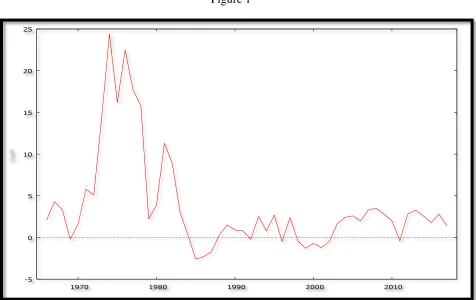
Figure 1
The Correlogram in Levels
Autocorrelation function for INF ***, **, * indicate significance at the 1%, 5%, 10% levels.
-5 0 5 10 15 20 25
Table 1
LAG ACF PACF Q-stat. [p-value]
1 0.7985 *** 0.7985 *** 35.1035 [0.000]
2 0.6372 *** -0.0009 57.9092 [0.000]
3 0.4877 *** -0.0575 71.5406 [0.000]
4 0.3555 ** -0.0471 78.9348 [0.000]
5 0.2042 -0.1433 81.4265 [0.000]
6 0.1205 0.0612 82.3130 [0.000]
7 0.0778 0.0558 82.6905 [0.000]
8 -0.0091 -0.1641 82.6958 [0.000]
9 -0.0951 -0.0925 83.2859 [0.000]
10 -0.1330 0.0248 84.4693 [0.000]
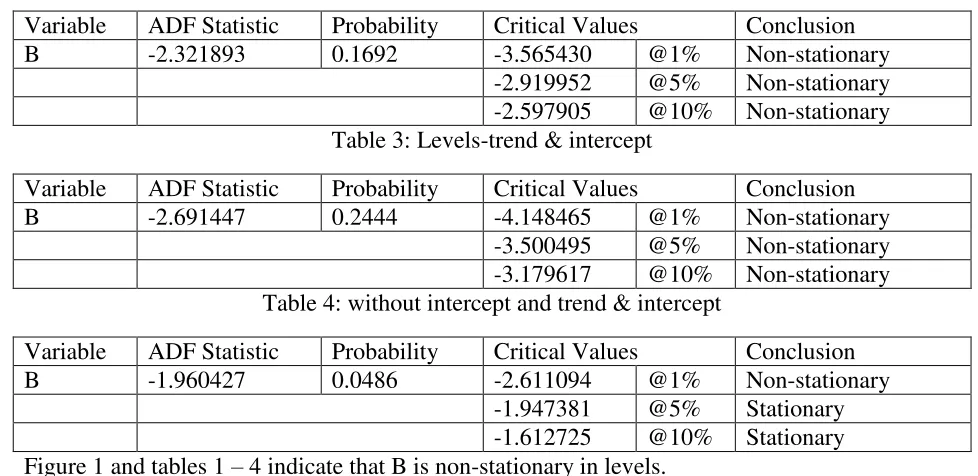
The ADF Test in Levels
Table 2: Levels-intercept
Variable ADF Statistic Probability Critical Values Conclusion B -2.321893 0.1692 -3.565430 @1% Non-stationary
-2.919952 @5% Non-stationary -2.597905 @10% Non-stationary Table 3: Levels-trend & intercept
Variable ADF Statistic Probability Critical Values Conclusion B -2.691447 0.2444 -4.148465 @1% Non-stationary
-3.500495 @5% Non-stationary -3.179617 @10% Non-stationary Table 4: without intercept and trend & intercept
Variable ADF Statistic Probability Critical Values Conclusion B -1.960427 0.0486 -2.611094 @1% Non-stationary
[image:5.612.60.549.400.638.2]-1.947381 @5% Stationary -1.612725 @10% Stationary Figure 1 and tables 1 – 4 indicate that B is non-stationary in levels.
The Correlogram (at 1st Differences)
Autocorrelation function for d_INF ***, **, * indicate significance at the 1%, 5%, 10% levels.
LAG ACF PACF Q-stat. [p-value]
1 -0.0915 -0.0915 0.4531 [0.501]
2 -0.0350 -0.0437 0.5205 [0.771]
3 -0.0489 -0.0569 0.6553 [0.884]
4 0.0544 0.0433 0.8256 [0.935]
5 -0.1617 -0.1591 2.3617 [0.797]
6 -0.1150 -0.1488 3.1557 [0.789]
7 0.1397 0.1103 4.3538 [0.738]
8 0.0230 0.0182 4.3872 [0.821]
9 -0.1372 -0.1364 5.5992 [0.779]
10 -0.0220 -0.0521 5.6311 [0.845]
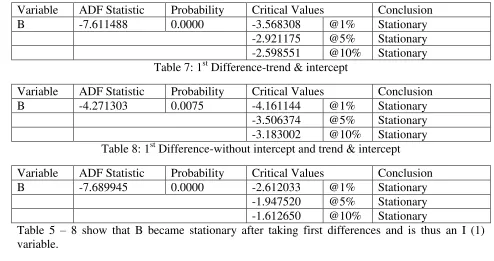
[image:6.612.80.302.76.331.2]ADF Test in 1st Differences
Table 6: 1st Difference-intercept
Variable ADF Statistic Probability Critical Values Conclusion B -7.611488 0.0000 -3.568308 @1% Stationary
[image:6.612.55.549.379.640.2]-2.921175 @5% Stationary -2.598551 @10% Stationary Table 7: 1st Difference-trend & intercept
Variable ADF Statistic Probability Critical Values Conclusion B -4.271303 0.0075 -4.161144 @1% Stationary
-3.506374 @5% Stationary -3.183002 @10% Stationary Table 8: 1st Difference-without intercept and trend & intercept
Variable ADF Statistic Probability Critical Values Conclusion B -7.689945 0.0000 -2.612033 @1% Stationary
-1.947520 @5% Stationary -1.612650 @10% Stationary
Table 5 – 8 show that B became stationary after taking first differences and is thus an I (1) variable.
Evaluation of ARIMA models (without a constant)
Table 9
Model AIC U ME MAE RMSE MAPE
ARIMA (0, 1, 1) 284.4530 0.97447 -0.012452 2.4983 3.7831 178.39 ARIMA (2, 1, 0) 286.4001 0.98575 -0.012843 2.4911 3.781 178.73 A model with a lower AIC value is better than the one with a higher AIC value (Nyoni, 2018). Theil’s U must lie between 0 and 1, of which the closer it is to 0, the better the forecast method (Nyoni, 2018). The study will only consider the AIC as the criteria for choosing the best model for forecasting inflation in Bahrain and therefore, the ARIMA (0, 1, 1) model is carefully selected.
Residual & Stability Tests
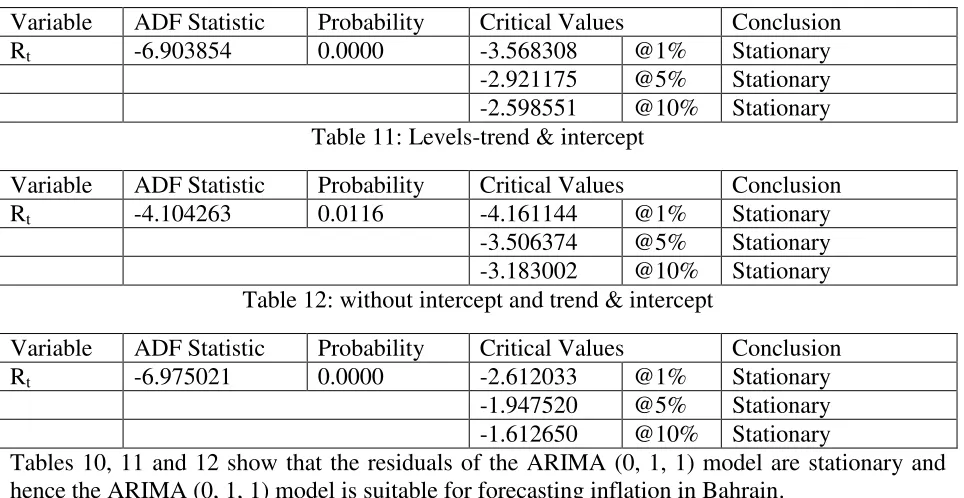
ADF Tests of the Residuals of the ARIMA (0, 1, 1) Model
Table 10: Levels-intercept
Variable ADF Statistic Probability Critical Values Conclusion Rt -6.903854 0.0000 -3.568308 @1% Stationary
[image:7.612.67.549.248.497.2]-2.921175 @5% Stationary -2.598551 @10% Stationary Table 11: Levels-trend & intercept
Variable ADF Statistic Probability Critical Values Conclusion Rt -4.104263 0.0116 -4.161144 @1% Stationary
-3.506374 @5% Stationary -3.183002 @10% Stationary Table 12: without intercept and trend & intercept
Variable ADF Statistic Probability Critical Values Conclusion Rt -6.975021 0.0000 -2.612033 @1% Stationary
-1.947520 @5% Stationary -1.612650 @10% Stationary
Tables 10, 11 and 12 show that the residuals of the ARIMA (0, 1, 1) model are stationary and hence the ARIMA (0, 1, 1) model is suitable for forecasting inflation in Bahrain.
[image:7.612.174.438.558.728.2]Stability Test of the ARIMA (0, 1, 1) Model
Figure 2
-1.5 -1.0 -0.5 0.0 0.5 1.0 1.5
-1.5 -1.0 -0.5 0.0 0.5 1.0 1.5
M
A
ro
ot
s
Since the corresponding inverse roots of the characteristic polynomial lie in the unit circle, it illustrates that the chosen ARIMA (0, 1, 1) model is stable and suitable for predicting inflation in Bahrain over the period under study.
FINDINGS
[image:8.612.71.548.186.310.2]Descriptive Statistics
Table 13
Description Statistic
Mean 3.7981
Median 2.3
Minimum -2.6
Maximum 24.4
Standard deviation 6.0215
Skewness 1.9623
Excess kurtosis 3.2117
As shown above, the mean is positive, i.e. 3.7981%. The minimum is -2.6% and the maximum is 24.4%. The skewness is 1.9623 and the most striking characteristic is that it is positive, indicating that the inflation series is positively skewed and non-symmetric. Excess kurtosis was found to be 3.2117 (the rule of thumb is that kurtosis must be around 3 for normally distributed variables); implying that the inflation series is normally distributed.
Results Presentation1
Table 14
ARIMA (0, 1, 1) Model:
∆𝐵𝑡−1= −0.0995377𝜇𝑡−1. … … … . . . [3]
P: (0.4756) S. E: (0.1395)
Variable Coefficient Standard Error z p-value
MA (1) -0.0995377 0.139517 -0.7134 0.4756
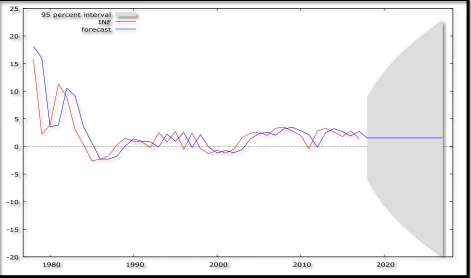
Forecast Graph
Figure 3
1
Predicted Annual Inflation in Bahrain
Table 15
Year Prediction Std. Error 95% Confidence Interval
2018 1.5 3.78 -5.9 - 8.9
2019 1.5 5.09 -8.4 - 11.5
2020 1.5 6.13 -10.5 - 13.5
2021 1.5 7.01 -12.2 - 15.3
2022 1.5 7.79 -13.7 - 16.8
2023 1.5 8.50 -15.1 - 18.2
2024 1.5 9.16 -16.4 - 19.5
2025 1.5 9.77 -17.6 - 20.7
2026 1.5 10.35 -18.8 - 21.8
2027 1.5 10.90 -19.8 - 22.9
Figure 3 (with a forecast range from 2018 – 2027) and table 15, clearly show that inflation in the Kingdom of Bahrain is projected to be hovering around 1.5% in the next 10 years. This clear
-20 -15 -10 -5 0 5 10 15 20 25
1980 1990 2000 2010 2020
[image:9.612.79.550.77.355.2]testimony to the fact that there is price stability in the Kingdom of Bahrain and this is indeed predicted to exist over the next decade, ceteris paribus.
CONCLUSION
The ARIMA model was employed to investigate annual inflation rates in the Kingdom of Bahrain from 1966 to 2017. The study planned to forecast inflation in the Kingdom of Bahrain for the upcoming period from 2018 to 2027 and the best fitting model was carefully selected. The ARIMA (0, 1, 1) model is stable and most suitable model to forecast inflation in the Kingdom of Bahrain for the next ten years. Based on the results, policy makers in Israel should continue to engage proper economic policies in order to fight against any inflationary pressures in the economy. In this regard, relevant monetary authorities in the Kingdom of Bahrain are encouraged to continue exercising prudent policy formulation and implementation.
REFERENCES
[1] Al-Ezzee, H. I (2016). Drivers of inflation in the economy of Bahrain, International Journal of Economics and Finance, 8 (3): 178 – 188.
[2] Blanchard, O (2000). Macroeconomics, 2nd Edition, Prentice Hall, New York.
[3] Box, G. E. P & Jenkins, G. M (1976). Time Series Analysis: Forecasting and Control,
Holden Day, San Francisco.
[4] Brocwell, P. J & Davis, R. A (2002). Introduction to Time Series and Forecasting,
Springer, New York.
[5] Buelens, C (2012). Inflation modeling and the crisis: assessing the impact on the performance of different forecasting models and methods, European Commission, Economic Paper No. 451.
[6] Chatfield, C (2004). The Analysis of Time Series: An Introduction, 6th Edition, Chapman & Hall, New York.
[7] Cryer, J. D & Chan, K. S (2008). Time Series Analysis with Application in R, Springer, New York.
[8] Enke, D & Mehdiyev, N (2014). A Hybrid Neuro-Fuzzy Model to Forecast Inflation,
Procedia Computer Science, 36 (2014): 254 – 260.
[9] Fenira, M (2014). Democracy: a determinant factor in reducing inflation, International Journal of Economics and Financial Issues, 4 (2): 363 – 375.
[10] Ghassan, O (2014). Macroeconomic indicators in the Kingdom of Bahrain: Measuring Economic Performance for Global Competitiveness, ME14 Dubai Conference, 10 – 12 October 2014.
[11] Hector, A & Valle, S (2002). Inflation forecasts with ARIMA and Vector Autoregressive models in Guatemala, Economic Research Department, Banco de Guatemala.
[12] Hurtado, C., Luis, J., Fregoso, C & Hector, J (2013). Forecasting Mexican Inflation Using Neural Networks, International Conference on Electronics, Communications and Computing, 2013: 32 – 35.
[13] Kharimah, F., Usman, M., Elfaki, W & Elfaki, F. A. M (2015). Time Series Modelling and Forecasting of the Consumer Price Bandar Lampung, Sci. Int (Lahore)., 27 (5): 4119 – 4624.
[14] King, M (2005). Monetary Policy: Practice Ahead of Theory, Bank of England.
[15] Kock, A. B & Terasvirta, T (2013). Forecasting the Finnish Consumer Price Inflation using Artificial Network Models and Three Automated Model Section Techniques, Finnish Economic Papers, 26 (1): 13 – 24.
[16] Mcnelis, P. D & Mcadam, P (2004). Forecasting Inflation with Think Models and Neural Networks, Working Paper Series, European Central Bank.
[17] Nyoni, T & Nathaniel, S. P (2019). Modeling Rates of Inflation in Nigeria: An Application of ARMA, ARIMA and GARCH models, Munich University Library – Munich Personal RePEc Archive (MPRA), Paper No. 91351.
[18] Nyoni, T (2018). Modeling and Forecasting Inflation in Zimbabwe: a Generalized Autoregressive Conditionally Heteroskedastic (GARCH) approach, Munich University Library – Munich Personal RePEc Archive (MPRA), Paper No. 88132.
[19] Nyoni, T (2018). Modeling Forecasting Naira / USD Exchange Rate in Nigeria: a Box – Jenkins ARIMA approach, University of Munich Library – Munich Personal RePEc Archive (MPRA), Paper No. 88622.
[20] Nyoni, T (2018). Modeling and Forecasting Inflation in Kenya: Recent Insights from ARIMA and GARCH analysis, Dimorian Review, 5 (6): 16 – 40.
[21] Nyoni, T. (2018). Box – Jenkins ARIMA Approach to Predicting net FDI inflows in Zimbabwe, Munich University Library – Munich Personal RePEc Archive (MPRA), Paper No. 87737.
[22] Wei, W. S (2006). Time Series Analysis: Univariate and Multivariate Methods, 2nd Edition, Pearson Education Inc, Canada.