74
Statistical Machine Transliteration Baselines for NEWS 2018
Snigdha Singhania1, Minh Nguyen1, Hoang Gia Ngo1, Nancy F. Chen2
1National University of Singapore, Singapore
{singhaniasnigdha,nguyen.binh.minh92,ngohgia}@u.nus.edu 2Singapore University of Technology and Design, Singapore
Abstract
This paper reports the results of our transliteration experiments conducted on NEWS 2018 Shared Task dataset. We focus on creating the baseline systems trained using two open-source, statistical transliteration tools, namely Sequitur and Moses. We discuss the pre-processing steps performed on this dataset for both the systems. We also provide a re-ranking system which uses top hypotheses from Sequitur and Moses to create a consoli-dated list of transliterations. The results obtained from each of these models can be used to present a good starting point for the participating teams.
1 Introduction
Transliteration is defined as the phonetic trans-lation of words across languages (Knight and Graehl,1998;Li et al., 2009). It can be consid-ered as a machine translation problem at the char-acter level. Transliteration converts words writ-ten in one writing system (source language, e.g., English) into phonetically equivalent words in an-other writing system (target language, e.g., Hindi) and is often used to translate foreign names of peo-ple, locations, organizations, and products (Gia et al.,2015). With names comprising over 75 per-cent of the unseen words (Bhargava and Kondrak,
2011), they are a challenging problem in machine translation, multilingual information retrieval, cor-pus alignment and other natural language process-ing applications. More so, studies suggest that cross-lingual information retrieval performances can improve by as much as 50 percent if the sys-tem is provided with suitably transliterated named entities (Larkey et al.,2003).
In this paper, we run two baseline transliter-ation experiments and report our results on the NEWS 2018 Shared Task dataset. A re-ranking model using linear regression has also been pro-vided in an attempt to combine hypotheses from both the baselines. Song et al. (2010) proposed that the performance of a transliteration system is expected to improve when the output candi-dates are re-ranked, as the Shared Task consid-ers only the top-1 hypothesis when evaluating a system. Our re-ranking approach which uses the union of Sequitur and Moses hypotheses results in the top-1 word accuracy for all language pairs to be either an improvement or lie in their re-spective Moses and Sequitur accuracy range, ex-cluding English-to-Thai, English-to-Chinese and English-to-Vietnamese where the results are rel-atively poorer.
The rest of this paper is structured as follows. Section 2 contains a summary of the datasets used for the transliteration task. Section 3 describes the two well-known statistical transliteration methods adopted; first, a joint-source channel approach us-ing Sequitur, and second, a phrase-based statis-tical machine translation approach using Moses. Section 4 focuses on the experimental setup, re-ranking approach, and documents the results ob-tained. Finally, Section 5 summarizes the paper.
2 Data
The corpus sizes of each of the data partitions, namely training, development and test for the 19 language pairs used in the transliteration experi-ments is summarized in Table 1.
3 Methods
Task ID Training Development Test
T-EnTh 30781 1000 1000 B-ThEn 27273 1000 1433 T-EnPe 13386 1000 1000 B-PeEn 15677 1000 908 T-EnCh 41318 1000 1000 B-ChEn 32002 1000 1000
T-EnVi 3256 500 500
M-EnBa 13623 1000 1000 M-EnHi 12937 1000 1000 T-EnHe 10501 1000 523 M-EnKa 10955 1000 1000 M-EnTa 10957 1000 1000 B-HeEn 9447 1000 590
[image:2.595.79.284.66.335.2]T-ArEn 31354 1000 1000 T-EnKo 7387 1000 1000 T-EnJa 28828 1000 1000 B-JnJk 10514 1000 1000 B-EnPe 11204 1000 1000 T-PeEn 6000 1000 1000
Table 1: Corpus Size for the 19 language pairs, where En: English, Th: Thai, Pe: Persian, Ch: Chinese, Vi: Vietnamese, Ba: Bangla, Hi: Hindi, He: Hebrew, Ka: Kannada, Ta: Tamil, Ar: Arabic, Ko: Korean, Ja: Japanese Katakana, Jn: English, Jk: Japanese Kanji.
and Moses, which adopts phrase-based statistical machine translation. It should be noted that iden-tical settings were used for all 19 language pairs.
3.1 Joint Source-Channel Model
The Joint Source-Channel Model was first stud-ied byLi et al.(2004), where a direct orthographic mapping was proposed for transliteration. Given a pair of languages, for example English and Hindi, wheree andhare representative of their translit-eration units, respectively; the translittranslit-eration pro-cess is nding the alignment for sub-sequences of the input string, E and the output string, H ( Per-vouchine et al.,2009), and can be represented for ann-gram model as
P(E, H) =P(e1, e2, ..., ek, h1, h2, ..., hk)
=P(< e1, h1>, ..., < ek, hk >)
=
k Y
i=1
P(< e, h >i |< e, h >i−i−n1+1)
(1) wherekis number of alignment units. P(E, H)
is, thus, the joint probability of thei-th alignment
pair, which depends onnprevious pairs in the se-quence.
Sequitur is a data-driven translation tool, orig-inally developed for grapheme-to-phoneme con-version byBisani and Ney(2008). It is applicable to several monotonous sequence translation tasks and hence is a popular tool in machine transliter-ation. It is different from many translation tools, as it is able to train a jointn-gram model from un-aligned data. Higher ordern-grams are trained it-eratively from the smaller ones — first, a unigram model is trained, which is then used for a bigram model, and so on. We report results on a 5-gram Sequitur model in this paper.
3.2 Phrase-Based Statistical Machine Translation (PB-SMT)
Phrase-based machine translation model breaks the source sentence into phrases and translates these phrases in the target language before com-bining them to produce one final translated result (Brown et al., 1993; Collins, 2011). Its use can be extended in the field of transliteration — as transliteration is defined as a translation task at the character level (Koehn et al.,2007). The best transliteration sequence, Hbest, in the target lan-guage is generated by multiplying the probabil-ities of the transliteration model, P and the lan-guage model,P(E|H), along with their respective weights,αandβ, as
Hbest=argmaxHhP(H|E)
=argmaxHhαP(E|H)×βP(H)
(2)
wherehis the set of all phonologically correct words in the target orthography.
Moses is the statistical translation tool, which adopts the Phrase-Based Statistical Machine Translation approach. GIZA++ is used for align-ing the word pairs and KenLM is used for creat-ing the n-gram language models. We create 5-gram language models using the target language corpus. The decoders log-linear model is tuned using MERT.
3.3 Hypothesis Re-ranking
Moses + Sequitur: We conduct an experiment to analyze the outcome when using hypotheses from both Sequitur and Moses, where a linear combination of their corresponding scores is used to rank the consolidated hypothesis list. The fea-ture set consists of 10 scores from lexical reorder-ing, language modellreorder-ing, word penalty, phrase penalty, and translation from Moses and 1 confi-dence score from Sequitur. We use constrained decoding to obtain Moses scores for Sequitur transliterations which do not occur in the top-n Moses hypotheses. A linear regression model sim-ilar to that adopted by Shao et al. (2015) is used for re-ranking. For each transliteration, we use the edit distance of the hypothesis from the refer-ence as the output of the linear regression model, following Wang et al. (2015). The hypotheses are ranked in increasing order of their calculated edit distance. The linear regression model can be mathematically represented using:
ED=c+
10 X
i=1
αixi (3)
whereEDis the edit distance calculated by the regression model, c is the intercept, and αi and xi are the coefficient and value of thei-th feature. As the edit distance between the hypothesis and reference is a measure of their similarity, it is seen as an effective parameter which can be used to re-rank the different hypotheses. It should be noted that these re-ranking experiments were performed after the Shared Task deadline and are not included in the official results submitted to the workshop.
4 Experiments
4.1 Experimental Setup for Sequitur
As an inherent grapheme-to-phoneme converter, the target language is broken down into its pho-netic letter representation (phonemes), which are individual target language characters in a translit-eration task. An example from the English-Hindi corpus is shown in Figure 1.
4.2 Experimental Setup for Moses
For this experiment, we augment word represen-tations with boundary markers (ˆfor the start of the word and $ for the end of the word). Adding boundary markers ensures that charac-ter position is encoded in these word repre-sentations, which is otherwise ignored in PB-SMT models (Kunchukuttan and Bhattacharyya,
2015). This significantly improves translitera-tion accuracy for languages (e.g., all Indian lan-guages) which have different characters for iden-tical phonological symbols depending on where (initial, medial or terminal position) they occur in a word. Figure 2 shows an example of how the strings are represented after pre-processing for Moses.
4.3 Results
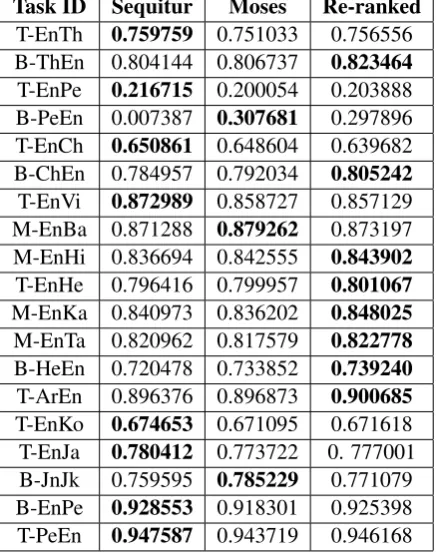
Results from Moses and Sequitur on the test set are included in Tables 2 and 3. Table 2 includes top-1 accuracy results, while Table 3 summarizes the mean F-scores, for outcomes from each of Sequitur, Moses, and the consolidated re-ranking model on the hidden test partition. The top-1 hy-pothesis from the (Moses + Sequitur) re-ranked model is found to be the top-1 Sequitur and top-1 Moses transliteration in 61.93% and 61.06% in-stances, on average; of which the Sequitur and Moses results are identical in 45.62% instances. 22.63% of the time, on average, the top-1 re-ranked hypothesis is neither the top-1 from Moses nor Sequitur. These numbers do not include the English-to-Persian and Persian-to-English (with Western names) datasets, on account of the en-coding mismatch between their test set with their training and development set, which is discussed later in this section.
Task ID Sequitur Moses Re-ranked
T-EnTh 14.10 13.90 13.50 B-ThEn 22.33 22.89 26.59
T-EnPe 0.10 0.10 0.10
B-PeEn 0.00 0.11 0.11
T-EnCh 26.20 26.30 24.90 B-ChEn 17.50 17.90 18.80
T-EnVi 45.00 43.40 40.40 M-EnBa 38.20 40.70 41.10
M-EnHi 30.03 33.33 31.83 T-EnHe 16.83 17.59 17.40 M-EnKa 28.41 26.90 30.02
M-EnTa 18.22 16.01 17.73 B-HeEn 6.78 9.16 8.47
T-ArEn 33.80 35.00 37.50
T-EnKo 25.90 26.10 29.20
[image:4.595.77.286.63.344.2]T-EnJa 31.83 29.13 31.73 B-JnJk 51.70 60.30 57.20 B-EnPe 61.00 55.60 57.10 T-PeEn 65.80 65.60 66.40
Table 2: Word accuracies (%) from Moses and Se-quitur models reported on the test set.
names) while Moses works best for another 5 — namely, English-to-Chinese, English-to-Hindi, English-to-Hebrew, Hebrew-to-English, and English-to-Kanji. The combined re-ranking of Moses + Sequitur improves the top-1 accuracy for 7 language pairs, which are Thai-to-English, Chinese-to-English, to-Bengali, English-to-Kannada, Arabic-to-English, English-to-Korean and Persian-to-English (with Persian names).
Further, it is observed that English-to-Persian and Persian-to-English (with Western names) per-form very poorly as 66.92% and 67.53% Persian characters in the test set, respectively, were not present in either the training or the development set. The model is thus unable to predict transliter-ations for these characters, which occurs very fre-quently in the test set and hence report 100% error rates. The same language pair, however, performs significantly better ( 55-65% accuracy) for Persian names where the test set introduces no new tokens from the data used to train the transliteration mod-els.
5 Summary
The two systems based on the joint source-channel and phrase-based statistical approaches are
base-Task ID Sequitur Moses Re-ranked
T-EnTh 0.759759 0.751033 0.756556 B-ThEn 0.804144 0.806737 0.823464
T-EnPe 0.216715 0.200054 0.203888 B-PeEn 0.007387 0.307681 0.297896 T-EnCh 0.650861 0.648604 0.639682 B-ChEn 0.784957 0.792034 0.805242
T-EnVi 0.872989 0.858727 0.857129 M-EnBa 0.871288 0.879262 0.873197 M-EnHi 0.836694 0.842555 0.843902
T-EnHe 0.796416 0.799957 0.801067
M-EnKa 0.840973 0.836202 0.848025
M-EnTa 0.820962 0.817579 0.822778
B-HeEn 0.720478 0.733852 0.739240
T-ArEn 0.896376 0.896873 0.900685
T-EnKo 0.674653 0.671095 0.671618 T-EnJa 0.780412 0.773722 0. 777001 B-JnJk 0.759595 0.785229 0.771079 B-EnPe 0.928553 0.918301 0.925398 T-PeEn 0.947587 0.943719 0.946168
Table 3: Mean F-scores from Moses and Sequitur models reported on the test set.
line systems for the NEWS 2018 shared task. For all our experiments we have adopted a guage independent approach, wherein each lan-guage pair is processed automatically from the character sequence representation supplied for the shared tasks, with no language specific treatment for any of the language pairs.
References
Aditya Bhargava and Grzegorz Kondrak. 2011. How do you pronounce your name?: improving g2p with transliterations. InProceedings of the 49th Annual Meeting of the Association for Computational Lin-guistics: Human Language Technologies-Volume 1, pages 399–408. Association for Computational Lin-guistics.
Maximilian Bisani and Hermann Ney. 2008. Joint-sequence models for grapheme-to-phoneme conver-sion.Speech communication, 50(5):434–451.
Peter F Brown, Vincent J Della Pietra, Stephen A Della Pietra, and Robert L Mercer. 1993. The mathemat-ics of statistical machine translation: Parameter esti-mation. Computational linguistics, 19(2):263–311.
Michael Collins. 2011. Statistical machine translation: Ibm models 1 and 2. Columbia Columbia Univ.
[image:4.595.308.527.66.345.2]Phonology-augmented statistical transliteration for low-resource languages. In Sixteenth Annual Confer-ence of the International Speech Communication Association.
Kevin Knight and Jonathan Graehl. 1998. Ma-chine transliteration. Computational Linguistics, 24(4):599–612.
Philipp Koehn, Hieu Hoang, Alexandra Birch, Chris Callison-Burch, Marcello Federico, Nicola Bertoldi, Brooke Cowan, Wade Shen, Christine Moran, Richard Zens, et al. 2007. Moses: Open source toolkit for statistical machine translation. In Pro-ceedings of the 45th annual meeting of the ACL on interactive poster and demonstration sessions, pages 177–180. Association for Computational Linguis-tics.
Anoop Kunchukuttan and Pushpak Bhattacharyya. 2015. Data representation methods and use of mined corpora for indian language transliteration. In Pro-ceedings of the Fifth Named Entity Workshop, pages 78–82.
Leah S Larkey, Nasreen AbdulJaleel, and Margaret Connell. 2003. What’s in a name?: Proper names in arabic cross language information retrieval. InACL Workshop on Comp. Approaches to Semitic Lan-guages. Citeseer.
Haizhou Li, A Kumaran, Vladimir Vladimire Pervou-chine, and Min Zhang. 2009. Report of news 2009 machine transliteration shared task. In Proceed-ings of the 2009 Named Entities Workshop: Shared Task on Transliteration, pages 1–18. Association for Computational Linguistics.
Haizhou Li, Min Zhang, and Jian Su. 2004. A joint source-channel model for machine transliteration. In Proceedings of the 42nd Annual Meeting on as-sociation for Computational Linguistics, page 159. Association for Computational Linguistics.
Vladimir Pervouchine, Haizhou Li, and Lin Bo. 2009. Transliteration alignment. In Proceedings of the Joint Conference of the 47th Annual Meeting of the ACL and the 4th International Joint Conference on Natural Language Processing of the AFNLP: Vol-ume 1-VolVol-ume 1, pages 136–144. Association for Computational Linguistics.
Yan Shao, J¨org Tiedemann, and Joakim Nivre. 2015. Boosting english-chinese machine transliteration via high quality alignment and multilingual resources. InProceedings of the Fifth Named Entity Workshop, pages 56–60.
Yan Song, Chunyu Kit, and Hai Zhou. 2010. Rerank-ing with multiple features for better transliteration. In Proceedings of the 2010 Named Entities Work-shop, pages 62–65. Association for Computational Linguistics.