47
Syntactic Dependency Representations in Neural Relation Classification
Farhad Nooralahzadeh and Lilja Øvrelid University of Oslo
Department of Informatics
{farhadno,liljao}@ifi.uio.no
Abstract
We investigate the use of different syntac-tic dependency representations in a neu-ral relation classification task and compare the CoNLL, Stanford Basic and Universal Dependencies schemes. We further com-pare with a syntax-agnostic approach and perform an error analysis in order to gain a better understanding of the results.
1 Introduction
The neural advances in the field of NLP challenge long held assumptions regarding system architec-tures. The classical NLP systems, where compo-nents of increasing complexity are combined in a pipeline architecture are being challenged by end-to-end architectures that are trained on distributed word representations to directly produce different types of analyses traditionally assigned to down-stream tasks. Syntactic parsing has been viewed as a crucial component for many tasks aimed at extracting various aspects of meaning from text, but recent work challenges many of these assump-tions. For the task of semantic role labeling for instance, systems that make little or no use of syntactic information, have achieved state-of-the-art results (Marcheggiani et al., 2017). For tasks where syntactic information is still viewed as use-ful, a variety of new methods for the incorpora-tion of syntactic informaincorpora-tion are employed, such as recursive models over parse trees (Socher et al., 2013; Ebrahimi and Dou, 2015) , tree-structured attention mechanisms (Kokkinos and Potamianos, 2017), multi-task learning (Wu et al., 2017), or the use of various types of syntactically aware input representations, such as embeddings over syntac-tic dependency paths (Xu et al., 2015b).
Dependency representations have by now be-come widely used representations for syntactic analysis, often motivated by their usefulness in
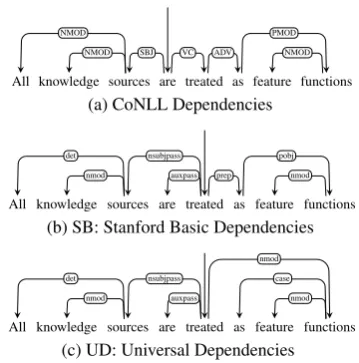
All knowledge sources are treated as feature functions
NMOD
NMOD SBJ VC ADV PMOD
NMOD ROOT
(a) CoNLL Dependencies
All knowledge sources are treated as feature functions
det nmod
nsubjpass auxpass prep
pobj nmod root
(b) SB: Stanford Basic Dependencies
All knowledge sources are treated as feature functions
det nmod
nsubjpass auxpass
nmod case
nmod root
[image:1.595.326.506.206.388.2](c) UD: Universal Dependencies
Figure 1: Dependency representations for the ex-ample sentence.
downstream application. There is currently a wide range of different types of dependency represen-tations in use, which vary mainly in terms of choices concerning syntactic head status. Some previous studies have examined the effects of de-pendency representations in various downstream applications (Miyao et al., 2008; Elming et al., 2013). Most recently, the Shared Task on Extrinsic Parser Evaluation (Oepen et al., 2017) was aimed at providing better estimates of the relative util-ity of different types of dependency representa-tions and syntactic parsers for downstream appli-cations. The downstream systems in this previous work have, however, been limited to traditional (non-neural) systems and there is still a need for a better understanding of the contribution of syn-tactic information in neural downstream systems.
2 Dependency representations
Figure 1 illustrates the three different
depen-dency representations we compare: the
so-called CoNLL-style dependencies (Johansson and Nugues, 2007) which were used for the 2007, 2008, and 2009 shared tasks of the Conference on Natural Language Learning (CoNLL), the Stan-ford ‘basic’ dependencies (SB) (Marneffe et al., 2006) and the Universal Dependencies (v1.3) (UD; McDonald et al., 2013; Marneffe et al., 2014; Nivre et al., 2016). We see that the analy-ses differ both in terms of their choices of heads vs. dependents and the inventory of dependency types. Where CoNLL analyses tend to view
func-tional words as heads (e.g., the auxiliary verbare),
the Stanford scheme capitalizes more on content
words as heads (e.g., the main verbtreated). UD
takes the tendency to select contentful heads one step further, analyzing the prepositional comple-mentfunctionsas a head, with the prepositionas
itself as a dependent case marker. This is in con-trast to the CoNLL and Stanford scheme, where the preposition is head.
For syntactic parsing we employ the parser de-scribed in Bohnet and Nivre (2012), a transition-based parser which performs joint PoS-tagging and parsing. We train the parser on the standard training sections 02-21 of the Wall Street Jour-nal (WSJ) portion of the Penn Treebank (Mar-cus et al., 1993). The constituency-based treebank is converted to dependencies using two different
conversion tools: (i) the pennconverter software1
(Johansson and Nugues, 2007), which produces
the CoNLL dependencies2, and (ii) the Stanford
parser using either the option to produce basic
de-pendencies 3 or its default option which is
Uni-versal Dependencies v1.34. The parser achieves a
labeled accuracy score of 91.23 when trained on the CoNLL08 representation, 91.31 for the Stan-ford basic model and 90.81 for the UD representa-tion, when evaluated against the standard evalua-tion set (secevalua-tion 23) of the WSJ. We acknowledge that these results are not state-of-the-art parse re-sults for English, however, the parser is
straight-1http://nlp.cs.lth.se/software/
treebank-converter/
2
The pennconverter tool is run using the
rightBranching=falseflag.
3
The Stanford parser is run using the-basicflag to pro-duce the basic version of Stanford dependencies.
4Note, however, that the Stanford converter does not
pro-duce UD PoS-tags, but outputs native PTB tags.
forward to use and re-train with the different de-pendency representations. We also compare to an-other widely used parser, namely the pre-trained parsing model for English included in the Stanford CoreNLP toolkit (Manning et al., 2014), which outputs Universal Dependencies only. However, it was clearly outperformed by our version of the Bohnet and Nivre (2012) parser in the initial de-velopment experiments.
3 Relation extraction system
We evaluate the relative utility of different types of dependency representations on the task of seman-tic relation extraction and classification in scien-tific papers, SemEval Task 7 (G´abor et al., 2018). We make use of the system of Nooralahzadeh et al. (2018): a CNN classifier with dependency paths as input, which ranked 3rd (out of 28) partici-pants in the overall evaluation of the shared task.
Here, the shortest dependency path (sdp)
connect-ing two target entities for each relation instance is provided by the parser and is embedded in the first layer of a CNN. We extend on their system by (i) implementing a syntax-agnostic approach, (ii) implementing hyper-parameter tuning for each de-pendency representation, and (iii) adding Univer-sal Dependencies as input representation. We thus
train classifiers withsdps extracted from the
differ-ent dependency represdiffer-entations discussed above and measure the effect of this information by the performance of the classifier.
3.1 Dataset and Evaluation Metrics
We use the SemEval-2018, Task 7 dataset (G´abor
et al., 2018) from itsSubtask 1.1. The training data
contains abstracts of 350 papers from the ACL An-thology Corpus, annotated for concepts and se-mantic relations. Given an abstract of a scien-tific paper with pre-annotated domain concepts, the task is to perform relation classification. The
classification sub-task 1.1 contains 1228 entity
pairs that are annotated based on five
asymmet-ric relations (USAGE, RESULT, MODEL-FEATURE,
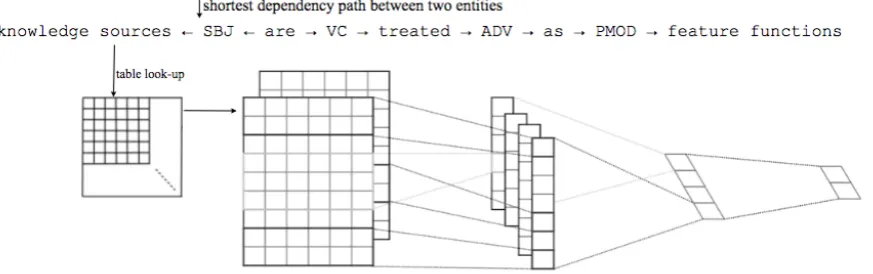
Figure 2: Model architecture with two channels for an example shortest dependency path (CNN model from Kim (2014)).
The training set for Subtask 1.1 is quite small, which is a challenge for end-to-end neural meth-ods. To overcome this, we combined the provided datasets for Subtask 1.1 and Subtask 1.2 (relation classification on noisy data), which provides addi-tional 350 abstracts and 1248 labeled entity pairs to train our model. This yields a positive impact
(+16.00%F1) on the classification task in our
ini-tial experiments.
3.2 Pre-processing
Sentence and token boundaries are detected us-ing the Stanford CoreNLP tool (Mannus-ing et al., 2014). Since most of the entities are multi-word units, we replace the entities with their codes in order to obtain a precise dependency path.
Our example sentenceAll knowledge sources are
treated as feature functions, an example of the
USAGE relation between the two entities knowl-edge sourcesandfeature functions, is thus
trans-formed to All P05 1057 3 are treated
as P05 1057 4.
Given an encoded sentence, we find the sdp
connecting two target entities for each relation
instance using a syntactic parser. Based on
the dependency graph output by the parser, we extract the shortest dependency path connecting two entities. The path records the direction of
arc traversal using left and right arrows (i.e. ←
and →) as well as the dependency relation of
the traversed arcs and the predicates involved, following Xu et al. (2015a). The entity codes in
the final sdpare replaced with the corresponding
word tokens at the end of the pre-processing step.
For the sentence above, we thus extract the path:
knowledge sources ← SBJ ← are → VC → treated → ADV → as → PMOD → feature functions
3.3 CNN model
The system is based on a CNN architecture sim-ilar to the one used for sentence classification in Kim (2014). Figure 2 provides an overview of the proposed model. It consists of 4 main layers
as follows: 1) Look-up Table and Embedding
layer: In the first step, the model takes a shortest dependency path (i.e., the words, dependency edge directions and dependency labels) between entity pairs as input and maps it into a feature vector us-ing a look-up table operation. Each element of the dependency path (i.e. word, dependency label and arrow) is transformed into a embedding layer by
looking up the embedding matrix M ∈ Rd×V,
wheredis the dimension of CNN embedding layer
andV is the size of vocabulary. Each column in
the embedding matrix can be initialized randomly or with pre-trained embeddings. The dependency labels and edge directions are always initialized
randomly. 2) Convolutional Layer: The next
layer performs convolutions with ReLU activation over the embeddings using multiple filter sizes and
extracts feature maps. 3)Max pooling Layer: By
applying themaxoperator, the most effective local
features are generated from each feature map. 4)
Fully connected Layer: Finally, the higher level
syntactic features are fed to a fully connected
soft-max layer which outputs the probability
Hyper parameters F1.(avg. in 5-fold)
Representation Filter size
Num. Feature maps
Activation func.
L2 Reg. Learning rate
Dropout Prob.
with default values
with optimal values
CoNLL08 4-5 1000 Softplus 1.15e+01 1.13e-03 1 73.34 74.49 SB 4-5 806 Sigmoid 8.13e-02 1.79e-03 0.87 72.83 75.05
UD v1.3 5 716 Softplus 1.66e+00 9.63E-04 1 68.93 69.57
Table 2: Hyper parameter optimization results for each model with different representation. Themax
pooling strategy consistently performs better in all model variations.
best F1(in 5-fold)
Relation without sdp with sdp Diff.
USAGE 60.34 80.24 + 19.90
MODEL-FEATURE 48.89 70.00 + 21.11
PART WHOLE 29.51 70.27 +40.76
TOPIC 45.80 91.26 +45.46
RESULT 54.35 81.58 +27.23
COMPARE 20.00 61.82 + 41.82
macro-averaged 50.10 76.10 +26.00
Table 1: Effect of using the shortest dependency path on each relation type.
4 Experiments
We run all the experiments with a multi-channel
setting5 in which the first channel is initialized
with pre-trained embeddings6in static mode (i.e.
it is not updated during training) and the second one is initialized randomly and is fine-tuned dur-ing traindur-ing (non-static mode). The macro F1-score is measured by 5-fold cross validation and to deal with the effects of class imbalance, we weight the cost by the ratio of class instances, thus each observation receives a weight, depending on the class it belongs to.
4.1 Effect of syntactic information
To evaluate the effects of syntactic information in general for the relation classification task, we compare the performance of the model with and
without the dependency paths. In the
syntax-agnostic setup, a sentence that contains the partici-pant entities is used as input for the CNN. We keep the value of hyper-parameters equal to the ones that are reported in the original work (Kim, 2014).
To provide the sdp for the syntax-aware version
we compare to, we use our parser with Stanford
5Initial experiments show that the multi-channel model
works better than the single channel model
6We train 300-d domain-specific embeddings on the ACL
Anthology corpus using the available word2vec implementa-tiongensimfor training.
dependencies. We find that the effect of syntac-tic structure varies between the different relation
types. However, the sdp information has a clear
positive impact on all the relation types (Table 1). It can be attributed to the fact that the context-based representations suffer from irrelevant sub-sequences or clauses when target entities occur far from each other or there are other target entities
in the same sentence. Thesdpbetween two
enti-ties in the dependency graph captures a condensed representation of the information required to assert a relationship between two entities (Bunescu and Mooney, 2005).
4.2 Comparison of different dependency representations
To investigate the model performance with various
parser representations, we create a sdp for each
training example using the different parse models and exploit them as input to the relation classi-fication model. With the use of default parame-ters there is a chance that these favour one of the representations. In order to perform a fair com-parison, we make use of Bayesian optimization (Brochu et al., 2010) in order to locate optimal hyper parameters for each of the dependency rep-resentations. We construct a Bayesian optimiza-tion procedure using a Gaussian process with 100 iterations and Expected Improvement (EI) for its acquisition functions. We set the objective func-tion to maximize the macro F1 score over 5-fold cross validation on the training set. Here we inves-tigate the impact of various system design choices
with the following parameters: 7: I) Filter
re-gion size: ∈ {3, 4, 5, 6, 7, 8, 9, 3-4, 4-5, 5-6,
6-7, 7-8, 8-9, 3-4-5, 4-5-6, 5-6-7, 6-7-8, 7-8-9}
II) Number of feature maps for each filter region
size: ∈ {10 : 1000} III) Activation function: ∈
{Sigmoid, ReLU, T anh, Sof tplus, Iden}. IV)
Pooling strategy: ∈ {max, avg}. V) L2
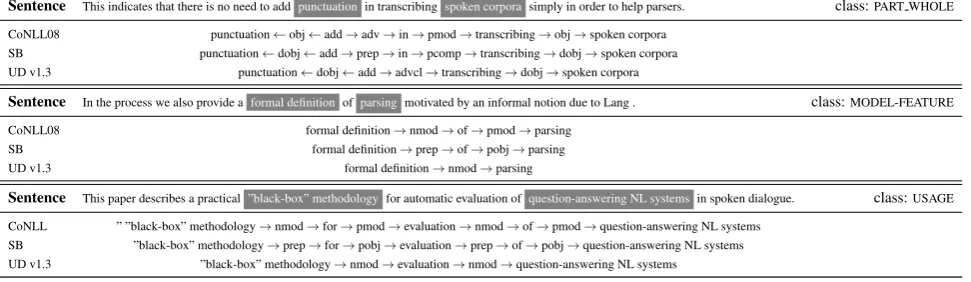
Sentence This indicates that there is no need to add punctuation in transcribingspoken corporasimply in order to help parsers. class:PART WHOLE
CoNLL08 punctuation←obj←add→adv→in→pmod→transcribing→obj→spoken corpora SB punctuation←dobj←add→prep→in→pcomp→transcribing→dobj→spoken corpora UD v1.3 punctuation←dobj←add→advcl→transcribing→dobj→spoken corpora
Sentence In the process we also provide aformal definitionofparsing motivated by an informal notion due to Lang . class:MODEL-FEATURE
CoNLL08 formal definition→nmod→of→pmod→parsing SB formal definition→prep→of→pobj→parsing UD v1.3 formal definition→nmod→parsing
Sentence This paper describes a practical”black-box” methodology for automatic evaluation ofquestion-answering NL systemsin spoken dialogue. class:USAGE
[image:5.595.74.560.67.208.2]CoNLL ” ”black-box” methodology→nmod→for→pmod→evaluation→nmod→of→pmod→question-answering NL systems SB ”black-box” methodology→prep→for→pobj→evaluation→prep→of→pobj→question-answering NL systems UD v1.3 ”black-box” methodology→nmod→evaluation→nmod→question-answering NL systems
Table 4: The examples for which the CoNLL/SB-based models correctly predict the relation type in 5-fold trials, whereas the UD based model has an incorrect prediction.
ization: ∈ {1e−4 : 1e+ 2}. VI) Learning rate:
∈ {1e−6 : 1e−2}. VII) Dropout probability8:
∈ {0.1 : 1}. Table 2 presents the optimal values for each configuration using different dependency representations. We see that the optimized param-eter settings vary for the different representations, showing the importance of tuning for these types of comparisons. The results furthermore show that
thesdps based on the Stanford Basic (SB)
repre-sentation provide the best performance, followed by the CoNLL08 representation. We observe that the results for the UD representation are quite a bit lower than the two others.
5 Error analysis
Table 3 presents the effect of each parser represen-tation in the classification task, broken down by re-lation type. We find that the UD-based model falls behind the others on the most relation types (i.e,
COMPARE, MODEL-FEATURE, PART WHOLE,
TOP-ICS). To explore these differences in more detail,
we manually inspect the instances for which the CoNLL/SB-based models correctly predict the re-lation type in 5-fold trials, whereas the UD-based model has an incorrect prediction. Table 4 shows some of these examples, marking the entities and the gold class of each instance and also showing
thesdpfrom each representation. We observe that
the UD paths are generally shorter. A striking sim-ilarity between most of the instances is the fact that one of the entities resides in a prepositional phrase. Whereas the SB and CoNLL paths explicitly rep-resent the preposition in the path, the UD represen-tation does not. Clearly, the difference between for
8The probability that each element is kept, in which1
im-plies that none of the nodes are dropped out
best F1(in 5-fold)
Relation Frq. CoNLL SB UD
USAGE 947 76.84 82.39 77.56
MODEL-FEATURE 498 68.27 68.54 66.36
PART WHOLE 425 75.32 71.28 67.11
TOPIC 258 89.32 90.57 87.62
RESULT 193 82.35 81.69 82.86
COMPARE 136 66.67 66.67 54.24
macro-averaged 76.94 77.57 72.83
Table 3: Effect of using the different parser repre-sentation on each relation type.
instance theUSAGEandPART WHOLErelation may
be indicated by the presence of a specific
prepo-sition (X for Y vs. X of Y). This is also
interest-ing since this particular syntactic choice has been shown in previous work to have a negative effect on intrinsic parsing results for English (Schwartz et al., 2012).
6 Conclusion
References
Bernd Bohnet and Joakim Nivre. 2012. A transition-based system for joint part-of-speech tagging and labeled non-projective dependency parsing. In Pro-ceedings of EMNLP, pages 1455–1465, Jeju Island, Korea. ACL.
Eric Brochu, Vlad M. Cora, and Nando de Freitas. 2010. A tutorial on bayesian optimization of expen-sive cost functions, with application to active user modeling and hierarchical reinforcement learning. CoRR, abs/1012.2599.
Razvan C. Bunescu and Raymond J. Mooney. 2005. A shortest path dependency kernel for relation ex-traction. InProceedings of the Conference on Hu-man Language Technology and Empirical Methods in Natural Language Processing, HLT ’05, pages 724–731, Stroudsburg, PA, USA. Association for Computational Linguistics.
Javid Ebrahimi and Dejing Dou. 2015. Chain based rnn for relation classification. InHLT-NAACL.
Jakob Elming, Anders Johannsen, Sigrid Klerke, Emanuele Lapponi, H´ector Mart´ınez Alonso, and Anders Søgaard. 2013. Down-stream effects of tree-to-dependency conversions. In Human Language Technologies: Conference of the North American Chapter of the Association of Computational Lin-guistics, 2013, pages 617–626.
Kata G´abor, Davide Buscaldi, Anne-Kathrin Schu-mann, Behrang QasemiZadeh, Ha¨ıfa Zargayouna, and Thierry Charnois. 2018. Semeval-2018 Task 7: Semantic relation extraction and classification in scientific papers. In Proceedings of International Workshop on Semantic Evaluation (SemEval-2018), New Orleans, LA, USA.
Richard Johansson and Pierre Nugues. 2007. Ex-tended constituent-to-dependency conversion for en-glish. InNODALIDA 2007 Proceedings, pages 105– 112. University of Tartu.
Yoon Kim. 2014. Convolutional neural networks for sentence classification. InProceedings of the 2014 Conference on Empirical Methods in Natural Lan-guage Processing, pages 1746–1751. Association for Computational Linguistics.
Filippos Kokkinos and Alexandros Potamianos. 2017. Structural attention neural networks for improved sentiment analysis. In Meeting of the European Chapter of the Association for Computational Lin-guistics, pages 586–591, Valencia, Spain.
Christopher D. Manning, Mihai Surdeanu, John Bauer, Jenny Finkel, Steven J. Bethard, and David Mc-Closky. 2014. The Stanford CoreNLP natural lan-guage processing toolkit. InAssociation for Compu-tational Linguistics (ACL) System Demonstrations, pages 55–60.
Diego Marcheggiani, Anton Frolov, and Ivan Titov. 2017. A simple and accurate syntax-agnostic neural model for dependency-based semantic role labeling. InProceedings of the 21st Conference on Computa-tional Natural Language Learning, pages 411–420. Association for Computational Linguistics.
Mitchell Marcus, Beatrice Santorini, and Mary Ann Marcinkiewicz. 1993. Building a large annotated corpora of English. The Penn Treebank. Journal of Computational Linguistics, 19:313–330.
M. Marneffe, B. Maccartney, and C. Manning. 2006. Generating typed dependency parses from phrase structure parses. InProceedings of the Fifth Interna-tional Conference on Language Resources and Eval-uation (LREC-2006).
Marie-Catherine de Marneffe, Timothy Dozat, Na-talia Silveira, Katri Haverinen, Filip Ginter, Joakim Nivre, and Christopher D. Manning. 2014. Uni-versal stanford dependencies: A cross-linguistic ty-pology. InProceedings of the Ninth International Conference on Language Resources and Evaluation (LREC-2014).
Ryan McDonald, Joakim Nivre, Yvonne Quirmbach-Brundage, Yoav Goldberg, Dipanjan Das, Kuzman Ganchev, Keith Hall, Slav Petrov, Hao Zhang, and Oscar T¨ackstr¨om. 2013. Universal dependency an-notation for multilingual parsing. In Proceedings of Association for Computational Linguistics (ACL), pages 92–97.
Yusuke Miyao, Rune Sætre, Kenji Sagae, Takuya Mat-suzaki, and Jun’ichi Tsujii. 2008. Task-oriented evaluation of syntactic parsers and their represen-tations. InMeeting of the Association for Compu-tational Linguistics, pages 46–54, Columbus, OH, USA.
Joakim Nivre, Marie-Catherine de Marneffe, Filip Ginter, Yoav Goldberg, Jan Hajic, Christopher D. Manning, Ryan T. McDonald, Slav Petrov, Sampo Pyysalo, Natalia Silveira, Reut Tsarfaty, and Daniel Zeman. 2016. Universal dependencies v1: A multi-lingual treebank collection. In Proceedings of the Tenth International Conference on Language Re-sources and Evaluation LREC.
Farhad Nooralahzadeh, Lilja Øvrelid, and Jan Tore Lønning. 2018. Sirius-ltg-uio at semeval-2018 task 7: Convolutional neural networks with shortest de-pendency paths for semantic relation extraction and classification in scientific papers. InProceedings of the 12th International Workshop on Semantic Eval-uation (SemEval-2018, New Orleans, LA, USA.
and the 15th International Conference on Parsing Technologies, pages 1–12, Pisa, Italy.
Roy Schwartz, Omri Abend, and Ari Rappoport. 2012. Learnability-based syntactic annotation design. In Proceedings of COLING 2012, pages 2405–2422. The COLING 2012 Organizing Committee.
Richard Socher, Alex Perelygin, Jean Wu, Jason Chuang, Chris Manning, Andrew Ng, and Chris Potts. 2013. Recursive deep models for semantic compositionality over a sentiment treebank. In Con-ference on Empirical Methods in Natural Language Processing, pages 1631–1642, Seattle, WA, USA.
Shuangzhi Wu, Dongdong Zhang, Nan Yang, Mu Li, and Ming Zhou. 2017. Sequence-to-dependency neural machine translation. In Meeting of the As-sociation for Computational Linguistics, pages 698– 707, Vancouver, Canada.
Kun Xu, Yansong Feng, Songfang Huang, and Dongyan Zhao. 2015a. Semantic relation classifica-tion via convoluclassifica-tional neural networks with simple negative sampling. CoRR, abs/1506.07650.