Proceedings of the 57th Annual Meeting of the Association for Computational Linguistics, pages 710–721 710
How to (Properly) Evaluate Cross-Lingual Word Embeddings:
On Strong Baselines, Comparative Analyses, and Some Misconceptions
Goran Glavaš1, Robert Litschko1, Sebastian Ruder2,3∗, and Ivan Vuli´c4
1Data and Web Science Group, University of Mannheim, Germany 2Insight Research Centre, National University of Ireland, Galway, Ireland
3Aylien Ltd., Dublin, Ireland 4PolyAI Ltd., London, United Kingdom
{goran, litschko}@informatik.uni-mannheim.de, [email protected], [email protected]
Abstract
Cross-lingual word embeddings (CLEs) facili-tate cross-lingual transfer of NLP models. De-spite their ubiquitous downstream usage, in-creasingly popular projection-based CLE mod-els are almost exclusively evaluated on bilin-gual lexicon induction (BLI). Even the BLI evaluations vary greatly, hindering our ability to correctly interpret performance and prop-erties of different CLE models. In this work, we take the first step towards a comprehensive evaluation of CLE models: we thoroughly eval-uate both supervised and unsupervised CLE models, for a large number of language pairs, on BLI and three downstream tasks, providing new insights concerning the ability of cutting-edge CLE models to support cross-lingual NLP. We empirically demonstrate that the per-formance of CLE models largely depends on the task at hand and that optimizing CLE mod-els for BLI may hurt downstream performance. We indicate the most robust supervised and unsupervised CLE models and emphasize the need to reassess simple baselines, which still display competitive performance across the board. We hope our work catalyzes further re-search on CLE evaluation and model analysis.
1 Introduction and Motivation
Following the ubiquitous use of word embeddings in monolingual NLP tasks, research in word repre-sentation quickly broadened towardscross-lingual word embeddings(CLEs). CLE models learn vec-tors of words in two or more languages and rep-resent them in ashared cross-lingual word vector spacewhere words with similar meanings obtain similar vectors, irrespective of their language. Ow-ing to this property, CLEs hold promise to support cross-lingual NLP by enabling multilingual model-ing of meanmodel-ing and facilitatmodel-ing cross-lmodel-ingual trans-fer for downstream NLP tasks and under-resourced
?Sebastian is now affiliated with DeepMind.
languages. CLEs are used as (cross-lingual) knowl-edge sources in range of tasks, such as bilingual lexicon induction (Mikolov et al., 2013), docu-ment classification (Klementiev et al.,2012), infor-mation retrieval (Vuli´c and Moens,2015), depen-dency parsing (Guo et al.,2015), sequence labeling (Zhang et al.,2016;Mayhew et al.,2017), and ma-chine translation (Artetxe et al., 2018c;Lample et al.,2018), among others.
Earlier work typically induces CLEs by leverag-ing billeverag-ingual supervision from multilleverag-ingual corpora aligned at the level of sentences (Zou et al.,2013;
Hermann and Blunsom,2014;Luong et al.,2015, inter alia) and documents (Søgaard et al., 2015;
Vuli´c and Moens, 2016;Levy et al., 2017, inter alia). A recent trend are the so-called projection-based CLE models1, which post-hoc align pre-trained monolingual embeddings. Their popular-ity stems from competitive performance coupled with a conceptually simple design, requiring only cheap bilingual supervision (Ruder et al.,2018b): they demand word-level supervision from seed translation dictionaries, spanning at most several thousand word pairs (Mikolov et al.,2013;Huang et al.,2015), but it has also been shown that reli-able projections can be bootstrapped from small dictionaries of 50–100 pairs (Vuli´c and Korhonen,
2016;Zhang et al.,2016), identical strings and cog-nates (Smith et al.,2017;Søgaard et al.,2018), and shared numerals (Artetxe et al.,2017).
Moreover, recent work has leveraged topological similarities between monolingual vector spaces to introducefully unsupervisedprojection-based CLE models, not demanding any bilingual supervision (Conneau et al.,2018a;Artetxe et al.,2018b,inter alia). Being conceptually attractive, such weakly supervised and unsupervised CLEs have recently taken the field by storm (Grave et al.,2018;Dou
et al.,2018;Doval et al.,2018;Hoshen and Wolf,
2018;Ruder et al.,2018a;Kim et al.,2018;Chen and Cardie,2018;Mukherjee et al.,2018; Nakas-hole,2018;Xu et al.,2018;Alaux et al.,2019).
Producing the same end result—a shared cross-lingual vector space—all CLE models are directly comparable, regardless of modelling assumptions and supervision requirements. Therefore, they can support exactly the same groups of tasks. Yet, a comprehensive evaluation of recent CLE models is missing. Limited evaluations impede comparative analyses and may lead to inadequate conclusions, as models are commonly trained to perform well on a single task. While early CLE models ( Kle-mentiev et al.,2012;Hermann and Blunsom,2014) were evaluated on downstream tasks like text clas-sification, a large body of recent work is judged exclusively on the task of bilingual lexicon induc-tion (BLI). This limits our understanding of CLE methodology as: 1)BLI is an intrinsic task, and agreement between BLI and downstream perfor-mance has been challenged (Ammar et al.,2016;
Bakarov et al.,2018);2)BLI is not the main motiva-tion for inducing cross-lingual embedding spaces— rather, we seek to exploit CLEs to tackle multilin-guality and downstream language transfer (Ruder et al.,2018b). In other words, previous research does not evaluate the true capacity of projection-based CLE models to support cross-lingual NLP. It is unclear whether and to which extent BLI perfor-mance of (projection-based) CLE models correlates with various downstream tasks of different types.
At the moment, it is virtually impossible to di-rectly compare all recent projection-based CLE models on BLI due to the lack of a common evalu-ation protocol: different papers consider different language pairs and employ different training and evaluation dictionaries. Furthermore, there is a sur-prising lack of testing of BLI results for statistical significance. The mismatches in evaluation yield partial conclusions and inconsistencies: on the one hand, some unsupervised models (Artetxe et al.,
2018b;Hoshen and Wolf,2018) reportedly outper-form competitive supervised CLE models (Artetxe et al.,2017;Smith et al.,2017). On the other hand, the most recent supervised approaches (Doval et al.,
2018;Joulin et al.,2018) report performances sur-passing the best unsupervised models.
Supervised projection-based CLEs require merely small-sized translation dictionaries (up to a few thousand word pairs) and such bilingual signal
is easily obtainable for most language pairs.2 There-fore, despite the attractive zero-supervision setup, we see unsupervised CLE models practically justi-fied only if such models can, unintuitively, indeed outperform their supervised competition.
Contributions. We provide a comprehensive comparative evaluation of a wide range of state-of-the-art—both supervised and unsupervised— projection-based CLE models. Our benchmark en-compasses BLI and three cross-lingual (CL) down-stream tasks of different nature: document clas-sification (CLDC), information retrieval (CLIR), and natural language inference (XNLI). We unify evaluation protocols for all models and conduct ex-periments over 28 language pairs spanning diverse language types.
Besides providing a unified testbed for guiding CLE research, we aim to answer the following re-search questions:1)Is BLI performance a good pre-dictor of downstream performance for projection-based CLE models? 2) Can unsupervised CLE models indeed outperform their supervised counter-parts? The simplest models often outperform more intricate competitors: we apply a simple bootstrap-ping to the basic Procrustes model (PROC-B, see §2.2) and show it is competitive across the board. We find that overfitting to BLI may severely hurt downstream performance, warranting the coupling of BLI experiments with downstream evaluations in order to paint a more informative picture of CLE models’ properties.
2 Projection-Based CLEs: Methodology
In contrast to more recent unsupervised models, CLE models typically require bilingual signal: aligned words, sentences, or documents. CLE mod-els based on sentence and document alignments have been extensively studied in previous work (Vuli´c and Korhonen,2016;Upadhyay et al.,2016;
Ruder et al.,2018b). Current CLE research is al-most exclusively focused on projection-based CLE models; they are thus also the focus of our study.3
2
We argue that, if acquiring a few thousand word transla-tion pairs is a challenge, one probably deals with a truly under-resourced language for which it would be difficult to obtain reliable monolingual embeddings in the first place. Further-more, there are initiatives in typological linguistics research such as the ASJP database (Wichmann et al.,2018), which offers 40-item word lists denoting the same set of concepts in all the world’s languages:https://asjp.clld.org/. Indirectly, such lists can offer the initial seed supervision.
⋯ ⋮ ⋱ ⋮
⋯ … XL1
XL2
⋯ ⋮ ⋱ ⋮
⋯ …
D = {xi L1, xjL2}K
⋯ ⋮ ⋱ ⋮
⋯
⋯ ⋮ ⋱ ⋮
⋯
XS
XT vector
lookup
projection learning
⋯ ⋮ ⋱ ⋮
⋯
⋯ ⋮ ⋱ ⋮
⋯
WL1
WL2
projecting vector spaces
XCL
… ⋱ … …
[image:3.595.116.479.64.173.2]… ⋱ … …
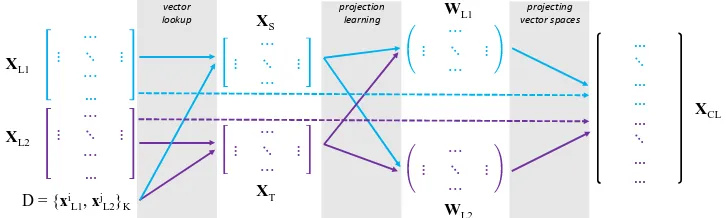
Figure 1: A general framework for post-hoc projection-based induction of cross-lingual word embeddings.
2.1 Projection-Based Framework
The goal is to learn a projection between indepen-dently trained monolingual embedding spaces. The mapping is sought using a seed bilingual lexicon, provided beforehand or extracted without super-vision. A general post-hoc projection-based CLE framework is depicted in Figure1. LetXL1 and
XL2be monolingual embedding spaces of two
lan-guages. All projection-based CLE approaches en-compass the following steps:
Step 1:Construct the seed translation dictionary D = {(wL1i , wjL2)}K
k=1 containing K word pairs.
Supervised models use an external dictionary; unsu-pervised models induceDautomatically, assuming approximate isomorphism betweenXL1andXL2.
Step 2: Align monolingual subspaces XS =
{xiL1}K
k=1 andXT = {x j
L2}Kk=1 using the
trans-lation dictionaryD: retrieve vectors of{wiL1}K k=1
fromXL1and vectors of{wL2j }Kk=1fromXL2.
Step 3:Learn to projectXL1andXL2to the shared
cross-lingual spaceXCLbased on the aligned
ma-tricesXS andXT. In the general case, we learn
two projection matricesWL1 andWL2:XCL =
XL1WL1 ∪XL2WL2 . Many models, however,
learn to directly projectXL1toXL2, i.e.,WL2 =I
andXCL=XL1WL1∪XL2.
2.2 Projection-Based CLE Models
While supervised models employ external dictio-naries, unsupervised models automatically induce seed translations using diverse strategies: adver-sarial learning (Conneau et al.,2018a), similarity-based heuristics (Artetxe et al., 2018b), PCA (Hoshen and Wolf, 2018), and optimal transport (Alvarez-Melis and Jaakkola,2018).
Canonical Correlation Analysis (CCA).Faruqui and Dyer(2014) use CCA to projectXL1andXL2
obtain monolingual vectors) andb)they do not require any multilingual corpora, they lend themselves to a wider spectrum of languages than the alternatives (Ruder et al.,2018b).
Algorithm 1:Bootstrapping Procrustes (PROC-B) XL1,XL2←monolingual embeddings ofL1andL2 D←initial word translation dictionary
foreach ofniterationsdo
XS,XT ←lookups forDin XL1, XL2 WL1 ←arg minWkXSW−XTk2 WL2 ←arg minWkXTW−XSk2 X0L1←XL1WL1;X0L2←XL2WL2
D1,2←nn(X0L1,XL2);D2,1←nn(X0L2,XL1) D←D∪(D1,2∩D2,1)
return:WL1(and/orWL2)
into a shared spaceXCL. Projection matrices,WL1
andWL2are obtained by applying CCA toXSand
XT. We evaluate CCA as a simple baseline that has
mostly been neglected in recent BLI evaluations.
Solving the Procrustes Problem.In their seminal work,Mikolov et al.(2013) findWL1by
minimiz-ing the Euclidean distance between projectedXS
and XT: WL1 = arg minWkXL1W −XL2k2. Xing et al. (2015) report BLI gains by impos-ing orthogonality onWL1. IfWL1is orthogonal,
the above minimization problem becomes the Pro-crustes problem, with the following closed-form solution (Schönemann,1966):
WL1=UV>,with
UΣV>=SVD(XTXS>). (1)
The mapWL1being the solution to the Procrustes
problem is the main baseline in our evaluation (PROC). Furthermore, followingself-learning pro-cedures that unsupervised models use to augment initially induced lexiconsD(Artetxe et al.,2018b;
Conneau et al.,2018a), we propose a simple boot-strapping extension of the PROC model (dubbed PROC-B). With PROC-B we aim to boost perfor-mance when starting with smaller but reliable ex-ternal dictionaries. The procedure is summarized in Algorithm 1. In each iteration, we use the trans-lation lexicon D to learn two projections: WL1
projects XL1 to XL2 and WL2 projects XL2 to
XL1. Next we induce two word translations sets
between (1)XL1WL1andXL2and (2)XL2WL2
andXL1. We finally augmentDwith mutual
near-est neighbours, i.e.,D12∩D21.4
Discriminative Latent-Variable Model (DLV).
Ruder et al.(2018a) augment the seed supervised lexicon through Expectation-Maximization in a latent-variable model. The source words{wiL1}K
k=1
and target words{wjL2}K
k=1are seen as a fully
con-nected bipartite weighted graphG = (E, VL1∪
VL2) with edges E = VL1 ×VL2. By drawing
embeddings from a Gaussian distribution and nor-malizing them, the weight of each edge(i, j)∈E is shown to correspond to the cosine similarity be-tween vectors. In the E-step, a maximal bipartite matching is found on the sparsified graph using the Jonker-Volgenant algorithm (Jonker and Volgenant,
1987). In the M-step, a better projectionWL1 is
learned by solving the Procrustes problem.
Ranking-Based Optimization (RCSLS). In-stead of minimizing the Euclidean distance,Joulin et al.(2018) follow earlier work (Lazaridou et al.,
2015) and maximize a ranking-based objective, specifically cross-domain similarity local scal-ing (CSLS;Conneau et al.,2018a), between the
XSWL1andXT. CSLS is an extension of cosine
similarity commonly used for BLI inference. Let r(xkL1W,XL2) be the average cosine similarity of the projected source vector with itsN nearest neighbors fromXL2. Inversely, letr(xkL2,XL1W)
be the average cosine similarity of a target vector with its N nearest neighbors from the projected source spaceXL1W. By relaxing the orthogonality
constraint onWL1, maximization of relaxed CSLS
(dubbed RCSLS) becomes a convex optimization problem:
WL1= arg min W
1
K X
xkL1∈XS
xkL2∈XT
−2 cosxkL1W,x
k L2
+r(xkL1W,XL2) +r(xkL2,XL1W) (2)
By maximizing (R)CSLS, this model is explicitly designed to induce cross-lingual embedding spaces that perform well in word translation, i.e., BLI.
Adversarial Alignment (MUSE). MUSE ( Con-neau et al.,2018a) initializes a seed bilingual lexi-con solely from monolingal data using Generative Adversarial Networks (GANs;Goodfellow et al.,
4
We obtain best performance with just one bootstrapping iteration. Even when starting withD of size 1K, the first iteration yields between 5K and 10K mutual translations. The second iteration already produces over 20K translations, which seem to be too noisy for further performance gains.
2014). The generator component is the linear map
WL1. MUSEimproves the generatorWL1 by
ad-ditionally competing with the discriminator (feed-forward net) that needs to distinguish between true L2 vectors from XL2 and projections from L1,
XL1WL1. MUSEthen improves the GAN-induced
mapping, through a refinement step similar to the PROC-B procedure. MUSEstrongly relies on the approximate isomorphism assumption (Søgaard et al.,2018), which often leads to poor GAN-based initialization, especially for distant languages.
Heuristic Alignment (VECMAP). Artetxe et al.
(2018b) assume that word translations have approx-imately the same vectors of monolingual similarity distribution. The seedDis the set of nearest neigh-bors according to the similarity between mono-lingual similarity distribution vectors. Next, they employ a self-learning bootstrapping procedure similar to MUSE. VECMAPowes robustness to a number of empirically motivated enhancements. It adopts both multi-step pre-processing: unit length normalization, mean centering, and ZCA whitening (Bell and Sejnowski, 1997); and mul-tiple post-processing steps: cross-correlational re-weighting, de-whitening, and dimensionality reduc-tion (Artetxe et al.,2018a). Moreover, VECMAP critically relies onstochasticdictionary induction: elements of the similarity matrix are randomly set to 0 (with varying probability across iterations), allowing the model to escape poor local optima.
Iterative Closest Point Model (ICP). Hoshen and Wolf(2018) induce the seed dictionaryDby projecting vectors of N most frequent words of both languages to a lower-dimensional space with PCA. They then search for an optimal alignment between L1 words (vectorsxi1) and L2 words (vec-torsxj2), assuming projectionsW1 andW2. Let
f1(i)(vice versaf2(j)) be the L2 index (vice versa
L1 index) to whichxi1 (vice versaxj2) is aligned. The goal is to find projections W1 and W2 that
minimize the sum of Euclidean distances between optimally-aligned vectors. Since both projections and optimal alignment are unknown, they employ a two-step Iterative Closest Point optimization algo-rithm that first fixes projections to find the optimal alignment and then uses that alignment to update projections, by minimizing:
X
i
kxi1W1−xf21(i)k+
X
j
kxj2W2−xf12(j)k+
λX
i
kxi1−x
i
1W1W2k+λ
X
j
The cyclical constraints in the second row force vectors not to change by round-projection (to the other space and back). They then employ a boot-straping procedure similar to PROC-B and MUSE and produce the finalWL1by solving Procrustes.
Gromov-Wasserstein Alignment Model (GWA). Since embedding models employ metric recov-ery algorithms,Alvarez-Melis and Jaakkola(2018) cast dictionary induction as optimal transport prob-lem based on the Gromov-Wasserstein distance. They first compute intra-language costs CL1 =
cos(XL1,XL1) and CL2 = cos(XL2,XL2) and
inter-language similarities C12 = C2L1p1>m +
1nq(C2L2)>, withpandqas uniform distributions
over respective vocabularies. They then induce the projections by solving the Gromov-Wasserstein op-timal transport problem with a fast iterative algo-rithm (Peyré et al.,2016), iteratively updating pa-rameter vectorsaandb,a =pKb;b =q
K>a, whereis element-wise division andK= exp(−CˆΓ/λ) (with CˆΓ = C12 −2CL1ΓC>L2).
The alignment matrix Γ = diag(a)Kdiag(b) is recomputed in each iteration. The final projection
WL1 is (again!) obtained by solving Procrustes
using the final alignments fromΓas supervision. In sum, our brief overview points to the main (dis)similarities of all projection-based CLE mod-els: while they differ in the way the initial seed lexicon is extracted, most models are based on bootstrapping procedures that repeatedly solve the Procrustes problem from Eq. (1), typically on the trimmed vocabulary. In the final step, the fine-tuned linear map is applied on the full vocabulary.
3 Bilingual Lexicon Induction
BLI has become thede factostandard evaluation task for projection-based CLE models. Given a CLE space, the task is to retrieve target language translations for a (test) set of source language words. A typical BLI evaluation in the recent lit-erature reports comparisons with the well-known MUSEmodel on a few language pairs, always in-volving English as one of the languages—a com-prehensive comparative BLI evaluation conducted on a large set of language pairs is missing. Our evaluation spans 28 language pairs, many of which do not involve English.5Furthermore, to allow for (1) fair comparison across supervised models and
5English participates as one of the languages in all pairs in existing BLI evaluations, with the exception of Estonian– Finnish evaluated bySøgaard et al.(2018).
(2) direct comparisons across different language pairs, we create training and evaluation dictionaries that arefully alignedacross all evaluated language pairs. Finally, we also discuss other choices in ex-isting BLI evaluations which are currently taken for granted: e.g., (in)appropriate evaluation metrics and lack of significance testing.
Language Pairs.Our evaluation comprises eight languages: Croatian (HR), English (EN), Finnish (FI), French (FR), German (DE), Italian (IT), Rus-sian (RU), and Turkish (TR). For diversity, we se-lected two languages from three different Indo-European branches: Germanic (EN,DE), Romance (FR,IT), and Slavic (HR,RU); as well as two non-Indo-European languages (FI,TR). From these, we create a total of 28 language pairs for evaluation.
Monolingual Embeddings.Following prior work, we use 300-dimensional fastText embeddings ( Bo-janowski et al., 2017)6, pretrained on complete Wikipedias of each language. We trim all vocabu-laries to the 200K most frequent words.
Translation Dictionaries. We automatically cre-ated translation dictionaries using Google Trans-late, similar to prior work (Conneau et al.,2018a). We selected the 20K most frequent English words and automatically translated them to the other seven languages. We retained only tuples for which all translations were unigrams found in vocabular-ies of respective monolingual embedding spaces, leaving us with≈7K tuples. We reserved 5K tuples created from the more frequent English words for training, and the remaining 2K tuples for testing. We also created two smaller training dictionaries, by selecting tuples corresponding to 1K and 3K most frequent English words.
Evaluation Measures and Significance. BLI is generally cast as a ranking task. Existing work uses precision at rankk(P@k,k∈ {1,5,10}) as a BLI evaluation metric. We advocate the use of mean average precision (MAP) instead.7 While corre-lated withP@k, MAP is more informative: unlike MAP,P@ktreats all models that rank the correct translation belowkequally.8
The limited size of BLI test sets warrants statis-tical significance testing. Yet, most current work
6https://fasttext.cc/docs/en/
pretrained-vectors.html
7
In this setup with only one correct translation for each query, MAP is equivalent to mean reciprocal rank (MRR).
Supervised Dict All LPs Filt. LPs Succ. LPs
CCA 1K .289 .404 28/28
CCA 3K .378 .482 28/28
CCA 5K .400 .498 28/28
PROC 1K .299 .411 28/28
PROC 3K .384 .487 28/28
PROC 5K .405 .503 28/28
PROC-B 1K .379 .485 28/28
PROC-B 3K .398 .497 28/28
DLV 1K .289 .400 28/28
DLV 3K .381 .484 28/28
DLV 5K .403 .501 28/28
RCSLS 1K .331 .441 28/28
RCSLS 3K .415 .511 28/28
RCSLS 5K .437 .527 28/28
Unsupervised
VECMAP .375 .471 28/28
MUSE .183 .458 13/28
ICP .253 .424 22/28
[image:6.595.71.292.62.287.2]GWA .137 .345 15/28
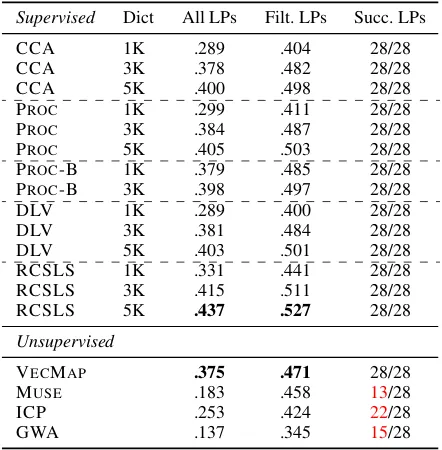
Table 1: Summary of BLI performance (MAP). All LPs: average scores over all 28 language pairs; Filt. LP: average scores only over language pairs for whichallmodels in evaluation yield at least one suc-cessful run;Succ. LPs: the number of language pairs for which we obtained at least one successful run. A run is consideredsuccessfulif MAP≥0.05.
provides no significance testing, declaring limited numeric gains (e.g., 1%P@1) to be relevant. We test BLI results for significance with the two-tailed t-test with Bonferroni correction (Dror et al.,2018).
Results and Discussion. Table 1 summarizes BLI performance over all 28 language pairs.9 RC-SLS (Joulin et al., 2018) displays the strongest BLI performance. This is not surprising given that its learning objective is tailored particularly for BLI. RCSLS outperforms other supervised mod-els (CCA, PROC, and DLV) trained with exactly the same dictionaries. We confirm previous find-ings (Smith et al.,2017) suggesting that CCA and PROCexhibit very similar performance. We con-firm that CCA and PROC, as well as DLV, are statistically indistinguishable in terms of BLI per-formance (even at α = 0.1). Our bootstrapping PROC-B approach significantly (p <0.01) boosts the performance of PROCwhen given a small trans-lation dictionary with 1K pairs. For the same 1K dictionary, PROC-B also significantly outperforms RCSLS. Interestingly, training on 5K pairs does not significantly outperform training on 3K pairs for any of the supervised models (whereas using 3K pairs is better than using 1K). This is in line with prior findings (Vuli´c and Korhonen,2016) that no
9We provide detailed BLI results for each of the 28 lan-guage pairs and all models in the appendix.
significant improvements are to be expected from training linear maps on more than 5K word pairs.
The results highlight VECMAP(Artetxe et al.,
2018b) as the most robust choice among unsu-pervised models: besides being the only model to produce successful runs for all language pairs, it also significantly outperforms other unsupervised models—both when considering all language pairs and only the subset where other models produce successful runs. However, VECMAPstill performs worse (p≤0.0002) than PROC-B (trained on only 1K pairs) and all supervised models trained on 3K or 5K word pairs. Our findings challenge un-intuitive claims from recent work (Artetxe et al.,
2018b;Hoshen and Wolf,2018;Alvarez-Melis and Jaakkola,2018) that unsupervised CLE models per-form on a par or even surpass supervised models.
Table 2 shows the scores for a subset of 10 language pairs using a subset of models from Ta-ble1.10As expected, all models work reasonably well for major languages—this is most likely due to a higher quality of the respective monolingual embeddings, which are pre-trained on much larger corpora.11 Language proximity also plays a crit-ical role: on average, models achieve better BLI performance for languages from the same family (e.g., compare the results of HR–RUvs. HR–EN). The gap between the best-performing supervised model (RCSLS) and the best-performing unsuper-vised model (VECMAP) is more pronounced for cross-family language pairs, especially those con-sisting of one Germanic and one Slavic or non-Indo-European language (e.g., 19 points MAP difference forEN–RU, 14 forDE–RUandEN–FI, 10 points for EN–TRandEN–HR, 9 points forDE–FIandEN–HR). We suspect that this is due to heuristics based on intra-language similarity distributions, employed byArtetxe et al.(2018b) to induce an initial transla-tion dictransla-tionary. This heuristic, critically relying on the approximate isomorphism assumption, is less effective the more distant the languages are.
4 Downstream Evaluation
Moving beyond the limiting BLI evaluation, we evaluate CLE models on three diverse cross-lingual downstream tasks:1)cross-lingual transfer for nat-ural language inference (XNLI), a language
under-10We provide full BLI results for all 28 language pairs and all models in the appendix.
11For instance,
EN Wikipedia is approximately 3 times larger than DE and RU Wikipedias, 19 times larger than
Model Dict EN–DE IT–FR HR–RU EN–HR DE–FI TR–FR RU–IT FI–HR TR–HR TR–RU
PROC 1K 0.458 0.615 0.269 0.225 0.264 0.215 0.360 0.187 0.148 0.168 PROC 5K 0.544 0.669 0.372 0.336 0.359 0.338 0.474 0.294 0.259 0.290 PROC-B 1K 0.521 0.665 0.348 0.296 0.354 0.305 0.466 0.263 0.210 0.230 RCSLS 1K 0.501 0.637 0.291 0.267 0.288 0.247 0.383 0.214 0.170 0.191 RCSLS 5K 0.580 0.682 0.404 0.375 0.395 0.375 0.491 0.321 0.285 0.324
VECMAP – 0.521 0.667 0.376 0.268 0.302 0.341 0.463 0.280 0.223 0.200
[image:7.595.72.527.63.160.2]Average – 0.520 0.656 0.343 0.294 0.327 0.304 0.440 0.260 0.216 0.234
Table 2: BLI performance (MAP) with a selection of models on a subset of evaluated language pairs.
standing task;2)cross-lingual document classifica-tion (CLDC), a task commonly requiring shallow n-gram-level modelling, and3)cross-lingual infor-mation retrieval (CLIR), an unsupervised ranking task relying on coarser semantic relatedness.
4.1 Natural Language Inference
Large training corpora for NLI exist only in En-glish (Bowman et al.,2015;Williams et al.,2018). Recently,Conneau et al.(2018b) released a mul-tilingual XNLI corpus created by translating the development and test portions of the MultiNLI cor-pus (Williams et al.,2018) to 15 other languages.
Evaluation Setup. XNLI covers 5 out of 8 lan-guages from our BLI evaluation:EN,DE,FR,RU, and TR. Our setup is straightforward: we train a well-known robust neural NLI model, Enhanced Sequential Inference Model (ESIM; Chen et al.,
2017)12on the large English MultiNLI corpus, us-ingENword embeddings from a sharedEN–L2 (L2 ∈{DE,FR,RU,TR}) embedding space. We then evaluate the model on the L2 portion of the XNLI by feeding L2 vectors from the shared space.13
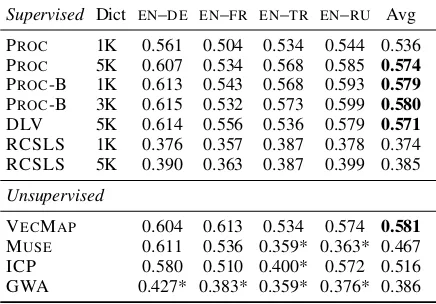
Results and Discussion. XNLI accuracy scores are summarized in Table3. The mismatch between BLI and XNLI performance is most obvious for RCSLS. While RCSLS is the best-performing model on BLI, it shows subpar performance on XNLI across the board. This suggests that special-izing CLE spaces for word translation can seriously hurt cross-lingual transfer for language understand-ing tasks. As the second indication of the mismatch, the unsupervised VECMAPmodel, outperformed by supervised models on BLI, performs on par with PROCand PROC-B on XNLI. Finally, there
12Since our aim is to compare different bilingual spaces— input vectors for ESIM, kept fixed during training—we simply use the default ESIM hyper-parameter configuration.
13
Our goal is not to compete with current state-of-the-art systems for (X)NLI (Artetxe and Schwenk,2018;Lample and Conneau,2019), but rather to provide means to analyze properties and relative performance of diverse CLE models in a downstream language understanding task.
Supervised Dict EN–DE EN–FR EN–TR EN–RU Avg
PROC 1K 0.561 0.504 0.534 0.544 0.536 PROC 5K 0.607 0.534 0.568 0.585 0.574 PROC-B 1K 0.613 0.543 0.568 0.593 0.579 PROC-B 3K 0.615 0.532 0.573 0.599 0.580 DLV 5K 0.614 0.556 0.536 0.579 0.571 RCSLS 1K 0.376 0.357 0.387 0.378 0.374 RCSLS 5K 0.390 0.363 0.387 0.399 0.385
Unsupervised
VECMAP 0.604 0.613 0.534 0.574 0.581 MUSE 0.611 0.536 0.359* 0.363* 0.467 ICP 0.580 0.510 0.400* 0.572 0.516 GWA 0.427* 0.383* 0.359* 0.376* 0.386
Table 3: XNLI performance (test set accuracy). Bold: highest scores, with mutually insignificant differences according to the non-parametric shuffling test (Yeh, 2000). Asterisks denote language pairs for which CLE models could not yield successful runs in the BLI task.
are significant differences between BLI and XNLI performance across language pairs—while we ob-serve much better BLI performance forEN–DEand EN–FRcompared toEN–RUand especiallyEN–TR, XNLI performance of most models forEN–RUand EN–TR surpasses that for EN–FR and is close to that for EN–DE. While this can be an artifact of the XNLI dataset creation, we support these ob-servations for invidivual language pairs by measur-ing an overall Spearman correlation of only 0.13 between BLI and XNLI over individual language pairs scores (for all models).
The PROCmodel performs significantly better on XNLI when trained on 5K pairs than with 1K pairs, and this is consistent with BLI results. How-ever, we show that we can reach the same per-formance level using 1K pairs and the proposed PROC-B bootstrapping scheme. VECMAPis again the most robust and most effective unsupervised model, but it is outperformed by the PROC-B model on more distant language pairs,EN–TRandEN–RU.
4.2 Document Classification
[image:7.595.307.525.191.343.2]Blun-Supervised Dict DE FR IT RU TR Avg
PROC 1K .250 .107 .158 .127 .309 .190 PROC 5K .345 .239 .310 .251 .190 .267 PROC-B 1K .374 .182 .205 .243 .254 .251 PROC-B 3K .352 .210 .218 .186 .310 .255 DLV 5K .299 .175 .234 .375 .208 .258 RCSLS 1K .557 .550 .516 .466 .419 .501 RCSLS 5K .588 .540 .451 .527 .447 .510
Unsupervised
[image:8.595.71.291.64.216.2]VECMAP .433 .316 .333 .504 .439 .405 MUSE .288 .223 .198 .226* .264* .240 ICP .492 .254 .457 .362 .175* .348 GWA .180* .209* .206* .151* .173* .184
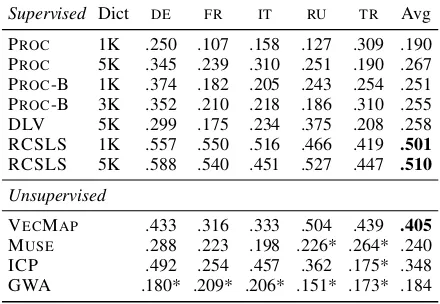
Table 4: CLDC performance (micro-averaged F1
scores); cross-lingual transferEN–X. Numbers in bold denote the best scores in the model group. Asterisks denote language pairs for which CLE models did not yield successful runs in the BLI task.
som,2014), covering 15 topics and 12 language pairs (EN is one of the languages in all pairs). A binary classifier is trained and evaluated for each topic and each language pair, using predefined train and test splits. Intersecting TED and BLI languages results in five CLDC evaluation pairs:EN–DE,EN– FR,EN–IT,EN–RU, andEN–TR. Since we seek to compare different CLEs and analyse their contri-bution and not to match state-of-the-art on TED, for the sake of simplicity we employ a light-weight CNN-based classifier in CLDC experiments.14
Results and Discussion. The CLDC results (F1
micro-averaged over 12 classes) are shown in Ta-ble 4. In contrast to XNLI, RCSLS, the best-performing model on BLI, obtains peak scores on CLDC as well, with a wide margin w.r.t. other mod-els. It significantly outperforms the unsupervised VECMAPmodel, which in turn significantly outper-forms all other supervised models. Surprisingly, su-pervised Procrustes-based models (PROC, PROC-B, and DLV) that performed strongly on both BLI and XNLI display very weak performance on CLDC: this calls for further analyses.
4.3 Information Retrieval
Finally, we analyse behaviour of CLE models in cross-lingual information retrieval. Unlike XNLI and CLDC, we perform CLIR in an unsupervised fashion by comparing aggregate semantic represen-tations of queries inL1with aggregate semantic representations of documents inL2. Retrieval
ar-14We implement a CNN with a single 1-D convolutional layer (8 filters for sizes 2–5) and a 1-max pooling layer, cou-pled with a softmax classifier. We minimize the negative log-likelihood using the Adam algorithm (Kingma and Ba,2014).
guably requires more language understanding than CLDC (where we capture n-grams) and less than XNLI (modeling subtle meaning nuances).
Evaluation Setup. We employ a simple and ef-fective unsupervised CLIR model from (Litschko et al.,2018)15that (1) builds query and document representations as weighted averages of word vec-tors from the CLE space and (2) computes the rele-vance score as the cosine similarity between aggre-gate query and document vectors. We evaluate CLE models on the standard test collections from the CLEF 2000-2003 ad-hoc retrieval Test Suite.16We obtain 9 language pairs by intersecting languages from CLEF and our BLI evaluation.
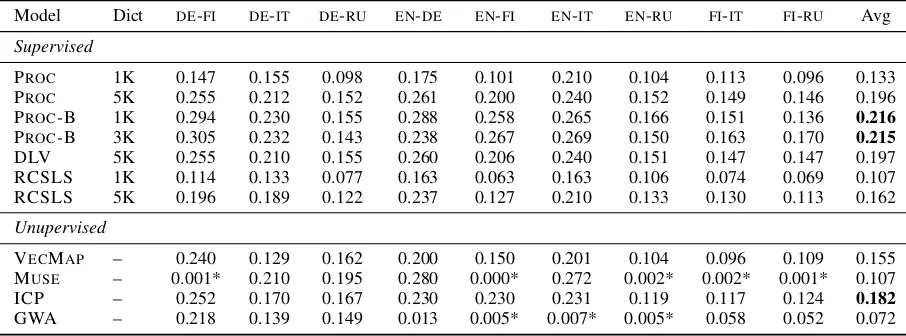
Results and Discussion. CLIR performance (MAP scores for all 9 language pairs) is shown in Table5. The supervised Procrustes-based meth-ods (PROC, PROC-B, DLV) appear to have an edge in CLIR, with the bootstrapping PROC-B model outperforming all other CLE methods.17Contrary to other downstream tasks, VECMAP is not the best-performing unsupervised model on CLIR— ICP performs best considering all nine language pairs (All LPs) and MUSEis best on LPs for which all models produced meaningful spaces (Filt. LPs). RCSLS, the best-performing BLI model, displays only mediocre CLIR performance.
4.4 Further Discussion
At first glance, BLI performance shows a weak and inconsistent correlation with results in downstream tasks. The behaviour of RCSLS is especially pe-culiar: it is the best-performing BLI model and it achieves the best results on CLDC by a wide margin, but it is not at all competitive on XNLI and falls short of other supervised models in CLIR. Downstream results of other models seem, with a few exceptions, to correspond to BLI trends.
To further investigate this, in Table6we measure correlations (in terms of Pearson’sρ) between ag-gregate task performances on BLI and each down-stream task by considering (1) all models and (2) all models except RCSLS.18 Without RCSLS,
15
The model is dubbed BWE-AGGin the original paper. 16
http://catalog.elra.info/en-us/ repository/browse/ELRA-E0008/
17Similarly to the BLI evaluation, we test the significance by applying a Student’s t-test on two lists of ranks of relevant documents (concatenated across all test collections), produced by two models under comparison. Even with Bonferroni cor-rection for multiple tests, PROC-B significantly outperforms all other CLE models atα= 0.05.
down-Model Dict DE-FI DE-IT DE-RU EN-DE EN-FI EN-IT EN-RU FI-IT FI-RU Avg
Supervised
PROC 1K 0.147 0.155 0.098 0.175 0.101 0.210 0.104 0.113 0.096 0.133
PROC 5K 0.255 0.212 0.152 0.261 0.200 0.240 0.152 0.149 0.146 0.196
PROC-B 1K 0.294 0.230 0.155 0.288 0.258 0.265 0.166 0.151 0.136 0.216 PROC-B 3K 0.305 0.232 0.143 0.238 0.267 0.269 0.150 0.163 0.170 0.215
DLV 5K 0.255 0.210 0.155 0.260 0.206 0.240 0.151 0.147 0.147 0.197
RCSLS 1K 0.114 0.133 0.077 0.163 0.063 0.163 0.106 0.074 0.069 0.107
RCSLS 5K 0.196 0.189 0.122 0.237 0.127 0.210 0.133 0.130 0.113 0.162
Unupervised
VECMAP – 0.240 0.129 0.162 0.200 0.150 0.201 0.104 0.096 0.109 0.155 MUSE – 0.001* 0.210 0.195 0.280 0.000* 0.272 0.002* 0.002* 0.001* 0.107
ICP – 0.252 0.170 0.167 0.230 0.230 0.231 0.119 0.117 0.124 0.182
GWA – 0.218 0.139 0.149 0.013 0.005* 0.007* 0.005* 0.058 0.052 0.072
Table 5: CLIR performance (MAP) of CLE models (the first language in each column is the query language, the second is the language of the document collection). Numbers in bold denote the best scores in the model group. Asterisks denote language pairs for which CLE models did not yield successful runs in BLI evaluation.
Models XNLI CLDC CLIR
All models 0.269 0.390 0.764
[image:9.595.72.525.63.231.2]All w/o RCSLS 0.951 0.266 0.910
Table 6: Correlations of model-level results between BLI and each of the three downstream tasks.
BLI results correlate strongly with XNLI and CLIR results and weakly with CLDC results.
But why does RCSLS diverge from other mod-els? All other models induce an orthogonal pro-jection (using given or induced dictionaries), mini-mizing the post-projection Euclidean distances be-tween aligned words. In contrast, by maximizing CSLS, RCSLS relaxes the orthogonality condition imposed on the projection. This allows for distor-tions of the source embedding space after projec-tion. The exact nature of these distortions and their impact on downstream performance of RCSLS require further investigation. However, these find-ings indicate that downstream evaluation is even more important for CLE models that learn non-orthogonal projections. For CLE models with or-thogonal projections, downstream results seem to be more in line with BLI performance.
This brief task correlation analysis is based on coarse-grained model-level aggregation. The ac-tual selection of the strongest baseline models re-quires finer-grained tuning at the level of partic-ular language pairs and evaluation tasks of inter-est. Nonetheless, our experiments detect two ro-bust baselines that should be included as indicative reference points in future CLE research: PROC-B (supervised) and VECMAP(unsupervised).
stream task T, we average model’s BLI performance only over the language pairs included in the task T.
5 Conclusion
Rapid development of cross-lingual word embed-ding (CLE) methods is not met with adequate progress in their fair and systematic evaluation. CLE models are commonaly evaluated only in bilingual lexicon induction (BLI), and even the BLI task includes a variety of evaluation setups which are not directly comparable, hindering our ability to correctly interpret the key results. In this work, we have made the first step towards a com-prehensive evaluation of CLEs. By systematically evaluating CLE models for many language pairs on BLI and three downstream tasks, we shed new light on the ability of current cutting-edge CLE models to support cross-lingual NLP. In particu-lar, we have empirically proven that the quality of CLE models is largely task-dependent and that overfitting the models to the BLI task can result in deteriorated performance in downstream tasks. We have highlighted the most robust supervised and unsupervised CLE models and have exposed the need for reassessing existing baselines, as well as for unified and comprehensive evaluation pro-tocols. We hope that this study will encourage fu-ture work on CLE evaluation and analysis and help guide the development of new CLE models. . We make the code and resources available at:https:
//github.com/codogogo/xling-eval.
Acknowledgments
References
Jean Alaux, Edouard Grave, Marco Cuturi, and Ar-mand Joulin. 2019. Unsupervised hyperalignment for multilingual word embeddings. InProceedings of ICLR.
David Alvarez-Melis and Tommi Jaakkola. 2018. Gromov-Wasserstein alignment of word embedding spaces. In Proceedings of EMNLP, pages 1881– 1890.
Waleed Ammar, George Mulcaire, Yulia Tsvetkov, Guillaume Lample, Chris Dyer, and Noah A Smith. 2016. Massively multilingual word embeddings.
arXiv preprint arXiv:1602.01925.
Mikel Artetxe, Gorka Labaka, and Eneko Agirre. 2017. Learning bilingual word embeddings with (almost) no bilingual data. In Proceedings of ACL, pages 451–462.
Mikel Artetxe, Gorka Labaka, and Eneko Agirre. 2018a. Generalizing and improving bilingual word embedding mappings with a multi-step framework of linear transformations. InProceedings of AAAI, pages 5012–5019.
Mikel Artetxe, Gorka Labaka, and Eneko Agirre. 2018b. A robust self-learning method for fully un-supervised cross-lingual mappings of word embed-dings. InProceedings of ACL, pages 789–798.
Mikel Artetxe, Gorka Labaka, Eneko Agirre, and Kyunghyun Cho. 2018c. Unsupervised neural ma-chine translation. InProceedings of ICLR.
Mikel Artetxe and Holger Schwenk. 2018. Mas-sively multilingual sentence embeddings for zero-shot cross-lingual transfer and beyond. CoRR, abs/1812.10464.
Amir Bakarov, Roman Suvorov, and Ilya Sochenkov. 2018. The limitations of cross-language word em-beddings evaluation. In Proceedings of *SEM, pages 94–100.
Anthony Bell and Terrence Sejnowski. 1997. The ’In-dependent Components’ of Natural Scenes are Edge Filters.Vision Research.
Piotr Bojanowski, Edouard Grave, Armand Joulin, and Tomas Mikolov. 2017. Enriching word vectors with subword information. Transactions of the ACL, 5:135–146.
Samuel R. Bowman, Gabor Angeli, Christopher Potts, and Christopher D Manning. 2015. A large anno-tated corpus for learning natural language inference. InProceedings of EMNLP, pages 632–642.
Qian Chen, Xiaodan Zhu, Zhen-Hua Ling, Si Wei, Hui Jiang, and Diana Inkpen. 2017.Enhanced LSTM for natural language inference. InProceedings of ACL, pages 1657–1668.
Xilun Chen and Claire Cardie. 2018. Unsupervised multilingual word embeddings. In Proceedings of EMNLP, pages 261–270.
Alexis Conneau, Guillaume Lample, Marc’Aurelio Ranzato, Ludovic Denoyer, and Hervé Jégou. 2018a. Word translation without parallel data. In Proceed-ings of ICLR.
Alexis Conneau, Ruty Rinott, Guillaume Lample, Ad-ina Williams, Samuel Bowman, Holger Schwenk, and Veselin Stoyanov. 2018b. XNLI: Evaluating cross-lingual sentence representations. In Proceed-ings of EMNLP, pages 2475–2485.
Zi-Yi Dou, Zhi-Hao Zhou, and Shujian Huang. 2018. Unsupervised bilingual lexicon induction via latent variable models. InProceedings of EMNLP, pages 621–626.
Yerai Doval, Jose Camacho-Collados, Luis Es-pinosa Anke, and Steven Schockaert. 2018. Improving cross-lingual word embeddings by meeting in the middle. InProceedings of EMNLP, pages 294–304.
Rotem Dror, Gili Baumer, Segev Shlomov, and Roi Re-ichart. 2018. The hitchhiker’s guide to testing statis-tical significance in natural language processing. In
Proceedings of ACL, pages 1383–1392.
Manaal Faruqui and Chris Dyer. 2014. Improving vec-tor space word representations using multilingual correlation. In Proceedings of EACL, pages 462– 471.
Ian J. Goodfellow, Jean Pouget-Abadie, Mehdi Mirza, Bing Xu, David Warde-Farley, Sherjil Ozair, Aaron C. Courville, and Yoshua Bengio. 2014. Gen-erative adversarial nets. In Proceedings of NIPS, pages 2672–2680.
Edouard Grave, Armand Joulin, and Quentin Berthet. 2018. Unsupervised alignment of embeddings with Wasserstein procrustes.CoRR, abs/1805.11222.
Jiang Guo, Wanxiang Che, David Yarowsky, Haifeng Wang, and Ting Liu. 2015. Cross-lingual depen-dency parsing based on distributed representations. InProceedings of ACL, pages 1234–1244.
Karl Moritz Hermann and Phil Blunsom. 2014. Multi-lingual models for compositional distributed seman-tics. InProceedings of ACL, pages 58–68.
Yedid Hoshen and Lior Wolf. 2018. Non-adversarial unsupervised word translation. In Proceedings of EMNLP, pages 469–478.
Roy Jonker and Anton Volgenant. 1987. A shortest augmenting path algorithm for dense and sparse lin-ear assignment problems. Computing, 38(4):325– 340.
Armand Joulin, Piotr Bojanowski, Tomas Mikolov, Hervé Jégou, and Edouard Grave. 2018. Loss in translation: Learning bilingual word mapping with a retrieval criterion. InProceedings of EMNLP, pages 2979–2984.
Yunsu Kim, Jiahui Geng, and Hermann Ney. 2018. Improving unsupervised word-by-word translation with language model and denoising autoencoder. In
Proceedings of EMNLP, pages 862–868.
Diederik P Kingma and Jimmy Ba. 2014. Adam: A method for stochastic optimization. arXiv preprint arXiv:1412.6980.
Alexandre Klementiev, Ivan Titov, and Binod Bhattarai. 2012. Inducing crosslingual distributed represen-tations of words. Proceedings of COLING, pages 1459–1474.
Guillaume Lample and Alexis Conneau. 2019. Cross-lingual language model pretraining. CoRR, abs/1901.07291.
Guillaume Lample, Myle Ott, Alexis Conneau, Lu-dovic Denoyer, and Marc’Aurelio Ranzato. 2018. Phrase-based & neural unsupervised machine trans-lation. In Proceedings of EMNLP, pages 5039– 5049.
Angeliki Lazaridou, Georgiana Dinu, and Marco Ba-roni. 2015. Hubness and Pollution: Delving into Cross-Space Mapping for Zero-Shot Learning. In
Proceedings of ACL-IJCNLP, pages 270–280.
Omer Levy, Anders Søgaard, and Yoav Goldberg. 2017. A strong baseline for learning cross-lingual word embeddings from sentence alignments. In Proceed-ings of EACL, pages 765–774.
Robert Litschko, Goran Glavaš, Simone Paolo Ponzetto, and Ivan Vuli´c. 2018. Unsupervised cross-lingual information retrieval using monocross-lingual data only. InProceedings of SIGIR, pages 1253–1256.
Thang Luong, Hieu Pham, and Christopher D. Man-ning. 2015. Bilingual word representations with monolingual quality in mind. InProceedings of the 1st Workshop on Vector Space Modeling for Natural Language Processing, pages 151–159.
Stephen Mayhew, Chen-Tse Tsai, and Dan Roth. 2017. Cheap translation for cross-lingual named entity recognition. In Proceedings of EMNLP, pages 2536–2545.
Tomas Mikolov, Quoc V Le, and Ilya Sutskever. 2013. Exploiting similarities among languages for ma-chine translation.CoRR, abs/1309.4168.
Tanmoy Mukherjee, Makoto Yamada, and Timothy Hospedales. 2018. Learning unsupervised word translations without adversaries. InProceedings of EMNLP, pages 627–632.
Ndapa Nakashole. 2018. NORMA: Neighborhood sen-sitive maps for multilingual word embeddings. In
Proceedings of EMNLP, pages 512–522.
Gabriel Peyré, Marco Cuturi, and Justin Solomon. 2016. Gromov-Wasserstein averaging of kernel and distance matrices. In Proceedings of ICML, pages 2664–2672.
Sebastian Ruder, Ryan Cotterell, Yova Kementched-jhieva, and Anders Søgaard. 2018a. A discrimina-tive latent-variable model for bilingual lexicon in-duction. InProceedings of EMNLP, pages 458–468.
Sebastian Ruder, Anders Søgaard, and Ivan Vuli´c. 2018b. A survey of cross-lingual embedding mod-els.arXiv preprint arXiv:1706.04902.
Peter H Schönemann. 1966. A generalized solution of the orthogonal Procrustes problem. Psychometrika, 31(1):1–10.
Samuel L. Smith, David H.P. Turban, Steven Hamblin, and Nils Y. Hammerla. 2017. Offline bilingual word vectors, orthogonal transformations and the inverted softmax. InProceedings of ICLR.
Anders Søgaard, Željko Agi´c, Héctor Martínez Alonso, Barbara Plank, Bernd Bohnet, and Anders Jo-hannsen. 2015. Inverted indexing for cross-lingual NLP. InProceedings of ACL, pages 1713–1722.
Anders Søgaard, Sebastian Ruder, and Ivan Vuli´c. 2018. On the limitations of unsupervised bilingual dictio-nary induction. InProceedings of ACL, pages 778– 788.
Shyam Upadhyay, Manaal Faruqui, Chris Dyer, and Dan Roth. 2016. Cross-lingual models of word em-beddings: An empirical comparison. InProceedings of ACL, pages 1661–1670.
Ivan Vuli´c and Anna Korhonen. 2016. On the role of seed lexicons in learning bilingual word embeddings. InProceedings of ACL, pages 247–257.
Ivan Vuli´c and Marie-Francine Moens. 2015. Monolin-gual and cross-linMonolin-gual information retrieval models based on (bilingual) word embeddings. In Proceed-ings of SIGIR, pages 363–372.
Ivan Vuli´c and Marie-Francine Moens. 2016. Bilingual distributed word representations from document-aligned comparable data. Journal of Artificial Intel-ligence Research, 55:953–994.
Adina Williams, Nikita Nangia, and Samuel R. Bow-man. 2018. A broad-coverage challenge corpus for sentence understanding through inference. In Pro-ceedings of NAACL-HLT, pages 1112–1122.
Chao Xing, Dong Wang, Chao Liu, and Yiye Lin. 2015. Normalized word embedding and orthogonal trans-form for bilingual word translation. InProceedings of NAACL-HLT, pages 1006–1011.
Ruochen Xu, Yiming Yang, Naoki Otani, and Yuexin Wu. 2018. Unsupervised cross-lingual transfer of word embedding spaces. InProceedings of EMNLP, pages 2465–2474.
Alexander Yeh. 2000. More accurate tests for the sta-tistical significance of result differences. In Proceed-ings of COLING, pages 947–953.
Yuan Zhang, David Gaddy, Regina Barzilay, and Tommi Jaakkola. 2016. Ten pairs to tag – Multi-lingual POS tagging via coarse mapping between embeddings. InProceedings of NAACL-HLT, pages 1307–1317.