Proceedings of the 56th Annual Meeting of the Association for Computational Linguistics (Short Papers), pages 157–162 157
Improved Evaluation Framework for Complex Plagiarism Detection
Anton Belyy1 Marina Dubova2 Dmitry Nekrasov1
1International laboratory “Computer Technologies”, ITMO University, Russia 2Saint Petersburg State University, Russia
{anton.belyy, marina.dubova.97, dpokrasko}@gmail.com
Abstract
Plagiarism is a major issue in science and education. It appears in various forms, starting from simple copying and ending with intelligent paraphrasing and summarization. Complex plagiarism, such as plagiarism of ideas, is hard to detect, and therefore it is especially important to track improvement of methods correctly and not to overfit to the structure of particular datasets. In this paper, we study the performance of plagdet, the main measure for Plagiarism Detection Systems evaluation, on manually paraphrased plagiarism datasets (such as PAN Summary). We reveal its fallibility under certain conditions and propose an evaluation framework with normalization of inner terms, which is resilient to the dataset imbalance. We conclude with the experimental justification of the proposed measure. The implementation of the new framework is made publicly available as a Github repository.
1 Introduction
Plagiarism is a problem of primary concern among publishers, scientists, teachers (Maurer et al., 2006). It is not only about text copying with minor revisions but also borrowing of ideas. Plagiarism appears in substantially paraphrased forms and presents conscious and unconscious appropriation of others’ thoughts (Gingerich and Sullivan,2013). This kind of borrowing has very serious consequences and can not be detected with common Plagiarism Detection Systems (PDS). That is why detection of complex plagiarism cases comes to the fore and becomes a central challenge in the field.
2 Plagiarism Detection
Most of the contributions to the plagiarism text alignment were made during the PAN annual track for plagiarism detection held from 2009 to 2015. The latest winning approach ( Sanchez-Perez et al.,2014) achieved good performance on all the plagiarism types except the Summary part. Moreover, this type of plagiarism turned out to be the hardest for all the competitors.
In a brief review, Kraus emphasized (2016) that the main weakness of modern PDS is imprecision in manually paraphrased plagiarism and, as a consequence, the weak ability to deal with real-world problems. Thus, the detection of manually paraphrased plagiarism cases is a focus of recently proposed methods for plagiarism text alignment. In the most successful contributions, scientists applied genetic algorithms ( Sanchez-Perez et al., 2018; Vani and Gupta, 2017), topic modeling methods (Le et al., 2016), and word embedding models (Brlek et al.,2016) to manually paraphrased plagiarism text alignment. In all of these works, authors used PAN Summary datasets to develop and evaluate their methods.
3 Task, Dataset, and Evaluation Metrics
3.1 Text Alignment
In this work we deal with an extrinsic text alignment problem. Thus, we are given pairs of suspicious documents and source candidates and try to detect all contiguous passages of borrowed information. For a review of plagiarism detection tasks, seeAlzahrani et al. 2012.
3.2 Datasets
since 2009 to 2015. We used the most recent 2013 (Potthast et al., 2013) and 2014 (Potthast et al., 2014) English datasets to develop and evaluate our models and metrics. They consist of copy&paste, random, translation, and summary plagiarism types. We consider only the last part, as it exhibits the problems of plagdet framework to the greatest extent.
3.3 Evaluation Metrics
Standard evaluation framework for text alignment task is plagdet (Potthast et al., 2010), which consists of macro- and micro-averaged precision, recall, granularity and the overall plagdet score. In this work, we consider only the macro-averaged metrics, whererecallcan be defined as follows:
recmacro(S, R) =
1 |S|
X
s∈S
recsingle
macro(s, Rs), (1)
andprecision can be defined through recall as follows:
precmacro(S, R) =recmacro(R, S), (2)
where S and R are true plagiarism cases and system’s detections, respectively.
Single case recallrecsingle macro
(s, Rs)is defined as
follows:
|splg∩(Rs)plg|+|ssrc∩(Rs)src|
|splg|+|ssrc|
,
where Rs is the union of all detections of a
given cases.
4 Problem Statement
In this section, we explore problems representative to several manual plagiarism datasets (mainly, Summary part of PAN corpora), and show that the plagdet framework can fail to correctly estimate PDS quality on these datasets.
4.1 Dataset Imbalance
The PAN Summary datasets turn out to be highly imbalanced.
• Source part of each plagiarism case takes up the whole source document:
∀s∈S∃dsrc ∈Dsrc:ssrc =dsrc. (3)
Plagiarism document
(dplg)
Source document
(dsrc)
true case s
splg ssrc
detection r1
(r1)src
(r2)plg (r2)src
detection r2
(Rs)plg (Rs)src
[image:2.595.307.536.61.339.2](r1)plg
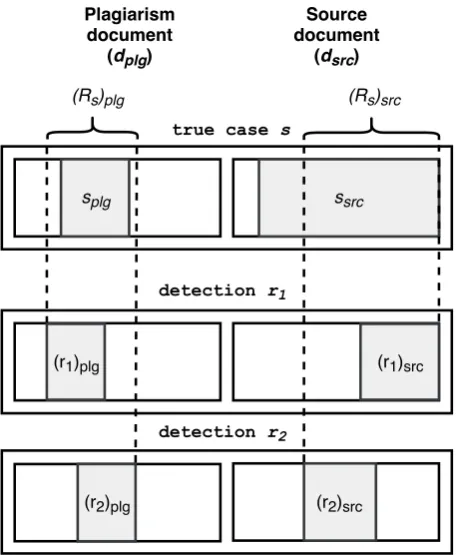
Figure 1: Single case recall computation for text alignment task. Note the imbalance in this case: plagiarism part splg is much shorter than source
partssrc.
• For any given case, its plagiarism part is much shorter than its source part1:
∀s∈S:|splg|<<|ssrc|. (4)
As these datasets are publicly available, anyone can figure out these details and, therefore, construct an algorithm where statements3 and4 are true for detectionsRas well.
Let us now consider a true cases, its detections
Rsand its source documentdsrc. Then single case
recall for PAN Summary document will be equal to:
|splg∩(Rs)plg|+|dsrc|
|splg|+|dsrc|
(5)
(here we used that andssrc = (Rs)src=dsrc).
Since plagiarism partsplgof the casesis much
shorter than source documentdsrc, the term|dsrc|
dominates numerator and denominator in eq. 5, which results in inadequately high document-level precision and recall on PAN Summary datasets.
Other datasets for manual plagiarism detection display the similar properties, however, not to the PAN Summary extent. Examples include: Palkovskii15, Mashhadirajab et al. 2016, and Sochenkov et al. 2017.
Discussion
The important question is whether such dataset imbalance reflects the real-world plagiarizers’ behavior.
There is an evidence that performing length unrestricted plagiarism task people tend to make texts shorter, however, not to the PAN Summary extent (Barr´on-Cede˜no et al., 2013). Moreover, we can find some supporting theoretical reasons. Firstly, summarization and paraphrasing are the only techniques students are taught to use for the transformation of texts. Hence, they can use summarization to plagiarize intellectually. Secondly, in the cases of inadvertent plagiarism and the plagiarism of ideas details of source texts are usually omitted or forgotten. This should also lead to smaller plagiarized texts. Though we can find some reasons, such huge imbalance does not seem to be supported enough and may be considered as a bias.
4.2 Degenerate Intersection
Lemma 4.1. For any sets e1 ⊆ dand e2 ⊆ d, their intersection length|e1∩e2|is bounded by:
a(e1, e2, d)6|e1∩e2|6b(e1, e2),
where:
a(e1, e2, d) =max(0,|e1|+|e2| − |d|),
b(e1, e2) =min(|e1|,|e2|).
Let us take a fresh look at a source part of
recsingle macro
. We assume that |ssrc∩(Rs)src|
|ssrc| ∈ [0; 1],
and this is actually the case if:
06|ssrc∩(Rs)src|6|ssrc|.
But, according to lemma4.1, we see that:
06asrc 6|ssrc∩(Rs)src|6bsrc 6|ssrc|,
where:
asrc =a(ssrc,(Rs)src, dsrc),
bsrc =b(ssrc,(Rs)src).
.
d
e1 e1∩ e2 e2
a(e1,e2, d)
d
e2 e1 = e1∩ e2
b(e1,e2)
Figure 2: Degenerate intersection lemma. Intuitively, lower bound (a) is achieved when e1
ande2 are “farthest” away from each other ind,
and upper bound (b) is achieved whene1⊆e2(or e2⊆e1).
This results in asmaller possible value range
of intersection length and, therefore, range of precision and recall values. Because of (3), on PAN Summary this leads to the extreme case of
asrc =bsrc =|dsrc|, which causes precision and
recall to take constant values on the source part of the dataset.
5 Proposed Metrics
5.1 Normalized Single Case Recall
To address issues of dataset imbalance (section 4.1) and degenerate intersection (section 4.2), we propose the following normalizedversion of
single case recall nrecsingle macro
(s, Rs) for
macro-averaged case:
wplg(|splg ∩(Rs)plg|) +wsrc(|ssrc∩(Rs)src|)
wplg(|splg|) +wsrc(|ssrc|)
,
where:
wi(x) =
(x−ai)(bi−ai)
|di|
,
ai=a(si,(Rs)i, di),
bi=b(si,(Rs)i),
5.2 Normalized recall, precision and plagdet
The result of (1) where every recsingle macro(s, Rs)
term is replaced fornrecsingle macro
(s, Rs)is defined as
normalized recallnrecmacro(S, R).Normalized
precisionnprecmacro(S, R)can be obtained from
normalized recall using eq.2.
Normalized macro-averaged plagdet, or
normplagdet, is defined as follows:
normplagdet(S, R) = Fα(S, R) log2(1 +gran(S, R)),
where Fα is the weighted harmonic mean of
nprecmacro(S, R) andnrecmacro(S, R), i.e. the
Fα-measure, and gran(S, R) is defined as in
Potthast et al. 2010.
6 Adversarial models
To justify the proposed evaluation metrics, we construct two models,M1andM2, which achieve inadequately high macro-averaged precision and recall.
6.1 Preprocessing
We represent each plagiarism document dplg as
a sequence of sentences, where each sentence
sentdplg,i ∈ dplg is a set of tokens. Each source
documentdsrc will be represented as a set of its
tokens.
For each sentence sentdplg,i we also define a
measure of similaritysimdplg,dsrc,iwith respect to
the source document as:
simdplg,dsrc,i=
|sentdplg,i∩dsrc|
|sentdplg,i| .
6.2 Models
Our models are rule-based classifiers, which proceed in three steps for each pair of documents
dplg, dsrc:
1. Form a candidate set according to similarity score:cand=ni|simdplg,dsrc,i>
3 4
o
.
2. Find the candidate with highest similarity score (if it exists): best = arg max
i
simdplg,dsrc,i|i∈cand .
3. (M1)Output sentencebestas a detection (if it exists).
(M2) Output sentences i|i 6= best as a detection (or all sentences if best does not exist).
7 Results and Discussion
We evaluated our adversarial models as well as several state-of-the-art algorithms, whose source code was available to us, using plagdet and normplagdet scores on all PAN Summary datasets available to date.
In plagdet score comparison (Table 1) we included additional state-of-the-art algorithms’ results (marked by ∗), borrowed from respective papers. Proposed models M1 and M2 outperform all algorithms by macro-averaged plagdet and recall measures on almost every dataset. Despite their simplicity, they show rather good results.
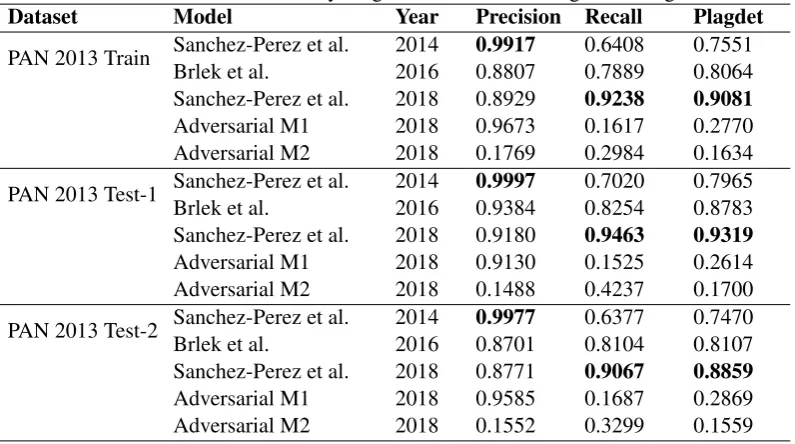
On the contrary, while measuring normplagdet score (Table 2), M1 and M2 exhibit poor results, while tested state-of-the-art systems evenly achieve better recall and normplagdet scores. These experimental results back up our claim that normplagdet is more resilient to dataset imbalance and degenerate intersection attacks and show that tested state-of-the-art algorithms do not exploit these properties of PAN Summary datasets. The code for calculating normplagdet metrics, both macro- and micro-averaged, is made available as a Github repository2. We preserved the command line interface of plagdet framework to allow easy adaptation for existing systems.
8 Conclusion
Our paper shows that the standard evaluation framework with plagdet measure can be misused to achieve high scores on datasets for manual plagiarism detection. We constructed two primitive models that achieve state-of-the-art results for detecting plagiarism of ideas by exploiting flaws of standard plagdet. Finally, we proposed a new framework, normplagdet, that normalizes single case scores to prevent misuse of datasets such as PAN Summary, and proved its correctness experimentally. The proposed evaluation framework seems beneficial not only for plagiarism detection but for any other text alignment task with imbalance or degenerate intersection dataset properties.
Acknowledgments
This work was financially supported by Government of Russian Federation (Grant 08-08).
2https://github.com/AVBelyy/
Table 1: Results of Summary Plagiarism Detection using Plagdet
Dataset Model Year Precision Recall Plagdet
PAN 2013 Train
Sanchez-Perez et al. 2014 0.9942 0.4235 0.5761 Brlek et al. 2016 0.9154 0.6033 0.7046
Le et al.∗ 2016 0.8015 0.7722 0.7866
Sanchez-Perez et al. 2018 0.9662 0.7407 0.8386 Adversarial M1 2018 0.9676 0.7892 0.8693
Adversarial M2 2018 0.5247 0.8704 0.4816
PAN 2013 Test-1
Sanchez-Perez et al. 2014 1.0000 0.5317 0.6703 Brlek et al. 2016 0.9832 0.7003 0.8180 Vani and Gupta∗ 2017 0.9998 0.7622 0.8149 Sanchez-Perez et al. 2018 0.9742 0.8093 0.8841
Adversarial M1 2018 0.9130 0.7641 0.8320 Adversarial M2 2018 0.4678 0.8925 0.4739
PAN 2013 Test-2
Sanchez-Perez et al. 2014 0.9991 0.4158 0.5638 Brlek et al. 2016 0.9055 0.6144 0.7072
Le et al.∗ 2016 0.8344 0.7701 0.8010
Vani and Gupta∗ 2017 0.9987 0.7212 0.8081 Sanchez-Perez et al. 2018 0.9417 0.7226 0.8125 Adversarial M1 2018 0.9594 0.8109 0.8789
[image:5.595.102.500.421.643.2]Adversarial M2 2018 0.5184 0.8938 0.4848
Table 2: Results of Summary Plagiarism Detection using NormPlagdet
Dataset Model Year Precision Recall Plagdet
PAN 2013 Train Sanchez-Perez et al. 2014 0.9917 0.6408 0.7551 Brlek et al. 2016 0.8807 0.7889 0.8064 Sanchez-Perez et al. 2018 0.8929 0.9238 0.9081
Adversarial M1 2018 0.9673 0.1617 0.2770 Adversarial M2 2018 0.1769 0.2984 0.1634
PAN 2013 Test-1 Sanchez-Perez et al. 2014 0.9997 0.7020 0.7965 Brlek et al. 2016 0.9384 0.8254 0.8783 Sanchez-Perez et al. 2018 0.9180 0.9463 0.9319
Adversarial M1 2018 0.9130 0.1525 0.2614 Adversarial M2 2018 0.1488 0.4237 0.1700
PAN 2013 Test-2 Sanchez-Perez et al. 2014 0.9977 0.6377 0.7470 Brlek et al. 2016 0.8701 0.8104 0.8107 Sanchez-Perez et al. 2018 0.8771 0.9067 0.8859
Adversarial M1 2018 0.9585 0.1687 0.2869 Adversarial M2 2018 0.1552 0.3299 0.1559
Table 3: Average Length of Plagiarism and Source Cases in Summary Datasets
Dataset Plagiarism (plg) Source (src)
PAN 2013 Train 626±45 5109±2431
PAN 2013 Test-1 639±40 3874±1427
References
Salha M Alzahrani, Naomie Salim, and Ajith Abraham. 2012. Understanding plagiarism linguistic patterns, textual features, and detection methods. IEEE Transactions on Systems, Man, and Cybernetics, Part C (Applications and Reviews), 42(2):133–149.
Alberto Barr´on-Cede˜no, Marta Vila, M Ant`onia Mart´ı, and Paolo Rosso. 2013. Plagiarism meets paraphrasing: Insights for the next generation in automatic plagiarism detection. Computational Linguistics, 39(4):917–947.
Arijana Brlek, Petra Franjic, and Nino Uzelac. 2016. Plagiarism detection using word2vec model. Text Analysis and Retrieval 2016 Course Project Reports, pages 4–7.
Amanda C Gingerich and Meaghan C Sullivan. 2013. Claiming hidden memories as one’s own: a review of inadvertent plagiarism. Journal of Cognitive Psychology, 25(8):903–916.
Christina Kraus. 2016. Plagiarism detection-state-of-the-art systems (2016) and evaluation methods. arXiv preprint arXiv:1603.03014.
Huong T Le, Lam N Pham, Duy D Nguyen,
Son V Nguyen, and An N Nguyen. 2016.
Semantic text alignment based on topic modeling. In Computing & Communication Technologies, Research, Innovation, and Vision for the Future (RIVF), 2016 IEEE RIVF International Conference on, pages 67–72. IEEE.
Fatemeh Mashhadirajab, Mehrnoush Shamsfard, Razieh Adelkhah, Fatemeh Shafiee, and Chakaveh Saedi. 2016. A text alignment corpus for persian plagiarism detection. In FIRE (Working Notes), pages 184–189.
Hermann A Maurer, Frank Kappe, and Bilal Zaka. 2006. Plagiarism-a survey. J. UCS, 12(8):1050– 1084.
Martin Potthast, Matthias Hagen, Anna Beyer, Matthias Busse, Martin Tippmann, Paolo Rosso, and Benno Stein. 2014. Overview of the 6th international competition on plagiarism detection. In CEUR Workshop Proceedings, volume 1180, pages 845–876. CEUR Workshop Proceedings.
Martin Potthast, Matthias Hagen, Tim Gollub, Martin Tippmann, Johannes Kiesel, Paolo Rosso, Efstathios Stamatatos, and Benno Stein. 2013. Overview of the 5th international competition on plagiarism detection. InCLEF Conference on Multilingual and Multimodal Information Access Evaluation, pages 301–331. CELCT.
Martin Potthast, Benno Stein, Alberto Barr´on-Cede˜no, and Paolo Rosso. 2010. An evaluation framework for plagiarism detection. In Proceedings of the 23rd international conference on computational linguistics: Posters, pages 997–1005. Association for Computational Linguistics.
Miguel A Sanchez-Perez, Alexander Gelbukh,
Grigori Sidorov, and Helena G´omez-Adorno. 2018. Plagiarism detection with genetic-based parameter tuning. International Journal of Pattern Recognition and Artificial Intelligence, 32(01):1860006.
Miguel A Sanchez-Perez, Grigori Sidorov, and Alexander F Gelbukh. 2014. A winning approach to text alignment for text reuse detection at pan 2014. InCLEF (Working Notes), pages 1004–1011.
Ilya Sochenkov, Denis Zubarev, and Ivan Smirnov. 2017.The paraplag: russian dataset for paraphrased plagiarism detection. InProceedings of the Annual International Conference “Dialogue” 2017 (1), pages 284–297.
K Vani and Deepa Gupta. 2017. Detection of