Proceedings of the 1st Workshop on Gender Bias in Natural Language Processing, pages 113–119 113
Resolving Gendered Ambiguous Pronouns with BERT
Matei Ionita University of Pennsylvania
Yury Kashnitsky
Moscow Institute of Physics and Technology
Ken Krige Kitsong
Vladimir Larin PJSC Sberbank
Denis Logvinenko Jet Infosystems
Atanas Atanasov Sofia University
Abstract
Pronoun resolution is part of coreference res-olution, the task of pairing an expression to its referring entity. This is an important task for natural language understanding and a nec-essary component of machine translation sys-tems, chat bots and assistants. Neural machine learning systems perform far from ideally in this task, reaching as low as 73% F1 scores on modern benchmark datasets. Moreover, they tend to perform better for masculine pronouns than for feminine ones. Thus, the problem is both challenging and important for NLP re-searchers and practitioners. In this project, we describe our BERT-based approach to solving the problem of gender-balanced pronoun reso-lution. We are able to reach 92% F1 score and a much lower gender bias on the benchmark dataset shared by Google AI Language team.
1 Introduction
In this work, we are dealing with gender bias in pronoun resolution. A more general task of coref-erence resolution is reviewed in Sec. 2. In Sec.
3, we give an overview of a related Kaggle com-petition. Then, Sec. 4describes the GAP dataset and Google AI’s heuristics to resolve pronomial coreference in a gender-agnostic way, so that pro-noun resolution is done equally well in cases of masculine and feminine pronouns. In Sec. 5, we provide the details of our BERT-based solution while in Sec. 6we analyze pleasantly low gender
bias specific for our system (our code is shared on GitHub1). Lastly, in Sec. 7, we draw conclusions and express some ideas for further research.
2 Related work
Among popular approaches to coreference res-olution are:2 rule-based, mention pair, mention ranking, and clustering. As for rule-based ap-proaches, they describe naïve Hobbs algorithm (Hobbs, 1986) which, in spite of being naïve, has shown state-of-the-art performance on the OntoNotes dataset3up to 2010.
Recent state-of-the-art approaches (Lee et al.,
2018, 2017; Peters et al., 2018a) are pretty complex examples of mention ranking systems. The 2017 version is the first end-to-end corefer-ence resolution model that didn’t utilize syntactic parsers or hand-engineered mention detectors. In-stead, it used LSTMs and attention mechanism to improve over previous NN-based solutions.
Some more state-of-the-art coreference resolu-tion systems are reviewed in (Webster et al.,2018) as well as popular datasets with ambiguous pro-nouns: Winograd schemas (Levesque et al.,2012), WikiCoref (Ghaddar and Langlais, 2016), and
1
https://github.com/Yorko/
gender-unbiased_BERT-based_pronoun_ resolution
2
https://bit.ly/2JbKxv1
3https://catalog.ldc.upenn.edu/
The Definite Pronoun Resolution Dataset ( Prad-han et al.,2007). We also refer to the GAP paper for a brief review of gender bias in machine learn-ing.
We further outline that e2e-coref model (Lee et al., 2018), in spite of being state-of-the-art in coreference resolution, didn’t show good results in the pronoun resolution task that we tackled, so we only used e2e-coref predictions as an additional feature.
3 Kaggle competition “Gendered Pronoun Resolution”
Following Kaggle competition “Gendered Pro-noun Resolution”,4 for each abstract from Wikipedia pages we are given a pronoun, and we try to predict the right coreference for it, i.e. to which named entity (A or B) it refers. Let’s take a look at this simple example:
“John entered the room and saw [A] Julia. [Pronoun] She was talking to [B] Mary Hendriks and looked so extremely gorgeous that John was stunned and couldn’t say a word.”
Here “Julia” is marked as entity A, “Mary Hen-driks” – as entity B, and pronoun “She” is marked as Pronoun. In this particular case the task is to correctly identify to which entity the given pro-noun refers.
If we feed this sentence into a coreference res-olution system (see Fig. 1and online demo5), we see that it correctly identifies that “she” refers to Julia, it also correctly clusters together two men-tions of “John” and detects that Mary Hendriks is a two-word span.
For instance, if you take an abstract like this it’s pretty hard to resolve coreference.
“Roxanne, a poet who now lives in France. Is-abel believes that she is there to help Roxanne dur-ing her pregnancy with her toddler infant, but later realizes that her father and step-mother sent her there so that Roxanne would help the shiftless Is-abel gain some direction in life. Shortly after she (pronoun) arrives, Roxanne confides in Isabel that her French husband, Claude-Henri has left her.”
Google AI and Kaggle (organizers of this com-petition) provided the GAP dataset (Webster et al.,
2018) with 4454 snippets from Wikipedia articles, in each of them named entities A and B are labeled
4
https://www.kaggle.com/c/ gendered-pronoun-resolution
5https://bit.ly/2I4tECI
along with a pronoun. The dataset is labeled, i.e. for each sentence a correct coreference is speci-fied, one of three mutually-exclusive classes: ei-ther A or B or “Neiei-ther”. Thus, the prediction task is actually that of multiclass classification type.
Moreover, the dataset is balanced w.r.t. mascu-line and feminine pronouns. Thus, the competition was supposed to address the problem of building a coreference resolution system which is not sus-ceptible to gender bias, i.e. works equally well for masculine and feminine pronouns.
These are the columns provided in the dataset (Webster et al.,2018):
• ID - Unique identifier for an example (matches to Id in output file format)
• Text - Text containing the ambiguous pro-noun and two candidate names (about a para-graph in length)
• Pronoun - target pronoun (text)
• Pronoun-offset - character offset of Pronoun in Text
• A - first name candidate (text)
• A-offset - character offset of name A in Text
• B - second name candidate
• B-offset - character offset of name B in Text
• URL - URL of the source Wikipedia page for the example
Evaluation metric chosen for the competition6 is multiclass logarithmic loss. Each pronoun has been labeled with whether it refers to A, B, or “Neither”. For each pronoun, a set of predicted probabilities (one for each class) is submitted. The formula is then
logloss=−1
N N X
i=1
M X
j=1
yijlogpij,
whereN is the number of samples in the test set, M is3, log is the natural logarithm,yij is1if ob-servationibelongs to classjand0otherwise, and pij is the predicted probability that observationi belongs to classj.
6https://www.kaggle.com/c/
Figure 1: Coreference resolution visualized with HuggingFace demohttps://huggingface.co/coref/.
Unfortunately, the chosen evaluation metric does not reflect the mentioned above goal of build-ing a gender-unbiased coreference resolution al-gorithm, i.e. the metric does not account for gen-der imbalance - logarithmic loss may not reflect the fact that e.g. predicted pronoun coreference is much worse for masculine pronouns than for feminine ones. Therefore, we explore gender bias separately in Sec. 6and compare our results with those published by the Google AI Language team (reviewed in Sec.4).
4 Mind the GAP: A Balanced Corpus of Gendered Ambiguous Pronouns
Google AI Language team addresses the prob-lem of gender bias in pronoun resolution (when systems favor masculine entities) and a gender-balanced labeled corpus of 8,908 ambiguous pronoun-name pairs sampled to provide diverse coverage of challenges posed by real-world text (Webster et al., 2018) (further referred to as the GAP dataset). They run 4 state-of-the-art coref-erence resolution models (Lee et al., 2013;Clark and Manning, 2015; Wiseman et al., 2016; Lee et al.,2017) on the OntoNotes and GAP datasets reporting F1 scores separately for masculine and feminine pronoun-named entity pairs (metrics M andF in the paper). Also they measure “gender bias” defined asB = F / M. In general, they con-clude, these models perform better for masculine pronoun-named entity pairs, but still pronoun res-olution is challenging - all achieved F1 scores are less than0.7for both datasets.
Further, they propose simple heuristics (called surface, structural and Wikipediacues). The best reported cues are “Parallelism” (if the pronoun is a subject or direct object, select the closest
can-didate with the same grammatical argument) and “URL” (select the syntactically closest candidate which has a token overlap with the page title). They compare the performance of “Parallelism + URL” cue with e2e-coref (Lee et al., 2017) on the GAP dataset and, surprisingly enough, con-clude that heuristics work better achieving bet-ter F1 scores (0.742 for M and 0.716 for F) at the same time being less gender-biased (some of heuristics are totally gender-unbiased, for “Paral-lelism + URL”B= F / M= 0.96).
Finally, they explored Transformer architecture (Vaswani et al.,2017) for this task and observed that the coreference signal is localized on specific heads and that these heads are in the deep layers of the network. In Sec. 5 we confirm this obser-vation. Actually, they select the candidate which attends most to the pronoun (“Transformer heuris-tic” in the paper). Even though they conclude that Transformer models implicitly learn language understanding relevant to coreference resolution, as for F1 scores, they didn’t make it work bet-ter than e2e-coref or Parallelism cues (F1 scores lower that 0.63). More to that, proposed Trans-formers heuristics are a bit biased towards mascu-line pronouns withBfrom0.95to0.98.
Further we report a much stronger gender-unbiased BERT-based (Devlin et al., 2018) pro-noun resolution system.
5 System
special-ized for the task of predicting missing words from context. At the same time BERT embeddings are learned for a second auxiliary task of resolving whether two consequent sentences are connected to each other or not.
In general, motivated by (Tenney et al.,2019), we found that BERT provides very good token em-beddings for the task in hand.
Our proposed pipeline is built upon solutions by teams “Ken Krige” and “[ods.ai] five zeros” (placed 5 and 22 in the final leaderboard7 corre-spondingly). The way these two teams approached the competition task are described in two Kaggle posts.89 The combined pipeline includes several subroutines:
• Extracting BERT-embeddings for named en-tities A, B, and pronouns
• Fine-tuning BERT classifier
• Hand-crafted features
• Neural network architectures
• Correcting mislabeled instances
5.1 Extracting BERT-embeddings for named entities A, B, and pronouns
We concatenated embeddings for entities A, B, and Pronoun taken from Cased and Uncased large BERT “frozen” (not fine-tuned) models.10We no-ticed that extracting embeddings from intermedi-ate layers (from -4 to -6) worked best for the task. Also we added pointwise products of embeddings for Pronoun and entity A, Pronoun and entity B as well as AB - PP. First of these embedding vectors expresses similarity between pronoun and A, the second one expresses similarity between pronoun and B, the third vector is supposed to represent the extent to which entities A and B are similar to each other but differ from the Pronoun.
7
https://www.kaggle.com/c/
gendered-pronoun-resolution/leaderboard
8
https://www.kaggle.com/c/
gendered-pronoun-resolution/discussion/ 90668
9https://www.kaggle.com/c/
gendered-pronoun-resolution/discussion/ 90431
10https://github.com/google-research/
bert
5.2 Fine-tuning BERT classifier
Apart from extracting embeddings from original BERT models, we also fine-tuned BERT classi-fier for the task in hand. We made appropri-ate changes to the “run_classifier.py” script from Google’s repository.11 Preprocessing input data for the BERT input layer included stripping text to 64 symbols, then into 4 segments, running BERT Wordpiece for each segment, adding start and end tokens (with truncation if needed) and concatenat-ing segments back together. The whole prepro-cessing is reproduced in a Kaggle Kernel12as well as in our final code on GitHub.13
5.3 Hand-crafted features
Apart from BERT embeddings, we also added 69 features which can be grouped into several cate-gories:
• Neuralcoref,14 Stanford CoreNLP (Manning et al.,2014) and e2e-coref (Lee et al.,2017) model predictions. It turned out that these models performed not really well in the task in hand, but their predictions worked well as additional features.
• Predictions of a Multi-Layered Perceptron trained with ELMo (Peters et al.,2018b) em-beddings
• Syntactic roles of entities A, B, and Pro-noun (subject, direct object, attribute etc.) ex-tracted with SpaCy15.
• Positional and frequency-based (distances between A, B, Pronoun and derivations, whether they all are in the same sentence or Pronoun is in the following one etc.). Many of these features we motivated by the Hobbs algorithm (Hobbs,1986) for coreference res-olution.
• Named entities predicted for A and B with SpaCy
11https://github.com/google-research/
bert
12https://www.kaggle.com/kenkrige/
bert-example-prep
13
https://github.com/Yorko/
gender-unbiased_BERT-based_pronoun_ resolution
14
https://github.com/huggingface/ neuralcoref
• GAP heuristics outlined in the corresponding paper (Webster et al., 2018) and briefly dis-cussed in Sec.4
We need to mention that adding all these fea-tures had only minor effect on the quality of pro-noun resolution (resulted in a 0.01 decrease in log-arithmic loss when measured on the Kaggle test dataset) as compared to e.g. fine-tuning BERT classifier.
5.4 Neural network architectures
Final setup includes:
• 6 independently trained fine-tuned BERT classifiers with preprocessing described in Subsec. 5.2. In Tables 1, 2, and 3, we re-fer to their averaged prediction as to that of a “fine-tuned” model ( )
• 5 multi-layered perceptrons trained with dif-ferent combinations of BERT embeddings for A, B, Pronoun (see Subsec. 5.1) and hand-crafted features (see Subsec.5.3), all together referred to as “frozen” in Tables1,2, and 3
( ). Using MLPs with pre-trained BERT embeddings is motivated by (Tenney et al.,
2019). Two MLPs- separate for Cased and Uncased BERT models - both taking 9216-d input an9216-d outputting 112-9216-d vectors. Two Siamese networks were trained on top of dis-tances between Pronoun and A-embeddings, Pronoun and B-embeddings as inputs. One more MLP took only 69-dimensional fea-ture vectors as an input. Finally, a single dense layer mapped outputs from the men-tioned 5 models into 3 classes corresponding to named entities A, B or “Neither”.
• Blending ( ) involves taking predicted probabilities for A, B and “Neither” with weight 0.65 for the “fine-tuned” model and summing the result with 0.35 times corre-sponding probabilities output by the “frozen” model.
In the next Section, we perform the analysis identical to the one done in (Webster et al.,2018) to measure the quality of pronoun resolution and the severity of gender bias in the task in hand.
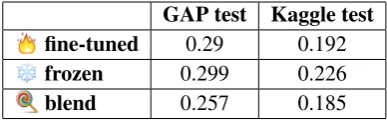
GAP test Kaggle test fine-tuned 0.29 0.192 frozen 0.299 0.226
[image:5.595.319.513.62.122.2]blend 0.257 0.185
Table 1: Logarithmic loss reported for the GAP test set, and Kaggle test (Stage 2) data for the model with fine-tuned BERT classifier ( ), MLPs with pre-trained BERT embeddings and hand-crafted features ( ) and a blend of the previous two ( ). There are 66 correc-tions done for GAP test labels as described in Subsec.
5.5.
5.5 Correcting mislabeled instances
During the competition, 158 label corrections were proposed for the GAP dataset16- when Pro-noun is said to mention A but actually mentions B and vice versa. For the GAP test set, this re-sulted in 66 pronoun coreferences being corrected. It’s important to mention that the observed misla-beling is a bit biased against female pronouns (39 mislabeled feminine pronouns versus 27 misla-beled masculine ones), and it turned out that most of the gender bias for F1 score and accuracy comes from these mislabeled examples.
6 Results
In Table 1, we report logarithmic loss that we got on GAP test (“gap-test.tsv”), and Kaggle test (Stage 2) datasets. Kaggle competition results can also be seen on the final competition leader-board.17 We report GAP test results as well to further compare with the results reported in the GAP paper: measured are logarithmic loss, F1 score and accuracy for masculine and feminine pronouns (Table 2). Logarithmic loss and accu-racy are computed for a 3-class classification prob-lem (A, B, or Neither) while F1 is computed for a 2-class problem (A or B) to compare with re-sults reported by the Google AI Language team in (Webster et al.,2018).
We also incorporated 66 label corrections as de-scribed in5.5and, interestingly enough, this lead to a conclusion that with corrected labels, models are less susceptible to gender bias. Table3reports the same metric in case of corrected labeling, and we see that in this case the proposed models are
16https://www.kaggle.com/c/
gendered-pronoun-resolution/discussion/ 81331
17https://www.kaggle.com/c/
Logarithmic loss Accuracy F1 score
M F O B M F O B M F O B
[image:6.595.90.507.61.122.2]fine-tuned 0.294 0.398 0.346 0.738 0.908 0.884 0.896 0.974 0.927 0.9 0.914 0.971 frozen 0.308 0.368 0.338 0.837 0.883 0.866 0.874 0.981 0.904 0.882 0.893 0.976 blend 0.259 0.338 0.299 0.766 0.907 0.883 0.895 0.974 0.923 0.898 0.911 0.973
Table 2: Performance of the proposed two models and their blending on the GAP test set, split by Masculine, Feminine (Bias shows F/M in case of F1 and accuracy, and M/F in case of logarithmic loss), andOverall.
almost gender-unbiased. These results imply that:
• Overall, in terms of F1 score, the proposed solution compares very favorably with the re-sults reported in the GAP paper, achieving as high as0.911overall F1 score, compared to 0.729for “Parallelism + URL” heuristic from (Webster et al.,2018);
• Blending model predictions improves loga-rithmic loss pretty well but does not impact F1 score and accuracy that much. It can be explained: logarithmic loss is high for con-fident and at the same time incorrect predic-tions. Blending averages predicted probabil-ities so that they end up less extreme (not so close to 0 or 1);
• With original labeling, all models are some-what susceptible to gender bias, especially in terms of logarithmic loss. However, in terms of F1 score, gender bias is still less than for e2e-coref and “Parallelism + URL” heuristic reported in (Webster et al.,2018);
• Fixing some incorrect labels almost elimi-nates gender bias, when we talk about F1 score and accuracy of pronoun resolution.
7 Conclusions and further work
We conclude that we managed to propose a BERT-based approach to pronoun resolution which re-sults in considerably better quality (as measured in terms of F1 score and accuracy) than in case of pronoun resolution done with heuristics described in the GAP paper. Moreover, the proposed solu-tion is almost gender-unbiased - pronoun resolu-tion is done almost equally well for masculine and feminine pronouns.
Further we plan to investigate which semantic and syntactic information is carried by different BERT layers and how it refers to coreference reso-lution. We are also going to benchmark our system on OntoNotes, Winograd, and DPR datasets.
Acknowledgments
Authors would like to thank Open Data Science18 community for all insightful discussions related to Natural Language Processing and, more gener-ally, to Deep Learning. Authors are also grateful to Kaggle and Google AI Language teams for or-ganizing the Gendered Pronoun Resolution chal-lenge.
References
Kevin Clark and Christopher D. Manning. 2015.
Entity-centric coreference resolution with model stacking. InProceedings of the 53rd Annual Meet-ing of the Association for Computational LMeet-inguistics and the 7th International Joint Conference on Natu-ral Language Processing (Volume 1: Long Papers), pages 1405–1415, Beijing, China. Association for Computational Linguistics.
Jacob Devlin, Ming-Wei Chang, Kenton Lee, and Kristina Toutanova. 2018. Bert: Pre-training of deep bidirectional transformers for language understand-ing. Cite arxiv:1810.04805Comment: 13 pages.
Abbas Ghaddar and Phillippe Langlais. 2016. Wiki-coref: An english coreference-annotated corpus of wikipedia articles. In Proceedings of the Tenth In-ternational Conference on Language Resources and Evaluation (LREC 2016), Paris, France. European Language Resources Association (ELRA).
J Hobbs. 1986. Readings in natural language process-ing. chapter Resolving Pronoun References, pages 339–352. Morgan Kaufmann Publishers Inc., San Francisco, CA, USA.
Heeyoung Lee, Angel Chang, Yves Peirsman, Nathanael Chambers, Mihai Surdeanu, and Dan Jurafsky. 2013. Deterministic coreference resolu-tion based on entity-centric, precision-ranked rules.
Comput. Linguist., 39(4):885–916.
Kenton Lee, Luheng He, Mike Lewis, and Luke Zettle-moyer. 2017. End-to-end neural coreference reso-lution. InProceedings of the 2017 Conference on Empirical Methods in Natural Language Process-ing, pages 188–197, Copenhagen, Denmark. Asso-ciation for Computational Linguistics.
Logarithmic loss Accuracy F1 score
M F O B M F O B M F O B
[image:7.595.88.507.61.122.2]fine-tuned 0.268 0.311 0.29 0.863 0.914 0.905 0.91 0.99 0.932 0.919 0.926 0.987 frozen 0.292 0.306 0.299 0.954 0.886 0.89 0.888 1.005 0.908 0.906 0.907 0.997 blend 0.241 0.273 0.257 0.882 0.913 0.908 0.91 0.995 0.928 0.921 0.924 0.992
Table 3: Performance of the proposed two models and their blending on the GAP test set with 66 corrected labels, split byMasculine,Feminine (Bias shows F/M in case of F1 and accuracy, and M/F in case of logarithmic loss), andOverall.
Kenton Lee, Luheng He, and Luke Zettlemoyer. 2018.
Higher-order coreference resolution with coarse-to-fine inference. InProceedings of the 2018 Confer-ence of the North American Chapter of the Associ-ation for ComputAssoci-ational Linguistics: Human Lan-guage Technologies, Volume 2 (Short Papers), pages 687–692, New Orleans, Louisiana. Association for Computational Linguistics.
Hector J. Levesque, Ernest Davis, and Leora Morgen-stern. 2012. The winograd schema challenge. In
Proceedings of the Thirteenth International Con-ference on Principles of Knowledge Representa-tion and Reasoning, KR’12, pages 552–561. AAAI Press.
Christopher D. Manning, Mihai Surdeanu, John Bauer, Jenny Finkel, Steven J. Bethard, and David Mc-Closky. 2014. The Stanford CoreNLP natural lan-guage processing toolkit. InAssociation for Compu-tational Linguistics (ACL) System Demonstrations, pages 55–60.
Matthew E. Peters, Mark Neumann, Mohit Iyyer, Matt Gardner, Christopher Clark, Kenton Lee, and Luke Zettlemoyer. 2018a. Deep contextualized word representations. Cite arxiv:1802.05365Comment: NAACL 2018. Originally posted to openreview 27 Oct 2017. v2 updated for NAACL camera ready.
Matthew E. Peters, Mark Neumann, Mohit Iyyer, Matt Gardner, Christopher Clark, Kenton Lee, and Luke Zettlemoyer. 2018b. Deep contextualized word rep-resentations.CoRR, abs/1802.05365.
Sameer Pradhan, Lance Ramshaw, Ralph Weischedel, Jessica Macbride, and Linnea Micciulla. 2007.
Unrestricted coreference: Identifying entities and events in ontonotes. International Conference on Semantic Computing, 0:446–453.
Ian Tenney, Patrick Xia, Berlin Chen, Alex Wang, Adam Poliak, R. Thomas McCoy, Najoung Kim, Benjamin Van Durme, Samuel R. Bowman, Dipan-jan Das, and Ellie Pavlick. 2019. What do you learn from context? probing for sentence structure in con-textualized word representations. In International Conference on Learning Representations.
Ashish Vaswani, Noam Shazeer, Niki Parmar, Jakob Uszkoreit, Llion Jones, Aidan N Gomez, Ł ukasz Kaiser, and Illia Polosukhin. 2017. Attention is all you need. In I. Guyon, U. V. Luxburg, S. Bengio,
H. Wallach, R. Fergus, S. Vishwanathan, and R. Gar-nett, editors, Advances in Neural Information Pro-cessing Systems 30, pages 5998–6008. Curran As-sociates, Inc.
Kellie Webster, Marta Recasens, Vera Axelrod, and Ja-son Baldridge. 2018. Mind the gap: A balanced cor-pus of gendered ambiguous pronouns. In Transac-tions of the ACL.