274
A Character Level Convolutional BiLSTM
for Arabic Dialect Identification
Mohamed Elaraby Raisa Energy
Ahmed Ismail Zahran Cairo University [email protected]
Abstract
In this paper, we describe the contribution of CU-RAISA team to the 2019 Madar shared task 21, which focused on Twitter User
fine-grained dialect identification. Among partici-pating teams, our system ranked the4th (with 61.54%) F1-Macro measure. Our system is trained using a character level convolutional bidirectional long-short-term memory (BiL-STM) network trained on approximately 2k users’ data. We show that training on concate-nated user tweets as input is further superior to training on user tweets separately and assign user’s label on the mode of user’s tweets’ pre-dictions.
1 Introduction
Dialect identification is a sub-domain of language identification, a task that aims to differentiate be-tween different languages given a sample of spo-ken or written text. Language and dialect identi-fication are active research areas due to their use-fulness as preliminary steps for other applications, such as automatic speech recognition and machine translation. The task of dialect identification poses harder challenges due to the higher inter-class sim-ilarity, which becomes harder to learn with hid-den text solely due to the absence of pronunci-ation informpronunci-ation that exists in audio data. ( Si-bun and Reynar,1996) made the first effort to dis-tinguish between languages with high similarity. Their dataset contained some languages with sim-ilar content, such as Serbian and Croatian, among others.
Arabic dialect identification (ADI) aims to dif-ferentiate between dialects of the Arab world, spo-ken by citizens of the Middle East and North Africa. Multiple forms of categorization can ex-ist when it comes to Arabic dialect identification.
1https://competitions.codalab.org/competitions/22475
The first form is based on the geographic loca-tion, where the text is categorized with respect to the home origin of the individual. The second form is concerned with major dialects, grouping the variations from different countries into larger classes. The most common categorization of the second form for Arabic dialects is the one de-scribed by (Habash et al.,2012), which details five major dialects (Egyptian, Gulf, Iraqi, Levantine, and Maghrebi). In this paper, we will be exploring the first form of categorization. This form poses more challenges due to the increased granularity it adds to the classification task.
2 Related Work
three-way classification task (Egyptian, Gulf, and Levantine), and a four-way classification task that adds the MSA dialect to the previous three-way task. The dataset used in this study is the Ara-bic Online Commentary (AOC) dataset. (Zaidan and Callison-Burch,2011). The system achieved an accuracy of 87.65%, 87.4% and 82.45% on the three aforementioned tasks, respectively using pretrained word embeddings trained on a large di-alectly rich corpus described in (Abdul-Mageed et al., 2018). (Ali, 2018) used a character-level convolution neural network with a GRU layer for a five-way classification task (MSA, Egyptian, Gulf, Levantine, and North African). This architecture achieved 92.64% cross-validation accuracy on the training set, and a 57.59% F1 (macro) score on the test set. (Lulu and Elnagar,2018) isolated the three most frequent dialects in AOC (Gulf, Egyp-tian, and Levantine). Using a word-based LSTM to differentiate between the three dialects, the au-thors obtained an accuracy of 71.4%, exceeding the performance of CNN, BLSTM and CLSTM models.
Along with exploring the performance of deep learning models on ADI, research has also con-tinued to explore more classical models, such as kernel-based models and linear models, in addi-tion to classical representaaddi-tions such as tf-idf. In a geographic location-based ADI task, Salameh et al.(2018) researched the effectiveness of com-bining multiple features with a Multinomial Naive Bias (MNB) classifier. The system combined multiple word-based and character-based n-grams with language models scoring probabilities as fea-tures. The authors used a translated version of the Basic Traveling Expression Corpus (BTEC) (Takezawa et al.,2007). For sentences with an av-erage length of seven words, the system obtained a classification accuracy of 67.9%. As the average length of the sentence increases to 16 words, the performance of the system increased to more than 90%. This finding gives an intuition about the pos-itive effect of sentence length on the performance of the classifier. In addition to the classification task, the authors analyzed the amount of pairwise dialect similarity between the dialects. To per-form the analysis, the authors used hierarchical agglomerative clustering on the similarity matrix obtained from the percentage of shared tokens be-tween dialects. The resulting analysis shows the amount of similarity between dialects in a certain
area, as well as the proximity of some dialects to others (e.g.: Egyptian and Levantine). MSA falls closest to Muscat and Khartoum. (Butnaru and Ionescu,2018) used multiple kernel learning on character n-grams from text and phonetic tran-scriptions, along with dialectal embeddings from the audio recordings. Their model obtained an accuracy of 58.65%. (El Haj et al., 2018) re-searched the subjects of code-switching and bi-valent words (words that occur in multiple lan-guages or dialects with similar semantic content) in dialect identification. They developed a method called Subtractive Bivalency Profiling to build a system that can handle both of these issues. Us-ing support vector machines (SVM) for a task to distinguish between four dialects (MSA, Egyp-tian, Levant, and Gulf), they achieved 76% ac-curacy. (Lichouri et al., 2018) researched word-based and sentence-word-based methods on tf-idf vec-tors, in addition to applying majority and minority voting techniques. The authors experimented with Bernoulli Naive Bayes (BNB) and MNB, along with Linear SVM’s (LSVM). Two datasets were used for this research. The first dataset, PADIC (Meftouh et al., 2015; Harrat et al., 2014), con-sists of multiple dialects (MSA, Tunisian, Mo-roccan, Algerian, Palestenian and Syrian). For this dataset, a sentence-level BNB achieved the highest accuracy (73.15%). The second dataset consisted of eight Algerian dialects (Tenes, Con-stantine, Djelfa, Ain-Defla, Tizi-Ouzou, Batna, Annaba, and Algiers), for which an LSVM model achieved the highest accuracy (41.05%).
3 Data
3.1 Dataset Description
We used the Arabic twitter dataset released by the organizers of the ”User Dialect Identification task”. The dataset is portioned into 217,593 tweets representing 2180 users for training, 29,870 for development representing 300 users, and 49,962 for testing representing 500 users. Full detailed description of the data can be found in task de-scription paperBouamor et al.(2019).
3.2 Accessibility of tweets
of training tweets were reduced to 192,389. Devel-opment data were reduced from 300 to 281 users, while the number of development tweets was re-duced to 26,528. The number of test users was reduced from 500 to 463.
4 Methods
4.1 Pre-processing
We adopt basic preprocessing techniques to our training, development, and test sets. This involves filtering out URLs and user mentions. For the vo-cabularyV, we train using character-based vocab-ulary. We filter out least frequent characters oc-curring< 20 times, which leaves|V| = 2377of unique characters.
4.2 Data Preparation:
We conduct two sets of experiments; (1): train on tweet level annotated by the country of the user. In that case, the maximum input sequence length is 140. (2) : train on user’s concatenated tweets together. Maximum sequence length grown to
12000characters. In the results section, we show that training on concatenated user tweets improves performance compared to training on individual tweets. On the hidden units layer to prevent the network from over-fitting on training set.
4.3 Models
4.3.1 Traditional Models
Traditional models refer to models based on fea-ture engineering methods with linear and prob-abilistic classifiers. In our experiments, we use (1) logistic regression, and (2) multinomial Naive Bayes as baselines. We use character ngrams, word ngrams, and a combination of both as fea-ture set.
4.3.2 Deep Learning Models
We develop models based on deep neural networks based on variations of (1) convolution neural net-works (CNNs) and (2) recurrent neural netnet-works (RNNs) which have proved useful for several NLP tasks. Both RNNs, and CNNs s are able to capture sequential dependencies especially in time series data, of which language can be seen as an exam-ple.
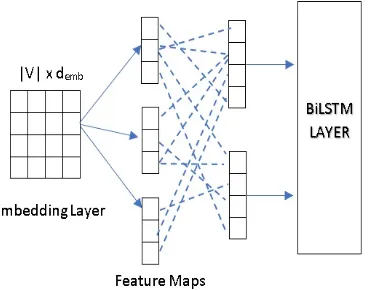
Our Model: We use a combination of convo-lution neural network and bidirectional long short term memory (BiLSTM). The following part de-scribes how we apply CNN to extract higher-level
sequences of word features and BiLSTM to cap-ture long-term dependencies over window feacap-ture sequences respectively.
• Input layer: an input layer to map word se-quence w into a sequence vector x where xw is a real-valued vector (XwRdemb where demb = 50). Character embedding are
ran-domly initialized and not learnt externally.
• Convolution layer: Multiple convolution op-erations are applied in parallel to the input layer to map input sequencex into a hidden sequenceh
A filterkRwdemb is applied to a window of
concatenated word embedding of size w to produce a new featureci . WhereciR, ci =
k· xi:i+w−1+b b is the inductive bias term
bR, and xi:i+w−1 is a concatenation of
xi, xi+1, .., xi+w−1
The filter sizes used are ranging from 1-13 and the number of filters used is rang-ing from 10-150. Finally, different convolu-tion outputs are concatenated into a sequence cRn−h+1 and passed into a time distributed layer to convert it into suitable output for the BiLSTM layer.
• BiLSTM Layer: We use a Bidirectional LSTM architecture consisting of256 dimen-sions hidden units. The BiLSTM is designed to capture long-term dependencies via aug-menting a standard RNN with two memory states, forward and backward. The forward direction state−→Ct, with
− →
Ct ∈Rat time step t. The forward LSTM takes in a previous state−→ht−1and inputxt, to calculate the
hid-den state−→htas follows:
− →
it=σ(W−→
i[ − →
ht−1, xt] +b−→
i ) −
→
ft=σ(W−→ f .[
− →
ht−1, xt] +b−→f )
− →
Ct=tanh(W−→
C.[ − →
ht−1, xt] +b−→
C) −
→ Ct=
− →
ft−→Ct−1+it
− →
C −
→o
t=σ(Wo[
− →
ht−1, xt] +b−→o)
− →
ht=ottanh(
− →
Ct)
where σ is the sigmoid, tanh is the hyper-polic tangent function, andis the dot prod-uct between two vectors. The −→it,
− →
Figure 1: Our char level Convolution -BiLSTM
are the input, forget, and output gates, and the−→Ctis a new memory cell vector with
can-didates that could be added to the state in the forward direction. The same operation is done for the backward direction. We ap-ply L2 regularization to avoid network over-fitting.
• Softmax Layer: Finally, the combined hid-den units (forward and backward) is con-verted into a probability distribution over l via softmax function, wherel is the number of classes in our case (21classes).
Figure1shows a block diagram of our network architecture.
Training and Optimization
We try a small set of hyper-parameters, identi-fying best settings on our validation set using grid search. We train the network for 40 epochs each. For optimization, we use Adam (Kingma and Ba,
2014), The models weights W are initialized from a normal distributionW ∼ N with a small stan-dard deviation of = 0.05 We apply two sources of regularization: dropout: we apply a dropout rate of 0.2 on the input embeddings to prevent co-adaptation of hidden units activation, and L2
norm: we also apply an L2-norm regularization with a small value (0.002)
5 Results
We evaluated most of the experiments on the de-velopment set using an accuracy metric. Table1
concluded our experimentation results on develop-ment set which consists of 281 users in total after excluding tweets of non-accessible users.
For the test which set consists of 500 users, we were able to access 463 users which we predicted
Models Accuracy F1-Macro
Individual tweets
Logistic Regression (1-11 ngrams) 36.5 -Multinomial Naive Bayes (1-11 ngrams) 36.75
-Char-Level CNN 50.12
-Char-Level C-BiLSTM 51.7 42.3
Concatenated tweets
Logistic Regression (1-11 ngrams) 45.5 -Multinomial Naive Bayes (1-11 ngrams) 46.7
-Char-Level CNN 68.8
[image:4.595.79.264.67.212.2]-Char-Level C-BiLSTM 71.92 62.21
Table 1: Experimental results on development set
using our C-BiLSTM network. For the left 37 users we assign the most common class to it which is”Saudi Arabia” . The final result reported by organizers on the test set was very close in terms of both accuracy and F1 macro measure achieving an accuracy of 72.6% and 61.5%.
6 Conclusion
In this paper, we described our system submit-ted to MADAR shared task, focused on coun-try level dialect identification from Twitter data. We explored the utility of tuning different word-and character-level based models. A char based convolutional BiLSTM achieved the best perfor-mance in terms of both accuracy and F1-macro measure. Given our limited resources at that time we weren’t able to experiment transfer learning techniques as pre-trained embeddings or language models which proved to be beneficial in vari-ous Natural Language Processing tasks. In fu-ture work, we plan to exploit a number of those techniques in the fine-grained dialect identification task.
References
Muhammad Abdul-Mageed, Hassan Alhuzali, and Mo-hamed Elaraby. 2018. You tweet what you speak: A city-level dataset of arabic dialects. InProceedings of the Eleventh International Conference on Lan-guage Resources and Evaluation (LREC-2018).
Mohamed Ali. 2018. Character level convolutional neural network for arabic dialect identification. In
Proceedings of the Fifth Workshop on NLP for Sim-ilar Languages, Varieties and Dialects (VarDial 2018), pages 122–127.
Houda Bouamor, Nizar Habash, and Kemal Oflazer. 2014. A multidialectal parallel corpus of arabic. In
LREC, pages 1240–1245.
Fine-Grained Dialect Identification. InProceedings of the Fourth Arabic Natural Language Processing Work-shop (WANLP19), Florence, Italy.
Andrei M Butnaru and Radu Tudor Ionescu. 2018. Unibuckernel reloaded: First place in arabic dialect identification for the second year in a row. arXiv preprint arXiv:1805.04876.
Mahmoud El Haj, Paul Edward Rayson, and Mariam Aboelezz. 2018. Arabic dialect identification in the context of bivalency and code-switching.
Mohamed Elaraby and Muhammad Abdul-Mageed. 2018. Deep models for arabic dialect identification on benchmarked data. In Proceedings of the Fifth Workshop on NLP for Similar Languages, Varieties and Dialects (VarDial 2018), pages 263–274.
Nizar Habash, Mona T Diab, and Owen Rambow. 2012. Conventional orthography for dialectal ara-bic. InLREC, pages 711–718.
Salima Harrat, Karima Meftouh, Mourad Abbas, and Kamel Smaili. 2014. Building resources for alge-rian arabic dialects. In 15th Annual Conference of the International Communication Association Inter-speech.
Diederik P Kingma and Jimmy Ba. 2014. Adam: A method for stochastic optimization. arXiv preprint arXiv:1412.6980.
Mohamed Lichouri, Mourad Abbas, Abed Alhakim Freihat, and Dhiya El Hak Megtouf. 2018. Word-level vs sentence-Word-level language identification: Ap-plication to algerian and arabic dialects. Procedia Computer Science, 142:246–253.
Leena Lulu and Ashraf Elnagar. 2018. Automatic ara-bic dialect classification using deep learning models.
Procedia computer science, 142:262–269.
Karima Meftouh, Salima Harrat, Salma Jamoussi, Mourad Abbas, and Kamel Smaili. 2015. Machine translation experiments on padic: A parallel arabic dialect corpus. InThe 29th Pacific Asia conference on language, information and computation.
Mohammad Salameh, Houda Bouamor, and Nizar Habash. 2018. Fine-grained Arabic dialect identi-fication. InProceedings of the International Con-ference on Computational Linguistics (COLING), pages 1332–1344, Santa Fe, New Mexico, USA.
Karim Sayadi, Mansour Hamidi, Marc Bui, Marcus Li-wicki, and Andreas Fischer. 2017. Character-level dialect identification in arabic using long short-term memory. In International Conference on Compu-tational Linguistics and Intelligent Text Processing, pages 324–337. Springer.
Karim Sayadi, Marcus Liwicki, Rolf Ingold, and Marc Bui. 2016. Tunisian dialect and modern standard arabic dataset for sentiment analysis: Tunisian elec-tion context. InSecond International Conference on
Arabic Computational Linguistics, ACLING, pages 35–53.
Penelope Sibun and Jeffrey C Reynar. 1996. Language identification: Examining the issues.
Toshiyuki Takezawa, Genichiro Kikui, Masahide Mizushima, and Eiichiro Sumita. 2007. Multilin-gual spoken language corpus development for com-munication research.International Journal of Com-putational Linguistics & Chinese Language Pro-cessing, Volume 12, Number 3, September 2007: Special Issue on Invited Papers from ISCSLP 2006, 12(3):303–324.