4081
Distant Learning for Entity Linking with Automatic Noise Detection
Phong Le1 and Ivan Titov1,2
1University of Edinburgh 2University of Amsterdam
[email protected] [email protected]
Abstract
Accurate entity linkers have been produced for domains and languages where annotated data (i.e., texts linked to a knowledge base) is available. However, little progress has been made for the settings where no or very limited amounts of labeled data are present (e.g., le-gal or most scientific domains). In this work, we show how we can learn to link mentions without having any labeled examples, only a knowledge base and a collection of unanno-tated texts from the corresponding domain. In order to achieve this, we frame the task as a multi-instance learning problem and rely on surface matching to create initial noisy la-bels. As the learning signal is weak and our surrogate labels are noisy, we introduce a noise detection component in our model: it lets the model detect and disregard examples which are likely to be noisy. Our method, jointly learning to detect noise and link en-tities, greatly outperforms the surface match-ing baseline. For a subset of entity categories, it even approaches the performance of super-vised learning.
1 Introduction
Entity linking (EL) is the task of linking poten-tially ambiguous textual mentions to the corre-sponding entities in a knowledge base. Accurate entity linking is crucial in many natural language processing tasks, including information extraction (Hoffart et al.,2011) and question answering (Yih et al., 2015). Though there has been significant progress in entity linking recently (Ratinov et al.,
2011;Hoffart et al.,2011;Chisholm and Hachey,
2015;Globerson et al.,2016;Yamada et al.,2017;
Ganea and Hofmann,2017;Le and Titov,2018), previous work has focused on supervised learning. Annotated data necessary for supervised learning is available for certain knowledge bases and do-mains. For example, one can directly use
web-pages linking to Wikipedia to learn a Wikipedia linker. Similarly, there exist domain-specific sets of manually annotated documents (e.g., AIDA-CoNLL news dataset for YAGO (Hoffart et al.,
2011)). However, for many ontologies and do-mains annotation is not available or limited (e.g., law). Our goal is to develop a method which does not rely on any training data besides unlabeled texts and a knowledge base.
In order to construct such a method, we use an insight from simple surface matching heuris-tics (e.g., Riedel et al. (2010)). Such heuristics choose entities from a knowledge base by measur-ing the overlap between the sets of content words in the mention and in the entity name. For ex-ample, in Figure 1, the entities BILL CLINTON
(PRESIDENT) and PRESIDENCY OFBILLCLIN
-TONboth have two matching words with the men-tionBill Clinton. Whereas we will see in our ex-periments that this method alone is not particularly accurate at selecting the best entity, the candidate lists it provides often include the correct entity. This implies that we can both focus on learning to select candidates from these lists and, less ob-viously, that we can leverage the lists as weak or distant supervision.
We frame this distance learning (DL) task as the multi-instance learning (MIL) problem (Dietterich et al., 1997). In MIL, each bag of examples is marked with a class label: the label indicates that the bag contains at least one example correspond-ing to that class. Relycorrespond-ing on such labeled bags, MIL methods aim at learning classifiers for indi-vidual examples.
CanBill Clintonreally emerge as a beloved father figure to a frazzledAmerica ?
Bill_Clinton (TV episode)
Bill_Clinton (president)
Bill_Clinton's_victory Presidency_of_Bill_Clinton ...
America (song) Volunteers_of_America
United_States_of_America (nation)
United_States_of_America (music track) ...
[image:2.595.101.501.81.158.2]name-matched candidates knowledge-base triples name-matched candidates
Figure 1: We annotate raw sentences using entity names and knowledge base triples. In training, we keep only red entities as positive candidates. In testing, we consider|E+|= 100name-matched candidates.
matching heuristic. For example, the four candi-date entities for the mention ‘Bill Clinton’ in Fig-ure 1could be marked as a positive set. The ‘neg-ative lists’ are randomly sampled sets of entities from the knowledge base. As with other MIL ap-proaches, while relying on labeled lists, we learn to classify individual entities, i.e. to predict if an entity should be linked to the mention.
One important detail is that the classifier must not have access to information which and how many words match between the mention and the entity name. If it would know this, it would eas-ily figure out which entity set is a candidate list and which one consists of randomly generated en-tities based solely on this information. Instead, by hiding it from the classifier, we force the classifier to extract features of the mention and its context predictive of the entity properties (e.g., an entity type), and hence ensure generalization.
Unfortunately, our supervision is noisy. The positive lists will often miss the correct entity for the given mention. This confuses the MIL model. In order to address this issue, we, jointly with the MIL model, learn a classifier which detects potentially problematic candidate lists. In other words, the classifier predicts how likely a given list is noisy (i.e., how much we should trust it). The probability is then used to weight the cor-responding term in the objective function of the MIL model. By jointly training the MIL model and the noise detection classifier, we effectively let the MIL model choose which examples to use for training. As we will see in our experimen-tal analysis, this joint learning method leads to a substantial improvement in performance. We also confirm that the noise detection model is generally able to identify and exclude wrong candidate lists by comparing its predictions to the gold standard. DL is the mainstream approach to learning re-lation extractors (RE) (Mintz et al.,2009;Riedel
et al., 2010), a problem related to entity linking. However, the two instantiations of the DL frame-work are very different. For RE, a bag of sentences is assigned to a categorical label (a relation). For EL, we assign a bag of entities, conditioned on the mention, to a positive class (correct) or a negative class (incorrect).
We evaluate our approach on the news domain for English as, having gold standard annotation (AIDA CoNLL), we can both assess performance and compute the upper bound, given by super-vised learning. Nevertheless, we expect that our methodology is applicable to a wider range of knowledge bases, as long as unlabeled texts can be obtained for the corresponding domain. We plan to verify this claim in future work. In addi-tion, we restrict ourselves to sentence-level mod-eling and, unlike state-of-the-art supervised meth-ods, (Yamada et al., 2017;Ganea and Hofmann,
2017;Le and Titov,2018) ignore interaction be-tween linking decisions in the document. Again, it would be interesting to see if such global mod-eling would be beneficial in the distance learning setting.
Our contributions can be summarized as follows
• we show how the entity linking problem can be framed as a distance learning problem, namely as a binary MIL task;
• we construct a model for this task;
• we introduce a method for detecting noise in the automatic annotation;
• we demonstrate the effectiveness of our ap-proach on a standard benchmark.
2 Entity linking as MIL
and negative candidates: E+ should have a high chance of containing the correct entity e, while E− should include only incorrect entities. As standard in MIL, this will be the only supervision the model receives at training time. When using this supervision, the model will need to learn to decide which entityeinE+is most likely to cor-respond to the mention-context pair(m, c). At test time, the model with be provided with the listE+ and will need to select an entity from this list.
Performing entity linking in two stages, candi-date selection (generating candicandi-date lists) and en-tity disambiguation (choosing an enen-tity from the list), is standard in EL, with the first stage usu-ally handled with heuristics and the second one ap-proached with statistical modeling (Ratinov et al.,
2011;Hoffart et al.,2011).
However, in our DL setting both stages change substantially. The candidate selection stage relies primarily on a surface matching heuristic, as de-scribed in Section4. Whereas supervised learning for the disambiguation stage (e.g., Hoffart et al.
(2011)) is replaced with MIL learning as described below in Section3.1
To make the following sections clear, we intro-duce the following terms.
Definition 1. A data point is a tuple hm, c, E+, E−iof mentionm, context c, positive setE+, and negative setE−. In testing,E−=∅.
Definition 2. A data point hm, c, E+, E−i is
noisyifE+does not contain the correct entity for mention m. If a data point is not noisy, we will refer to it asvalid.
3 Models
We introduce two approaches. The first one di-rectly applies MIL, disregarding the fact that many data points are noisy. The second one addresses this shortcoming by integrating a noise detection component.
3.1 Model 1: MIL
Encoding context Contextcis the entirel-word sentence w1, ..., wl which also includes the
men-tion m = (wh, ..., wk),1 ≤ h ≤ k ≤ l. We use
a BiLSTM to encode sentences. The input to the BiLSTM is a concatenationw∗i = [wi,pi]where
pi ∈ Rdp is position embedding andw ∈ Rdw is
1Supervised learning is equivalent to assuming thatE+ are singletons containing only the gold-standard entity.
from GloVe2 (Pennington et al.,2014). Forward fiand backwardbistates of BiLSTM are fed into
the classifier described below.
Entity embeddings In this work, we use a simple and scalable approach which involves computing entity embeddings on the fly using associated types. For instance, the TV episode BILL CLINTON is associated with several types
including BASE.TYPE ONTOLOGY.NON AGENT
and TV.TV SERIES EPISODE. Specifically, in order to produce an entity embedding, each typet is assigned a vectort ∈ Rdt. We then compute a
vector for entityeas
e=ReLU(We 1 |Te|
X
t∈Te
t+be),
whereTeis the set ofe’s types, andWe∈Rde×dt,
b∈Rde are a weight matrix and a bias vector.
More sophisticated approaches to producing en-tity embeddings (e.g., using relational graph con-volutional networks (Schlichtkrull et al., 2018)) are likely to yield further improvements.
Scoring a candidate We use a one-hidden layer feed forward NN to compute score compatibility between a context-mention pair(m, c)and an en-titye:
g(e, m, c) =FFNg([e,fh−1,bh−1,fk,bk])
Ife∗ is the correct entity, we want g(e∗, m, c) > g(e, m, c)for any entitye6=e∗.
Training Recall that for each mention-context pair(m, c), we have a positive setE+and a neg-ative setE−. We want to train the model to score at least one candidate inE+higher than any can-didate in E−. We use the max-margin loss to achieve this. Let
l(m, c) = [ max
e∈E−g(e, m, c) +δ−emax∈E+g(e, m, c)]+
L1 =
X
(m,c)∈D
l(m, c)
whereδ is a margin and[x]+ = xif x > 0 else
0;Dis the training set. We want to minimizeL1 with respect to the model parameters. We rely on Adam optimizer and employ early stopping.
2 http://nlp.stanford.edu/data/glove.
3.2 Model 2: MIL with Noise Detection (MIL-ND)
The model 1 ignores the fact that many data points are noisy, i.e. E+may not contain the correct en-tity. We address this by integrating a binary noise detection (ND) classifier which predicts if a data point is noisy. Intuitively, data points classified as noisy need to be discarded from training of the EL model. In practice, we weight them with the confi-dence of the ND classifier. As discussed below, we train the ND classifier jointly with the EL model.
Representation forE+ The ND classifier needs to decide if there is at least one entity in the listE+ corresponding to the mention-context pair(m, c). The question is now how to representE+to make classification as easy as possible. One option is to use mean pooling, but this would result in un-informative representations, especially for longer candidate lists. Another option is max pooling, but it would not take into account which mention-context pair(m, c)is currently considered, so also unlikely to yield informative features ofE+. In-stead we use attention, with the attention weight computed as a function of(m, c):
eE+ = X
e∈E+
αee
whereαeare attention weights
αe=
exp{g0(e, m, c)/T} P
e0∈E+exp{g0(e0, m, c)/T}
,
where g0 is a score function. Instead of learn-ing a separate attention function for the ND clas-sifier, we reuse the one from the EL model, i.e. g = g0. This will reduce the number of param-eters and make the method less prone to overfit-ting. Maybe more importantly, we expect that the better the entity disambiguation score function is, the better the ND classifier is, so tying the two to-gether may provide an appropriate inductive bias. T is temperature, controlling how sharpαeshould
be. We found that a smallT = 1/3stabilizes the learning.
Noise detection We use a binary classifier to de-tect noisy data points. The probability that a data point is noisy is defined as
pN(1|m, c, E+) =
σ
FFNf([eE+,fh−1,bh−1,fk,bk])
T
,
σ is the logistic sigmoid function. For simplicity, we use the sameT as above.
Training Our goal is to down-weight potentially noisy data points. Our new loss is
L2 =
X
(m,c)∈D
pN(0|m, c, E+)l(m, c)+
η×KL( P
(m,c)∈DpN(·|m, c, E+)
|D| |p
∗
N),
wherep∗N is a prior distribution indicating our be-liefs about the proportion of noisy data points; η is a hyper-parameter. We optimize the objective with respect to the parameters of both ND and EL models. The second term is necessary, as without it the loss can be trivially minimized by the ND classifier predicting that all data points are noisy with the probability of 1. This would set the first term to exactly zero.
Intuitively, when using the second term, the model can disregard certain data points but disre-garding too many of them incurs a penalty. Which data points are likely to be disregarded? Presum-ably the ones less consistent with the predictions of the EL model. In other words, joint training of EL and ND models encourages learning an entity-linking scoring function consistent with a large proportion of the data set but not necessarily with the entire data set. As we will see in the exper-imental section, the ND classifier indeed detects noisy data points rather than chooses some ran-dom subset of the data.3
We use the same optimization procedure as for the model 1. The second term is estimated at the mini-batch level.
Testing Differently from model 1, with model 2 we have two options on how to use it at test time:
• ignoring the ND classifier, thus doing entity disambiguation the same way as for model 1, or
• using the ND classifier as a mechanism to decide if the test data point should be clas-sified as ‘undecidable’ or not. Specifically, if pN(1|m, c, E+)> τ, model 2 will not output
an entity for this data point. This should in-crease precision, as at test timeE+also may not contain the correct entity.
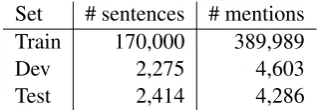
Set # sentences # mentions Train 170,000 389,989
Dev 2,275 4,603
[image:5.595.101.261.62.117.2]Test 2,414 4,286
Table 1: The statistics of the proposed dataset.
We call the two versions MIL-ND andτMIL-ND, respectively.
4 Dataset
We describe how we create our dataset. We use Freebase4, though our approach should be appli-cable to many other knowledge bases. Brief statis-tics of the dataset are shown in Table1.
4.1 Training set
We took raw texts from the New York Times cor-pus, tagged them with the CoreNLP named entity recognizer5 (Manning et al., 2014). We then se-lected only sentences that contain at least two en-tity mentions. We did this because on the one hand in most applications of EL we care about relations between entities (e.g., relation extraction), on the other hand, it provides us with an opportunity to prune the candidate list effectively, as discussed below. Note that we do it only for training.
For each mention m we carried out candidate selection as follows. First, we listed all entities which names contain all words of m. For in-stance, “America” (Figure1) can be both the na-tion UNITED STATES OF AMERICA and Simon
& Garfunkel’s song AMERICA. We ranked these chosen entities by the entity ordering in the knowl-edge base (i.e., the one that appears first in the knowledge base would be ranked first); for Free-base this order is correlated with prominence.
Second, for each mention (e.g., “Bill Clinton”), we kept only entities which participate in a relation with one of the candidate entities for another men-tion in the sentence. For example, BILL CLIN
-TON(PRESIDENT) is kept because it is in thePER
-SON.PERSON.NATIONALITYrelation with the
en-tity UNITEDSTATES OFAMERICA(NATION). Last, to keep candidate lists manageable, we se-lected only|E+|= 100candidates from step 2 for
4https://developers.google.com/
freebase/. Freebase is chosen because it contains the largest set of entities among available knowledge bases (F¨arber and Rettinger,2018).
5https://stanfordnlp.github.io/
CoreNLP/
15.16% 29.85%
45.10% 50.10%
63.61% 69.09%
76.25% 76.67%
# positive candidates
Oracle Recall
0.00% 20.00% 40.00% 60.00% 80.00%
1 10 100 1000 10000 100000
Figure 2: Oracle recall as a function of|E+|(the num-ber of positive candidates) on the development set.
each mention as positive candidates. During train-ing, we sampled|E−| = 10 candidates from the rest of the knowledge base as negative candidates.
4.2 Development and test sets
We took manually annotated A and AIDA-B as development and test sets (Hoffart et al.,
2011). We turned the ground truth Wikipedia links in these sets to Freebase entities, thanks to the mapping available in Freebase.6
Candidate selection was done in the same way as for training, except for not filtering out sen-tences with only 1 entity (i.e. no step 2 from Section 4.1). The oracle recall for surface name matching (i.e. step 1 from Section4.1) is 77%. It goes down to 50% if we restrict|E+|= 100(see Figure 2). We believe that there are straightfor-ward ways to improve the selection heuristic (e.g., modifying the string matching heuristic or using word embeddings to match words in entity names and words in the mention) but we leave this for future work.
Note that because AIDA CoNLL dataset is based on Reuters newswire articles, these develop-ment and test sets do not overlap with the training set.
5 Experiments
We evaluated the models above using the data from Section 4. The source code and the data are available at https://github.com/ lephong/dl4el
We ran each model five times and report mean and 95% confidence interval of three metrics:
[image:5.595.311.525.66.201.2](micro) precision, (micro) recall, and (micro) F1 (Cornolti et al.,2013) under two settings:
• ‘All’: all mentions are taken into account,
• ‘InE+’: only mentions withE+containing the correct entity are considered.
The latter, though not realistic, is interesting as it lets us concentrate on the contribution of the dis-ambiguation model, and ignore cases which are hopeless with the considered candidate selection method.
Note that, for system outputting exactly one en-tity for each mention (e.g., MIL model 1), preci-sion and recall are equal.
5.1 Systems
We compared our models against ‘Name match-ing’. It was proposed by Riedel et al.(2010) for RE: a mention is linked to an entity if it matches the entity’s name. For tie cases, we chose the first matched entity appearing in Freebase. For in-stance, “America” is linked to the song instead of the nation. To our knowledge, name matching is the only method tried in previous work for our set-ting (i.e. with no annotated texts).
We also compared with a supervised version of model 1. We used the same method in Section4.2
to convert AIDA CoNLL training set, withE+ be-ing sbe-ingletons consistbe-ing of the correct entity pro-vided by human annotators. This system can be considered as an upper-bound of our two models because: (i) it is trained in supervised rather than MIL setting with gold standard labels rather than weak supervision, and (ii) the training set is in the same domain (i.e. Reuter) with the test set. Al-though it uses only entity types but no other entity-related information for entity disambiguation, in Appendix B we show that this system performs on par with Hoffart et al. (2011) when evaluated in their setting.
Note that comparison with supervised linkers proposed in previous work is not possible as they require Wikipedia (see Section6) for candidate se-lection, as a source of supervision, and often for learning entity embeddings.
We tuned hyper-parameters on the development set. Details are in Appendix A. Note that, in model 2 (both MIL-ND andτMIL-ND), we set the prior p∗N(1) to 0.9, i.e. requiring 90% of training data
points should be ignored.7 We experimented with
|E+| = 100 for both training and testing. For
training, we set|E−|= 10.
5.2 Results
Table 2 shows results on the test set. ‘Name matching’ is far behind the two models. Many en-tities in the knowledge base have similar or even identical names, so relying only on the surface form does not result in an effective method.8
MIL-ND achieves higher precision, recall, and F1 than MIL, this suggests that the ND classifier helped to eliminate bad data points during train-ing. Using its confidence at test time (τMIL-ND, ‘All’ setting) was also beneficial in terms of pre-cision and F1 (it cannot possibly increase recall). Because all the test data points are valid for the ‘In E+’ setting, using the ND classifier had a slight negative effect on F1.
MIL-ND significantly outperforms MIL: the 95% confidence intervals for them do not over-lap. However, this is not the case for MIL-ND andτMIL-ND. We therefore conclude that the ND classifier is clearly helpful for training and poten-tially for testing.
5.3 Analysis
Error types In Table3 we classified errors ac-cording to named entity types thanks to the an-notation from Tjong Kim Sang and De Meulder
(2003). PER is the easiest type for all systems. Even name matching, without any learning, can correctly predict in half of the cases.
For LOC, it turns out that candidate selection is a bottleneck: when candidate selection was flaw-less, the models made only about 12% errors, down from about 57%. For MISC a similar con-clusion can be drawn.
Can the ND classifier detect noise? From the training set, we collected 100 data points and man-ually checked if a data point is valid (i.e.,E+ con-tains the correct entity). We then checked how the accuracy changes depending on the threshold τ (Figure3), the accuracy is defined as
# valid data points withpN < τ
# all data points withpN < τ
7Section5.3shows that 90% is too high, but it helps the model to rely only on those entity disambiguation decisions that are very certain.
8For instance, there are 36 entities named B
All InE+
System P R F1 P R F1
Name matching 15.03 15.03 15.03 29.13 29.13 29.13 MIL (model 1) 35.87 35.87 35.87±0.72 69.38 69.38 69.38±1.29
MIL-ND (model 2) 37.42 37.42 37.42±0.35 72.50 72.50 72.50±0.68
τMIL-ND (model 2) 38.91 36.73 37.78±0.26 73.19 71.15 72.16±0.48
[image:7.595.106.493.62.157.2]Supervised learning 42.90 42.90 42.90±0.59 83.12 83.12 83.12±1.15
Table 2: Results on the test set under two settings. 95% confidence intervals of F1 scores are shown.
All InE+
System LOC ORG PER MISC LOC ORG PER MISC
[image:7.595.89.511.192.289.2]Name matching 96.26 89.48 57.38 96.60 92.32 76.87 47.40 76.29 MIL 57.09 76.30 41.35 93.35 11.90 47.90 27.60 53.61 MIL-ND 57.15 77.15 35.95 92.47 12.02 49.77 20.94 47.42 τMIL-ND 55.15 76.56 34.03 92.15 11.14 51.18 20.59 40.00 Supervised learning 55.58 61.32 24.98 89.96 8.80 14.95 7.40 29.90
Table 3: % errors on the development set for different named entity types under two settings. (Smaller is better.)
τ
accuracy (%)
0.00% 25.00% 50.00% 75.00% 100.00%
0.7 0.8 0.9 1
Figure 3: Accuracy vs τ. There are large plateaus between τ ∈ (0.7,0.95) and τ < 0.6 because the ND classifier hardly used these ranges. We hence set
τ= 0.75inτMIL-ND.
As expected, the smaller τ is, the higher the chance is that the chosen data point is valid (i.e., not noise). Hence, we can use the ND classifier to select high quality data points by adjustingτ.
For a further examination, from the training set, we collected all 47,213 data points (i.e. 27.8%) withpN(1|m, c, E+) > τ = 0.75, and randomly
chose 100 data points. We found that 89% are in-deed noisy. This further confirms that the ND clas-sifier is sufficiently accurate. Some examples are given in Table4.
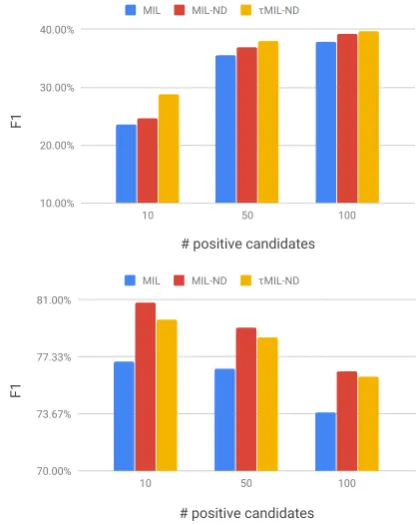
Number of positive candidates We also experi-mented with different values of|E+|(10, 50, 100) on the development set (Figure4).
First, MIL-ND andτMIL-ND are always better
# positive candidates
F1
10.00% 20.00% 30.00% 40.00%
10 50 100 MIL MIL-ND τMIL-ND
# positive candidates
F1
70.00% 73.67% 77.33% 81.00%
10 50 100 MIL MIL-ND τMIL-ND
Figure 4: F1 (top:‘All’; bottom:‘InE+’) on the devel-opment set with different numbers of positive candi-dates.
than MIL. This is more apparent in the ‘In E+’ settings: with this evaluation regime, we zoom in on cases where our models can predict correct en-tities (of course, all models equally fail for exam-ples outsideE+).
[image:7.595.76.298.330.463.2] [image:7.595.310.520.335.598.2]Correctly detected as noise:
* Small-market teams , like Milwaukee and San Diego , even big-market clubs , like Boston , Atlanta and the two [Chicago] franchises , trumpet them .
Candidates: CHICAGO(music single), BOSTON TOCHICAGO(music track)
* The politically powerful [Green] movement in Germany has led public opposition to genetic technology research and production .
Candidates: THEGREENPRINCE(movie), THEGREENARCHER(movie), GREENGOLD(movie) Incorrectly detected as noise:
* Everything Forrest remains unaffected by , [Jenny] self-indulgently , self-destructively drowns in : radical politics , drug abuse , promiscuity .
Candidates: JENNYCURRAN(book/film character)
Table 4: Examples of 100 randomly chosen sentences from the training set whosepN(1|m, c, E+)> τ = 0.75.
The first two examples are correctly detected as noise by our ND classifier. The last one is incorrectly detected.
the more realistic ‘All’ setting. The difference be-tweenτMIL-ND and MIL-ND is less pronounced for largerE+. This is expected as the proportion of valid data points is higher, and hence the ND classifier is less necessary at test time. For ‘inE+’ setting,τMIL-ND performs worse than MIL-ND, as we expected, because there are no noisy data points at test time.
What is wrong with the candidate selector? The above results show that candidate selection is a bottleneck and that the used selector is far from perfect. We found two cases where the se-lector is problematic: (i) the mention or the en-tity name is in an abbreviated form, such as ‘U.N.’ rather than ‘United Nations’, (ii) the mention and the entity’s name only fuzzily match, such as ‘[En-glish] county’ and ENGLAND (country). We can overcome these problems via extending our sur-face matching as inCharton et al.(2014);Usbeck et al.(2014) or using word embeddings.
Even in some cases when the selector does not have any problems with surface matching, the number of candidates may be too large. For instance, consider ‘[Simpson] killed his wife...’, there are more than 1,500 entities in the knowl-edge base containing the word ‘Simpson’. It is unlikely that our entity disambiguation model can deal with such large lists. We may need a stronger mechanism for reducing the number of candidates. For example, we could use document-level infor-mation to discard highly unlikely entities.
6 Related work
High performance approaches to EL, such as Rati-nov et al. (2011); Chisholm and Hachey (2015);
Globerson et al. (2016); Yamada et al. (2017);
Ganea and Hofmann(2017), are two-stage
meth-ods: candidate generation is followed by select-ing an entity for the candidate lists. We follow the same paradigm but with some important dif-ferences discussed below.
Most approaches use alias-entity maps, i.e. weighted sets of (mention, entity) pairs created from anchors in Wikpedia. For example, one can count how many times phrase “the president” refers to BILL CLINTON to assign the weight to the corresponding pair. However, the method re-quires large annotated datasets, and it cannot deal with less prominent entities. As we do not have access to links, we use surface matching instead.
To choose an entity from a candidate list, two main disambiguation frameworks (Ratinov et al.,
2011) are introduced: localwhich resolves men-tions independently, andglobalwhich makes use of coherence modeling at the document level. Though we experimented with local models, the local-global distinction is largely orthogonal as we can directly integrate coherence modeling compo-nents in our DL approach.
7 Conclusions
We introduced the first approach to entity linking which neither uses annotated texts, nor assumes that entities are associated with textual documents (e.g., Wikipedia articles).
We learn the model using the MIL paradigm, and introduce a novel component, a noise detect-ing classifier, estimated jointly with the EL model. The classifier lets us disregard noisy labels, re-sulting in a more accurate entity linking model. Experimental results showed that our models sub-stantially outperform the heuristic baseline, and, for certain categories, they approach the model es-timated with supervised learning.
In future work we will aim to improve candidate selection (including different strategies to select candidate lists E+, E−). We will also use extra document information and jointly predict entities for different mentions in the document. Besides, we will consider additional knowledge bases (e.g. YAGO and Wikidata).
Acknowledgments
We would like to thank anonymous reviewers for their suggestions and comments. The project was supported by the European Research Council (ERC StG BroadSem 678254), the Dutch National Science Foundation (NWO VIDI 639.022.518), and an Amazon Web Services (AWS) grant.
References
Eric Charton, Marie-Jean Meurs, Ludovic Jean-Louis, and Michel Gagnon. 2014. Improving entity link-ing uslink-ing surface form refinement. InProceedings of the Ninth International Conference on Language Resources and Evaluation (LREC’14).
Andrew Chisholm and Ben Hachey. 2015. Entity dis-ambiguation with web links.Transactions of the As-sociation for Computational Linguistics, 3:145–156.
Marco Cornolti, Paolo Ferragina, and Massimiliano Ciaramita. 2013. A framework for benchmarking entity-annotation systems. In Proceedings of the 22nd international conference on World Wide Web, pages 249–260. ACM.
Thomas G. Dietterich, Richard H. Lathrop, and Tom´as Lozano-P´erez. 1997. Solving the multiple instance problem with axis-parallel rectangles. Artif. Intell., 89(1-2):31–71.
Miao Fan, Qiang Zhou, and Thomas Fang Zheng. 2015.
Distant supervision for entity linking. In Proceed-ings of the 29th Pacific Asia Conference on Lan-guage, Information and Computation, pages 79–86.
Michael F¨arber and Achim Rettinger. 2018. Which
knowledge graph is best for me? CoRR,
abs/1809.11099.
Kuzman Ganchev, Jennifer Gillenwater, Ben Taskar, et al. 2010. Posterior regularization for structured latent variable models. Journal of Machine Learn-ing Research, 11(Jul):2001–2049.
Octavian-Eugen Ganea and Thomas Hofmann. 2017.
Deep joint entity disambiguation with local neural attention. InProceedings of the 2017 Conference on Empirical Methods in Natural Language Process-ing, pages 2619–2629, Copenhagen, Denmark. As-sociation for Computational Linguistics.
Amir Globerson, Nevena Lazic, Soumen Chakrabarti, Amarnag Subramanya, Michael Ringaard, and Fer-nando Pereira. 2016. Collective entity resolution with multi-focal attention. In Proceedings of the 54th Annual Meeting of the Association for Compu-tational Linguistics (Volume 1: Long Papers), pages 621–631, Berlin, Germany. Association for Compu-tational Linguistics.
Johannes Hoffart, Mohamed Amir Yosef, Ilaria Bor-dino, Hagen F¨urstenau, Manfred Pinkal, Marc Span-iol, Bilyana Taneva, Stefan Thater, and Gerhard Weikum. 2011. Robust disambiguation of named entities in text. In Proceedings of the 2011 Con-ference on Empirical Methods in Natural Language Processing, pages 782–792, Edinburgh, Scotland, UK. Association for Computational Linguistics.
Nevena Lazic, Amarnag Subramanya, Michael Ring-gaard, and Fernando Pereira. 2015. Plato: A selec-tive context model for entity resolution. Transac-tions of the Association for Computational Linguis-tics, 3:503–515.
Phong Le and Ivan Titov. 2018. Improving entity link-ing by modellink-ing latent relations between mentions. In Proceedings of the 56th Annual Meeting of the Association for Computational Linguistics (Volume 1: Long Papers), pages 1595–1604. Association for Computational Linguistics.
Gideon S Mann and Andrew McCallum. 2010. Gener-alized expectation criteria for semi-supervised learn-ing with weakly labeled data. Journal of machine learning research, 11(Feb):955–984.
Christopher Manning, Mihai Surdeanu, John Bauer, Jenny Finkel, Steven Bethard, and David McClosky. 2014. The stanford corenlp natural language pro-cessing toolkit. In Proceedings of 52nd Annual Meeting of the Association for Computational Lin-guistics: System Demonstrations, pages 55–60. As-sociation for Computational Linguistics.
on Natural Language Processing of the AFNLP, pages 1003–1011, Suntec, Singapore. Association for Computational Linguistics.
Jeffrey Pennington, Richard Socher, and Christopher Manning. 2014. Glove: Global vectors for word representation. In Proceedings of the 2014 Con-ference on Empirical Methods in Natural Language Processing (EMNLP), pages 1532–1543, Doha, Qatar. Association for Computational Linguistics.
Lev Ratinov, Dan Roth, Doug Downey, and Mike An-derson. 2011. Local and global algorithms for dis-ambiguation to wikipedia. In Proceedings of the 49th Annual Meeting of the Association for Com-putational Linguistics: Human Language Technolo-gies, pages 1375–1384. Association for Computa-tional Linguistics.
Sebastian Riedel, Limin Yao, and Andrew McCallum. 2010. Modeling relations and their mentions with-out labeled text. In Joint European Conference on Machine Learning and Knowledge Discovery in Databases, pages 148–163. Springer.
Michael Schlichtkrull, Thomas N Kipf, Peter Bloem, Rianne Van Den Berg, Ivan Titov, and Max Welling. 2018. Modeling relational data with graph convolu-tional networks. InEuropean Semantic Web Confer-ence, pages 593–607. Springer.
Erik F. Tjong Kim Sang and Fien De Meulder. 2003. Introduction to the conll-2003 shared task: Language-independent named entity recognition. In
Proceedings of the Seventh Conference on Natu-ral Language Learning at HLT-NAACL 2003, pages 142–147.
Ricardo Usbeck, Axel-Cyrille Ngonga Ngomo, Michael R¨oder, Daniel Gerber, Sandro Athaide Coelho, S¨oren Auer, and Andreas Both. 2014. Agdistis-graph-based disambiguation of named entities using linked data. InInternational semantic web conference, pages 457–471. Springer.
Ikuya Yamada, Hiroyuki Shindo, Hideaki Takeda, and Yoshiyasu Takefuji. 2017. Learning distributed rep-resentations of texts and entities from knowledge base. Transactions of the Association for Compu-tational Linguistics, 5:397–411.
Wen-tau Yih, Ming-Wei Chang, Xiaodong He, and Jianfeng Gao. 2015. Semantic parsing via staged query graph generation: Question answering with knowledge base. InProceedings of the 53rd Annual Meeting of the Association for Computational Lin-guistics and the 7th International Joint Conference on Natural Language Processing (Volume 1: Long Papers), pages 1321–1331, Beijing, China. Associ-ation for ComputAssoci-ational Linguistics.
A Hyper-parameters
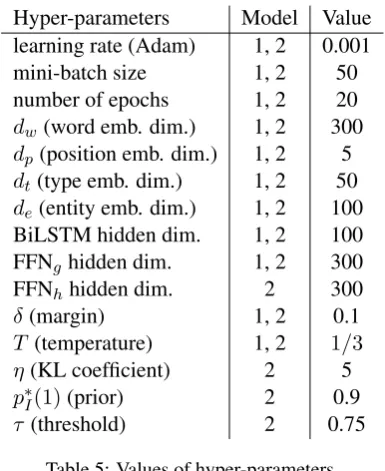
The used values for the hyper-parameters are shown in Table5.
Hyper-parameters Model Value learning rate (Adam) 1, 2 0.001 mini-batch size 1, 2 50 number of epochs 1, 2 20 dw (word emb. dim.) 1, 2 300
dp (position emb. dim.) 1, 2 5
dt(type emb. dim.) 1, 2 50
de(entity emb. dim.) 1, 2 100
BiLSTM hidden dim. 1, 2 100 FFNghidden dim. 1, 2 300
FFNhhidden dim. 2 300
δ(margin) 1, 2 0.1
T (temperature) 1, 2 1/3
η(KL coefficient) 2 5 p∗I(1)(prior) 2 0.9
[image:10.595.320.513.60.296.2]τ (threshold) 2 0.75
Table 5: Values of hyper-parameters.
System Micro accuracy
Ours 81.47±1.27
Hoffart et al.(2011) 81.91
Table 6: Micro accuracy on AIDA CoNLL testb of our supervised system and (Hoffart et al.,2011).
B Supervised learning system
Our supervised learning system is a supervised version of model 1. To examine how good this sys-tem is, we tested it on the AIDA CoNLL dataset. Because this system uses entity types for entity disambiguation (and uses no other information re-lated to entities), we made use of the map between Freebase entities and Wikipedia entities. We com-pared it withHoffart et al. (2011). Note that we did not tune the system: it used the same values of hyper-parameters with model 1 (see Table5).
Because Wikipedia and YAGO are often used for candidate selection and/or for additional su-pervision, we here also used them for candidate selection and for computingp(e|m)as a feature as in most existing systems (such as inHoffart et al.
(2011); Globerson et al.(2016); Ganea and Hof-mann(2017)). For the candidate section, for each mention we kept maximally 20 candidates.