Zero-shot Entity Extraction from Web Pages
Panupong Pasupat Computer Science Department
Stanford University
Percy Liang
Computer Science Department Stanford University
Abstract
In order to extract entities of a fine-grained category from semi-structured data in web pages, existing information extraction sys-tems rely on seed examples or redundancy across multiple web pages. In this paper, we consider a new zero-shot learning task of extracting entities specified by a natural language query (in place of seeds) given only a single web page. Our approach de-fines a log-linear model over latent extrac-tion predicates, which select lists of enti-ties from the web page. The main chal-lenge is to define features on widely vary-ing candidate entity lists. We tackle this by abstracting list elements and using aggre-gate statistics to define features. Finally, we created a new dataset of diverse queries and web pages, and show that our system achieves significantly better accuracy than a natural baseline.
1 Introduction
We consider the task of extracting entities of a given category (e.g., hiking trails) from web pages. Previous approaches either (i) assume that the same entities appear on multiple web pages, or (ii) require information such as seed examples (Etzioni et al., 2005; Wang and Cohen, 2009; Dalvi et al., 2012). These approaches work well for common categories but encounter data sparsity problems for more specific categories, such as the products of a small company or the dishes at a lo-cal restaurant. In this context, we may have only a single web page that contains the information we need and no seed examples.
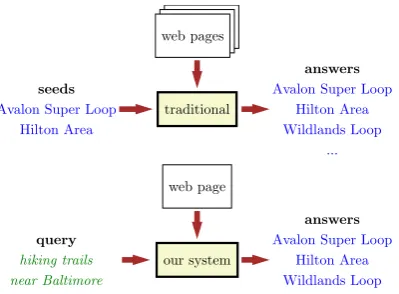
In this paper, we propose a novel task, zero-shot entity extraction, where the specification of the desired entities is provided as a natural language query. Given a query (e.g., hiking
seeds
Avalon Super Loop Hilton Area
traditional
answers
Avalon Super Loop Hilton Area Wildlands Loop
...
query
hiking trails near Baltimore
our system
answers
Avalon Super Loop Hilton Area Wildlands Loop
... web pages
web pages web pages
web page
Figure 1: Entity extraction typically requires ad-ditional knowledge such as a small set of seed ex-amples or depends on multiple web pages. In our setting, we take as input a natural language query and extract entities from a single web page.
trails near Baltimore) and a web page (e.g.,
http://www.everytrail.com/best/ hiking-baltimore-maryland), the goal is to extract all entities corresponding to the query on that page (e.g., Avalon Super Loop, etc.). Figure 1 summarizes the task setup.
The task introduces two challenges. Given a single web page to extract entities from, we can no longer rely on the redundancy of entities across multiple web pages. Furthermore, in the zero-shot learning paradigm (Larochelle et al., 2008), where entire categories might be unseen during training, the system must generalize to new queries and web pages without the additional aid of seed examples. To tackle these challenges, we cast the task as a structured prediction problem where the input is the query and the web page, and the output is a list of entities, mediated by a latent extraction predicate. To generalize across different inputs, we rely on two types of features: structural fea-tures, which look at the layout and placement of the entities being extracted; and denotation
[image:1.595.319.519.202.349.2]tures, which look at the list of entities as a whole and assess their linguistic coherence. When defin-ing features on lists, one technical challenge is be-ing robust to widely varybe-ing list sizes. We ap-proach this challenge by defining features over a histogram of abstract tokens derived from the list elements.
For evaluation, we created the OPENWEB dataset comprising natural language queries from the Google Suggest API and diverse web pages re-turned from web search. Despite the variety of queries and web pages, our system still achieves a test accuracy of 40.5% and an accuracy at 5 of 55.8%.
2 Problem statement
We define the zero-shot entity extraction task as follows: let x be a natural language query (e.g., hiking trails near Baltimore), and w be a web page. Our goal is to construct a mapping from
(x, w) to a list of entities y (e.g., [Avalon Super Loop,Patapsco Valley State Park, . . . ]) which are extracted from the web page.
Ideally, we would want our data to be anno-tated with the correct entity listsy, but this would be very expensive to obtain. We instead define each training and test example as a triple(x, w, c), where thecompatibility functioncmaps eachyto
c(y)∈ {0,1}denoting the (approximate) correct-ness of the listy. In this paper, an entity listyis compatible(c(y) = 1) when the first, second, and last elements ofymatch the annotation; otherwise, it isincompatible(c(y) = 0).
2.1 Dataset
To experiment with a diverse set of queries and web pages, we created a new dataset, OPENWEB, using web pages from Google search results.1 We
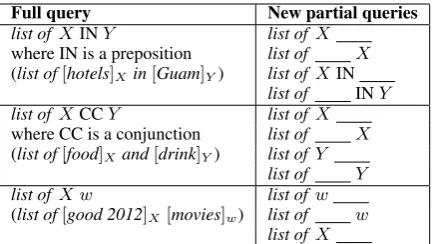
use the method from Berant et al. (2013) to gen-erate search queries by performing a breadth-first search over the query space. Specifically, we use the Google Suggest API, which takes a par-tial query (e.g., “list of movies”) and out-puts several complete queries (e.g., “list of hor-ror movies”). We start with seed partial queries “list of • ”where •is one or two initial let-ters. In each step, we call the Google Suggest API on the partial queries to obtain complete queries,
1The OPENWEBdataset and our code base are available
for download at http://www-nlp.stanford.edu/ software/web-entity-extractor-ACL2014.
Full query New partial queries
list ofXINY list ofX where IN is a preposition list of X (list of[hotels]Xin[Guam]Y) list ofXIN
list of INY
list ofXCCY list ofX where CC is a conjunction list of X (list of[food]Xand[drink]Y) list ofY
list of Y
list ofX w list ofw
[image:2.595.309.526.61.183.2](list of[good 2012]X[movies]w) list of w list ofX
Table 1: Rules for generating new partial queries from complete queries. (X andY are sequences of words;wis a single word.)
and then apply the transformation rules in Table 1 to generate more partial queries from complete queries. We run the procedure until we obtained 100K queries.
Afterwards, we downloaded the top 2–3 Google search results of each query, sanitized the web pages, and randomly submitted 8000 query / web page pairs to Amazon Mechanical Turk (AMT). Each AMT worker must either mark the web page as irrelevant or extract the first, second, and last entities from the page. We only included exam-ples where at least two AMT workers agreed on the answer.
The resulting OPENWEB dataset consists of 2773 examples from 2269 distinct queries. Among these queries, there are 894 headwords ranging from common categories (e.g., movies, companies, characters) to more specific ones (e.g., enzymes, proverbs, headgears). The dataset con-tains web pages from 1438 web domains, of which 83% appear only once in our dataset.
Figure 2 shows some queries and web pages from the OPENWEB dataset. Besides the wide range of queries, another main challenge of the dataset comes from the diverse data representa-tion formats, including complex tables, grids, lists, headings, and paragraphs.
3 Approach
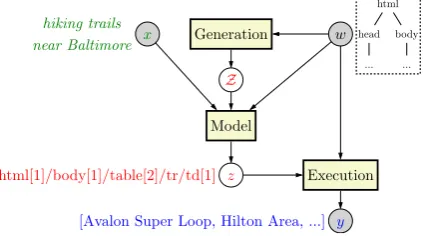
Figure 3 shows the framework of our system. Given a query x and a web page w, the system generates a set Z(w) of extraction predicates z
Queries
airlines of italy
natural causes of global warming lsu football coaches
bf3 submachine guns badminton tournaments foods high in dha
technical colleges in south carolina songs on glee season 5
singers who use auto tune san francisco radio stations actors from boston
Examples (web page, query)
[image:3.595.87.520.66.202.2]airlines of italy natural causes of global warming lsu football coaches
Figure 2: Some examples illustrating the diversity of queries and web pages from the OPENWEBdataset.
x Generation w
Z
Model
z Execution
y hiking trails
near Baltimore
html
head
... body
...
/html[1]/body[1]/table[2]/tr/td[1]
[Avalon Super Loop, Hilton Area, ...]
Figure 3: An overview of our system. The system uses the input queryxand web pagewto produce a list of entitiesyvia an extraction predicatez.
wto get the list of entitiesy = JzKw. Section 3.2
describes the model and the training procedure, while Section 3.3 presents the features used in our model.
3.1 Extraction predicates
We represent each web pagewas a DOM tree, a common representation among wrapper induction and web information extraction systems (Sahuguet and Azavant, 1999; Liu et al., 2000; Crescenzi et al., 2001). The text of any DOM tree node that is shorter than 140 characters is a candidate entity. However, without further restrictions, the number of possible entity lists grows exponentially with the number of candidate entities.
To make the problem tractable, we introduce an extraction predicatezas an intermediate represen-tation for extracting entities from w. In our sys-tem, we let an extraction predicate be a simplified XML path (XPath) such as
/html[1]/body[1]/table[2]/tr/td[1]
Informally, an extraction predicate is a list of path entries. Each path entry is either a tag (e.g.,
tr), which selects all children with that tag; or a tag and an index i (e.g., td[1]), which selects only the ith child with that tag. The denotation
y=JzKw of an extraction predicatezis the list of
entities selected by the XPath. Figure 4 illustrates the execution of the extraction predicate above on a DOM tree.
In the literature, many information extraction systems employ more versatile extraction predi-cates (Wang and Cohen, 2009; Fumarola et al., 2011). However, despite the simplicity, we are able to find an extraction predicate that extracts a compatible entity list in 69.7% of the develop-ment examples. In some examples, we cannot ex-tract a compatible list due to unrecoverable issues such as incorrect annotation. Section 4.4 provides a detailed analysis of these issues. Additionally, extraction predicates can be easily extended to in-crease the coverage. For example, by introduc-ing new index types[1:](selects all but the first node) and [:-1] (selects all but the last node), we can increase the coverage to 76.2%.
Extraction predicate generation. We generate a set Z(w) of extraction predicates for a given web page w as follows. For each node in the DOM tree, we find an extraction predicate which selects only that node, and then gener-alizes the predicate by removing any subset of the indices of the last k path entries. For in-stance, when k = 2, an extraction predicate ending in .../tr[5]/td[2]will be general-ized to.../tr[5]/td[2],.../tr/td[2],
[image:3.595.78.290.252.370.2]DOM treew
html
head body
table
tr
td
Home..
td
Expl..
td
Mobi..
td
Crea..
h1
Hiki..
table
tr
th
Name..
th
Loca..
tr
td
Aval..
td
12.7..
... tr
td
Gove..
td
3.1 .. Extraction predicatez
/html[1]/body[1]/table[2]/tr/td[1]
Rendered web page
Home Explore Mobile Apps Create Trip
Hiking near Baltimore, Maryland
Name Length
Avalon Super Loop 12.7 miles
Hilton Area 7.8 miles
Avalon Loop 9.4 miles
Wildlands Loop 4.4 miles
Mckeldin Area 16.7 miles
Greenbury Point 3.7 miles
Governer Bridge Natural Area 3.1 miles
Figure 4: A simplified example of a DOM treewand an extraction predicatez, which selects a list of entity stringsy=JzKwfrom the page (highlighted in red).
table cells from the same column or list items from the same section of the page).
Out of all generalized extraction predicates, we retain the ones that extract at least two entities from w. Note that several extraction predicates may select the same list of nodes and thus produce the same list of entities.
The procedure above gives a manageable num-ber of extraction predicates. Among the devel-opment examples of the OPENWEB dataset, we generate an average of 8449 extraction predicates per example, which evaluate to an average of 1209 unique entity lists.
3.2 Modeling
Given a query x and a web page w, we define a log-linear distribution over all extraction predi-catesz∈ Z(w)as
pθ(z|x, w)∝exp{θ>φ(x, w, z)}, (1)
where θ ∈ Rd is the parameter vector and φ(x, w, z) is the feature vector, which will be de-fined in Section 3.3.
To train the model, we find a parameter vec-torθthat maximizes the regularized log marginal probability of the compatibility function being sat-isfied. In other words, given training data D =
{(x(i), w(i), c(i))}n
i=1, we findθthat maximizes
n X
i=1
logpθ(c(i)= 1|x(i), w(i))−λ2kθk22
where
pθ(c= 1|x, w) = X
z∈Z(w)
pθ(z|x, w)·c(JzKw).
Note that c(JzKw) = 1 when the entity list y = JzKw selected byzis compatible with the
annota-tion; otherwise,c(JzKw) = 0.
We use AdaGrad, an online gradient descent with an adaptive per-feature step size (Duchi et al., 2010), making 5 passes over the training data. We useλ = 0.01 obtained from cross-validation for all experiments.
3.3 Features
To construct the log-linear model, we define a fea-ture vectorφ(x, w, z)for each queryx, web page
w, and extraction predicate z. The final feature vector is the concatenation ofstructural features
φs(w, z), which consider the selected nodes in the DOM tree, and denotation features φd(x, y),
which look at the extracted entities.
We will use the query hiking trails near Balti-more and the web page in Figure 4 as a running example. Figure 5 lists some features extracted from the example.
3.3.1 Recipe for defining features on lists
One main focus of our work is finding good fea-ture representations for a list of objects (DOM tree nodes for structural features and entity strings for denotation features). One approach is to define the feature vector of a list to be the sum of the feature vectors of individual elements. This is commonly done in structured prediction, where the elements are local configurations (e.g., rule applications in parsing). However, this approach raises a normal-ization issue when we have to compare and rank lists of drastically different sizes.
html
head body
table
...
h1 table
tr
th th tr
td td tr
td td
... tr
td td
Structural feature Value
Features on selected nodes:
TAG-MAJORITY=td 1
INDEX-ENTROPY 0.0
Features on parent nodes:
CHILDRENCOUNT-MAJORITY= 2 1
PARENT-SINGLE 1
INDEX-ENTROPY 1.0
HEADHOLE(The first node is skipped) 1
Features on grandparent nodes:
PAGECOVERAGE 0.6
. . . .
Selected entities
Avalon Super Loop Hilton Area Avalon Loop Wildlands Loop
Mckeldin Area Greenbury Point Governer Bridge Natural Area
Denotation feature Value
WORDSCOUNT-MEAN 2.42
PHRASESHAPE-MAJORITY=Aa Aa 1
PHRASESHAPE-MAJORITYRATIO 0.71
WORDSHAPE-MAJORITY=Aa 1
PHRASEPOS-MAJORITY= NNP NN 1
LASTWORD-ENTROPY 0.74
WORDPOS = NN (normalized count) 0.53
[image:5.595.83.278.310.460.2]. . . .
Figure 5: A small subset of features from the examplehiking trails near Baltimorein Figure 4.
A B C D E
1 2 0 1 0
0 1 2 histogram
Abstraction
Aggregation
Entropy Majority MajorityRatio Single
(Mean) (Variance)
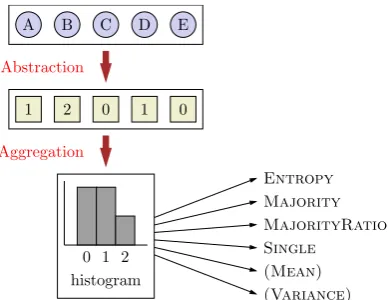
Figure 6: The recipe for defining features on a list of objects: (i) theabstractionstep converts list elements into abstract tokens; (ii) theaggregation step defines features using the histogram of the ab-stract tokens.
Step 1: Abstraction. We map each list element into an abstract token. For example, we can map each DOM tree node onto an integer equal to the number of children, or map each entity string onto its part-of-speech tag sequence.
Step 2: Aggregation. We create a histogram of the abstract tokens and define features on proper-ties of the histogram. Generally, we use ENTROPY (entropy normalized to the maximum value of 1), MAJORITY (mode), MAJORITYRATIO (percent-age of tokens sharing the majority value), and SINGLE (whether all tokens are identical). For abstract tokens with finitely many possible values (e.g., part-of-speech), we also use the normalized
histogram count of each possible value as a fea-ture. And for real-valued abstract tokens, we also use the mean and the standard deviation. In the actual system, we convert real-valued features (en-tropy, histogram count, mean, and standard devia-tion) into indicator features by binning.
Figure 6 summarizes the steps explained above. We use this recipe for defining both structural and denotation features, which are discussed below.
3.3.2 Structural features
Although different web pages represent data in different formats, they still share some common hierarchical structures in the DOM tree. To cap-ture this, we define structural feacap-tures φs(w, z), which consider the properties of the selected nodes in the DOM tree, as follows:
Features on selected nodes. We apply our
recipe on the list of nodes inwselected byzusing the following abstract tokens:
• TAG, ID, CLASS, etc. (HTML attributes)
• CHILDRENCOUNT and SIBLINGSCOUNT (number of children and siblings)
• INDEX(position among its siblings)
• PARENT(parent node; e.g., PARENT-SINGLE means that all nodes share the same parent.) Additionally, we define the following features based on the coverage of all selected nodes:
• PAGECOVERAGE (node coverage relative to the entire tree; we use depth-first traversal timestamps to estimate the fraction of nodes in the subtrees of the selected nodes.)
Features on ancestor nodes. We also define the same feature set on the list of ancestors of the se-lected nodes in the DOM tree. In our experiments, we traverse up to 5 levels of ancestors and define features from the nodes in each level.
3.3.3 Denotation features
Structural features are not powerful enough to dis-tinguish between entity lists appearing in similar structures such as columns of the same table or fields of the same record. To solve this ambiguity, we introduce denotation features φd(x, y) which
considers the coherence or appropriateness of the selected entity stringsy=JzKw.
We observe that the correct entities often share some linguistic statistics. For instance, entities in many categories (e.g., people and place names) usually have only 2–3 word tokens, most of which are proper nouns. On the other hand, random words on the web page tend to have more diverse lengths and part-of-speech tags.
We apply our recipe on the list of selected enti-ties using the following abstract tokens:
• WORDSCOUNT(number of words)
• PHRASESHAPE(abstract shape of the phrase; e.g.,Barack ObamabecomesAa Aa) • WORDSHAPE(abstract shape of each word;
the number of abstract tokens will be the total number of words over all selected entities) • FIRSTWORDand LASTWORD
• PHRASEPOS and WORDPOS (part-of-speech tags for whole phrases and individual words)
4 Experiments
In this section we evaluate our system on the OPENWEBdataset.
4.1 Evaluation metrics
Accuracy. As the main metric, we use a notion of accuracybased on compatibility; specifically, we define the accuracy as the fraction of examples where the system predicts a compatible entity list as defined in Section 2. We also report accuracy at 5, the fraction of examples where the top five predictions contain a compatible entity list.
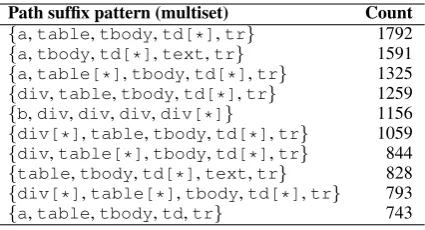
Path suffix pattern (multiset) Count
{a,table,tbody,td[*],tr} 1792
{a,tbody,td[*],text,tr} 1591
{a,table[*],tbody,td[*],tr} 1325 {div,table,tbody,td[*],tr} 1259
{b,div,div,div,div[*]} 1156
{div[*],table,tbody,td[*],tr} 1059 {div,table[*],tbody,td[*],tr} 844 {table,tbody,td[*],text,tr} 828 {div[*],table[*],tbody,td[*],tr} 793
[image:6.595.311.524.61.176.2]{a,table,tbody,td,tr} 743
Table 2: Top 10 path suffix patterns found by the baseline learner in the development data. Since we allow path entries to be permuted, each suffix pattern is represented by a multiset of path entries. The notation[*]denotes any path entry index.
To see how our compatibility-based accuracy tracks exact correctness, we sampled 100 web pages which have at least one valid extraction predicate and manually annotated the full list of entities. We found that in 85% of the examples, the longest compatible list y is the correct list of entities, and many lists in the remaining 15% miss the correct list by only a few entities.
Oracle. In some examples, our system cannot find any list of entities that is compatible with the gold annotation. The oraclescore is the fraction of examples in which the system can find at least one compatible list.
4.2 Baseline
As a baseline, we list the suffixes of the cor-rect extraction predicates in the training data, and then sort the resulting suffix patterns by frequency. To improve generalization, we treat path entries with different indices (e.g.,td[1]vs.td[2]) as equivalent and allow path entries to be permuted. Table 2 lists the top 10 suffix patterns from the de-velopment data. At test time, we choose an extrac-tion predicate with the most frequent suffix pat-tern. The baseline should work considerably well if the web pages were relatively homogeneous.
4.3 Main results
Development data Test data
Acc A@5 Acc A@5
Baseline 10.8±1.3 25.6±2.0 10.3 20.9
Our system 41.1±3.4 58.4±2.7 40.5 55.8
[image:7.595.73.290.63.115.2]Oracle 68.7±2.4 68.7±2.4 66.6 66.6
Table 3: Main results on the OPENWEB dataset using the default set of features. (Acc = accuracy, A@5 = accuracy at 5)
4.4 Error analysis
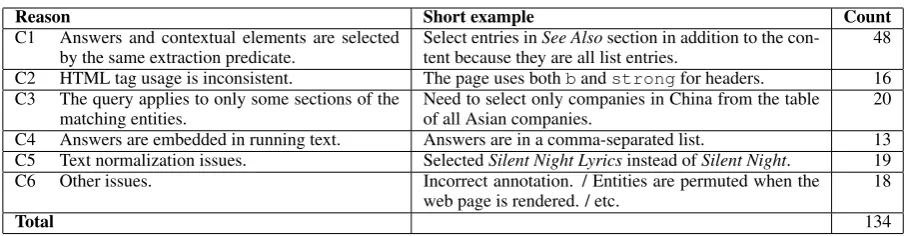
We now investigate the errors made by our system using the development data. We classify the er-rors into two types: (i)coverage errors, which are when the system cannot find any entity list satis-fying the compatibility function; and (ii) ranking errors, which are when a compatible list of entities exists, but the system outputs an incompatible list. Tables 4 and 5 show the breakdown of cover-age and ranking errors from an experiment on the development data.
Analysis of coverage errors. From Table 4, about 36% of coverage errors happen when the extraction predicate for the correct entities also captures unrelated parts of the web page (Reason C1). For example, many Wikipedia articles have theSee Alsosection that lists related articles in an unordered list (/ul/li/a), which causes a prob-lem when the entities are also represented in the same format.
Another main source of errors is the in-consistency in HTML tag usage (Reason C2). For instance, some web pages use <b> and
<strong> tags for bold texts interchangeably, or switch between <b><a>...</a></b> and
<a><b>...</b></a>across entities. We ex-pect that this problem can be solved by normaliz-ing the web page, usnormaliz-ing an alternative web page representation (Cohen et al., 2002; Wang and Co-hen, 2009; Fumarola et al., 2011), or leveraging more expressive extraction predicates (Dalvi et al., 2011).
One interesting source of errors is Reason C3, where we need to filter the selected entities to match the complex requirement in the query. For example, the query tech companies in China re-quires the system to select only the company names with China in the corresponding location column. To handle such queries, we need a deeper understanding of the relation between the linguis-tic structure of the query and the hierarchical structure of the web page. Tackling this error
re-Setting Acc A@5
All features 41.1±3.4 58.4±2.7
Oracle 68.7±2.4 68.7±2.4
(Section 4.5)
Structural features only 36.2±1.9 54.5±2.5 Denotation features only 19.8±2.5 41.7±2.7 (Section 4.6)
Structural + query-denotation 41.7±2.5 58.1±2.4 Query-denotation features only 25.0±2.3 48.0±2.7 Concat. a random web page +
structural + denotation 19.3±2.6 41.2±2.3 Concat. a random web page +
structural + query-denotation 29.2±1.7 49.2±2.2 (Section 4.7)
Add 1 seed entity 52.9±3.0 66.5±2.5 Table 6: System accuracy with different feature and input settings on the development data. (Acc = accuracy, A@5 = accuracy at 5)
quires compositionality and is critical to general-ize to more complex queries.
Analysis of ranking errors. From Table 5, a large number of errors are attributed to the system selecting non-content elements such as navigation links and content headings (Reason R1). Feature analysis reveals that both structural and linguis-tic statislinguis-tics of these non-content elements can be more coherent than those of the correct entities. We suspect that since many of our features try to capture the coherence of entities, the system some-times erroneously favors the more homonogenous non-content parts of the page. To disfavor these parts, One possible solution is to add visual fea-tures that capture how the web page is rendered and favor more salient parts of the page. (Liu et al., 2003; Song et al., 2004; Zhu et al., 2005; Zheng et al., 2007).
4.5 Feature variations
We now investigate the contribution of each fea-ture type. The ablation results on the development set over 10 random splits are shown in Table 6. We observe that denotation features improves ac-curacy on top of structural features.
Reason Short example Count
C1 Answers and contextual elements are selected
by the same extraction predicate. Select entries intent because they are all list entries.See Alsosection in addition to the con- 48 C2 HTML tag usage is inconsistent. The page uses bothbandstrongfor headers. 16 C3 The query applies to only some sections of the
matching entities. Need to select only companies in China from the tableof all Asian companies. 20 C4 Answers are embedded in running text. Answers are in a comma-separated list. 13 C5 Text normalization issues. SelectedSilent Night Lyricsinstead ofSilent Night. 19 C6 Other issues. Incorrect annotation. / Entities are permuted when the
web page is rendered. / etc. 18
[image:8.595.72.527.59.177.2]Total 134
Table 4: Breakdown of coverage errors from the development data.
Reason Short example Count
R1 Select non-content strings. Select navigation links, headers, footers, or sidebars. 25 R2 Select entities from a wrong field. Select book authors instead of book names. 22 R3 Select entities from the wrong section(s). For the queryschools in Texas, select all schools on the
page, or select the schools in Alabama instead. 19 R4 Also select headers or footers. Select the table header in addition to the answers. 7 R5 Select only entities with a particular formatting. From a list of answers, select only anchored (a) entities. 4 R6 Select headings instead of the contents or vice
versa. Select the categories of rums inrum names in the tables. h2tags instead of the 2 R7 Other issues. Incorrect annotation. / Multiple sets of answers appear
on the same page. / etc. 9
Total 88
Table 5: Breakdown of ranking errors from the development data.
All features Structural only Denotation only
The Sun CIRC: 2,279,492 Paperboy Australia Daily Mail CIRC: 1,821,684 Paperboy UK Daily Mirror CIRC: 1,032,144 Paperboy Home Page
. . . .
Table 7: System outputs for the queryUK news-paperswith different feature sets. Without deno-tation features, the system selects the daily circu-lation of each newspaper instead of the newspaper names. And without structural features, the sys-tem selects the hidden navigation links from the top of the page.
4.6 Incorporating query information
So far, note that all our features depend only on the extraction predicatezand not the input query
x. Remarkably, we were still able to obtain rea-sonable results. One explanation is that since we obtained the web pages from a search engine, the most prominent entities on the web pages, such as entities in table cells in the middle of the page, are likely to be good independent of the query.
However, different queries often denote enti-ties with different linguistic properenti-ties. For exam-ple, queriesmayors of Chicagoanduniversities in Chicagowill produce entities of different lengths, part-of-speech sequences, and word distributions. This suggests incorporating features that depend
on the query.
To explore the potential of query informa-tion, we conduct the following oracle experi-ment. We replace each denotation feature f(y)
with a corresponding query-denotation feature
(f(y), g(x)), where g(x) is the category of the queryx. We manually classified all queries in our dataset into 7 categories: person, media title, loca-tion/organization, abtract entity, word/phrase, ob-ject name, and miscellaneous.
Table 8 shows some examples where adding these query-denotation features improves the se-lected entity lists by favoring answers that are more suitable to the query category. However, Ta-ble 6 shows that these new features do not signifi-cantly improve the accuracy of our original system on the development data.
Query euclid’s elements book titles soft drugs professional athletes with concussions
Default
features “Prematter”, “Book I.”,“Book II.”, “Book III.”, . . . “Hard drugs”, “Soft drugs”,“Some drugs cannot be classified that way”, . . .
“Pistons-Knicks Game Becomes Site of Incredible Dance Battle”, “Toronto Mayor Rob Ford Attends . . . ”, . . .
Structural + Query-Denotation
(category =media title)
“Book I. The fundamentals . . . ”, “Book II. Geometric algebra”, . . .
(category =object name) “methamphetamine”, “psilocybin”, “caffeine”
(category =person)
[image:9.595.71.525.62.134.2]“Mike Richter”, “Stu Grimson”, “Geoff Courtnall”, . . .
Table 8: System outputs after changing denotation features into query-denotation features.
this modified dataset, the prominent entities may not be the answers to the query. Here, query-denotation features improves accuracy over deno-tation features alone from 19.3% to 29.2%.
4.7 Comparison with other problem settings
Since zero-shot entity extraction is a new task, we cannot directly compare our system with other systems. However, we can mimic the settings of other tasks. In one experiment, we augment each input query with a single seed entity (the second annotated entity in our experiments); this setting is suggestive of Wang and Cohen (2009). Table 6 shows that this augmentation increases accuracy from 41.1% to 52.9%, suggesting that our sys-tem can perform substantially better with a small amount of additional supervision.
5 Discussion
Our work shares a base with the wrapper induc-tion literature (Kushmerick, 1997) in that it lever-ages regularities of web page structures. However, wrapper induction usually focuses on a small set of web domains, where the web pages in each do-main follow a fixed template (Muslea et al., 2001; Crescenzi et al., 2001; Cohen et al., 2002; Arasu and Garcia-Molina, 2003). Later work in web data extraction attempts to generalize across different web pages, but relies on either restricted data for-mats (Wong et al., 2009) or prior knowledge of web page structures with respect to the type of data to extract (Zhang et al., 2013).
In our case, we only have the natural language query, which presents the more difficult problem of associating the entity class in the query (e.g., hiking trails) to concrete entities (e.g.,Avalon Su-per Loop). In contrast to information extraction systems that extract homogeneous records from web pages (Liu et al., 2003; Zheng et al., 2009), our system must choose the correct field from each record and also identify the relevant part of the page based on the query.
Another related line of work is information ex-traction from text, which relies on natural lan-guage patterns to extract categories and relations of entities. One classic example is Hearst pat-terns (Hearst, 1992; Etzioni et al., 2005), which can learn new entities and extraction patterns from seed examples. More recent approaches also leverage semi-structured data to obtain more ro-bust extraction patterns (Mintz et al., 2009; Hoff-mann et al., 2011; Surdeanu et al., 2012; Riedel et al., 2013). Although our work focuses on semi-structured web pages rather than raw text, we use linguistic patterns of queries and entities as a sig-nal for extracting appropriate answers.
Additionally, our efforts can be viewed as build-ing a lexicon on the fly. In recent years, there has been a drive to scale semantic parsing to large databases such as Freebase (Cai and Yates, 2013; Berant et al., 2013; Kwiatkowski et al., 2013). However, despite the best efforts of information extraction, such databases will always lag behind the open web. For example, Berant et al. (2013) found that less than 10% of naturally occurring questions are answerable by a simple Freebase query. By using the semi-structured data from the web as a knowledge base, we hope to increase fact coverage for semantic parsing.
Finally, as pointed out in the error analysis, we need to filter or aggregate the selected entities for complex queries (e.g.,tech companies in Chinafor a web page with all Asian tech companies). In fu-ture work, we would like to explore the issue of compositionality in queries by aligning linguistic structures in natural language with the relative po-sition of entities on web pages.
Acknowledgements
References
A. Arasu and H. Garcia-Molina. 2003. Extracting structured data from web pages. InACM SIGMOD international conference on Management of data, pages 337–348.
J. Berant, A. Chou, R. Frostig, and P. Liang. 2013. Semantic parsing on Freebase from question-answer pairs. InEmpirical Methods in Natural Language Processing (EMNLP).
Q. Cai and A. Yates. 2013. Large-scale semantic pars-ing via schema matchpars-ing and lexicon extension. In Association for Computational Linguistics (ACL).
W. W. Cohen, M. Hurst, and L. S. Jensen. 2002. A flexible learning system for wrapping tables and lists in HTML documents. InWorld Wide Web (WWW), pages 232–241.
V. Crescenzi, G. Mecca, P. Merialdo, et al. 2001. Roadrunner: Towards automatic data extraction from large web sites. In VLDB, volume 1, pages 109–118.
N. Dalvi, R. Kumar, and M. Soliman. 2011. Auto-matic wrappers for large scale web extraction. Pro-ceedings of the VLDB Endowment, 4(4):219–230.
B. Dalvi, W. Cohen, and J. Callan. 2012. Websets: Extracting sets of entities from the web using unsu-pervised information extraction. InWeb Search and Data Mining (WSDM), pages 243–252.
J. Duchi, E. Hazan, and Y. Singer. 2010. Adaptive sub-gradient methods for online learning and stochastic optimization. In Conference on Learning Theory (COLT).
O. Etzioni, M. Cafarella, D. Downey, A. Popescu, T. Shaked, S. Soderland, D. S. Weld, and A. Yates. 2005. Unsupervised named-entity extraction from the web: An experimental study. Artificial Intelli-gence, 165(1):91–134.
F. Fumarola, T. Weninger, R. Barber, D. Malerba, and J. Han. 2011. Extracting general lists from web doc-uments: A hybrid approach. Modern Approaches in Applied Intelligence Springer.
M. A. Hearst. 1992. Automatic acquisition of hy-ponyms from large text corpora. In Interational Conference on Computational linguistics, pages 539–545.
R. Hoffmann, C. Zhang, X. Ling, L. S. Zettlemoyer, and D. S. Weld. 2011. Knowledge-based weak su-pervision for information extraction of overlapping relations. In Association for Computational Lin-guistics (ACL), pages 541–550.
N. Kushmerick. 1997. Wrapper induction for informa-tion extracinforma-tion. Ph.D. thesis, University of Washing-ton.
T. Kwiatkowski, E. Choi, Y. Artzi, and L. Zettlemoyer. 2013. Scaling semantic parsers with the-fly on-tology matching. InEmpirical Methods in Natural Language Processing (EMNLP).
H. Larochelle, D. Erhan, and Y. Bengio. 2008. Zero-data learning of new tasks. In AAAI, volume 8, pages 646–651.
L. Liu, C. Pu, and W. Han. 2000. XWRAP: An XML-enabled wrapper construction system for web infor-mation sources. In Data Engineering, 2000. Pro-ceedings. 16th International Conference on, pages 611–621.
B. Liu, R. Grossman, and Y. Zhai. 2003. Mining data records in web pages. InProceedings of the ninth ACM SIGKDD international conference on Knowl-edge discovery and data mining, pages 601–606. M. Mintz, S. Bills, R. Snow, and D. Jurafsky. 2009.
Distant supervision for relation extraction without labeled data. InAssociation for Computational Lin-guistics (ACL), pages 1003–1011.
I. Muslea, S. Minton, and C. A. Knoblock. 2001. Hi-erarchical wrapper induction for semistructured in-formation sources. Autonomous Agents and Multi-Agent Systems, 4(1):93–114.
S. Riedel, L. Yao, and A. McCallum. 2013. Re-lation extraction with matrix factorization and uni-versal schemas. InNorth American Association for Computational Linguistics (NAACL).
A. Sahuguet and F. Azavant. 1999. WysiWyg web wrapper factory (W4F). InWWW Conference. R. Song, H. Liu, J. Wen, and W. Ma. 2004. Learning
block importance models for web pages. InWorld Wide Web (WWW), pages 203–211.
M. Surdeanu, J. Tibshirani, R. Nallapati, and C. D. Manning. 2012. Multi-instance multi-label learning for relation extraction. InEmpirical Methods in ural Language Processing and Computational Nat-ural Language Learning (EMNLP/CoNLL), pages 455–465.
R. C. Wang and W. W. Cohen. 2009. Character-level analysis of semi-structured documents for set expan-sion. In Empirical Methods in Natural Language Processing (EMNLP), pages 1503–1512.
Y. W. Wong, D. Widdows, T. Lokovic, and K. Nigam. 2009. Scalable attribute-value extraction from semi-structured text. In IEEE International Conference on Data Mining Workshops, pages 302–307. Z. Zhang, K. Q. Zhu, H. Wang, and H. Li. 2013.
Au-tomatic extraction of top-k lists from the web. In International Conference on Data Engineering. S. Zheng, R. Song, and J. Wen. 2007.
S. Zheng, R. Song, J. Wen, and C. L. Giles. 2009. Ef-ficient record-level wrapper induction. In Proceed-ings of the 18th ACM conference on Information and knowledge management, pages 47–56.