Munich Personal RePEc Archive
The Category of Node-and-Choice
Forms, with Subcategories for
Choice-Sequence Forms and Choice-Set
Forms
Streufert, Peter
Western University (University of Western Ontario)
27 November 2018
Online at
https://mpra.ub.uni-muenchen.de/90490/
THE CATEGORY OF NODE-AND-CHOICE FORMS, WITH SUBCATEGORIES FOR
CHOICE-SEQUENCE FORMS AND CHOICE-SET FORMS
Peter A. Streufert Economics Department
Western University
Abstract. The literature specifies extensive-form games in several styles, and eventually I hope to formally translate games across those styles. Toward that end, this paper defines NCF, the category of node-and-choice forms. The category’s objects are game forms in any style, and the category’s isomor-phisms are made to accord with the literature’s small handful of ad hoc style equivalences.
More specifically, the paper develops two full subcategories: CsqF for forms whose nodes are choice-sequences, andCsetFfor forms whose nodes are choice-sets. I show thatNCFis “isomorphically enclosed” inCsqFin the sense that eachNCFform is isomorphic to aCsqFform. Similarly, I show thatCsqF˜ais isomorphically enclosed inCsetFin the sense that eachCsqF
form with no-absentmindedness is isomorphic to aCsetFform. The converses are found to be almost immediate, and the resulting equivalences unify and simplify two ad hoc style equivalences in Kline and Luckraz 2016 and Streufert 2018a.
Aside from the larger agenda, this paper makes three practical contribu-tions. Style equivalences are made easier to derive by [1] a natural concept of isomorphic invariance and [2] the composability of isomorphic enclosures. In addition, [3] some new consequences of equivalence are systematically deduced.
1. Introduction
1.1. General Motivation
To
(Identical to Western University Department of Economics Research Report 2018-6.)
set the stage, this paragraph recalls that there are many styles in which to specify an extensive-form game. Streufert 2018a (henceforth “S5”) lists five of them. [1] Nodes and choices1 can be specified abstractly without restriction, as in Kuhn 1953 and Selten 1975. [2] Nodes can be specified as sequences of choices as in Osborne and Rubinstein 1994. [3] Nodes can be specified as sets of choices as in S5 itself. [4] Choices can be specified as sets of nodes, as in Al´os-Ferrer and Ritzberger 2016 Section 6.3. [5] Both nodes and choices can be expressed as sets of outcomes, as in von Neumann and Morgenstern 1944, and Al´os-Ferrer and Ritzberger 2016
Date: November 27, 2018. Keywords:extensive form, game form, isomorphic enclosure. JEL Classification: C73. AMS Classification:91A70. Contact information:[email protected], 519-661-2111x85384, Economics Department, University of Western Ontario, London, Ontario, N6A 5C2, Canada.
I thank Deanna Walker for many valuable suggestions.
1The terms “choice”, “action”, and “alternative” are fundamentally synonymous. See note 17
for further discussion.
2 1. Introduction
Section 6.2. S5 Section 1 provides examples of the five styles, and S5 Section 7 explains how each style has its own advantages and disadvantages.
It is difficult to formally compare the different styles. Indeed, the first such results have only recently appeared in Al´os-Ferrer and Ritzberger 2016 Section 6.3, in Kline and Luckraz 2016, and in S5 (whose Figure 1.2 provides an overview). These contributions show, by ad hoc constructions, that the five styles in the previous paragraph are of roughly equal generality. To be somewhat more precise, these papers argue that one style is at least as general as another style, by showing that each game in the first style can be reasonably mapped to a game in the second style. Then two styles are regarded as equivalent if such an argument can be made in both directions. Notice that each such argument hinges upon an ad hoc mapping linking games in one style to games in another style. Lacking is a way to compare styles that is based on a systematic way of comparing games. I hope to provide that systematization in a fashion that is compatible with the prior style equivalences.
Further, I have a larger agenda in mind. Suppose that two styles have been compared and found to be equivalent. Then I hope to do more than merely translate each game in one style to an equivalent game in the other style. I hope to translate properties, defined for games, from one style to the other. I hope to translate equilibrium concepts from one style to the other. And ultimately, I hope to translate theorems from one style to the other. In other words, I hope to formally translate game theory from one style to another.
I believe this would be useful. Since each game-theory paper typically uses just one style, one can sort the game-theory literature into separate subliteratures cor-responding to the different styles. Then, the present lack of formal translation across styles implies that communication across the subliteratures is informal. So, unavoidably, a considerable amount of game-theoretic understanding is informal. Formally defragmenting the literature would increase communication, reduce the likelihood of laboriously reproducing past results, reduce editorial effort, and facil-itate teaching. In addition, the ability to translate would help researchers to freely choose the style that is most insightful and/or most convenient for the particular task at hand.
Formal translation is a daunting task. Fortunately, category theory promises to be a natural and powerful tool. In order to gain access to this tool, my intermediate-range objective has been to construct a category [a] whose objects are extensive-form games in any style, and [b] whose isomorphisms accord with the handful of style equivalences already in the literature. My first step was Streufert 2018b (henceforth “SP”). That paper defined NCP, which is the category of node-and-choice “preforms”, where a preform is a rooted tree with node-and-choices and information sets. My second step is the present paper. Here I will define NCF, which is the category of node-and-choice “forms”, where a form augments a preform with players. Later, a third paper will augment NCFforms with preferences in order to define extensive-form games.
1. Introduction 3
1.2. Categorical Investments
As suggested, this paper constructs a category of forms [a] whose objects are forms in any style, and [b] whose isomorphisms accord with the style equivalences already in the literature. Goals [a] and [b] are discussed in the next two paragraphs. Section 2 introducesNCF, which is the category of node-and-choice forms, in which both nodes and choices are specified abstractly without restriction. Thereby goal [a] is achieved. Further, one special kind of node-and-choice form is a choice-sequence form, in which nodes are choice-choice-sequences. Correspondingly, Section 3 introduces CsqF, which is the full NCF subcategory for choice-sequence forms. Similarly, another special kind of node-and-choice form is a choice-set form, in which nodes are choice-sets. Correspondingly, Section 4 introducesCsetF, which is the full NCFsubcategory for choice-set forms. Finally, consider again the five styles in the paper’s opening paragraph. NCFitself corresponds to style [1],CsqF
corresponds to style [2], andCsetFcorresponds to style [3]. Left for future research are style [4] with its node-set choices, and style [5] with its outcome-set nodes and outcome-set choices. These two additional styles will correspond to two additional subcategories ofNCF, as suggested in Section 5.2’s discussion of future research.
To achieve goal [b], Section 2 defines NCF’s morphisms in such a way that the category’s isomorphisms accord with the style equivalences in the literature. Since this paper does not build subcategories for the node-set and outcome-set styles, only two of the literature’s style equivalences remain: [i] Kline and Luckraz 2016 Theorems 1 and 2, which are essentially an equivalence between node-and-choice forms and node-and-choice-sequence forms, and [ii] S5 Theorems 3.1 and 3.2, which are essentially an equivalence between (no-absentminded) choice-sequence forms and choice-set forms. As discussed earlier, each of these two equivalences is a matching pair of results, in which each result states that each form in one style can be reasonably mapped to a form in the other style. Section 3.2 proposes to strengthen each such result by requiring that each form in one style is NCFisomorphic to a form in the other style. This new kind of result is called an “isomorphic enclosure”, and a matching pair of isomorphic enclosures is called an “isomorphic equivalence”. Equivalence [i] accords with Corollary 3.3(b), which states thatNCFandCsqFare isomorphically equivalent. Similarly, equivalence [ii] accords with Corollary 4.3(b), which states thatCsqF˜aandCsetFare isomorphically equivalent. The paragraphs
after these two corollaries provide historical context, more details, and more senses in which the two corollaries accord with literature’s equivalences [i] and [ii].
Other results show thatNCFis pleasant in other ways. Theorem 2.3 shows that
NCF is a well-defined category. Theorem 2.4 shows that an NCF isomorphism can be characterized by bijections for nodes, choices, and players. Theorem 2.7 shows that there is a forgetful functor fromNCFtoNCP, which is SP’s category of node-and-choice preforms. In addition, various results in Sections 2.1–2.3 show that the category interacts naturally with game-theoretic concepts like the assign-ment of information sets to players. Also, Section 2.4 shows that the properties of no-absentmindedness and perfect-information are invariant toNCFisomorphisms.
2Extensive-form games are not readily comparable to the games defined in the theoretical
4 1. Introduction
Finally, the paragraph after Corollary 3.5 shows how the negation of isomorphic en-closure formalizes the notion that a property is truly “restrictive” and “substantial” as opposed to merely “notational”.
1.3. Categorical Dividends
Section 1.2 above argues that NCF systematizes prior style equivalences and that it is a pleasant category in a variety of other ways. Also, Sections 1.1 and 5.2 argue that NCFpromises to be of practical importance in the larger agenda of translating game theory across styles. Further, the following three paragraphs identify three practical ways thatNCFdirectly contributes to game theory.
First, isomorphic invariance is a natural and powerful concept. For example, two elementary propositions in Section 3.3 use isomorphic invariance to find [1] general circumstances in which one subcategory is strictly isomorphically enclosed by another and [2] general circumstances in which an isomorphic enclosure can be restricted to smaller subcategories. The latter proposition is used by Corol-lary 3.7(b) to easily construct an isomorphic enclosure for the proof highlighted in the next paragraph. Further, both propositions are used by Section 4.3 to easily derive new results about perfect-information.
Second, isomorphic enclosures can be composed (note 15). Such compositions can make it much easier to derive other isomorphic enclosures. For example, the proof of Corollary 4.3(b)’s reverse direction is just six lines long, and the third para-graph following the corollary’s proof explains how this simple argument replaces six difficult pages in S5’s proof of its Theorem 3.2. Thus the isomorphic equivalence of Corollary 4.3(b) is much easier to prove than the corresponding ad hoc equivalence of S5 Theorems 3.1 and 3.2 (this was called equivalence [ii] above).
Third, isomorphic enclosures have consequences for form derivatives, and Section 5.1 deduces them simultaneously for all isomorphic enclosures. More specifically, each isomorphic enclosure is defined via isomorphisms, and Proposition 2.6 implies that each such isomorphism has consequences not only for form components (such as nodes, choices, and players) but also for form derivatives (such as the precedence relation among nodes, and each player’s collection of information sets). In contrast, the literature’s ad hoc style equivalences concern only form components.
1.4. Organization
Section 2 developsNCF, the category of node-and-choice forms. Less generally, Section 3 develops the subcategoryCsqFfor choice-sequence forms, and Section 4 develops the subcategoryCsetFfor choice-set forms. Sections 3.2 and 3.3 use the context of CsqFto introduce the general concept of isomorphic enclosure, and to introduce general propositions about isomorphic invariance. Further, Section 5.1 uses parts of Sections 3 and 4 to illustrate some general consequences of isomorphic enclosure. Finally, Section 5.2 discusses future research.
2. The Category of Node-and-Choice Forms 5
2. The Category of Node-and-Choice Forms
2.1. Objects
Let T be a set of elements t called nodes. As in SP Section 2.1 (where “SP” abbreviates Streufert 2018b), a pair (T, p) is a functioned tree iff there areto∈T andX ⊆T such that [T1]pis a nonempty function fromTr{to}ontoX and [T2]
(∀t∈Tr{to})(∃m∈N1)pm(t) =to.3 Callpthe(immediate) predecessorfunction.
A functioned tree (uniquely) determines many entities beyondT andp. First, it determines itsrootnodetoand its setXofdecisionnodes. Second, it determines its
stagefunctionk:T→N0by [a]k(to) = 0 and [b] (∀t∈Tr{to})pk(t)(t) =to. Further,
it determines its (strict) precedence relation ≺ on T by (∀t1∈T, t2∈T) t1≺t2 iff (∃m∈N1)t1 =pm(t2). Relatedly, it determines its weak precedence relation 4on
T by (∀t1∈T, t2∈T)t14t2 iff (∃m∈N0)t1=pm(t2). Finally, it determines the set Z of maximal chains in (T,4). This can be split into the setZft of finite maximal chains and the (possibly empty) setZinft of infinite maximal chains. These derived entities and their basic properties are developed in SP Sections 2.1 and 2.2.
LetC be a set of elements c calledchoices. A triple Π = (T, C,⊗) is a (node-and-choice) preform(SP Section 3.1) iff
[P1] there is a correspondence4F:T։Cand ato∈T
such that⊗is a bijection from5Fgr ontoTr{to},
[P2] (T, p) is a functioned tree wherep:Tr{to}→F−1(C)
is defined6bypgr ={(t♯, t)∈T2|(∃c∈C)(t, c, t♯)∈⊗gr}, and
[P3] Hpartitions F−1(C)
where H ⊆ P(T) is defined byH={F−1(c)|c∈C}.
Call⊗ thenode-and-choice operator, and lett⊗c denote its value at (t, c)∈Fgr. CallF thefeasibility correspondence, call to the rootnode, call pthe
immediate-predecessorfunction, and callHthe collection ofinformation sets. In addition, let
X equal F−1(C) (inconsequentially, SP uses F−1(C) rather than X). CallX the
decision-node set.7
A node-and-choice preform Π (uniquely) determines many entities. First, it determines its componentsT,C, and⊗. Second, it determines itsF,to,p,H, and
X, as discussed in the previous paragraph. Third, [P2] determines the functioned tree (T, p), which in turn determines k, ≺, 4, Zft, and Zinft, as discussed in the second-previous paragraph. Finally, define the preform’sprevious-choice function
3I adopt the conventions thatN
0is{0,1,2, ...}, thatN1is{1,2, ...}, and that, for any function
f,f0is the identity function.
4To be clear, letF:T։C mean thatF is a correspondence fromT to C, which means that (∀t∈T)F(t)⊆C. Also, forc∈C, letF−1(c) ={t∈T|c∈F(t)}. Also, letF−1(C) =∪
c∈CF−1(c).
5In contrast to SP, the present paper notationally distinguishes between a correspondence
and its graph, between a function and its graph, and between a binary relation and its graph. Thus [P1] distinguishes between the correspondenceF and its graph Fgr⊆T×C. Also, [P2] distinguishes between the functionpand its graphpgr⊆T×T, and between the function⊗and its graph⊗gr⊆T×C×T. Also, for example, Proposition 2.2(o) distinguishes between a relation
≺and its graph≺gr⊆T×T.
6SP Lemma C.1(a) shows that [P1] implies the well-definition and surjectivity ofp.
7SP Lemma C.1(b,c) implies that a preform’stoandX coincide with the underlying tree’sto
6 2. The Category of Node-and-Choice Forms
q:Tr{to}→C by qgr = {(t♯, c)∈T×C|(∃t∈T)(t, c, t♯)∈⊗gr}. All these entities and
their basic properties are developed in SP Sections 3.1 and 3.2. Among the basic properties is the convenient fact that (p, q) = ⊗−1. Further properties appear in SP Lemmas A.1, C.1, and C.2, and also in Lemma A.1 here.
LetIbe a set of elementsicalledplayers. A quadrupleΦ= (I, T,(Ci)i∈I,⊗) is a(node-and-choice) form iff
[F1] (T, C,⊗) is a preform whereC=∪i∈ICi,
[F2] (∀i∈I, j∈Ir{i})Ci∩Cj =∅, and
[F3] (∀t∈T)(∃i∈I)F(t)⊆Ci.
Each Ci is the set of choices that are assigned to playeri. The definitions in this paragraph are new to this paper (and an earlier version, Streufert 2016).
A node-and-choice formΦ(uniquely) determines many entities. First, it deter-mines its components I, T, (Ci)i∈I, and ⊗. Second, [F1] determines C and the preform (T, C,⊗), which in turn determinesF, to, p, q, H, X, k, ≺, 4, Z
ft, and Zinft, as discussed in the second-previous paragraph. In addition, define (Xi)i∈I at each i byXi =∪c∈CiF
−1(c). X
i is the set of decision nodes that are assigned to playeri. Further, define (Hi)i∈I at eachi by Hi ={F−1(c)|c∈Ci}. Hi is the collection of information sets that are assigned to playeri.
Proposition 2.1. Suppose(I, T,(Ci)i,⊗)is a node-and-choice form with itsX, H,(Xi)i∈I, and(Hi)i∈I. Then the following hold.
(a)∪i∈IXi=X and(∀i∈I, j∈Ir{i})Xi∩Xj =∅.
(b)(∀i∈I)Hi partitions Xi.
(c)∪i∈IHi=Hand(∀i∈I, j∈Ir{i})Hi∩Hj =∅. (Proof A.3.)
Here are two minor remarks. [1] A preform can be understood as a one-player form. Specifically, (T, C,⊗) is a preform iff ({1}, T,(C),⊗) is a form, where (Ci)i= (C) is taken to mean C1 = C. [2] A player i in a form is said to be vacuous iff
Ci=∅. A vacuous player inecessarily hasXi=∅andHi=∅. Vacuous players can be convenient. For example, one can posit the existence of a chance player, and yet create a game without chance nodes by letting the chance player be vacuous.
2.2. Morphisms
A (node-and-choice) preform morphism (SP Section 3.3) is a quadruple α = [Π, Π′, τ, δ] such that Π= (T, C,⊗) andΠ′ = (T′, C′,⊗′) are preforms,
[PM1] τ:T→T′,
[PM2] δ:C→C′, and
[PM3] {(τ(t), δ(c), τ(t♯))|(t, c, t♯)∈⊗gr} ⊆ ⊗′gr.
SP Propositions 3.3 and 3.4 give two characterizations of preform morphisms which feel more category-theoretic. A (node-and-choice) form morphism is a quintuple
β= [Φ, Φ′, ι, τ, δ] s.t.Φ= (I, T,(C
i)i∈I,⊗) andΦ′= (I′, T′,(Ci′′)i′∈I′,⊗′) are forms,
[FM1] [Π, Π′, τ, δ] is a preform morphism where
Π = (T, C,⊗), C =∪i∈ICi, Π′= (T′, C′,⊗′), andC′=∪i′∈I′C′
i′,
[FM2] ι:I→I′, and
2. The Category of Node-and-Choice Forms 7
The first paragraph of Proposition 2.2 rearranges the definition of a morphism. Meanwhile, the second and third paragraphs concern the many derivatives which can be constructed, via Section 2.1, from the source and target forms. Parts (k) and (m) are new, while the remainder are obtained by combining [FM1] with various SP results for preforms and trees.
Proposition 2.2. SupposeΦ= (I, T,(Ci)i∈I,⊗)andΦ′= (I′, T′,(Ci′′)i′∈I′,⊗′)
are forms. Let C =∪i∈ICi and C′=∪i′∈I′C′
i′. Then[Φ, Φ′, ι, τ, δ] is a morphism
iff the following hold. (a)ι:I→I′.
(b)τ:T→T′.
(c)δ:C→C′.
(d)(∀i∈I)δ(Ci)⊆Cι′(i).
(e){(τ(t), δ(c), τ(t♯))|(t, c, t♯)∈⊗gr} ⊆ ⊗′gr.
Further, suppose [Φ, Φ′, ι, τ, δ] is a morphism. Let Π = (T, C,⊗) and Π′ = (T′, C′,⊗′). Also, deriveF, to,p,q, X,(X
i)i∈I, H, and (Hi)i∈I fromΠ andΦ.
Also, deriveF′,t′o,p′,q′,X′,(X′
i′)i′∈I′,H′, and(H′
i′)i′∈I′ fromΠ′ andΦ′. Then
the following hold.
(f ){(τ(t), δ(c))|(t, c)∈Fgr} ⊆F′gr.
(g)t′o 4′ τ(to).
(h){(τ(t♯), τ(t))|(t♯, t)∈pgr} ⊆ p′gr.
(i){(τ(t♯), δ(c))|(t♯, c)∈qgr} ⊆ q′gr.
(j)τ(X) ⊆X′.
(k)(∀i∈I)τ(Xi)⊆Xι′(i).
(l)(∀H∈H)(∃H′∈H′)τ(H)⊆H′.
(m)(∀i∈I, H∈Hi)(∃H′∈Hι′(i))τ(H)⊆H′.
Finally, derive k,≺,4,Zft, and Zinft from(T, p). Also, derive k′,≺′,4′,Zft′,
andZ′
inft from(T′, p′). Then the following hold.
(n)(∀t∈T)k′(τ(t)) =k(t) +k′(τ(to)).
(o){(τ(t1), τ(t2))|(t1, t2)∈≺gr} ⊆ ≺′gr.
(p){(τ(t1), τ(t2))|(t1, t2)∈4gr} ⊆ 4′gr.
(q)(∀Z∈Zft)(∃Z′∈Zft′∪Zinft′ )τ(Z)⊆Z′.
(r)(∀Z∈Zinft)(∃Z′∈Zinft′ )τ(Z) ⊆Z
′. (Proof A.4.)
2.3. The category NCF
This paragraph and Theorem 2.3 define the categoryNCF, which is called the
category of node-and-choice forms. Let an object be a (node-and-choice) form
Φ = (I, T,(Ci)i∈I,⊗). Let an arrow be a (node-and-choice) form morphismβ =
[Φ, Φ′, ι, τ, δ]. Let source, target, identity, and composition be
βsrc= [Φ, Φ′, ι, τ, δ]src=Φ, βtrg= [Φ, Φ′, ι, τ, δ]trg=Φ′,
idΦ=id(I,T,(Ci)i∈I,⊗)= [Φ, Φ,idI,idT,id∪i∈ICi], and
β′◦β = [Φ′, Φ′′, ι′, τ′, δ′]◦[Φ, Φ′, ι, τ, δ] = [Φ, Φ′′, ι′◦ι, τ′◦τ, δ′◦δ],
8 2. The Category of Node-and-Choice Forms
Theorem 2.3. NCFis a category. (Proof A.5.)
Theorem 2.4. Suppose β = [Φ, Φ′, ι, τ, δ] is a morphism. Then (a) β is an
isomorphism iffι,τ, andδare bijections. Further (b) ifβ is an isomorphism, then β−1= [Φ′, Φ, ι−1, τ−1, δ−1]. (Proof A.7.)
Corollary 2.5. Suppose[Φ, Φ′, ι, τ, δ] is a morphism. Let Π be the preform in
Φ, and let Π′ be the preform in Φ′. Then [Φ, Φ′, ι, τ, δ] is an isomorphism iff [1]
[Π, Π′, τ, δ] is a preform isomorphism and [2]ι is a bijection. (Proof here.)
Proof. Note [Π, Π′, τ, δ] is a preform morphism by [FM1] for [Φ, Φ′, ι, τ, δ]. Thus SP Theorem 3.7(a) shows that [1] is equivalent to the bijectivity ofτ andδ. There-fore [1] and [2] together are equivalent to the bijectivity ofι, τ, and δ. By Theo-rem 2.4(a), this is equivalent to [Φ, Φ′, ι, τ, δ] being an isomorphism.
✷
Proposition 2.6 organizes some8 of the consequences of a form isomorphism. The proposition’s first paragraph concerns form components, while the second and third paragraphs concern form derivatives. Consequences (a)–(c) repeat the forward direction of Theorem 2.4(a). Consequences (d), (k), and (m) are new, while the remainder are obtained by combining the forward direction of Corollary 2.5 with SP results about preforms and trees. The entire proposition is comparable to Proposition 2.2 for morphisms, and Section 5.1 will discuss how the proposition contributes directly to game theory.
To address a minor technical issue, note that many of the proposition’s con-sequences are formulated by restricting functions. In each case, the codomain of the restriction is defined so that the restriction is surjective. Some other minor technical issues are discussed in notes 5, 9, and 10.
Proposition 2.6. Suppose [Φ, Φ′, ι, τ, δ] is an isomorphism, where Φ = (I, T, (Ci)i∈I,⊗) and Φ′ = (I′, T′,(Ci′′)i′∈I′,⊗′). Let C =∪i∈ICi and C′ = ∪i′∈I′C′
i′.
Then the following hold.
(a)ι is a bijection fromI ontoI′.
(b)τ is a bijection fromT ontoT′.
(c)δ is a bijection fromC ontoC′.
(d)(∀i∈I)δ|Ci is a bijection fromCi ontoC ′ ι(i).
9
(e)(τ, δ, τ)|⊗gr is a bijection from⊗gr onto⊗′gr.
Further, let Π = (T, C,⊗) andΠ′ = (T′, C′,⊗′). Also, derive F, to, p, q, X, (Xi)i∈I,H, and(Hi)i∈I fromΠ andΦ. Also, deriveF′,t′o,p′,q′,X′,(Xi′′)i′∈I′,
H′, and(H′
i′)i′∈I′ fromΠ′ andΦ′. Then the following hold.
(f )(τ, δ)|Fgr is a bijection fromFgr ontoF′gr. (g)τ(to) =t′o.
(h)(τ, τ)|pgr is a bijection from pgr ontop′gr. (i)(τ, δ)|qgr is a bijection fromqgr ontoq′gr. (j)τ|X is a bijection fromX ontoX′.
(k)(∀i∈I)τ|Xi is a bijection from Xi ontoX ′ ι(i).9
8The proposition’s list of consequences is far from exhaustive. For example, in the
nota-tion of the proposinota-tion’s second paragraph, Lemma A.2(b) deduces that (∀c∈C)τ(F−1(c)) = (F′)−1(δ(c)).
9To be clear, parts (d), (k), and (m) do hold when there is a vacuous playeri. In this case,
2. The Category of Node-and-Choice Forms 9
(l)τ|H is a bijection fromHontoH′.10
(m)(∀i∈I) τ|Hi is a bijection fromHi ontoH ′ ι(i).9,10
Finally, derive k,≺,4,Zft, and Zinft from(T, p). Also, derive k′,≺′,4′,Zft′, Z′
inft from(T′, p′). Then the following hold.
(n)(∀t∈T)k′(τ(t)) =k(t).
(o)(τ, τ)|≺gr is a bijection from≺gr onto≺′gr. (p)(τ, τ)|4gr is a bijection from4gr onto4′gr.
(q)τ|Zft is a bijection from Zft ontoZ
′ ft.10
(r)τ|Zinft is a bijection fromZinft ontoZ
′
inft.10 (Proof A.9.)
As already noted, the definition of a form incorporates a preform, and the def-inition of a form morphism incorporates a preform morphism. Correspondingly, Theorem 2.7 shows there is a “forgetful” functorPfromNCFto NCP. Inciden-tally, SP Theorem 3.9 shows there is a similar functorFfromNCPtoTree. Hence
F◦Pis a functor fromNCFtoTree.
Theorem 2.7. DefinePfrom NCFtoNCPby
P0 : (I, T,(Ci)i∈I,⊗) 7→(T,∪i∈ICi,⊗)and
P1 : [Φ, Φ′, ι, τ, δ] 7→ [P0(Φ),P0(Φ′), τ, δ].
ThenPis a well-defined functor. (Proof A.10.)
2.4. No-absentmindedness and perfect-information
Consider an arbitrary categoryZ, and a property which is defined for the objects of Z. The property is said to beisomorphically invariant iff, for each object, the object satisfies the property iff all of its isomorphs satisfy the property. This section explores two isomorphically invariant properties: [1] no-absentmindedness and [2] perfect-information. Both properties restrict information sets.
No-absentmindedness is a standard property which is widely regarded as being very weak (see, for example, Al´os-Ferrer and Ritzberger 2016 Section 4.2.3). To define this property inNCP, consider anNCPpreform with its≺andH. Then the preform is said to haveno-absentmindedness iff (/∃H∈H, tA∈H, tB∈H)tA ≺tB.11 Further, consider an NCF form with its preform. Then the form is said to have
no-absentmindednessiff its preform has no-absentmindedness.
Proposition 2.8. (ao) If [Π, Π′, τ, δ] is an NCP morphism and Π′ has
no-absentmindedness, then Π has no-absentmindedness. (a) No-absentmindedness is isomorphically invariant inNCP. (bo) If[Φ, Φ′, ι, τ, δ]is anNCFmorphism andΦ′
has no-absentmindedness, thenΦ has no-absentmindedness. (b) No-absentminded-ness is isomorphically invariant inNCF. (Proof A.11.)
10In parts (l), (m), (q), and (r), τ is understood to be the function P(T)∋S 7→
{τ(t)|t∈S} ∈ P(T′). For example, if H ∈ H, then τ(H) = {τ(t)|t∈H}. Similarly, if
Z∈ Zft∪Zinft, thenτ(Z) ={τ(t)|t∈Z}.
11Piccione and Rubinstein 1997 Figure 1 provides an example of absentmindedness. A
cor-respondingNCPpreform Π = (T, C,⊗) can be defined byT ={{},(a),(b),(a,a),(a,b)},C =
{a,b}, and⊗={({},a,(a)),({},b,(b)), ((a),a,(a,a)), ((a),b,(a,b)}. No-absentmindedness fails becauseHcontainsH={{},(a)}and{} ≺(a). A correspondingNCFformΦ= (I, T,(Ci)i,⊗)
10 2. The Category of Node-and-Choice Forms
Let NCP˜a be the full subcategory of NCP whose objects are preforms with
no-absentmindedness. (I am endeavouring to use subscripts for isomorphically in-variant properties.) Similarly, let NCF˜a be the full subcategory of NCF whose
objects are forms with no-absentmindedness. No-absentmindedness will appear again in Section 3.3.
Perfect-information is another standard property. It is restrictive, and at the same time, there are many interesting games which satisfy it (see, for example, Osborne and Rubinstein 1994 Part II). As in SP Section 3.5, anNCPpreform, with its collectionHof information setsH, is said to haveperfect-informationiff (∀H∈H) |H| = 1. Perfect-information is strictly stronger than no-absentmindedness.12,13 Further, an NCFform is said to have perfect-information iff the form’s preform has perfect-information. (In spite of Proposition 2.9, the existence of a morphism does not lead to any logical relationship between the source’s perfect-information and the target’s perfect-information.)
Proposition 2.9. (a) Perfect-information is isomorphically invariant inNCP. (b) Perfect-information is isomorphically invariant inNCF. (Proof A.12.)
Let NCPp be the full subcategory of NCP whose objects are preforms with
perfect-information. (The subscript˜ap would be equivalent to the subscriptp,
be-cause no-absentmindedness is implied by perfect-information, as shown in note 12.) Further, let NCFp be the full subcategory of NCFwhose objects are forms with perfect-information. Perfect-information will appear again in Section 4.3.
3. The Subcategory of Choice-Sequence Forms
3.1. Objects
Let a(finite) sequencebe a function from{1,2, ... m}for some nonnegative inte-germ(to be clear, the empty sequence14with empty domain is admitted bym= 0). I will regard a sequence as a set of ordered pairs. For example, t∗={(1,g),(2,f), (3,f)} is a sequence with domain {1,2,3}. An alternative notation for the same entity ist∗= (g,f,f). Yet another ist∗= (t∗
n)3n=1where t∗1=gand t∗2=t∗3=f. Let the length of a sequence t be |t|. For instance, the length of the example sequence is|t∗|=|{(1,g),(2,f),(3,f)}|= 3, which is consistent with the observation that (2,f)6= (3,f). Note that the length of the empty sequence{}is|{}|= 0. Next,
12To see that perfect-information implies no-absentmindedness, assume no-absentmindedness
is violated. Then there isH ∈ H,tA ∈H, andtB ∈H such thattA≺tB. ThustA6=tB. So
|H|>1 and perfect-information is violated.
13The “horse game” of Selten 1975 Figure 1 is an interesting example which satisfies
no-absentmindedness but not perfect-information, and SP Section 4 spells out (several) corresponding NCPpreforms. However, the simplest example with this combination of properties is an extensive form of a two-person simultaneous-move game. A correspondingNCPpreformΠ= (T, C,⊗) can be defined by T ={{},(a),(b),(a,c),(a,d),(b,c),(b,d)},C ={a,b,c,d}, and⊗={({},a,(a)),
({},b,(b)), ((a),c,(a,c)), ((a),d,(a,d)), ((b),c,(b,c)), ((b),d,(b,d))}. Note that Hconsists of
H = {{}} and H′ = {(a),(b)}. No-absentmindedness holds because [i] H is a singleton and
[ii] neither (a)≺(b) nor (a)≻(b). Perfect-information fails because|H′| 6= 1. A corresponding
NCFformΦ= (I, T,(Ci)i,⊗) can be defined by settingT and ⊗as above, settingI ={1,2},
and settingC1={a,b}andC2 ={c,d}. The existence of this example is used in the proof of Corollary 4.4.
3. The Subcategory of Choice-Sequence Forms 11
let therangeof a sequencetbeR(t) ={tn|n∈{1,2, ...|t|} }. For instance, the range of the example sequence isR(t∗) ={t∗
n|n∈{1,2,3} }={g,f,f}={g,f}. Note that the range of the empty sequence{}isR({}) =∅.
Let the concatenation t⊕s of two sequences t and s be {(1, t1), ... (|t|, t|t|), (|t|+1, s1), ...(|t|+|s|, s|s|)}. Thus the concatenation of a sequencet= (t1, t2, ... t|t|) with a one-element sequence (c) ist⊕(c) = (t1, t2, ... t|t|, c). Next, for any sequence
t and any ℓ∈ {0,1,2, ...|t|}, let 1tℓ denote theinitial segment (t1, t2, ... tℓ). Thus for any sequencet, 1t0={}.
Achoice-sequence NCPpreform is anNCPpreform (T, C,⊗) such that [Csq1] T is a collection of (finite) sequences which contains{},
[Csq2] (∀(t, c, t♯)∈ ⊗gr)t⊕(c) =t♯.
LetCsqPbe the full subcategory ofNCPwhose objects are choice-sequence pre-forms. Proposition 3.1 lists some of the special properties of CsqPpreforms. In-cidentally, property (h) and assumption [Csq1] together imply that each node in a
CsqPpreform is actually a choice sequence, as the terminology suggests.
Proposition 3.1. Suppose(T, C,⊗)is aCsqPpreform. Derive itsF,to,p,q,
k,≺, and4. Then the following hold.
(a)to={}.
(b)(∀t♯∈Tr{{}}) p(t♯) =
1t♯|t♯|−1andq(t♯) =t ♯ |t♯|.
(c)⊗gr={ (t, c, t♯)∈T×C×T | t⊕(c)=t♯ }.
(d)Fgr ={(t, c)∈T×C |t⊕(c)∈T }.
(e)(∀t∈T, m∈{0,1, ...|t|})pm(t) =
1t|t|−m.
(f )(∀t∈T)k(t) =|t|.
(g)(∀t∈T) t= (q◦p|t|−ℓ(t))|t| ℓ=1.
(h)C=∪t∈TR(t).
(i)(∀tA∈T, tB∈T)tA ≺tB iff(|tA|<|tB|andtA= 1tB|tA|).
(j)(∀tA∈T, tB∈T)tA 4tB iff(|tA| ≤ |tB|andtA=
1tB|tA|). (Proof B.1.)
Finally, let a choice-sequence NCFform be an NCFform whose preform is a
CsqPpreform. Then letCsqFbe the full subcategory ofNCFwhose objects are choice-sequenceNCFforms.
3.2. Isomorphic Enclosure
Consider two full subcategories A andB of some overarching category Z. Say thatAisisomorphically enclosedinB(in symbols,A→. B) iff every object ofAis isomorphic to an object ofB. Note thatA→. Bconcerns not only the subcategories
AandBbut also, implicitly, the overarching categoryZwithin which isomorphisms are defined. Further note that isomorphic enclosures can be composed in the sense that A →. B and B →. C imply A →. C.15 Finally, letA↔. B mean that both
A→. BandA←. Bhold. Call ↔. isomorphic equivalence. Isomorphic equivalence implies the standard categorical concept of equivalence in MacLane 1998 page 18.
Theorem 3.2. (a) NCP →. CsqP. In particular, suppose Π = (T, C,⊗) is an NCP preform with its p, q, and k. Define T¯ = {(q◦pk(t)−ℓ(t))k(t)
ℓ=1|t∈T},
15To prove composability, recallA→
12 3. The Subcategory of Choice-Sequence Forms
define τ¯:T→T¯ by τ¯(t) = (q◦pk(t)−ℓ(t))k(t)
ℓ=1, and define ⊗¯ by surjectivity and ⊗¯gr = {(¯τ(t), c,τ¯(t♯))|(t, c, t♯)∈⊗gr}. Then Π¯ = ( ¯T, C,⊗)¯ is an CsqP preform, τ¯ is
a bijection, and [Π,Π,¯ τ,¯ idC] is an NCP isomorphism. (b) NCF →. CsqF. In
particular, suppose Φ= (I, T,(Ci)i∈I,⊗)is an NCFform. DefineT¯,τ, and¯ ⊗¯ as
in part (a). Then Φ¯= (I,T,¯ (Ci)i∈I,⊗)¯ is aCsqF form and [Φ,Φ,¯ idI,τ,¯ id∪i∈ICi]
is anNCFisomorphism. (Proof B.3.)16
Corollary 3.3. (a)NCP↔. CsqP. (b)NCF↔. CsqF. (Proof here.) Proof. (a). NCP→. CsqPby Theorem 3.2(a). Conversely, eachCsqPpreform is anNCPpreform by definition. (b). This is very similar to (a). Change “preform”
to “form”,Pto F, and (a) to (b). ✷
This equivalence has a long history. In the more distant past, it was informally understood that game trees could be specified in terms of either [i] a collection of nodes and a collection of edges or [ii] a collection of sequences. Harris 1985 page 617 provides an example of this informal understanding. Specification [i] uses the nomenclature of graph theory (e.g., Tutte 1984), and specification-[i] trees were the basis on which Kuhn 1953 and Selten 1975 built game forms. Later, specification-[ii] trees became the basis on which Osborne and Rubinstein 1994 built game forms.
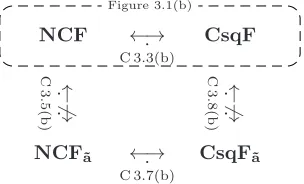
Kline and Luckraz 201617 (henceforth “KL16”) develop this equivalence by a pair of theorems. In recognition of the above authors, they call specification-[i] forms “KS forms” and call specification-[ii] forms “OR forms”. Then, one of their theorems (their Theorem 2) shows that a KS form can be derived from each OR form, while the other theorem (their Theorem 1) shows that each KS form can be mapped to an OR form.18 These two theorems are depicted by the two arrows in Figure 3.1(a). The arrows are dashed to convey that the equivalence is ad hoc.
KS OR
NCF CsqF
L99 99K
KL16 KL16
T2 T1
←−. −→.
⊇ T3.2(b) C3.3(b)
(a)
(b)
Figure 3.1. (a) The ad hoc equivalence of Kline and Luckraz 2016 (KL16). (b) The isomorphic equivalence of Corollary 3.3(b). T = Theorem. C = Corollary.
16Theorems 3.2 and 4.2 draw upon Lemmas A.14 and A.15. These nontrivial lemmas show
how to construct isomorphisms inNCPandNCFfrom bijections for nodes, choices, and players. These lemmas appear to have application beyond this paper.
17The terms “choice”, “action”, and “alternative” are fundamentally synonymous. However,
the literature tends to use “choice” when it is assumed that information sets do not share alter-natives, and conversely, to use “action” when the assumption is relaxed. The assumption itself is insubstantial in the sense that one can always introduce more alternatives until each information set has its own alternatives (see S5 Section 5.2, first paragraph, for more discussion). This pa-per makes the assumption for notational convenience, and correspondingly, uses “choice” (see SP Proposition 3.2(16b) and the paragraphs beforehand). In contrast, KL16 relaxes the assumption and uses “action”.
3. The Subcategory of Choice-Sequence Forms 13
Corollary 3.3(b) develops the equivalence further. Specification-[i] forms are written as NCF forms, and specification-[ii] forms are written as CsqF forms. Corollary 3.3(b) is then a pair of results: one half (the very easy half) shows that anNCFform is isomorphic to eachCsqFform, while the other half (Theorem 3.2) shows that each NCF form is isomorphic to aCsqF form. Thus the corollary’s isomorphic equivalence strengthens the KL16 equivalence by introducing isomor-phisms.
There are further senses in which the corollary’s isomorphic equivalence accords with the KL16 equivalence. In the backward direction, KL16 Theorem 2 is appeal-ing because the nodes in the constructed KS form are identical to the sequences in the given OR form. This is possible because KS nodes admit OR sequences as special cases. Nonetheless KL16 Theorem 2 is nontrivial because KS forms do not admit OR forms as special cases. Here the analogous result is cleaner: NCF
forms have been defined so that NCFforms admit CsqF forms as special cases. In the forward direction, KL16 Theorem 1 is made appealing by KL16 Lemma 2, which shows that there is a bijectionαfrom the “vertex histories” in the given KS form to the nodes in the constructed OR form. That bijection is closely related to Theorem 3.2’s bijection ¯τ, which maps from the nodes of the givenNCFform to the nodes in the constructedCsqFform.
3.3. More about No-absentmindedness
3.3.1. Proposition 3.4 describes a general situation in which one subcategory strictly isomorphically encloses another. In the proposition,wandsare two prop-erties defined for the objects ofZ. Further,w⇐6⇒smeans thatwis strictly weaker than s. In other words,w ⇐6⇒s means that [a] each object of Z satisfies w if it satisfiess, and [b] there is an object ofZ that satisfieswbut nots. Corollary 3.5 applies Proposition 3.4 to the nonvacuous property of no-absentmindedness.
Proposition 3.4. Supposew ands are properties defined for the objects ofZ, and that sis isomorphically invariant. Let Zw be the full subcategory of Z whose
objects satisfy w, and let Zs be the full subcategory of Z whose objects satisfy s.
Thenw⇐6⇒ simpliesZw ←. 6→. Zs. (Proof here.)
Proof. Supposew⇐6⇒s. To seeZw ←. Zs, take an object of Zs. Sincew⇐s, the object is also an object ofZw. Thus (trivially) the object is isomorphic to an object ofZw. To seeZw6→. Zs, note the assumptionw⇐6⇒simplies that there is an object ofZ that satisfiesw and violatess. Thus there is an object ofZw that violates s. Thus since s is isomorphically invariant, this object does not have an isomorph that satisfiess. Thus the object does not have an isomorph in Zs. ✷
Corollary 3.5. (a)NCP←. 6→. NCP˜a. (b)NCF←. 6→. NCF˜a. (Proof here.)
Proof. (a). Consider Proposition 3.4 at Z equal to NCP, when w is the vacuous property satisfied by all objects of NCP, and s is the property of no-absentmindedness. No-absentmindedness is invariant by Proposition 2.8(a). Fur-ther the vacuous property is strictly weaker than no-absentmindedness because there exists an absentminded preform (recall note 11). Thus Proposition 3.4 im-plies that NCPw =NCPstrictly isomorphically encloses NCPs =NCP˜a. (b).
This is very similar to (a). Change “preform” to “form”, Pto F, and (a) to (b).
14 3. The Subcategory of Choice-Sequence Forms
To better interpret Corollary 3.5, recall Theorem 3.2(b) which states NCF→.
CsqF. Formally, this means eachNCFform is isomorphic to aCsqF form. This can be interpreted to mean that the property of having choice-sequence nodes is not “restrictive”. In contrast, Corollary 3.5(b) impliesNCF6→. NCF˜a. Formally,
this means there is at least one NCF form (such as the one in note 11) that is not isomorphic to an NCF˜a form. This can be interpreted to mean that the
property of no-absentmindedness is “restrictive”. Informally, the first result states that choice-sequence-ness is “purely notational”. In contrast, the second result states that no-absentmindedness is “substantial”, “significant”, and “real”, and that it “limits the range of decision processes and social interactions that can be modelled”. The categorical concept of isomorphic enclosure (→. ) serves to formalize and to standardize these important terms. Note that both an isomorphic enclosure, and the negation of an isomorphic enclosure, are meaningful.
3.3.2. Next, Proposition 3.6 shows that an isomorphic enclosure can be restricted by any isomorphically invariant property. Corollary 3.7 uses this result to restrict Corollary 3.3 by no-absentmindedness. Corollary 3.7 will in turn be used in the remarkably quick proof of Corollary 4.3.
Proposition 3.6. Suppose thatAandBare full subcategories ofZ, and thatw is an isomorphically invariant property defined for the objects ofZ. LetAw be the full subcategory ofA whose objects satisfyw, and let Bw be the full subcategory of
B whose objects satisfyw. Then A→. B impliesAw →. Bw. (Proof here.)
Proof. SupposeA →. B. To showAw →. Bw, take an object ofAw. Then [1] the object is an object of A and [2] the object satisfies w. By [1] and A →. B, the object has an isomorph in B. By [2] and the isomorphic invariance ofw, the isomorph satisfiesw. The conclusions of the previous two sentences imply that the
isomorph is inBw. ✷
Corollary 3.7. (a)NCP˜a↔. CsqP˜a. (b)NCF˜a↔. CsqF˜a. (Proof here.)
Proof. (a) follows from Corollary 3.3(a), Proposition 3.6, and Proposition 2.8(a).
(b) is very similar to (a). Just change (a) to (b). ✷
NCF ←→. C 3.3(b)
CsqF
←
.
6→
.
C
3
.5
(b
)
←
.
6→
.
C
3
.8
(b
)
NCF˜a ←→.
C 3.7(b)
CsqF˜a
Figure 3.1(b)
Figure 3.2. Half of the previous figure, augmented with some results about no-absentmindedness. C = Corollary.
3.3.3. Finally, Corollary 3.8 could be proved by mimicking the proof of Corol-lary 3.5, in which case Proposition 3.4 would be employed once for part (a) atZ
[image:15.612.232.384.520.612.2]4. The Subcategory of Choice-Set Forms 15
composing isomorphic enclosures (note 15), and the proof of the corollary’s part (b) is illustrated by Figure 3.2. Both proof techniques are straightforward, and a more interesting example of composition will soon appear in the proof of Corollary 4.3.
Corollary 3.8. (a)CsqP←. 6→. CsqP˜a. (b) CsqF←.6→. CsqF˜a. (Proof here.)
Proof. (a). This is very similar to (b). ChangeFtoP, and (b) to (a). (b). To see
CsqF←. CsqF˜a, note that CsqF←. NCF←. NCF˜a ←. CsqF˜a by, respectively,
Corollary 3.3(b), Corollary 3.5(b), and Corollary 3.7(b). To seeCsqF6→. CsqF˜a,
suppose it were. ThenNCF→. CsqF→. CsqF˜a→. NCF˜aby, respectively,
Corol-lary 3.3(b), the supposition of the previous sentence, and CorolCorol-lary 3.7(b). This
contradicts Corollary 3.5(b), which states thatNCF6→. NCF˜a. ✷
4. The Subcategory of Choice-Set Forms
4.1. Objects
Let achoice-setNCPpreform be anNCPpreform (T, C,⊗) such that [Cset1] T is a collection of finite sets which contains{}and
[Cset2] (∀(t, c, t♯)∈⊗gr)t∪{c}=t♯.
Then letCsetPbe the full subcategory ofNCPwhose objects are choice-setNCP
preforms. Proposition 4.1 lists some of the special properties ofCsetPpreforms.19 Incidentally, property (f) and assumption [Cset1] together imply that each node in aCsetPpreform is actually a choice set, in accord with the terminology. More sig-nificantly, property (g) shows that everyCsetPpreform has no-absentmindedness. In this sense the combination of [Cset1] and [Cset2] is restrictive.
Proposition 4.1. Suppose(T, C,⊗)is aCsetP preform with itsF,to,p,q,k, ≺,4, andH. Then the following hold.
(a)to={}.
(b)(∀t♯∈Tr{{}}) q(t♯)∈/ p(t♯) andp(t♯)∪{q(t♯)}=t♯.
(c)(∀t∈T) k(t) =|t|.
(d)(∀t∈T, m∈{0,1, ...|t|})pm(t)⊆tand trpm(t) ={q◦pn(t)|m>n≥0}.
(e)(∀t∈T) t={q◦pn(t)| |t|>n≥0}.
(f )C=∪T.
(g)(T, C,⊗)has no-absentmindedness.
(h)(∀t∈T, H∈H)|t∩F(H)| ≤1.
(i)(∀tA∈T, tB∈T)tA ⊆tB impliestA=p|tB|−|tA| (tB).
(j)(∀tA∈T, tB∈T)tA ≺tB ifftA ⊂tB.
(k)(∀tA∈T, tB∈T) tA 4tB ifftA ⊆tB.
(l)⊗gr ={(t, c, t♯)∈T×C×T | c /∈t, t∪{c}=t♯ }.20
(m)Fgr={ (t, c)∈T×C |c /∈t, t∪{c}∈T }. (Proof C.2.)
Finally, let achoice-setNCFform be anNCFform whose preform is aCsetP
preform. Then letCsetFbe the full subcategory ofNCFwhose objects are choice-setNCFforms.
19Almost everyCsetPproperty in Proposition 4.1 has aCsqPanalog in Proposition 3.1. The
properties are merely presented in different orders because they are proved in different orders. The exceptions are that properties (g)–(i) have noCsqPanalogs in Proposition 3.1.
20Lemma C.1 shows the following are equivalent: [a]c /∈tandt∪{c}=t♯. [b]t6=t♯andt∪{c}=t♯.
16 4. The Subcategory of Choice-Set Forms
4.2. Isomorphic Enclosure
Theorem 4.2. (a) CsqP˜a →. CsetP. In particular, suppose Π¯ = ( ¯T,C,¯ ⊗)¯
is a CsqP˜a preform. Define T =R( ¯T), and define ⊗ by surjectivity and ⊗gr =
{(R(¯t),¯c, R(¯t♯))|(¯t,¯c,t¯♯)∈⊗¯gr}. ThenΠ= (T,C,¯ ⊗)is aCsetPpreform,R| ¯ T is a
bijection, and[ ¯Π, Π, R|T¯,idC¯]is anNCPisomorphism. (b)CsqF˜a →. CsetF. In
particular, suppose Φ¯= ( ¯I,T,¯ ( ¯C¯i)¯i∈I¯,⊗)¯ is a CsqF˜a form. DefineT and ⊗as in
part (a). Then Φ= ( ¯I, T,( ¯C¯i)¯i∈I¯,⊗)is aCsetFform and [ ¯Φ, Φ,idI¯, R|T¯,id∪¯i∈I¯C¯¯i]
is anNCFisomorphism. (Proof C.3.)
Corollary 4.3. (a)CsqP˜a ↔. CsetP. (b)CsqF˜a ↔. CsetF. (Proof here.)
Proof. (a). This is very similar to (b). Change “form” to “preform”, F to P, (b) to (a), and the last phrase to “because it has no-absentmindedness by Propo-sition 4.1(g)”.
(b). Theorem 4.2(b) showsCsqF˜a→. CsetF. Thus it remains to showCsqF˜a←. CsetF. Since isomorphic enclosures can be composed, it suffices to show [1]CsetF
→. NCF˜aand [2]NCF˜a→. CsqF˜a. [2] is the forward direction of Corollary 3.7(b).
[1] holds simply because anyCsetFform is aNCF˜aform. To see this, take aCsetF
form. It is anNCFform by construction. It has no-absentmindedness because its
preform has no-absentmindedness by Proposition 4.1(g). ✷
OR¯a S5cs
NCF ←→. C3.3(b)
CsqF
←
.
6→
.
C
3
.5
(b
)
←
.
6→
.
C
3
.8
(b
)
NCF˜a ←→.
C3.7(b)
CsqF˜a CsetF L99 99K
S5 S5
T3.2 T3.1
←−. −→. easy T4.2(b)
[image:17.612.180.427.373.526.2]C4.3(b)
Figure 3.2
.
⊇([1] in C4.3(b)’s proof)
(a)
(b)
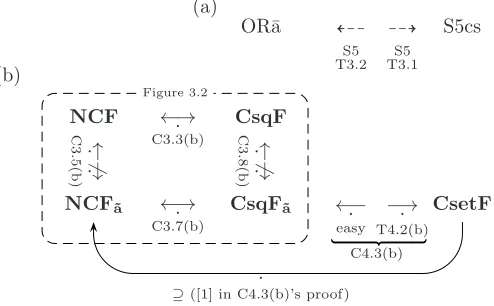
Figure 4.1. (a) An ad hoc equivalence from S5. (b) The previous figure, augmented with Corollary 4.3(b) and its proof. T = Theorem. C = Corollary.
Corollary 4.3(b) is analogous to an ad hoc style equivalence in S5. There, a pair of results argues that no-absentminded OR forms (“OR¯a forms” in this subsection) are equivalent to S5-choice-set forms (“S5cs forms” in this subsection). One of the results (S5 Theorem 3.2) shows that an OR¯a form can be reasonably derived from each S5cs form, and the other result (S5 Theorem 3.1) shows that each OR¯a form can be reasonably mapped to an S5cs form. These two theorems are depicted by the two dashed arrows in Figure 4.1(a).
Corollary 4.3(b) strengthens this equivalence. CsqF˜aforms are like OR¯a forms
4. The Subcategory of Choice-Set Forms 17
equivalence is a matching pair of results: one half (labelled “easy” in Figure 4.1(b)) shows that a CsqF˜aform is isomorphic to eachCsetFform, while the other half
(Theorem 4.2) shows that eachCsqF˜aform is isomorphic to a CsetFform. Thus
Corollary 4.3(b) strengthens the S5 equivalence by introducing isomorphisms.21 Corollary 4.3(b)’s proof highlights how useful it is to compose isomorphic en-closures. In particular, consider the reverse direction of Corollary 4.3(b), which is
CsqF˜a ←. CsetFin Figure 4.1(b), and compare it with S5 Theorem 3.2, which is
OR¯a L99 S5cs in Figure 4.1(a). The lemmas and proof for S5 Theorem 3.2 span
six difficult pages. In contrast, the reverse direction of Corollary 4.3(b) is proved in six lines by composing an easily-proved enclosure (CsetF→. NCF˜a in part [1]
of proof) with a previously-proved enclosure (NCF˜a→. CsqF˜a from the forward
half of Corollary 3.7(b)). Figure 4.1(b) shows this composition as the curved arrow followed by the forward direction of Corollary 3.7(b).
4.3. More about Perfect-Information
Corollaries 4.4 and 4.5 are additional applications of Section 3.3’s general propo-sitions using isomorphic invariance.
Corollary 4.4. (a)NCP˜a←. 6→. NCPp. (b)NCF˜a←.6→. NCFp. (Proof here.)
Proof. (a). Consider Proposition 3.4 atZ equal toNCP, whenwis the prop-erty of no-absentmindedness ˜a, and s is the property of perfect-information p. Perfect-information is isomorphically invariant by Proposition 2.9(a). Further no-absentmindedness is strictly weaker than perfect-information by notes 12 and 13. Thus Proposition 3.4 implies that NCP˜a strictly isomorphically encloses NCPp.
(b). This is very similar to (a). ChangePtoF, and (a) to (b). ✷
Corollary 4.5. (a) NCPp ↔. CsqPp ↔. CsetPp. (b)NCFp ↔. CsqFp ↔.
CsetFp. (Proof here.)
Proof. (a). Corollary 3.7(a) and Corollary 4.3(a) imply NCP˜a ↔. CsqP˜a ↔. CsetP. Thus, Propositions 3.6 and 2.9(a) imply that NCP˜ap ↔. CsqP˜ap ↔. CsetPp, whereNCP˜apis the full subcategory ofNCPconsisting of those objects
that satisfy both no-absentmindedness and perfect-information, and where similarly
CsqP˜ap is the full subcategory of CsqP consisting of those objects that satisfy
both no-absentmindedness and perfect-information. Since no-absentmindedness is weaker than perfect-information (note 12), NCP˜ap = NCPp and CsqP˜ap = CsqPp. (b). This is very similar to (a). ChangePtoF, and (a) to (b). ✷
Incidentally, since isomorphic equivalence implies categorical equivalence, Corol-lary 4.5(a) impliesNCPp,CsqPp, andCsetPpare categorically equivalent. Fur-ther, SP Theorem 3.13 and Corollary 3.14 show thatNCPp,Tree, andGrphcaare categorically equivalent, where Tree is the category of functioned trees which SP uses in its development ofNCP, and whereGrphcais the full subcategory ofGrph
whose objects are converging arborescences. Thus,NCPp,CsqPp,CsetPp,Tree, andGrphcaare categorically equivalent.
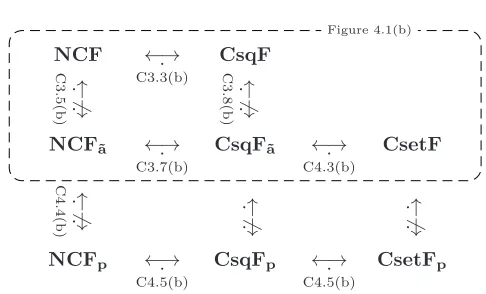
Figure 4.2’s arrow diagram illustrates most of the isomorphic-enclosure results from Sections 3.2 and following. In addition, the diagram has some unlabelled
21There is also another sense in which Corollary 4.3(b) accords with the S5 equivalence. The
18 4. The Subcategory of Choice-Set Forms
NCF ←→. C3.3(b) CsqF ← . 6→ . C 3 .5 (b ) ← . 6→ . C 3 .8 (b )
NCF˜a ←→.
C3.7(b)
CsqF˜a ←→.
C4.3(b) CsetF ← . 6→ . C 4 .4 (b ) ← . 6→ . ← . 6→ .
NCFp ←→. C4.5(b)
CsqFp ←→. C4.5(b)
CsetFp
Figure 4.1(b)
Figure 4.2. Most of the previous figure, augmented with some results about perfect-information. C = Corollary.
arrows. They are derived by composing arrows as in the proof of Corollary 3.8. Many diagonal arrows could be similarly derived.
5. Further Remarks
5.1. Deducing consequences from an isomorphic enclosure
Consider this paper’s first isomorphic enclosure. Theorem 3.2 shows that each
NCFformΦis isomorphic to aCsqFform ¯Φby means of an isomorphism which transforms nodes via the bijection ¯τ. Proposition 2.6 deduces many consequences from such an isomorphism. For example, its part (o) implies that (∀t1∈T, t2∈T)
t1 ≺t2 iff ¯τ(t1) ¯≺τ¯(t2), where T is the node set of Φ,≺is derived fromΦ, and ¯≺ is derived from ¯Φ. Although such consequences about form derivatives like≺and
¯
≺ are tantalizingly natural, the consequences about form derivatives in Proposi-tion 2.6(f)–(r) take about 10 pages to prove. That work is important because such consequences are fundamental to drawing more conclusions from the isomorphic enclosure ofNCFinCsqF.
As Section 3.2 explained, the isomorphic enclosure ofNCFinCsqFis analogous to KL16 Theorem 1. No consequences about form derivatives have been deduced from that ad hoc theorem, and an analog of Proposition 2.6(f)–(r) would likely require about 10 pages to prove. Moreover, like KL16 Theorem 1, no consequences about form derivatives have been deduced from KL16 Theorem 2 or from S5 The-orems 3.1 and 3.2. Each of these ad hoc theThe-orems has its own formulation, so deriving analogs of Proposition 2.6(f)–(r) for the three of them would likely require another 3×10 = 30 pages.
In contrast, Proposition 2.6(f)–(r) applies not only to the isomorphic enclosure of NCFin CsqF. It applies to any isomorphic enclosure. Thus it applies to all the arrows in Figure 4.2, as well as to all isomorphic enclosures in the future.
5.2. Future research
[image:19.612.183.426.106.253.2]Appendix A.NCF 19
basis of these isomorphic enclosures, Proposition 2.6(f)–(r) (discussed just above) can be seen as a way of translating form derivatives from one style to another.
The
5. Further Remarks
results of this paper wait to be expanded in three orthogonal directions. [1] There is more to translate beyond forms and their derivatives. This would include properties that forms might satisfy, and theorems that might relate these properties to one another. (This paper makes some limited progress in this direction by exploring the isomorphically invariant properties of no-absentmindedness and perfect-information, and by identifying some special properties ofCsqFforms and
CsetF forms via Propositions 3.1 and 4.1.) Expanding in this direction would correspond to expanding the three substantive sections of this paper.
[2] This paper concerns only three styles: NCF,CsqF, and CsetF. There are other styles to explore, including the two neglected styles mentioned at the start of this paper, namely, the “node-set” style of Al´os-Ferrer and Ritzberger 2016 Section 6.3, and the “outcome-set” style of von Neumann and Morgenstern 1944 and Al´ os-Ferrer and Ritzberger 2016 Section 6.2. Expanding in this direction will require defining new NCF subcategories for “node-set” forms and “outcome-set” forms, and will correspond to adding, to the present paper, two new sections for the two new subcategories.
[3] This paper concerns only forms, which need to be augmented with preferences in order to define games. At the higher level of games, many more issues emerge. To return to [1], there is more to translate, including equilibrium concepts and the theorems which might relate one equilibrium concept to another. To return to [2], there will be more than five specifications because there are alternative ways to specify preferences over the same form. Expanding in this third direction will require building a new category for games that incorporates this paper’s category for forms.
Appendix A. NCF
Lemma A.1. Suppose(T, C,⊗) is anNCP preform with its F,to,p,q, and H. Then the following hold.
(a)|T| ≥2,|C| ≥1,|⊗gr| ≥ 1.
(b)(∀H∈H, c∈C) c∈ F(H)iffF−1(c) =H.
(c)(∀H∈H, t♯∈Tr{to})q(t♯)∈F(H)iff p(t♯)∈H.
Proof. (a). In the paragraph after SP equation (1), remark [ii] shows that (/∃t∈T)
p(t) =t. Thus, since pis nonempty by [T1], there are distinctt1 ∈T andt2∈T such thatt1=p(t2). Thus, by the definition ofpin [P2], there isc ∈C such that (t1, c, t2)∈ ⊗gr.
(b). (Forward direction). Suppose [a] c ∈C, [b] H ∈ H, and [c] c∈F(H). [c] implies there is [d] t ∈H such that [e] c∈F(t). [e] implies [f] t∈F−1(c). Meanwhile, [a] and [P3] imply [g] F−1(c)∈ H. Since His a partition by [P3], [b] and [g] imply H andF−1(c) are elements of the same partition. Hence [d] and [f] implyH =F−1(c).
(Reverse direction). Suppose c∈C, [a] H ∈ H, and [b] F−1(c) = H. Since
H belongs to a partition by [a] and [P3], there is [c] t ∈H. [c] and [b] implies