Proceedings of the 57th Annual Meeting of the Association for Computational Linguistics, pages 2002–2012 2002
Enhancing Topic-to-Essay Generation with External Commonsense
Knowledge
Pengcheng Yang1,2∗, Lei Li3∗, Fuli Luo2, Tianyu Liu2, Xu Sun1,2 1Deep Learning Lab, Beijing Institute of Big Data Research, Peking University 2MOE Key Lab of Computational Linguistics, School of EECS, Peking University
3School of Computer Science and Technology, Xidian University {yang pc, luofuli, tianyu0421, xusun}@pku.edu.cn, [email protected]
Abstract
Automatic topic-to-essay generation is a chal-lenging task since it requires generating novel, diverse, and topic-consistent paragraph-level text with a set of topics as input. Previous work tends to perform essay generation based solely on the given topics while ignoring mas-sive commonsense knowledge. However, this commonsense knowledge provides additional background information, which can help to generate essays that are more novel and di-verse. Towards filling this gap, we propose to integrate commonsense from the external knowledge base into the generator through dy-namic memory mechanism. Besides, the ad-versarial training based on a multi-label dis-criminator is employed to further improve topic-consistency. We also develop a series of automatic evaluation metrics to comprehen-sively assess the quality of the generated es-say. Experiments show that with external com-monsense knowledge and adversarial training, the generated essays are more novel, diverse, and topic-consistent than existing methods in terms of both automatic and human evaluation.
1 Introduction
Automatic topic-to-essay generation (TEG) aims at generating novel, diverse, and topic-consistent paragraph-level text given a set of topics. It not only has plenty of practical applications, e.g., benefiting intelligent education or assisting in keyword-based news writing (Lepp¨anen et al., 2017), but also serves as an ideal testbed for con-trollable text generation (Wang and Wan,2018).
Despite its wide applications described above, the progress in the TEG task lags behind other generation tasks such as machine translation (Bah-danau et al., 2014) or text summarization (Rush et al.,2015).Feng et al.(2018) are the first to pro-pose the TEG task and they utilize coverage vector
∗Equal Contribution.
[image:1.595.306.527.225.361.2]
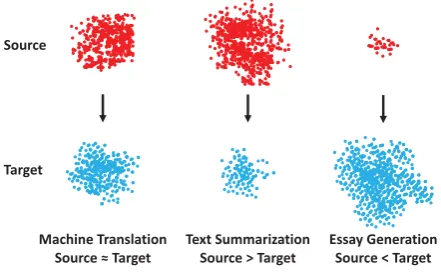
Figure 1: Toy illustration of the information volume on three different text generation tasks, which shows that the source information is extremely insufficient com-pared to the target output on the TEG task.
to incorporate topic information for essay genera-tion. However, the model performance is not sat-isfactory. The generated essays not only lack nov-elty and diversity, but also suffer from poor topic-consistency. One main reason is that the source information is extremely insufficient compared to the target output on the TEG task. We summarize the comparison of information flow between the TEG task and other generation tasks in Figure1. In machine translation and text summarization, the source input provides enough semantic informa-tion to generate the desired target text. However, the TEG task aims to generate paragraph-level text based solely on several given topics. Extremely in-sufficient source information is likely to make the generated essays of low quality, both in terms of novelty and topic-consistency.
im-OutputEssay:
Ourlifeisamovement,ajourney,anadventure towardsagoal. Areyounearertoyourportofgoal todaythanyouwereyesterday?Sinceyourshipwas firstsailedupontheseaoflife,youhavenever beenstillforasinglemoment. Theseaistoodeep, youcouldnotfindananchorifyouwould,andthere canbenopauseuntilyoucomeintoport.
Commonsense Knowledge
InputTopics life port sea
port [LocateAt]ship
sea [UsedFor] sailaship
sea [Property ]deep
life adventure
journey
[IsA]
life [IsA]
goal life [HasA]
Input
[image:2.595.75.526.61.149.2]Memory
Figure 2: Incorporate commonsense knowledge into topic-to-essay generation via the dynamic memory mecha-nism. The dashed line indicates that the memory is dynamically updated.
prove the quality of the generated essay. Figure2 intuitively shows an example. For the given topic “life”, some closely related concepts (e.g. “adven-ture”, “journey”, “goal”) are connected as a graph structure inConceptNet1. These related concepts are an important part of the skeleton of the es-say, which provides additional key information for the generation. Therefore, such external common-sense knowledge can contribute to generating es-says that are more novel and diverse. More specif-ically, this commonsense knowledge is integrated into the generator through the dynamic memory mechanism. In the decoding phase, the model can attend to the most informative memory concepts for each word. At the same time, the memory ma-trix is dynamically updated to incorporate infor-mation of the generated text. This interaction be-tween the memory and the generated text can con-tribute to the coherent transition of topics. To en-hance the topic-consistency, we adopt adversarial training based on a multi-label discriminator. The discriminative signal can comprehensively evalu-ate the coverage of the output on the given top-ics, making the generated essays more closely sur-round the semantics of all input topics.
The main contributions of this paper are sum-marized as follows:
• We propose a memory-augmented neural
model with adversarial training to integrate external commonsense knowledge into topic-to-essay generation.
• We develop a series of automatic evaluation metrics to comprehensively assess the quality of the generated essay.
• Experiments show that our approach can out-perform existing methods by a large margin. With the help of commonsense knowledge and adversarial training, the generated essays are more novel, diverse, and topic-consistent.
1
A large-scale commonsense knowledge base.
Label Distribution Multi-Label
Discriminator
Memory-Augmented Generator
Our life is a movement, a journey ...
Generated Essay ..
. . .
Topics
Generated Text Binary Cross
Entropy Loss Reward-Based Objective
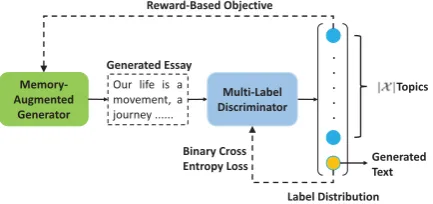
Figure 3: The sketch of our proposed model and adver-sarial training.
2 Proposed Model
Given a topic sequencexcontainingmtopics, the TEG task aims to generate a topic-consistent essay ycontainingnwords, wherenis much larger than m. Figure3 presents a sketch of our model and training process. The proposed model consists of a memory-augmented generator and a multi-label discriminator. We adopt adversarial training to al-ternately train the generator and the discriminator.
2.1 Memory-Augmented Generator
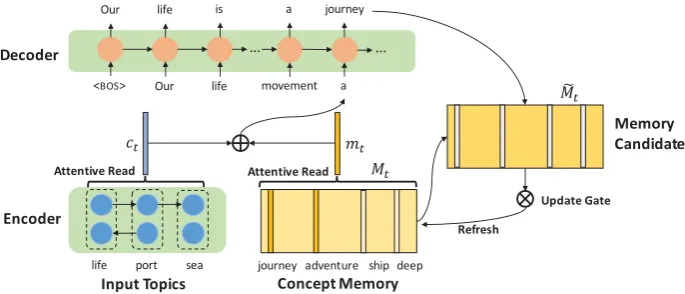
The memory-augmented generatorGθis responsi-ble for generating the desired essayyconditioned on the input topics x. Figure 4 illustrates the overview ofGθ, which consists of an encoder and a decoder with the memory mechanism.
Encoder: Here we implement the encoder as
an LSTM (Hochreiter and Schmidhuber, 1997)
model, which aims to integrate topic information. It reads the input topic sequencexfrom both di-rections and computes hidden states for each topic,
− →
hi=−−−−→LSTM(−→hi−1, e(xi)) (1) ←−
hi=←−−−−LSTM(←−hi+1, e(xi)) (2)
wheree(xi)is embedding ofxi. The final hidden representation of thei-th topic ishi = [−→hi;←h−i], where semicolon represents vector concatenation.
[image:2.595.309.526.199.301.2]
[image:3.595.129.472.63.210.2]
Figure 4: The overview of our memory-augmented generatorGθ. At time-stept, the decoder attends to the concept memory and topic representations to generate a new word. In addition, the memory matrix is dynamically updated via the adaptive gate mechanism.
generate essays that are more novel and diverse. Therefore, we equip the decoder with a memory mechanism to effectively incorporate
common-sense knowledge fromConceptNet.ConceptNetis
a semantic network which consists of triplesR= (h;r;t)meaning that head concepthhas the rela-tionrwith tail conceptt. Since the commonsense knowledge of each topic can be represented by its neighboring concepts in the knowledge base, we use each topic as the query to retrieve k neigh-boring concepts. The pre-trained embeddings of these concepts are stored as commonsense
knowl-edge in a memory matrix M0 ∈ Rd×mk, where
dis the dimension of the embedding vector.2 In the decoding phase, the generatorGθ refers to the memory matrix for text generation. Specially, the hidden statestof the decoder at time-steptis:
st= LSTMst−1,[e(yt−1);ct;mt] (3)
where [e(yt−1);ct;mt] means the concatenation of vectors e(yt−1), ct, andmt. yt−1 is the word generated at time-stept−1.ctis the context vec-tor that is computed by integrating the hidden rep-resentations of the input topic sequence,
et,i =f(st−1, hi) (4)
αt,i = mexp(et,i)
j=1exp(et,j)
(5)
ct=
m
i=1
αt,ihi (6)
2
In practice, the number of columns inM0is fixed toK. Supposing there are minput topics, then each topic is as-signed[K/m]concepts. For special cases where the concept is insufficient, the pre-trained word2vec embeddings are used as an alternative.
wheref(st−1, hi)is an aligned model (Bahdanau et al.,2014), which measures the dependency be-tweenst−1andhi.
mt in Eq. (3) is the memory vector extracted fromMt, which aims to encode the commonsense knowledge to assist in essay generation. Inspired by Sukhbaatar et al.(2015), we use the attention
mechanism to find the rows inMt that are most
relevant to the output. Formally,
vt= tanh(Wst−1+b) (7)
qt= softmax(vtTMt) (8)
mt=
i
qtiMit (9)
whereWandbare weight parameters. Mitis the i-th column ofMtandqitis thei-th value ofqt.
Dynamic Memory: As the generation pro-gresses, the topic information that needs to be ex-pressed keeps changing, which requires the mem-ory matrix to be dynamically updated. In addition, the dynamic memory mechanism enables the in-teraction between the memory and the generated text, which contributes to the coherent transition of topics in the generated essay. Concretely, for each memory entryMitinMt, we first compute a candidate update memoryMit,
Mi
t= tanh
U1Mit+V1e(yt)
(10)
where U1 andV1 are trainable parameters. In-spired by Highway network (Srivastava et al., 2015), we adopt the adaptive gate mechanism to determine how much thei-th memory entry should be updated,
Algorithm 1Adversarial training algorithm. Require: the memory-augmented generatorGθ; multi-label
discriminatorDφ; the training corpusS={(x,y)} 1: InitializeGθ,Dφwith random weightsθ, φ. 2: Pre-trainGθusing MLE onS
3: Generate negative samples usingGθ
4: Pre-trainDφvia minimizing Eq. (18)
5: repeat
6: forg-stepsdo
7: Generate a sequencey= (y1, . . . , yn)∼Gθ
8: fortin1 : (n−1)do
9: Computer(y1:t, yt+1)by Eq. (16) 10: end for
11: Calculate the gradient∇θJ(θ)by Eq. (15)
12: Update generator parameters 13: end for
14: ford-stepsdo
15: Generate negative examples usingGθ
16: Train discriminatorDφvia minimizing Eq. (18) 17: end for
18: untilConverges
whereU2andV2are learnable parameters.Mitis eventually updated to
Mi
t+1=1−gti
Mi
t+gitMit (12)
where 1 refers to the vector with all elements 1 anddenotes pointwise multiplication.
2.2 Multi-Label Discriminator
The discriminator Dφ is introduced to evaluate topic-consistency between the input topics and the generated essay, which further improves the text quality. Since the source input contains a vari-able number of topics, here we implementDφ as a multi-label classifier to distinguish between the real text with several topics and the generated text. In detail, suppose there are a total of|X |topics, the discriminator produces a sigmoid probability dis-tribution over(|X |+ 1)classes. The score at the i-th(i∈ {1,· · ·,|X |})index represents the prob-ability that it belongs to the real text with thei-th topic, and the score at the(|X |+ 1)-th index rep-resents the probability that the sample is the gen-erated text. Here we implement the discriminator Dφas a CNN (Kim,2014) binary classifier.
2.3 Adversarial Training
Inspired by SeqGAN (Yu et al., 2017), here
we adopt the adversarial training. We train the
memory-augmented generatorGθ via policy
gra-dient method (Williams,1992). Our generatorGθ can be viewed as an agent, whose state at time-step t is the current generated words y1:t−1 = (y1,· · ·, yt−1) and theactionis the prediction of the next word yt. Once the reward r(y1:t−1, yt)
based on both state y1:t−1 and action yt is ob-served, the training objective of the generatorGθ is to minimize the negative expected reward,
J(θ) =−Ey∼Gθ[r(y)] (13)
=−
n−1
t=1
Gθ(yt+1|y1:t)·r(y1:t, yt+1) (14)
whereGθ(yt+1|yt)means the probability that se-lects the wordyt+1 based on the previous gener-ated words. Applying the likelihood ratios trick and sampling method, we can build an unbiased estimation for the gradient ofJ(θ),
∇θJ(θ)≈ − n−1
t=1
∇θlogGθ(yt+1|y1:t)
·r(y1:t, yt+1)
(15)
where yt+1 is the sampled word. Since the dis-criminator can only evaluate a complete sequence, here Monte Carlo Search with roll-out policyGθ is applied to sample the unknownn−twords. The final reward function is computed as :
r(y1:t−1, yt) = ⎧ ⎪ ⎨ ⎪ ⎩ 1 N
N
i=1D(y
n
1:t) t < n
D(y1:n) t=n
(16)
where N is the number of searches, y1:tn is the sampled complete sequence based on the roll-out policyGθandstatey1:t, andD(y)is defined as:
D(y) = 1 m
m
i=1
Dφ(xi|y) (17)
whereDφ(xi|y)denotes the probability predicted byDφ that the completed sequencey belongs to topicxi. D(y)can be treated as a measure of the coverage of the input topics by the output. A high D(y) requires the generated essay to closely sur-round the semantics of all input topic words.
The discriminator is trained to predict all true topics by minimizing binary cross entropy loss3,
J(φ) =−
|X |+1
i=1
xilogDφ(xi|y)
+ (1−xi)log1−Dφ(xi|y) (18)
We alternately train the generator Gθ and the discriminator Dφ. An overview of the training process is summarized in Algorithm1.
3
When calculating binary cross entropy loss, we convert
3 Experiments
In this section, we introduce the dataset, evalua-tion metrics, all baselines, and settings in detail.
3.1 Datasets
We conduct experiments on the ZHIHU cor-pus (Feng et al., 2018). It consists of Chinese essays whose length is between 50 and 100. We select topic words based on the frequency and re-move the rare topic words. The total number of labels are set to 100. Sizes of the training set and the test set are 27,000 and 2500. For tuning hyper-parameters, we set aside 10% of training samples as the validation set.
3.2 Settings
We tune hyper-parameters on the validation set. We use the 200-dim pre-trained word embeddings
provided by Song et al. (2018). The vocabulary
size is 50,000 and batch size is 64. We use a sin-gle layer of LSTM with hidden size 512 for both encoder and decoder. We pre-train our model for 80 epochs with the MLE method. The optimizer is Adam (Kingma and Ba,2014) with10−3 learn-ing rate for pre-trainlearn-ing and10−5 for adversarial training. Besides, we make use of the dropout method (Srivastava et al., 2014) to avoid overfit-ting and clip the gradients (Pascanu et al., 2013) to the maximum norm of 10.
3.3 Baselines
We adopt the following competitive baselines:
SC-LSTM(Wen et al.,2015) uses gating mech-anism to control the flow of topic information.
PNN(Wang et al.,2016) applies planning based neural network to generate topic-consistent text.
MTA(Feng et al.,2018) utilizes coverage vec-tors to integrate topic information. Their work also includes:TAVrepresenting topic semantics as the average of all topic embeddings andTATapplying attention mechanism to select the relevant topics.
CVAE (Yang et al., 2018b) presents a
condi-tional variacondi-tional auto-encoder with a hybrid de-coder to learn topic via latent variables.
Plan&Write(Yao et al.,2018) proposes a plan-and-write framework with two planning strategies to improve diversity and coherence.
3.4 Evaluation Metrics
In this paper, we adopt two evaluation methods: automatic evaluation and human evaluation.
3.4.1 Automatic Evaluation
The automatic evaluation of TEG remains an open and tricky question since the output is highly flexi-ble. Previous work (Feng et al.,2018) only adopts
BLEU (Papineni et al., 2002) score based on
n-gram overlap to perform evaluation. However, it is unreasonable to only use BLEU for evaluation be-cause TEG is an extremely flexible task. There are multiple ideal essays for a set of input topics. To remedy this, here we develop a series of evaluation metrics to comprehensively measure the quality of output from various aspects.
Consistency: An ideal essay should closely surround the semantics of all input topics. There-fore, we pre-train a multi-label classifier to evalu-ate topic-consistency of the output. Given the in-put topicsx, we define the topic-consistency of the generated essayyˆas:
Consistency(yˆ|x) =ϕ(x,xˆ) (19)
where ϕ is Jaccard similarity function and xˆ is topics predicted by a pre-trained multi-label clas-sifier. Here we adopt the SGM model proposed inYang et al.(2018a) to implement the pre-trained multi-label classifier.
Novelty: The novelty of the output can be re-flected by the difference between it and the train-ing texts. We calculate the novelty of each gener-ated essayyˆas:
N ovelty(yˆ|x) =1−max{ϕ(yˆ,y0)|
(x0,y0)∈ Cx} (20)
where ϕis Jaccard similarity function and Cx is composed of training samples whose correspond-ing labels are similar tox. Formally,
Cx ={(x0,y0)|ϕ(x,x0)> τ} (21)
whereτ is the set threshold.
Diversity: We also calculate the proportion of distinctn-grams in the generated essays to evalu-ate the diversity of the outputs.
In addition, the BLEU scores of different sys-tems are also reported for reference.
3.4.2 Human Evaluation
Methods BLEU Consistency Novelty Dist-1 Dist-2
SC-LSTM 5.73 1.98 66.51 0.20 0.69
PNN 5.91 11.25 59.52 1.73 6.92
TAV 6.05 16.59 70.32 2.69 14.25
TAT 6.32 9.19 68.77 2.25 12.17
MTA 7.09 25.73 70.68 2.24 11.70
CVAE 7.46 34.84* 71.28 3.72* 17.92*
Plan&Write 8.69* 32.91 72.17* 2.74 14.29
Proposal 9.72 39.42 75.71 5.19 20.49
[image:6.595.105.491.63.186.2]Impv-Best 11.85% 13.15% 4.91% 39.52% 14.34%
Table 1: Results of automatic evaluation. Dist-nevaluates the diversity of the output. The best performance is highlighted in bold and “*” indicates the best result achieved by the baselines.
in advance about which model the generated es-says come from. Then, they are required to score the generated essay from 1 to 5 in terms of four criteria: novelty, diversity, coherence, and topic-consistency. For novelty, we use the TF-IDF fea-ture to retrieve 10 most similar training samples to provide references for the annotators.
4 Results and Discussion
In this section, we report the experimental results. Besides, further analysis is also provided.
4.1 Experimental Results
The automatic evaluation results are shown in Ta-ble 1. Results show that our approach achieves the best performance in all metrics. For instance, the proposed model achieves 11.85% relative im-provement over the best baseline on BLEU score. It demonstrates the effectiveness of our approach in improving the quality of the generated essay. More importantly, in terms of novelty, diversity, and topic-consistency, our model can substantially outperform all baselines.
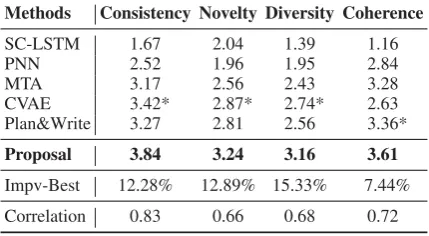
Table 2 presents the human evaluation results, from which we can draw similar conclusions. It is obvious that our approach can outperform the baselines by a large margin, especially in terms
of diversity and topic-consistency. For
exam-ple, the proposed model achieves improvements of 15.33% diversity score and 12.28% consistency score over the best baseline. The main reason for this increase in diversity is that we integrate com-monsense knowledge into the generator through the memory mechanism. This external common-sense knowledge provides additional background information, making the generated essays more novel and diverse. In addition, the adversarial training is employed to increase the coverage of
Methods Consistency Novelty Diversity Coherence
SC-LSTM 1.67 2.04 1.39 1.16
PNN 2.52 1.96 1.95 2.84
MTA 3.17 2.56 2.43 3.28
CVAE 3.42* 2.87* 2.74* 2.63
Plan&Write 3.27 2.81 2.56 3.36*
Proposal 3.84 3.24 3.16 3.61
Impv-Best 12.28% 12.89% 15.33% 7.44%
Correlation 0.83 0.66 0.68 0.72
Table 2: Results of human evaluation. The best perfor-mance is highlighted in bold and “*” indicates the best result achieved by baselines. We calculate the Pearson correlation to show the inter-annotator agreement.
the output on the target topics, which further en-hances the topic-consistency.
4.2 Ablation Study
To understand the importance of key components of our approach, here we perform an ablation study by training multiple ablated versions of our model: without adversarial training, without mem-ory mechanism, and without dynamic update. Ta-ble 3 and Table 4 present the automatic and hu-man evaluation results of the ablation study, re-spectively. Results show that all three ablation op-erations will result in a decrease in model perfor-mance. This indicates that both adversarial train-ing and dynamic memory mechanism can con-tribute to improving the quality of the output. However, an interesting finding is that the adver-sarial training and memory mechanism focus on improving different aspects of the model.
[image:6.595.309.524.241.359.2]Visualization of Memory Attention
I am a student major in in finance and I study
economics. I am not a freshman. I I have no special skills.I want to know what can I do to
enrich my knowledge and plan my future.I do not want to work work work after graduation.
Is there other choices, except for looking for a job job? I hope you can give me some advice,
thank you very very very much!
Output Essay:
Input Topics: Finance Career
“know” “knowledge”
“economics”
“major” “finance”
“plan”
“hope”
“choice” “job”
“skills” “special”
Word
Index
Concepts of “Finance” Concepts of “Career” “economics” “going to work” “occupation” “work”
A
C
[image:7.595.76.522.62.226.2]B
Figure 5: Overview of memory attention during generation. The original Chinese output is translated into English.
Methods BLEU Consistency Novelty Dist-1 Dist-2
Full Model 9.72 39.42 75.71 5.19 20.49
w/o Adversarial Training 7.74 31.74 74.13 5.22 20.43
w/o Memory 8.40 33.95 71.86 4.16 17.59
[image:7.595.99.500.261.329.2]w/o Dynamic 8.46 36.18 73.62 4.18 18.49
Table 3: Automatic evaluations of ablation study. “w/o Dynamic” means that we use static memory mechanism.
Methods Consistency Novelty Diversity Coherence
Full model 3.84 3.24 3.16 3.61
w/o Adversarial 3.31 3.07 3.14 3.43
w/o Memory 3.53 2.73 2.77 3.19
[image:7.595.72.292.368.434.2]w/o Dynamic 3.62 2.91 2.95 3.37
Table 4: Human evaluations of ablation study.
of novelty and diversity when the memory mecha-nism is removed. This shows that with the help of external commonsense knowledge, the source in-formation can be enriched, leading to the outputs that are more novel and diverse.
Adversarial training Another conclusion is that adversarial training can better benefit the model to enhance the topic-consistency of the gen-erated essay compared to memory mechanism. In detail, Table 4 shows that the consistency score given by humans for ablated versions without ad-versarial training and memory mechanism decline 0.53 and 0.31, respectively. The reason is that the discriminative signal in training not only evaluates the quality of the generated text, but also models its degree of association with the input topics, thus enhancing the topic-consistency.
4.3 Validity of Memory Module
Here we visualize the attention weights in Eq. (9) to provide a more comprehensive understanding of
the memory module. Figure5shows an overview
of the heatmap of the memory attention weights throughout the process of essay generation.
The attention of coarse-grained topics Ac-cording to Figure5, in the early stage of decoding (word index 0 to 30), the generated words focus on the topic “finance”. In this case, the genera-tor pays more attention to concepts related to “fi-nance” (areaAin the heatmap). As the generation turns more focus on the topic “career”, some con-cepts related to “career” (areaCin the heatmap) are assigned larger attention weights. This indi-cates that our approach can automatically select the most informative concepts based on the topic being focused by the generated text.
The attention of fine-grained words Figure 5 also shows that even focusing on the same topic, our model can finely select the most relevant con-cepts based on the generated word. For example, when the model generates the word “finance” or “economics”, it pays the most attention to the con-cept “economics”. This further demonstrates that the memory module can provide external com-monsense knowledge, which does a great favor to the generation of high-quality text.
Input Topics:Mother, Childhood
SC-LSTM:My hometown is a beautiful city, where the scenery is so beautiful! My hometown has a long history, and the history is so wonderful. Its beauty is beautiful. It is a kind of beauty. It is a kind of beauty.
PNN:Childhood is a song. Childhood is a moving song, which carries our laughter. Many, many stories of childhood, childhood memories, just like the stars. Let our childhood be full of happiness. Let us play together, play together.
MTA:The mother’s love is selfless. It is my mother who gave me life. My mother gave precious life. Let me try to do my best to repay the mother’s love. I love my mother. My mother is a great mother!
CVAE:My mother is a great. She is very great and she loves me very much. She has given a lot to me. I must love my mother, love my mother in the future.
Plan&Write:My mother is very beautiful. She loves me very much. I am very happy with her. I have a good childhood. My happy childhood. I have a good time and let us play together.
Proposal:My childhood is a happy family. My mother watches TV at home. I do my homework with my mother. My mother likes to read books, and I am a big fan of books.
Table 5: Essays generated by different systems. We have translated the original Chinese output into English.
essay in Figure5, “I want to know what can I do to enrich my knowledge and plan my future” is a transition sentence from the topic “finance” to the topic “career”. When generating this sentence, the concepts of both topics (areaBin the heatmap) re-ceive a certain degree of attention. This illustrates that the dynamic interaction between the memory and the generated text makes the transition be-tween topics more smooth, thus improving the co-herence of the output.
4.4 Case Study
Table 5 presents the output of different systems with “mother” and “childhood” as input topics. As shown in Table 5, the baselines tend to gen-erate low-quality essays. For instance, the output of SC-LSTM and PNN contains massive dupli-cate phrases. Neither MTA nor CVAE can express information about topic “childhood”. Although Plan&Write can embody information about both topics, its output is relatively incoherent and less informative. Besides, for the output of these base-lines, there exist similar samples in the training set. This indicates that they suffer from poor nov-elty. Although these baselines strive to incorporate topic information in their unique ways, it is diffi-cult to develop a coherent topic-line based solely on several input topics. This limitation leads to
poor coherence and topic-consistency. In
con-trast, the proposed model succeeds in generating novel high-quality text that closely surrounds the semantics of all input topics. The reason is that our approach can integrate commonsense knowl-edge into the generator through dynamic memory mechanism. With these additional background in-formation, our model is able to make full
expan-sion to generate the novel and coherent essay. Be-sides, adversarial training based on the multi-label discriminator further improves the quality of the output and enhances topic-consistency.
5 Related Work
Automatic topic-to-essay generation (TEG) aims to compose novel, diverse, and topic-consistent paragraph-level text for several given topics.Feng et al.(2018) are the first to propose the TEG task and they utilize coverage vector to integrate topic information. However, the performance is unsat-isfactory, showing that more effective model ar-chitecture needs to be explored, which is also the original intention of our work.
A similar topic-to-sequence learning task is Chinese poetry generation. Early work adopts rule
and template based methods (Tosa et al., 2008;
Yan et al., 2013). When involving in neural
net-works, bothZhang and Lapata (2014) andWang
et al.(2016) employ recurrent neural network and planning to perform generation. Yan (2016) fur-ther propose a new generative model with a pol-ishing schema. To balance linguistic accordance and aesthetic innovation,Zhang et al.(2017) adopt memory network to choose each term from
re-served inventories. Yang et al. (2018b) and Li
et al.(2018) further utilize conditional variational autoencoder to learn topic information. Yi et al. (2018) simultaneously train two generators via
mutual reinforcement learning. However,
Another similar task is story generation, which aims to generate a story based on the short descrip-tion of an event. Jain et al. (2017) employ statis-tical machine translation to explore story gener-ation whileLewis et al.(2018) propose a hierar-chical strategy. Xu et al.(2018) utilize reinforce-ment learning to extract a skeleton of the story to promote the coherence. To improve the diversity and coherence, Yao et al. (2018) present a plan-and-write framework with two planning strategies to fully leverage storyline. However, story gener-ation and the TEG task focus on different goals. The former focuses on logical reasoning and aims to generate a coherent story with plots, while the latter strives to generate the essay with aesthet-ics based on the input topaesthet-ics. Besides, the source information of the TEG task is more insufficient, putting higher demands on the model.
6 Conclusion
This work presents a memory-augmented neu-ral model with adversarial training for automatic topic-to-essay generation. The proposed model in-tegrates commonsense from the external knowl-edge base into the generator through a dynamic memory mechanism to enrich the source informa-tion. In addition, the adversarial training based on a multi-label discriminator is employed to further enhance topic-consistency. A series of evaluation metrics are also developed to comprehensively as-sess the quality of the generated essays. Exten-sive experimental results show that the proposed method can outperform competitive baselines by a large margin. Further analysis demonstrates that with external commonsense knowledge and ad-versarial training, the generated essays are more novel, diverse, and topic-consistent.
Acknowledgement
We thank the anonymous reviewers for their thoughtful comments. This work was supported in part by National Natural Science Foundation of China (No. 61673028). Xu Sun is the correspond-ing author of this paper.
References
Dzmitry Bahdanau, Kyunghyun Cho, and Yoshua Ben-gio. 2014. Neural machine translation by jointly learning to align and translate. 3rd International Conference on Learning Representations.
Xiaocheng Feng, Ming Liu, Jiahao Liu, Bing Qin, Yibo Sun, and Ting Liu. 2018. Topic-to-essay generation with neural networks. InProceedings of the Twenty-Seventh International Joint Conference on Artificial Intelligence, pages 4078–4084.
Ian J. Goodfellow, Jean Pouget-Abadie, Mehdi Mirza, Bing Xu, David Warde-Farley, Sherjil Ozair, Aaron C. Courville, and Yoshua Bengio. 2014. Gen-erative adversarial nets. In Advances in Neural Information Processing Systems 27: Annual Con-ference on Neural Information Processing Systems 2014, pages 2672–2680.
Sepp Hochreiter and J¨urgen Schmidhuber. 1997. Long short-term memory. Neural Computation, 9(8):1735–1780.
Parag Jain, Priyanka Agrawal, Abhijit Mishra, Mo-hak Sukhwani, Anirban Laha, and Karthik Sankara-narayanan. 2017. Story generation from sequence of independent short descriptions. arXiv preprint arXiv:1707.05501.
Yoon Kim. 2014. Convolutional neural networks for sentence classification. InProceedings of the 2014 Conference on Empirical Methods in Natural Lan-guage Processing, pages 1746–1751.
Diederik P Kingma and Jimmy Ba. 2014. Adam: A method for stochastic optimization. arXiv preprint arXiv:1412.6980.
Leo Lepp¨anen, Myriam Munezero, Mark Granroth-Wilding, and Hannu Toivonen. 2017. Data-driven news generation for automated journalism. In Pro-ceedings of the 10th International Conference on Natural Language Generation, pages 188–197.
Mike Lewis, Yann Dauphin, and Angela Fan. 2018. Hi-erarchical neural story generation. InProceedings of the 56th Annual Meeting of the Association for Computational Linguistics, pages 889–898.
Jiwei Li, Michel Galley, Chris Brockett, Jianfeng Gao, and Bill Dolan. 2016. A diversity-promoting objec-tive function for neural conversation models. InThe 2016 Conference of the North American Chapter of the Association for Computational Linguistics: Hu-man Language Technologies, pages 110–119.
Juntao Li, Yan Song, Haisong Zhang, Dongmin Chen, Shuming Shi, Dongyan Zhao, and Rui Yan. 2018. Generating classical chinese poems via conditional variational autoencoder and adversarial training. In Proceedings of the 2018 Conference on Empirical Methods in Natural Language Processing, pages 3890–3900.
Fuli Luo, Tianyu Liu, Qiaolin Xia, Baobao Chang, and Zhifang Sui. 2018. Incorporating glosses into neural word sense disambiguation. InProceedings of the 56th Annual Meeting of the Association for Compu-tational Linguistics, Volume 1: Long Papers, pages 2473–2482.
Kishore Papineni, Salim Roukos, Todd Ward, and Wei-Jing Zhu. 2002. Bleu: a method for automatic eval-uation of machine translation. InProceedings of the 40th Annual Meeting of the Association for Compu-tational Linguistics,, pages 311–318.
Razvan Pascanu, Tomas Mikolov, and Yoshua Ben-gio. 2013. On the difficulty of training recurrent neural networks. InProceedings of the 30th Inter-national Conference on Machine Learning, pages 1310–1318.
Alexander M. Rush, Sumit Chopra, and Jason Weston. 2015. A neural attention model for abstractive sen-tence summarization. In Proceedings of the 2015 Conference on Empirical Methods in Natural Lan-guage Processing, pages 379–389.
Yan Song, Shuming Shi, Jing Li, and Haisong Zhang. 2018. Directional skip-gram: Explicitly distinguish-ing left and right context for word embedddistinguish-ings. In Proceedings of the 2018 Conference of the North American Chapter of the Association for Computa-tional Linguistics: Human Language Technologies, pages 175–180.
Robert Speer and Catherine Havasi. 2012. Represent-ing general relational knowledge in conceptnet 5. In Proceedings of the Eighth International Confer-ence on Language Resources and Evaluation, pages 3679–3686.
Nitish Srivastava, Geoffrey E. Hinton, Alex Krizhevsky, Ilya Sutskever, and Ruslan Salakhutdi-nov. 2014. Dropout: a simple way to prevent neural networks from overfitting. Journal of Machine Learning Research, 15(1):1929–1958.
Rupesh Kumar Srivastava, Klaus Greff, and J¨urgen Schmidhuber. 2015. Highway networks. arXiv preprint arXiv:1505.00387.
Sainbayar Sukhbaatar, Arthur Szlam, Jason Weston, and Rob Fergus. 2015. End-to-end memory net-works. InAdvances in Neural Information Process-ing Systems 28: Annual Conference on Neural Infor-mation Processing Systems 2015, pages 2440–2448.
Ilya Sutskever, Oriol Vinyals, and Quoc V. Le. 2014. Sequence to sequence learning with neural net-works. InAdvances in Neural Information Process-ing Systems 27: Annual Conference on Neural Infor-mation Processing Systems 2014, pages 3104–3112.
Richard S. Sutton, David A. McAllester, Satinder P. Singh, and Yishay Mansour. 1999. Policy gradi-ent methods for reinforcemgradi-ent learning with func-tion approximafunc-tion. InAdvances in Neural Informa-tion Processing Systems 12: Annual Conference on
Neural Information Processing Systems 1999, pages 1057–1063.
Naoko Tosa, Hideto Obara, and Michihiko Minoh. 2008. Hitch haiku: An interactive supporting sys-tem for composing haiku poem. In Entertainment Computing - ICEC 2008, 7th International Confer-ence, volume 5309, pages 209–216.
Ke Wang and Xiaojun Wan. 2018. Sentigan: Gener-ating sentimental texts via mixture adversarial net-works. InProceedings of the Twenty-Seventh Inter-national Joint Conference on Artificial Intelligence, pages 4446–4452.
Zhe Wang, Wei He, Hua Wu, Haiyang Wu, Wei Li, Haifeng Wang, and Enhong Chen. 2016. Chinese poetry generation with planning based neural net-work. In26th International Conference on Compu-tational Linguistics, Proceedings of the Conference: Technical Papers, pages 1051–1060.
Tsung-Hsien Wen, Milica Gasic, Nikola Mrksic, Pei-hao Su, David Vandyke, and Steve J. Young. 2015. Semantically conditioned lstm-based natural lan-guage generation for spoken dialogue systems. In Proceedings of the 2015 Conference on Empirical Methods in Natural Language Processing, pages 1711–1721.
Ronald J. Williams. 1992. Simple statistical gradient-following algorithms for connectionist reinforce-ment learning. Machine Learning, 8:229–256.
Jingjing Xu, Xuancheng Ren, Yi Zhang, Qi Zeng, Xi-aoyan Cai, and Xu Sun. 2018. A skeleton-based model for promoting coherence among sentences in narrative story generation. In Proceedings of the 2018 Conference on Empirical Methods in Natural Language Processing, pages 4306–4315.
Rui Yan. 2016. i, poet: Automatic poetry composition through recurrent neural networks with iterative pol-ishing schema. InProceedings of the Twenty-Fifth International Joint Conference on Artificial Intelli-gence, pages 2238–2244.
Rui Yan, Han Jiang, Mirella Lapata, Shou-De Lin, Xueqiang Lv, and Xiaoming Li. 2013. i, poet: Au-tomatic chinese poetry composition through a gen-erative summarization framework under constrained optimization. InProceedings of the 23rd Interna-tional Joint Conference on Artificial Intelligence, pages 2197–2203.
Pengcheng Yang, Xu Sun, Wei Li, Shuming Ma, Wei Wu, and Houfeng Wang. 2018a. SGM: sequence generation model for multi-label classification. In Proceedings of the 27th International Conference on Computational Linguistics, pages 3915–3926.
Lili Yao, Nanyun Peng, Weischedel Ralph, Kevin Knight, Dongyan Zhao, and Rui Yan. 2018. Plan-and-write: Towards better automatic storytelling. arXiv preprint arXiv:1811.05701.
Xiaoyuan Yi, Maosong Sun, Ruoyu Li, and Wenhao Li. 2018. Automatic poetry generation with mutual reinforcement learning. InProceedings of the 2018 Conference on Empirical Methods in Natural Lan-guage Processing, pages 3143–3153.
Lantao Yu, Weinan Zhang, Jun Wang, and Yong Yu. 2017. Seqgan: Sequence generative adversarial nets with policy gradient. In Proceedings of the Thirty-First AAAI Conference on Artificial Intelli-gence, pages 2852–2858.
Jiyuan Zhang, Yang Feng, Dong Wang, Yang Wang, Andrew Abel, Shiyue Zhang, and Andi Zhang. 2017. Flexible and creative chinese poetry gener-ation using neural memory. In Proceedings of the 55th Annual Meeting of the Association for Compu-tational Linguistics, pages 1364–1373.
Xingxing Zhang and Mirella Lapata. 2014. Chinese poetry generation with recurrent neural networks. In Proceedings of the 2014 Conference on Empiri-cal Methods in Natural Language Processing, pages 670–680.