1538
A Lightweight Recurrent Network for Sequence Modeling
Biao Zhang1 Rico Sennrich1,2
1School of Informatics, University of Edinburgh [email protected], [email protected]
2Institute of Computational Linguistics, University of Zurich
Abstract
Recurrent networks have achieved great suc-cess on various sequential tasks with the as-sistance of complex recurrent units, but suffer from severe computational inefficiency due to weak parallelization. One direction to allevi-ate this issue is to shift heavy computations outside the recurrence. In this paper, we pro-pose a lightweight recurrent network, orLRN. LRN uses input and forget gates to handle long-range dependencies as well as gradient vanishing and explosion, with all parameter-related calculations factored outside the recur-rence. The recurrence in LRN only manipu-lates the weight assigned to each token, tightly connecting LRN with self-attention networks. We apply LRN as a drop-in replacement of ex-isting recurrent units in several neural sequen-tial models. Extensive experiments on six NLP tasks show that LRN yields the best running efficiency with little or no loss in model per-formance.1
1 Introduction
Various natural language processing (NLP) tasks can be categorized as sequence modeling tasks, where recurrent networks (RNNs) are widely ap-plied and contribute greatly to state-of-the-art neu-ral systems (Yang et al., 2018; Peters et al.,
2018;Zhang et al., 2018;Chen et al.,2018;Kim et al., 2019). To avoid the optimization bottle-neck caused by gradient vanishing and/or explo-sion (Bengio et al.,1994),Hochreiter and Schmid-huber (1997) and Cho et al. (2014) develop gate structures to ease information propagation from distant words to the current position. Neverthe-less, integrating these traditional gates inevitably increases computational overhead which is accu-mulated along token positions due to the
sequen-1Source code is available athttps://github.com/
bzhangGo/lrn.
tial nature of RNNs. As a result, the weak par-allelization of RNNs makes the benefits from im-proved model capacity expensive in terms of com-putational efficiency.
Recent studies introduce different solutions to this issue. Zhang et al. (2018) introduce the addition-subtraction twin-gated recurrent unit (ATR), which reduces the amount of matrix oper-ations by developing parameter-shared twin-gate mechanism.Lei et al.(2018) introduce the simple recurrent unit (SRU), which improves model par-allelization by moving matrix computations out-side the recurrence. Nevertheless, both ATR and SRU perform affine transformations of the previ-ous hidden state for gates, though SRU employs a vector parameter rather than a matrix parame-ter. In addition, SRU heavily relies on its highway component, without which the recurrent compo-nent itself suffers from weak capacity and gener-alization (Lei et al.,2018).
In this paper, we propose a lightweight recurrent network (LRN), which combines the strengths of ATR and SRU. The structure of LRN is simple: an input gate and a forget gate are applied to weight the current input and previous hidden state, re-spectively. LRN has fewer parameters than SRU, and compared to ATR, removes heavy calculations outside the recurrence, generating gates based on the previous hidden state without any affine trans-formation. In this way, computation inside each recurrent step is highly minimized, allowing bet-ter parallelization and higher speed.
these two gates together manipulate the weight as-signed to each token. We also reveal how LRN manages long-term and short-term memories with the decomposition.
We carry out extensive experiments on six NLP tasks, ranging from natural language infer-ence, document classification, machine transla-tion, question answering and part-of-speech tag-ging to language modeling. We use LRN as a drop-in replacement of existing recurrent units in different neural models without any other modi-fication of model structure. Experimental results show that LRN outperforms SRU by 10%∼20% in terms of running speed, and is competitive with re-spect to performance and generalization compared against all existing recurrent units.
2 Related Work
Past decades have witnessed the rapid develop-ment of RNNs since the Elman structure was pro-posed (Elman,1990). Bengio et al. (1994) point out that the gradient vanishing and explosion is-sue impedes the optimization and performance of RNNs. To handle this problem, Hochreiter and Schmidhuber(1997) develop LSTM where infor-mation and gradient from distant tokens can suc-cessfully pass through the current token via a gate structure and a memory cell. Unfortunately, the enhanced expressivity via complex gates comes at the cost of sacrificing computational efficiency, which becomes more severe when datasets are scaled up. Simplifying computation but keeping model capacity in RNNs raises a new challenge.
One direction is to remove redundant structures in LSTM. Cho et al. (2014) remove the memory cell and introduce the gated recurrent unit (GRU) with only two gates. Lee et al.(2017) introduce an additive structure to generate hidden repre-sentations with linear transformed inputs directly, though we empirically observe that non-linear ac-tivations can stabilize model training.Zhang et al.
(2018) propose a twgate mechanism where in-put and forget gate are simultaneously produced from the same variables. We extend this mecha-nism by removing the affine transformation of pre-vious hidden states.
Another direction is to shift recurrent matrix multiplications outside the recurrence so as to improve the parallelization of RNNs. Bradbury et al.(2016) propose the quasi-recurrent network (QRNN). QRNN factors all matrix multiplications
out of the recurrence and employs a convolutional network to capture local input patterns. A min-imal recurrent pooling function is used in paral-lel across different channels to handle global input patterns.Lei et al.(2017) apply the kernel method to simplify recurrence and show improved model capacity with deep stacked RNNs. This idea is ex-tended to SRU (Lei et al.,2018) where a minimal recurrent component is strengthened via an exter-nal highway layer. The proposed LRN falls into this category with the advantage over SRU of the non-dependence on the highway component.
Orthogonal to the above work, recent stud-ies also show the potential of accelerating matrix computation with low-level optimization.Diamos et al. (2016) emphasize persistent computational kernels to exploit GPU’s inverted memory hierar-chy for reusing/caching purpose. Appleyard et al.
(2016) upgrade NIVIDIA’s cuDNN implementa-tion through exposing parallelism between opera-tions within the recurrence. Kuchaiev and Gins-burg(2017) reduce the number of model parame-ters by factorizing or partitioning LSTM matrices. In general, all these techniques can be applied to any recurrent units to reduce computational over-head.
Our work is closely related with ATR and SRU. Although recent work shows that novel recurrent units derived from weighted finite state automata are effective without the hidden-to-hidden con-nection (Balduzzi and Ghifary,2016;Peng et al.,
2018), we empirically observe that including pre-vious hidden states for gates is crucial for model capacity which also resonates with the evolution of SRU. Unlike ATR and SRU, however, we demon-strate that the affine transformation on the previ-ous hidden state for gates is unnecessary. In addi-tion, our model has a strong connection with self-attention networks.
3 Lightweight Recurrent Network
Given a sequence of inputX=[x|1;x|2;. . .;x|n]∈ Rn×dwith length ofn, LRN operates as follows2:
Q,K,V=XWq,XWk,XWv (1)
it=σ(kt+ht−1) (2)
ft=σ(qt−ht−1) (3)
ht=g(itvt+ftht−1) (4)
where Wq,Wk,Wv ∈ Rd×d are model
param-eters and g(·) is an activation function, such as
identityandtanh.andσ(·)indicate the element-wise multiplication and sigmoid activation func-tion, respectively. qt,ktandvtcorrespond to the t-th row of the projected sequence representation
Q,K,V. We use the termq,kandvto denote the implicit correspondence toquery,keyandvaluein self-attention networks which is elaborated in the next section.
As shown in Eq. (1), all matrix-related opera-tions are shifted outside the recurrence and can be pre-calculated, thereby reducing the complexity of the recurrent computation fromO(d2)toO(d)and easing model parallelization. The design of the input gate it and forget gateft is inspired by the twin-gate mechanism in ATR (Zhang et al.,2018). Unlike ATR, however, we eschew the affine trans-formation on the previous hidden state. By doing so, the previous hidden state directly offers posi-tive contribution to the input gate but negaposi-tive to the forget gate, ensuring adverse correlation be-tween these two gates.
The current hidden state ht is a weighted av-erage of the current input and the previous hid-den state followed by an element-wise activation.
When identity function is employed, our model
shows analogous properties to ATR. However, we empirically observe that this leads to gradually in-creased hidden representation values, resulting in optimization instability. Unlike SRU, which con-trols stability through a particular designed scaling term, we replace theidentityfunction with thetanh
function, which is simple but effective.
4 Structure Decomposition
In this section, we show an in-depth analysis of LRN by decomposing the recurrent structure. With an identity activation, the t-th hidden state can be expanded as follows:
ht= t X
k=1
ik t−k Y
l=1
fk+l !
vk, (5)
where the representation of the current token is composed of all previous tokens with their con-tribution distinguished by both input and forget gates.
Relation with self-attention network. After
grouping these gates, we observe that:
ht= t X
k=1
ik |{z} key(K)
fk+1 · · · ft
| {z }
query(Q)
vk |{z} value(V)
. (6)
Each weight can be regarded as a query from the current token ft to the k-th input token ik. This query chain can be decomposed into two parts: a
keyrepresented byik and aqueryrepresented by Qt−k
l=1fk+l. The former is modulated through the
weight matrixWk, and tightly associated with the
corresponding input token. Information carried by the key remains intact during the evolution of time stept. In contrast, the latter, induced by the weight matrix Wq, highly depends on the position and
length of this chain, which dynamically changes between different token pairs.
The weights generated by keys and queries are assigned to values represented by vk and
ma-nipulated by the weight matrix Wv. Compared with self-attention networks, LRN shows analo-gous weight parameters and model structure. The difference is that weights in self-attention net-works are normalized across all input tokens. In-stead, weights in LRN are unidirectional, unnoma-lized and spanned over all channels.
Memory in LRN Alternatively, we can view the
gating mechanism in LRN as a memory that grad-ually forgets information.
Given the value representation atk-th time step
vk, the information delivered to later time stept
(k < t) in LRN is as follows:
ik |{z} short term
fk+1 · · · ft
| {z }
forget chain (long term)
vk. (7)
The input gateik indicates the moment that LRN first accesses the input tokenxk, whose value
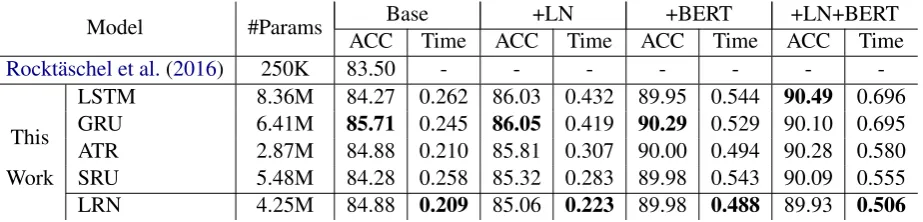
Model #Params Base +LN +BERT +LN+BERT ACC Time ACC Time ACC Time ACC Time
Rockt¨aschel et al.(2016) 250K 83.50 - - -
-This
[image:4.595.75.537.63.174.2]LSTM 8.36M 84.27 0.262 86.03 0.432 89.95 0.544 90.49 0.696 GRU 6.41M 85.71 0.245 86.05 0.419 90.29 0.529 90.10 0.695 ATR 2.87M 84.88 0.210 85.81 0.307 90.00 0.494 90.28 0.580 Work SRU 5.48M 84.28 0.258 85.32 0.283 89.98 0.543 90.09 0.555 LRN 4.25M 84.88 0.209 85.06 0.223 89.98 0.488 89.93 0.506
Table 1: Test accuracy (ACC) on SNLI task. “#Params”: the parameter number of Base.BaseandLNdenote the baseline model and layer normalization respectively. Time: time in seconds per training batch measured from 1k training steps on GeForce GTX 1080 Ti. Best results are highlighted in bold.
5 Gradient Analysis
Gradient vanishing and explosion are the bottle-neck that impedes training of vanilla RNNs ( Pas-canu et al.,2013). Consider a vanilla RNN formu-lated as follows:
ht=g(Wxt+Uht−1). (8)
The gradient back-propagated from the t-th step heavily depends on the following one-step deriva-tion:
∂ht
∂ht−1
=UTg0. (9)
Due to the chain rule, the recurrent weight ma-trix U will be repeatedly multiplied along the sequence length. Gradient vanishing/explosion results from a weight matrix with small/large norm (Pascanu et al.,2013).
In LRN, however, the recurrent weight matrix is removed. The current hidden state is gener-ated by directly weighting the current input and the previous hidden state. The one-step derivation of Eq. (2-4) is as follows:
∂ht
∂ht−1
= σ0ivt−ht−1σf0 +ft
| {z }
A
g0 (10)
whereσ0i andσf0 denote the derivation of Eq. (2) and Eq. (3), respectively. The difference between Eq. (9) and Eq. (10) is that the recurrent weight matrix is substituted by a more expressive compo-nent denoted asAin Eq. (10). Unlike the weight matrixU, the norm ofA is input-dependent and varies dynamically along different positions. The dependence on inputs provides LRN with the ca-pability of avoiding gradient vanishing/explosion.
6 Experiments
We verify the effectiveness of LRN on six di-verse NLP tasks. For each task, we adopt (near) state-of-the-art neural models with RNNs han-dling sequence representation. We compare LRN with several cutting-edge recurrent units, includ-ing LSTM, GRU, ATR and SRU. For all compar-isons, we keep the neural architecture intact and only alter the recurrent unit.3All RNNs are imple-mented without specialized cuDNN kernels. Un-less otherwise stated, different models on the same task share the same set of hyperparameters.
6.1 Natural Language Inference
SettingsNatural language inference reasons about the entailment relationship between a premise sen-tence and a hypothesis sensen-tence. We use the Stanford Natural Language Inference (SNLI) cor-pus (Bowman et al., 2015) and treat the task as a three-way classification task. This dataset con-tains 549,367 premise-hypothesis pairs for train-ing, 9,842 pairs for developing and 9,824 pairs for testing. We employ accuracy for evaluation.
We implement a variant of the word-by-word attention model (Rockt¨aschel et al., 2016) using Tensorflow for this task, where we stack two addi-tional bidirecaddi-tional RNNs upon the final sequence representation and incorporate character embed-ding for word-level representation. The pretrained GloVe (Pennington et al., 2014) word vectors are used to initialize word embedding. We also inte-grate the base BERT (Devlin et al., 2018) to im-prove contextual modeling.
3
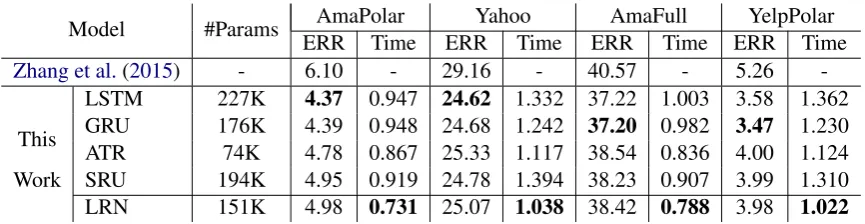
Model #Params AmaPolar Yahoo AmaFull YelpPolar ERR Time ERR Time ERR Time ERR Time
Zhang et al.(2015) - 6.10 - 29.16 - 40.57 - 5.26
-This
[image:5.595.83.516.61.173.2]LSTM 227K 4.37 0.947 24.62 1.332 37.22 1.003 3.58 1.362 GRU 176K 4.39 0.948 24.68 1.242 37.20 0.982 3.47 1.230 ATR 74K 4.78 0.867 25.33 1.117 38.54 0.836 4.00 1.124 Work SRU 194K 4.95 0.919 24.78 1.394 38.23 0.907 3.99 1.310 LRN 151K 4.98 0.731 25.07 1.038 38.42 0.788 3.98 1.022
Table 2: Test error (ERR) on document classification task. “#Params”: the parameter number in AmaPolar task.
Time: time in seconds per training batch measured from 1k training steps on GeForce GTX 1080 Ti.
We set the character embedding size and the RNN hidden size to 64 and 300 respectively. Dropout is applied between consecutive layers with a rate of 0.3. We train models within 10 epochs using the Adam optimizer (Kingma and Ba, 2014) with a batch size of 128 and gradient norm limit of 5.0. We set the learning rate to 1e−3, and apply an exponential moving average to all model parameters with a decay rate of 0.9999. These hyperparameters are tuned according to de-velopment performance.
ResultsTable1shows the test accuracy and train-ing time of different models. Our implementation outperforms the original model whereRockt¨aschel et al.(2016) report an accuracy of 83.50. Over-all results show that LRN achieves competitive performance but consumes the least training time. Although LSTM and GRU outperform LRN by 0.3∼0.9 in terms of accuracy, these recurrent units sacrifice running efficiency (about 7%∼48%) de-pending on whether LN and BERT are applied. No significant performance difference is observed be-tween SRU and LRN, but LRN has fewer model parameters and shows a speedup over SRU of 8%∼21%.
Models with layer normalization (LN) (Ba et al., 2016) tend to be more stable and effec-tive. However, for LSTM, GRU and ATR, LN re-sults in significant computational overhead (about 27%∼71%). In contrast, quasi recurrent models like SRU and LRN only suffer a marginal speed decrease. This is reasonable because layer normal-ization is moved together with matrix multiplica-tion out of the recurrence.
Results with BERT show that contextual infor-mation is valuable for performance improvement. LRN obtains additional 4 percentage points gain with BERT and reaches an accuracy of around 89.9. This shows the compatibility of LRN with
existing pretrained models. In addition, although the introduction of BERT brings in heavy matrix computation, the benefits from LRN do not disap-pear. LRN is still the fastest model, outperforming other recurrent units by 8%∼27%.
6.2 Document Classification
SettingsDocument classification poses challenges in the form of long-range dependencies where in-formation from distant tokens that contribute to the correct category should be captured. We use Amazon Review Polarity (AmaPolar, 2 labels, 3.6M/0.4M for training/testing), Amazon Review Full (AmaFull, 5 labels, 3M/0.65M for train-ing/testing), Yahoo! Answers (Yahoo, 10 labels, 1.4M/60K for training/testing) and Yelp Review Polarity (YelpPolar, 2 labels, 0.56M/38K for train-ing/testing) from Zhang et al. (2015) for experi-ments. We randomly select 10% of training data for validation. Models are evaluated by test error.
We treat a document as a sequence of words. Our model is a bidirectional RNN followed by an attentive pooling layer. The word-level represen-tation is composed of a pretrained GloVe word vector and a convolutional character vector. We use Tensorflow for implementation and do not use layer normalization. We set character embedding size to 32, RNN hidden size to 64 and dropout rate to 0.1. Model parameters are tuned by Adam op-timizer with initial learning rate of1e−3. Gradi-ents are clipped when their norm exceeds 5. We limit the maximum document length to 400 and maximum training epochs to 6. Parameters are smoothed by an exponential moving average with a decay rate of 0.9999. These hyperparameters are tuned according to development performance.
Model #Params BLEU Train Decode
GNMT - 24.61 -
-GRU 206M 26.28 2.67 45.35 ATR 122M 25.70 1.33 34.40
SRU 170M 25.91 1.34 42.84 LRN 143M 26.26 0.99 36.50
[image:6.595.73.290.60.161.2]oLRN 164M 26.73 1.15 40.19
Table 3: Case-insensitive tokenized BLEU score on WMT14 English-German translation task. Train: time in seconds per training batch measured from 0.2k train-ing steps on Tesla P100. Decode: time in millisec-onds used to decode one sentence measured on new-stest2014 dataset.
underperforms LSTM and GRU (-0.45∼-1.22). This indicates that LRN is capable of handling long-range dependencies though not as strong as complex recurrent units. Instead, the simplifica-tion endows LRN with less computasimplifica-tional over-head than these units. Particularly, LRN acceler-ates the training over LSTM and SRU by about 20%, or several days of training time on GeForce GTX 1080 Ti.4
6.3 Machine Translation
Settings Machine translation is the task of trans-forming meaning from a source language to a tar-get language. We experiment with the WMT14 English-German translation task (Bojar et al.,
2014) which consists of 4.5M training sentence pairs.5 We use newstest2013 as our develop-ment set and newstest2014 as our test set. Case-sensitive tokenized BLEU score is used for evalu-ation.
We implement a variant of the GNMT sys-tem (Wu et al., 2016) using Tensorflow, en-hanced with residual connections, layer normal-ization, label smoothing, a context-aware com-ponent (Zhang et al., 2017) and multi-head at-tention (Vaswani et al., 2017). Byte-pair encod-ing (Sennrich et al., 2016) is used to reduce the vocabulary size to 32K. We set the hidden size and embedding size to 1024. Models are trained using Adam optimizer with adaptive learning rate
sched-4We notice that ATR operates faster than SRU. This is be-cause though in theory SRU can be highly optimized for par-allelization, computational framework like Tensorflow can not handle it automatically and the smaller amount of cal-culation in ATR has more advantage in practice.
5Preprocessed data is available at (Zhang et al.,
2018): https://drive.google.com/open?id=
15WRLfle66CO1zIGKbyz0FsFmUcINyb4X.
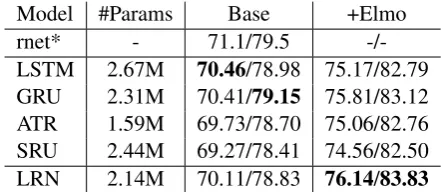
[image:6.595.305.527.62.158.2]Model #Params Base +Elmo rnet* - 71.1/79.5 -/-LSTM 2.67M 70.46/78.98 75.17/82.79 GRU 2.31M 70.41/79.15 75.81/83.12 ATR 1.59M 69.73/78.70 75.06/82.76 SRU 2.44M 69.27/78.41 74.56/82.50 LRN 2.14M 70.11/78.83 76.14/83.83
Table 4: Exact match/F1-score on SQuad dataset. “#Params”: the parameter number of Base. rnet*: re-sults published byWang et al.(2017).
ule (Chen et al.,2018). We cut gradient norm to 1.0 and set the token size to 32K. Label smoothing rate is set to 0.1.
Model VariantApart from LRN, we develop an improved variant for machine translation that in-cludes an additional output gate. Formally, we change the Eq. (4) to the following one:
ct=itvt+ftht−1 (11)
ot=σ(Woxt−ct) (12)
ht=otct (13)
We denote this variantoLRN. Like LRN, the added matrix transformation in oLRN can be shifted out of the recurrence, bringing in little computational overhead. The design of this output gateotis in-spired by the LSTM structure, which acts as a con-troller to adjust information flow. In addition, this gate helps stabilize the hidden activation to avoid value explosion, and also improves model fitting capacity.
Results The results in Table 3 show that trans-lation quality of LRN is slightly worse than that of GRU (-0.02 BLEU). After incorporating the output gate, however, oLRN yields the best BLEU score of 26.73, outperforming GRU (+0.45 BLEU). In addition, the training time results in Table 3 confirm the computational advantage of LRN over all other recurrent units, where LRN speeds up over ATR and SRU by approximately 25%. For decoding, nevertheless, the autoregres-sive schema of GNMT disables position-wise par-allelization. In this case, the recurrent unit with the least computation operations, i.e. ATR, becomes the fastest. Still, both LRN and oLRN translate sentences faster than SRU (+15%/+6%).
6.4 Reading Comprehension
Model #Params PTB WT2
Base +Finetune +Dynamic Base +Finetune +Dynamic
Yang et al.(2018) 22M 55.97 54.44 47.69 63.33 61.45 40.68
This
LSTM 22M 63.78 62.12 53.11 69.78 68.68 44.60
GRU 17M 69.09 67.61 60.21 73.37 73.05 49.77 ATR 9M 66.24 65.86 58.29 75.36 73.35 48.65 Work SRU 13M 69.64 65.29 60.97 85.15 84.97 57.97
[image:7.595.77.522.61.174.2]LRN 11M 61.26 61.00 54.45 69.91 68.86 46.97
Table 5: Test perplexity on PTB and WT2 language modeling task. “#Params”: the parameter number in PTB task. Finetune: fintuning the model after convergence. Dynamicdynamic evaluation. Lower perplexity indicates better performance.
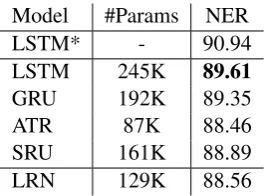
Model #Params NER LSTM* - 90.94
LSTM 245K 89.61
GRU 192K 89.35 ATR 87K 88.46 SRU 161K 88.89 LRN 129K 88.56
Table 6: F1 score on CoNLL-2003 English NER task. “#Params”: the parameter number in NER task.
LSTM* denotes the reported result (Lample et al.,
2016).
given document, which involves complex sen-tence matching, reasoning and knowledge asso-ciation. We use the SQuAD corpus (Rajpurkar et al.,2016) for this task and adopt span-based ex-traction method. This corpus contains over 100K document-question-answer triples. We report ex-act match (EM) and F1-score (F1) on the develop-ment set for evaluation.
We employ the public available rnet model (Wang et al., 2017)6 in Tensorflow. We use the default model settings: character embedding size 8, hidden size 75, batch size 64, and Adadelta optimizer (Zeiler,2012) with initial learning rate of 0.5. Gradient norm is cut to 5.0. We also experiment with Elmo (Peters et al.,
2018), and feed the Elmo representation in before the encoding layer and after the matching layer with a dropout of 0.5.
Results Table 4 lists the EM/F1 score of differ-ent models. In this task, LRN outperforms ATR and SRU in terms of both EM and F1 score. After integrating Elmo for contextual modeling, the performance of LRN reaches the best (76.14
6https://github.com/HKUST-KnowComp/
R-Net
EM and 83.83 F1), beating both GRU and LSTM (+0.33EM, +0.71F1). As recent studies show that cases in SQuAD are dominated by local pattern matching (Jia and Liang, 2017), we argue that LRN is good at handling local dependencies.
6.5 Named Entity Recognition
Settings Named entity recognition (NER) classi-fies named entity mentions into predefined cate-gories. We use the CoNLL-2003 English NER dataset (Tjong Kim Sang and De Meulder,2003) and treat NER as a sequence labeling task. We use the standard train, dev and test split. F1 score is used for evaluation.
We adopt the bidirectional RNN with CRF in-ference architecture (Lample et al., 2016). We implement different models based on the public codebase in Tensorflow.7 We use the default hy-perparameter settings. Word embedding is initial-ized by GloVe vectors.
Results As shown in Table 68, the performance of LRN matches that of ATR and SRU, though LSTM and GRU operate better (+1.05 and +0.79). As in the SQuAD task, the goal of NER is to de-tect local entity patterns and figure out the entity boundaries. However, the performance gap be-tween LSTM/GRU and LRN in NER is signifi-cantly larger than that in SQuAD. We ascribe this to the weak model architecture and the small scale NER dataset where entity patterns are not fully captured by LRN.
6.6 Language Modeling
Settings Language modeling aims to estimate the probability of a given sequence, which
re-7
https://github.com/Hironsan/anago
[image:7.595.115.248.241.339.2]Figure 1: The decay curve of each token modulated by input and forget gates along the token position. Notice how the memory of term “great” flows to the final state shown in red, and contributes to aPositivedecision. Weight
denotes the averaged activation ofik Qt−k
l=1fk+l
as shown in Eq. (5).
quires models to memorize long-term structure of language. We use two widely used datasets, Penn Treebank (PTB) (Mikolov et al.,2010) and WikiText-2 (WT2) (Merity et al., 2016) for this task. Models are evaluated by perplexity.
We modify the mixture of softmax model (MoS) (Yang et al.,2018)9 in PyTorch to include different recurrent units. We apply weight dropout to all recurrent-related parameters instead of only hidden-to-hidden connection. We follow the ex-perimental settings of MoS, and manually tune the initial learning rate based on whether training di-verges.
ResultsTable5shows the test perplexity of differ-ent models.10 In this task, LRN significantly out-performs GRU, ATR and SRU, and achieves near the same perplexity as LSTM. This shows that in spite of its simplicity, LRN can memorize long-term language structures and capture a certain de-gree of language variation. In summary, LRN gen-eralizes well to different tasks and can be used as a drop-in replacement of existing recurrent units.
6.7 Ablation Study
Part of LRN can be replaced with some alterna-tives. In this section, we conduct ablation analysis to examine two possible designs:
gLRN The twin-style gates in Eq. (2-3) can be
re-9https://github.com/zihangdai/mos
10
Our re-implementation of LSTM model is worse than the original model (Yang et al.,2018) because the system is sen-sitive to hyperparameters, and we apply weight dropout to all LSTM parameters which makes the original best choices not optimal.
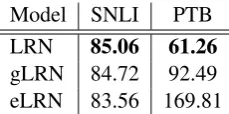
Model SNLI PTB LRN 85.06 61.26
gLRN 84.72 92.49 eLRN 83.56 169.81
Table 7: Test accuracy on SNLI task withBase+LN
setting and test perplexity on PTB task withBase set-ting.
placed with a general one:
ft=σ(qt−ht−1),it= 1−ft. (14)
In this way, input and forget gate are inferable from each other with the key weight parame-ter removed.
eLRN The above design can be further simplified into an extreme case where the forget gate is only generated from the previous hidden state without the query vector:
ft=σ(−ht−1),it= 1−ft. (15)
We experiment with SNLI and PTB tasks. Re-sults in Table 7 show that although the accuracy on SNLI is acceptable, gLRN and eLRN perform significantly worse on the PTB task. This suggests that these alternative structures suffer from weak generalization.
6.8 Structure Analysis
In this section, we provide a visualization to check how the gates work in LRN.
[image:8.595.358.473.289.346.2]is used for document classification. Figure 1
shows the decay curve of each token along the to-ken position. The memory curve of each toto-ken decays over time. However, important clues that contribute significantly to the final decision, as the token “great” does, decrease slowly, as shown by the red curve. Different tokens show different decay rate, suggesting that input and forget gate are capable of learning to propagate relevant sig-nals. All these demonstrate the effectiveness of our LRN model.
7 Conclusion and Future Work
This paper presents LRN, a lightweight recur-rent network that factors matrix operations outside the recurrence and enables higher parallelization. Theoretical and empirical analysis shows that the input and forget gate in LRN can learn long-range dependencies and avoid gradient vanishing and ex-plosion. LRN has a strong correlation with self-attention networks. Experiments on six different NLP tasks show that LRN achieves competitive performance against existing recurrent units. It is simple, effective and reaches better trade-off among parameter number, running speed, model performance and generalization.
In the future, we are interested in testing low-level optimizations of LRN, which are orthogonal to this work, such as dedicated cuDNN kernels.
Acknowledgments
We thank the reviewers for their insightful com-ments. Biao Zhang acknowledges the sup-port of the Baidu Scholarship. This work has been performed using resources provided by the Cambridge Tier-2 system operated by the Uni-versity of Cambridge Research Computing Ser-vice (http://www.hpc.cam.ac.uk) funded by EP-SRC Tier-2 capital grant EP/P020259/1.
References
Jeremy Appleyard, Tomas Kocisky, and Phil Blun-som. 2016. Optimizing performance of recur-rent neural networks on gpus. arXiv preprint arXiv:1604.01946.
Jimmy Lei Ba, Jamie Ryan Kiros, and Geoffrey E Hin-ton. 2016. Layer normalization. arXiv preprint arXiv:1607.06450.
David Balduzzi and Muhammad Ghifary. 2016.
Strongly-typed recurrent neural networks. In
Pro-ceedings of the 33rd International Conference on In-ternational Conference on Machine Learning - Vol-ume 48, ICML’16, pages 1292–1300. JMLR.org.
Yoshua Bengio, Patrice Simard, and Paolo Frasconi. 1994. Learning long-term dependencies with gradi-ent descgradi-ent is difficult. IEEE Transactions on Neu-ral Networks, 5(2):157–166.
Ondrej Bojar, Christian Buck, Christian Federmann, Barry Haddow, Philipp Koehn, Johannes Leveling, Christof Monz, Pavel Pecina, Matt Post, Herve Saint-Amand, Radu Soricut, Lucia Specia, and Aleˇs Tamchyna. 2014. Findings of the 2014 workshop on statistical machine translation. InProceedings of the Ninth Workshop on Statistical Machine Translation, pages 12–58, Baltimore, Maryland, USA. Associa-tion for ComputaAssocia-tional Linguistics.
Samuel R. Bowman, Gabor Angeli, Christopher Potts, and Christopher D. Manning. 2015. A large an-notated corpus for learning natural language infer-ence. In Proceedings of the 2015 Conference on Empirical Methods in Natural Language Processing (EMNLP). Association for Computational Linguis-tics.
James Bradbury, Stephen Merity, Caiming Xiong, and Richard Socher. 2016. Quasi-recurrent neural net-works. arXiv preprint arXiv:1611.01576.
Mia Xu Chen, Orhan Firat, Ankur Bapna, Melvin Johnson, Wolfgang Macherey, George Foster, Llion Jones, Mike Schuster, Noam Shazeer, Niki Parmar, Ashish Vaswani, Jakob Uszkoreit, Lukasz Kaiser, Zhifeng Chen, Yonghui Wu, and Macduff Hughes. 2018. The best of both worlds: Combining recent advances in neural machine translation. In Proceed-ings of the 56th Annual Meeting of the Association for Computational Linguistics (Volume 1: Long Pa-pers), pages 76–86. Association for Computational Linguistics.
Kyunghyun Cho, Bart van Merrienboer, Caglar Gul-cehre, Dzmitry Bahdanau, Fethi Bougares, Holger Schwenk, and Yoshua Bengio. 2014. Learning phrase representations using rnn encoder–decoder for statistical machine translation. InProceedings of the 2014 Conference on Empirical Methods in Nat-ural Language Processing (EMNLP), pages 1724– 1734. Association for Computational Linguistics.
Jacob Devlin, Ming-Wei Chang, Kenton Lee, and Kristina Toutanova. 2018. Bert: Pre-training of deep bidirectional transformers for language understand-ing.arXiv preprint arXiv:1810.04805.
Greg Diamos, Shubho Sengupta, Bryan Catanzaro, Mike Chrzanowski, Adam Coates, Erich Elsen, Jesse Engel, Awni Hannun, and Sanjeev Satheesh. 2016. Persistent rnns: Stashing recurrent weights on-chip. In International Conference on Machine Learning, pages 2024–2033.
Sepp Hochreiter and J¨urgen Schmidhuber. 1997. Long short-term memory. Neural Comput., 9(8):1735– 1780.
Robin Jia and Percy Liang. 2017. Adversarial exam-ples for evaluating reading comprehension systems. In Proceedings of the 2017 Conference on Empiri-cal Methods in Natural Language Processing, pages 2021–2031. Association for Computational Linguis-tics.
Seonhoon Kim, Jin-Hyuk Hong, Inho Kang, and No-jun Kwak. 2019. Semantic sentence matching with densely-connected recurrent and co-attentive infor-mation. AAAI19.
Diederik P Kingma and Jimmy Ba. 2014. Adam: A method for stochastic optimization. arXiv preprint arXiv:1412.6980.
Oleksii Kuchaiev and Boris Ginsburg. 2017. Factor-ization tricks for lstm networks. arXiv preprint arXiv:1703.10722.
Guillaume Lample, Miguel Ballesteros, Sandeep Sub-ramanian, Kazuya Kawakami, and Chris Dyer. 2016.
Neural architectures for named entity recognition. InProceedings of the 2016 Conference of the North American Chapter of the Association for Computa-tional Linguistics: Human Language Technologies, pages 260–270. Association for Computational Lin-guistics.
Kenton Lee, Omer Levy, and Luke Zettlemoyer. 2017. Recurrent additive networks. arXiv preprint arXiv:1705.07393.
T. Lei, W. Jin, R. Barzilay, and T. Jaakkola. 2017. De-riving neural architectures from sequence and graph kernels. In International Conference on Machine Learning (ICML).
Tao Lei, Yu Zhang, Sida I. Wang, Hui Dai, and Yoav Artzi. 2018. Simple recurrent units for highly par-allelizable recurrence. In Proceedings of the 2018 Conference on Empirical Methods in Natural Lan-guage Processing, pages 4470–4481. Association for Computational Linguistics.
Stephen Merity, Caiming Xiong, James Bradbury, and Richard Socher. 2016. Pointer sentinel mixture models. arXiv preprint arXiv:1609.07843.
Tom´aˇs Mikolov, Martin Karafi´at, Luk´aˇs Burget, Jan ˇ
Cernock`y, and Sanjeev Khudanpur. 2010. Recurrent neural network based language model. InEleventh annual conference of the international speech com-munication association.
Razvan Pascanu, Tomas Mikolov, and Yoshua Bengio. 2013. On the difficulty of training recurrent neural networks. In International conference on machine learning, pages 1310–1318.
Hao Peng, Roy Schwartz, Sam Thomson, and Noah A. Smith. 2018. Rational recurrences. In Proceed-ings of the 2018 Conference on Empirical Methods in Natural Language Processing, pages 1203–1214. Association for Computational Linguistics.
Jeffrey Pennington, Richard Socher, and Christo-pher D. Manning. 2014. Glove: Global vectors for word representation. InEmpirical Methods in Nat-ural Language Processing (EMNLP), pages 1532– 1543.
Matthew E. Peters, Mark Neumann, Mohit Iyyer, Matt Gardner, Christopher Clark, Kenton Lee, and Luke Zettlemoyer. 2018. Deep contextualized word rep-resentations. InProc. of NAACL.
Pranav Rajpurkar, Jian Zhang, Konstantin Lopyrev, and Percy Liang. 2016. Squad: 100,000+ questions for machine comprehension of text. InProceedings of the 2016 Conference on Empirical Methods in Nat-ural Language Processing, pages 2383–2392. Asso-ciation for Computational Linguistics.
Tim Rockt¨aschel, Edward Grefenstette, Karl Moritz Hermann, Tomas Kocisky, and Phil Blunsom. 2016. Reasoning about entailment with neural attention. InInternational Conference on Learning Represen-tations (ICLR).
Rico Sennrich, Barry Haddow, and Alexandra Birch. 2016. Neural machine translation of rare words with subword units. InProceedings of the 54th An-nual Meeting of the Association for Computational Linguistics (Volume 1: Long Papers), pages 1715– 1725. Association for Computational Linguistics.
Erik F. Tjong Kim Sang and Fien De Meulder. 2003. Introduction to the conll-2003 shared task: Language-independent named entity recognition. In
Proceedings of the Seventh Conference on Natural Language Learning at HLT-NAACL 2003 - Volume 4, CONLL ’03, pages 142–147, Stroudsburg, PA, USA. Association for Computational Linguistics.
Ashish Vaswani, Noam Shazeer, Niki Parmar, Jakob Uszkoreit, Llion Jones, Aidan N Gomez, Ł ukasz Kaiser, and Illia Polosukhin. 2017. Attention is all you need. In I. Guyon, U. V. Luxburg, S. Bengio, H. Wallach, R. Fergus, S. Vishwanathan, and R. Gar-nett, editors, Advances in Neural Information Pro-cessing Systems 30, pages 5998–6008. Curran As-sociates, Inc.
Wenhui Wang, Nan Yang, Furu Wei, Baobao Chang, and Ming Zhou. 2017. Gated self-matching net-works for reading comprehension and question an-swering. InProceedings of the 55th Annual Meet-ing of the Association for Computational LMeet-inguistics (Volume 1: Long Papers), pages 189–198. Associa-tion for ComputaAssocia-tional Linguistics.
Macherey, Jeff Klingner, Apurva Shah, Melvin Johnson, Xiaobing Liu, ukasz Kaiser, Stephan Gouws, Yoshikiyo Kato, Taku Kudo, Hideto Kazawa, Keith Stevens, George Kurian, Nishant Patil, Wei Wang, Cliff Young, Jason Smith, Jason Riesa, Alex Rudnick, Oriol Vinyals, Greg Corrado, Macduff Hughes, and Jeffrey Dean. 2016. Google’s neural machine translation system: Bridging the gap between human and machine translation. CoRR, abs/1609.08144.
Zhilin Yang, Zihang Dai, Ruslan Salakhutdinov, and William W Cohen. 2018. Breaking the softmax bot-tleneck: A high-rank rnn language model.ICLR.
Matthew D Zeiler. 2012. Adadelta: an adaptive learn-ing rate method.arXiv preprint arXiv:1212.5701.
Biao Zhang, Deyi Xiong, and Jinsong Su. 2018. Accel-erating neural transformer via an average attention network. InProceedings of the 56th Annual Meet-ing of the Association for Computational LMeet-inguistics (Volume 1: Long Papers), pages 1789–1798, Mel-bourne, Australia. Association for Computational Linguistics.
Biao Zhang, Deyi Xiong, and Jinsong Su. 2018. Neu-ral machine translation with deep attention. IEEE Transactions on Pattern Analysis and Machine In-telligence, pages 1–1.
Biao Zhang, Deyi Xiong, Jinsong Su, and Hong Duan. 2017. A context-aware recurrent encoder for neu-ral machine translation. IEEE/ACM Trans. Audio, Speech and Lang. Proc., 25(12):2424–2432.
Biao Zhang, Deyi Xiong, jinsong su, Qian Lin, and Huiji Zhang. 2018. Simplifying neural machine translation with addition-subtraction twin-gated re-current networks. InProceedings of the 2018 Con-ference on Empirical Methods in Natural Language Processing, pages 4273–4283. Association for Com-putational Linguistics.
Xiang Zhang, Junbo Zhao, and Yann LeCun. 2015.