1614
Historical Text Normalization with Delayed Rewards
Simon Flachs, Marcel Bollmann, Anders Søgaard Department of Computer Science
University of Copenhagen Denmark
{flachs,marcel,soegaard}@di.ku.dk
Abstract
Training neural sequence-to-sequence models with simple token-level log-likelihood is now a standard approach to historical text normal-ization, albeit often outperformed by phrase-based models. Policy gradient training enables direct optimization for exact matches, and while the small datasets in historical text nor-malization are prohibitive of from-scratch re-inforcement learning, we show that policy gra-dientfine-tuningleads to significant improve-ments across the board. Policy gradient train-ing, in particular, leads to more accurate nor-malizations for long or unseen words.
1 Introduction
Historical text normalization is a common ap-proach to making historical documents accessible and searchable. It is a challenging problem, since most historical texts were written without fixed spelling conventions, and spelling is therefore at times idiosyncratic (Piotrowski,2012).
Traditional approaches to historical text nor-malization relied on hand-written rules, but re-cently, several authors have proposed neural mod-els for historical text normalization (Bollmann and Søgaard,2016;Bollmann,2018;Tang et al., 2018). Such models are trained using character-level maximum-likelihood training, which is in-consistent with the objective of historical text normalization; namely, transduction into modern, searchable word forms. The discrepancy between character-level loss and our word-level objective means that model decision costs are biased. Our objective, however, is reflected by the standard evaluation metric, which is computed as the frac-tion of benchmark words that are translated cor-rectly.
In order to mitigate the discrepancy between the optimization method and the task objective, work has been carried out on using reinforcement
learning to optimize directly for the evaluation metric (Ranzato et al., 2016; Shen et al., 2016). Reinforcement learning enables direct optimiza-tion of exact matches or other non-decomposable metrics, computing updates based on delayed re-wards rather than token-level error signals. This paper contrasts maximum likelihood training and training with delayed rewards, in the context of sequence-to-sequence historical text normaliza-tion (Bollmann et al.,2017).
Contributions We show that training with de-layed rewards achieves better performance than maximum likelihood training across six different historical text normalization benchmarks; and that training with delayed rewards is particularly help-ful for long words, words where maximum likeli-hood training leads to predicting long words, and for unseen words. We note that our approach dif-fers from other applications in the NLP literature in using the mean reward as our baseline, and in comparing different reward functions; we also fine-tune relying only on rewards, rather than a mixture of cross entropy loss and rewards.
2 Historical text normalization datasets
Language Time Period Train IAT
EN English 1386–1698 148k 75%
DE German 14th–16thc. 234k 30%
HU Hungarian 1440–1541 134k 18%
IS Icelandic 15thc. 50k 47%
SL Slovene 1750–1840s 50k 41%
[image:2.595.306.528.72.295.2]SV Swedish 1527–1812 24k 60%
Table 1: Historical datasets with the time period they represent, the size of their training sets (in tokens), and the approximate percentage of tokens that are invariant across time (IAT), i.e. where the historical and normal-ized forms are identical.
Note the differences in the number of words that are invariant across time, i.e., where the original input word form is the correct prediction accord-ing to the manual annotations. The differences are reasons to expect performance to be higher on En-glish, but lower on Hungarian, for example; since it is easier to learn to memorize the input than to learn abstract transduction patterns. In practice, we see differences being relatively small. Perfor-mance on English, however, is significantly higher than for the other languages (see Table2).
3 Normalization models
Our baseline model is an LSTM-based encoder-decoder model with attention. The model re-ceives as input a sequence of characters from the source vocabulary(i1, . . . , iN). Each characterit
is mapped to the corresponding randomly initial-ized embedding, which is then given as input to the bi-LSTM encoder. The decoder then uses the Bahdanau attention mechanism (Bahdanau et al., 2014) over the encoded representation to output a sequence of characters from the target vocabu-lary (o1, ..., oM). Note that the input and output
sequences may differ in length. Both the encoder and decoder is composed of three layers with di-mensionality 256. The character embeddings have 128 dimensions.
For training our maximum likelihood baseline, we use the Adam optimiser initialized with a learning rate of 0.001 and default decay rates. In addition, we use a dropout probability of 20%. The model is trained with batch size 16 for 10 epochs with early stopping. All hyper-parameters were tuned on English development data.
Algorithm 1:Reinforcement learning for the neural encoder-decoder model
Input :Parallel Corpus, PC; MLE pretrained parameters,θ
Output:Model parametersθˆ
1 for (X, Y)∈P C do
2 ( ˆY1, ...Yˆk),(P( ˆY1), ...P( ˆYk)) = sample(X, k,θˆ);
3 Q( ˆY) =normalise(P( ˆY));
4 r¯= 0; // expected reward
5 forYˆi ∈Yˆ do
6 ¯r+ =Q( ˆYi)·A( ˆYi);
7 end
8 backprop(ˆθ,r¯); // policy gradient
9 end
10 returnθˆ
Policy gradient fine-tuning We use policy gra-dient training with delayed rewards for fine-tuning our models: We use maximum likelihood pretrain-ing for 10 epochs (see above) and update our model based on policy gradients computed us-ing the REINFORCE algorithm (Williams,1992; Sutton et al., 1999). This enables us to optimize for delayed rewards that are non-decomposable. Specifically, we directly minimize a distance func-tion between strings, e.g., Levenshtein distance, by using negative distance as a delayed reward:1 R( ˆY) =−Levenshtein(Y,Yˆ).
REINFORCE maximizes the expected reward, under some probability distribution P( ˆY|θ), pa-rameterized by some θ. This way, the cost func-tion,J(θ), is defined as the negative expected re-ward:J(θ) =−EYˆ∼P( ˆY|θ)[R( ˆY)]. From this cost function, the PG can be derived as:
P G=∇θJ(θ) (1)
=−EYˆ∼P( ˆY|θ)[∇θ log P( ˆY)·R( ˆY)] (2)
We refer the reader to prior work for the full derivation (Williams, 1992; Karpathy, 2016). In Equation (2), there is no need to differentiate R( ˆY), and policy gradient training therefore is possible with non-differentiable reward functions (Karpathy, 2016). To explore the search space, we use a stochastic sampling functionS(X)that, given an input sequence X, produces k sample
hypothesesYˆ1, . . . ,Yˆk. The hypotheses are
gener-ated by, at each time step, sampling actions based on the multinomial probability distribution of the policy. In order to reduce the search space, we sample only from the ten most likely actions at each time step. Furthermore, duplicate samples are filtered.
In practice, we do not optimize directly for the reward R( ˆY). Instead we replace it with the ad-vantage score (Weaver and Tao, 2001; Mnih and Gregor, 2014): A( ˆY) = R( ˆY) −b, where b is a baseline reward (Weaver and Tao, 2001), intro-duced to reduce the variance in the gradients. We use the mean reward over the samples as our base-line reward. This way, the advantage scores of the samples will be centered around 0, meaning that about half of the produced samples will be encour-aged and about half will be discourencour-aged (Karpa-thy,2016).
We also found it necessary to normalize the probability distribution P( ˆY|X;θ)over the sam-ples from S(X). We follow Shen et al. (2016) and define a probability distributionQ( ˆY|X;θ, α) over the subspace ofS(X).
Q( ˆY|X;θ, α) = P( ˆY|X;θ)
α
P ˆ
Y0∈S(X)P( ˆY 0
|X;θ)α (3)
This function is essentially a smoothing func-tion over the sample probabilities, with a hyper-parameter αthat controls the level of smoothing. We followShen et al.(2016) and setα = 0.005. With these alterations, our cost function and gra-dients can be defined as:
J(θ) =−EYˆ∈S(X)[A( ˆY)] (4)
P G=−EYˆ∈S(X)[∇θ log Q( ˆY)·A( ˆY)] (5)
The algorithm is described in pseudocode in Algorithm1. We optimized hyper-parameters the same way we optimized our baseline model hyper-parameters. Compared to the baseline, the policy gradient model’s optimal batch size is bigger (64), and the learning rate is smaller (0.00001). Both strategies are known to increase generalization, by increasing the scale of random fluctuations in the SGD dynamics (Smith and Le,2018;Balles et al., 2017).
4 Experiments
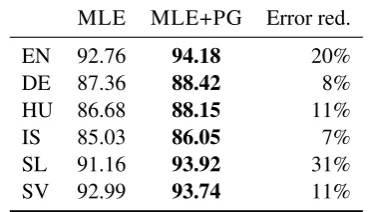
[image:3.595.307.524.61.184.2]Our experiments compare maximum likelihood training and policy gradient training across six his-torical text normalization datasets (cf. Table 1).
Figure 1: Different reward functions on Icelandic (dev)
MLE MLE+PG Error red.
EN 92.76 94.18 20%
DE 87.36 88.42 8%
HU 86.68 88.15 11%
IS 85.03 86.05 7%
SL 91.16 93.92 31%
SV 92.99 93.74 11%
Table 2: Comparison of maximum likelihood training (MLE) and policy gradient fine-tuning (MLE+PG), given in word-level accuracy in percent, as well as the error reduction between MLE and MLE+PG.
We optimized hyper-parameters on the English development data and used the same hyper-parameters across the board (see above).
[image:3.595.323.508.235.341.2]GOLDLENGTH MLE LENGTH MLE BACKOFF IDENTICAL UNSEENWORDS
EN ∗∗0.09 ∗∗0.14 ∗∗-0.20 ∗∗-0.07 ∗∗0.10
DE ∗∗0.11 ∗∗0.10 ∗∗-0.08 -0.05 ∗∗0.12
HU ∗∗0.09 ∗∗0.11 ∗∗-0.07 ∗∗-0.03 ∗∗0.10
IS ∗∗0.04 ∗∗0.05 0.02 ∗∗0.08 ∗∗0.05
Table 3: Correlations (Pearson’sr) between improvements with reinforcement learning and datapoint characteris-tics; ** denotes significance withp <0.001.
Results The results are presented in Table 2.2 Generally, we see that policy gradient fine-tuning improves results across the board. For English, the error reduction is 20%. For German, Hungarian, Icelandic, Slovene, and Swedish, the error reduc-tion is smaller (7–16%), but still considerable and highly significant (p < 0.01).Tang et al. (2018) do show, however, that multi-headed attention ar-chitectures (Vaswani et al.,2017) generally seem to outperform sequence-to-sequence models with attention for historical text normalization. This is orthogonal to the analysis presented here, and sim-ilar improvements can likely be obtained by multi-headed attention architectures.
Analysis To avoid bias from small, high vari-ance datasets, we limit error analysis to English, German, Hungarian, and Icelandic. In Table3, we present correlation scores between our observed improvements and characteristics of the data.3We consider the following characteristics:
1. GOLD LENGTH: Reinforcement learning
with delayed rewards can potentially mitigate error propagation, and we do observe that gains from reinforcement learning, i.e., the distribution of correct normalizations by rein-forcement learning that our baseline architec-ture classified wrongly, correlate significantly with the length of the input across all four languages.
2. MLE LENGTH: The correlations are even stronger with the length of the output of
2Note that for the MLE baseline, we performed our own hyperparameter tuning, which results in a different configura-tion than used in previous work (e.g.,Bollmann et al.,2017;
Tang et al.,2018). We observe that our baseline is weaker than the models reported inBollmann(2019), but even so, the MLE+PG approach yields state-of-the-art performance on the Slovene dataset.
3Correlations are Pearson’sr. Samples are big enough to motivate a parametric test, but we obtain similar coefficients and significance levels with Spearman’sρ.
the MLE model. This suggests that rein-forcement learning – or policy gradient train-ing – is particularly effective on examples for which maximum likelihood training tends to predict long normalizations.
3. MLE BACKOFF: We also correlate gains with the distribution of instances on which the MLE backed off to predicting the origi-nal input word form. Here, we see a negative correlation, suggesting our baseline is good at predicting when the word form is invariant across time.
4. IDENTICAL: The three trends above are all
quite strong. Our fourth variable is when in-put and outin-put are identical (invariant across time). Here, we see mixed results. Policy gra-dient gains correlate negatively with invari-ance in English, but positively in Icelandic.
5. UNSEENWORDS: Finally, we correlate gains
with whether words had been previously seen at training time. Our policy gradient fine-tuned model performs much better on unseen words, and especially for English, German, and Hungarian, we see strong correlations be-tween improvements and unseen words. Our predictions also exhibit smaller Levenshtein distances to the annotations compared to our baseline model, e.g., 0.11 vs. 0.14 for En-glish, respectively, and 0.20 vs. 0.23 for Ger-man.
5 Conclusions
our results are very promising. In our error anal-ysis, we, in addition, observe that reinforcement learning is particularly beneficial for long words and unseen words, which are probably the hardest challenges in historical text normalization.
Acknowledgments
Simon Flachs was supported by a PhD grant from Innovation Fund Denmark. Anders Søgaard was supported by a Google Focused Research Award. Marcel Bollmann was partly funded from the Eu-ropean Union’s Horizon 2020 research and inno-vation programme under the Marie Sklodowska-Curie grant agreement No 845995. We gratefully acknowledge the donation of a Titan Xp GPU by the NVIDIA Corporation.
References
Dzmitry Bahdanau, Kyunghyun Cho, and Yoshua Ben-gio. 2014. Neural machine translation by jointly learning to align and translate. arXiv preprint arXiv:1409.0473.
Lukas Balles, Javier Romero, and Philipp Hennig. 2017. Coupling adaptive batch sizes with learning rates. InProceedings of the Thirty-Third Conference on Uncertainty in Artificial Intelligence (UAI).
Marcel Bollmann. 2018. Normalization of historical texts with neural network models. Bochumer Lin-guistische Arbeitsberichte, 22.
Marcel Bollmann. 2019. A large-scale comparison of historical text normalization systems. In Proceed-ings of the 2019 Conference of the North American Chapter of the Association for Computational Lin-guistics: Human Language Technologies, Volume 1 (Long and Short Papers), pages 3885–3898. Associ-ation for ComputAssoci-ational Linguistics.
Marcel Bollmann, Joachim Bingel, and Anders Søgaard. 2017. Learning attention for historical text normalization by learning to pronounce. In Pro-ceedings of the 55th Annual Meeting of the Associa-tion for ComputaAssocia-tional Linguistics (Volume 1: Long Papers), pages 332–344, Vancouver, Canada. Asso-ciation for Computational Linguistics.
Marcel Bollmann and Anders Søgaard. 2016. Im-proving historical spelling normalization with bi-directional LSTMs and multi-task learning. In Pro-ceedings of COLING 2016, the 26th International Conference on Computational Linguistics: Techni-cal Papers, pages 131–139, Osaka, Japan. The COL-ING 2016 Organizing Committee.
William W. Cohen, Pradeep Ravikumar, and Stephen E. Fienberg. 2003. A comparison of string metrics for matching names and records.
In KDD Workshop on Data Cleaning and Object Consolidation.
Andrej Karpathy. 2016. Deep reinforcement learning: Pong from pixels. Retrieved on 21-10-2017.
Nikola Ljubeˇsi´c, Katja Zupan, Darja Fiˇser, and Tomaˇz Erjavec. 2016. Normalising Slovene data: historical texts vs. user-generated content. InProceedings of the 13th Conference on Natural Language Process-ing (KONVENS 2016), volume 16 ofBochumer Lin-guistische Arbeitsberichte, pages 146–155, Bochum, Germany.
Andriy Mnih and Karol Gregor. 2014. Neural vari-ational inference and learning in belief networks. InProceedings of the 31st International Conference on Machine Learning, volume 32 ofProceedings of Machine Learning Research, pages 1791–1799, Be-jing, China. PMLR.
Eva Pettersson. 2016.Spelling Normalisation and Lin-guistic Analysis of Historical Text for Information Extraction. Doctoral dissertation, Uppsala Univer-sity, Department of Linguistics and Philology, Upp-sala.
Michael Piotrowski. 2012.Natural Language Process-ing for Historical Texts. Number 17 in Synthesis Lectures on Human Language Technologies. Mor-gan & Claypool.
Marc’Aurelio Ranzato, Sumit Chopra, Michael Auli, and Wojciech Zaremba. 2016. Sequence level train-ing with recurrent neural networks. In 4th Inter-national Conference on Learning Representations, ICLR 2016, San Juan, Puerto Rico, May 2–4, 2016, Conference Track Proceedings.
Shiqi Shen, Yong Cheng, Zhongjun He, Wei He, Hua Wu, Maosong Sun, and Yang Liu. 2016. Minimum risk training for neural machine translation. In Pro-ceedings of the 54th Annual Meeting of the Associa-tion for ComputaAssocia-tional Linguistics (Volume 1: Long Papers), pages 1683–1692, Berlin, Germany. Asso-ciation for Computational Linguistics.
Samuel L. Smith and Quoc V. Le. 2018. A Bayesian perspective on generalization and stochastic gradient descent. In International Conference on Learning Representations.
Richard S. Sutton, David McAllester, Satinder Singh, and Yishay Mansour. 1999. Policy gradient methods for reinforcement learning with function approxima-tion. InProceedings of the 12th International Con-ference on Neural Information Processing Systems, NIPS’99, pages 1057–1063, Cambridge, MA, USA. MIT Press.
Ashish Vaswani, Noam Shazeer, Niki Parmar, Jakob Uszkoreit, Llion Jones, Aidan N Gomez, Ł ukasz Kaiser, and Illia Polosukhin. 2017. Attention is all you need. InAdvances in Neural Information Pro-cessing Systems 30, pages 5998–6008. Curran Asso-ciates, Inc.
Lex Weaver and Nigel Tao. 2001. The optimal reward baseline for gradient-based reinforcement learning. In Proceedings of the Seventeenth Conference on Uncertainty in Artificial Intelligence (UAI).