Proceedings of the 55th Annual Meeting of the Association for Computational Linguistics, pages 929–938 Proceedings of the 55th Annual Meeting of the Association for Computational Linguistics, pages 929–938
Naturalizing a Programming Language via Interactive Learning
Sida I. Wang, Samuel Ginn, Percy Liang, Christopher D. Manning
Computer Science Department Stanford University
{sidaw, samginn, pliang, manning}@cs.stanford.edu
Abstract
Our goal is to create a convenient natu-ral language interface for performing well-specified but complex actions such as ana-lyzing data, manipulating text, and query-ing databases. However, existquery-ing natu-ral language interfaces for such tasks are quite primitive compared to the power one wields with a programming language. To bridge this gap, we start with a core pro-gramming language and allow users to “naturalize” the core language incremen-tally by defining alternative, more natural syntax and increasingly complex concepts in terms of compositions of simpler ones. In a voxel world, we show that a com-munity of users can simultaneously teach a common system a diverse language and use it to build hundreds of complex voxel structures. Over the course of three days, these users went from using only the core language to using the naturalized language in 85.9% of the last 10K utterances.
1 Introduction
In tasks such as analyzing and plotting data (Gulwani and Marron, 2014), querying databases (Zelle and Mooney, 1996; Berant et al., 2013), manipulating text (Kushman and Barzilay,2013), or controlling the Internet of Things (Campagna et al.,2017) and robots (Tellex et al.,2011), peo-ple need computers to perform well-specified but complex actions. To accomplish this, one route is to use a programming language, but this is inac-cessible to most and can be tedious even for ex-perts because the syntax is uncompromising and all statements have to be precise. Another route is to convert natural language into a formal
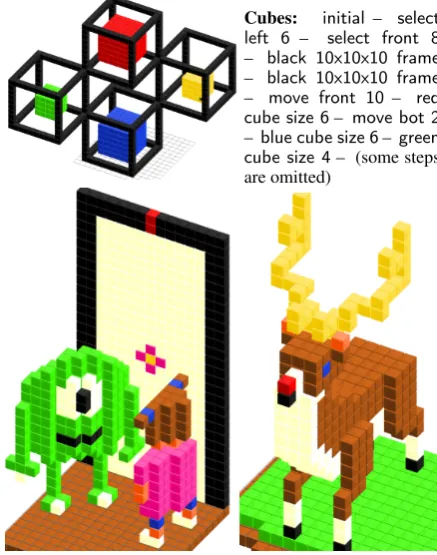
lan-Cubes: initial – select left 6 – select front 8
– black 10x10x10 frame
– black 10x10x10 frame
– move front 10 – red cube size 6– move bot 2
–blue cube size 6–green cube size 4– (some steps are omitted)
Monsters, Inc: initial– move forward– add green monster– go down 8– go right and front– add brown floor– add girl– go back and down– add door– add black column 30– go up 9– finish door– (some steps for moving are omitted)
[image:1.595.305.524.225.503.2]Deer: initial– bird’s eye view– deer head; up; left 2; back 2; { left antler }; right 2; {right antler}– down 4; front 2; left 3; deer body; down 6; {deer leg front}; back 7; {deer leg back}; left 4; {deer leg back}; front 7; {deer leg front}– (some steps omitted)
Figure 1: Some examples of users building struc-tures using a naturalized language in Voxelurn:
http://www.voxelurn.com
guage, which has been the subject of work in se-mantic parsing (Zettlemoyer and Collins, 2005; Artzi and Zettlemoyer, 2011, 2013; Pasupat and Liang,2015). However, the capability of seman-tic parsers is still quite primitive compared to the power one wields with a programming language. This gap is increasingly limiting the potential of
both text and voice interfaces as they become more ubiquitous and desirable.
In this paper, we propose bridging this gap with an interactive language learning process which we callnaturalization. Before any learning, we seed a system with a core programming language that is always available to the user. As users instruct the system to perform actions, they augment the lan-guage bydefiningnew utterances — e.g., the user can explicitly tell the computer that ‘X’ means ‘Y’. Through this process, users gradually and interac-tively teach the system to understand the language that theywant to use, rather than the core language that they are forced to use initially. While the first users have to learn the core language, later users can make use of everything that is already taught. This process accommodates both users’ preferences and the computer action space, where the final language is both interpretable by the com-puter and easier to produce by human users.
Compared to interactive language learning with weak denotational supervision (Wang et al.,2016), definitions are critical for learning complex ac-tions (Figure 1). Definitions equate a novel ut-terance to a sequence of utut-terances that the sys-tem already understands. For example, ‘go left 6 and go front’ might be defined as ‘repeat 6 [go left]; go front’, which eventually can be traced back to the expression ‘repeat 6 [select left of this]; select front of this’ in the core language. Unlike function definitions in programming lan-guages, the user writes concrete values rather than explicitly declaring arguments. The system auto-matically extracts arguments and learns to produce the correct generalizations. For this, we propose a grammar induction algorithm tailored to the learn-ing from definitions settlearn-ing. Compared to stan-dard machine learning, say from demonstrations, definitions provide a much more powerful learn-ing signal: the system is told directly that ‘a 3 by 4 red square’ is ‘3 red columns of height 4’, and does not have to infer how to generalize from ob-serving many structures of different sizes.
We implemented a system called Voxelurn, which is a command language interface for a voxel world initially equipped with a programming lan-guage supporting conditionals, loops, and variable scoping etc. We recruited 70 users from Ama-zon Mechanical Turk to build 230 voxel struc-tures using our system. All users teach the sys-tem at once, and what is learned from one user
[image:2.595.308.526.222.391.2]can be used by another user. Thus acommunityof users evolves the language to becomes more effi-cient over time, in a distributed way, through in-teraction. We show that the user community de-fined many new utterances—short forms, alterna-tive syntax, and also complex concepts such as ‘add green monster, add yellow plate 3 x 3’. As the system learns, users increasingly prefer to use the naturalized language over the core language: 85.9% of the last 10K accepted utterances are in the naturalized language.
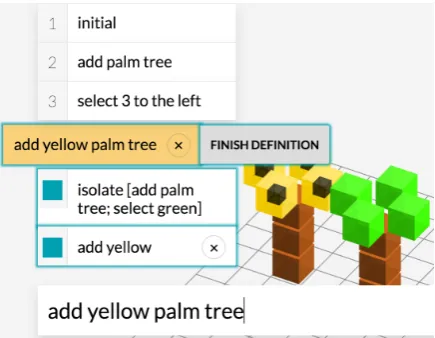
Figure 2: Interface used by users to enter utter-ances and create definitions.
2 Voxelurn
World. A world state in Voxelurn contains a set of voxels, where each voxel has relations ‘row’, ‘col’, ‘height’, and ‘color’. There are two specific actions, ‘add’ and ‘move’, one domain-specific relation ‘direction’. In addition, the state contains a selection, which is a set of positions. While our focus is Voxelurn, we can think more generally about the world as a set of objects equiped with relations — events on a calendar, cells of a spreadsheet, or lines of text.
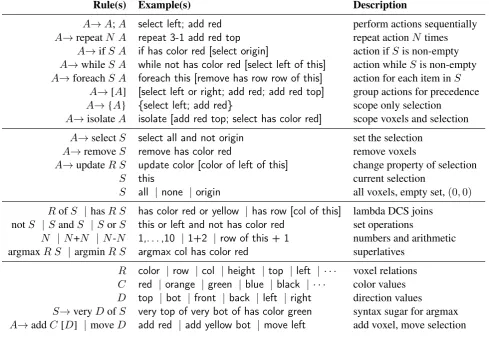
Core language. The system is born understand-ing a core language called Dependency-based Ac-tion Language (DAL), which we created (see Ta-ble1for an overview).
intersec-Rule(s) Example(s) Description
A→A;A select left; add red perform actions sequentially
A→repeatN A repeat 3-1 add red top repeat actionN times A→ifS A if has color red [select origin] action ifSis non-empty A→whileS A while not has color red [select left of this] action whileS is non-empty A→foreachS A foreach this [remove has row row of this] action for each item inS
A→[A] [select left or right; add red; add red top] group actions for precedence A→{A} {select left; add red} scope only selection
A→isolateA isolate [add red top; select has color red] scope voxels and selection
A→selectS select all and not origin set the selection
A→removeS remove has color red remove voxels
A→updateR S update color [color of left of this] change property of selection
S this current selection
S all | none | origin all voxels, empty set,(0,0)
RofS |hasR S has color red or yellow | has row [col of this] lambda DCS joins
notS |SandS |SorS this or left and not has color red set operations
N |N+N |N-N 1,. . . ,10 | 1+2 | row of this + 1 numbers and arithmetic argmaxR S |argminR S argmax col has color red superlatives
R color | row | col | height | top | left |· · · voxel relations
C red | orange | green | blue | black |· · · color values
D top | bot | front | back | left | right direction values
S→veryDofS very top of very bot of has color green syntax sugar for argmax
[image:3.595.70.560.65.402.2]A→addC[D] |moveD add red | add yellow bot | move left add voxel, move selection
Table 1: Grammar of the core language (DAL), which includes actions (A), relations (R), and sets of
values (S). The grammar rules are grouped into four categories. From top to bottom: domain-general
action compositions, actions using sets, lambda DCS expressions for sets, and domain-specific relations and actions.
tion and complement, lambda DCS leverages the tree dependency structure common in natural lan-guage: for the relation ‘color’, ‘has color red’ refers to the set of voxels that have color red, and its reverse ‘color of has row 1’ refers to the set of colors of voxels having row number 1. Tree-structured joins can be chained without using any variables, e.g., ‘has color [yellow or color of has row 1]’.
We protect the core language from being rede-fined so it is always precise and usable.1 In
ad-dition to expressivity, the core language interpo-lateswell with natural language. We avoid explicit variables by using aselection, which serves as the default argument for most actions.2 For example,
‘select has color red; add yellow top; remove’ adds yellow on top of red voxels and then removes the red voxels.
To enable the building of more complex struc-1Not doing so resulted in ambiguities that propagated
un-controllably, e.g., once ‘red’ can mean many different colors.
2The selection is like the turtle in LOGO, but can be a set.
tures in a more modular way, we introduce a no-tion ofscoping. Suppose one is operating on one of the palm trees in Figure2. The user might want to use ‘select all’ to select only the voxels in that tree rather than all of the voxels in the scene. In general, an action A can be viewed as taking a
set of voxels v and a selection s, and producing
an updated set of voxelsv0 and a modified
selec-tions0. The default scoping is ‘[A]’, which is the
same as ‘A’ and returns (v0, s0). There are two
constructs that alter the flow: First, ‘{A}’ takes
(v, s)and returns(v0, s), thus restoring the
selec-tion. This allowsAto use the selection as a
tem-porary variable without affecting the rest of the program. Second, ‘isolate [A]’ takes (v, s), calls
A with(s, s) (restricting the set of voxels to just
the selection) and returns (v00, s), where v00
con-sists of voxels in v0 and voxels in v that occupy empty locations in v0. This allows A to focus
‘[ ]’, ‘isolate’, and ‘{ }’, it is an unnatural concept for non-programmers. Therefore when the choice is not explicit, the parser generates all three pos-sible scoping interpretations, and the model learns which is intended based on the user, the rule, and potentially the context.
3 Learning interactively from definitions
The goal of the user is to build a structure in Vox-elurn. In Wang et al. (2016), the user provided interactive supervision to the system by selecting from a list of candidates. This is practical when there are less than tens of candidates, but is com-pletely infeasible for a complex action space such as Voxelurn. Roughly, 10 possible colors over the
3×3×4box containing the palm tree in Figure2
yields 1036 distinct denotations, and many more programs. Obtaining the structures in Figure1by selecting candidates alone would be infeasible.
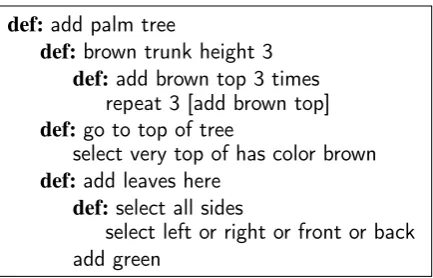
This work thus usesdefinitionsin addition to se-lecting candidates as the supervision signal. Each definition consists of aheadutterance and abody, which is a sequence of utterances that the system understands. One use of definitions is paraphras-ing and definparaphras-ing alternative syntax, which helps naturalize the core language (e.g., defining ‘add brown top 3 times’ as ‘repeat 3 add brown top’). The second use is building up complex concepts hierarchically. In Figure2, ‘add yellow palm tree’ is defined as a sequence of steps for building the palm tree. Once the system understands an utter-ance, it can be used in the body of other defini-tions. For example, Figure3shows the full defini-tion tree of ‘add palm tree’. Unlike funcdefini-tion defi-nitions in a programming language, our defidefi-nitions do not specify the exact arguments; the system has to learn to extract arguments to achieve the correct generalization.
The interactive definition process is described in Figure4. When the user types an utterancex, the
system parsesxinto a list of candidate programs.
If the user selects one of them (based on its de-notation), then the system executes the resulting program. If the utterance is unparsable or the user rejects all candidate programs, the user is asked to provide the definition body forx. Any utterances
in the body not yet understood can be defined re-cursively. Alternatively, the user can first execute a sequence of commandsX, and then provide a
head utterance for bodyX.
When constructing the definition body, users
def:add palm tree
def:brown trunk height 3
def: add brown top 3 times repeat 3 [add brown top]
def:go to top of tree
select very top of has color brown
def:add leaves here
def: select all sides
[image:4.595.309.526.63.202.2]select left or right or front or back add green
Figure 3:Defining ‘add palm tree’, tracing back to the core language (utterances withoutdef:).
beginexecutex:
ifxdoes not parsethendefinex; ifuser rejects all parsesthendefinex;
execute user choice
begindefinex:
repeatstarting withX ←[ ]
user entersx0;
ifx0does not parsethendefinex0; ifuser rejects allx0 thendefinex0; X ←[X;x0];
[image:4.595.307.527.253.416.2]untiluser acceptsXas the def’n ofx;
Figure 4:When the user enters an utterance, the system tries to parse and execute it, or requests that the user define it.
can type utterances with multiple parses; e.g., ‘move forward’ could either modify the selec-tion (‘select front’) or move the voxel (‘move front’). Rather than propagating this ambiguity to the head, we force the user to commit to one interpretation by selecting a particular candidate. Note that we are using interactivity to control the exploding ambiguity.
4 Model and learning
Let us turn to how the system learns and predicts. This section contains prerequisites before we de-scribe definitions and grammar induction in Sec-tion5.
Semantic parsing. Our system is based on a se-mantic parser that maps utterancesxto programs z, which can be executed on the current states(set
of voxels and selection) to produce the next state
s0=JzKs. Our system is implemented as the
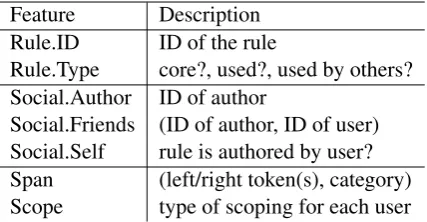
Feature Description Rule.ID ID of the rule
Rule.Type core?, used?, used by others? Social.Author ID of author
[image:5.595.73.287.62.173.2]Social.Friends (ID of author, ID of user) Social.Self rule is authored by user? Span (left/right token(s), category) Scope type of scoping for each user
Table 2: Summary of features.
seeLiang(2016) for a gentle exposition.
Aderivationdrepresents the process by which
an utterancexturns into a programz = prog(d).
More precisely, d is a tree where each node
contains the corresponding span of the utterance
(start(d),end(d)), the grammar rulerule(d), the
grammar category cat(d), and a list of child
derivations[d1, . . . , dn].
FollowingZettlemoyer and Collins (2005), we define a log-linear model over derivationsdgiven
an utterancexproduced by the useru:
pθ(d|x, u)∝exp(θTφ(d, x, u)), (1)
where φ(d, x, u) ∈ Rp is a feature vector and
θ ∈ Rp is a parameter vector. The user u does not appear in previous work on semantic parsing, but we use it to personalize the semantic parser trained on the community.
We use a standard chart parser to construct a chart. For each chart cell, indexed by the start and end indices of a span, we construct a list of partial derivations recursively by selecting child derivations from subspans and applying a gram-mar rule. The resulting derivations are sorted by model score and only the top K are kept. We
usechart(x)to denote the set of all partial
deriva-tions across all chart cells. The set of grammar rules starts with the set of rules for the core lan-guage (Table1), but grows via grammar induction when users add definitions (Section5). Rules in the grammar are stored in a trie based on the right-hand side to enable better scalability to a large number of rules.
Features. Derivations are scored using a weighted combination of features. There are three types of features, summarized in Table2.
Rule featuresfire on each rule used to construct a derivation. ID features fire on specific rules (by ID). Type features track whether a rule is part of the core language or induced, whether it has been
used again after it was defined, if it was used by someone other than its author, and if the user and the author are the same (5 +#rules features).
Social features fire on properties of rules that capture the unique linguistic styles of different users and their interaction with each other. Author features capture the fact that some users provide better, and more generalizable definitions that tend to be accepted. Friends features are cross products of author ID and user ID, which captures whether rules from a particular author are systematically preferred or not by the current user, due to stylistic similarities or differences (#users+#users×#users features).
Span featuresinclude conjunctions of the cate-gory of the derivation and the leftmost/rightmost token on the border of the span. In addition, span features include conjunctions of the category of the derivation and the 1 or 2 adjacent tokens just outside of the left/right border of the span. These capture a weak form of context-dependence that is generally helpful (<≈ V4 × #cats features for a vocabulary of sizeV).
Scoping featurestrack how the community, as well as individual users, prefer each of the 3 scoping choices (none, selection only ‘{A}’, and voxels+selection ‘isolate {A}’), as described in Section 2. 3 global indicators, and 3 indicators for each user fire every time a particular scoping choice is made (3 + 3×#users features).
Parameter estimation. When the user types an utterance, the system generates a list of candidate next states. When the user chooses a particular next states0from this list, the system performs an
online AdaGrad update (Duchi et al.,2010) on the parametersθaccording to the gradient of the fol-lowing loss function:
−log X
d:Jprog(d)Ks=s0
pθ(d|x, u) +λ||θ||1,
which attempts to increase the model probability on derivations whose programs produce the next states0.
5 Grammar induction
these definitions into new grammar rules that can be used by the system to parse new utterances.
Previous systems of grammar induction for semantic parsing were given utterance-program pairs (x, z). Both the GENLEX (Zettlemoyer
and Collins, 2005) and higher-order unifica-tion (Kwiatkowski et al., 2010) algorithms over-generate rules that liberally associate parts of x
with parts ofz. Though some rules are
immedi-ately pruned, many spurious rules are undoubtedly still kept. In the interactive setting, we must keep the number of candidates small to avoid a bad user experience, which means a higher precision bar for new rules.
Fortunately, the structure of definitions makes the grammar induction task easier. Rather than be-ing given an utterance-program(x, z)pair, we are
given a definition, which consists of an utterance
x (head) along with the bodyX = [x1, . . . , xn], which is a sequence of utterances. The bodyXis
fully parsed into a derivationd, while the headxis
likely only partially parsed. These partial deriva-tions are denoted bychart(x).
At a high-level, we find matches—partial derivationschart(x)of the headxthat also occur
in the full derivationdof the bodyX. A grammar rule is produced by substituting any set of non-overlapping matches by their categories. As an example, suppose the user defines
‘add red top times 3’ as ‘repeat 3 [add red top]’.
Then we would be able to induce the following two grammar rules:
A→addC DtimesN :
λCDN.repeat N [add C D]
A→AtimesN :
λAN.repeat N [A]
The first rule substitutes primitive values (‘red’, ‘top’, and ‘3’) with their respective pre-terminal categories (C, D, N). The second rule contains compositional categories like actions (A), which
require some care. One might expect that greedily substituting the largest matches or the match that covers the largest portion of the body would work, but the following example shows that this is not the case:
A1 A1 A1
z }| { z }| { z }| {
add red left and here=add red left; add red
| {z } | {z }
A2 A2
Here, both the highest coverage substitution (A1: ‘add red’, which covers 4 tokens of the body), and the largest substitution available (A2: ‘add red left’) would generalize incorrectly. The correct grammar rule only substitutes the primitive values (‘red’, ‘left’).
5.1 Highest scoring abstractions
We now propose a grammar induction procedure that optimizes a more global objective and uses the learned semantic parsing model to choose substi-tutions. More formally, letM be the set of partial
derivations in the head whose programs appear in the derivationdX of the bodyX:
M def= {d∈chart(x) :
∃d0∈desc(dX)∧prog(d) = prog(d0)},
wheredesc(dX)are the descendant derivations of
dX. Our goal is to find a packing P ⊆ M, which is a set of derivations corresponding to non-overlapping spans of the head. We say that a pack-ingP is maximal if no other derivations may be
added to it without creating an overlap.
Let packings(M) denote the set of maximal
packings, we can frame our problem as finding the maximal packing that has the highest score under our current semantic parsing model:
PL∗ = argmax
P∈packings(M);
X
d∈P
score(d). (2)
Finding the highest scoring packing can be done using dynamic programming onPi∗ fori = 0,1, . . . , L, whereLis the length ofxandP0∗ =∅. Sinced∈M,start(d)andend(d)(exclusive)
re-fer to span in the headx. To obtain this dynamic
program, let Di be the highest scoring maximal packing containing a derivation endingexactly at positioni(if it exists):
Di ={di} ∪Pstart(d∗ i), (3)
di = argmax d∈M;end(d)=i
score(d∪Pstart(d)∗ ). (4)
Then the maximal packing of up toi can be
de-fined recursively as
Pi∗= argmax
D∈{Ds(i)+1,Ds(i)+2,...,Di}
score(D) (5)
s(i) = max
Input :x, dX, P∗
Output: rule
r ←x; f ←dX;
for d∈P∗do
r←r[cat(d)/span(d)]
f ←λcat(d).f[cat(d)/d]
returnrule(cat(dX)→r:f)
Algorithm 1:Extract a ruler from a derivation dX of bodyX and a packingP∗. Here, f[t/s] means substituting s by t in f, with the usual
care about names of bound variables.
wheres(i)is the largest index such thatDs(i)is no longer maximal for the span(0, i) (i.e. there is a
d∈Mon the spanstart(d)≥s(i)∧end(d)≤i.
Once we have a packing P∗ = PL∗, we can go
throughd ∈ P∗ in order ofstart(d), as in
Algo-rithm1. This generates one high precision rule per packing per definition. In addition to the highest scoring packing, we also use a “simple packing”, which includes only primitive values (in Voxelurn, these are colors, numbers, and directions). Un-like the simple packing, the rule induced from the highest scoring packing does not always ize correctly. However, a rule that often general-izes incorrectly should be down-weighted, along with the score of its packings. As a result, a differ-ent rule might be induced next time, even with the same definition.
5.2 Extending the chart via alignment
Algorithm 1yields high precision rules, but fails to generalize in some cases. Suppose that ‘move up’ is defined as ‘move top’, where ‘up’ does not parse, and does not match anything. We would like to infer that ‘up’ means ‘top’. To handle this, we leverage a property of definitions that we have not used thus far: the utterances themselves. If we align the head and body, then we would in-tuitively expect aligned phrases to correspond to the same derivations. Under this assumption, we can then transplant these derivations from dX to
chart(x)to create new matches. This is more con-strained than the usual alignment problem (e.g., in machine translation) since we only need to con-sider spans ofXwhich corresponds to derivations indesc(dX).
Algorithm2provides the algorithm for extend-ing the chart via alignments. Thealignedfunction
is implemented using the following two heuristics:
Input :x, X, dX
for d∈desc(dX),x0 ∈spans(x)do
if aligned(x0, d,(x, X))then
d0←d;
start(d0)←start(x0); end(d0)←end(x0);
chart(x)←chart(x)∪d0 end
end
Algorithm 2:Extending the chart by alignment: If d is aligned with x0 based on the utterance,
then we pretend thatx0 should also parse to d, anddis transplanted tochart(x) as if it parsed
fromx0.
• exclusion: if all but 1 pair of short spans (1 or 2 tokens) are matched, the unmatched pair is considered aligned.
• projectivity: if d1, d2 ∈ desc(dX) ∩
chart(x), thenances(d1, d2)is aligned to the corresponding span inx.
With the extended chart, we can run the algo-rithm from Section5.1to induce rules. The trans-planted derivations (e.g., ‘up’) might now form new matches which allows the grammar induction to induce more generalizable rules. We only per-form this extension when the body consists of one utterance, which tend to be a paraphrase. Bodies with multiple utterances tend to be new concepts (e.g., ‘add green monster’), for which alignment is impossible. Because users have to select from candidates parses in the interactive setting, induc-ing low precision rules that generate many parses degrade the user experience. Therefore, we induce alignment-based rules conservatively—only when all but 1 or 2 tokens of the head aligns to the body and vice versa.
6 Experiments
Figure 5: The target used for the qualifier.
Next, we allowed the workers who qualified to enter the second freebuildingtask, in which they were asked to build any structure they wanted in 30 minutes. This process was designed to give users freedom while ensuring quality. The anal-ogy of this scheme in a real system is that early users (or a small portion of expert users) have to make some learning investment, so the system can learn and become easier for other users.
Statistics. 70 workers passed the qualifier task, and 42 workers participated in the final free-building experiment. They built 230 structures. There were over 103,000 queries consisting of 5,388 distinct token types. Of these, 64,075 utter-ances were tried and 36,589 were accepted (so an action was performed). There were 2,495 defini-tions combining over 15,000 body utterances with 6.5 body utterances per head on average (96 max). From these definitions, 2,817 grammar rules were induced, compared to less than 100 core rules. Over all queries, there were 8.73 parses per utter-ance on average (starting from 1 for core).
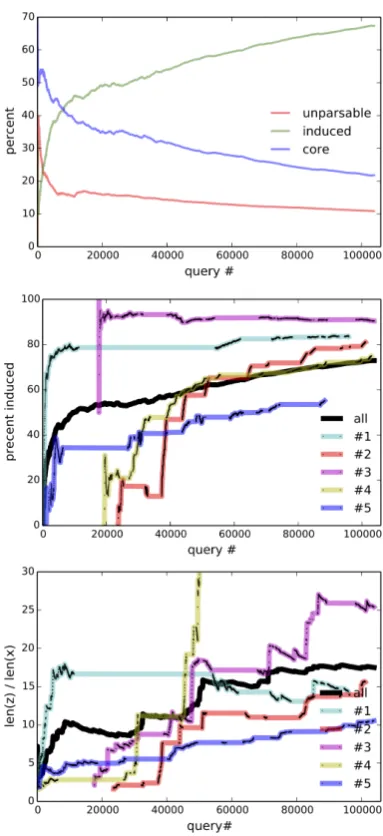
Is naturalization happening? The answer is yes according to Figure 6, which plots the cum-mulative percentage of utterances that are core, duced, or unparsable. To rule out that more in-duced utterances are getting rejected, we consider only accepted utterances in the middle of Fig-ure6, which plots the percentage of induced rules among accepted utterances for the entire commu-nity, as well as for the 5 heaviest users. Since un-parsable utterances cannot be accepted, accepted core (which is not shown) is the complement of accepted induced. At the conclusion of the ex-periment, 72.9% of all accepted utterances are induced—this becomes 85.9% if we only consider the final 10,000 accepted utterances.
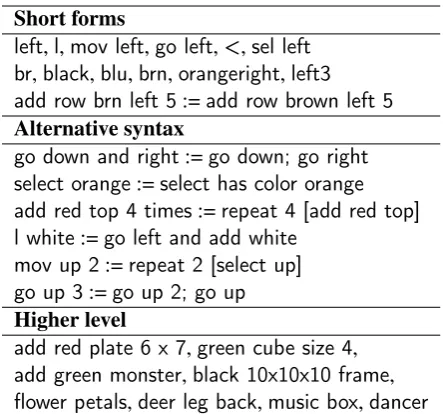
Three modes of naturalization are outlined in Table3. For very common operations, like moving the selection, people found ‘select left’ too ver-bose and shorterned this to l, left, >, sel l. One user preferred ‘go down and right’ instead of ‘se-lect bot; se‘se-lect right’ in core and defined it as ‘go down; go right’. Definitions for high-level
Figure 6: Learning curves. Top: percentage of all utterances that are part of the core language, the induced language, or unparsable by the sys-tem. Middle: percentage of accepted utterances belonging to the induced language, overall and for the 5 heaviest users.Bottom:expressiveness mea-sured by the ratio of the length of the program to the length of the corresponding utterance.
concepts tend to be whole objects that are not pa-rameterized (e.g., ‘dancer’). The bottom plot of Figure6 suggests that users are defining and us-ing higher level concepts, since programs become longer relative to utterances over time.
Short forms
left,l,mov left,go left,<,sel left br,black,blu,brn,orangeright,left3 add row brn left 5:=add row brown left 5
Alternative syntax
go down and right:=go down; go right select orange:=select has color orange add red top 4 times:=repeat 4 [add red top] l white:=go left and add white
mov up 2:=repeat 2 [select up] go up 3:=go up 2; go up
Higher level
[image:9.595.71.293.60.267.2]add red plate 6 x 7,green cube size 4, add green monster,black 10x10x10 frame, flower petals,deer leg back,music box,dancer
Table 3: Example definitions. See CodaLab work-sheet for the full leaderboard.
Learned parameters. Training using L1 regu-larization, we obtained 1713 features with non-zero parameters. One user defined many con-cepts consisting of a single short token, and the Social.Author feature for that user has the most negative weight overall. With user compatibil-ity (Social.Friends), some pairs have large pos-itive weights and others large negative weights. The ‘isolate’ scoping choice (which allows easier hierarchical building) received the most positive weights, both overall and for many users. The 2 highest scoring induced rules correspond to ‘add row red right 5’ and ‘select left 2’.
Incentives. Having complex structures show that the actions in Voxelurn are expressive and that hierarchical definitions are useful. To incentivize this behavior, we created a leaderboard which ranked structures based on recency and upvotes (like Hacker News). Over the course of 3 days, we picked three prize categories to be released daily. The prize categories for each day were bridge, house, animal; tower, monster, flower; ship, dancer, and castle.
To incentivize more definitions, we also track
citations. When a rule is used in an accepted ut-terance by another user, the rule (and its author) receives a citation. We pay bonuses to top users according to their h-index. Most cited definitions are also displayed on the leaderboard. Our qual-itative results should be robust to the incentives scheme, because the users do not overfit to the incentives—e.g., around 20% of the structures are
not in the prize categories and users define com-plex concepts that are rarely cited.
7 Related work and discussion
This work is an evolution ofWang et al. (2016), but differs crucially in several ways: WhileWang et al.(2016) starts from scratch and relies on se-lecting candidates, this work starts with a pro-gramming language (PL) and additionally relies on definitions, allowing us to scale. Instead of having a private language for each user, the user community in this work shares one language.
Azaria et al. (2016) presents Learning by In-struction Agent (LIA), which also advocates learn-ing from users. They argue that developers can-not anticipate all the actions that users want, and that the system cannot understand the correspond-ing natural language even if the desired action is built-in. LikeJia et al.(2017),Azaria et al.(2016) starts with an ad-hoc set of initial slot-filling com-mands in natural language as the basis of further instructions—our approach starts with a more ex-pressive core PL designed to interpolate with nat-ural language. Compared to previous work, this work studied interactive learning in a shared com-munity setting and hierarchical definitions result-ing in more complex concepts.
Allowing ambiguity and a flexible syntax is a key reason why natural language is easier to produce—this cannot be achieved by PLs such as Inform and COBOL which look like natural lan-guage. In this work, we use semantic parsing tech-niques that can handle ambiguity (Zettlemoyer and Collins,2005,2007;Kwiatkowski et al.,2010; Liang et al.,2011;Pasupat and Liang,2015). In semantic parsing, the semantic representation and action space is usually designed to accommodate the natural language that is considered constant. In contrast, the action space is considered constant in the naturalizing PL approach, and the language adapts to be more natural while accommodating the action space.
Acknowledgments. We thank our reviewers, Panupong (Ice) Pasupat for helpful suggestions and discussions on lambda DCS, DARPA Com-municating with Computers (CwC) program un-der ARO prime contract no. W911NF-15-1-0462, and NSF CAREER Award no. IIS-1552635.
Reproducibility. All code, data, and experi-ments for this paper are available on the CodaLab platform:
https://worksheets. codalab.org/worksheets/
0xbf8f4f5b42e54eba9921f7654b3c5c5d
and a demo:http://www.voxelurn.com
References
Y. Artzi and L. Zettlemoyer. 2011. Bootstrapping
semantic parsers from conversations. In
Em-pirical Methods in Natural Language Processing (EMNLP). pages 421–432.
Y. Artzi and L. Zettlemoyer. 2013. Weakly supervised learning of semantic parsers for mapping
instruc-tions to acinstruc-tions. Transactions of the Association for
Computational Linguistics (TACL)1:49–62.
A. Azaria, J. Krishnamurthy, and T. M. Mitchell. 2016.
Instructable intelligent personal agent. In
Associa-tion for the Advancement of Artificial Intelligence (AAAI). pages 2681–2689.
J. Berant, A. Chou, R. Frostig, and P. Liang. 2013. Se-mantic parsing on Freebase from question-answer
pairs. InEmpirical Methods in Natural Language
Processing (EMNLP).
G. Campagna, R. Ramesh, S. Xu, M. Fischer, and M. S. Lam. 2017. Almond: The architecture of an open, crowdsourced, privacy-preserving,
pro-grammable virtual assistant. In World Wide Web
(WWW). pages 341–350.
J. Duchi, E. Hazan, and Y. Singer. 2010. Adaptive sub-gradient methods for online learning and stochastic
optimization. In Conference on Learning Theory
(COLT).
S. Gulwani and M. Marron. 2014. NLyze: interac-tive programming by natural language for
spread-sheet data analysis and manipulation. In
Interna-tional Conference on Management of Data,
SIG-MOD. pages 803–814.
R. Jia, L. Heck, D. Hakkani-Tür, and G. Nikolov. 2017. Learning concepts through conversations in spoken
dialogue systems. In International Conference on
Acoustics, Speech, and Signal Processing (ICASSP).
N. Kushman and R. Barzilay. 2013. Using semantic unification to generate regular expressions from
nat-ural language. InHuman Language Technology and
North American Association for Computational Lin-guistics (HLT/NAACL). pages 826–836.
T. Kwiatkowski, L. Zettlemoyer, S. Goldwater, and M. Steedman. 2010. Inducing probabilistic CCG grammars from logical form with higher-order
unifi-cation. InEmpirical Methods in Natural Language
Processing (EMNLP). pages 1223–1233.
P. Liang. 2013. Lambda dependency-based
composi-tional semantics. arXiv preprint arXiv:1309.4408.
P. Liang. 2016. Learning executable semantic parsers
for natural language understanding.
Communica-tions of the ACM59.
P. Liang, M. I. Jordan, and D. Klein. 2011. Learn-ing dependency-based compositional semantics. In
Association for Computational Linguistics (ACL). pages 590–599.
P. Pasupat and P. Liang. 2015. Compositional semantic
parsing on semi-structured tables. InAssociation for
Computational Linguistics (ACL).
S. Tellex, T. Kollar, S. Dickerson, M. R. Walter, A. G.
Banerjee, S. J. Teller, and N. Roy. 2011.
Un-derstanding natural language commands for robotic
navigation and mobile manipulation. In
Associa-tion for the Advancement of Artificial Intelligence (AAAI).
S. I. Wang, P. Liang, and C. Manning. 2016. Learning
language games through interaction. InAssociation
for Computational Linguistics (ACL).
M. Zelle and R. J. Mooney. 1996. Learning to parse database queries using inductive logic
program-ming. InAssociation for the Advancement of
Arti-ficial Intelligence (AAAI). pages 1050–1055.
L. S. Zettlemoyer and M. Collins. 2005. Learning to map sentences to logical form: Structured
classifica-tion with probabilistic categorial grammars. In
Un-certainty in Artificial Intelligence (UAI). pages 658– 666.
L. S. Zettlemoyer and M. Collins. 2007. Online learn-ing of relaxed CCG grammars for parslearn-ing to
log-ical form. In Empirical Methods in Natural