Proceedings of the 55th Annual Meeting of the Association for Computational Linguistics, pages 146–157 Vancouver, Canada, July 30 - August 4, 2017. c2017 Association for Computational Linguistics Proceedings of the 55th Annual Meeting of the Association for Computational Linguistics, pages 146–157
Vancouver, Canada, July 30 - August 4, 2017. c2017 Association for Computational Linguistics
Neural AMR: Sequence-to-Sequence Models for Parsing and Generation
Ioannis Konstas† Srinivasan Iyer† Mark Yatskar†
Yejin Choi† Luke Zettlemoyer†‡
†Paul G. Allen School of Computer Science & Engineering, Univ. of Washington, Seattle, WA
{ikonstas,sviyer,my89,yejin,lsz}@cs.washington.edu
‡Allen Institute for Artificial Intelligence, Seattle, WA [email protected]
Abstract
Sequence-to-sequence models have shown strong performance across a broad range of applications. However, their applica-tion to parsing and generating text using Abstract Meaning Representation (AMR) has been limited, due to the relatively lim-ited amount of labeled data and the non-sequential nature of the AMR graphs. We present a novel training procedure that can lift this limitation using millions of unla-beled sentences and careful preprocessing of the AMR graphs. For AMR parsing, our model achieves competitive results of 62.1 SMATCH, the current best score reported without significant use of external seman-tic resources. For AMR generation, our model establishes a new state-of-the-art performance of BLEU 33.8. We present extensive ablative and qualitative analysis including strong evidence that sequence-based AMR models are robust against ordering variations of graph-to-sequence conversions.
1 Introduction
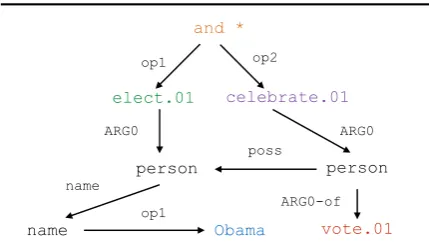
Abstract Meaning Representation (AMR) is a se-mantic formalism to encode the meaning of natu-ral language text. As shown in Figure 1, AMR rep-resents the meaning using a directed graph while abstracting away the surface forms in text. AMR has been used as an intermediate meaning repre-sentation for several applications including ma-chine translation (MT) (Jones et al., 2012), sum-marization (Liu et al., 2015), sentence compres-sion (Takase et al., 2016), and event extraction (Huang et al., 2016). While AMR allows for rich semantic representation, annotating training data in AMR is expensive, which in turn limits the use
Obama was electedand hisvoters celebrated
Obama
elect.01 celebrate.01
vote.01 and *
op1 op2
ARG0
poss
ARG0
person name
name op1
person
ARG0-of
Figure 1: An example sentence and its cor-responding Abstract Meaning Representation (AMR). AMR encodes semantic dependencies be-tween entities mentioned in the sentence, such as “Obama” being the “arg0” of the verb “elected”.
of neural network models (Misra and Artzi, 2016; Peng et al., 2017; Barzdins and Gosko, 2016).
In this work, we present the first success-ful sequence-to-sequence (seq2seq) models that achieve strong results for both text-to-AMR pars-ing and AMR-to-text generation. Seq2seq models have been broadly successful in many other appli-cations (Wu et al., 2016; Bahdanau et al., 2015; Luong et al., 2015; Vinyals et al., 2015). How-ever, their application to AMR has been limited, in part because effective linearization (encoding graphs as linear sequences) and data sparsity were thought to pose significant challenges. We show that these challenges can be easily overcome, by demonstrating that seq2seq models can be trained usinganygraph-isomorphic linearization and that unlabeled text can be used to significantly reduce sparsity.
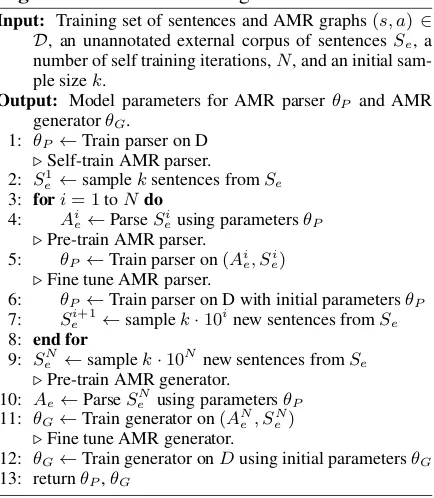
Our approach is two-fold. First, we introduce a novel paired training procedure that enhances both the text-to-AMR parser and AMR-to-text genera-tor. More concretely, first we use self-training to
[image:1.595.308.523.240.362.2]bootstrap a high quality AMR parser from mil-lions of unlabeled Gigaword sentences (Napoles et al., 2012) and then use the automatically parsed AMR graphs to pre-train an AMR generator. This paired training allows both the parser and genera-tor to learn high quality representations of fluent English text from millions of weakly labeled ex-amples, that are then fine-tuned using human an-notated AMR data.
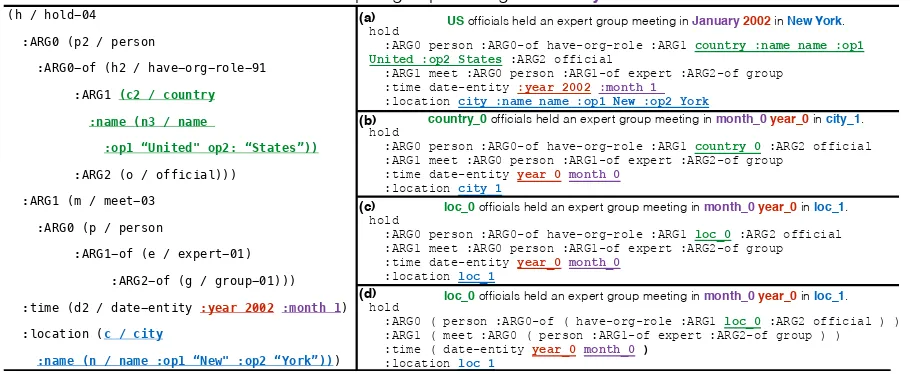
Second, we propose a preprocessing procedure for the AMR graphs, which includes anonymizing entities and dates, grouping entity categories, and encoding nesting information in concise ways, as illustrated in Figure 2(d). This preprocessing pro-cedure helps overcoming the data sparsity while also substantially reducing the complexity of the AMR graphs. Under such a representation, we show that any depth first traversal of the AMR is an effective linearization, and it is even possible to use a different random order for each example.
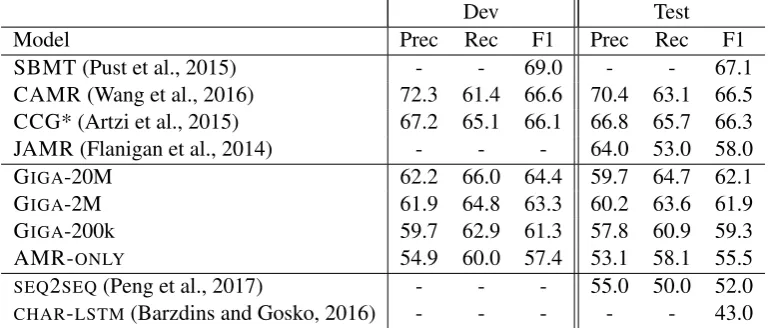
Experiments on the LDC2015E86 AMR cor-pus (SemEval-2016 Task 8) demonstrate the ef-fectiveness of the overall approach. For parsing, we are able to obtain competitive performance of 62.1 SMATCH without using any external anno-tated examples other than the output of a NER system, an improvement of over 10 points rela-tive to neural models with a comparable setup. For generation, we substantially outperform previ-ous best results, establishing a new state of the art of 33.8 BLEU. We also provide extensive ablative and qualitative analysis, quantifying the contribu-tions that come from preprocessing and the paired training procedure.
2 Related Work
Alignment-based Parsing Flanigan et al. (2014) (JAMR) pipeline concept and relation identification with a graph-based algorithm. Zhou et al. (2016) extend JAMR by performing the concept and relation identification tasks jointly with an incremental model. Both systems rely on features based on a set of alignments produced using bi-lexical cues and hand-written rules. In contrast, our models train directly on parallel cor-pora, and make only minimal use of alignments to anonymize named entities.
Grammar-based Parsing Wang et al. (2016) (CAMR) perform a series of shift-reduce transfor-mations on the output of an externally-trained de-pendency parser, similar to Damonte et al. (2017),
Brandt et al. (2016), Puzikov et al. (2016), and Goodman et al. (2016). Artzi et al. (2015) use a grammar induction approach with Combinatory Categorical Grammar (CCG), which relies on pre-trained CCGBank categories, like Bjerva et al. (2016). Pust et al. (2015) recast parsing as a string-to-tree Machine Translation problem, us-ing unsupervised alignments (Pourdamghani et al., 2014), and employing several external semantic resources. Our neural approach is engineering lean, relying only on a large unannotated corpus of English and algorithms to find and canonicalize named entities.
Neural Parsing Recently there have been a few seq2seq systems for AMR parsing (Barzdins and Gosko, 2016; Peng et al., 2017). Similar to our approach, Peng et al. (2017) deal with sparsity by anonymizing named entities and typing low fre-quency words, resulting in a very compact vocab-ulary (2k tokens). However, we avoid reducing our vocabulary by introducing a large set of unlabeled sentences from an external corpus, therefore dras-tically lowering the out-of-vocabulary rate (see Section 6).
AMR Generation Flanigan et al. (2016) spec-ify a number of tree-to-string transduction rules based on alignments and POS-based features that are used to drive a tree-based SMT system. Pour-damghani et al. (2016) also use an MT decoder; they learn a classifier that linearizes the input AMR graph in an order that follows the output sentence, effectively reducing the number of align-ment crossings of the phrase-based decoder. Song et al. (2016) recast generation as a traveling sales-man problem, after partitioning the graph into fragments and finding the best linearization order. Our models do not need to rely on a particular lin-earization of the input, attaining comparable per-formance even with a per example random traver-sal of the graph. Finally, all three systems intersect with a large language model trained on Gigaword. We show that our seq2seq model has the capacity to learn the same information as a language model, especially after pretraining on the external corpus.
and mixing it with the human translations. We instead pre-train on the external corpus first, and then fine-tune on the original dataset.
3 Methods
In this section, we first provide the formal defini-tion of AMR parsing and generadefini-tion (secdefini-tion 3.1). Then we describe the sequence-to-sequence mod-els we use (section 3.2), graph-to-sequence con-version (section 3.3), and our paired training pro-cedure (section 3.4).
3.1 Tasks
We assume access to a training dataset Dwhere each example pairs a natural language sentences with an AMRa. The AMR is a rooted directed acylical graph. It contains nodes whose names correspond to sense-identified verbs, nouns, or AMR specific concepts, for exampleelect.01, Obama, and person in Figure 1. One of these nodes is a distinguished root, for exam-ple, the node and in Figure 1. Furthermore, the graph contains labeled edges, which correspond to PropBank-style (Palmer et al., 2005) seman-tic roles for verbs or other relations introduced for AMR, for example,arg0orop1in Figure 1. The set of node and edge names in an AMR graph is drawn from a set of tokensC, and every word in a sentence is drawn from a vocabularyW.
We study the task of training anAMR parser, i.e., finding a set of parametersθP for model f,
that predicts an AMR graphˆa, given a sentences:
ˆ
a= argmax
a f a|s;θP
(1)
We also consider the reverse task, training an
AMR generator by finding a set of parameters θG, for a modelf that predicts a sentencesˆ, given
an AMR grapha:
ˆ
s= argmax
s f s|a;θG
(2)
In both cases, we use the same family of pre-dictors f, sequence-to-sequence models that use global attention, but the models have independent parameters,θP andθG.
3.2 Sequence-to-sequence Model
For both tasks, we use a stacked-LSTM sequence-to-sequence neural architecture employed in neu-ral machine translation (Bahdanau et al., 2015; Wu
et al., 2016).1 Our model uses a global
atten-tion decoder and unknown word replacement with small modifications (Luong et al., 2015).
The model uses a stacked bidirectional-LSTM encoder to encode an input sequence and a stacked LSTM to decode from the hidden states produced by the encoder. We make two modifications to the encoder: (1) we concatenate the forward and backward hidden states at every level of the stack instead of at the top of the stack, and (2) intro-duce dropout in the first layer of the encoder. The decoder predicts an attention vector over the en-coder hidden states using previous deen-coder states. The attention is used to weigh the hidden states of the encoder and then predict a token in the out-put sequence. The weighted hidden states, the decoded token, and an attention signal from the previous time step (input feeding) are then fed to-gether as input to the next decoder state. The de-coder can optionally choose to output an unknown word symbol, in which case the predicted atten-tion is used to copy a token directly from the input sequence into the output sequence.
3.3 Linearization
Our seq2seq models require that both the input and target be presented as a linear sequence of tokens. We define a linearization order for an AMR graph as any sequence of its nodes and edges. A lin-earization is defined as (1) a linlin-earization order and (2) a rendering function that generates any number of tokens when applied to an element in the linearization order (see Section 4.2 for imple-mentation details). Furthermore, for parsing, a valid AMR graph must be recoverable from the linearization.
3.4 Paired Training
Obtaining a corpus of jointly annotated pairs of sentences and AMR graphs is expensive and cur-rent datasets only extend to thousands of exam-ples. Neural sequence-to-sequence models suffer from sparsity with so few training pairs. To reduce the effect of sparsity, we use an external unan-notated corpus of sentences Se, and a procedure
which pairs the training of the parser and genera-tor.
Our procedure is described in Algorithm 1, and first trains a parser on the datasetDof pairs of sen-tences and AMR graphs. Then it uses self-training
1We extended the Harvard NLP seq2seq framework from
Algorithm 1Paired Training Procedure
Input: Training set of sentences and AMR graphs(s, a)∈ D, an unannotated external corpus of sentencesSe, a number of self training iterations,N, and an initial sam-ple sizek.
Output: Model parameters for AMR parserθP and AMR generatorθG.
1: θP ←Train parser on D
.Self-train AMR parser. 2: S1
e ←sampleksentences fromSe 3: fori= 1toNdo
4: Ai
e←ParseSeiusing parametersθP
.Pre-train AMR parser.
5: θP ←Train parser on(Aie, Sei)
.Fine tune AMR parser.
6: θP ←Train parser on D with initial parametersθP 7: Sei+1←samplek·10inew sentences fromSe 8: end for
9: SeN←samplek·10Nnew sentences fromSe
.Pre-train AMR generator.
10: Ae←ParseSeNusing parametersθP 11: θG←Train generator on(ANe , SeN)
.Fine tune AMR generator.
12: θG←Train generator onDusing initial parametersθG 13: returnθP,θG
to improve the initial parser. Every iteration of self-training has three phases: (1) parsing samples from a large, unlabeled corpus Se, (2) creating a
new set of parameters by training on Se, and (3)
fine-tuning those parameters on the original paired data. After each iteration, we increase the size of the sample fromSeby an order of magnitude.
Af-ter we have the best parser from self-training, we use it to label AMRs forSeand pre-train the
gen-erator. The final step of the procedure fine-tunes the generator on the original datasetD.
4 AMR Preprocessing
We use a series of preprocessing steps, including AMR linerization, anonymization, and other mod-ifications we make to sentence-graph pairs. Our methods have two goals: (1) reduce the complex-ity of the linearized sequences to make learning easier while maintaining enough original informa-tion, and (2) address sparsity from certain open class vocabulary entries, such as named entities (NEs) and quantities. Figure 2(d) contains exam-ple inputs and outputs with all of our preprocess-ing techniques.
Graph Simplification In order to reduce the overall length of the linearized graph, we first re-move variable names and theinstance-of re-lation ( / ) before every concept. In case of re-entrant nodes we replace the variable mention with its co-referring concept. Even though this replacement incurs loss of information, often the
surrounding context helps recover the correct real-ization, e.g., the possessive role:possin the ex-ample of Figure 1 is strongly correlated with the surface formhis. Following Pourdamghani et al. (2016) we also remove senses from all concepts for AMR generation only. Figure 2(a) contains an example output after this stage.
4.1 Anonymization of Named Entities
Open-class types including NEs, dates, and num-bers account for 9.6% of tokens in the sentences of the training corpus, and 31.2% of vocabulary W. 83.4% of them occur fewer than 5 times in the dataset. In order to reduce sparsity and be able to account for new unseen entities, we perform ex-tensive anonymization.
[image:4.595.74.291.78.327.2]First, we anonymize sub-graphs headed by one of AMR’s over 140 fine-grained entity types that contain a :name role. This captures structures referring to entities such asperson,country, miscellaneous entities marked with*-enitity, and typed numerical values, *-quantity. We excludedateentities (see the next section). We then replace these sub-graphs with a token indicat-ing fine-grained type and an index,i, indicating it is theith occurrence of that type.2For example, in
Figure 2 the sub-graph headed bycountrygets replaced withcountry 0.
On the training set, we use alignments obtained using the JAMR aligner (Flanigan et al., 2014) and the unsupervised aligner of Pourdamghani et al. (2014) in order to find mappings of anonymized subgraphs to spans of text and replace mapped text with the anonymized token that we inserted into the AMR graph. We record this mapping for use during testing of generation models. If a gener-ation model predicts an anonymizgener-ation token, we find the corresponding token in the AMR graph and replace the model’s output with the most fre-quent mapping observed during training for the entity name. If the entity was never observed, we copy its name directly from the AMR graph.
Anonymizing Dates For dates in AMR graphs, we use separate anonymization tokens for year, month-number, month-name, day-number and day-name, indicating whether the date is men-tioned by word or by number.3 In AMR
gener-2In practice we only used three groups of ids: a different
one for NEs, dates and constants/numbers.
3We also use three date format markers that appear in the
US officials held an expert group meeting in January2002 in New York.
(h / hold-04
:ARG0 (p2 / person
:ARG0-of (h2 / have-org-role-91
:ARG1 (c2 / country
:name (n3 / name
:op1 “United" op2: “States”))
:ARG2 (o / official)))
:ARG1 (m / meet-03
:ARG0 (p / person
:ARG1-of (e / expert-01)
:ARG2-of (g / group-01)))
:time (d2 / date-entity :year 2002:month 1)
:location (c / city
:name (n / name :op1 “New" :op2 “York”)))
hold
:ARG0 person :ARG0-of have-org-role :ARG1 loc_0 :ARG2 official :ARG1 meet :ARG0 person :ARG1-of expert :ARG2-of group :time date-entity year_0month_0
:location loc_1 hold
:ARG0 person :ARG0-of have-org-role :ARG1 country_0 :ARG2 official :ARG1 meet :ARG0 person :ARG1-of expert :ARG2-of group
:time date-entity year_0month_0 :location city_1
hold
:ARG0 person :ARG0-of have-org-role :ARG1 country :name name :op1 United :op2 States :ARG2 official
:ARG1 meet :ARG0 person :ARG1-of expert :ARG2-of group :time date-entity :year 2002 :month 1
:location city :name name :op1 New :op2 York
hold
:ARG0 ( person :ARG0-of ( have-org-role :ARG1 loc_0 :ARG2 official ) ) :ARG1 ( meet :ARG0 ( person :ARG1-of expert :ARG2-of group ) ) :time ( date-entity year_0 month_0 )
:location loc_1
US officials held an expert group meeting in January2002 in New York.
country_0 officials held an expert group meeting in month_0 year_0 in city_1.
loc_0 officials held an expert group meeting in month_0year_0 in loc_1.
loc_0 officials held an expert group meeting in month_0year_0 in loc_1. (a)
(b)
(c)
[image:5.595.73.528.73.260.2](d)
Figure 2: Preprocessing methods applied to sentence (top row) - AMR graph (left column) pairs. Sentence-graph pairs after (a) graph simplification, (b) named entity anonymization, (c) named entity clustering, and (d) insertion of scope markers.
ation, we render the corresponding format when predicted. Figure 2(b) contains an example of all preprocessing up to this stage.
Named Entity Clusters When performing
AMR generation, each of the AMR fine-grained entity types is manually mapped to one of the four coarse entity types used in the Stanford NER system (Finkel et al., 2005): person, location, organization and misc. This reduces the sparsity associated with many rarely occurring entity types. Figure 2 (c) contains an example with named entity clusters.
NER for Parsing When parsing, we must nor-malize test sentences to match our anonymized training data. To produce fine-grained named enti-ties, we run the Stanford NER system and first try to replace any identified span with a fine-grained category based on alignments observed during training. If this fails, we anonymize the sentence using the coarse categories predicted by the NER system, which are also categories in AMR. After parsing, we deterministically generate AMR for anonymizations using the corresponding text span.
4.2 Linearization
Linearization Order Our linearization order is defined by the order of nodes visited by depth first search, including backward travers-ing steps. For example, in Figure 2, start-ing at meet the order contains meet, :ARG0, person, :ARG1-of, expert, :ARG2-of,
group,:ARG2-of,:ARG1-of,:ARG0.4 The
order traverses children in the sequence they are presented in the AMR. We consider alternative or-derings of children in Section 7 but always follow the pattern demonstrated above.
Rendering Function Our rendering function marks scope, and generates tokens following the pre-order traversal of the graph: (1) if the element is a node, it emits the type of the node. (2) if the el-ement is an edge, it emits the type of the edge and then recursively emits a bracketed string for the (concept) node immediately after it. In case the node has only one child we omit the scope mark-ers (denoted with left “(”, and right “)” paren-theses), thus significantly reducing the number of generated tokens. Figure 2(d) contains an example showing all of the preprocessing techniques and scope markers that we use in our full model.
5 Experimental Setup
We conduct all experiments on the AMR cor-pus used in SemEval-2016 Task 8 (LDC2015E86), which contains 16,833/1,368/1,371 train/dev/test examples. For the paired training procedure of Al-gorithm 1, we use Gigaword as our external cor-pus and sample sentences that only contain words from the AMR corpus vocabulary W. We sub-sampled the original sentence to ensure there is no overlap with the AMR training or test sets. Table 2
4Sense, instance-of and variable information has
Dev Test
Model Prec Rec F1 Prec Rec F1
SBMT (Pust et al., 2015) - - 69.0 - - 67.1 CAMR (Wang et al., 2016) 72.3 61.4 66.6 70.4 63.1 66.5 CCG* (Artzi et al., 2015) 67.2 65.1 66.1 66.8 65.7 66.3 JAMR (Flanigan et al., 2014) - - - 64.0 53.0 58.0
GIGA-20M 62.2 66.0 64.4 59.7 64.7 62.1
GIGA-2M 61.9 64.8 63.3 60.2 63.6 61.9
GIGA-200k 59.7 62.9 61.3 57.8 60.9 59.3
AMR-ONLY 54.9 60.0 57.4 53.1 58.1 55.5
[image:6.595.107.494.63.227.2]SEQ2SEQ(Peng et al., 2017) - - - 55.0 50.0 52.0 CHAR-LSTM(Barzdins and Gosko, 2016) - - - 43.0
Table 1: SMATCH scores for AMR Parsing. *Reported numbers are on the newswire portion of a previous release of the corpus (LDC2014T12).
summarizes statistics about the original dataset and the extracted portions of Gigaword. We evalu-ate AMR parsing with SMATCH (Cai and Knight, 2013), and AMR generation using BLEU (Pap-ineni et al., 2002)5.
We validated word embedding sizes and RNN hidden representation sizes by maximizing AMR development set performance (Algorithm 1 – line 1). We searched over the set {128, 256, 500, 1024} for the best combinations of sizes and set
both to 500. Models were trained by optimiz-ing cross-entropy loss with stochastic gradient de-scent, using a batch size of 100 and dropout rate of 0.5. Across all models when performance does not improve on the AMR dev set, we decay the learning rate by 0.8.
For the initial parser trained on the AMR cor-pus, (Algorithm 1 – line 1), we use a single stack version of our model, set initial learning rate to 0.5 and train for 60 epochs, taking the best per-forming model on the development set. All subse-quent models benefited from increased depth and we used 2-layer stacked versions, maintaining the same embedding sizes. We set the initial Giga-word sample size tok = 200,000and executed a
maximum of 3 iterations of self-training. For pre-training the parser and generator, (Algorithm 1 – lines 4 and 9), we used an initial learning rate of 1.0, and ran for 20 epochs. We attempt to fine-tune the parser and generator, respectively, after every epoch of pre-training, setting the initial learning rate to 0.1. We select the best performing model on the development set among all of these fine-tuning
5We use the multi-BLEU script from the MOSES decoder
suite (Koehn et al., 2007).
Corpus Examples OOV@1 OOV@5
AMR 16833 44.7 74.9
GIGA-200k 200k 17.5 35.3
GIGA-2M 2M 11.2 19.1
GIGA-20M 20M 8.0 12.7
Table 2: LDC2015E86 AMR training set, GIGA-200k, GIGA-2M and GIGA-20M statistics;
OOV@1 and OOV@5 are the out-of-vocabulary rates on the NL side with thresholds of 1 and 5, re-spectively. Vocabulary sizes are 13027 tokens for the AMR side, and 17319 tokens for the NL side.
Model Dev Test
GIGA-20M 33.1 33.8
GIGA-2M 31.8 32.3
GIGA-200k 27.2 27.4
AMR-ONLY 21.7 22.0
PBMT* (Pourdamghani et al., 2016) 27.2 26.9 TSP (Song et al., 2016) 21.1 22.4 TREETOSTR(Flanigan et al., 2016) 23.0 23.0
Table 3: BLEU results for AMR Generation. *Model has been trained on a previous release of the corpus (LDC2014T12).
attempts. During prediction we perform decoding using beam search and set the beam size to 5 both for parsing and generation.
6 Results
parser improves. Our final parser outperforms comparable seq2seq and character LSTM models by over 10 points. While much of this improve-ment comes from self-training, our model with-out Gigaword data with-outperforms these approaches by 3.5 points on F1. We attribute this increase in performance to different handling of prepro-cessing and more careful hyper-parameter tuning. All other models that we compare against use se-mantic resources, such as WordNet, dependency parsers or CCG parsers (models marked with * were trained with less data, but only evaluate on newswire text; the rest evaluate on the full test set, containing text from blogs). Our full models out-perform JAMR, a graph-based model but still lags behind other parser-dependent systems (CAMR6),
and resource heavy approaches (SBMT).
Generation Results Table 3 summarizes our AMR generation results on the development and test set. We outperform all previous state-of-the-art systems by the first round of self-training and further improve with the next rounds. Our fi-nal model trained on GIGA-20M outperforms TSP
and TREETOSTR trained on LDC2015E86, by
over 9 BLEU points.7 Overall, our model
incor-porates less data than previous approaches as all reported methods train language models on the whole Gigaword corpus. We leave scaling our models to all of Gigaword for future work.
Sparsity Reduction Even after anonymization of open class vocabulary entries, we still encounter a great deal of sparsity in vocabulary given the small size of the AMR corpus, as shown in Ta-ble 2. By incorporating sentences from Gigaword we are able to reduce vocabulary sparsity dramati-cally, as we increase the size of sampled sentences: the out-of-vocabulary rate with a threshold of 5 re-duces almost 5 times for GIGA-20M.
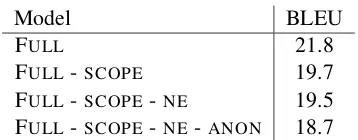
Preprocessing Ablation Study We consider the contribution of each main component of our pre-processing stages while keeping our linearization order identical. Figure 2 contains examples for each setting of the ablations we evaluate on. First we evaluate using linearized graphs without
paren-6Since we are currently not using any Wikipedia resources
for the prediction of named entities, we compare against the no-wikification version of the CAMR system.
7We also trained our generator on GIGA-2M and
fine-tuned on LDC2014T12 in order to have a direct comparison with PBMT, and achieved a BLEU score of 29.7, i.e., 2.8 points of improvement.
Model BLEU
FULL 21.8
FULL-SCOPE 19.7
FULL-SCOPE-NE 19.5
[image:7.595.327.506.60.130.2]FULL-SCOPE-NE- ANON 18.7
Table 4: BLEU scores for AMR generation abla-tions on preprocessing (DEV set).
Model Prec Rec F1 FULL 54.9 60.0 57.4
[image:7.595.334.498.177.219.2]FULL- ANON 22.7 54.2 32.0
Table 5: SMATCH scores for AMR parsing abla-tions on preprocessing (DEV set).
theses for indicating scope, Figure 2(c), then with-out named entity clusters, Figure 2(b), and addi-tionally without any anonymization, Figure 2(a).
Tables 4 summarizes our evaluation on the AMR generation. Each components is required, and scope markers and anonymization contribute the most to overall performance. We suspect with-out scope markers our seq2seq models are not as effective at capturing long range semantic rela-tionships between elements of the AMR graph. We also evaluated the contribution of anonymiza-tion to AMR parsing (Table 5). Following pre-vious work, we find that seq2seq-based AMR parsing is largely ineffective without anonymiza-tion (Peng et al., 2017).
7 Linearization Evaluation
In this section we evaluate three strategies for con-verting AMR graphs into sequences in the context of AMR generation and show that our models are largely agnostic to linearization orders. Our re-sults argue, unlike SMT-based AMR generation methods (Pourdamghani et al., 2016), that seq2seq models can learn to ignore artifacts of the conver-sion of graphs to linear sequences.
7.1 Linearization Orders
All linearizations we consider use the pattern de-scribed in Section 4.2, but differ on the order in which children are visited. Each linearization gen-erates anonymized, scope-marked output (see Sec-tion 4), of the form shown in Figure 2(d).
Linearization Order BLEU
HUMAN 21.7
GLOBAL-RANDOM 20.8
[image:8.595.114.251.62.117.2]RANDOM 20.3
Table 6: BLEU scores for AMR generation for dif-ferent linearization orders (DEV set).
Global-Random We construct a random global ordering of all edge types appearing in AMR graphs and re-use it for every example in the dataset. We traverse children based on the posi-tion in the global ordering of the edge leading to a child.
Random For each example in the dataset we tra-verse children following a different random order of edge types.
7.2 Results
We present AMR generation results for the three proposed linearization orders in Table 6. Ran-dom linearization order performs somewhat worse than traversing the graph according to Human lin-earization order. Surprisingly, a per example ran-dom linearization order performs nearly identi-cally to a global random order, arguing seq2seq models can learn to ignore artifacts of the conver-sion of graphs to linear sequences.
Human-authored AMR leaks information
The small difference between random and global-random linearizations argues that our models are largely agnostic to variation in linearization order. On the other hand, the model that follows the human order performs better, which leads us to suspect it carries extra information not apparent in the graphical structure of the AMR.
To further investigate, we compared the rela-tive ordering of edge pairs under the same par-ent to the relative position of children nodes de-rived from those edges in a sentence, as reported by JAMR alignments. We found that the majority of pairs of AMR edges (57.6%) always occurred in the same relative order, therefore revealing no extra generation order information.8Of the
exam-ples corresponding to edge pairs that showed vari-ation, 70.3% appeared in an order consistent with the order they were realized in the sentence. The relative ordering of some pairs of AMR edges was
8This is consistent with constraints encoded in the
anno-tation tool used to collect AMR. For example,:ARG0edges are always ordered before:ARG1edges.
Error Type % Coverage 29 Disfluency 23 Anonymization 14 Sparsity 13 Attachment 12
Other 10
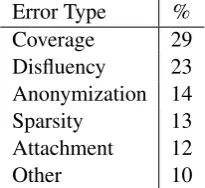
Table 7: Error analysis for AMR generation on a sample of 50 examples from the development set.
particularly indicative of generation order. For ex-ample, the relative ordering of edges with types locationandtime, was 17% more indicative of the generation order than the majority of gener-ated locations beforetime.9
To compare to previous work we still report re-sults using human orderings. However, we note that any practical application requiring a system to generate an AMR representation with the intention to realize it later on, e.g., a dialog agent, will need to be trained either using consistent, or random-derived linearization orders. Arguably, our models are agnostic to this choice.
8 Qualitative Results
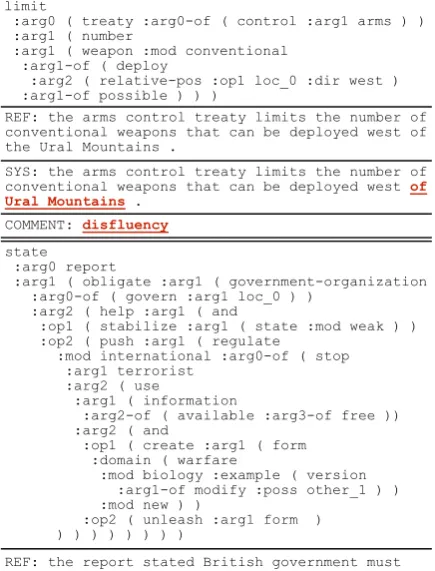
Figure 3 shows example outputs of our full sys-tem. The generated text for the first graph is nearly perfect with only a small grammatical error due to anonymization. The second example is more challenging, with a deep right-branching struc-ture, and a coordination of the verbsstabilize and push in the subordinate clause headed by state. The model omits some information from the graph, namely the conceptsterroristand virus. In the third example there are greater parts of the graph that are missing, such as the whole sub-graph headed by expert. Also the model makes wrong attachment decisions in the last two sub-graphs (it is the evidence that is unimpeachable and irrefutable, and not the equipment), mostly due to insufficient annota-tion (thing) thus making their generation harder. Finally, Table 7 summarizes the proportions of error types we identified on 50 randomly selected examples from the development set. We found that the generator mostly suffers from coverage issues,
9Consider the sentences“She went to school in New York
[image:8.595.365.468.63.157.2]an inability to mention all tokens in the input, fol-lowed by fluency mistakes, as illustrated above. Attachment errors are less frequent, which sup-ports our claim that the model is robust to graph linearization, and can successfully encode long range dependency information between concepts.
9 Conclusions
We applied sequence-to-sequence models to the tasks of AMR parsing and AMR generation, by carefully preprocessing the graph representation and scaling our models via pretraining on mil-lions of unlabeled sentences sourced from Giga-word corpus. Crucially, we avoid relying on re-sources such as knowledge bases and externally trained parsers. We achieve competitive results for the parsing task (SMATCH 62.1) and state-of-the-art performance for generation (BLEU 33.8).
For future work, we would like to extend our work to different meaning representations such as the Minimal Recursion Semantics (MRS; Copes-take et al. (2005)). This formalism tackles certain linguistic phenomena differently from AMR (e.g., negation, and co-reference), contains explicit an-notation on concepts for number, tense and case, and finally handles multiple languages10(Bender,
2014). Taking a step further, we would like to apply our models on Semantics-Based Machine Translation using MRS as an intermediate rep-resentation between pairs of languages, and in-vestigate the added benefit compared to directly translating the surface strings, especially in the case of distant language pairs such as English and Japanese (Siegel, 2000).
Acknowledgments
The research was supported in part by DARPA un-der the DEFT program through AFRL (FA8750-13-2-0019) and the CwC program through ARO (W911NF-15-1-0543), the ARO (W911NF-16-1-0121), the NSF (1252835, 1562364, IIS-1524371), an Allen Distinguished Investigator Award, and gifts by Google and Facebook. The authors thank Rik Koncel-Kedziorski and the UW NLP group for helpful discussions, and the anony-mous reviewers for their thorough and helpful comments.
10A list of actively maintained languages can be
found here: http://moin.delph-in.net/ GrammarCatalogue
limit
:arg0 ( treaty :arg0-of ( control :arg1 arms ) ) :arg1 ( number
:arg1 ( weapon :mod conventional :arg1-of ( deploy
:arg2 ( relative-pos :op1 loc_0 :dir west ) :arg1-of possible ) ) )
SYS: the arms control treaty limits the number of conventional weapons that can be deployed west of Ural Mountains .
REF: the arms control treaty limits the number of conventional weapons that can be deployed west of the Ural Mountains .
COMMENT: disfluency
state
:arg0 ( person
:arg0-of ( have-org-role
:arg1 ( committee :mod technical ) :arg3 ( expert
:arg1 person :arg2 missile :mod loc_0 ) ) ) :arg1 ( evidence :arg0 equipment
:arg1 ( plan :arg1 ( transfer :arg1 ( contrast :arg1 ( missile :mod ( just :polarity - ) ) :arg2 ( capable
:arg1 thing
:arg2 ( make :arg1 missile ) ) ) ) ) :mod ( impeach :polarity - :arg1 thing ) :mod ( refute :polarity - :arg1 thing ) )
SYS: a technical committee expert on the
technical committee stated that the equipment is
not impeach , but it is not refutes . REF: a technical committee of Indian missile experts stated that the equipment was
unimpeachable and irrefutable evidence of a plan to transfer not just missiles but missile-making capability.
COMMENT: coverage , disfluency, attachment
state :arg0 report
:arg1 ( obligate :arg1 ( government-organization :arg0-of ( govern :arg1 loc_0 ) )
:arg2 ( help :arg1 ( and
:op1 ( stabilize :arg1 ( state :mod weak ) ) :op2 ( push :arg1 ( regulate
:mod international :arg0-of ( stop :arg1 terrorist
:arg2 ( use
:arg1 ( information
:arg2-of ( available :arg3-of free )) :arg2 ( and
:op1 ( create :arg1 ( form :domain ( warfare
:mod biology :example ( version :arg1-of modify :poss other_1 ) ) :mod new ) )
:op2 ( unleash :arg1 form ) ) ) ) ) ) ) ) )
REF: the report stated British government must help to stabilize weak states and push for international regulations that would stop terrorists using freely available information to create and unleash new forms of biological warfare such as a modified version of the influenza virus .
COMMENT: coverage , disfluency, attachment
[image:9.595.308.526.64.350.2]SYS: the report stated that the Britain government must help stabilize the weak states and push international regulations to stop the use of freely available information to create a form of new biological warfare such as the modified version of the influenza .
References
Yoav Artzi, Kenton Lee, and Luke Zettlemoyer. 2015. Broad-coverage CCG semantic parsing with AMR. In Proceedings of the 2015 Con-ference on Empirical Methods in Natural Lan-guage Processing. Association for Computational Linguistics, Lisbon, Portugal, pages 1699–1710. http://aclweb.org/anthology/D15-1198.
Dzmitry Bahdanau, Kyunghyun Cho, and Yoshua Ben-gio. 2015. Neural machine translation by jointly learning to align and translate. In Proceedings of the 2015 International Conference on Learn-ing Representations. CBLS, San Diego, California. http://arxiv.org/abs/1409.0473.
Guntis Barzdins and Didzis Gosko. 2016. RIGA at SemEval-2016 Task 8: Impact of Smatch ex-tensions and character-level neural translation on AMR parsing accuracy. In Proceedings of the 10th International Workshop on Semantic Eval-uation. Association for Computational Linguis-tics, San Diego, California, pages 1143–1147. http://www.aclweb.org/anthology/S16-1176. Emily M. Bender. 2014. Language CoLLAGE:
Gram-matical description with the LinGO grammar ma-trix. InProceedings of the 9th International Confer-ence on Language Resources and Evaluation. Reyk-javik, Iceland, pages 2447–2451.
Johannes Bjerva, Johan Bos, and Hessel Haagsma. 2016. The Meaning Factory at SemEval-2016 Task 8: Producing AMRs with Boxer. In Proceed-ings of the 10th International Workshop on Seman-tic Evaluation. Association for Computational Lin-guistics, San Diego, California, pages 1179–1184. http://www.aclweb.org/anthology/S16-1182. Lauritz Brandt, David Grimm, Mengfei Zhou, and
Yannick Versley. 2016. ICL-HD at SemEval-2016 Task 8: Meaning representation parsing - aug-menting AMR parsing with a preposition seman-tic role labeling neural network. In Proceed-ings of the 10th International Workshop on Seman-tic Evaluation. Association for Computational Lin-guistics, San Diego, California, pages 1160–1166. http://www.aclweb.org/anthology/S16-1179. Shu Cai and Kevin Knight. 2013. Smatch: an
evalua-tion metric for semantic feature structures. In Pro-ceedings of the 51st Annual Meeting of the Associa-tion for ComputaAssocia-tional Linguistics. Association for Computational Linguistics, Sofia, Bulgaria, pages 748–752. http://www.aclweb.org/anthology/P13-2131.
Ann Copestake, Dan Flickinger, Carl Pollard, and Ivan A. Sag. 2005. Minimal Recur-sion Semantics: An introduction. Research on Language and Computation 3(2):281–332. https://doi.org/10.1007/s11168-006-6327-9. Marco Damonte, Shay B. Cohen, and Giorgio Satta.
2017. An incremental parser for abstract meaning
representation. InProceedings of the 15th Confer-ence of the European Chapter of the Association for Computational Linguistics. Association for Compu-tational Linguistics, Valencia, Spain, pages 536– 546. http://www.aclweb.org/anthology/E17-1051.
Jenny Rose Finkel, Trond Grenager, and Christo-pher Manning. 2005. Incorporating non-local in-formation into inin-formation extraction systems by Gibbs sampling. In Proceedings of the 43rd An-nual Meeting on Association for Computational Linguistics. Association for Computational Lin-guistics, Ann Arbor, Michigan, pages 363–370. https://doi.org/10.3115/1219840.1219885.
Jeffrey Flanigan, Chris Dyer, Noah A. Smith, and Jaime Carbonell. 2016. Generation from abstract meaning representation using tree transducers. In
Proceedings of the 2016 Conference of the North American Chapter of the Association for Compu-tational Linguistics. Association for Computational Linguistics, San Diego, California, pages 731–739. http://www.aclweb.org/anthology/N16-1087.
Jeffrey Flanigan, Sam Thomson, Jaime Carbonell, Chris Dyer, and Noah A. Smith. 2014. A discrim-inative graph-based parser for the abstract mean-ing representation. InProceedings of the 52nd An-nual Meeting of the Association for Computational Linguistics. Association for Computational Lin-guistics, Baltimore, Maryland, pages 1426–1436. http://www.aclweb.org/anthology/P14-1134.
James Goodman, Andreas Vlachos, and Jason Narad-owsky. 2016. UCL+Sheffield at SemEval-2016 Task 8: Imitation learning for AMR parsing with an alpha-bound. In Proceedings of the 10th International Workshop on Semantic Eval-uation. Association for Computational Linguis-tics, San Diego, California, pages 1167–1172. http://www.aclweb.org/anthology/S16-1180.
Lifu Huang, Taylor Cassidy, Xiaocheng Feng, Heng Ji, Clare R. Voss, Jiawei Han, and Avirup Sil. 2016. Liberal event extraction and event schema induction. In Proceedings of the 54th An-nual Meeting of the Association for Computa-tional Linguistics. Association for Computational Linguistics, Berlin, Germany, pages 258–268. http://www.aclweb.org/anthology/P16-1025.
Bevan Jones, Jacob Andreas, Daniel Bauer, Karl Moritz Hermann, and Kevin Knight. 2012. Semantics-Based Machine Translation with Hyper-edge Replacement Grammars. InProceedings of the 2012 International Conference on Computational Linguistics. Bombay, India, pages 1359–1376. http://www.aclweb.org/anthology/C12-1083.
translation. In Proceedings of the 45th Annual Meeting of the Association for Computational Linguistics. Association for Computational Lin-guistics, Prague, Czech Republic, pages 177–180. http://dl.acm.org/citation.cfm?id=1557769.1557821. Fei Liu, Jeffrey Flanigan, Sam Thomson, Norman
Sadeh, and Noah A. Smith. 2015. Toward abstrac-tive summarization using semantic representations. InProceedings of the 2015 Conference of the North American Chapter of the Association for Compu-tational Linguistics. Association for Computational Linguistics, Denver, Colorado, pages 1077–1086. http://www.aclweb.org/anthology/N15-1114. Thang Luong, Hieu Pham, and Christopher D.
Man-ning. 2015. Effective approaches to attention-based neural machine translation. In Proceedings of the 2015 Conference on Empirical Methods in Natu-ral Language Processing. Association for Compu-tational Linguistics, Lisbon, Portugal, pages 1412– 1421. http://aclweb.org/anthology/D15-1166. Dipendra Kumar Misra and Yoav Artzi. 2016.
Neu-ral shift-reduce CCG semantic parsing. In Proceed-ings of the 2016 Conference on Empirical Meth-ods in Natural Language Processing. Association for Computational Linguistics, Austin, Texas, pages 1775–1786. https://aclweb.org/anthology/D16-1183.
Courtney Napoles, Matthew Gormley, and Ben-jamin Van Durme. 2012. Annotated Gigaword. In Proceedings of the Joint Workshop on Auto-matic Knowledge Base Construction and Web-scale Knowledge Extraction. Association for Computa-tional Linguistics, Montr´eal, Canada, pages 95–100. http://www.aclweb.org/anthology/W12-3018. Martha Palmer, Daniel Gildea, and Paul
Kingsbury. 2005. The Proposition Bank: An annotated corpus of semantic roles.
Computational Linguistics 31(1):71–106.
http://www.cs.rochester.edu/ gildea/palmer-propbank-cl.pdf.
Kishore Papineni, Salim Roukos, Todd Ward, and Wei-Jing Zhu. 2002. Bleu: a method for automatic evaluation of machine transla-tion. In Proceedings of 40th Annual Meeting of the Association for Computational Linguis-tics. Association for Computational Linguistics, Philadelphia, Pennsylvania, USA, pages 311–318. https://doi.org/10.3115/1073083.1073135.
Xiaochang Peng, Chuan Wang, Daniel Gildea, and Nianwen Xue. 2017. Addressing the data spar-sity issue in neural AMR parsing. In Pro-ceedings of the 15th Conference of the Eu-ropean Chapter of the Association for Com-putational Linguistics. Association for Computa-tional Linguistics, Valencia, Spain, pages 366–375. http://www.aclweb.org/anthology/E17-1035. Nima Pourdamghani, Yang Gao, Ulf Hermjakob, and
Kevin Knight. 2014. Aligning English strings with
abstract meaning representation graphs. In Proceed-ings of the 2014 Conference on Empirical Methods in Natural Language Processing. Association for Computational Linguistics, Doha, Qatar, pages 425– 429. http://www.aclweb.org/anthology/D14-1048.
Nima Pourdamghani, Kevin Knight, and Ulf Her-mjakob. 2016. Generating English from ab-stract meaning representations. In Proceed-ings of the 9th International Natural Language Generation conference. Association for Computa-tional Linguistics, Edinburgh, UK, pages 21–25. http://anthology.aclweb.org/W16-6603.
Michael Pust, Ulf Hermjakob, Kevin Knight, Daniel Marcu, and Jonathan May. 2015. Parsing english into abstract meaning representation using syntax-based machine translation. In Proceedings of the 2015 Conference on Empirical Methods in Natu-ral Language Processing. Association for Compu-tational Linguistics, Lisbon, Portugal, pages 1143– 1154. https://aclweb.org/anthology/D/D15/D15-1136.
Yevgeniy Puzikov, Daisuke Kawahara, and Sadao Kurohashi. 2016. M2L at SemEval-2016 Task 8: AMR parsing with neural networks. In Proceed-ings of the 10th International Workshop on Seman-tic Evaluation. Association for Computational Lin-guistics, San Diego, California, pages 1154–1159. http://www.aclweb.org/anthology/S16-1178.
Rico Sennrich, Barry Haddow, and Alexandra Birch. 2016. Improving neural machine translation mod-els with monolingual data. In Proceedings of the 54th Annual Meeting of the Association for Com-putational Linguistics. Association for Computa-tional Linguistics, Berlin, Germany, pages 86–96. http://www.aclweb.org/anthology/P16-1009.
Melanie Siegel. 2000. HPSG Analysis of Japanese, Springer Berlin Heidelberg, pages 264–279.
Linfeng Song, Yue Zhang, Xiaochang Peng, Zhiguo Wang, and Daniel Gildea. 2016. AMR-to-text gen-eration as a traveling salesman problem. In Pro-ceedings of the 2016 Conference on Empirical Meth-ods in Natural Language Processing. Association for Computational Linguistics, Austin, Texas, pages 2084–2089. https://aclweb.org/anthology/D16-1224.
Sho Takase, Jun Suzuki, Naoaki Okazaki, Tsu-tomu Hirao, and Masaaki Nagata. 2016. Neu-ral headline generation on abstract meaning rep-resentation. In Proceedings of the 2016 Con-ference on Empirical Methods in Natural Lan-guage Processing. Association for Computational Linguistics, Austin, Texas, pages 1054–1059. https://aclweb.org/anthology/D16-1112.
28th International Conference on Neural Informa-tion Processing Systems, MIT Press, pages 2773– 2781. http://papers.nips.cc/paper/5635-grammar-as-a-foreign-language.pdf.
Chuan Wang, Sameer Pradhan, Xiaoman Pan, Heng Ji, and Nianwen Xue. 2016. CAMR at SemEval-2016 Task 8: An extended transition-based AMR parser. In Proceedings of the 10th International Workshop on Semantic Evaluation. Association for Compu-tational Linguistics, San Diego, California, pages 1173–1178. http://www.aclweb.org/anthology/S16-1181.
Yonghui Wu, Mike Schuster, Zhifeng Chen, Quoc V. Le, Mohammad Norouzi, Wolfgang Macherey, Maxim Krikun, Yuan Cao, Qin Gao, Klaus Macherey, Jeff Klingner, Apurva Shah, Melvin Johnson, Xiaobing Liu, Lukasz Kaiser, Stephan Gouws, Yoshikiyo Kato, Taku Kudo, Hideto Kazawa, Keith Stevens, George Kurian, Nishant Patil, Wei Wang, Cliff Young, Jason Smith, Jason Riesa, Alex Rudnick, Oriol Vinyals, Greg Corrado, Macduff Hughes, and Jeffrey Dean. 2016. Google’s neural machine translation system: Bridging the gap between human and machine translation. CoRR
abs/1609.08144. http://arxiv.org/abs/1609.08144.