Munich Personal RePEc Archive
Count and duration time series with
equal conditional stochastic and mean
orders
Aknouche, Abdelhakim and Francq, Christian
USTHB and Qassim University, CREST and University of Lille
11 November 2018
Online at
https://mpra.ub.uni-muenchen.de/97392/
Count and duration time series with equal conditional
stochastic and mean orders
Abdelhakim Aknouche
University of Science and Technology Houari Boumediene
and
Christian Francq
∗CREST and University of Lille
Abstract
We consider a positive-valued time series whose conditional distribution has a
time-varying mean, which may depend on exogenous variables. The main applications
con-cern count or duration data. Under a contraction condition on the mean function, it is
shown that stationarity and ergodicity hold when the mean and stochastic orders of the
conditional distribution are the same. The latter condition holds for the exponential
family parametrized by the mean, but also for many other distributions. We also
pro-vide conditions for the existence of marginal moments and for the geometric decay of the
beta-mixing coefficients. We give conditions for consistency and asymptotic normality
of the Exponential Quasi-Maximum Likelihood Estimator (QMLE) of the conditional
mean parameters. Simulation experiments and illustrations on series of stock market
volumes and of greenhouse gas concentrations show that the multiplicative-error form
of usual duration models deserves to be relaxed, as allowed in the present paper.
∗I am grateful to the Agence Nationale de la Recherche (ANR), which supported this work via the Project
Keywords: Absolute regularity, Autoregressive Conditional Duration, Count
time series models, Distance correlation, Ergodicity, Exponential QMLE, Integer-valued
GARCH, Mixing.
1
Introduction
Models for nonnegative time series include the Autoregressive Conditional Duration (ACD)
model introduced by Engle and Russell (1998) to analyze durations between events (such
as trades, quotes, price changes), the Conditional AutoRegressive Range (CARR) model
introduced by Chou (2005) to study the range of an asset during a trading day, the more
general Multiplicative Error Model (MEM) introduced by Engle (2002) and count time
series models such as the INteger-valued AutoRegressive (INAR) studied by Al-Osh and
Alzaid (1987) or the Poisson INteger GARCH (INGARCH) studied by Ferland, Latour and
Oraichi (2006). Count time series models have been used in various domains, in particular
economics, finance, insurance, environmental science, social science and epidemiology (see
Davis, Holan, Lund and Ravishanker (2016) and the references therein). For MEM-like
mod-els, the stationary solutions are obtained explicitly, like for GARCH modmod-els, as function of
the parameters and the rescaled iid innovations of the model (see e.g. Francq and Zako¨ıan, 2019). INGARCH-type count time series models are not defined by means of an iid white
noise, but by assuming a discrete conditional distribution with a time-varying parameter
depending on the past values. Since the primary goal of these time series models is to
forecast the future level of the observed series, that parameter is generally the conditional
mean. The absence of an iid sequence in the definition of these models prevents exhibiting
an explicit solution. The fact that the support of the conditional distribution is countable
also prevents using the theory of Markov chains with continuous state space (see Meyn and
Tweedie, 2009). As a consequence, studying the probabilistic structure of most count time
series models is not obvious (see Fokianos, Rahbek and Tjøstheim, 2009, Tjøstheim, 2012,
stationarity results for INGARCH models with Poisson conditional distribution of linear
intensity parameter. Neumann (2011) proved the absolute regularity and relaxed the
linear-ity assumption on the Poisson intenslinear-ity parameter. Doukhan and Neumann (2019) showed
the absolute regularity for a much broader class of processes. Franke (2010) and Doukhan,
Fokianos and Tjøstheim (2012, 2013) studied the weak dependence of nonlinear Poisson
autoregressions. Douc, Doukhan and Moulines (2013) gave conditions on the associated
Markov kernel for stationarity and ergodicity of a first-order observation-driven time series
valued inN. These results have been extended to more general observation-driven models by
Douc, Roueff and Sim (2015, 2016) and Sim, Douc and Roueff (2016). Gon¸calves,
Mendes-Lopes and Silva (2015) showed the stationarity and ergodicity of the INGARCH model with
compound Poisson conditional distributions. Davis and Liu (2016) showed stationarity and
mixing properties when the conditional distribution belongs to the one-parameter
exponen-tial family of distributions. The assumption that the conditional distribution belongs to
the exponential family is however restrictive. In particular, that assumption precludes the
zero-inflated distributions and hurdle models, which proved to be useful to deal with count
data sets that have an excess of zero counts (see e.g. Gurmu and Trivedi (1996), and Zhu (2012)).
The main aim of the present paper is to give stationarity and ergodicity conditions for
conditional distributions that are not restricted to belong to the one-parameter exponential
family. In addition we will allow the conditional mean to depend on covariates, which seems
relevant for some applications.
We thus consider a stochastic process of interest{Yt, t∈Z}valued in the set [0,∞), and
a stochastic process of exogenous explanatory variables{Xt, t∈Z}valued in Rr. LetFt be
the information set available at time t, i.e. the sigma-field generated by {Yu,Xu, u ≤ t}.
When there is no exogenous variable, i.e. when Ft = σ(Yu, u ≤ t), the most frequent
specifications of λt :=E(Yt| Ft−1) is the linear equation
λt =ω+ q
X
i=1
αiYt−i+ p
X
j=1
where ω >0, αi ≥0 andβj ≥0. The standard ACD duration models and MEMs are of the
form
Yt=λtzt, (1.2)
where (λt) satisfies (1.1) and (zt) is an iid sequence of positive variables of mean 1, for
instance of exponential distribution of rate parameter 1. Note that for time series of counts,
i.e. when Yt is valued in N, the sequence zt = Yt/λt cannot be independent, in general.
Even for duration models for which the support of Yt is [0,∞), assuming that zt and λt
are independent is very restrictive. In particular, this implies that the conditional variance
Var(Yt | Ft−1) is proportional toλ2t, whatever the distribution ofzt. In the numerical part of
this paper, the independence betweenztandλtwill be assessed by bootstrapping the distance
covariance test of Sz´ekely, Rizzo and Bakirov (2007). For more versatile duration time series
models, it is thus of interest to relax the MEM specification (1.2), by only specifying a
conditional distribution with mean λt.
We refer to a distribution ofYtgivenFt−1 with mean (1.1) as a positive linear POLI(p, q)
model. If, as for INGARCH (p, q) models, the distribution ofYtgivenFt−1 is integer-valued,
the model is intended to represent time series of counts. If, as for the above-mentioned
extension of the ACD models, the distribution ofYtgivenFt−1 is valued in (0,∞), the POLI
model could suit for some time series of duration or volume, for instance.
Even if many references mention the possibility of adding exogenous variables in count
or duration time series models (see e.g. Cameron and Trivedi, 2001), we are only aware of few references focusing on exogenous variables: the paper on Poisson autoregresssion with
exogenous covariates (PARX) by Agosto, Cavaliere, Kristensen and Rahbek (2016) and that
of Liboschik, Fokianos and Fried (2017) which also considers negative binomial conditional
distributions and has the R companion package tscount (see also the R package acp of
Siakoulis, 2015). In the PARX model, we have
λt=ω+ q
X
i=1
αiYt−i+ p
X
j=1
βjλt−j+π⊤Xt−1, (1.3)
and π = (π1, . . . , πr)⊤ ≥0 componentwise. We also consider more general specifications of
the form
λt =g(Yt−1, . . . , Yt−q, λt−1, . . . , λt−p) +π(Xt−1), (1.4)
where the functions g and π are valued in [0,∞).
We do not make a specific parametric assumption on the conditional distribution of Yt
given Ft−1, but we assume that its stochastic order increases with its mean. More precisely,
let Fλ be a family of cumulative distribution functions (cdf) indexed by the mean λ =
R
ydFλ(y) ∈ R. Assume that, within this family, the stochastic order is equal to the mean
order, i.e.
λ≤λ∗ ⇒ Fλ(y)≥Fλ∗(y), ∀y∈R. (1.5)
We shall refer to (1.5) as the stochastic-equal-mean order property. Section2gives examples
of cdf satisfying this property. Section3studies the existence and properties of a process (Yt)
with conditional meanλtand cdf satisfying (1.5). Subsection3.1assumes a linear conditional
mean of the form (1.3) and Subsection3.2 considers the more general specification (1.4). It
is shown that a positive-valued time series whose conditional cdf satisfies (1.5) and the mean
verifies mild regularity conditions is stationary and ergodic. When Yt is valued in N, we
show that the β-mixing coefficients have exponential decay rate. For some particular POLI
models, necessary and sufficient conditions for the existence of moments are also provided.
Section 4 considers the estimation of the parameters involved in the conditional mean λt.
Section 5 proposes a test of independence between zt and λt in the duration model (1.2).
Monte Carlo experiments and illustrations on series of trading volume and greenhouse gas
concentrations are presented. Concluding remarks are given in Section 6.
2
Examples of distributions with stochastic-equal-mean
order
We first recall that the exponential family is included in the class of the distributions for
that the conditional distribution of any ACD-MEM model also satisfies the
stochastic-equal-mean order property. We then give other examples of such conditional distributions which, to
our knowledge, are not yet fully considered in existing count or duration time series models.
2.1
One-parameter exponential family
Using Yu (2009), Davis and Liu (2016) demonstrated (see Proposition 6 and the discussion
after (2.1) in their paper) that (1.5) holds true when Fλ is the cdf of a one-parameter
exponential family on [0,∞). A distribution Fλ is said to belong to such an exponential
family if, with respect to a σ-finite measure, it admits a density of the form
gλ(y) = h(y) exp{ηy−A(η)}1{y≥0}, (2.1)
for some scalar natural parameterη=η(λ) and some twice differentiable cumulant
generat-ing functionA(η). It is known thatλ=A′(η). For exampleF
λ can be the cdf of the Poisson
distribution with intensity parameter λ = eη. Recall that a random variable Y follows a
negative binomial, Y ∼N B(r0, p0), of parametersr0 >0 and p0 ∈(0,1) if
P(Y =k) = Γ(k+r0)
k!Γ(r0)
pr0
0 (1−p0)k, k ∈N.
We have λ = r0(1−p0)/p0. This distribution also belongs to the exponential family when
p0 =r0/(λ+r0)) and r0 is fixed (withη = log(1−p0)).
2.2
Standard multiplicative ACD-type models
LetFλ− be the quantile function associated to the cdf Fλ. Note that (1.5) is equivalent to
λ≤λ∗ ⇒ Fλ−(u)≤Fλ−∗(u), ∀u∈(0,1). (2.2)
By positive homogeneity of the quantile function, conditional on Ft−1, the quantile function
of Yt satisfying (1.2) is
Fλ−t(α) = λtF−(α),
whereF−is the quantile function ofz
t. Therefore the conditional distribution of any standard
2.3
Additive duration models
An alternative to the multiplicative ACD model (1.2) is the additive model
Yt =λt−Eǫ1+ǫt, (2.3)
where (ǫt) is a stationary sequence of positive random variables, ǫt and λt are independent,
λt satisfies (1.3) or (1.4) with λt ≥ ω, and ω ≥ Eǫt to ensure positivity of λt. Any model
of this form satisfies (1.5) because Fλ(y) :=P(Yt ≤ y| λt =λ) =P(ǫ1 ≤y+Eǫ1 −λ) is a
decreasing function of λ.
2.4
Negative binomial NB
(
r
0, p
0)
with fixed
p
0For any fixed p0, the negative binomial distribution Fλ with parameter r0 = p0λ/(1−p0)
apparently does not belong to the one-parameter exponential family. The next Lemma shows
that this family of distributions however satisfies (1.5). Write X ≤st Y when the random
variable Y stochastically dominates the random variable X, i.e. if P(X ≤ y) ≥P(Y ≤ y) for all y.
Lemma 2.1 If X ∼N B(r1, p0) and Y ∼N B(r2, p0) with r1 ≤r2, then X ≤st Y.
The previous lemma is quite obvious and can probably be found somewhere in the literature,
but we did not find a precise reference of such a result. For completeness, we thus give a
proof in Appendix.
2.5
Gamma distributions
A random variable Y is said to be Gamma distributed Γ(a, b) with shape parameter a >0
and rate parameter b > 0 if it admits the density g(y) = Γ−1(a)baya−1e−by1
{y>0}. We have
λ := EY = a/b. For fixed a, the distribution Γ(a, a/λ) readily belongs to the exponential
family (2.1). For fixedb, the distribution Γ(λb, b) is not of the form (2.1). However, denoting
by gλ(y) the density of that Γ(λb, b) distribution, it can be seen that when λ < λ∗ the
Ft−1 ∼Γ(λtb, b), then Var(Yt | Ft−1) =λt/b. This entails that (Yt) does not follow an ACD
model of the form (1.2), for which the variance is proportional to λ2t.
2.6
Zero-inflated distributions
There exists numerous instances of count data sets with excess zeros with respect to a
baseline model, for example the Poisson distribution (see e.g. Ridout, Dem´etrio and Hinde (1998) and Zhu (2012)). One solution consists in assuming that a random element Y of the
data set has a zero-inflated Poisson (ZIP) distribution, given by
P(Y =k) =
τ + (1−τ)e−µ if k= 0
(1−τ)e−µ µk
k! if k >0.
(2.4)
Ifτ ∈[0,1], the ZIP(τ , µ) distribution (2.4) is that of a mixture of a proportionτ of variables
that structurally always take the zero value and a proportion 1−τ of variables that follow
the Poisson distribution with intensity µ. When τ ∈[−e−µ/(1−e−µ),0) and µ >0, the ZIP
distribution is actually zero-deflated. The same law can be obtained with the hurdle model
which assumes that a proportionτ of variables always take the zero value and a proportion
1−τ of variables follow the zero-truncated Poisson distribution
P(Y =k) =
τ if k = 0
(1−τ)e−µµk
(1−e−µ)k! if k > 0.
More generally, assume that the baseline cdf is not necessarily Poisson P(µ) but the cdf
Fλ, and define two zero-inflated distributions by
P(Y ≤y) = τ+ (1−τ)Fλ(y), P(Y∗ ≤y) = τ+ (1−τ)Fλ∗(y), (2.5)
for all y ≥ 0 and P(Y ≤ y) = P(Y∗ ≤ y) = 0 for all y < 0 , where τ ∈[0,1] is some extra
zero probability. The following lemma shows that if the family of distributions Fλ satisfies
(1.5) then this is also the case for the zero-inflated distributions.
3
Probabilistic properties
We first consider the strict stationarity and ergodicity of the linear POLI-X model (1.3).
Ergodicity entails the strong law of large numbers, and is thus a fundamental tool for studying
the asymptotic properties of estimators and test statistics. We also discuss the existence
of moments in the case p = q = 1. We then extend the stationarity results for general
conditional means of the form (1.4), and show the geometric decay of the mixing coefficients
in the case where Yt is valued in N.
3.1
The linear conditional mean case
Theorem 3.1 Let {Fλ, λ ∈ (0,∞)} be a family of cdf on [0,∞) (i.e. Fλ(y) = 0 for all
y <0) satisfying (1.5). There exists a stationary (and ergodic) sequence (Yt) such that
P (Yt≤y| Ft−1) = Fλt(y), (3.1)
where λt satisfies either (1.1) or (1.3) with (Xt) stationary and ergodic, if q
X
i=1
αi+ p
X
j=1
βj <1. (3.2)
Conversely, if there exists a solution of (3.1) such that EYt =m < ∞, then Eπ⊤Xt <∞
and (3.2) holds.
Remark 3.1 (The exogenous variables do not matter for stationarity) The strict sta-tionarity condition (3.2) does not depend on the exogenous variables. This is not surprising since adding covariates remains to substitute a stationary interceptωt=ω+Pri=1πixi,t−1 for
the constantω in λt, and it is known (at least for conditional cdf belonging to the exponential
family) that the stationarity condition does not depend on the intercept. Francq and Thieu (2019) made a similar comment on GARCH models with exogenous variables.
Remark 3.2 (Markovian representation) The proof of Theorem3.1shows the existence of a solution of the form
where λt satisfies (1.1) or (1.3) with (3.2), Fλ satisfies (1.5), the sequences (Ut) and (Xt)
are independent and (Ut) is iid uniformly distributed in [0,1]. It follows that, given (Xt),
the process Zt := (Yt−1, . . . , Yt−q, λt−1, . . . , λt−p)⊤ is a Markovian process. First note that
this excludes conditional means of AR(∞)-type λt = λ(Xt−1, Xt−2, . . .). This also suggests
using Markov chain techniques, as in Meyn and Tweedie (2009). However, when Yt is
integer-valued, those techniques seem difficult to apply. Note also that, in the case (1.1)with
p = q = 1, the conditional mean satisfies a Stochastic Recurrence Equation (SRE) of the form λt =ϕ(λt−1, Ut−1) where ϕ(λ, u) = ω+αFλ−(u) +βλ. It is also difficult to apply the
SRE theory, as developed in Bougerol (1993) and Straumann and Mikosch (2006), because the application λ 7→ Fλ−(u) is not continuous when Yt is integer-valued, and thus it seems
impossible to impose the Cauchy root test constraint
Elog sup
λ6=λ∗
|ϕ(λ, U1)−ϕ(λ∗, U1)|
|λ−λ∗| <0
required by the SRE theory (see Bougerol, 1993).
Remark 3.3 (Joint stationarity with the exogenous variables) The stationary solu-tion defined in the proof has a causal Bernoulli shift representasolu-tion of the form
Yt=ϕ(Ut, Ut−1, . . .;Xt−1,Xt−2, . . .).
It follows that, under the conditions of Theorem 3.1, the condition (3.2) also entails that the multivariate process (Yt,X⊤t )⊤ is stationary and ergodic.
Remark 3.4 (Link with the stationarity of ACD and GARCH) The square of a GARCH is an ACD model. It has been shown in Subsection 2.2 that any conditional distri-bution of an ACD model satisfies (1.5). Therefore, when Yt in Theorem 3.1 corresponds to
the square of a GARCH whose squared volatility λt follows (1.1), we retrieve the very well
From Theorem 3.1, we retrieve that (3.2) ensures the stationarity and ergodicity of the
Poisson-INGARCH(p, q) model (see Ferland, Latour and Oraichi, 2006) and of the NB(r0, pt
)-INGARCH(1,1) model withpt=r0/(λt+r0) (see Zhu (2011), Christou and Fokianos (2014)
and Davis and Liu (2016)). The theorem also provides new stationarity results, examples of
which are given in the following corollaries.
Corollary 3.1 (NB(rt, p0)-INGARCH) There exists a stationary and ergodic sequence
(Yt) such that the distribution of Yt conditional to Ft−1 is NB(p0λt/(1−p0), p0) where λt
satisfies either (1.1) or (1.3) with (Xt) stationary and ergodic if (3.2) holds.
Conversely, if there exists (Yt) such that Yt | Ft−1 ∼ N B(p0λt/(1−p0), p0) with EYt =
m <∞ and λt satisfies (1.3), then Eπ⊤Xt <∞ and (3.2) holds.
Corollary 3.1 is a direct consequence of Theorem 3.1 and Subsection 2.4. This result has
been conjectured by Aknouche, Bendjeddou and Touche (2018) but, to our knowledge, it
had not yet been formally proven.
We now consider a ZIP(τ , µ) distribution of the form (2.4). Zhu (2012) investigated such
conditional distributions with an INGARCH dynamics on the parameter µ. Denoting by λ
the mean of the ZIP(τ , µ) distribution, we have µ = λ/(1−τ). To make the link between
Zhu (2012) and our framework, note that if τ is fixed and µt = ω +αYt−1 +βµt−1 then
λt = (1−τ)ω+ (1−τ)αYt−1 +βµt−1. Therefore, a linear dynamics on µt (as in Zhu 2012)
is equivalent to a linear dynamics on λt, under an appropriate change of notation. Since τ
is fixed, denote by FZIP
λ the cdf of the ZIP(τ , λ/(1−τ)) distribution.
Corollary 3.2 (ZIP) There exists a stationary and ergodic sequence (Yt) such that Yt |
Ft−1 ∼FλZIPt with τ ∈[0,1] andλt satisfies either (1.1) or (1.3), (Xt) being stationary and
ergodic, if (3.2) holds.
Conversely, if there exists (Yt) such that Yt | Ft−1 ∼ FλZIPt with EYt = m < ∞ and λt
satisfies (1.3), then Eπ⊤X
t<∞ and (3.2) holds.
Corollary 3.2, which is a direct consequence of Theorem 3.1 and Subsection 2.6, shows the
stationar-ity under the same condition. The same results could be trivially obtained for zero-inflated
negative binomial conditional distributions.
We now give conditions for the existence of moments for the POLI(1,1) model. For
simplicity of notation, we write α and β instead of α1 and β1. Theorem 3.1 showed that,
for strict stationarity (and ergodicity), the precise form of the conditional distribution is
not important (provided it satisfies the stochastic-equal-mean order property (1.5)). For
the second-order stationarity, and more generally for the existence of moments, the next
proposition shows that the shape of the conditional distribution matters.
Theorem 3.2 Let {Fλ, λ ∈ (0,∞)} be a family of cdf on [0,∞) satisfying (1.5).
As-sume that, for Y ∼ Fλ(y) and some integer ℓ ≥ 2, there exist nonnegative coefficients
aj(0), aj(1), . . . , aj(j) for all j ≤ℓ such that
EYj =
j
X
i=0
aj(i)λi for j = 1, . . . , ℓ. (3.3)
Under (3.2), let (Yt) be a stationary sequence such that P (Yt≤y| Ft−1) =Fλt(y), where λt
satisfies (1.1) with p=q = 1. We have EYℓ
t <∞ if and only if ℓ
X
j=0
a(j)
ℓ j
αjβℓ−j <1, (3.4)
where a(0) =a(1) = 1 and a(j) =aj(j) for j ≥2.
Example 3.1 (NB(r0, pt)) The first momentsmi =EYi ofY following the BN(r0, r0/(λ+r0))
distribution are
m1 = λ, m2 =λ+
1 +r0
r0
λ2, m3 =λ+ 3
1 +r0
r0
λ2+2 + 3r0+r
2 0
r2 0
λ3,
m4 = λ+ 7
1 +r0
r0
λ2 + 62 + 3r0+r
2 0
r2 0
λ3+ 6 + 11r0 + 6r
2 0+r03
r3 0
λ4.
It follows that (3.3) holds with
a(2) = 1 +r0
r0
, a(3) = 2 + 3r0+r
2 0
r2 0
, a(4) = 6 + 11r0+ 6r
2 0+r30
r3 0
Theorem 3.2 shows that the POLI(1,1) model with BN(r0, r0/(λt+r0)) conditional
distribu-tion admits a moment of
order 2 iff (α+β)2+α
2
r0
<1, (3.5)
order 3 iff (α+β)3+3α
2(α+β)
r0
+2α
3
r2 0
<1, (3.6)
order 4 iff (α+β)4+6α
2(α+β)2
r0
+α
3(11α+ 8β)
r2 0
+ 6α
4
r3 0
<1. (3.7)
Figure 1 displays these moment conditions when r0 = 1.
0.0 0.2 0.4 0.6 0.8 1.0
0.0
0.2
0.4
0.6
0.8
1.0
Region of existence of E(Y), E(Y2), E(Y3) and E(Y4)
α
β
E(Y)< ∞ E(Y2)< ∞
[image:14.612.180.539.106.477.2]E(Y3)< ∞ E(Y4)< ∞
Figure 1: Moment conditions for the INGARCH(1,1) process with NB(r0, pt) conditional
distribution.
The condition (3.5) has been given by Christou and Fokianos (2014) and (3.7) by Ahmad
and Francq (2016), but without formal proof.
Example 3.2 (NB(rt, p0)) Now consider the INGARCH(1,1) model with BN(p0λt/(1 −
[image:14.612.202.399.247.459.2]Y ∼N B(r, p0) satisfy
mℓ=p0λ ℓ−1
X
j=0
ℓ−1
j mj+
1−p0
λp0 mj+1
, ℓ≥1.
It follows that
m1 =λ, m2 =λ2+
1
p0
λ, m3 =λ3+
3
p0
λ2+2−p0
p2 0
λ,
and, more generally, (3.3) holds with a(j) =aj(j) = 1 for all j. We then have ℓ
X
j=0
a(j)
ℓ j
αjβℓ−j = (α+β)j,
and Theorem 3.2 shows that this INGARCH(1,1) model admits moments of any orders if and only if α+β <1.
3.2
Extension to nonlinear conditional means
LetB be the Borel sigma-algebra of R∞. For h≥0, let the β-mixing coefficient (also called
absolute regularity coefficient)
β(h) =Esup
A∈B|
P{(Yh, Yh+1, . . .)∈A|Y0, Y−1, . . .} −P {(Yh, Yh+1, . . .)∈A}|.
We now give conditions for stationarity and ergodicity when the conditional mean has the
general form (1.4). For integer-valued observations, we also show the geometric decrease of
the β-mixing coefficients. The geometric decrease of the β-mixing coefficients is a stronger
property than ergodicity, which entails the central limit theorem under some moment
con-ditions.
Theorem 3.3 Let {Fλ, λ ∈ (0,∞)} be a family of cdf on [0,∞) satisfying (1.5), and let
(Xt)be a stationary and ergodic process. Assume that the functiong(y1, . . . , yq, λ1, . . . , λp)is
such that, for all (yi, yi′)∈[0,+∞)2, i= 1, . . . , q and for all (λj, λ′j)∈(0,∞)2, j = 1, . . . , p,
g(y1, . . . , yq, λ1, . . . , λp)−g(y1′, . . . , yq′, λ′1, . . . , λ′p)
≤
q
X
i=1
αi|yi−y′i|+ p
X
j=1
If
q
X
i=1
αi+ p
X
j=1
βj <1, (3.9)
then there exists a stationary and ergodic sequence (Yt) such that the distribution of Yt
conditional on Ft−1 is Fλt, where λt satisfies (1.4). Moreover, if Yt is valued in N, there
exist constants K >0 and ρ∈(0,1) such that
β(h)≤Kρh, h≥0.
Remark 3.5 (On the integer value assumption) Showing the ergodicity is much more difficult for count time series models than for standard time series models such as ARMA, GARCH or ACD. Surprisingly enough, when the stationarity is established, showing geo-metric mixing seems simpler for integer valued observations than for continuous state space observations. We used a simple coupling technique that works when observations are integer valued. Establishing a mixing property without that assumption remains an open problem.
Note also that (3.8)is satisfied when (1.3) holds. Therefore (3.9)andYtvalued in Nalso
entail geometric mixing in the linear case (1.3).
4
Exponential QMLE of the conditional mean
The previous section showed that simple stationarity and ergodicity conditions can be
ob-tained when the conditional distribution is not fully specified, but satisfies the
stochastic-equal-mean order property (1.5). This section shows that the conditional mean parameter
can be consistently estimated by using a QMLE based on a member of the exponential
fam-ily. We concentrate on the Exponential QMLE because this estimator coincides with the
Maximum Likelihood Estimator (MLE) in the benchmark ACD model (1.2) whenzt follows
the Exponential Γ(1,1) distribution.
Let Y1, .., Yn be observations with conditional mean of the form (1.4):
where (Xt) is a stationary and ergodic process and θ0, the true parameter, belongs to some parametric space Θ⊂Rd. The conditional distribution of the model may be unknown, but
assume:
A1 Yt| Ft−1 ∼Fλt whereFλ satisfies (1.5).
Let us approximateλt(θ) by the observable proxy eλt(θ), given by
e
λt(θ) = g(Yt−1, . . . , Yt−q,eλt−1, . . . ,eλt−p;θ) +π(Xt−1;θ), t≥q+ 1,
where eλq(θ), . . . ,λeq+1−p(θ) are fixed initial values for any θ ∈ Θ. When (1.4) reduces to
(1.3), we have θ = (ω, α1, . . . , βp,π⊤)⊤ and
e
λt(θ) = ω+ q
X
i=1
αiYt−i+ p
X
j=1
βjeλt−j(θ) +π⊤Xt−1, t≥q+ 1. (4.2)
Wedderburn (1974) and Gouri´eroux, Monfort and Trognon (1984) demonstrated that, under
some high-level assumptions, a MLE is a QMLE – that is the estimator remains consistent
even when the conditional distribution is misspecified – for estimating a conditional mean
parameter if and only if it is based on a member of the exponential family (like Poisson
or Exponential). Ahmad and Francq (2016) give regularity conditions for consistency and
asymptotic normality (CAN) of the Poisson QMLE (PQMLE) defined by
b
θP = arg max θ∈Θ
n
X
t=q+1
n
Ytlog
e
λt(θ)
−eλt(θ)
o
.
Aknouche, Bendjeddou and Touche (2018) considered the (profile) negative binomial QMLE
b
θN B = arg max
θ∈Θ n
X
t=q+1
Ytlog
e
λt(θ)
r+eλt(θ)
!
−rlognr+λet(θ)
o
.
For integer-valued observations, these two estimators may seem natural because they give
the maximum likelihood estimate (MLE) in the benchmark Poisson or negative binomial
INGARCH models, respectively. For positive observations, these estimators remain generally
consistent. However, in case of duration data, the Exponential QMLE (EQMLE) given by
b
θ = arg min
θ∈Θ n
X
t=q+1
might be preferred because it corresponds to the MLE when the DGP is the standard
Expo-nential ACD model. In this section we give regularity conditions for CAN of this EQMLE.
The main condition is the stochastic-equal-mean order property (1.5). In addition we need
to consider the following assumptions, similar to those made by Ahmad and Francq (2016)
for the strong consistency of their PQMLE.
A2 g(·) =g(·;θ0) is a contraction in the sense of (3.8) and (3.9), substituting θ0 for θ.
In addition, for all θ ∈Θ,Ppj=1βj <1.
A3 θ 7→ λt(θ) is a.s. continuous and valued in (ω,∞) and ∀t ≥ 1, λet(θ)> ω, a.s. for
some ω >0.
A4 EY1 <∞.
A5 λt(θ) =λt(θ0) a.s. iff θ =θ0.
A6 θ0 ∈Θ and Θ is compact.
By Theorem3.3, AssumptionsA1andA2ensure the stationarity and ergodicity of{Yt, t ∈Z}.
Assumption A3 holds true if, for instance, the function π(x;·) is continuous for allx∈Rr,
and the function g(x;·) is continuous and valued in (ω,∞) for all x ∈ Rp+q. In the proof
of Theorem 3.3, λt is defined as the limit in L1 of a Cauchy sequence (λ(k)t )k. Under the
assumption thatEπ(X1)<∞,λ(k)t belongs toL1 for allk. By theL1completeness theorem,
the limit λt also belongs toL1. It follows that EYt=Eλt<∞, and thusA4 is satisfied by
the solution given in the proof of Theorem 3.3 when Eπ(X1)< ∞. Assumption A5 is an identifiability condition, and the compactness assumption A6 is standard.
Now, let us further comment the assumptions in the linear case (1.3). First note that
A3 is satisfied when infΘw > 0. Under A1, let the polynomials Aθ(z) = Pqi=1αizi and
Bθ(z) = 1−Ppi=1βizi. Consider the case where r = 0 (no exogenous variables). When
p= 0, it is easy to see that A5 is satisfied when, for all λ > 0, the conditional distribution
Fλ is not degenerated. When p > 0, it suffices to assume further that Aθ0(z) and Bθ0(z)
have no common root,Aθ0(1)6= 0 andα0q+β0p 6= 0 (see A4 page 174 in Francq and Zakoian
(2019) for an analog condition in the GARCH(p, q) framework). The caser > 0 is trickier.
Using the arguments of Theorem 1 in Francq and Thieu (2019), the identifiability condition
A5 can be shown by assuming, in addition, that Yt is not a measurable function of (Xu).
Note that this condition is satisfied for the solution given in the proof of Theorem3.3because
(Xt) and (Ut) are supposed to be independent and Fλ−(Ut) is not degenerated.
Theorem 4.1 Let {Yt, t∈Z} be a strictly stationary and ergodic process and bθ a sequence
of estimators satisfying (4.3). Under A1–A6, we have
b
θ →θ0 a.s. as n→ ∞.
Remark 4.1 (Consistency of the PQMLE) Ahmad and Francq (2016) studied bθP in the case of integer-valued observations, without exogenous variables, but it is easy to see that the PQMLE remains consistent in the present framework, under the assumptions of Theorem 4.1, except that A4 is replaced by the marginally stronger assumption
A4’ EY11+ε<∞ for some ε >0.
This assumption is required to show that EYt|logλt(θ)| < ∞ (instead of showing that
EYt/λt(θ)<∞ for the EQMLE).
Fory ∈Rq and λ∈Rp, consider the partial derivatives
Dθ y⊤,λ⊤,θ
= ∂
∂θg y
⊤,λ⊤;θ, D
λ y⊤,λ⊤,θ
= ∂
∂λg y
⊤,λ⊤;θ.
By the chain rule, with the R notation for indices, we have
∂
∂θg(Yt−1:q, λt−1:p;θ) =Dθ+
∂λt−1(θ)
∂θ · · ·
∂λt−p(θ)
∂θ
Dλ, (4.4)
where
Dθ =Dθ(Yt−1:q, λt−1:p;θ), Dλ=Dλ(Yt−1:q, λt−1:p;θ).
Denote by ρ(A) the spectral radius of a square matrix A and let Ip be the identity matrix
of order p. The following assumption is used to show that the initial values are unimportant
A7 For y ∈Rq and λ ∈Rp, the function θ 7→g y⊤,λ⊤;θ and λ7→ g y⊤,λ⊤;θ are continuously differentiable. The random variable
ut= sup θ∈Θ
(
kDθk+
∂π(Xt−1;θ)
∂θ
+ supλ≥0
∂Dθ Yt−1:q,λ⊤;θ
∂λ⊤
+
∂Dλ Yt−1:q,λ⊤;θ
∂λ !)
In the linear case (1.3), we have
Dθ = 1, Yt−1, . . . , Yt−q, λt−1, . . . , λt−p,0⊤
⊤
, Dλ= β1, . . . , βp
⊤.
It is thus easy to verify that, under A2, Assumption A7 is always satisfied in the linear
case. Let lt(θ) be defined in the same way as elt(θ) in (4.3) with λt(θ) in place of eλt(θ).
The following extra assumptions are standard.
A8 θ0 belongs to the interior of Θ.
A9 The conditional varianceυt(θ0) := Var(Yt| Ft−1) is a.s. finite.
A10 ∂2λt(θ)
∂θ∂θ′ and
∂2eλ
t(θ)
∂θ∂θ′ exist and are continuous, the matrices
I =Eυt(θ0)
λ4t(θ0)
∂λt(θ0)
∂θ
∂λt(θ0)
∂θ′
and J =E 1 λ2t(θ0)
∂λt(θ0)
∂θ
∂λt(θ0)
∂θ′
are finite, and J is nonsingular.
A11 There is a neighborhood V (θ0) ofθ0 such thatE sup θ∈V(θ0)
∂2lt(θ)
∂θ∂θ′
!
<∞.
Let us go back to the linear case (1.3). By adapting Remark 2.3 of Ahmad and Francq
(2016) to the presence of exogenous variables, it is easy to see that J exists under A2, A4,
A8 and EkX1k < ∞. If, in addition, Eυt1+ε(θ0) < ∞ for some ε > 0 then I also exists.
The invertibility of J is a consequence of the identifiability conditions discussed before the statement of Theorem 4.1. Similarly, it can be shown that A11 is entailed by the previous
assumptions and A4′.
The symbol → NL (0,Σ) denotes the convergence in distribution to a Gaussian vector
with zero mean and variance Σas n→ ∞.
Theorem 4.2 Under the assumptions of Theorem 4.1 and A7–A11
√
Remark 4.2 (Optimality of the EQMLE) When the conditional distribution ofYtis
ex-ponential with mean λt(θ0), the conditional variance of Yt is υt(θ0) = λ2t(θ0), thus I =J
and Σ = J−1. In such a case, θb is asymptotically efficient. More generally, bθ is asymp-totically efficient within the class of the QMLE’s of the linear exponential family (see e.g. Gouri´eroux, Monfort and Trognon (1984), Wooldridge (1999)) under the so-called exponen-tial nominal (quadratic) variance assumption
υt(θ0) =κλ2t(θ0) for some κ >0, (4.5)
and we then have
√
nbθ−θ0
L
→ N 0, κJ−1.
For example, if Yt/Ft−1 ∼ Γ (a, a/λt) then (4.5) holds with κ = 1a, and the EQMLE is thus
an asymptotically optimal QMLE.
Remark 4.3 (Comparison with the PQMLE) Ahmad and Francq (2016) established CAN of the PQMLE:
√
nθbP −θ0
L
→ N(0,ΣP), (4.6)
whereΣP =J−P1IPJ−P1,IP =E
υt(θ0)
λ2t(θ0)
∂λt(θ0)
∂θ
∂λt(θ0)
∂θ′
andJP =E
1 λt(θ0)
∂λt(θ0)
∂θ
∂λt(θ0)
∂θ′
. Let us compare the asymptotic variances of the EQMLE and PQMLE for some particular POLI models.
i) For the conditional distribution Γ (a, a/λt) we have seen in Remark 4.2 that EQMLE is
optimal. It can be seen that EQMLE is indeed strictly more efficient than PQMLE.
ii) When Yt/Ft−1 ∼ Γ (bλt, b), the model satisfies the Poisson nominal (linear) variance
assumption (cf. Wooldridge, 1999)
υt(θ0) = 1bλt(θ0),
discrete distribution) is asymptotically more efficient than EQMLE in this continuous distribution framework, with
√
nbθP −θ0→ NL 0,1 bJ−
1 P
, 1
bJ− 1
P ≺Σ=J−
1IJ−1, (4.7)
where A≺B means that B−A is definite positive. Indeed, omitting ”(θ0)” we have
Var J−1 1√n n
X
t=1 F−
λt(Ut)−λt
λ2
t
∂λt
∂θ −J
−1 P √1n
n
X
t=1 F−
λt(Ut)−λt
λt
∂λt
∂θ
!
=Σ− 1 bJ−
1 P .
Similarly to Ahmad and Francq (2016), a consistent estimate of the asymptotic variance
Σis Σb =Jb−1IbJb−1 with
b
I = 1 n
n
X
t=1
Yt−eλt(bθ)
e
λ2t(bθ)
2
∂eλt(bθ)∂eλt(bθ)
∂θ∂θ′ and Jb = 1n
n
X
t=1 1
e
λ2t(bθ)
∂eλt(bθ)∂eλt(bθ)
∂θ∂θ′ .
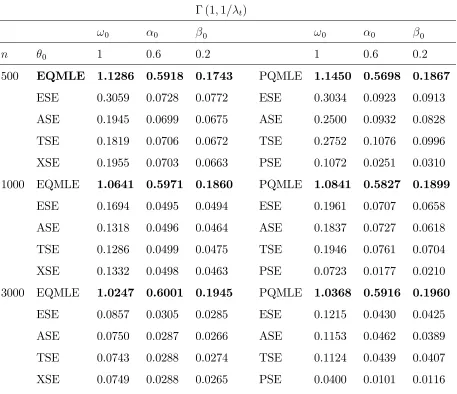
Monte Carlo experiments, not presented here for the sake of brevity, confirm the asymptotic
results of this section in finite samples.
5
Testing the multiplicative form of duration models
Instead of a standard ACD duration model (1.2), the present paper suggests a more general
POLI model with a conditional distribution that is not constrained by the MEM structure.
The variablezt=Yt/λtis independent of λt:=E(Yt| Ft−1) in model (1.2), whereas the two
variables are uncorrelated but not necessarily independent in the POLI model. In particular
the conditional variance of a POLI model is not constrained to be proportional to λ2t. It is
thus of interest to test
H0 : zt and λt are independent, (5.1)
without specifying a particular alternative model. Based on observations Y1, . . . , Yn, the
hypothesis H0 can be tested by using the empirical distance covariance (see Sz´ekely et al.
(2007), Rizzo and Sz´ekely (2016), and the references therein)
Vn2 =
Z
where ϕbz,λ, ϕbz and ϕbλ are respectively empirical estimators of the characteristic functions of (zt, λt), zt and λt. As shown in Sz´ekely, Rizzo and Bakirov (2007), a relevant choice of
weighting function is w(t, s) proportional to t−2s−2. Under the null and the existence of
marginal moments,nV2
n converges in distribution. The limiting distribution depends on the
marginal laws of the two variablesztandλtin the iid case. Davis, Matsui, Mikosch and Wan
(2018) recently showed that the nice properties of the distance covariance and correlation
can also be extended to time series. In our framework, the sequence (zt, λt)t≥1 is not iid
under the null, and λt is not directly observable, but can be approximated by eλt(bθ) defined
by (4.2). We propose to approximate the distribution of V2
n by the bootstrap distribution of
the variable V∗2
n defined in the following resampling scheme:
(i) Calculate the QMLE bθ = θn(Y1, . . . , Yn) defined by (4.3), the test statistics Vn2 =
V2
n(Y1, . . . , Yn), and the residualszbt =Yt/λet(bθ) for t=q+ 1, . . . , n. Denote by Fn the
empirical distribution of {zbt/sn, t = 1 +q, . . . , n} where sn =Pnt=q+1bzt/(n−q) (with
this scaling factor, the expectation of the distribution Fn is equal to 1).
(ii) GenerateY∗
1, . . . , Yn∗whereYt∗ =zt∗eλ ∗
t(bθ), thez∗t’s are independent andFn-distributed,
andeλ∗t(θ) is defined aseλt(θ) withYt−ireplaced byYt∗−i. Calculateθb ∗
=θn(Y1∗, . . . , Yn∗)
and the test statistics V∗2
n =Vn2(Y1∗, . . . , Yn∗).
(iv) Repeat step (ii) B times and calculate the corresponding test statisticsV∗2
n,1, . . . ,Vn,B∗2 .
(v) At the nominal significance level α ∈ (0,1), reject H0 if Vn2 > Vn,(B∗2 −[αB]), where
V∗2
n,(1) ≤. . .≤ Vn,(B)∗2 denote the corresponding order statistics.
The validity, i.e. the consistency under the null and the alternative, of an apparently sim-ilar resampling scheme has been proven in Francq, Jim´enez-Gamero and Meintanis (2017).
However, our framework is not the same, since the above-mentioned paper concerns
spheric-ity tests based on the empirical characteristic function. Proving the validspheric-ity of the present
algorithm does not seem trivial and will be the topic of future research.
Of course, when one wants to test a given ACD model against a particular POLI model, a
com-paring the likelihood of the two models. This will be illustrated in an empirical application
below.
5.1
Monte Carlo experiments
We simulated two data generating processes (DGP), one which satisfies H0 and the other
which does not. The first DGP is an ACD(1,1) modelYt =λtztwhereλt=ω+αYt−1+βλt−1
with (ω, α, β) = (0.5,0.1,0.89), and thezt’s are independent with exponential distribution of
mean 1. The other DGP (denotedH1in Table1) is a POLI model of conditional distribution
Γ(bλt, b) with b = 0.01 and λt which follows the same equation as in the first DGP. We used
the resampling algorithm with B = 99 replications (in the numerical illustration of the next
subsection, we also used B = 999 and noticed that the results were similar for B = 99 and
B = 999). Table 1 displays the empirical relative frequency of rejection over N = 1000
independent replications of the two DGP’s, for the sample sizes n = 500 and n = 1000.
The exercise is computationally demanding since N ×(B + 1) ×2×2 = 400000 models
have to be estimated and as many distance covariances have to be computed (leading to
around 3 days of computations on a personal laptop). Table 1 shows that the error of first
n= 500 n= 1000
DGP α= 1% α = 5% α= 10% α = 1% α= 5% α= 10%
H0 1.2 3.0 5.8 0.7 3.8 6.7
[image:24.612.117.491.413.500.2]H1 54.0 86.0 95.2 73.8 96.5 99.2
Table 1: Percentages of rejections of the bootstrapped distance covariance test.
kind is well controlled when α = 1%, but the test is slightly conservative at levels α = 5%
and α = 10%. Indeed, over N = 1000 replications of a test with nominal level α = 1%
(respectively 5% and 10%), the empirical relative frequency of rejection should vary between
0.2% and 1.9% (respectively 3.2% and 6.9%, and 7.5% and 12.5%) with probability 0.99.
our Monte Carlo setting. Of course, for other alternative models, that omnibus test of
independence may be less powerful. For instance, when the conditional distribution of the
DGP is Γ(bλt, b) with larger b, the power is smaller. This is not surprising because the
varianceλt/bof zt∼Γ(bλt, b) is a decreasing function ofb and, since the variablezttends to
become constant when b increases, it is harder and harder to detect a relationship between
zt and any other variable.
5.2
S&P 500 transaction volume
Consider the series (Yt) of the S&P 500 transaction volume from 3/10/2013 to 3/10/2018,
which corresponds to 1260 values (downloaded on Yahoo! Finance). Fitting a model (1.1)
with (p, q) = (2,1), the parameter estimates of the QMLE (4.3) are ωb = 0.680, αb1 = 0.498,
b
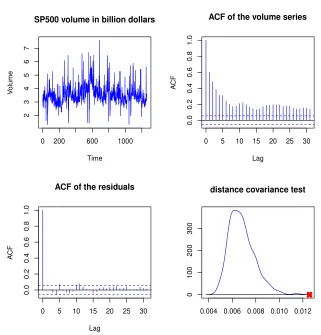
β1 = 0.271, βb2 = 0.040. As shown in the bottom-left panel of Figure 2, the autocorrelation function (ACF) of the residuals bzt = Yt/eλt(bθ) no longer shows any sign of dynamics. The
distance covariance test however rejects the standard MEM-ACD model in which zt and
λt are independent. Indeed, a kernel density estimator of the bootstrapped distribution
of V2
n under the null is displayed at the bottom-right panel of Figure 2. The value of Vn2
computed on the observations, indicated by a cross on the figure, is located at the extreme
right of the distribution, which gives strong evidence for rejecting the null. Actually, the
observed value of the distance covariance is larger than all theB = 999 bootstrap replications
used to approximate the distribution of V2
n under the null. The estimated p-value is thus
1/1000 = 0.001. On a personal computer with a 2.80 GHz processor, the bootstrap-based
test run time was around 600 seconds.
The distance covariance test concludes that a non-multiplicative POLI model is better
than an ACD model for this particular series, but the test is not informative about the
distributionFλ. We therefore tried several specifications for the conditional distribution Fλ:
the Exponential (ACD), the Γ(a, a/λt) (G-ACD), the Γ(bλt, b) (G-POLI), and two additive
models of the form (2.3) in which ǫt is assumed to follow a Γ(a, b) distribution (G-Add) or
a Fisk distribution (F-Add) with density f(y) = ab(ay)b−1/(1 + (ay)b)21
SP500 volume in billion dollars
Time
V
olume
0 200 600 1000
2
3
4
5
6
7
0 5 10 15 20 25 30
0.0
0.2
0.4
0.6
0.8
1.0
Lag
A
CF
ACF of the volume series
0 5 10 15 20 25 30
0.0
0.2
0.4
0.6
0.8
1.0
Lag
A
CF
ACF of the residuals
0.004 0.006 0.008 0.010 0.012
0
100
200
300
[image:26.612.138.459.126.461.2]distance covariance test
Figure 2: S&P 500 transaction volume from 3/10/2013 to 3/10/2018, ACF on the observed
series, ACF on the residuals of the POLI(2,2) model, distribution of the distance covariance
under the null hypothesis of multiplicative form, and observed distance covariance (cross
is a scale parameter and b > 0 is a shape parameter. For instance, the Fisk distribution is
used for hydrological stream flow modeling, or for the distribution of wealth in economics.
These models being fully parametric, they have been estimated by maximum-likelihood.
Table 2 shows that, according to the usual Akaike and bayesian information criteria (AIC
and BIC), the F-Add model outperforms the other models. This is certainly due to the
fact that the Fisk distribution can better take into account the fat tails of the conditional
distribution of the series (see the top-left panel of Figure 2) than the Gamma distribution.
Note that the Fisk distribution admits finite moments of order less than b only, while the
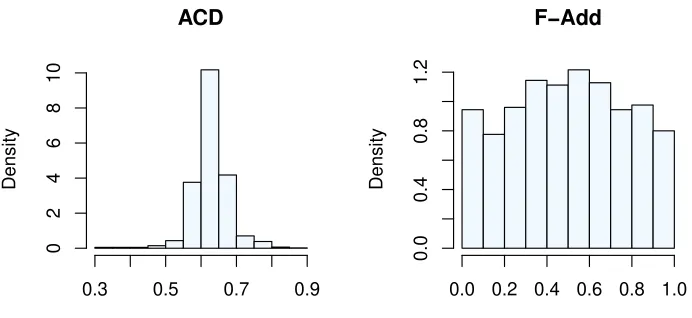
Gamma distribution admits moments of any order. Figure 3 compares the histograms of
the Probability Integral Transform (PIT) of the ACD and F-Add models, i.e. the empirical distributions ofFbλb
t(Yt), whereλt andFλ are estimated by the MLE of the two models. Note
that if the actual conditional distribution of Yt is the continuous cdf Fλt, then Fλt(Yt) is
uniformly distributed on [0,1]. Given this graph, the ACD is clearly rejected, while there is
no visible evidence against the F-Add model. Indeed, similar PIT histograms are obtained
on simulations of the F-Add model.
ACD G-ACD G-POLI G-Add F-Add
AIC 5657.409 1871.527 1888.031 1927.031 1636.941
BIC 5677.933 1897.181 1913.685 1957.816 1667.726
Table 2: AIC and BIC of the different models for the S&P 500 transaction volume series.
5.3
Greenhouse gas concentrations
Lucaset al. (2015) studied a large network data set of greenhouse gas (GHG) concentrations collected by tracers located at different areas in California. The left panel of Figure4displays
the time series obtained by one of these tracers. The partial autocorrelogram suggests
that the simple model (1.1) with q = 1 and p = 0 could be sufficient to summarize the
ACD
Density
0.3 0.5 0.7 0.9
0
2
4
6
8
10
F−Add
Density
0.0 0.2 0.4 0.6 0.8 1.0
0.0
0.4
0.8
[image:28.612.125.471.62.221.2]1.2
Figure 3: Probability integral transform (PIT) histograms for the ACD and F-Add models.
p-values of the test generally vary between 2% and 14% among the different series of GHG
concentrations. On the time series plot, one can see a concentration of observations around
zero, which precludes a continuous conditional distribution such as the Gamma law. We
thus investigated the use of zero-inflated conditional distributions. We denote by ZIE-ACD
the model of the ACD form (1.2) where zt follows a zero-inflated exponential distribution,
i.e. the model
Yt=λtzt, λt=ω+αYt−1, zt∼τ δ0(x) + (1−τ)µe−µx1x>0,
with standard notation for the mixture distribution, andµ= 1−τ in order to haveEzt = 1.
We denoted by ZIG-ACD the same model where, in the Radon-Nikodym density of zt, the
exponential distribution is replaced by the Γ(a,(1−τ)a) law. Note that the conditional
distribution of Yt is then Yt| Ft−1 ∼τ δ0+ (1−τ)Γ(a,(1−τ)a/λt). We also considered the
model
λt=ω+αYt−1, Yt| Ft−1 ∼τ δ0+ (1−τ)Γ(λtb,(1−τ)b).
Since this model can not be written in ACD multiplicative form (1.2) (its conditional variance
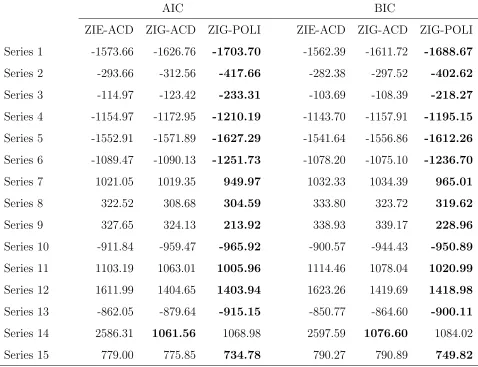
been estimated by maximum-likelihood on 15 series of GHG concentrations. Table 3shows
that, according to the AIC and BIC criteria, the POLI model is almost always preferable to
the ACD models. On the series displayed in Figure4(corresponding to Series 1 of Table 3),
the maximum-likelihood estimates of the ZIG-POLI parameters areωb = 0.0020,αb = 0.6888,
b
τ = 0.1743 andbb= 297.0.
Time
GHG
0 50 150 250
0.00
0.02
0.04
0.06
5 10 15 20 25
0.0
0.2
0.4
0.6
0.8
Lag
P
ar
tial A
[image:29.612.130.486.172.356.2]CF
Figure 4: Greenhouse gas time series concentration every 6 hours from May 10 to July 31,
2010, and empirical partial autocorrelations of the time series.
6
Conclusion
Proving the ergodicity of count time series models is a notorious tricky problem, for which
the present paper gives a simple solution. This also applies to more general positive-valued
series. In Sections 2-3, we present a unified approach to investigate stationarity and other
probabilistic properties of many, seemingly distinct, models of count and durations time
series. Section 4 shows that the approach also allows for a unified treatment in terms of
estimation of the conditional mean. The illustrations presented in Section 5 suggest that
AIC BIC
ZIE-ACD ZIG-ACD ZIG-POLI ZIE-ACD ZIG-ACD ZIG-POLI
Series 1 -1573.66 -1626.76 -1703.70 -1562.39 -1611.72 -1688.67
Series 2 -293.66 -312.56 -417.66 -282.38 -297.52 -402.62
Series 3 -114.97 -123.42 -233.31 -103.69 -108.39 -218.27
Series 4 -1154.97 -1172.95 -1210.19 -1143.70 -1157.91 -1195.15
Series 5 -1552.91 -1571.89 -1627.29 -1541.64 -1556.86 -1612.26
Series 6 -1089.47 -1090.13 -1251.73 -1078.20 -1075.10 -1236.70
Series 7 1021.05 1019.35 949.97 1032.33 1034.39 965.01
Series 8 322.52 308.68 304.59 333.80 323.72 319.62
Series 9 327.65 324.13 213.92 338.93 339.17 228.96
Series 10 -911.84 -959.47 -965.92 -900.57 -944.43 -950.89
Series 11 1103.19 1063.01 1005.96 1114.46 1078.04 1020.99
Series 12 1611.99 1404.65 1403.94 1623.26 1419.69 1418.98
Series 13 -862.05 -879.64 -915.15 -850.77 -864.60 -900.11
Series 14 2586.31 1061.56 1068.98 2597.59 1076.60 1084.02
[image:30.612.74.552.145.512.2]Series 15 779.00 775.85 734.78 790.27 790.89 749.82
Table 3: Information criteria of ACD and POLI models on 15 series of GHG concentrations
This gives a motivation for relaxing the usual multiplicative form of the ACD-like models,
even if the probabilistic structure of the model is then complicated by the absence of an
explicit iid innovation sequence. Note that the positivity of the observations is not
funda-mental for some of the results. In particular, one could easily obtain sufficient stationarity
conditions without this assumption. Moreover, our results can be applied to positive-valued
transformations of a non-positive series ǫt. For example, the square of a GARCH has the
ACD form ǫ2
t = σ2tη2t where the volatility σt is independent of the iid sequence ηt. Since
the multiplicative form of the GARCH model entails strong restrictions, such as a constant
conditional kurtosis, it could be of interest to consider a POLI model on ǫ2
t. This is a topic
that we leave for future research.
A
Proofs
Proof of Lemma 2.1 Note that the result is trivial when the number of failures r1 and r2
are integers. More generally, note that the likelihood ratio
P {N B(r2, p0) = k}
P {N B(r1, p0) = k}
=pr2−r1
0 k
Y
i=1
r2+k−i
r1+k−i
increases withk, which is known to entail the required stochastic dominance (see e.g. The-orem 1 in Lehmann (1955)).
Proof of Lemma 2.2 Assume (1.5), (2.5) and EY = (1−τ)λ ≤ EY∗ = (1−τ)λ∗. Then
for y ≥0 we have P(Y ≤y) =τ + (1−τ)Fλ(y)≥τ + (1−τ)Fλ∗(y) = P(Y∗ ≤y) and the
result follows.
Proof of Theorem 3.1 Assume (1.3) with (Xt) stationary and ergodic, for which (1.1) can be considered as a particular case.
If there exists m ∈(0,∞) such that m =EYt =Eλt for all t, then
1−
q
X
i=1
αi− p
X
j=1
βj
!
Under the positivity constraints on the parameters and exogenous variables, this equality
entails (3.2) and Eπ⊤Xt <∞.
It thus remains to show that (3.2) is sufficient for the existence of a strictly stationary
and ergodic solution to (3.1). Let (Ut) be an iid sequence of random variables uniformly
distributed in [0,1], independent of the sequence (Xt). Fort ∈Z, let Yt(k) =λ(k)t = 0 when
k ≤0 and, fork >0, let
Yt(k) =Fλ−(k)
t
(Ut), λ(k)t =ω+ q
X
i=1
αiYt(k−i−i)+ p
X
j=1
βjλ(kt−−jj)+π⊤Xt−1. (A.1)
Fork ≥2, we have
λ(k)t =ψk(Ut−1, . . . , Ut−k+1; Xs, s < t),
where ψk : [0,1]k ×[0,∞)∞ → [0,∞) is a measurable function. Therefore, for any k, the
sequences λ(k)t
t and
Yt(k)
t are stationary and ergodic. Let F (k)
t−1 and Ft∗−1 be the
sigma-fields generated by nYt(k−i−i), i > 0;Xs, s < to and {Us,Xs, s < t}, respectively. We have
EYt(k) | Ft(k)−1=EYt(k) | Ft∗−1=λ(k)t , PYt(k) ≤y| F
(k) t−1
=P F−
λ(tk)
(Ut)≤y| Ft∗−1
=Fλ(k)
t (y).
We have used the well known result that Fλ−(U) has the cdf Fλ when U is uniformly
dis-tributed in [0,1]. To show the existence of a solution to (3.1), with Ft−1 replaced by Ft∗−1,
it is now sufficient to show that
λt= lim k→∞λ
(k)
t exists almost surely (a.s.) in [0,+∞). (A.2)
Taking the limit as k→ ∞ in both sides of the equalities in (A.1), the solution will be then
given by Yt = limk→∞Yt(k) = Fλ−t(Ut) a.s. We then note that the distribution of Yt given
F∗
t−1 is the same as that of Yt given Ft−1 since λt isFt−1-measurable.
We now show (A.2) under (3.2). We first prove that, for all k,
0≤λ(kt −1) ≤λ (k)
and
EYt(k)−Y (k−1) t
=Eλ(k)t −λ (k−1) t
∈[0,∞). (A.4)
Clearly, (A.3) and (A.4) hold true for k ≤ 0. Assume (A.3) is satisfied for k ≤k0, then
using (2.2) we have
λ(k0+1)
t =ω+
q
X
i=1
αiF− λ(k0+1−i)
t−i
(Ut−i) + p
X
j=1
βjλ
(k0+1−j)
t−j +
r
X
i=1
πixi,t−1
≥ω+
q
X
i=1
αiF− λ(k0−i)
t−i
(Ut−i) + p
X
j=1
βjλ (k0−j)
t−j +
r
X
i=1
πixi,t−1 =λ(kt 0).
Therefore the inequalities in (A.3) are shown by induction. Now note that EYt(k) = Eλ(k)t
exists for any fixed k, and for all positive parameters. It follows that (A.4) holds true. In
the casep=q= 1, we then have
Eλ(k)t −λt(k−1)= (α+β)Eλt(k−−11)−λ(kt−−12)= (α+β)k−1ω.
More generally, with obvious convention, under (3.2) we have
Eλ(k)t −λ(kt −1)=
max(p,q)X i=1
(αi+βi)E
λt(k−−ii)−λ(kt−−ii−1)≤Kρk, ∀k≥1,
with K > 0 and ρ ∈(0,1). This entails that the sequence nλ(k)t
o
k converges in L
1 and a.s.
under (3.2). Moreover, since
λt=ψ(Ut−1, Ut−2, . . .; Xt−1,Xt−2, . . .),
where ψ : [0,1]∞×[0,∞)∞→[0,∞) is a measurable function, the sequence (λ
t) is ergodic.
Proof of Theorem 3.2 Let the notation ms = EYts when the moment exists, and b(ℓ) =
Pℓ−1
i=0aℓ(i)Eλ i
t. Then (3.3) entails mℓ=a(ℓ)Eλℓt+b(ℓ).
We first show EY2
t <∞ iff (3.4) holds with ℓ= 2. The latter condition writes
Since m2 =a(2)Eλ2t +b(2), we have
m2 = a(2)
ω2+α2m2+ 2ω(α+β)m1 + (β2+ 2αβ){m2−b(2)}+b(2)
= a(2)α2+β2+ 2αβ m2+K,
where
K =a(2)ω2+ 2ω(α+β)m1 +b(2) 1−β2 −2αβ
>0.
Therefore EY2
t < ∞ entails (A.5). To show that (A.5) is also sufficient, recall that it has
been shown in the proof of Theorem3.1 that
Yt= lim
k→∞↑Y
(k)
t .
By the monotone convergence theorem, to prove thatm2 exists it thus suffices to prove that
limk→∞m(k)2 is finite, where m (k)
s denotes EYt(k)s (which is finite for all s ≥ 0 and all k).
Letting µ(k)s =Eλ(k)st and b(k)(ℓ) =
Pℓ−1
i=0aℓ(i)Eλ(k)it we have
m(k)2 =a(2)µ(k)2 +b(k)(2)
= a(2)nω2+α2m2(k−1)+ 2ω(α+β)m(k1 −1)o
+(β2+ 2αβ)nm2(k−1)−b(k−1)(2)o+b(k)(2) = a(2)α2+β2 + 2αβ m(k2 −1)+K(k),
where
K(k) =a(2)nω2+ 2ω(α+β)m1(k−1)o+b(k)(2)−b(k−1)(2) β2+ 2αβ→K
a.s. ask → ∞, since we have seen in the proof of Theorem3.1that (3.2) entails limk→∞m(k)1 =
limk→∞µ(k)1 =m1. We thus have
m(k)2 ≤ρm(k2 −1)+ 2K ≤2K
∞
X
i=0
ρi <∞
The proof of (3.4) is complete in the case ℓ= 2. Now consider the general case, arguing
by induction on ℓ≥3. We have
mℓ = a(ℓ)
( ℓ X j=0 ℓ j
αjβℓ−jEYtj−1λℓt−−j1+Rℓ
)
+b(ℓ)
= a(ℓ)αℓmℓ+ ℓ−1
X
j=0
a(j)
ℓ j
αjβℓ−j{mℓ−b(ℓ)}+a(ℓ)R(ℓ) +b(ℓ),
where the term R(ℓ) is a linear combination of 1, Eλt, . . . , Eλℓt−1 with positive coefficients.
By induction, one can assume that R(ℓ) andb(ℓ) are finite under (3.4). It follows that (3.4)
is necessary to have mℓ finite. The converse is shown as in the case ℓ= 2.
Proof of Theorem 3.3 As in the proof of Theorem 3.1, consider an iid sequence (Ut)
of random variables uniformly distributed in [0,1], independent of the sequence (Xt), and
define Yt(k)=λ (k)
t = 0 when k ≤0 and, whenk >0,
Yt(k)=Fλ−(k)
t
(Ut), (A.6)
λ(k)t =g(Yt(k−1−1), . . . , Yt(k−q−q), λt(k−−11), . . . , λ(kt−−pp)) +π(Xt−1).
By the argument of the proof of Theorem 3.1, to show the existence of a stationary solution
it suffices to show the almost sure convergence (A.2) of λ(k)t as k→ ∞. In view of (2.2), we
have
En|Yt(k)−Y (k−1)
t |λ
(k) t , λ
(k−1) t
o
=λ(k)t −λ (k−1) t
.
Therefore
EYt(k)−Y (k−1) t
=Eλ(k)t −λ (k−1) t
.
It follows that, under (3.9),
Eλ(k)t −λ(kt −1)≤
p∨q
X
i=1
(αi+βi)E
λ(kt−−ii)−λt(k−−ii−1)≤Kρk, ∀k ≥1,
for some constans K >0 and ρ∈(0,1). The proof of the existence of a stationary solution
Now assume (3.9) and Yt is valued in N. For i= 1,2, define stationary processes by
Yt[i] =F−
λ[ti]
(Ut), λ[i]t =g(Y [i]
t−1, . . . , Y [i] t−q, λ
[i]
t−1, . . . , λ [i]
t−p) +π(Xt−1),
for t≥1, where
Z[1]0 = (Y0[1], . . . , Y1[1]−q, λ[1]0 , . . . , λ[1]1−p) and
Z[2]0 = (Y0[2], . . . , Y1[2]−q, λ[2]0 , . . . , λ[2]1−p) are independent and follow the stationary law of
Zt:= (Yt−1, . . . , Yt−q, λt−1, . . . , λt−p).
By the coupling arguments used to show (5.6) in Davis and Liu (2016) or (5.9) in Neumann
(2011), we have
β(h) =Esup
A∈B|
P {(Yh, Yh+1, . . .)∈A|Z0} −P {(Yh, Yh+1, . . .)∈A}|
=Esup
A∈B
P n(Yh[1], Yh+1[1] , . . .)∈A|Z[1]0 o−P n(Yh[2], Yh+1[2] , . . .)∈A|Z[1]0 o
≤
∞
X
k=0
P Yh+k[1] 6=Yh+k[2] ≤
∞
X
k=0
EYh+k[1] −Yh+k[2] ,
with obvious notation. The last inequality holds becauseYh+k[1] −Yh+k[2] is valued in N. Now,
note that (2.2) implies that
E|Yt[1]−Y [2]
t |λ
[1] t , λ
[2] t
=|λ[1]t −λ [2] t |.
Therefore
E|Yt[1]−Y [2]
t |=E|λ [1]
t −λ
[2]
t | ≤
q
X
i=1
αiE|Yt[1]−i−Y [2] t−i|+
p
X
j=1
βjE|λ [1] t−j −λ
[2]
t−j| ≤Kρt,
and the conclusion follows.
Lemma A.1 Let {Yt, t∈Z} be a strictly stationary and ergodic sequence satisfyingA1and A2. Assume that Θsatisfies the compactness assumption A6. There exist a F0-measurable
random variable K >0 and a constant ρ∈(0,1) such that
sup
θ∈Θ
λt(θ)−eλt(θ)
Proof of Lemma A.1 By (3.8), fort ≥q+ 1 we have
δt:=
λt(θ)−eλt(θ)
≤
p
X
j=1
βjλt−j(θ)−eλt−j(θ)
≤β max
j=1,...,pδt−j,
where β := supθ∈Θ
Pp
j=1βj < 1 by A2 and A6. Iterating the previous inequality, and
setting K0 = supθ∈Θmaxj=1,...,pδq+1−j, we obtain
δq+1 ≤K0β, δq+2 ≤βmax{δq+1, K0} ≤K0β, δq+j ≤K0β, j = 1, . . . , p
δq+p+j ≤K0β2, j = 1, . . . , p, δq+kp+j ≤K0βk+1, j = 1, . . . , p.
When β = 0, the result is obvious. When β > 0, the result holds with K = K0β−q/p and
ρ=β1/p.
Lemma A.2 Let{Yt, t∈Z}be a strictly stationary and ergodic sequence satisfyingA1, A2
and A4, and assume A6. We have
Esup
θ∈Θ
λt(θ)<∞.
Proof of Lemma A.2 Note that, by (3.8),
λt(θ)≤ct(θ) + p
X
i=1
βjλt−j(θ), ct(θ) = g(0⊤;θ) +π(Xt−1) + q
X
i=1
αiYt−i.
Let λt(θ) = (λt(θ), . . . , λt−p+1(θ))⊤, ct(θ) = ct(θ),0⊤⊤ and B a companion-like matrix
such that the previous inequality yieldsλt(θ)≤ct(θ)+Bλt−1(θ). Lettingλt = supθ∈Θλt(θ)
and ct = supθ∈Θct(θ) componentwise, we obtain
kλtk ≤ kctk ∞
X
i=0
sup
θ∈Θk
Bki <∞
because A2 and A6 entail supθ∈Θρ(B)< 1 (see e.g. (7.27) in Francq and Zakoian, 2019).
The conclusion follows.
the inequality log (x)≤x−1,A3 and Lemma A.1, it follows that
sup
θ∈Θ
Ln(θ)−Len(θ)
= 1
nsupθ∈Θ
n X t=1 Yt 1
λt(θ) −
1
e
λt(θ)
!
+ log λt(θ)
e
λt(θ)
!! ≤ 1 n n X t=1
Ytsupθ∈Θ
λt(θ)−eλt(θ)
λt(θ)eλt(θ)
+ supθ∈Θ
eλt(θ)−λt(θ)
e
λt(θ)
≤ K n n X t=1
Ytρt
ω2 +
ρt
ω
→0,a.s. asn → ∞. (A.7)
B