Automatic Body Feature Extraction from Front and Side
Images
Lingyan Jiang
1,3, Jian Yao
2,1*, Baopu Li
3, Fei Fang
1, Qi Zhang
3, Max Q.-H. Meng
4,31School of Computer, Electronics and Information, Guangxi University, Nanning, Guangxi, P.R. China; 2School of Remote Sensing
and Information Engineering, Wuhan University, Wuhan, Hubei, P.R. China; 3Shenzhen Institutes of Advanced Technology, Chinese Academy of Sciences, Shenzhen, P.R. China; 4Department of Electronic Engineering, The Chinese University of Hong Kong, Hong Kong, P.R. China.
Email: *[email protected]
Received 2012.
ABSTRACT
Human body feature extraction based on 2D images provides an efficient method for many applications, e.g. non-contact body size measurements, constructing 3D human model and recognizing human actions. In this paper a systematic approach is proposed to detect feature points of human body automatically from its front and side images. Firstly, an efficient approach for silhouette and contour detection is used to represent the contour curves of a human body shape with Freeman’s 8-connected chain codes. The contour curves are considered as a number of segments con-nected together. Then, a series of feature points on human body are extracted based on the specified rules by measuring the differences between the directions of the segments. In total, 101 feature points with clearly geometric properties (that rather accurately reflect the bump or turning of the contours) are extracted automatically, including 27 points cor-responding to the definitions of the landmarks about garment measurements. Finally, the proposed approach was tested on ten human subjects and the entire 101 feature points with specific geography geometrical characteristics were cor-rectly extracted, indicating an effective and robust performance.
Keywords: Silhouette detection; Contour representation; Human feature point extraction
1.
Introduction
With the popularity of digital cameras, 2D images are captured conveniently with much lower cost, which are considered as the main information carriers for the hu-man recording and understanding. In the past decades, how to efficiently and robustly extract more information from the 2D images, especially from the human images, has become a research hotspot. Recently, automatic body feature extraction from 2D human images is widely used in many fields, such as non-contact body size measuments [11], constructing 3D human models [9,10], re-cognizing human actions [1-3].
For anthropometric data collection, the traditional way is the manual measurement. Since many problems such as subjective judgments of landmarks may be involved in the manual measurement processing, a computerized image-based approach provides an alternative to the tra-ditional method of manual measurement [5]. The body scanner is developed for realizing non-contact 3D
mea-surements that often need to segment the body parts and it is such a tedious process [4]. Recently the 3D mea-surement based on 2D images has aroused extensive at-tention. Image-based systems are capable of providing anthropometric measurements that are quite comparable to traditional measurement methods, in terms of both accuracy and repeatability [5]. Extracting human feature points automatically from the front and side images is the key part to the non-contact body measurement based on images for the garment industry.
Extraction of human body feature points accurately also plays a very important role in the establishment of a virtual human model. Lin and Wang [9,10] presented a systematic approach for constructing 3D human model using the front and side images of a person based on the feature points of the silhouettes that were identified. To recognize human actions, Ali and Aggarwal [13] identi-fied the knee and hip by calculating the curvature of the silhouette as the feature points to recognize human ac-tions.
bust human body feature point detection algorithm based on the front and side images of a human body, whose key inspiration stems from a series of studies [9-12]. Background subtraction is used to obtain the contours. Canny edge detection operator [8] and Freeman’s 8-connected [6] chain codes are used to represent the silhouette curves. Then the curves are cut into a series of segments whose directions are denoted by the corres-ponding values of second chain codes in the segments. Therefore, specific rules for measuring the differences between the directions of segments are utilized to extract the feature points. The proposed method was tested on ten human subjects and all of the 101 pre-defined feature points were correctly extracted. Among these feature points, there are 27 points with geometrical properties that indicate concavity and convexity of the curves per-fectly, corresponding to the definitions of landmarks related to garment measurements.
In [11, 12], a total of 55 and 60 feature points can be extracted from front and side images, respectively. Comparing with [11,12], there are more feature points detected in our work. In addition, different methods of contour detection and different feature point extraction rules are used in our approach. Firstly, the used ground subtraction is more applicable to complex back-ground than the methods used in [11, 12]. Secondly, the feature points extracted in our work are independent with each other. However, in [11,12] the feature point always depend on the previous feature point, even both the ad-jacent feature points, so if one point is wrongly detected, the others may be unbelievable. Thirdly, in [11,12], the method to extract the secondary feature points is to use the primary feature points as the auxiliary points to help to locate the new feature points. Our method is more intuitive, since all feature points extracted in the same batch. Finally, the feather points detected in [11,12] had not compared with definitions in any standard, it is not enough to take it as left shoulder acromion or other landmarks, but it had been done in this paper.
2.
Feature Points Extraction
2.1.
Photographing and Pre-processing
Firstly, the camera is positioned at 5m distance from the subjects and 1m height from the ground and four images are captured, two of the background and two of the hu-man subject. In experiments, the Canon SX130 camera was used to capture the images with a resolution of 4000×3000 pixels and with opening flash to reduce the effects of shadowing. In order to reduce the data processing time, the front and side images are resized into 1260×1854 pixels and 504×1854 ones which remain the parts of the human body and then are reduced to
211×309 pixels and 84×309 pixels, respectively. At the same time, the corresponding parts of the backgrounds are processed in the same way.
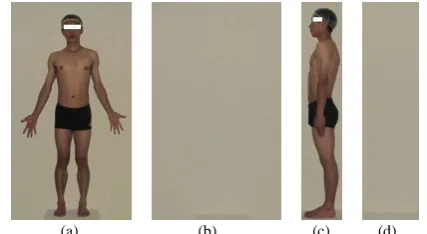
(a) (b) (c) (d) Figure 1. The results of a male model after photographing & pre-processing: (a)-(b) The front image and its back-ground; (c)-(d) The side image and its background.
Subjects are lightly clothed and also are required to wear a headgear to reduce the influences of hair on the test results. The subjects are requested to stand in front of a white wall with a standing posture.When shooting the human from the frontal view, Legs of the subject are apart from each other for shoulder width and arms open on both sides of the body, while the fingers face to the camera and are forced open. The results of a male model after photographing and pre-processing are shown in Figure 1 (The pictures in this paper all come from our experiment about a male model).
2.2.
Silhouette Detection and Contour
Representation
The used extraction algorithm of the body silhouettes is a standard background subtraction to isolate the subject from images, whose steps are described as follows: 1) Calculating the color difference values of the cur-rent image and the background as follows:
[ ] [ ]
[ ] [ ]
[ ] [ ]
-(R)
C (G) =
-C (B)
-ij ij ij
ij ij ij ij ij ij
X R Y R C
X G Y G
X B Y B
(i,j)∈Ω (1)
where Ω denotes the fields of images, Xij and Yij
represent the RGB color value of the current image pixel (i,j), and the background pixel (i,j), respectively.
2) Differences between foreground and background pixels are measured as follows:
D i j
( )
, =d1×Cij[ ]
R +d2×Cij[ ]
G +d3×Cij[ ]
B (2) where d1, d2 and d3 are the weighted values of Red,Green and Blue channels, respectively.
All of our images were taken under the natural light. Since RGB are basically the same as the natural light, the weighted values are set to 1.
[image:2.595.318.532.127.244.2]val-ue∆T , the pixel (i,j) is regarded as a former attractions, and vice versa for background. After that, two binary images of the body shapes can be obtained. In our expe-riments ∆Twas empirically set to 35.
(a) (b) (c) (d) Figure 2. Silhouettes and contours of a human body: (a) Silhouette extraction result of the front image; (b) Sil-houette extraction result of the side image; (c) Body contour
f
C from the front image of the subject; (d) Body contour
s
C from the side image of the subject.
As illustrated in Figures 2(a)-(b), silhouettes of the front and side views of the subject are extracted. After extracting the body silhouettes from the 2D images, the Canny edge detector [8] is subsequently applied to locate the silhouettes of human body from the two binary im-ages. The single-pixel and closed contour curves are ex-tracted as shown in Figures 2(c)-(d). The silhouette points on Cfand Csare denoted as:
{
0 1 -1}
= , ,...,ff
n
C f f s=
{
0, ,...,1 -1}
m
C s s s (3) where f0 and s0are the starting points on the left-top of
the head on each contour curves, fi and si are the
clock-wise
( )
i+1 th points from the first points, and Cf ands
C have a total of
n
points and m ones respectively. To identify these points automatically, the edge pixels of the body silhouettes are encoded by the Freeman’s 8-connected chain codes [6,7]. With the Freeman chain code, the numbers “0”-“7” are used to represent 45° in-crements in a counterclockwise directions starting from an initial horizontal vector “0”. The body contours are descripted with a series of chain codes of pix-els: f=000000000000070...C , s=000000000007000...
C .
2.3.
Feature Extraction
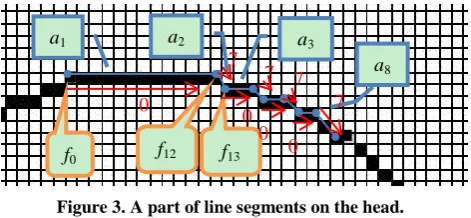
The contour curves of the body are considered as con-nections of a series of line segments. A part of line seg-ments on the head of the front curve are shown in Figure 3. The first segment a1 connects the first point f0 and the
consecutive points with the same code value of “0” in sequence, so it starts from the point f0to the point f12. The
next segments are the connections of the continuous points are in the same direction and the previous point in the different direction, such as a2 starts from the point f12
[image:3.595.308.544.83.192.2]to the point f13.
Figure 3. A part of line segments on the head.
The freeman code of the second point of the line seg-ment in addition to the starting point is taken as the in-clination of the line segment or its direction. If the incli-nations of the current line segment and the adjacent two segments satisfy one of the conditions that are shown in Figure 4, then the starting or last point (when it comes the left part of the front human silhouette curve) of the current segment line is considered as the feature point of human body. The current line segment direction is presented using red line with arrow and that of the two segments are adjacent to it are used blue lines with ar-rows to present. If one of the two adjacent segments is in the 45° clockwise direction and the other one must be in the 45° counterclockwise direction of the current seg-ment line. So actually, there are 16 cases that can be used to judge a feature point.
(a) (b) (c) (d)
[image:3.595.314.535.401.539.2]
(e) (f) (g) (h) Figure 4. Eight cases of the line segment directions.
Another judgment principle is used while the current line segment is perpendicular to the previous line seg-ment. The starting point of the current segment line is considered as the feature point of human body. All of the judgments principle can be expressed as:
(a) d d2- =-1,1 d d2- 3=1 (b) d d2- =1,1 d d2- 3=-1 (c) d d2- =-1,1 d d2- 3=-7 (d) d d2- =-7,1 d d2- 3=-1 (e) d d2- =1,1 d d2- 3=7 (f) d d2- 1=7,d d2- 3=1
(g) d d2- 1 =2 (4) where d1, d2 and d3denote the inclinations of the three
adjacent segments. Formulas (4)(a) and (4)(b) corres-pond with conditions shown in Figures 4(b-g), formulas
a1 a2 a3
a8
f0 f12 f13
0 1 2 3 4
5
7 6
0 1 2 3 4
5 7
6
0 1 2 3 4
5
7 6 0
1 2 3 4
5 7
6 0
1 2 3 4
5 7
6
0 1 2 3 4
5
7 6
0 1 2 3 4
5 7
6
0 1 2 3 4
5 6 7
0 0
7
7 7
7 0
(4)(c) and (4)(d) correspond with the case shown in Fig-ure 4(a) and formulas (4)(e) and (4)(f) correspond with the case shown in Figure 4(h). Moreover, another judg-ment principle that the absolute value of d2 subtracts d1
equals to 2 in formula (4)(g) corresponds with the condi-tion of two segments are perpendicular. The testing processes of some points are shown in Figure 5 where the starting point on the left-top of the head is token as the first feature point H1. The directions of a9, a10 and a11
are 0, 7 and 6, respectively. Since the three segments conform to the case shown in Figure 4(h), the first point of a10 is token as the second feature point F1. The
[image:4.595.310.534.86.348.2]re-maining feature points are detected according to the rules.
Figure 5. Feature points F1 and F2 extracted on the head.
Detailed steps of the algorithm are described as fol-lows (the front silhouette is taken as an example): 1) Calculating the inclinations of the segments. The contour curves are expressed with the code sequence as:
p0, p1, …, p(n-1), and then pk is taken as the code value of
the point fk. At the first, f0is inserted into the sequence V.
If pk−p(k−1) ≠0 (0<k<n), fk is inserted into V. In
addi-tion to f0, every point in V happens to be the second point
of each segment whose code value can be used to represent direction of the segment.
2) The detections of feature points. Z is taken as the sequence of feature points. V: v0, v1, …, v(u-1) represents
the sequence of pixels. v0 is inserted into Z as the first
feature point. The code values of the current point vk and
the adjacent points v(k-1), v(k+1), (0<k<u-1) just represent
their line segment directions. Then the principles in for-mula (4) are used to judge the feature points. If vk, v(k-1)
and v(k+1) conform one of the conditions in formula (4),
the one of two endpoints of the segment line that in-cludes the point vk is considered as a feature point to be
inserted into the sequence Z.
3.
Evaluation
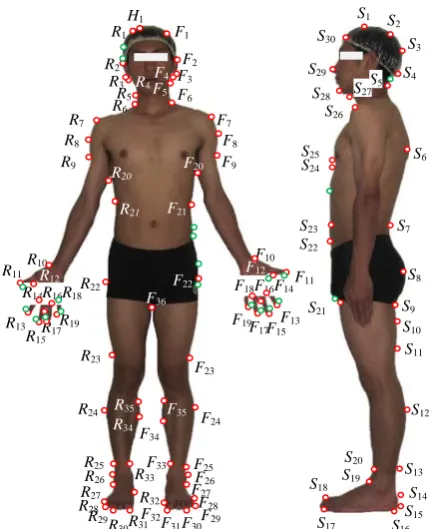
The algorithm is demonstrated in Matlab 2009a, the 101 feature points are completely detected from ten objects. It proves that this approach is effective and robust. The feature points on front and side images are shown in Figure 6. The same positions of the feature points de-tected are also marked in the color images, as shown in Figure 7. It is demonstrated that the feature points is
ra-ther accurate and reliable by visual inspection.
[image:4.595.311.534.97.612.2]Figure 6. Body feature points (marked with red circles) consisting of 71 front ones and 30 side ones.
Figure 7. Body feature points (marked with red circles) on a male model consisting of 71 front ones and 30 side ones.
The test results of ten subjects consisting of five males and five females are shown in Table 1.
Table 1. Test results of the ten subjects.
H1
F1
a10=7
a11=6
a9=0
F1 F2 F3 F6 F4 F5 F7 F8 F9 F20 F10 F11 F12 F13 F15 F17 F19
F18F16F14
F21
F22
F36
R1
R2
R3 R4
R5 R6 R8 R9 R20 R10 R7 R11 R12 R13
R15 R17
R19
R14R16R18
R22 R21 F23 F24 F25 F26 F27 F28 F29 F30 F31 F32 F33 F34 F35 R23 R24 R25 R26 R27 R28
R29 R 30 R31
R32 R33 R34 R35
H1 S1 S2
S3 S4 S5 S6 S7 S8 S9 S10 S11 S12 S13 S14 S15 S16 S17
S18 S19
S20 S21 S22 S23 S25 S24 S26 S27 S28 S29 S30 F1 F2 F3 F6 F4 F5 F7 F8 F9 F20 F10 F11 F12 F13 F15 F17 F19
F18F16F14 F21
F22 F36
R1
R2
R3 R4
R5 R6 R8 R9 R20 R10 R7
R11 R12
R13
R15
R17R19
R14R16R18R22 R21 F23 F24 F25 F26 F27 F28 F29 F30 F31 F32 F33 F34 F35 R23 R24 R25 R26 R27 R28
R29 R 30 R31
R32 R33 R34 R35
H1 S1 S
[image:4.595.57.292.250.341.2] [image:4.595.317.534.374.639.2]Number, Sex, Age, Height, Weight of subject
The detected
points All detected points 5, Male, 25-27, 172-189cm,
64-70kg
Front: 117-119
Side: 31-33 Front: 71 Side: 30 5, Female, 25-27,
155-161cm, 50-55kg
Front: 112-121 Side: 31-34
In total, there are 119 points detected from the front silhouette curve of the male models. However, only 71 points are taken as the feature points. The reasons are given as follows. Firstly, hands have large individual differences and severe changes of concavity and convex-ity. Only the 18 points representing fingertips and finger roots of the 60 points detected on the hands are taken as the feature points. Secondly, as shown in Figure 6, there are other 6 points marked in Green on the head and waist of the front silhouette curve, and 3 points on the side silhouette curve that are discarded, because they are not
detected in the same parts of the other subjects. With these two reasons, the 101 points with reproducibility and stability are taken as the feature points.
In [14], 35 landmarks were evaluated. It used “Lowest point”, “Tip of process”, “Uppermost point”, “Most lateral point” and some other words to describe the landmarks related to body dimensions. Leong [15] launched geometry definitions of feature points accord-ing to basic definitions in ISO 8559(1989) [16]. So the definitions of feature points in [14-16] and GB/T 16160-2008 [17] are combined to evaluate the effective-ness of feature point that be detected.
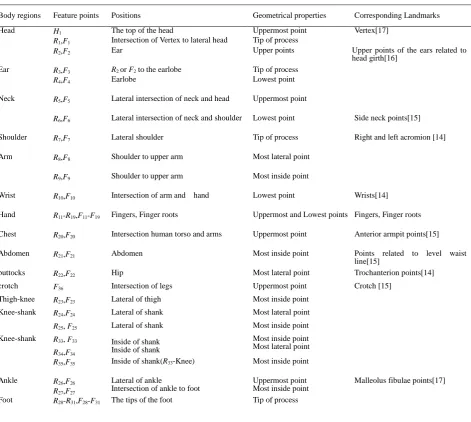
[image:5.595.64.536.304.726.2]The geometrical properties of the feature points are analyzed. The results are shown in Table 2 and Table 3.
Table 2. Geometrical properties of the front feature points and the corresponding landmarks.
Body regions Feature points Positions Geometrical properties Corresponding Landmarks
Head H1 The top of the head Uppermost point Vertex[17]
R1,F1 Intersection of Vertex to lateral head Tip of process
R2,F2 Ear Upper points Upper points of the ears related to head girth[16]
Ear R3,F3 R2 or F2 to the earlobe Tip of process
R4,F4 Earlobe Lowest point
Neck R5,F5 Lateral intersection of neck and head Uppermost point
R6,F6 Lateral intersection of neck and shoulder Lowest point Side neck points[15]
Shoulder R7,F7 Lateral shoulder Tip of process Right and left acromion [14]
Arm R8,F8 Shoulder to upper arm Most lateral point
R9,F9 Shoulder to upper arm Most inside point
Wrist R10,F10 Intersection of arm and hand Lowest point Wrists[14]
Hand R11-R19,F11-F19 Fingers, Finger roots Uppermost and Lowest points Fingers, Finger roots
Chest R20,F20 Intersection human torso and arms Uppermost point Anterior armpit points[15]
Abdomen R21,F21 Abdomen Most inside point Points related to level waist line[15]
buttocks R22,F22 Hip Most lateral point Trochanterion points[14]
crotch F36 Intersection of legs Uppermost point Crotch [15]
Thigh-knee R23,F23 Lateral of thigh Most inside point
Knee-shank R24,F24 Lateral of shank Most lateral point
R25, F25 Lateral of shank Most inside point Knee-shank R33, F33 Inside of shank
Inside of shank
Most inside point Most lateral point
R34,F34
R35,F35 Inside of shank(R33-Knee) Most inside point
Ankle R26,F26
R27,F27
Lateral of ankle
Intersection of ankle to foot
Uppermost point Most inside point
Malleolus fibulae points[17]
R32,F32 Inside of foot Most inside point
Table 3. Geometrical properties of the side feature points and the corresponding landmarks.
Body regions Feature points Positions Geometrical properties Corresponding Landmarks
Head S1 The top of the head Uppermost point
S2 S1 to S3 Tip of process
S3 After side of the head Most lateral point
S4 S3-neck Tip of process
S30 S1- forehead Tip of process
S29 nose Uppermost point
S28 chin Lowest point
Neck S5 Intersection of the back side of head and neck Lowest point of head After neck point [15]
S27 Chin to neck Turning point
S26 Intersection of Neck and chest Lowest point Front neck point [15]
Chest S6 shoulder blade Most lateral point Prominent point of the scapula [15]
S25 Front of chest Most lateral point The highest point in the chest [15]
S24 Chest to Abdomen Turning point
Abdomen S7 the back of waist Most inside point
S23 Abdomen Most inside point
S22 Abdomen Most lateral point
Hip S8 Bake side of hip Most lateral point Bake side of hip[15]
Huckle S9 Intersection of hip and huckle Lowest point of hip
S21 Intersection of huckle and abdomen Uppermost point The root of front segment of thigh[17]
S10 Bake side of huckle Most lateral point The root of back segment of thigh[17]
S11 Bake side of huckle Most inside point
Knee-Shank S12 Bake side of shank Most lateral point
S13 Bake side of shank Most inside point
Shank -knee S20 Front side of shank Most inside point
Foot S19 Intersection of shank and foot Uppermost point
S14-S18 Foot and ground The tips of foot
Experimental results show that the feature points can be extracted reliably and effectively by the proposed method. The 27 points that are in line with the definitions of measurement landmarks can be used in garment in-dustry. In addition, all the points have clearly geometric properties what rather accurately reflect the bump, or turning of the contours, so they can be used for the estab-lishment of a virtual human model and the recognition of human actions. In particular, the points of fingertips and the roots of fingers can be used for gesture recognition.
4.
Conclusion
reliable and effective. All the points have clearly geome-tric properties that can be used in many fields. Further-more, by comparing the proposed method with the pre-vious researches, it demonstrates the improved perfor-mance in feature points extraction. In future work, we will focus on collecting the human dimensions, as well as the establishment of three-dimensional human models based on these extracted feature points.
REFERENCES
[1] S.A. Rahman, S.-Y. Cho and M.K.H. Leung, “Recognis-ing human actions by analyz“Recognis-ing negative spaces,” IET Computer Vision, Vol. 6, No. 3, 2012, pp. 197–213.
[2] N. Ikizler and D.A. Forsyth, “Searching for complex hu-man activities with no visual examples,” Int. Journal of Comput. Vision, Vol. 80, No. 3, 2008, pp. 337–357.
[3] C. Bregler, “Learning and recognizing human dynamics in video Sequences,” Proc. Computer Vision and Pattern Recognition, San Juan, 1997, pp. 568–574.
[4] J.M. Lu and M.J. Wang, “Automated data collection using 3D whole body scanner,” Expert Systems with Applica-tions, Vol. 35, No. 1-2, 2008, pp. 407–414.
[5] P. Meunier and S. Yin, “Performance of a 2D image-based anthropometric measurement and clothing sizing system,”
Applied Ergonomics, Vol. 31, No. 5, 2000, pp. 445–451.
[6] H. Freeman, “On the encoding of arbitrary geometric con-figuration,” IRE Transactions on Electronics Computers, Vol. EC-10, No. 2, 1961, pp. 264–268.
[7] H. Freeman and L.S. Davis, “A corner-finding algorithm for chain-coded curves,” IEEE Transactions on
Comput-ers, Vol. C-26, No. 3, 1977, pp.
297–303.
[8] J. Canny, “A computational approach to edge detection,”
IEEE Transactions on Pattern Analysis and Machine In-telligence, Vol. 8, No. 6, 1986, pp.
679-698.
[9] Y.L. Lin and M.J. Wang, “Constructing 3D Human Model from 2D images,” Int. Conf. on Industrial Engineering and Engineering Management, Xiamen, Oct, 2010, pp.1902-1906.
[10]Y.L. Lin and M.J. Wang, “Constructing 3D human model from front and side images,” Expert Systems with Applica-tions, Vol. 39, No. 5, April 2012, pp. 5012–5018.
[11]Y.L. Lin and M.J. Wang, “Automatic Feature Extraction from Front and Side Images,” Int. Conf. on Industrial En-gineering and EnEn-gineering Management, Singapore, Dec, 2008, pp. 1949-1953.
[12]Y.L. Lin and M.J. Wang, “Automated body feature ex-traction from 2D images,” Expert Systems with Applica-tions, Vol. 38, No. 3, 2011, pp. 2585–2591.
[13]A. Ali and J.K. Aggarwal, “Segmentation and recognition of continuous human activity,” Proc. IEEE Workshop on Detection & Recog. of Events in Video, Vancouver, BC, 2001, pp. 28–35.
[14]M. Kouchi and M. Mochimaru, “Errors in landmarking and the evaluation of the accuracy of traditional and 3D anthropometry,” Applied Ergonomics, Vol. 42, No. 3,
2011, pp. 518-527.
[15]Iat-Fai Leong, “A study of automatic anthropometry and construction of computer manikins,” Master's thesis of National Cheng Kung University, 1992. (In Chinese) [16]ISO8559-1989 garment construction and anthropometric
surveys body dimensions.