Generative Topic Embedding: a Continuous Representation of Documents
Shaohua Li1,2 Tat-Seng Chua1 Jun Zhu3 Chunyan Miao2
[email protected] [email protected] [email protected] [email protected] 1. School of Computing, National University of Singapore
2. Joint NTU-UBC Research Centre of Excellence in Active Living for the Elderly (LILY) 3. Department of Computer Science and Technology, Tsinghua University
Abstract
Word embedding maps words into a low-dimensional continuous embedding space by exploiting the local word collocation patterns in a small context window. On the other hand, topic modeling maps docu-ments onto a low-dimensional topic space, by utilizing the global word collocation patterns in the same document. These two types of patterns are complementary. In this paper, we propose a generative topic embedding model to combine the two types of patterns. In our model, topics are represented by embedding vectors, and are shared across documents. The proba-bility of each word is influenced by both its local context and its topic. A variational inference method yields the topic embed-dings as well as the topic mixing propor-tions for each document. Jointly they rep-resent the document in a low-dimensional continuous space. In two document clas-sification tasks, our method performs bet-ter than eight existing methods, with fewer features. In addition, we illustrate with an example that our method can generate co-herent topics even based on only one doc-ument.
1 Introduction
Representing documents as fixed-length feature vectors is important for many document process-ing algorithms. Traditionally documents are rep-resented as a bag-of-words (BOW) vectors. How-ever, this simple representation suffers from being high-dimensional and highly sparse, and loses se-mantic relatedness across the vector dimensions.
Word Embedding methods have been demon-strated to be an effective way to represent words
as continuous vectors in a low-dimensional em-bedding space (Bengio et al., 2003; Mikolov et al., 2013; Pennington et al., 2014; Levy et al., 2015). The learned embedding for a word encodes its semantic/syntactic relatedness with other words, by utilizing local word collocation patterns. In each method, one core component is the embed-ding link function, which predicts a word’s distri-bution given its context words, parameterized by their embeddings.
When it comes to documents, we wish to find a method to encode their overall semantics. Given the embeddings of each word in a document, we can imagine the document as a “bag-of-vectors”. Related words in the document point in similar di-rections, formingsemantic clusters. The centroid of a semantic cluster corresponds to the most rep-resentative embedding of this cluster of words, re-ferred to as thesemantic centroids. We could use these semantic centroids and the number of words around them to represent a document.
In addition, for a set of documents in a partic-ular domain, some semantic clusters may appear in many documents. By learning collocation pat-terns across the documents, the derived semantic centroids could be more topical and less noisy.
Topic Models, represented by Latent Dirichlet Allocation (LDA) (Blei et al., 2003), are able to group words into topics according to their colloca-tion patterns across documents. When the corpus is large enough, such patterns reflect their seman-tic relatedness, hence topic models can discover coherent topics. The probability of a word is gov-erned by its latent topic, which is modeled as a categorical distribution in LDA. Typically, only a small number of topics are present in each docu-ment, and only a small number of words have high probability in each topic. This intuition motivated Blei et al. (2003) to regularize the topic distribu-tions with Dirichlet priors.
Semantic centroids have the same nature as top-ics in LDA, except that the former exist in the em-bedding space. This similarity drives us to seek the common semantic centroids with a model similar to LDA. We extend a generative word embedding model PSDVec (Li et al., 2015), by incorporating topics into it. The new model is named TopicVec. In TopicVec, an embedding link function models the word distribution in a topic, in place of the cat-egorical distribution in LDA. The advantage of the link function is that the semantic relatedness is al-ready encoded as the cosine distance in the em-bedding space. Similar to LDA, we regularize the topic distributions with Dirichlet priors. A varia-tional inference algorithm is derived. The learning process derivestopic embeddingsin the same em-bedding space of words. These topic emem-beddings aim to approximate the underlying semantic cen-troids.
To evaluate how well TopicVec represents doc-uments, we performed two document classifica-tion tasks against eight existing topic modeling or document representation methods. Two setups of TopicVec outperformed all other methods on two tasks, respectively, with fewer features. In addi-tion, we demonstrate that TopicVec can derive co-herent topics based only ononedocument, which is not possible for topic models.
The source code of our implementation is avail-able at https://github.com/askerlee/topicvec.
2 Related Work
Li et al. (2015) proposed a generative word em-bedding method PSDVec, which is the precur-sor of TopicVec. PSDVec assumes that the con-ditional distribution of a word given its context words can be factorized approximately into inde-pendent log-bilinear terms. In addition, the word embeddings and regression residuals are regular-ized by Gaussian priors, reducing their chance of overfitting. The model inference is approached by an efficient Eigendecomposition and blockwise-regression method (Li et al., 2016b). TopicVec differs from PSDVec in that in the conditional dis-tribution of a word, it is not only influenced by its context words, but also by a topic, which is an em-bedding vector indexed by a latent variable drawn from a Dirichlet-Multinomial distribution.
Hinton and Salakhutdinov (2009) proposed to model topics as a certain number of binary hidden variables, which interact with all words in the
doc-ument through weighted connections. Larochelle and Lauly (2012) assigned each word a unique topic vector, which is a summarization of the con-text of the current word.
Huang et al. (2012) proposed to incorporate global (document-level) semantic information to help the learning of word embeddings. The global embedding is simply a weighted average of the embeddings of words in the document.
Le and Mikolov (2014) proposed Paragraph Vector. It assumes each piece of text has a la-tent paragraph vector, which influences the distri-butions of all words in this text, in the same way as a latent word. It can be viewed as a special case of TopicVec, with the topic number set to 1. Typ-ically, however, a document consists of multiple semantic centroids, and the limitation of only one topic may lead to underfitting.
Nguyen et al. (2015) proposed Latent Feature Topic Modeling (LFTM), which extends LDA to incorporate word embeddings as latent features. The topic is modeled as a mixture of the con-ventional categorical distribution and an embed-ding link function. The coupling between these two components makes the inference difficult. They designed a Gibbs sampler for model infer-ence. Their implementation1 is slow and infeasi-ble when applied to a large corpous.
Liu et al. (2015) proposed Topical Word Em-bedding (TWE), which combines word embed-ding with LDA in a simple and effective way. They train word embeddings and a topic model separately on the same corpus, and then average the embeddings of words in the same topic to get the embedding of this topic. The topic embedding is concatenated with the word embedding to form the topical word embedding of a word. In the end, the topical word embeddings of all words in a doc-ument are averaged to be the embedding of the document. This method performs well on our two classification tasks. Weaknesses of TWE include: 1) the way to combine the results of word embed-ding and LDA lacks statistical foundations; 2) the LDA module requires a large corpus to derive se-mantically coherent topics.
Das et al. (2015) proposed Gaussian LDA. It uses pre-trained word embeddings. It assumes that words in a topic are random samples from a mul-tivariate Gaussian distribution with the topic em-bedding as the mean. Hence the probability that a
Name Description
S Vocabulary{s1,· · ·, sW} V Embedding matrix(vs1,· · ·,vsW) D Document set{d1,· · ·, dM} vsi Embedding of wordsi
asisj,A Bigram residuals
tik,Ti Topic embeddings in docdi
rik,ri Topic residuals in docdi
zij Topic assignment of thej-th wordjin docdi
φi Mixing proportions of topics in docdi
Table 1: Table of notations
word belongs to a topic is determined by the Eu-clidean distance between the word embedding and the topic embedding. This assumption might be improper as the Euclidean distance is not an opti-mal measure of semantic relatedness between two embeddings2.
3 Notations and Definitions
Throughout this paper, we use uppercase bold let-ters such asS,V to denote a matrix or set, low-ercase bold letters such asvwi to denote a vector,
a normal uppercase letter such asN, W to denote a scalar constant, and a normal lowercase letter as
[image:3.595.74.292.63.200.2]si, wito denote a scalar variable.
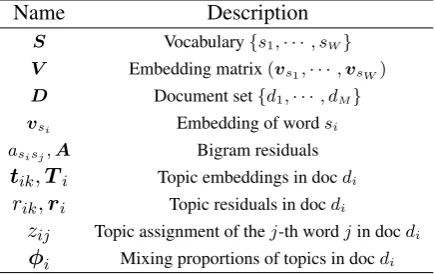
Table 1 lists the notations in this paper.
In a document, a sequence of words is referred to as a text window, denoted by wi,· · ·, wi+l, or wi:wi+l. A text window of chosen size c before a word wi defines the context of wi as
wi−c,· · · , wi−1. Herewi is referred to as the fo-cus word. Each context wordwi−j and the focus wordwicomprise a bigramwi−j, wi.
We assume each word in a document is seman-tically similar to atopic embedding. Topic embed-dings reside in the sameN-dimensional space as word embeddings. When it is clear from context, topic embeddings are often referred to as topics. Each document hasK candidate topics, arranged in the matrix formTi = (ti1· · ·tiK), referred to as thetopic matrix. Specifically, we fixti1 = 0, referring to it as thenull topic.
In a documentdi, each wordwij is assigned to a topic indexed byzij ∈ {1,· · · , K}. Geometri-cally this means the embeddingvwijtends to align
2Almost all modern word embedding methods adopt the exponentiated cosine similarity as the link function, hence the cosine similarity may be assumed to be a better estimate of the semantic relatedness between embeddings derived from these methods.
with the direction ofti,zij. Each topic tik has a
document-specific prior probability to be assigned to a word, denoted asφik = P(k|di). The vector φi = (φi1,· · ·, φiK)is referred to as the mixing proportionsof these topics in documentdi.
4 Link Function of Topic Embedding
In this section, we formulate the distribution of a word given its context words and topic, in the form of a link function.
The core of most word embedding methods is a link functionthat connects the embeddings of a fo-cus word and its context words, to define the distri-bution of the focus word. Li et al. (2015) proposed the following link function:
P(wc|w0 :wc−1)
≈P(wc) exp
v>
wc
c−1
X
l=0 vwl+
c−1
X
l=0
awlwc
. (1)
Here awlwc is referred as the bigram
resid-ual, indicating the non-linear part not captured by v>
wcvwl. It is essentially the logarithm of the
nor-malizing constant of a softmax term. Some litera-ture, e.g. (Pennington et al., 2014), refers to such a term as a bias term.
(1) is based on the assumption that the con-ditional distribution P(wc | w0 : wc−1) can be factorized approximately into independent log-bilinear terms, each corresponding to a context word. This approximation leads to an efficient and effective word embedding algorithmPSDVec (Li et al., 2015). We follow this assumption, and pro-pose to incorporate the topic ofwcin a way like a latent word. In particular, in addition to the con-text words, the corresponding embeddingtikis in-cluded as a new log-bilinear term that influences the distribution of wc. Hence we obtain the fol-lowing extended link function:
P(wc|w0:wc−1, zc, di)≈P(wc)·
expnv>
wc
Xc−1
l=0
vwl+tzc
+Xc−1
l=0
awlwc+rzc
o
, (2)
where di is the current document, and rzc is the
logarithm of the normalizing constant, named the topic residual. Note that the topic embeddingstzc
may be specific todi. For simplicity of notation, we drop the document index in tzc. To restrict
w1 · · ·
w0 wc
zc
θd
α vsi
µi
Word Embeddings asisj hij
Residuals
Gaussian Gaussian
Mult
Dir t
Topic Embeddings
wc∈d
T
d∈D
Documents
[image:4.595.305.556.504.732.2]V A
Figure 1: Graphical representation of TopicVec.
It is infeasible to compute the exact value of the topic residualrk. We approximate it by the context sizec= 0. Then (2) becomes:
P(wc|k, di) =P(wc) expv>wctk+rk . (3)
It is required that Pwc∈SP(wc | k) = 1 to
make (3) a distribution. It follows that
rk=−log
X
sj∈S
P(sj) exp{v>sjtk}
. (4)
(4) can be expressed in the matrix form: r=−log(uexp{V>T}), (5)
whereuis the row vector of unigram probabilities.
5 Generative Process and Likelihood
The generative process of words in documents can be regarded as a hybrid of LDA and PSDVec. Analogous to PSDVec, the word embedding vsi
and residualasisjare drawn from respective
Gaus-sians. For the sake of clarity, we ignore their gen-eration steps, and focus on the topic embeddings. The remaining generative process is as follows: 1. For thek-th topic, draw a topic embedding
uni-formly from a hyperball of radiusγ, i.e. tk ∼
Unif(Bγ);
2. For each documentdi:
(a) Draw the mixing proportions φi from the Dirichlet prior Dir(α);
(b) For thej-th word:
i. Draw topic assignmentzij from the cate-gorical distribution Cat(φi);
ii. Draw word wij from S according to
P(wij |wi,j−c:wi,j−1, zij, di).
The above generative process is presented in plate notation in Figure (1).
5.1 Likelihood Function
Given the embeddings V, the bigram residuals A, the topics Ti and the hyperparameter α, the complete-data likelihood of a single documentdi is:
p(di,Zi,φi|α,V,A,Ti)
=p(φi|α)p(Zi|φi)p(di|V,A,Ti,Zi)
=Γ(
PK
k=1αk)
QK
k=1Γ(αk) K
Y
j=1
φαj−1
ij · Li
Y
j=1
φi,zijP(wij)
·exp
v>
wij
Xj−1
l=j−c
vwil+tzij
+
j−1
X
l=j−c
awilwij+ri,zij
!
, (6)
where Zi = (zi1,· · · , ziLi), and Γ(·) is the
Gamma function.
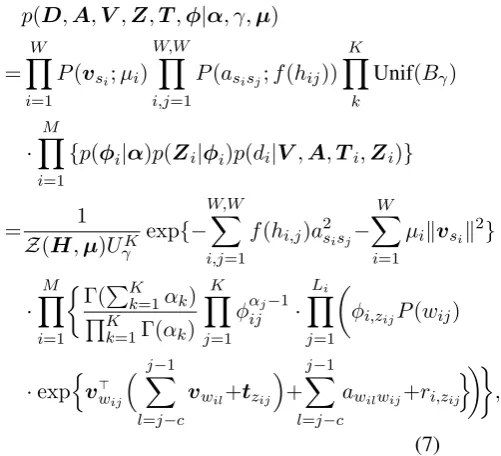
Let Z,T,φ denote the collection of all the document-specific {Zi}Mi=1,{Ti}Mi=1,{φi}Mi=1, respectively. Then the complete-data likelihood of the whole corpus is:
p(D,A,V,Z,T,φ|α, γ,µ)
=YW
i=1
P(vsi;µi)
W,WY
i,j=1
P(asisj;f(hij))
K
Y
k
Unif(Bγ)
·YM
i=1
{p(φi|α)p(Zi|φi)p(di|V,A,Ti,Zi)}
= 1
Z(H,µ)UK
γ exp{− W,WX
i,j=1
f(hi,j)a2sisj−
W
X
i=1
µikvsik2}
·
M
Y
i=1
Γ(PK
k=1αk)
QK
k=1Γ(αk) K
Y
j=1
φαj−1
ij · Li
Y
j=1
φi,zijP(wij)
·expnv>
wij
Xj−1
l=j−c
vwil+tzij
+
j−1
X
l=j−c
awilwij+ri,zij
o
,
(7) whereP(vsi;µi)andP(asisj;f(hij))are the two
Following the convention in (Li et al., 2015),
hij,H are empirical bigram probabilities, µare the embedding magnitude penalty coefficients, andZ(H,µ)is the normalizing constant for word embeddings. Uγ is the volume of the hyperball of radiusγ.
Taking the logarithm of both sides, we obtain
logp(D,A,V,Z,T,φ|α, γ,µ)
=C0−logZ(H,µ)− kAk2f(H)−
W
X
i=1
µikvsik2
+
M
X
i=1
XK
k=1
logφik(mik+αk−1) + Li
X
j=1
ri,zij
+v>
wij
Xj−1
l=j−c
vwil+tzij
+
j−1
X
l=j−c
awilwij
, (8)
wheremik=PLj=1i δ(zij =k)counts the number of words assigned with thek-th topic indi,C0 =
MlogΓ(PKk=1αk)
QK
k=1Γ(αk)+
PM,Li
i,j=1logP(wij)−KlogUγ is constant given the hyperparameters.
6 Variational Inference Algorithm
6.1 Learning Objective and Process
Given the hyperparameters α, γ,µ, the learning objective is to find the embeddingsV, the topics T, and the word-topic and document-topic distri-butionsp(Zi,φi|di,A,V,T). Here the hyperpa-rameters α, γ,µare kept constant, and we make them implicit in the distribution notations.
However, the coupling between A,V and T,Z,φ makes it inefficient to optimize them si-multaneously. To get around this difficulty, we learn word embeddings and topic embeddings sep-arately. Specifically, the learning process is di-vided into two stages:
1. In the first stage, considering that the topics have a relatively small impact to word dis-tributions and the impact might be “averaged out” across different documents, we simplify the model by ignoring topics temporarily. Then the model falls back to the original PSDVec. The optimal solution V∗,A∗ is obtained
ac-cordingly;
2. In the second stage, we treat V∗,A∗ as
constant, plug it into the likelihood func-tion, and find the corresponding optimal T∗, p(Z,φ|D,A∗,V∗,T∗) of the full model.
As in LDA, this posterior is analytically in-tractable, and we use a simpler variational dis-tributionq(Z,φ)to approximate it.
6.2 Mean-Field Approximation and Variational GEM Algorithm
In this stage, we fix V = V∗,A = A∗, and seek the optimalT∗, p(Z,φ|D,A∗,V∗,T∗). As
V∗,A∗ are constant, we also make them implicit
in the following expressions.
For an arbitrary variational distribution
q(Z,φ), the following equalities hold
Eqlog
p(D,Z,φ|T) q(Z,φ)
=Eq[logp(D,Z,φ|T)] +H(q)
= logp(D|T)−KL(q||p), (9)
wherep= p(Z,φ|D,T),H(q)is the entropy of
q. This implies KL(q||p)
= logp(D|T)−Eq[logp(D,Z,φ|T)] +H(q)
= logp(D|T)− L(q,T). (10)
In (10), Eq[logp(D,Z,φ|T)] +H(q) is usu-ally referred to as the variational free energy
L(q,T), which is a lower bound of logp(D|T). Directly maximizing logp(D|T) w.r.t. T is in-tractable due to the hidden variablesZ,φ, so we maximize its lower bound L(q,T) instead. We adopt a mean-field approximation of the true pos-terior as the variational distribution, and use a variational algorithm to find q∗,T∗ maximizing L(q,T).
The following variational distribution is used:
q(Z,φ;π,θ) =q(φ;θ)q(Z;π)
=YM
i=1
Dir(φi;θi)
Li
Y
j=1
Cat(zij;πij)
. (11)
We can obtain (Li et al., 2016a)
L(q,T)
=XM
i=1
( K
X
k=1
XLi
j=1
πijk +αk−1
ψ(θik)−ψ(θi0)
+Tr(T>
i Li
X
j=1
vwijπ>ij) +r>i
Li
X
j=1 πij
)
where Ti is the topic matrix of the i-th docu-ment, and ri is the vector constructed by con-catenating all the topic residuals rik. C1 =
C0−logZ(H,µ)−kAk2f(H)−
PW
i=1µikvsik2+
PM,Li
i,j=1
v>
wij
Pj−1
k=j−cvwik+
Pj−1
k=j−cawikwij
is constant.
We proceed to optimize (12) with a General-ized Expectation-Maximization (GEM) algorithm w.r.t.qandT as follows:
1. Initialize all the topicsTi=0, and correspond-ingly their residualsri=0;
2. Iterate over the following two steps until con-vergence. In thel-th step:
(a) Let the topics and residuals be T =
T(l−1),r=r(l−1), findq(l)(Z,φ)that max-imizesL(q,T(l−1)). This is the Expectation step (E-step). In this step,logp(D|T)is con-stant. Then theq that maximizes L(q,T(l))
will minimize KL(q||p), i.e. such aq is the closest variational distribution topmeasured by KL-divergence;
(b) Given the variational distributionq(l)(Z,φ), findT(l),r(l) that improveL(q(l),T), using Gradient descent method. This is the gener-alized Maximization step (M-step). In this step,π,θ,H(q)are constant.
6.2.1 Update Equations ofπ,θin E-Step
In the E-step, T = T(l−1),r = r(l−1) are con-stant. Taking the derivative ofL(q,T(l−1))w.r.t.
πk
ij andθik, respectively, we can obtain the opti-mal solutions (Li et al., 2016a) at:
πk
ij ∝exp{ψ(θik) +v>wijtik+rik}. (13)
θik= Li
X
j=1
πijk +αk. (14)
6.2.2 Update Equation ofTiin M-Step
In the Generalized M-step,π=π(l),θ =θ(l)are constant. For notational simplicity, we drop their superscripts(l).
To update Ti, we first take the derivative of (12) w.r.t. Ti, and then take the Gradient Descent method.
The derivative is obtained as (Li et al., 2016a):
∂L(q(l),T)
∂Ti
=XLi
j=1
vwijπ>ij+
K
X
k=1
¯ mik∂r∂Tik
i, (15)
where m¯ik = PLj=1i πijk = E[mik], the sum of the variational probabilities of each word being as-signed to thek-th topic in thei-th document. ∂rik
∂Ti
is a gradient matrix, whosej-th column is ∂rik
∂tij.
Remind thatrik =−log
EP(s)[exp{v>stik}]
. When j 6= k, it is easy to verify that ∂rik
∂tij = 0.
Whenj=k, we have
∂rik
∂tik =e
−rik·E
P(s)[exp{v>stik}vs]
=e−rik·X
s∈W
exp{v>
stik}P(s)vs
=e−rik·exp{t>
ikV}(u◦V), (16) whereu◦V is to multiply each column ofV with uelement-by-element.
Therefore ∂rik
∂Ti = (0,· · ·
∂rik
∂tik,· · ·,0).
Plug-ging it into (15), we obtain
∂L(q(l),T)
∂Ti =
Li
X
j=1
vwijπ>ij+( ¯mi1
∂ri1
∂ti1,· · · ,m¯iK
∂riK
∂tiK).
We proceed to optimizeTi with a gradient de-scent method:
T(l)i =T(l−1)+λ(l, Li)∂L(q (l),T)
∂Ti , whereλ(l, Li) = l·maxL{0Lλ0i,L0} is the learning rate function, L0 is a pre-specified document length threshold, and λ0 is the initial learning rate. As the magnitude of ∂L(q(l),T)
∂Ti is approximately
pro-portional to the document lengthLi, to avoid the step size becoming too big a on a long document, ifLi > L0, we normalize it byLi.
To satisfy the constraint thatkt(l)ikk ≤ γ, when t(l)ik > γ, we normalize it byγ/kt(l)ikk.
After we obtain the newT, we updater(m)i us-ing (5).
Sometimes, especially in the initial few itera-tions, due to the excessively big step size of the gradient descent, L(q,T) may decrease after the update ofT. Nonetheless the general direction of
L(q,T)is increasing.
6.3 Sharing of Topics across Documents
In principle we could use one set of topics across the whole corpus, or choose different topics for different subsets of documents. One could choose a way to best utilize cross-document information.
of topics, so thatM categories correspond toM
sets of topics. In the learning algorithm, only the update ofπk
ij needs to be changed to cater for this situation: when the k-th topic is relevant to the documenti, we updateπk
ij using (13); otherwise
πk ij = 0.
An identifiability problem may arise when we split topic embeddings according to document subsets. In different topic groups, some highly similar redundant topics may be learned. If we project documents into the topic space, portions of documents in the same topic in different docu-ments may be projected onto different dimensions of the topic space, and similar documents may eventually be projected into very different topic proportion vectors. In this situation, directly us-ing the projected topic proportion vectors could cause problems in unsupervised tasks such as clus-tering. A simple solution to this problem would be to compute the pairwise similarities between topic embeddings, and consider these similarities when computing the similarity between two projected topic proportion vectors. Two similar documents will then still receive a high similarity score.
7 Experimental Results
To investigate the quality of document represen-tation of our TopicVec model, we compared its performance against eight topic modeling or doc-ument representation methods in two docdoc-ument classification tasks. Moreover, to show the topic coherence of TopicVec on a single document, we present the top words in top topics learned on a news article.
7.1 Document Classification Evaluation 7.1.1 Experimental Setup
Compared Methods Two setups of TopicVec
were evaluated:
• TopicVec: the topic proportions learned by
TopicVec;
• TV+WV: the topic proportions,
concate-nated with the mean word embedding of the document (same as the MeanWV below). We compare the performance of our methods against eight methods, including three topic mod-eling methods, three continuous document repre-sentation methods, and the conventional bag-of-words (BOW) method. The count vector of BOW is unweighted.
The topic modeling methods include:
• LDA: the vanilla LDA (Blei et al., 2003) in the gensim library3;
• sLDA: Supervised Topic Model4(McAuliffe and Blei, 2008), which improves the predic-tive performance of LDA by modeling class labels;
• LFTM: Latent Feature Topic Modeling5 (Nguyen et al., 2015).
The document-topic proportions of topic modeling methods were used as their document representa-tion.
The document representation methods are:
• Doc2Vec: Paragraph Vector (Le and
Mikolov, 2014) in the gensim library6.
• TWE: Topical Word Embedding7 (Liu et al., 2015), which represents a document by concatenating average topic embedding and average word embedding, similar to our TV+WV;
• GaussianLDA: Gaussian LDA8 (Das et al.,
2015), which assumes that words in a topic are random samples from a multivariate Gaussian distribution with the mean as the topic embedding. Similar to TopicVec, we derived the posterior topic proportions as the features of each document;
• MeanWV: The mean word embedding of the
document.
Datasets We used two standard document
clas-sification corpora: the 20 Newsgroups9 and the ApteMod version of the Reuters-21578 corpus10. The two corpora are referred to as the20Newsand
Reutersin the following.
20News contains about 20,000 newsgroup doc-uments evenly partitioned into 20 different cate-gories. Reuters contains 10,788 documents, where each document is assigned to one or more cate-gories. For the evaluation of document classifi-cation, documents appearing in two or more cate-gories were removed. The numbers of documents in the categories of Reuters are highly imbalanced, and we only selected the largest 10 categories, leaving us with 8,025 documents in total.
3https://radimrehurek.com/gensim/models/ldamodel.html 4http://www.cs.cmu.edu/˜chongw/slda/
5https://github.com/datquocnguyen/LFTM/
6https://radimrehurek.com/gensim/models/doc2vec.html 7https://github.com/largelymfs/topical word embeddings/ 8https://github.com/rajarshd/Gaussian LDA
The same preprocessing steps were applied to all methods: words were lowercased; stop words and words out of the word embedding vocabulary (which means that they are extremely rare) were removed.
Experimental Settings TopicVec used the word
embeddings trained using PSDVec on a March 2015 Wikipedia snapshot. It contains the most fre-quent 180,000 words. The dimensionality of word embeddings and topic embeddings was 500. The hyperparameters wereα= (0.1,· · ·,0.1), γ= 5. For 20news and Reuters, we specified 15 and 12 topics in each category on the training set, respec-tively. The first topic in each category was al-ways set to null. The learned topic embeddings were combined to form the whole topic set, where redundant null topics in different categories were removed, leaving us with 281 topics for 20News and 111 topics for Reuters. The initial learning rate was set to 0.1. After 100 GEM iterations on each dataset, the topic embeddings were ob-tained. Then the posterior document-topic distri-butions of the test sets were derived by performing one E-step given the topic embeddings trained on the training set.
LFTM includes two models: LDA and LF-DMM. We chose the better performing LF-LDA to evaluate. TWE includes three models, and we chose the best performing TWE-1 to compare.
LDA, sLDA, LFTM and TWE used the spec-ified 50 topics on Reuters, as this is the optimal topic number according to (Lu et al., 2011). On the larger 20news dataset, they used the specified 100 topics. Other hyperparameters of all com-pared methods were left at their default values.
GaussianLDA was specified 100 topics on 20news and 70 topics on Reuters. As each sam-pling iteration took over 2 hours, we only had time for 100 sampling iterations.
For each method, after obtaining the document representations of the training and test sets, we trained an`-1 regularized linear SVM one-vs-all classifier on the training set using the scikit-learn library11. We then evaluated its predictive perfor-mance on the test set.
Evaluation metrics Considering that the largest
few categories dominate Reuters, we adopted macro-averaged precision, recall and F1 measures as the evaluation metrics, to avoid the average re-sults being dominated by the performance of the
11http://scikit-learn.org/stable/modules/svm.html
20News Reuters
Prec Rec F1 Prec Rec F1 BOW 69.1 68.5 68.6 92.5 90.3 91.1
LDA 61.9 61.4 60.3 76.1 74.3 74.8 sLDA 61.4 60.9 60.9 88.3 83.3 85.1 LFTM 63.5 64.8 63.7 84.6 86.3 84.9 MeanWV 70.4 70.3 70.1 92.0 89.6 90.5 Doc2Vec 56.3 56.6 55.4 84.4 50.0 58.5 TWE 69.5 69.3 68.8 91.0 89.1 89.9 GaussianLDA 30.9 26.5 22.7 46.2 31.5 35.3 TopicVec 71.4 71.3 71.2 91.8 92.0 91.7 TV+WV1 72.1 71.9 71.8 91.4 91.9 91.5
1Combined features of TopicVec topic proportions and MeanWV.
Table 2: Performance on multi-class text classifi-cation. Best score is in boldface.
Avg. Features BOW MeanWV TWE TopicVec TV+WV
20News 50381 500 800 281 781
[image:8.595.307.541.62.237.2]Reuters 17989 500 800 111 611
Table 3: Number of features of the five best per-forming methods.
top categories.
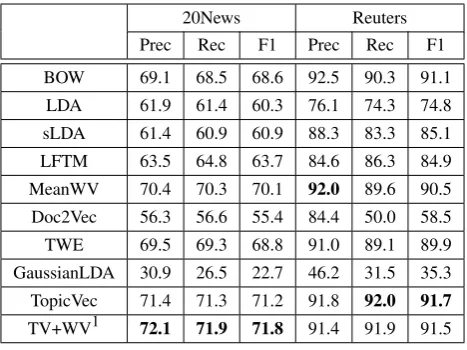
Evaluation Results Table 2 presents the
perfor-mance of the different methods on the two clas-sification tasks. The highest scores were high-lighted with boldface. It can be seen that TV+WV and TopicVec obtained the best performance on the two tasks, respectively. With only topic pro-portions as features, TopicVec performed slightly better than BOW, MeanWV and TWE, and sig-nificantly outperformed four other methods. The number of features it used was much lower than BOW, MeanWV and TWE (Table 3).
Figure 2: Topic Cloud of the pharmaceutical com-pany acquisition news.
7.2 Qualitative Assessment of Topics Derived from a Single Document
Topic models need a large set of documents to ex-tract coherent topics. Hence, methods depending on topic models, such as TWE, are subject to this limitation. In contrast, TopicVec can extract co-herent topics and obtain document representations even when only one document is provided as in-put.
To illustrate this feature, we ran TopicVec on a New York Times news article about a pharma-ceutical company acquisition12, and obtained 20 topics.
Figure 2 presents the most relevant words in the top-6 topics as a topic cloud. We first calcu-lated the relevance between a word and a topic as the frequency-weighted cosine similarity of their embeddings. Then the most relevant words were selected to represent each topic. The sizes of the topic slices are proportional to the topic pro-portions, and the font sizes of individual words are proportional to their relevance to the topics. Among these top-6 topics, the largest and small-est topic proportions are 26.7% and 9.9%, respec-tively.
As shown in Figure 2, words in obtained topics were generally coherent, although the topics were 12 http://www.nytimes.com/2015/09/21/business/a-huge-overnight-increase-in-a-drugs-price-raises-protests.html
only derived from a single document. The reason is that TopicVec takes advantage of the rich se-mantic information encoded in word embeddings, which were pretrained on a large corpus.
The topic coherence suggests that the derived topic embeddings were approximately the seman-tic centroids of the document. This capacity may aid applications such as document retrieval, where a “compressed representation” of the query docu-ment is helpful.
8 Conclusions and Future Work
In this paper, we proposed TopicVec, a generative model combining word embedding and LDA, with the aim of exploiting the word collocation patterns both at the level of the local context and the global document. Experiments show that TopicVec can learn high-quality document representations, even given only one document.
In our classification tasks we only explored the use of topic proportions of a document as its rep-resentation. However, jointly representing a doc-ument by topic proportions and topic embeddings would be more accurate. Efficient algorithms for this task have been proposed (Kusner et al., 2015). Our method has potential applications in vari-ous scenarios, such as document retrieval, classifi-cation, clustering and summarization.
Acknowlegement
We thank Xiuchao Sui and Linmei Hu for their help and support. We thank the anonymous men-tor provided by ACL for the careful proofread-ing. This research is funded by the National Re-search Foundation, Prime Minister’s Office, Sin-gapore under its IDM Futures Funding Initiative and IRC@SG Funding Initiative administered by IDMPO.
References
Yoshua Bengio, R´ejean Ducharme, Pascal Vincent, and Christian Jauvin. 2003. A neural probabilistic
lan-guage model. Journal of Machine Learning
Re-search, pages 1137–1155.
David M Blei, Andrew Y Ng, and Michael I Jordan.
2003. Latent dirichlet allocation. the Journal of
ma-chine Learning research, 3:993–1022.
Rajarshi Das, Manzil Zaheer, and Chris Dyer. 2015. Gaussian LDA for topic models with word
embed-dings. In Proceedings of the 53rd Annual
and the 7th International Joint Conference on Natu-ral Language Processing (Volume 1: Long Papers), pages 795–804, Beijing, China, July. Association for Computational Linguistics.
Geoffrey E Hinton and Ruslan R Salakhutdinov. 2009. Replicated softmax: an undirected topic model. In Advances in neural information processing systems, pages 1607–1614.
Eric H Huang, Richard Socher, Christopher D Man-ning, and Andrew Y Ng. 2012. Improving word representations via global context and multiple word
prototypes. InProceedings of the 50th Annual
Meet-ing of the Association for Computational LMeet-inguis- Linguis-tics: Long Papers-Volume 1, pages 873–882. Asso-ciation for Computational Linguistics.
Matt Kusner, Yu Sun, Nicholas Kolkin, and Kilian Q. Weinberger. 2015. From word embeddings to docu-ment distances. In David Blei and Francis Bach,
ed-itors,Proceedings of the 32nd International
Confer-ence on Machine Learning (ICML-15), pages 957– 966. JMLR Workshop and Conference Proceedings. Hugo Larochelle and Stanislas Lauly. 2012. A neural
autoregressive topic model. InAdvances in Neural
Information Processing Systems, pages 2708–2716. Quoc Le and Tomas Mikolov. 2014. Distributed
repre-sentations of sentences and documents. In
Proceed-ings of the 31st International Conference on Ma-chine Learning (ICML-14), pages 1188–1196. Omer Levy, Yoav Goldberg, and Ido Dagan. 2015.
Im-proving distributional similarity with lessons learned
from word embeddings. Transactions of the
Associ-ation for ComputAssoci-ational Linguistics, 3:211–225. Shaohua Li, Jun Zhu, and Chunyan Miao. 2015. A
generative word embedding model and its low rank
positive semidefinite solution. In Proceedings of
the 2015 Conference on Empirical Methods in Natu-ral Language Processing, pages 1599–1609, Lisbon, Portugal, September. Association for Computational Linguistics.
Shaohua Li, Tat-Seng Chua, Jun Zhu, and
Chun-yan Miao. 2016a. Generative topic
em-bedding: a continuous representation of docu-ments (extended version with proofs). Technical
report. https://github.com/askerlee/topicvec/blob/
master/topicvec-ext.pdf.
Shaohua Li, Jun Zhu, and Chunyan Miao. 2016b. PS-DVec: a toolbox for incremental and scalable word
embedding. To appear in Neurocomputing.
Yang Liu, Zhiyuan Liu, Tat-Seng Chua, and Maosong
Sun. 2015. Topical word embeddings. In AAAI,
pages 2418–2424.
Yue Lu, Qiaozhu Mei, and ChengXiang Zhai. 2011. Investigating task performance of probabilistic topic
models: an empirical study of PLSA and LDA.
In-formation Retrieval, 14(2):178–203.
Jon D McAuliffe and David M Blei. 2008.
Super-vised topic models. InAdvances in neural
informa-tion processing systems, pages 121–128.
Tomas Mikolov, Ilya Sutskever, Kai Chen, Greg S Cor-rado, and Jeff Dean. 2013. Distributed representa-tions of words and phrases and their
compositional-ity. InProceedings of NIPS 2013, pages 3111–3119.
Dat Quoc Nguyen, Richard Billingsley, Lan Du, and Mark Johnson. 2015. Improving topic models with
latent feature word representations. Transactions
of the Association for Computational Linguistics, 3:299–313.
Jeffrey Pennington, Richard Socher, and Christopher D
Manning. 2014. GloVe: Global vectors for
word representation. Proceedings of the Empiricial