End-to-End Relation Extraction using LSTMs
on Sequences and Tree Structures
Makoto Miwa
Toyota Technological Institute Nagoya, 468-8511, Japan
Mohit Bansal
Toyota Technological Institute at Chicago Chicago, IL, 60637, USA
Abstract
We present a novel end-to-end neural model to extract entities and relations be-tween them. Our recurrent neural net-work based model captures both word se-quence and dependency tree substructure information by stacking bidirectional tree-structured LSTM-RNNs on bidirectional sequential LSTM-RNNs. This allows our model to jointly represent both entities and relations with shared parameters in a sin-gle model. We further encourage detec-tion of entities during training and use of entity information in relation extraction via entity pretraining and scheduled sam-pling. Our model improves over the state-of-the-art feature-based model on end-to-end relation extraction, achieving 12.1% and 5.7% relative error reductions in F1-score on ACE2005 and ACE2004, respec-tively. We also show that our LSTM-RNN based model compares favorably to the state-of-the-art CNN based model (in F1-score) on nominal relation classifica-tion (SemEval-2010 Task 8). Finally, we present an extensive ablation analysis of several model components.
1 Introduction
Extracting semantic relations between entities in text is an important and well-studied task in in-formation extraction and natural language pro-cessing (NLP). Traditional systems treat this task as a pipeline of two separated tasks, i.e., named entity recognition (NER) (Nadeau and Sekine, 2007; Ratinov and Roth, 2009) and relation extraction (Zelenko et al., 2003; Zhou et al., 2005), but recent studies show that end-to-end
(joint) modeling of entity and relation is impor-tant for high performance (Li and Ji, 2014; Miwa and Sasaki, 2014) since relations interact closely with entity information. For instance, to learn that Toefting and Bolton have an Organization-Affiliation (ORG-AFF) relation in the sentence Toefting transferred to Bolton, the entity informa-tion thatToeftingandBoltonarePersonand Orga-nizationentities is important. Extraction of these entities is in turn encouraged by the presence of the context wordstransferred to, which indicate an employment relation. Previous joint models have employed feature-based structured learning. An alternative approach to this end-to-end relation ex-traction task is to employ automatic feature learn-ing via neural network (NN) based models.
There are two ways to represent relations be-tween entities using neural networks: recur-rent/recursive neural networks (RNNs) and convo-lutional neural networks (CNNs). Among these, RNNs can directly represent essential linguis-tic structures, i.e., word sequences (Hammerton, 2001) and constituent/dependency trees (Tai et al., 2015). Despite this representation ability, for relation classification tasks, the previously re-ported performance using long short-term memory (LSTM) based RNNs (Xu et al., 2015b; Li et al., 2015) is worse than one using CNNs (dos Santos et al., 2015). These previous LSTM-based sys-tems mostly include limited linguistic structures and neural architectures, and do not model entities and relations jointly. We are able to achieve im-provements over state-of-the-art models via end-to-end modeling of entities and relations based on richer LSTM-RNN architectures that incorporate complementary linguistic structures.
Word sequence and tree structure are known to be complementary information for extracting rela-tions. For instance, dependencies between words
are not enough to predict that source and U.S. have anORG-AFFrelation in the sentence“This is ...”, one U.S. source said, and the context word said is required for this prediction. Many tradi-tional, feature-based relation classification mod-els extract features from both sequences and parse trees (Zhou et al., 2005). However, previous RNN-based models focus on only one of these linguistic structures (Socher et al., 2012).
We present a novel end-to-end model to extract relations between entities on both word sequence and dependency tree structures. Our model allows joint modeling of entities and relations in a sin-gle model by using both bidirectional sequential (left-to-right and right-to-left) and bidirectional tree-structured (bottom-up and top-down) LSTM-RNNs. Our model first detects entities and then extracts relations between the detected entities us-ing a sus-ingle incrementally-decoded NN structure, and the NN parameters are jointly updated using both entity and relation labels. Unlike traditional incremental end-to-end relation extraction models, our model further incorporates two enhancements into training: entity pretraining, which pretrains the entity model, and scheduled sampling (Ben-gio et al., 2015), which replaces (unreliable) pre-dicted labels with gold labels in a certain probabil-ity. These enhancements alleviate the problem of low-performance entity detection in early stages of training, as well as allow entity information to further help downstream relation classification.
On end-to-end relation extraction, we improve over the state-of-the-art feature-based model, with 12.1% (ACE2005) and 5.7% (ACE2004) relative error reductions in F1-score. On nominal relation classification (SemEval-2010 Task 8), our model compares favorably to the state-of-the-art CNN-based model in F1-score. Finally, we also ab-late and compare our various model components, which leads to some key findings (both positive and negative) about the contribution and effec-tiveness of different RNN structures, input depen-dency relation structures, different parsing mod-els, external resources, and joint learning settings.
2 Related Work
LSTM-RNNs have been widely used for sequen-tial labeling, such as clause identification (Ham-merton, 2001), phonetic labeling (Graves and Schmidhuber, 2005), and NER (Hammerton, 2003). Recently, Huang et al. (2015) showed that
building a conditional random field (CRF) layer on top of bidirectional LSTM-RNNs performs com-parably to the state-of-the-art methods in the part-of-speech (POS) tagging, chunking, and NER.
For relation classification, in addition to tra-ditional feature/kernel-based approaches (Zelenko et al., 2003; Bunescu and Mooney, 2005), sev-eral neural models have been proposed in the SemEval-2010 Task 8 (Hendrickx et al., 2010), including embedding-based models (Hashimoto et al., 2015), CNN-based models (dos Santos et al., 2015), and RNN-based models (Socher et al., 2012). Recently, Xu et al. (2015a) and Xu et al. (2015b) showed that the shortest dependency paths between relation arguments, which were used in feature/kernel-based systems (Bunescu and Mooney, 2005), are also useful in NN-based models. Xu et al. (2015b) also showed that LSTM-RNNs are useful for relation classification, but the performance was worse than CNN-based models. Li et al. (2015) compared separate sequence-based and tree-structured LSTM-RNNs on relation clas-sification, using basic RNN model structures.
Research on tree-structured LSTM-RNNs (Tai et al., 2015) fixes the direction of information propagation from bottom to top, and also cannot handle an arbitrary number of typed children as in a typed dependency tree. Furthermore, no RNN-based relation classification model simultaneously uses word sequence and dependency tree informa-tion. We propose several such novel model struc-tures and training settings, investigating the simul-taneous use of bidirectional sequential and bidi-rectional tree-structured LSTM-RNNs to jointly capture linear and dependency context for end-to-end extraction of relations between entities.
In 1909 , Sidney Yates was born in Chicago . B-PER L-PER
word/POS embeddings
Bi-LSTM hidden
softmax
nsubjpass prep pobj Yates
born
in
Chicago PHYS
Bi-TreeLSTM hidden
softmax
Sequence (Entity)
Dependency (Relation)
LSTM unit dropout
tanh
tanh
dependency embeddings tanh
label embeddings embeddings neural net / softmax
[image:3.595.122.480.61.248.2]・・・ ・・・
Fig. 1: Our incrementally-decoded end-to-end relation extraction model, with bidirectional sequential and bidirectional tree-structured LSTM-RNNs.
3 Model
We design our model with LSTM-RNNs that rep-resent both word sequences and dependency tree structures, and perform end-to-end extraction of relations between entities on top of these RNNs. Fig. 1 illustrates the overview of the model. The model mainly consists of three representation lay-ers: a word embeddings layer (embedding layer), a word sequence based LSTM-RNN layer (se-quence layer), and finally a dependency subtree based LSTM-RNN layer (dependency layer). Dur-ing decodDur-ing, we build greedy, left-to-right entity detection on the sequence layer and realize rela-tion classificarela-tion on the dependency layers, where each subtree based LSTM-RNN corresponds to a relation candidate between two detected enti-ties. After decoding the entire model structure, we update the parameters simultaneously via back-propagation through time (BPTT) (Werbos, 1990). The dependency layers are stacked on the se-quence layer, so the embedding and sese-quence lay-ers areshared by both entity detection and rela-tion classificarela-tion, and the shared parameters are affected by both entity and relation labels.
3.1 Embedding Layer
The embedding layer handles embedding repre-sentations.nw,np,ndandne-dimensional vectors
v(w), v(p), v(d) andv(e) are embedded to words, part-of-speech (POS) tags, dependency types, and entity labels, respectively.
3.2 Sequence Layer
The sequence layer represents words in a linear se-quence using the representations from the embed-ding layer. This layer represents sentential con-text information and maintains entities, as shown in bottom-left part of Fig. 1.
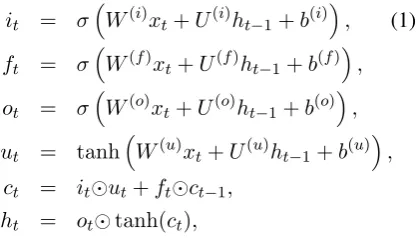
We represent the word sequence in a sentence with bidirectional LSTM-RNNs (Graves et al., 2013). The LSTM unit at t-th word consists of a collection of nls-dimensional vectors: an input gateit, a forget gateft, an output gateot, a mem-ory cell ct, and a hidden state ht. The unit re-ceives ann-dimensional input vectorxt, the previ-ous hidden stateht−1, and the memory cell ct−1, and calculates the new vectors using the following equations:
it = σ
W(i)xt+U(i)ht−1+b(i)
, (1)
ft = σ
W(f)xt+U(f)ht−1+b(f)
, ot = σ
W(o)x
t+U(o)ht−1+b(o)
, ut = tanh
W(u)x
t+U(u)ht−1+b(u)
, ct = itut+ftct−1,
ht = ottanh(ct),
whereσ denotes the logistic function,denotes element-wise multiplication,W andU are weight matrices, andbare bias vectors. The LSTM unit at t-th word receives the concatenation of word and POS embeddings as its input vector: xt =
h
[image:3.595.317.526.530.649.2]its output vector,st =
h−→ ht;←h−t
i
, and pass it to the subsequent layers.
3.3 Entity Detection
We treat entity detection as a sequence labeling task. We assign an entity tag to each word us-ing a commonly used encodus-ing scheme BILOU (Begin, Inside, Last, Outside, Unit) (Ratinov and Roth, 2009), where each entity tag represents the entity type and the position of a word in the entity. For example, in Fig. 1, we assign B-PER and L-PER(which denote the beginning and last words of a person entity type, respectively) to each word inSidney Yates to represent this phrase as aPER (person) entity type.
We perform entity detection on top of the se-quence layer. We employ a two-layered NN with an nhe-dimensional hidden layerh(e) and a soft-max output layer for entity detection.
h(te) = tanhW(eh)[s
t;vt(−e)1] +b(eh)
(2)
yt = softmax
W(ey)h(e)
t +b(ey)
(3)
Here, W are weight matrices andbare bias vec-tors.
We assign entity labels to words in a greedy, left-to-right manner.1 During this decoding, we
use the predicted label of a word to predict the label of the next word so as to take label depen-dencies into account. The NN above receives the concatenation of its corresponding outputs in the sequence layer and the label embedding for its pre-vious word (Fig. 1).
3.4 Dependency Layer
The dependency layer represents a relation be-tween a pair of two target words (corresponding to a relation candidate in relation classification) in the dependency tree, and is in charge of relation-specific representations, as is shown in top-right part of Fig. 1. This layer mainly focuses on the shortest pathbetween a pair of target words in the dependency tree (i.e., the path between the least common node and the two target words) since these paths are shown to be effective in relation classification (Xu et al., 2015a). For example, we show the shortest path betweenYatesandChicago in the bottom of Fig. 1, and this path well captures the key phrase of their relation, i.e.,born in.
1We also tried beam search but this did not show
improve-ments in initial experiimprove-ments.
We employ bidirectional tree-structured LSTM-RNNs (i.e., bottom-up and top-down) to represent a relation candidate by capturing the dependency structure around the target word pair. This bidirec-tional structure propagates to each node not only the information from the leaves but also informa-tion from the root. This is especially important for relation classification, which makes use of ar-gument nodes near the bottom of the tree, and our top-down LSTM-RNN sends information from the top of the tree to such near-leaf nodes (unlike in standard bottom-up LSTM-RNNs).2 Note that the
two variants of tree-structured LSTM-RNNs by Tai et al. (2015) are not able to represent our tar-get structures which have a variable number of typed children: the Child-Sum Tree-LSTM does not deal with types and theN-ary Tree assumes a fixed number of children. We thus propose a new variant of tree-structured LSTM-RNN that shares weight matricesUs for same-type children and also allows variable number of children. For this variant, we calculatenlt-dimensional vectors in the LSTM unit att-th node withC(t) children using following equations:
it=σ
W(i)x
t+
X
l∈C(t)
Um(i)(l)htl+b(i)
, (4)
ftk =σ
W(f)x
t+
X
l∈C(t)
Um(f()k)m(l)htl+b(f)
,
ot=σ
W(o)x
t+ X l∈C(t)
Um(o()l)htl+b(o)
,
ut= tanh
W(u)x
t+
X
l∈C(t)
Um(u()l)htl+b(u)
,
ct=itut+
X
l∈C(t)
ftlctl,
ht=ottanh(ct),
wherem(·)is a type mapping function.
To investigate appropriate structures to repre-sent relations between two target word pairs, we experiment with three structure options. We pri-marily employ the shortest path structure ( SP-Tree), which captures the core dependency path between a target word pair and is widely used in relation classification models, e.g., (Bunescu and
2We also tried to use one LSTM-RNN by connecting the
Mooney, 2005; Xu et al., 2015a). We also try two other dependency structures: SubTreeand Full-Tree. SubTree is the subtree under the lowest common ancestor of the target word pair. This pro-vides additional modifier information to the path and the word pair in SPTree. FullTree is the full dependency tree. This captures context from the entire sentence. While we use one node type for SPTree, we define two node types for SubTree and FullTree, i.e., one for nodes on shortest paths and one for all other nodes. We use the type mapping functionm(·)to distinguish these two nodes types.
3.5 Stacking Sequence and Dependency Layers
We stack the dependency layers (corresponding to relation candidates) on top of the sequence layer to incorporate both word sequence and dependency tree structure information into the output. The dependency-layer LSTM unit at thet-th word re-ceives as inputxt =
h
st;v(td);v(te)
i
, i.e., the con-catenation of its corresponding hidden state vec-tors st in the sequence layer, dependency type embeddingvt(d) (denotes the type of dependency to the parent3), and label embeddingv(e)
t (corre-sponds to the predicted entity label).
3.6 Relation Classification
We incrementally build relation candidates using all possible combinations of the last words of de-tected entities, i.e., words with L or U labels in the BILOU scheme, during decoding. For in-stance, in Fig. 1, we build a relation candidate us-ingYates with anL-PERlabel and Chicagowith an U-LOClabel. For each relation candidate, we realize the dependency layerdp(described above) corresponding to the path between the word pair
pin the relation candidate, and the NN receives a relation candidate vector constructed from the out-put of the dependency tree layer, and predicts its relation label. We treat a pair as a negative relation when the detected entities are wrong or when the pair has no relation. We represent relation labels by type and direction, except for negative relations that have no direction.
The relation candidate vector is constructed as the concatenationdp = [↑hpA;↓hp1;↓hp2], where
↑hpA is the hidden state vector of the top LSTM 3We use the dependency to the parent since the number of
children varies. Dependency types can also be incorporated intom(·), but this did not help in initial experiments.
unit in the bottom-up LSTM-RNN (representing the lowest common ancestor of the target word pair p), and ↓hp1, ↓hp2 are the hidden state
vec-tors of the two LSTM units representing the first and second target words in the top-down LSTM-RNN.4All the corresponding arrows are shown in
Fig. 1.
Similarly to the entity detection, we employ a two-layered NN with an nhr-dimensional hidden layerh(r)and a softmax output layer (with weight matricesW, bias vectorsb).
h(pr) = tanhW(rh)d
p+b(rh)
(5)
yp = softmax
W(ry)h(r)
t +b(ry)
(6) We construct the input dp for relation classifi-cation from tree-structured LSTM-RNNs stacked on sequential LSTM-RNNs, so the contribution of sequence layer to the input is indirect. Fur-thermore, our model uses words for represent-ing entities, so it cannot fully use the entity in-formation. To alleviate these problems, we di-rectly concatenate the average of hidden state vec-tors for each entity from the sequence layer to the input dp to relation classification, i.e., d0p =
h
dp;|I1p1|Pi∈Ip1 si;
1
|Ip2|
P
i∈Ip2 si i
(Pair), where
Ip1 and Ip2 represent sets of word indices in the
first and second entities.5
Also, we assign two labels to each word pair in prediction since we consider both left-to-right and right-to-left directions. When the predicted labels are inconsistent, we select the positive and more confident label, similar to Xu et al. (2015a).
3.7 Training
We update the model parameters including weights, biases, and embeddings by BPTT and Adam (Kingma and Ba, 2015) with gradient clip-ping, parameter averaging, and L2-regularization (we regularize weights W and U, not the bias termsb). We also apply dropout (Srivastava et al., 2014) to the embedding layer and to the final hid-den layers for entity detection and relation classi-fication.
We employ two enhancements,scheduled sam-pling (Bengio et al., 2015) and entity pretrain-ing, to alleviate the problem of unreliable pre-diction of entities in the early stage of training,
4Note that the order of the target words corresponds to the
direction of the relation, not the positions in the sentence.
5Note that we do not show thisPairin Fig.1 for
and to encourage building positive relation in-stances from the detected entities. In scheduled sampling, we use gold labels as prediction in the probability of i that depends on the number of epochs iduring training if the gold labels are le-gal. As fori, we choose the inverse sigmoid de-cay i = k/(k+ exp(i/k)), where k(≥ 1)is a hyper-parameter that adjusts how often we use the gold labels as prediction. Entity pretraining is in-spired by (Pentina et al., 2015), and we pretrain the entity detection model using the training data before training the entire model parameters.
4 Results and Discussion
4.1 Data and Task Settings
We evaluate on three datasets: ACE05 and ACE04 for end-to-end relation extraction, and SemEval-2010 Task 8 for relation classification. We use the first two datasets as our primary target, and use the last one to thoroughly analyze and ablate the relation classification part of our model.
ACE05 defines 7 coarse-grained entity types and 6 coarse-grained relation types between enti-ties. We use the same data splits, preprocessing, and task settings as Li and Ji (2014). We report the primary micro F1-scores as well as micro pre-cision and recall on both entity and relation extrac-tion to better explain model performance. We treat an entity as correct when its type and the region of its head are correct. We treat a relation as correct when its type and argument entities are correct; we thus treat all non-negative relations on wrong en-tities as false positives.
ACE04 defines the same 7 coarse-grained en-tity types as ACE05 (Doddington et al., 2004), but defines 7 coarse-grained relation types. We fol-low the cross-validation setting of Chan and Roth (2011) and Li and Ji (2014), and the preprocessing and evaluation metrics of ACE05.
SemEval-2010 Task 8 defines 9 relation types between nominals and a tenth type Other when two nouns have none of these relations (Hendrickx et al., 2010). We treat thisOther type as a nega-tive relation type, and no direction is considered. The dataset consists of 8,000 training and 2,717 test sentences, and each sentence is annotated with a relation between two given nominals. We ran-domly selected 800 sentences from the training set as our development set. We followed the official task setting, and report the official macro-averaged F1-score (Macro-F1) on the 9 relation types.
For more details of the data and task settings, please refer to the supplementary material.
4.2 Experimental Settings
We implemented our model using thecnnlibrary.6
We parsed the texts using the Stanford neural de-pendency parser7(Chen and Manning, 2014) with
the original Stanford Dependencies. Based on pre-liminary tuning, we fixed embedding dimensions
nw to 200, np, nd, ne to 25, and dimensions of intermediate layers (nls,nlt of LSTM-RNNs and
nhe,nhr of hidden layers) to 100. We initialized word vectors via word2vec (Mikolov et al., 2013) trained on Wikipedia8and randomly initialized all
other parameters. We tuned hyper-parameters us-ing development sets for ACE05 and SemEval-2010 Task 8 to achieve high primary (Micro- and Macro-) F1-scores.9 For ACE04, we directly
em-ployed the best parameters for ACE05. The hyper-parameter settings are shown in the supplementary material. For SemEval-2010 Task 8, we also omit-ted the entity detection and label embeddings since only target nominals are annotated and the task de-fines no entity types. Our statistical significance results are based on the Approximate Randomiza-tion (AR) test (Noreen, 1989).
4.3 End-to-end Relation Extraction Results
Table 1 compares our model with the state-of-the-art feature-based model of Li and Ji (2014)10 on
final test sets, and shows that our model performs better than the state-of-the-art model.
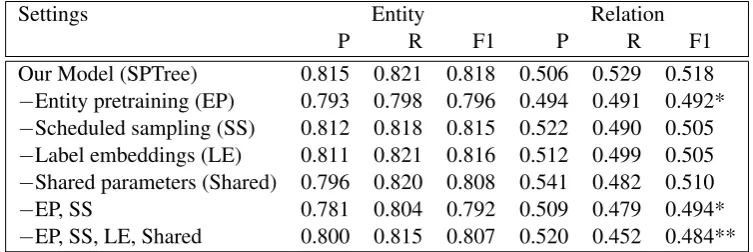
To analyze the contributions and effects of the various components of our end-to-end relation ex-traction model, we perform ablation tests on the ACE05 development set (Table 2). The perfor-mance slightly degraded without scheduled sam-pling, and the performance significantly degraded when we removed entity pretraining or removed both (p<0.05). This is reasonable because the model can only create relation instances when both of the entities are found and, without these enhancements, it may get too late to find some re-lations. Removing label embeddings did not affect
6https://github.com/clab/cnn 7http://nlp.stanford.edu/software/ stanford-corenlp-full-2015-04-20.zip
8https://dumps.wikimedia.org/enwiki/ 20150901/
9We did not tune the precision-recall trade-offs, but doing
so can specifically improve precision further.
10Other work on ACE is not comparable or performs worse
Corpus Settings Entity Relation
P R F1 P R F1
ACE05 Our Model (SPTree) 0.829 0.839 0.834 0.572 0.540 0.556
Li and Ji (2014) 0.852 0.769 0.808 0.654 0.398 0.495 ACE04 Our Model (SPTree) 0.808 0.829 0.818 0.487 0.481 0.484
Li and Ji (2014) 0.835 0.762 0.797 0.608 0.361 0.453
Table 1: Comparison with the state-of-the-art on the ACE05 test set and ACE04 dataset.
Settings Entity Relation
P R F1 P R F1
Our Model (SPTree) 0.815 0.821 0.818 0.506 0.529 0.518
−Entity pretraining (EP) 0.793 0.798 0.796 0.494 0.491 0.492*
−Scheduled sampling (SS) 0.812 0.818 0.815 0.522 0.490 0.505
−Label embeddings (LE) 0.811 0.821 0.816 0.512 0.499 0.505
−Shared parameters (Shared) 0.796 0.820 0.808 0.541 0.482 0.510
−EP, SS 0.781 0.804 0.792 0.509 0.479 0.494*
[image:7.595.111.485.63.147.2]−EP, SS, LE, Shared 0.800 0.815 0.807 0.520 0.452 0.484**
Table 2: Ablation tests on the ACE05 development dataset. * denotes significance at p<0.05, ** denotes p<0.01.
Settings Entity Relation
P R F1 P R F1
SPTree 0.815 0.821 0.818 0.506 0.529 0.518 SubTree 0.812 0.818 0.815 0.525 0.506 0.515 FullTree 0.806 0.816 0.811 0.536 0.507 0.521 SubTree (-SP) 0.803 0.816 0.810 0.533 0.495 0.514 FullTree (-SP) 0.804 0.817 0.811 0.517 0.470 0.492* Child-Sum 0.806 0.819 0.8122 0.514 0.499 0.506 SPSeq 0.801 0.813 0.807 0.500 0.523 0.511 SPXu 0.809 0.818 0.813 0.494 0.522 0.508
Table 3: Comparison of LSTM-RNN structures on the ACE05 development dataset.
the entity detection performance, but this degraded the recall in relation classification. This indicates that entity label information is helpful in detecting relations.
We also show the performance without shar-ing parameters, i.e., embeddshar-ing and sequence lay-ers, for detecting entities and relations (−Shared parameters); we first train the entity detection model, detect entities with the model, and build a separate relation extraction model using the detected entities, i.e., without entity detection. This setting can be regarded as a pipeline model since two separate models are trained sequentially. Without the shared parameters, both the perfor-mance in entity detection and relation classifica-tion drops slightly, although the differences are
not significant. When we removed all the en-hancements, i.e., scheduled sampling, entity pre-training, label embedding, and shared parameters, the performance is significantly worse than SP-Tree (p<0.01), showing that these enhancements provide complementary benefits to end-to-end re-lation extraction.
[image:7.595.110.487.183.309.2]FullTree (-SP), significantly hurts performance (p<0.05). We then compare our tree-structured LSTM-RNN (SPTree) with the Child-Sum tree-structured LSTM-RNN on the shortest path of Tai et al. (2015). Child-Sum performs worse than our SPTree model, but not with as big of a decrease as above. This may be because the difference in the models appears only on nodes that have multi-ple children and all the nodes except for the least common node have one child.
We finally show results with two counterparts of sequence-based LSTM-RNNs using the short-est path (last two rows in Table 3).SPSeqis a bidi-rectional LSTM-RNN on the shortest path. The LSTM unit receives input from the sequence layer concatenated with embeddings for the surround-ing dependency types and directions. We concate-nate the outputs of the two RNNs for the relation candidate. SPXuis our adaptation of the shortest path LSTM-RNN proposed by Xu et al. (2015b) to match our sequence-layer based model.11 This
has two LSTM-RNNs for the left and right sub-paths of the shortest path. We first calculate the max pooling of the LSTM units for each of these two RNNs, and then concatenate the outputs of the pooling for the relation candidate. The compar-ison with these sequence-based LSTM-RNNs in-dicates that a tree-structured LSTM-RNN is com-parable to sequence-based ones in representing shortest paths.
Overall, the performance comparison of the LSTM-RNN structures in Table 3 show that for end-to-end relation extraction, selecting the ap-propriate tree structure representation of the input (i.e., the shortest path) is more important than the choice of the LSTM-RNN structure on that input (i.e., sequential versus tree-based).
4.4 Relation Classification Analysis Results
To thoroughly analyze the relation classification part alone, e.g., comparing different LSTM struc-tures, architecture components such as hidden lay-ers and input information, and classification task settings, we use the SemEval-2010 Task 8. This dataset, often used to evaluate NN models for rela-tion classificarela-tion, annotates only relarela-tion-related nominals (unlike ACE datasets), so we can focus cleanly on the relation classification part.
11This is different from the original one in that we use the
sequence layer and we concatenate the embeddings for the in-put, while the original one prepared individual LSTM-RNNs for different inputs and concatenated their outputs.
Settings Macro-F1
No External Knowledge Resources Our Model (SPTree) 0.844
dos Santos et al. (2015) 0.841 Xu et al. (2015a) 0.840
+WordNet
Our Model (SPTree + WordNet) 0.855 Xu et al. (2015a) 0.856
[image:8.595.309.524.60.192.2]Xu et al. (2015b) 0.837
Table 4: Comparison with state-of-the-art models on SemEval-2010 Task 8 test-set.
Settings Macro-F1 SPTree 0.851
SubTree 0.839
FullTree 0.829∗
SubTree (-SP) 0.840
FullTree (-SP) 0.828∗
Child-Sum 0.838
SPSeq 0.844
SPXu 0.847
Table 5: Comparison of LSTM-RNN structures on SemEval-2010 Task 8 development set.
We first report official test set results in Ta-ble 4. Our novel LSTM-RNN model is compara-ble to both the state-of-the-art CNN-based models on this task with or without external sources, i.e., WordNet, unlike the previous best LSTM-RNN model (Xu et al., 2015b).12
Next, we compare different LSTM-RNN struc-tures in Table 5. As for the three input de-pendency structures (SPTree, SubTree, FullTree), FullTree performs significantly worse than other structures regardless of whether or not we dis-tinguish the nodes in the shortest paths from the other nodes, which hints that the information out-side of the shortest path significantly hurts the per-formance (p<0.05). We also compare our tree-structured LSTM-RNN (SPTree) with sequence-based LSTM-RNNs (SPSeq and SPXu) and tree-structured LSTM-RNNs (Child-Sum). All these LSTM-RNNs perform slightly worse than our
SP-12When incorporating WordNet information into our
[image:8.595.349.483.239.368.2]Settings Macro-F1
SPTree 0.851
−Hidden layer 0.839
−Sequence layer 0.840
−Pair 0.844
−Pair, Sequence layer 0.827∗
Stanford PCFG 0.844
+WordNet 0.854
Left-to-right candidates 0.843
[image:9.595.76.289.61.203.2]Neg. sampling (Xu et al., 2015a) 0.848
Table 6: Model setting ablations on SemEval-2010 development set.
Tree model, but the differences are small.
Overall, for relation classification, although the performance comparison of the LSTM-RNN structures in Table 5 produces different results on FullTree as compared to the results on ACE05 in Table 3, the trend still holds that selecting the ap-propriate tree structure representation of the input is more important than the choice of the LSTM-RNN structure on that input.
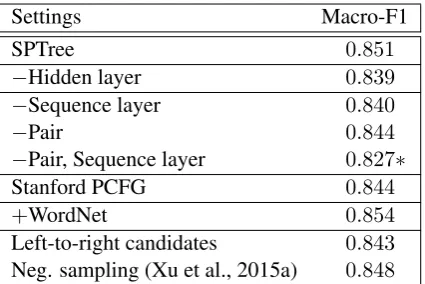
Finally, Table 6 summarizes the contribution of several model components and training set-tings on SemEval relation classification. We first remove the hidden layer by directly connecting the LSTM-RNN layers to the softmax layers, and found that this slightly degraded performance, but the difference was small. We then skip the se-quence layer and directly use the word and POS embeddings for the dependency layer. Removing the sequence layer13 or entity-related information
from the sequence layer (−Pair) slightly degraded performance, and, on removing both, the perfor-mance dropped significantly (p<0.05). This indi-cates that the sequence layer is necessary but the last words of nominals are almost enough for ex-pressing the relations in this task.
When we replace the Stanford neural depen-dency parser with the Stanford lexicalized PCFG parser (Stanford PCFG), the performance slightly dropped, but the difference was small. This in-dicates that the selection of parsing models is not critical. We also included WordNet, and this slightly improved the performance (+WordNet), but the difference was small. Lastly, for the gener-ation of relgener-ation candidates, generating only left-to-right candidates slightly degraded the
perfor-13Note that this setting still uses some sequence layer
in-formation since it uses the entity-related inin-formation (Pair).
mance, but the difference was small and hence the creation of right-to-left candidates was not critical. Treating the inverse relation candidate as a nega-tive instance (Neganega-tive sampling) also performed comparably to other generation methods in our model (unlike Xu et al. (2015a), which showed a significance improvement over generating only left-to-right candidates).
5 Conclusion
We presented a novel end-to-end relation extrac-tion model that represents both word sequence and dependency tree structures by using bidirec-tional sequential and bidirecbidirec-tional tree-structured LSTM-RNNs. This allowed us to represent both entities and relations in a single model, achiev-ing gains over the state-of-the-art, feature-based system on end-to-end relation extraction (ACE04 and ACE05), and showing favorably compara-ble performance to recent state-of-the-art CNN-based models on nominal relation classification (SemEval-2010 Task 8).
Our evaluation and ablation led to three key findings. First, the use of both word sequence and dependency tree structures is effective. Sec-ond, training with the shared parameters improves relation extraction accuracy, especially when em-ployed with entity pretraining, scheduled sam-pling, and label embeddings. Finally, the shortest path, which has been widely used in relation clas-sification, is also appropriate for representing tree structures in neural LSTM models.
Acknowledgments
We thank Qi Li, Kevin Gimpel, and the anony-mous reviewers for dataset details and helpful dis-cussions.
References
Samy Bengio, Oriol Vinyals, Navdeep Jaitly, and Noam Shazeer. 2015. Scheduled sampling for sequence prediction with recurrent neural net-works. arXiv preprint arXiv:1506.03099.
Yee Seng Chan and Dan Roth. 2011. Exploit-ing syntactico-semantic structures for relation extraction. In Proceedings of the 49th An-nual Meeting of the Association for Computa-tional Linguistics: Human Language Technolo-gies, pages 551–560, Portland, Oregon, USA, June. ACL.
Danqi Chen and Christopher Manning. 2014. A fast and accurate dependency parser using neu-ral networks. InProceedings of the 2014 Con-ference on Empirical Methods in Natural Lan-guage Processing (EMNLP), pages 740–750, Doha, Qatar, October. ACL.
Massimiliano Ciaramita and Yasemin Altun. 2006. Broad-coverage sense disambiguation and information extraction with a supersense sequence tagger. In Proceedings of the 2006 Conference on Empirical Methods in Natural Language Processing, pages 594–602, Sydney, Australia, July. ACL.
George Doddington, Alexis Mitchell, Mark Przy-bocki, Lance Ramshaw, Stephanie Strassel, and Ralph Weischedel. 2004. The automatic con-tent extraction (ace) program – tasks, data, and evaluation. In Proceedings of the Fourth In-ternational Conference on Language Resources and Evaluation (LREC-2004), Lisbon, Portu-gal, May. European Language Resources Asso-ciation (ELRA).
Cicero dos Santos, Bing Xiang, and Bowen Zhou. 2015. Classifying relations by ranking with convolutional neural networks. InProceedings of the 53rd Annual Meeting of the Association for Computational Linguistics and the 7th In-ternational Joint Conference on Natural Lan-guage Processing (Volume 1: Long Papers), pages 626–634, Beijing, China, July. ACL.
Alex Graves and J¨urgen Schmidhuber. 2005. Framewise phoneme classification with bidirec-tional lstm and other neural network architec-tures. Neural Networks, 18(5):602–610.
Alan Graves, Abdel-rahman Mohamed, and Ge-offrey Hinton. 2013. Speech recognition with deep recurrent neural networks. In Acoustics, Speech and Signal Processing (ICASSP), 2013 IEEE International Conference on, pages 6645– 6649. IEEE.
James Hammerton. 2001. Clause identification with long short-term memory. In Proceedings of the 2001 workshop on Computational Nat-ural Language Learning-Volume 7, page 22. ACL.
James Hammerton. 2003. Named entity recog-nition with long short-term memory. In Wal-ter Daelemans and Miles Osborne, editors, Pro-ceedings of the Seventh Conference on Natu-ral Language Learning at HLT-NAACL 2003, pages 172–175. ACL.
Kazuma Hashimoto, Pontus Stenetorp, Makoto Miwa, and Yoshimasa Tsuruoka. 2015. Task-oriented learning of word embeddings for se-mantic relation classification. In Proceedings of the Nineteenth Conference on Computational Natural Language Learning, pages 268–278, Beijing, China, July. ACL.
Iris Hendrickx, Su Nam Kim, Zornitsa Kozareva, Preslav Nakov, Diarmuid ´O S´eaghdha, Sebas-tian Pad´o, Marco Pennacchiotti, Lorenza Ro-mano, and Stan Szpakowicz. 2010. Semeval-2010 task 8: Multi-way classification of se-mantic relations between pairs of nominals. In Proceedings of the 5th International Workshop on Semantic Evaluation, pages 33–38, Uppsala, Sweden, July. ACL.
Zhiheng Huang, Wei Xu, and Kai Yu. 2015. Bidi-rectional lstm-crf models for sequence tagging. arXiv preprint arXiv:1508.01991.
Rohit J. Kate and Raymond Mooney. 2010. Joint entity and relation extraction using card-pyramid parsing. In Proceedings of the Four-teenth Conference on Computational Natural Language Learning, pages 203–212, Uppsala, Sweden, July. ACL.
Diederik Kingma and Jimmy Ba. 2015. Adam: A method for stochastic optimization. InICLR 2015, San Diego, CA, May.
Jiwei Li, Thang Luong, Dan Jurafsky, and Eduard Hovy. 2015. When are tree structures neces-sary for deep learning of representations? In Proceedings of the 2015 Conference on Empir-ical Methods in Natural Language Processing, pages 2304–2314, Lisbon, Portugal, September. ACL.
Wei Lu and Dan Roth. 2015. Joint mention extraction and classification with mention hy-pergraphs. In Proceedings of the 2015 Con-ference on Empirical Methods in Natural Lan-guage Processing, pages 857–867, Lisbon, Por-tugal, September. ACL.
Tomas Mikolov, Ilya Sutskever, Kai Chen, Greg S Corrado, and Jeff Dean. 2013. Distributed representations of words and phrases and their compositionality. InAdvances in neural infor-mation processing systems, pages 3111–3119. Makoto Miwa and Yutaka Sasaki. 2014.
Model-ing joint entity and relation extraction with ta-ble representation. In Proceedings of the 2014 Conference on Empirical Methods in Natural Language Processing (EMNLP), pages 1858– 1869, Doha, Qatar, October. ACL.
David Nadeau and Satoshi Sekine. 2007. A sur-vey of named entity recognition and classifica-tion. Lingvisticae Investigationes, 30(1):3–26. Eric W. Noreen. 1989. Computer-Intensive
Meth-ods for Testing Hypotheses : An Introduction. Wiley-Interscience, April.
Romain Paulus, Richard Socher, and Christo-pher D Manning. 2014. Global belief re-cursive neural networks. In Z. Ghahramani, M. Welling, C. Cortes, N.D. Lawrence, and K.Q. Weinberger, editors, Advances in Neu-ral Information Processing Systems 27, pages 2888–2896. Curran Associates, Inc.
Anastasia Pentina, Viktoriia Sharmanska, and Christoph H. Lampert. 2015. Curriculum learning of multiple tasks. In IEEE Confer-ence on Computer Vision and Pattern Recog-nition CVPR, pages 5492–5500, Boston, MA, USA, June.
Lev Ratinov and Dan Roth. 2009. Design challenges and misconceptions in named en-tity recognition. In Proceedings of the Thir-teenth Conference on Computational Natural
Language Learning (CoNLL-2009), pages 147– 155, Boulder, Colorado, June. ACL.
Dan Roth and Wen-Tau Yih, 2007. Global Infer-ence for Entity and Relation Identification via a Linear Programming Formulation. MIT Press. Sameer Singh, Sebastian Riedel, Brian Martin,
Ji-aping Zheng, and Andrew McCallum. 2013. Joint inference of entities, relations, and coref-erence. In Proceedings of the 2013 work-shop on Automated knowledge base construc-tion, pages 1–6. ACM.
Richard Socher, Brody Huval, Christopher D. Manning, and Andrew Y. Ng. 2012. Seman-tic compositionality through recursive matrix-vector spaces. InProceedings of the 2012 Joint Conference on Empirical Methods in Natural Language Processing and Computational Natu-ral Language Learning, pages 1201–1211, Jeju Island, Korea, July. ACL.
Nitish Srivastava, Geoffrey Hinton, Alex Krizhevsky, Ilya Sutskever, and Ruslan Salakhutdinov. 2014. Dropout: A simple way to prevent neural networks from overfitting. The Journal of Machine Learning Research, 15(1):1929–1958.
Kai Sheng Tai, Richard Socher, and Christo-pher D. Manning. 2015. Improved semantic representations from tree-structured long short-term memory networks. InProceedings of the 53rd Annual Meeting of the Association for Computational Linguistics and the 7th Interna-tional Joint Conference on Natural Language Processing (Volume 1: Long Papers), pages 1556–1566, Beijing, China, July. ACL.
Paul J Werbos. 1990. Backpropagation through time: what it does and how to do it. Proceed-ings of the IEEE, 78(10):1550–1560.
Kun Xu, Yansong Feng, Songfang Huang, and Dongyan Zhao. 2015a. Semantic relation classification via convolutional neural networks with simple negative sampling. InProceedings of the 2015 Conference on Empirical Methods in Natural Language Processing, pages 536– 540, Lisbon, Portugal, September. ACL. Yan Xu, Lili Mou, Ge Li, Yunchuan Chen, Hao
along shortest dependency paths. In Proceed-ings of the 2015 Conference on Empirical Meth-ods in Natural Language Processing, pages 1785–1794, Lisbon, Portugal, September. ACL.
Bishan Yang and Claire Cardie. 2013. Joint in-ference for fine-grained opinion extraction. In Proceedings of the 51st Annual Meeting of the Association for Computational Linguistics (Vol-ume 1: Long Papers), pages 1640–1649, Sofia, Bulgaria, August. ACL.
Xiaofeng Yu and Wai Lam. 2010. Jointly iden-tifying entities and extracting relations in ency-clopedia text via a graphical model approach. In Coling 2010: Posters, pages 1399–1407, Beijing, China, August. Coling 2010 Organiz-ing Committee.
Dmitry Zelenko, Chinatsu Aone, and Anthony Richardella. 2003. Kernel methods for relation extraction. The Journal of Machine Learning Research, 3:1083–1106.
GuoDong Zhou, Jian Su, Jie Zhang, and Min Zhang. 2005. Exploring various knowledge in relation extraction. InProceedings of the 43rd Annual Meeting of the Association for Compu-tational Linguistics (ACL’05), pages 427–434, Ann Arbor, Michigan, June. ACL.
A Supplemental Material
A.1 Data and Task Settings
ACE05 defines 7 coarse-grained entity types: Facility (FAC), Geo-Political Entities (GPE), Location (LOC), Organization (ORG), Person (PER), Vehicle (VEH) and Weapon (WEA), and 6 coarse-grained relation types between enti-ties: Artifact (ART), Gen-Affiliation (GEN-AFF), Org-Affiliation (ORG-AFF), Part-Whole ( PART-WHOLE), Person-Social (PER-SOC) and Physical (PHYS). We removed thects,unsubsets, and used a 351/80/80 train/dev/test split. We removed du-plicated entities and relations, and resolved nested entities. We used head spans for entities. We fol-low the settings by (Li and Ji, 2014), and we did not use the full mention boundary unlike Lu and Roth (2015). We useentitiesandrelationsto refer to entity mentions andrelation mentions in ACE for brevity.
ACE04defines the same 7 coarse-grained entity types as ACE05 (Doddington et al., 2004), but
de-fines 7 coarse-grained relation types: PYS, PER-SOC, Employment / Membership / Subsidiary (EMP-ORG), ART, PER/ORG affiliation ( Other-AFF),GPEaffiliation (GPE-AFF), and Discourse (DISC). We follow the cross-validation setting of Chan and Roth (2011) and Li and Ji (2014). We removedDISC and did 5-fold CV onbnews and nwiresubsets (348 documents). We use the same preprocessing and evaluation metrics of ACE05.
SemEval-2010 Task 8 defines 9 relation types between nominals ( Cause-Effect, Instrument-Agency, Product-Producer, Content-Container, Entity-Origin, Entity-Destination, Component-Whole, Member-Collection and Message-Topic), and a tenth typeOtherwhen two nouns have none of these relations (Hendrickx et al., 2010). We treat this Other type as a negative relation type, and no direction is considered. The dataset con-sists of 8,000 training and 2,717 test sentences, and each sentence is annotated with a relation be-tween two given nominals. We randomly selected 800 sentences from the training set as our devel-opment set. We followed the official task setting, and report the official macro-averaged F1-score (Macro-F1) on the 9 relation types.
A.2 Hyper-parameter Settings
Here we show the hyper-parameters and the range tried for the hyper-parameters in parentheses. Hyper-parameters include the initial learning rate (5e-3, 2e-3, 1e-3, 5e-4, 2e-4, 1e-4), the regular-ization parameter (1e-4, 1e-5, 1e-6, 1e-7), dropout probabilities (0.0, 0.1, 0.2, 0.3, 0.4, 0.5), the size of gradient clipping (1, 5, 10, 50, 100), scheduled sampling parameterk(1, 5, 10, 50, 100), the num-ber of epochs for training and entity pretraining (≤