Proceedings of the 55th Annual Meeting of the Association for Computational Linguistics, pages 1891–1900 Proceedings of the 55th Annual Meeting of the Association for Computational Linguistics, pages 1891–1900
An Algebra for Feature Extraction
Vivek Srikumar School of Computing
University of Utah [email protected]
Abstract
Though feature extraction is a necessary first step in statistical NLP, it is often seen as a mere preprocessing step. Yet, it can dominate computation time, both during training, and especially at deployment. In this paper, we formalize feature extraction from an algebraic perspective. Our for-malization allows us to define a message passing algorithm that can restructure fea-ture templates to be more computationally efficient. We show via experiments on text chunking and relation extraction that this restructuring does indeed speed up feature extraction in practice by reducing redun-dant computation.
1 Introduction
Often, the first step in building statistical NLP models involves feature extraction. It is well un-derstood that the right choice of features can sub-stantially improve classifier performance. How-ever, from the computational point of view, the process of feature extraction is typically treated, at best as the preprocessing step of caching fea-turized inputs over entire datasets, and at worst, as ‘somebody else’s problem’. While such ap-proaches work for training, when trained models are deployed, the computational cost of feature ex-traction cannot be ignored.
In this paper, we present the first (to our knowl-edge) algebraic characterization of the process of feature extraction. We formalize feature extrac-tors as arbitrary functions that map objects (words, sentences, etc) to a vector space and show that this set forms a commutative semiring with respect to feature addition and feature conjunction.
An immediate consequence of the semiring characterization is a computational one. Every
semiring admits theGeneralized Distributive Law (GDL) Algorithm (Aji and McEliece, 2000) that exploits the distributive property to provide com-putational speedups. Perhaps the most common manifestation of this algorithm in NLP is in the form of inference algorithms for factor graphs and Bayesian networks like the product, max-sum and max-sum-product algorithms (e.g.Goodman,
1999;Kschischang et al.,2001). When applied to feature extractors, the GDL algorithm can refactor a feature extractor into a faster one by reducing re-dundant computation. In this paper, we propose a junction tree construction to allow such refactor-ing. Since the refactoring is done at the feature template level, the actual computational savings grow as classifiers encounter more examples.
We demonstrate the practical utility of our ap-proach by factorizing existing feature sets for text chunking and relation extraction. We show that, by reducing the number of operations performed, we can obtain significant savings in the time taken to extract features.
To summarize, the main contribution of this pa-per is the recognition that feature extractors form a commutative semiring over addition and conjunc-tion. We demonstrate a practical consequence of this characterization in the form of a mechanism for automatically refactoring any feature extractor into a faster one. Finally, we show the empirical usefulness of our approach on relation extraction and text chunking tasks.
2 Problem Definition
Before formal definitions, let us first see a running example.
2.1 Motivating Example
Consider the frequently used unigram, bigram and trigram features. Each of these is a template that specifies a feature representation for a word. In
fact, the bigram and trigram templates them-selves are compositional by definition. Abigram is simply the conjunction of a word w and pre-vious word, which we will denote as w-1; i.e., bigram = w-1&w. Similarity, atrigram is the
conjunction ofw-2andbigram.
These templates are a function that operate on inputs. Given a sentence, sayJohn ate alone, and a target word, say alone, they will produce indi-cators for the strings w=alone, w-1=ate&w=alone and w-2=John&w-1=ate&w=alone respectively.
Equivalently, each template maps an input to a vector. Here, the three vectors will be basis vec-tors associated with the feature strings.
Observe that the function that extracts the target word (i.e.,w) has to be executed in all three feature templates. Similarly, w-1 has to be extracted to
compute both the bigrams and the trigrams. Can we optimize feature computation by automatically detecting such repetitions?
2.2 Definitions and Preliminaries
LetX be a set of inputs to a classification
prob-lem at hand; e.g., X could be words, sentences, etc. LetV be a possibly infinite dimensional vec-tor space that represents the feature space. Feature extractors are functions that map the input space
X to the feature space V to produce feature vec-tors for inputs. LetF represent the set of feature
functions, defined as the set{f : X → V}. We will use the typewriter font to denote feature func-tions likewandbigram.
To round up the definitions, we will name two special feature extractors inF. The feature
extrac-tor0maps all inputs to the zero vector. The feature
extractor1maps all inputs to a bias feature vector. Without loss of generality, we will designate the basis vectori0 ∈ V as the bias feature vector.
In this paper, we are concerned about two gen-erally well understood operators on feature func-tions – addition and conjunction. However, let us see formal definitions for completeness.
Feature Addition. Given two feature extractors f1,f2 ∈ F, feature addition (denoted by+)
pro-duces a feature extractorf1 +f2that adds up the
images of f1 and f2. That is, for any example
x∈X, we have
(f1+f2) (x) =f1(x) +f2(x) (1)
For example, the feature extractor w+ w-1 will
map the wordaloneto a vector that is one for the
basis elementsw=aloneandw-1=went. This vec-tor is the sum of the indicavec-tor vecvec-tors produced by the two operandswandw-1.
Feature Conjunction. Given two feature extrac-tors f1,f2 ∈ F, their conjunction (denoted by
&) can be interpreted as an extension of Boolean
conjunction. Indicator features like bigram are predicates for certain observations. Conjoining in-dicator features for two predicates is equivalent to an indicator feature for the Boolean conjunc-tion of the predicates. More generally, with fea-ture extractors that produce real valued vectors, the conjunction will produce their tensor prod-uct. The equivalence of feature conjunctions to tensor products has been explored and exploited in recent literature for various NLP tasks (Lei et al.,2014;Srikumar and Manning,2014; Gorm-ley et al.,2015;Lei et al.,2015).
We can further generalize this with an addi-tional observation that is crucial for the rest of this paper. We argue that the conjunction opera-tor producessymmetric tensor productsrather than general tensor products. To see why, consider the bigramexample. Though we defined thebigram feature as the conjunction ofw-1 andw, their or-dering is irrelevant from classification perspective – the eventual goal is to associate weights with this combination of features. This observation allows us to formally define the conjunction operator as:
(f1&f2) (x) =vec(f1(x)f2(x)) (2)
Here, vec(·) stands for vectorize, which simply
converts the resulting tensor into a vector and
denotes the symmetric tensor product, introduced by Ryan (1980, Proposition 1.1). A symmetric tensor product is defined to be the average of the tensor products of all possible permutations of the operands, and thus, unlike a simple tensor product, is invariant to permutation of is operands. Infor-mally, if we think of a tensor as a mapping from an ordered sequence of keys to real numbers, then, symmetric tensor product can be thought of as a mapping from asetof keys to numbers.
3 An Algebra for Feature Extraction In this section, we will see that the set of feature extractors F form a commutative semiring with
bi-nary operations⊕and⊗(addition and multipli-cation respectively) such that:
S1. (K,⊕)is a commutative monoid:⊕is
asso-ciative and commutative, and the setK con-tains a unique additive identity 0 such that ∀x∈K, we have0⊕x=x⊕0 =x.
S2. (K,⊗)is a commutative monoid:⊗is
asso-ciative and commutative, and the setK
con-tains a unique multiplicative identity1 such
that∀x∈K, we have1⊗x=x⊗1 =x.
S3. Multiplication distributes over addition on both sides. That is, for anyx, y, z ∈ K, we
havex⊗(y⊕z) = (x⊗y)⊕(x⊗z)and (x⊕y)⊗z= (x⊗z)⊕(y⊗z).
S4. The additive identity is an annihilating ele-ment with respect to multiplication. That is, for anyx∈K, we havex⊗0 = 0 = 0⊗x.
We refer the reader toGolan(2013) for a broad-ranging survey of semiring theory. We can now state and prove the main result of this paper. Theorem 1. LetXbe any set and letFdenote the set of feature extractors defined on the set. Then,
(F,+,&)is a commutative semiring.
Proof. We will show that the properties of a commutative semiring hold for (F,+,&) using
the definitions of the operators from §2.2. Let f1,f2andf∈ F be feature extractors.
S1. For any example x ∈ X, we have (f1 +f2) (x) = f1(x) +f2(y). The right
hand side denotes vector addition, which is associative and commutative. The0 feature extractor is the additive identify because it produces the zero vector for any input. Thus,
(F,+)is a commutative monoid.
S2. To show that the conjunction operator is as-sociative over feature extractors, it suffices to observe that the tensor product (and hence the symmetric tensor product) is associative. Furthermore, the symmetric tensor product is commutative by definition, because it is in-variant to permutation of its operands. Finally, the bias feature extractor, 1, that
maps all inputs to the bias vector i0, is the
multiplicative identity. To see this, consider the conjunctionf&1, applied to an inputx:
(f&1) (x) = vec(f(x)1(x)) = vec(f(x)i0)
The product term within the vec(·) in the
final expression is a symmetric tensor, de-fined by basis vectors that are sets of the form
{i0, i0},{i1, i0},· · ·. Each basis {ij, i0} is
associated with a feature valuef(x)j. Thus,
the vectorized form of this tensor will contain thesame elementsasf(x), perhaps mapped to different bases. The mapping fromf(x)
to the final vector is independent of the input
x because the bias feature extractor is
inde-pendent ofx. Without loss of generality, we
can fix this mapping to be the identity map-ping, thereby rendering the final vectorized form equal tof(x). That is,f&1=f. Thus,(F,&)is a commutative monoid.
S3. Since tensor products distribute over addi-tion, we get the distributive property.
S4. By definition, conjoining with the 0 feature
extractor annihilates all feature functions be-cause0maps all inputs to the zero vector.
4 From Algebra to an Algorithm
The fact that feature extractors form a commuta-tive semiring has a computational consequence. The generalized distributive law (GDL) algo-rithm(Aji and McEliece,2000) exploits the prop-erties of a commutative semiring to potentially re-duce the computational effort for marginalizing sums of products. The GDL algorithm manifests itself as the Viterbi, Baum-Welch, Floyd-Warshall and belief propagation algorithms, and the Fast Fourier and Hadamard transforms. Each corre-sponds to a different commutative semiring and a specific associated marginalization problem.
Here, we briefly describe the general marginal-ization problem fromAji and McEliece(2000) to introduce notation and also highlight the analogies to inference in factor graphs. Letx1, x2,· · ·, xn denote a collection of variables that can take val-ues from finite setsA1, A2,· · ·, An respectively. Let boldface xdenote the entire set of variables.
These variables are akin to inference variables in factor graphs that may be assigned values or marginalized away.
Let(K,⊕,⊗)denote a commutative semiring.
Supposeαiis a function that maps a subset of the variables {xi1, xi2,· · · } to the set K. The
product” problem is that of computing: X
x
Y
i
αi(xi1, xi2,· · ·) (3)
Here, the sum and product use the semiring op-erators. The summation is over all possible valid assignments of the variablesxover the cross
prod-uct of the setsA1, A2,· · ·, An. This problem gen-eralizes the familiar max-product or sum-product settings. Indeed, the GDL algorithm is a gener-alization of the message passing (Pearl,2014) for efficiently computing marginals.
To make feature extraction efficient using the GDL algorithm, in the next section, we will define a marginalization problem in terms of the semir-ing operators by specifysemir-ing the variables involved, the local domains and local functions. Instead of describing the algorithm in the general setting, we will instantiate it on the semiring at hand.
5 Marginalizing Feature Extractors First, let us see why we can expect any benefit from the GDL algorithm by revisiting our running example (unigrams, bigrams and trigrams), writ-ten below using the semiring operations:
f=w+ (w-1&w) + (w-2&w-1&w) (4)
When applied to a token,fperforms two additions and three conjunctions. However, by applying the distributive property, we can refactor it as follows to reduce the number of operations:
f0 = (1+ (1+w-2)&w-1)&w (5)
The refactored versionf0 – equivalent to the orig-inal one – only performs two additions and two conjunctions, offering a computational saving of one operation. This refactoring is done at the level of feature templates (i.e., feature extractors); the actual savings are realized when the feature vec-tors are computed by applying this feature func-tion to an input. Thus, the simplificafunc-tion, though seemingly modest at the template level, can lead to a substantial speed improvements when the fea-tures vectors are actually manifested from data.
The GDL algorithm instantiated with the fea-ture extractor semiring, automates such factoriza-tion at a symbolic level. In the rest of this sec-tion, first (§5.1), we will write our problem as a marginalization problem, as in Equation (3). Then (§5.2), we will construct a junction tree to apply the message passing algorithm.
5.1 Canonicalizing Feature Extractors To frame feature simplification as marginalization, we need to first write any feature extractor as a canonical sum of products that is amenable for factorization (i.e., as in (3)). To do so, in this sec-tion, we will define: (a) the variables involved, (b) the local domains (i.e., subsets of variables contributing to each product term), and, (c) a lo-cal function for each lolo-cal domain (i.e., theαi’s). Variables. First, we write a feature extrac-tor as a sum of products. Our running exam-ple (4) is already one. If we had an expres-sion like f1& (f2 +f3), we can expand it into
f1&f2 +f1&f3. From the sum of products, we
identify thebase feature extractors(i.e., ones not composed of other feature extractors) and define a variablexi for each. In our example, we have w, w-1andw-2.
Next, recall from §4 that each variable xi can take values from a finite setAi. If a base feature extractor fi corresponds to the variable xi, then, we definexi’s domain to be the setAi ={1,fi}. That is, each variable can either be the bias feature extractor or the feature extractor associated with it. Our example gives three variables x1, x2, x3
with domainsA1={1,w},A2 ={1,w-1},A3 =
{1,w-2}respectively.
Local domains.Local domains are subsets of the variables defined above. They are the domains of functions that constitute products in the canonical form of a feature extractor. We define the follow-ing local domains, each illustrated with the corre-sponding instantiation in our running example:
1. A singleton set for each variable:{x1},{x2},
and{x3}.
2. One local domain consisting of all the vari-ables: The set{x1, x2, x3}.
3. One local domain consisting of no variables: The empty set{}.
4. One local domain for each subset of base feature extractors that participate in at least two conjunctions in the sum-of-products (i. e., the ones that can be factored away): Only
{x1, x2}in our example, because onlywand
de-signing a marginalization problem that pushes to-wards simpler feature functions.
1. We associate the identity function with all singleton local domains, and the constant function that returns the bias 1 with the empty domain{}.
2. With all other local domains, we asso-ciate an indicator function, denoted by z.
For a local domain, z is an indicator for
those assignments of the variables involved, whose conjunctions are present in any prod-uct term in sum-of-prodprod-ucts. In our run-ning example, the function z(x1, x2) is the
indicator for (x1, x2) belonging to the set
{(w,1),(w,w-1)}, represented by the table:
x1 x2 z(x1, x2)
1 1 0
1 w-1 0
w 1 1
w w-1 1
The indicator returns the semiring’s multi-plicative and additive identities. The value ofz above for inputs(w,1)is1 because the
first term in (4) that defines the feature ex-tractor containsw, but notw-1. On the other
hand, the input (1,1) is mapped to 0
be-cause every product term contains either w or w-1. For the local domain {x1, x2, x3},
the local function is the indicator for the set
{(w,1,1),(w,w-1,1),(w,w-1,w-2)},
corre-sponding to each product term.
In summary, for the running example we have: Local domain Local function
{x1} x1
{x2} x2
{x3} x3
{x1, x2, x3} z(x1, x2, x3)
{} 1
{x1, x2} z(x1, x2)
The procedure described here aims to convert anyfeature function into a canonical form that can be factorized using the GDL algorithm. Indeed, using local domains and functions specified above, any feature extractor can we written as a canonical sum of products as in (3). For example, using the table above, our running example is identical to
X
x1,x2,x3
z(x1, x2, x3)&z(x1, x2)&x1&x2&x3 (6)
Here, the summation is over the cross product of theAi’s. The choice of thezfunctions ensures that only those conjunctions that were in the original feature extractor remain.
This section shows one approach for canonical-ization; the local domains and functions are a
de-sign choice that may be optimized in future work. We should also point out that, while this process is notationally tedious, its actual computational cost is negligible, especially given that it is to be per-formed only once at the template level.
5.2 Simplifying feature extractors
As mentioned in §4, a commutative semiring can allow us to employ the GDL algorithm to effi-ciently compute a sum of products. Starting from a canonical sum-of-products expression such as the one in (6), this process is similar to variable elim-ination for Bayesian networks. The junction tree algorithm is a general scheme to avoid redundant computation in such networks (Cowell,2006). To formalize this, we will first build a junction tree and then define the messages sent from the leaves to the root. The final message at the root will give us the simplified feature function.
Constructing a Junction Tree.First, we will con-struct a junction tree using the local domains from §5.1. In any junction tree, the edges should satisfy the running intersection property: i.e., if a vari-ablexi is in two nodes in the tree, then it should be in every node in the path connecting them. To build a junction tree, we will first create a graph whose nodes are the local domains. The edges of this graph connect pairs of nodes if the variables in one are a subset of the other. For simplicity, we will assume that our nodes are arranged in a lat-tice as shown in Figure1, with edges connecting nodes in subsequent levels. For example, there is no edge connecting nodesBandC.
Every spanning tree of this lattice is a junction tree. Which one should we consider? Let us ex-amine the properties that we need. First, the root of the tree should correspond to the empty local domain{}because messages arriving at this node
fig-{}
{x1} {x2} {x3}
{x1, x2}
{x1, x2, x3}
A
B C
D E
[image:6.595.108.251.63.170.2]F
Figure 1: The junction tree for our running example. The process of constructing the junction tree is described in the text. Here, we show both the tree and the graph from which it is constructed; dashed lines show edges are not in the tree. Filled circles denote the names of the nodes. The local do-main{x1}is connected to the empty local domain because the featurewcorresponding to it is most frequent.
ure can be the average cost of thewandw-1feature
extractors. If computational costs are unavailable, we can use the number times a feature extractor appears in the expression to be simplified. Under this criterion, in our example, edges connectingE to its neighbors will be weighted highest.
Once we have a spanning tree, we make the edges directed so that the empty set is the root. Figure1shows the junction tree obtained for our running example.
Message Passing for Feature Simplification. Given the junction tree, we can use a standard message passing scheme for factorization. The goal is to collect information at each node in the tree from its children all the way to the root.
Suppose vi, vj denote two nodes in the tree. Since nodes are associated with sets of variables, their intersectionsvi ∩vj and differences vi\vj are defined. For example, in the example,A∩B= {x3}andB\D = {x3}. We will denote children
of a nodeviin the junction tree byC(vi).
The message from any nodevi to its parent vj is a function that maps the variables vi∩vj to a feature extractor by marginalizing out all variables that are invibut not invj. Formally, we define the messageµij from a nodevi to a nodevjas:
µij(vi∩vj) =
X
vj\vi
αi(vi)
Y
vk∈C(vi)
µki(vk∩vi). (7)
Here,αi is the local function at nodevi. To com-plete the formal definition of the algorithm, we note that by performing post-order traversal of the junction tree, we will accumulate all messages at the root of the tree, that corresponds to the empty set of variables. The incoming message at this node represents the factorized feature extractor.
Algorithm1briefly summarizes the entire simpli-fication process. The proof of correctness of the algorithm follows from the fact that the range of all the local functions is a commutative semiring, namely the feature extractor semiring. We refer the reader to (Aji and McEliece,2000, Appendix A) for details.
Algorithm 1The Generalized Distributive Law Algorithm for simplifying a feature extractorf. See the text for details.
1: Convertfinto a canonical sum of products representa-tion (§5.1).
2: Construct a junction tree whose nodes are local domains. 3: foredge(vj, vi)in the post-order traversal of the treedo
4: Receive a messageµijatvjusing (7).
5: end for
6: return the incoming message at the root
Example run of message propagation.As an il-lustration, let us apply it to our running example.
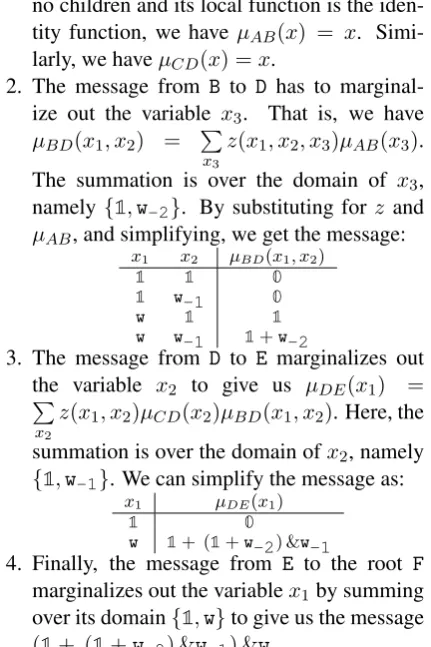
1. The first message is fromAtoB. SinceAhas no children and its local function is the iden-tity function, we haveµAB(x) = x. Simi-larly, we haveµCD(x) =x.
2. The message from B to D has to marginal-ize out the variable x3. That is, we have
µBD(x1, x2) = P
x3
z(x1, x2, x3)µAB(x3).
The summation is over the domain of x3,
namely{1,w-2}. By substituting forz and µAB, and simplifying, we get the message:
x1 x2 µBD(x1, x2)
1 1 0
1 w-1 0
w 1 1
w w-1 1+w-2
3. The message from D to E marginalizes out the variable x2 to give us µDE(x1) =
P x2
z(x1, x2)µCD(x2)µBD(x1, x2). Here, the
summation is over the domain ofx2, namely
{1,w-1}. We can simplify the message as:
x1 µDE(x1)
1 0
w 1+ (1+w-2) &w-1
4. Finally, the message from E to the root F marginalizes out the variablex1by summing
over its domain{1,w}to give us the message
(1+ (1+w-2) &w-1) &w.
The message received at the root is the factorized feature extractor. Note that the final form is iden-tical to (5) at the beginning of §5.
[image:6.595.313.529.327.651.2]refac-tored feature function to the fastest one depends on the heuristic used to weight edges for iden-tifying the junction tree. Changing the heuristic can change the junction tree, thus changing the fi-nal factorized function. We found via experiments that using the number of times a feature extractor occurs in the sum-of-products to weight edges is promising. A formal study of optimality of factor-ization is an avenue of future research.
6 Experiments
We show the practical usefulness of feature func-tion refactoring using text chunking and relafunc-tion extraction. In both cases, the question we seek to evaluate empirically is: Does the feature function refactoring algorithm improve feature extraction time? We should point out that our goal is not to measure accuracy of prediction, but the efficiency of feature extraction. Indeed, we are guaranteed that refactoring will not change accuracy; factor-ized feature extractors produce the same feature vectors as the original ones.
In all experiments, we compare a feature extrac-tor and its refacextrac-tored variant. For the facextrac-torization, we incentivized the junction tree to factor out base feature extractors that occurred most frequently in the feature extractor. For both tasks, we use ex-isting feature representations that we briefly de-scribe. We refer the reader to the original work that developed the feature representations for fur-ther details. For both the original and the factor-ized feature extractors, we report (a) the number of additions and conjunctions at the template level, and, (b) the time for feature extraction on the en-tire dataset. For the time measurements, we report average times for the original and factorized fea-ture extractors over five paired runs to average out variations in system load.1
6.1 Text Chunking
We use data from the CoNLL 2000 shared task (Tjong Kim Sang and Buchholz,2000) of text chunking and the feature set described byMartins et al.(2011), consisting of the following templates extracted at each word: (1) Up to 3-grams of POS tags within a window of size ten centered at the word, (2) up to 3-grams of words, within a win-dow of size six centered at the word, and (3) up to 2-grams of word shapes, within a window of size
1We performed all our experiments on a server with
128GB RAM and 24 CPU cores, each clocking at 2600 MHz.
[image:7.595.324.506.62.105.2]Size Average feature Setting + & extraction time (ms) Original 47 75 17776.6 Factorized 47 54 4294.2
Table 1: Comparison of the original and factorized feature extractors for the text chunking task. The time improvement is statistically significant using the paired t-test atp <0.01.
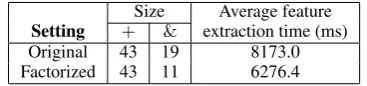
Size Average feature Setting + & extraction time (ms) Original 43 19 8173.0 Factorized 43 11 6276.4
Table 2: Comparison of the original and factorized feature extractors for the relation extraction task. We measured time using 3191 training mention pairs. The time improvement is statistically significant using the paired t-test atp <0.01.
four centered at the word. In all, there are 96 fea-ture templates.
We factorized the feature representation using Algorithm1. Table1reports the number of opera-tions (addition and conjunction) in the templates in the original and factorized versions of the feature extractor. The table also reports feature extraction time taken from the entire training set of 8,936 sentences, corresponding to 211,727 tokens. First, we see that the factorization reduces the number of feature conjunction operations. Thus, to produce exactly the same feature vector, the factorized fea-ture extractor does less work. The time results show that this computational gain is not merely a theoretical one; it also manifests itself practically.
6.2 Relation Extraction
Our second experiment is based on the task of re-lation extraction using the English section of the ACE 2005 corpus (Walker et al.,2006). The goal is to identify semantic relations between two en-tity mentions in text. We use the feature represen-tation developed byZhou et al. (2005) as part of an investigation of how various lexical, syntactic and semantic sources of information affect the re-lation extraction task. To this end, the feature set consists of word level information about mentions, their entity types, their relationships with chunks, path features from parse trees, and semantic fea-tures based on WordNet and various word lists. Given the complexity of the features, we do not describe them here and refer the reader to the orig-inal work for details. Note that compared to the chunking features, these features are more diverse in their computational costs.
[image:7.595.323.507.157.200.2]Ta-ble 2. As before, we see that the number of conjunction operations decreases after factoriza-tion. Curiously, however, despite the complexity of the feature set, the actual number of operations is smaller than text chunking. Due to this, we see a more modest, yet significant decrease in the time for feature extraction after factorization.
7 Related Work and Discussion
Simplifying Expressions. The problem of sim-plifying expressions with an eye on computa-tional efficiency is the focus of logic synthesis (cf.
Hachtel and Somenzi,2006), albeit largely geared towards analyzing and verifying digital circuits. Logic synthesis is NP-hard in general. In our case, the hardness is hidden in the fact that our approach does not guarantee that we will find the smallest (or most efficient) factorization. The junction tree construction determines the factorization quality. Semirings in NLP. Semirings abound in NLP, though primarily as devices to design efficient inference algorithms for various graphical mod-els (e.g. Wainwright and Jordan, 2008; Sutton et al., 2012). Goodman (1999) synthesized var-ious parsing algorithms in terms of semiring op-erations. Since then, we have seen several ex-plorations of the interplay between weighted dy-namic programs and semirings for inference in tasks such as parsing and machine translation (e. g.Eisner et al.,2005;Li and Eisner,2009;Lopez,
2009;Gimpel and Smith,2009). Allauzen et al.
(2003) developed efficient algorithms for con-structing statistical language models by exploiting the algebraic structure of the probability semiring. Feature Extraction and Modeling Languages. Much work around features in NLP is aimed at improving classifier accuracy. There is some work on developing languages to better construct fea-ture spaces (Cumby and Roth,2002;Broda et al.,
2013;Sammons et al.,2016), but they do not for-malize feature extraction from an algebraic per-spective. We expect that the algorithm proposed in this paper can be integrated into such feature con-struction languages, and also into libraries geared towards designing feature rich models (e.g. Mc-Callum et al.,2009;Chang et al.,2015).
Representation vs. Speed. As the recent suc-cesses (Goodfellow et al.,2016) of distributed rep-resentations show, the representational capacity of a feature space is of primary importance. Indeed, several recent lines of work that use distributed
representations have independently identified the connection between conjunctions (of features or factors in a factor graph) and tensor products (Lei et al.,2014;Srikumar and Manning,2014; Gorm-ley et al., 2015;Yu et al.,2015;Lei et al., 2015;
Primadhanty et al.,2015). They typically impose sparsity or low-rank requirements to induce better representations for learning. In this paper, we use the connection between tensor products and con-junctions to prove algebraic properties of feature extractors, leading to speed improvements via fac-torization.
In this context, we note that in both our experi-ments, the number of conjunctions are reduced by factorization. We argue that this is an important saving because conjunctions can be a more expen-sive operation. This is especially true when deal-ing with dense feature representations, as is in-creasingly common with word vectors and neural networks, because conjunctions of dense feature vectors are tensor products, which can be slow.
Finally, while training classifiers can be time consuming, when trained classifiers are deployed, feature extraction will dominate computation time over the classifier’s lifetime. However, the pre-diction step includes both feature extraction and computing inner products between features and weights. Many features may be associated with zero weights because of sparsity-inducing learn-ing (e.g. Andrew and Gao, 2007;Martins et al.,
2011;Strubell et al., 2015). Since these two as-pects are orthogonal to each other, the factoriza-tion algorithm presented in this paper can be used to speed up extraction of those features that have non-zero weights.
8 Conclusion
In this paper, we studied the process of feature ex-traction using an algebraic lens. We showed that the set of feature extractors form a commutative semiring over addition and conjunction. We ex-ploited this characterization to develop a factor-ization algorithm that simplifies feature extractors to be more computationally efficient. We demon-strated the practical value of the refactoring algo-rithm by speeding up feature extraction for text chunking and relation extraction tasks.
Acknowledgments
References
Srinivas M Aji and Robert J McEliece. 2000. The gen-eralized distributive law. IEEE Transactions on
In-formation Theory46(2).
Cyril Allauzen, Mehryar Mohri, and Brian Roark. 2003. Generalized algorithms for constructing sta-tistical language models. InACL.
Galen Andrew and Jianfeng Gao. 2007. Scalable train-ing ofL1-regularized log-linear models. InICML.
Bartosz Broda, Paweł K˛edzia, Michał Marci´nczuk, Adam Radziszewski, Radosław Ramocki, and Adam Wardy´nski. 2013. Fextor: A feature extrac-tion framework for natural language processing: A case study in word sense disambiguation, relation recognition and anaphora resolution. In Computa-tional Linguistics, Springer, pages 41–62.
Kai-Wei Chang, Shyam Upadhyay, Ming-Wei Chang, Vivek Srikumar, and Dan Roth. 2015. IllinoisSL: A JAVA library for Structured Prediction. arXiv
preprint arXiv:1509.07179.
Robert G Cowell. 2006. Probabilistic networks and expert systems: Exact computational methods for Bayesian networks. Springer Science & Business Media.
Chad M Cumby and Dan Roth. 2002. Learning with feature description logics. In Inductive logic
pro-gramming, Springer.
Jason Eisner, Eric Goldlust, and Noah A Smith. 2005. Compiling Comp Ling: Practical weighted dynamic programming and the Dyna language. In
HLT-EMNLP.
Kevin Gimpel and Noah A Smith. 2009. Cube sum-ming, approximate inference with non-local fea-tures, and dynamic programming without semirings. InEACL.
Jonathan S Golan. 2013. Semirings and their Applica-tions. Springer Science & Business Media.
Ian Goodfellow, Yoshua Bengio, and Aaron Courville. 2016.Deep Learning. MIT Press.
Joshua Goodman. 1999. Semiring parsing. Computa-tional Linguistics25(4):573–605.
Matthew R. Gormley, Mo Yu, and Mark Dredze. 2015. Improved relation extraction with feature-rich com-positional embedding models. InEMNLP.
Gary D Hachtel and Fabio Somenzi. 2006. Logic syn-thesis and verification algorithms. Springer Science & Business Media.
Frank R Kschischang, Brendan J Frey, and H-A Loeliger. 2001. Factor graphs and the sum-product algorithm. IEEE Transactions on information the-ory47(2):498–519.
Tao Lei, Yuan Zhang, Regina Barzilay, and Tommi Jaakkola. 2014. Low-rank tensors for scoring de-pendency structures. InACL.
Tao Lei, Yuan Zhang, Lluís Màrquez, Alessandro Moschitti, and Regina Barzilay. 2015. High-order lowrank tensors for semantic role labeling. In
NAACL.
Zhifei Li and Jason Eisner. 2009. First- and second-order expectation semirings with applications to minimum-risk training on translation forests. In
EMNLP.
Adam Lopez. 2009. Translation as weighted deduc-tion. InEACL.
André FT Martins, Noah A Smith, Pedro MQ Aguiar, and Mário AT Figueiredo. 2011. Structured sparsity in structured prediction. InCoNLL.
Andrew McCallum, Karl Schultz, and Sameer Singh. 2009. Factorie: Probabilistic programming via im-peratively defined factor graphs. InNIPS.
Judea Pearl. 2014. Probabilistic reasoning in intelli-gent systems: networks of plausible inference. Mor-gan Kaufmann.
Audi Primadhanty, Xavier Carreras, and Ariadna Quat-toni. 2015. Low-rank regularization for sparse con-junctive feature spaces: An application to named en-tity classification. InACL.
Raymond A Ryan. 1980. Applications of topological tensor products to infinite dimensional holomorphy. Ph.D. thesis, Trinity College.
Mark Sammons, Christos Christodoulopoulos, Parisa Kordjamshidi, Daniel Khashabi, Vivek Srikumar, and Dan Roth. 2016. EDISON: Feature Extraction for NLP. InLREC.
Vivek Srikumar and Christopher D. Manning. 2014. Learning distributed representations for structured output prediction. InNIPS.
Emma Strubell, Luke Vilnis, Kate Silverstein, and An-drew McCallum. 2015. Learning Dynamic Feature Selection for Fast Sequential Prediction. InACL.
Charles Sutton, Andrew McCallum, et al. 2012. An introduction to conditional random fields.
Founda-tions and TrendsR in Machine Learning4(4):267–
373.
Erik F Tjong Kim Sang and Sabine Buchholz. 2000. Introduction to the CoNLL-2000 shared task: Chunking. InCoNLL.
Martin J Wainwright and Michael I Jordan. 2008. Graphical models, exponential families, and varia-tional inference. Foundations and TrendsR in
Christopher Walker, Stephanie Strassel, Julie Medero, and Kazuaki Maeda. 2006. ACE 2005 multilin-gual training corpus. Linguistic Data Consortium,
Philadelphia57.
Mo Yu, Matthew R. Gormley, and Mark Dredze. 2015. Combining Word Embeddings and Feature Embed-dings for Fine-grained Relation Extraction. In
NAACL.