Graph-Based Translation Via Graph Segmentation
Liangyou Li and Andy Way and Qun Liu ADAPT Centre, School of Computing
Dublin City University, Ireland
{liangyouli,away,qliu}@computing.dcu.ie
Abstract
One major drawback of phrase-based translation is that it segments an input sen-tence into continuous phrases. To sup-port linguistically informed source discon-tinuity, in this paper we construct graphs which combine bigram and dependency relations and propose a graph-based trans-lation model. The model segments an input graph into connected subgraphs, each of which may cover a discontinuous phrase. We use beam search to combine translations of each subgraph left-to-right to produce a complete translation. Experi-ments on Chinese–English and German– English tasks show that our system is significantly better than the phrase-based model by up to +1.5/+0.5 BLEU scores. By explicitly modeling the graph segmen-tation, our system obtains further improve-ment, especially on German–English.
1 Introduction
Statistical machine translation (SMT) starts from sequence-based models. The well-known phrase-based (PB) translation model (Koehn et al., 2003) has significantly advanced the progress of SMT by extending translation units from single words to phrases. By using phrases, PB models can cap-ture local phenomena, such as word order, word deletion, and word insertion. However, one of the significant weaknesses in conventional PB models is that only continuous phrases are used, so gen-eralizations such as French ne . . . pas to English notcannot be learned. To solve this, syntax-based models (Galley et al., 2004; Chiang, 2005; Liu et al., 2006; Marcu et al., 2006) take tree struc-tures into consideration to learn translation pat-terns by using non-terminals for generalization.
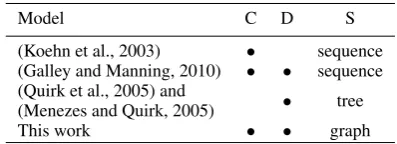
Model C D S
(Koehn et al., 2003) • sequence (Galley and Manning, 2010) • • sequence (Quirk et al., 2005) and • tree (Menezes and Quirk, 2005)
[image:1.595.316.515.221.293.2]This work • • graph
Table 1: Comparison between our work and pre-vious work in terms of three aspects: keeping continuous phrases (C), allowing discontinuous phrases (D), and input structures (S).
However, the expressiveness of these models is confined by hierarchical constraints of the gram-mars used (Galley and Manning, 2010) since these patterns still cover continuous spans of an input sentence.
By contrast, Quirk et al. (2005), Menezes and Quirk (2005) and Xiong et al. (2007) take treelets from dependency trees as the basic translation units. These treelets are connected and may cover discontinuous phrases. However, their mod-els lack the ability to handle continuous phrases which are not connected in trees but could in fact be extremely important to system performance (Koehn et al., 2003). Galley and Manning (2010) directly extract discontinuous phrases from input sequences. However, without imposing additional restrictions on discontinuity, the amount of ex-tracted rules can be very large and unreliable.
Different from previous work (as shown in Ta-ble 1), in this paper we use graphs as input struc-tures and propose a graph-based translation model to translate a graph into a target string. The ba-sic translation unit in this model is a connected subgraph which may cover discontinuous phrases. The main contributions of this work are summa-rized as follows:
• We propose to use a graph structure to com-bine a sequence and a tree (Section 3.1). The
graph contains both local relations between words from the sequence and long-distance relations from the tree.
• We present a translation model to translate a graph (Section 3). The model segments the graph into subgraphs and uses beam search to generate a complete translation from left to right by combining translation options of each subgraph.
• We present a set of sparse features to explic-itly model the graph segmentation (Section 4). These features are based on edges in the input graph, each of which is either inside a subgraph or connects the subgraph with a previous subgraph.
• Experiments (Section 5) on Chinese–English and German–English tasks show that our model is significantly better than the PB model. After incorporating the segmentation model, our system achieves still further im-provement.
2 Review: Phrase-based Translation
We first review the basic PB translation approach, which will be extended to our graph-based trans-lation model. Given a pair of sentenceshS, Ti, the conventional PB model is defined as Equation (1):
p(tI1 |sI
1) =
I
Y
i=1
p(ti|sai)d(sai, sai−1) (1)
The target sentence T is broken into I phrases
t1· · ·tI, each of which is a translation of a source
phrasesai.dis a distance-based reordering model. Note that in the basic PB model, the phrase seg-mentation is not explicitly modeled which means that different segmentations are treated equally (Koehn, 2010).
The performance of PB translation relies on the quality of phrase pairs in a translation table. Con-ventionally, a phrase pair hs, ti has two proper-ties: (i)sandtare continuous phrases. (ii) hs, ti
is consistent with a word alignment A (Och and Ney, 2004): ∀(i, j) ∈ A, si ∈ s ⇔ tj ∈ t and ∃si∈s, tj ∈t,(i, j)∈A.
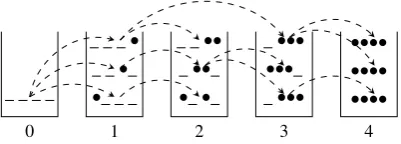
PB decoders generate hypotheses (partial trans-lations) from left to right. Each hypothesis main-tains a coverage vector to indicate which source words have been translated so far. A hypothe-sis can be extended on the right by translating an
0 1
• •
•
2 • •
•• ••
3 ••• •••
•••
[image:2.595.317.518.69.141.2]4 •••• •••• ••••
Figure 1: Beam search for phrase-based MT.• de-notes a covered source position while indicates an uncovered position (Liu and Huang, 2014).
uncovered source phrase. The translation process ends when all source words have been translated.
Beam search (as in Figure 1) is taken as an ap-proximate search strategy to reduce the size of the decoding space. Hypotheses which cover the same number of source words are grouped in a stack. Hypotheses can be pruned according to their par-tial translation cost and an estimated future cost.
3 Graph-Based Translation
Our graph-based translation model extends PB translation by translating an input graph rather than a sequence to a target string. The graph is seg-mented into a sequence of connected subgraphs, each of which corresponds to a target phrase, as in Equation (2):
(2)
p(tI1 |G(˜sI1)) =YI
i=1
p(ti|G(˜sai))d(G(˜sai), G(˜sai−1))
≈YI i=1
p(ti|G(˜sai))d(˜sai,˜sai−1)
whereG(˜si)denotes a connected source subgraph
which covers a (discontinuous) phrases˜i.
3.1 Building Graphs
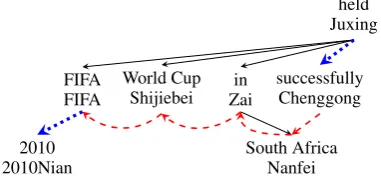
As a more powerful and natural structure for sen-tence modeling, a graph can model various kinds of word-relations together in a unified represen-tation. In this paper, we use graphs to combine two commonly used relations: bigram relations and dependency relations. Figure 2 shows an ex-ample of a graph. Each edge in the graph denotes either a dependency relation or a bigram relation. Note that the graph we use in this paper is directed, connected, node-labeled and may contain cycles.
2010 2010Nian
FIFA
FIFA World CupShijiebei Zaiin
South Africa Nanfei
[image:3.595.86.277.67.157.2]successfully Chenggong held Juxing
Figure 2: An example graph for a Chinese sen-tence. Each node includes a Chinese word and its English meaning. Dashed red lines are bigram re-lations. Solid lines are dependency rere-lations. Dot-ted blue lines are shared by bigram and depen-dency relations.
of continuous words. Phrases connected by bi-gram relations (i.e. continuous phrases) are known to be useful to improve phrase coverage (Hanne-man and Lavie, 2009). By contrast, dependency relations come from dependency structures which model syntactic and semantic relations between words. Phrases whose words are connected by dependency relations (also known as treelets) are linguistic-motivated and thus more reliable (Quirk et al., 2005).
By combining these two relations together in graphs, we can make use of both continuous and linguistic-informed discontinuous phrases as long as they are connected subgraphs.
3.2 Training
Different from PB translation, the basic translation units in our model are subgraphs. Thus, during training, we extract subgraph–phrase pairs instead of phrase pairs on parallel graph–string sentences associated with word alignments.1 An example of
a translation rule is as follows:
FIFA Shijiebei Juxing FIFA World Cup was held
Note that the source side of a rule in our model is a graph which can be used to cover either a continu-ous phrase or a discontinucontinu-ous phrase according to its match in an input graph during decoding.
The algorithm for extracting translation rules is shown in Algorithm 1. This algorithm traverses each phrase pair hs, ti˜ , which is within a length limit and consistent with a given word alignment 1Different from translation rules in conventional syntax-based MT, rules in our model are not learned syntax-based on syn-chronous grammars and so non-terminals are disallowed.
Algorithm 1:Algorithm for extracting trans-lation rules from a graph-string pair.
Data: A word-aligned graph–string pair (G(S), T, A)
Result: A set of translation pairsR
1 foreach phrasetinT:|t|≤Ldo
2 find the minimal (may be discontinuous)
phrases˜inSso that|s˜|≤Landh˜s, tiis consistent withA;
3 QueueQ={s}˜ ; 4 whileQis not emptydo 5 pop an element˜soff; 6 ifG(˜s)is connectedthen
7 addhG(˜s), titoR;
8 end
9 if|˜s|< Lthen
10 foreach unaligned wordsi
adjacent tos˜do
11 s˜0= extend˜swithsi;
12 add˜s0 toQ;
13 end
14 end
15 end
16 end
(lines 1–2), and outputshG(˜s), tiifs˜is covered by a connected subgraphG(˜s)(lines 6–8). A source phrase can be extended with unaligned source words which are adjacent to the phrase (lines 9– 14). We use a queueQto store all phrases which are consistently aligned to the same target phrase (line 3).
3.3 Model and Decoding
We define our model in the log-linear framework (Och and Ney, 2002) over a derivation D =
r1r2· · ·rN, as in Equation (3): p(D)∝Y
i
φi(D)λi (3)
whereri are translation rules,φi are features
de-fined on derivations and λi are feature weights.
In our experiments, we use the standard 9 fea-tures: two translation probabilitiesp(G(s)|t) and
p(t|G(s)), two lexical translation probabilities
plex(s|t) and plex(t|s), a language model lm(t)
over a translationt, a rule penalty, a word penalty, an unknown word penalty and a distortion feature
dfor distance-based reordering.
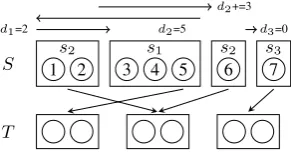
S 1 2s2 3 4 5s1 s62 s73
T
d1=2 d2=5
d2+=3
[image:4.595.305.527.62.125.2]d3=0
Figure 3: Distortion calculation for both continu-ous and discontinucontinu-ous phrases in a derivation.
.
model is different from the one used in conven-tional PB models, as we need to take disconti-nuity into consideration. In this paper, we use a distortion function defined in Galley and Manning (2010) to penalize discontinuous phrases that have relatively long gaps. Figure 3 shows an example of calculating distortion for discontinuous phrases.
Our graph-based decoder is very similar to the PB decoder except that, in our decoder, each hy-pothesis is extended by translating an uncovered subgraph instead of a phrase. Positions covered by the subgraph are then marked as translated.
4 Graph Segmentation Model
Each derivation in our graph-based translation model implies a sequence of subgraphs (also called a segmentation). By default, similar to PB translation, our model treats each segmenta-tion equally as shown in Equasegmenta-tion (2). However, previous work on PB translation has suggested that such segmentations provide useful informa-tion which can improve translainforma-tion performance. For example, boundary information in a phrase segmentation can be used for reordering models (Xiong et al., 2006; Cherry, 2013).
In this paper, we are interested in directly mod-eling the segmentation using information from graphs. By making the assumption that each sub-graph is only dependent on previous subsub-graphs, we define a generative process over a graph seg-mentation as in Equation (4):
(4)
p(G(˜s1)· · ·G(˜sI))
=YI
i=1
P(G(˜si)|G(˜s1)· · ·G(˜si−1))
Instead of training a stand-alone discriminative segmentation model to assign each subgraph a probability given previous subgraphs, we imple-ment the model via sparse features, each of which is extracted at run-time during decoding and then
ZH–EN #Sents
Train 1.5M+
MT02 (Dev) 878
MT04 1,597
MT05 1,082
DE–EN #Sents
Train 2M+
WMT11 (Dev) 3,003
WMT12 3,003
[image:4.595.109.255.65.142.2]WMT13 3,000
Table 2: The number of sentences in our corpora.
directly added to the log-linear framework, so that these features can be tuned jointly with other fea-tures (of Section 3.3) to directly maximize the translation quality.
Since a segmentation is obtained by breaking up the connectivity of an input graph, it is intuitive to use edges to model the segmentation. Accord-ing to Equation (4), for a current subgraphGi, we
only consider those edges which are either inside
Gior connectGiwith a previous subgraph. Based
on these edges, we extract sparse features for each node in the subgraph. The set of sparse features is defined as follows:
n.w n.c
×
n0.w
n0.c
×
C P H
×
in out
wheren.w andn.c are the word and class of the current node n, and n0.w and n0.c are the word
and class of a noden0 connected ton. C,P, and
H denote that the node n0 is in the current
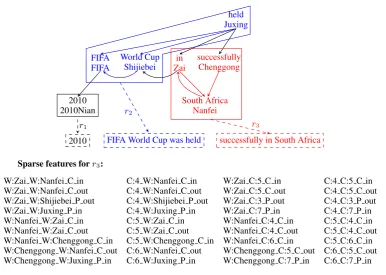
sub-graphGi or the adjacent previous subgraphGi−1 or other previous subgraphs, respectively. Note that we treat the adjacent previous subgraph differ-ently from others since information from the last previous unit is quite useful (Xiong et al., 2006; Cherry, 2013). inandoutdenote that the edge is an incoming edge or outgoing edge for the current noden. Figure 4 shows an example of extracting sparse features for a subgraph.
Inspired by success in using sparse features in SMT (Cherry, 2013), in this paper we lexicalize only on the top-100 most frequent words. In ad-dition, we group source words into 50 classes by usingmkclswhich should provide useful general-ization (Cherry, 2013) for our model.
5 Experiment
2010 2010Nian
FIFA
FIFA World CupShijiebei Zaiin
South Africa Nanfei
successfully Chenggong
held Juxing
2010 FIFA World Cup was held successfully in South Africa
r1
r2
r3
Sparse features forr3: W:Zai W:Nanfei C in W:Zai W:Nanfei C out W:Zai W:Shijiebei P out W:Zai W:Juxing P in W:Nanfei W:Zai C in W:Nanfei W:Zai C out W:Nanfei W:Chenggong C in W:Chenggong W:Nanfei C out W:Chenggong W:Juxing P in
C:4 W:Nanfei C in C:4 W:Nanfei C out C:4 W:Shijiebei P out C:4 W:Juxing P in C:5 W:Zai C in C:5 W:Zai C out C:5 W:Chenggong C in C:6 W:Nanfei C out C:6 W:Juxing P in
W:Zai C:5 C in W:Zai C:5 C out W:Zai C:3 P out W:Zai C:7 P in W:Nanfei C:4 C in W:Nanfei C:4 C out W:Nanfei C:6 C in W:Chenggong C:5 C out W:Chenggong C:7 P in
[image:5.595.108.495.57.332.2]C:4 C:5 C in C:4 C:5 C out C:4 C:3 P out C:4 C:7 P in C:5 C:4 C in C:5 C:4 C out C:5 C:6 C in C:6 C:5 C out C:6 C:7 P in
Figure 4: An illustration of extracting sparse features for each node in a subgraph during decoding. The decoder segments the graph in Figure 2 into three subgraphs (solid rectangles) and produces a complete translation by combining translations of each subgraph (dashed rectangles). In this figure, the class of a word is randomly assigned.
2004 (MT04) and NIST 2005 (MT05) are two test sets used to evaluate the systems. The Stanford Chinese word segmenter (Chang et al., 2008) is used to segment Chinese sentences. The Stan-ford dependency parser (Chang et al., 2009) parses a Chinese sentence into a projective dependency tree which is then converted to a graph by adding bigram relations.
The DE–EN training corpus is from WMT 2014, including Europarl V7 and News Commen-tary. News-Test 2011 (WMT11) is taken as a de-velopment set while News-Test 2012 (WMT12) and News-Test 2013 (WMT13) are test sets. We use mate-tools2 to perform morphological
analy-sis and parse German sentences (Bohnet, 2010). Then, MaltParser3 converts a parse result into a
projective dependency tree (Nivre and Nilsson, 2005).
5.1 Settings
In this paper, we mainly report results from five systems under the same configuration. PBMTis built by the PB model in Moses (Koehn et al., 2http://code.google.com/p/mate-tools/ 3http://www.maltparser.org/
2007). Treelet extends PBMT by taking treelets as the basic translation units (Quirk et al., 2005; Menezes and Quirk, 2005). We implement a Treelet model in Moses which produces transla-tions from left to right and uses beam search for decoding. DTUextends the PB model by allow-ing discontinuous phrases (Galley and Mannallow-ing, 2010). We implement DTU with source disconti-nuity in Moses.4 GBMTis our basic graph-based
translation system whileGSMadds the graph seg-mentation model into GBMT. Both systems are implemented in Moses.
Word alignment is performed by GIZA++ (Och and Ney, 2003) with the heuristic function grow-diag-final-and. We use SRILM (Stolcke, 2002) to train a 5-gram language model on the Xinhua portion of the English Gigaword corpus 5th edi-tion with modified Kneser-Ney discounting (Chen and Goodman, 1996). Batch MIRA (Cherry and Foster, 2012) is used to tune weights. BLEU (Pa-pineni et al., 2002), METEOR (Denkowski and Lavie, 2011), and TER (Snover et al., 2006) are used for evaluation.
Metric System MT04ZH–ENMT05 WMT12DE–ENWMT13
BLEU↑
PBMT 33.2 31.8 19.5 21.9
Treelet 33.8∗ 31.7 19.6 22.1∗
DTU 34.5∗ 32.3∗ 19.8∗ 22.3∗
GBMT 34.7∗ 32.4∗ 19.8∗ 22.4∗
GSM 34.9∗+ 32.7∗+ 20.3∗+ 22.9∗+
METEOR↑
PBMT 32.1 32.3 28.0 29.2
Treelet 31.9 31.8 28.0 29.1 DTU 32.3∗ 32.4 28.2∗ 29.5∗
GBMT 32.4∗+ 32.5∗ 28.2∗ 29.4∗
GSM 32.7∗+ 32.6∗+ 28.5∗+ 29.8∗+
TER↓
PBMT 60.6 61.6 63.7 60.2
Treelet 60.1∗ 61.4 63.2∗ 59.6∗
DTU 60.0∗ 61.5 63.5∗ 59.8∗
GBMT 59.8∗+ 61.3∗ 63.5∗ 59.8∗
[image:6.595.171.430.62.252.2]GSM 60.5 62.1 63.1∗+ 59.3∗+
Table 3: Metric scores for all systems on Chinese–English (ZH–EN) and German–English (DE–EN). Each score is an average over three MIRA runs (Clark et al., 2011). ∗means a system is significantly better than PBMT atp≤0.01. Bold figures mean a system is significantly better than Treelet atp≤0.01. +means a system is significantly better than DTU at p ≤ 0.01. In this table, we mark a system by comparing it with previous ones.
5.2 Results and Discussion
Table 3 shows our evaluation results. We find that our GBMT system is significantly better than PBMT as measured by all three metrics across all test sets. Specifically, the improvements are up to +1.5/+0.5 BLEU, +0.3/+0.2 METEOR, and -0.8/-0.4 TER on ZH–EN and DE–EN, respectively. This improvement is reasonable as our system al-lows discontinuous phrases which can reduce data sparsity and handle long-distance relations (Gal-ley and Manning, 2010). Another argument for discontinuous phrases is that they allow the de-coder to use larger translation units which tend to produce better translations (Galley and Manning, 2010). However, this argument was only verified on ZH–EN. Therefore, we are interested in seeing whether we have the same observation in our ex-periments on both language pairs.
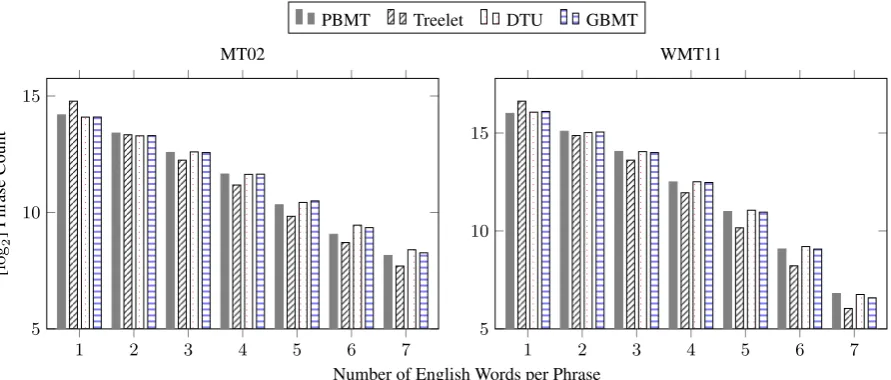
We count the used translation rules in MT02 and WMT11 based on different target lengths. The re-sults are shown in Figure 5. We find that both DTU and GBMT indeed tend to use larger translation units on ZH–EN. However, more smaller transla-tion units are used on DE–EN.5 We presume this
is because long-distance reordering is performed more often on ZH–EN than on DE–EN. Based on the fact that the distortion functiondmeasures the reordering distance, we find that the average dis-tortion value in PB on ZH–EN MT02 is 18.4 and
5We have the same finding on all test sets.
System ZH–EN# RulesDE–EN
DTU 224M+ 352M+
[image:6.595.358.477.345.399.2]GBMT 99M+ 153M+
Table 4: The number of rules in DTU and GBMT.
3.5 on DE–EN WMT11. Our observations suggest that the argument that discontinuous phrases allow decoders to use larger translation units should be considered with caution when we explain the ben-efit of discontinuity on different language pairs.
Compared to PBMT, the Treelet system does not show consistent improvements. Our system achieves significantly better BLEU and METEOR scores than Treelet on both ZH–EN and DE–EN, and a better TER score on DE–EN. This suggests that continuous phrases are essential for system ro-bustness since it helps to improve phrase coverage (Hanneman and Lavie, 2009). Lower phrase cov-erage in Treelet results in more short phrases be-ing used, as shown in Figure 5. In addition, we find that both DTU and our systems do not achieve consistent improvements over Treelet in terms of TER. We observed that both DTU and our systems tend to produce longer translations than Treelet, which might cause unreliable TER evaluation in our experiments as TER favours shorter sentences (He and Way, 2010).
1 2 3 4 5 6 7 5
10 15
MT02
1 2 3 4 5 6 7
5 10 15
WMT11
[
log
2
]Phrase
Count
Number of English Words per Phrase
[image:7.595.80.526.62.252.2]PBMT Treelet DTU GBMT
Figure 5: Phrase Length Histogram for MT02 and WMT11.
more reliable (Koehn et al., 2003), our GBMT sys-tem achieves comparable performance with DTU but uses significantly fewer rules, as shown in Ta-ble 4. After integrating the graph segmentation model to help subgraph selection, GBMT is fur-ther improved and the resulted system G2S has significantly better evaluation scores than DTU on both language pairs. However, our segmenta-tion model is more helpful on DE–EN than ZH– EN. We find that the number of features learned on ZH–EN (25K+) is much less than on DE–EN (49K+). This may result in a lower feature cov-erage during decoding. The lower number of fea-tures in ZH–EN could be caused by the fact that the development set MT02 has many fewer sen-tences than WMT11. Accordingly, we suggest to use a larger development set during tuning to achieve better translation performance when the segmentation model is integrated.
Our current model is more akin to addressing problems in phrase-based and treelet-based mod-els by segmenting graphs into pieces rather than extracting a recursive grammar. Therefore, simi-lar to those models, our model is weak at phrase reordering as well. However, we are interesting in the potential power of our model by incorporating lexical reordering (LR) models and comparing it with syntax-based models.
Table 5 shows BLEU scores of the hierarchi-cal phrase-based (HPB) system (Chiang, 2005) in Moses6and GBMT combined with a word-based
6For a fairer comparison, we disallow target discontinuity in HPB rules. This means that a non-terminal on the target side is either the first symbol or the last symbol.
System MT04ZH–ENMT05 WMT12DE–ENWMT13
GBMT+LR 36.0 33.9 20.6 23.6
HPB 36.1 34.1 20.3 22.8
Table 5: BLEU scores of a Moses hierarchi-cal phrase-based system (HPB) and our system (GBMT) with a word-based lexical reordering model (LR).
LR model (Koehn et al., 2005). We find that the LR model significantly improves our system. GBMT+LR is comparable with the Moses HPB model on Chinese–English and better than HPB on German–English.
5.3 Examples
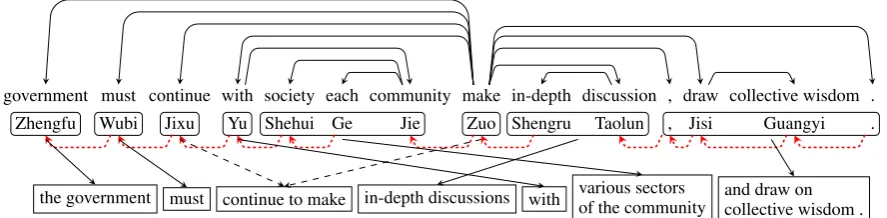
Figure 6 shows three examples from MT04 to bet-ter explain the differences of each system. Exam-ple 1 shows that systems which allow discontin-uous phrases (namely Treelet, DTU, GBMT, and GSM) successfully translate a Chinese colloca-tion “Yu . . . Wuguan” to “have nothing to do with” while PBMT fails to catch the generalization since it only allows continuous phrases.
Example 1 PBMT: the united states has indicated that the united states and north korea dele-gation has visited
Treelet: the united states has indicated that it has nothing to do with the us del-egation visited the north korea
DTU: the united states has indicated that it has nothing to do with the us dele-gation visited north korea
GBMT: the united states has indicated that it has nothing to do with the us dele-gation visited north korea
GSM: the united states has indicated that it has nothing to do with the us dele-gation visited north korea
REF: the american government said that it has nothing to do with the american delegation to visit north korea
american government said with visit north korea of american delegation no tie Meiguo Zhengfu Biaoshi Yu Zoufang BeiHan De Meiguo Daibiaotuan Wuguan
the united states has indicated that it has nothing to do with the us delegation visited north korea
Example 2 PBMT: the united states government to brazil has repeatedly expressed its dissatis-faction .
Treelet: the govern-ment of brazil to the united states has on many occasions ex-pressed their discon-tent .
DTU: the united states has repeat-edly expressed its dissatisfaction with the approach of the government to brazil .
GBMT: the us gov-ernment has repeat-edly expressed dis-satisfaction with the practice of brazil .
GSM: the us govern-ment has repeatedly expressed dissatisfac-tion with the practice of brazil .
REF: the us government has expressed their resentment against this practice of brazil on many occasions .
US government to Brazil of practice already many times express dissatisfaction .
Meiguo Zhengfu Dui Baxi De Zuofa Yijing Duo Ci Biaoshi Buman .
the us government has repeatedly expressed dissatisfaction with the practice of brazil .
Example 3 PBMT: the govern-ment and all sectors of society should continue to explore in depth and draw on collective wisdom .
Treelet: the govern-ment must continue to make in-depth dis-cussions with various sectors of the com-munity and the col-lective wisdom .
DTU: the govern-ment must continue to work together with various sectors of the community to make an in-depth study and draw on collective wisdom .
GBMT: the govern-ment must continue to work together with various sectors of the community in-depth study and draw on collective wisdom .
GSM: the govern-ment must continue to make in-depth dis-cussions with various sectors of the com-munity and draw on collective wisdom .
REF: the government must continue to hold thorough discussions with all walks of life to pool the wisdom of the masses .
government must continue with society each community make in-depth discussion , draw collective wisdom . Zhengfu Wubi Jixu Yu Shehui Ge Jie Zuo Shengru Taolun , Jisi Guangyi .
[image:8.595.79.523.598.707.2]the government must continue to make in-depth discussions with various sectorsof the community and draw oncollective wisdom .
linguistically motivated and could be unreliable. By disallowing phrases which are not connected in the input graph, GBMT and GSM produce bet-ter translations.
Example 3 illustrates that our graph segmenta-tion model helps to select better subgraphs. Af-ter obtaining a partial translation “the government must”, GSM chooses to translate a subgraph which covers a discontinuous phrase “Jixu . . . Zuo” to “continue to make” while GBMT translates “Jixu Yu” (continue . . . with) to “continue to work to-gether with”. By selecting the proper subgraph to translate, GSM performs a better reordering on the translation.
6 Related Work
Starting from sequence-based models, SMT has been benefiting increasingly from complex struc-tures.
Sequence-based MT: Since the breakthrough made by IBM on word-based models in the 1990s (Brown et al., 1993), SMT has developed rapidly. The PB model (Koehn et al., 2003) advanced the state-of-the-art by translating multi-word units, which makes it better able to capture local phe-nomena. However, a major drawback in PBMT is that only continuous phrases are considered. Galley and Manning (2010) extend PBMT by al-lowing discontinuity. However, without linguis-tic structure information such as syntax trees, sequence-based models can learn a large amount of phrases which may be unreliable.
Tree-based MT: Compared to sequences, trees provide recursive structures over sentences and can handle long-distance relations. Typically, trees used in SMT are either phrasal structures (Galley et al., 2004; Liu et al., 2006; Marcu et al., 2006) or dependency structures (Menezes and Quirk, 2005; Xiong et al., 2007; Xie et al., 2011; Li et al., 2014). However, conventional tree-based models only use linguistically well-formed phrases. Although they are more reliable in the-ory, discarding all phrase pairs which are not lin-guistically motivated is an overly harsh decision. Therefore, exploring more translation rules usu-ally can significantly improve translation perfor-mance (Marcu et al., 2006; DeNeefe et al., 2007; Wang et al., 2007; Mi et al., 2008).
Graph-based MT: Compared to sequences and trees, graphs are more general and can represent more relations between words. In recent years,
graphs have been drawing quite a lot of attention from researchers. Jones et al. (2012) propose a hypergraph-based translation model where hyper-graphs are taken as a meaning representation of sentences. However, large corpora with annotated hypergraphs are not readily available for MT. Li et al. (2015) use an edge replacement grammar to translate dependency graphs which are converted from dependency trees by labeling edges. How-ever, their model only focuses on subgraphs which cover continuous phrases.
7 Conclusion
In this paper, we extend the conventional phrase-based translation model by allowing discontinuous phrases. We use graphs which combine bigram and dependency relations together as inputs and present a graph-based translation model. Exper-iments on Chinese–English and German–English show our model to be significantly better than the phrase-based model as well as other more sophisti-cated models. In addition, we present a graph seg-mentation model to explicitly guide the selection of subgraphs. In experiments, this model further improves our system.
In the future, we will extend this model to allow discontinuity on target sides and explore the possi-bility of directly encoding reordering information in translation rules. We are also interested in using graphs for neural machine translation to see how it can translate and benefit from graphs.
Acknowledgments
This research has received funding from the Peo-ple Programme (Marie Curie Actions) of the Euro-pean Union’s Framework Programme (FP7/2007-2013) under REA grant agreement no 317471
and the European Union’s Horizon 2020 research and innovation programme under grant agreement no 645452 (QT21). The ADAPT Centre for
Dig-ital Content Technology is funded under the SFI Research Centres Programme (Grant 13/RC/2106) and is co-funded under the European Regional De-velopment Fund. The authors thank all anony-mous reviewers for their insightful comments and suggestions.
References
Computational Linguistics, pages 89–97, Beijing, China, August.
Peter F Brown, Vincent J Della Pietra, Stephen A Della Pietra, and Robert L Mercer. 1993. The Mathe-matics of Statistical Machine Translation: Parameter Estimation. Computational Linguistics, 19(2):263– 311.
Pi-Chuan Chang, Michel Galley, and Christopher D. Manning. 2008. Optimizing Chinese Word Seg-mentation for Machine Translation Performance. In
Proceedings of the Third Workshop on Statistical Machine Translation, pages 224–232, Columbus, Ohio, June.
Pi-Chuan Chang, Huihsin Tseng, Dan Jurafsky, and Christopher D. Manning. 2009. Discriminative Re-ordering with Chinese Grammatical Relations Fea-tures. InProceedings of the Third Workshop on Syn-tax and Structure in Statistical Translation, pages 51–59, Boulder, Colorado, June.
Stanley F. Chen and Joshua Goodman. 1996. An Empirical Study of Smoothing Techniques for Lan-guage Modeling. InProceedings of the 34th Annual Meeting on Association for Computational Linguis-tics, ACL ’96, pages 310–318, Santa Cruz, Califor-nia, June.
Colin Cherry and George Foster. 2012. Batch Tun-ing Strategies for Statistical Machine Translation. In
Proceedings of the 2012 Conference of the North American Chapter of the Association for Computa-tional Linguistics: Human Language Technologies, pages 427–436, Montreal, Canada, June.
Colin Cherry. 2013. Improved Reordering for Phrase-Based Translation using Sparse Features. In Pro-ceedings of the 2013 Conference of the North Amer-ican Chapter of the Association for Computational Linguistics: Human Language Technologies, pages 22–31, Atlanta, Georgia, June.
David Chiang. 2005. A Hierarchical Phrase-based Model for Statistical Machine Translation. In Pro-ceedings of the 43rd Annual Meeting on Association for Computational Linguistics, pages 263–270, Ann Arbor, Michigan, June.
Jonathan H. Clark, Chris Dyer, Alon Lavie, and Noah A. Smith. 2011. Better Hypothesis Testing for Statistical Machine Translation: Controlling for Op-timizer Instability. In Proceedings of the 49th An-nual Meeting of the Association for Computational Linguistics: Human Language Technologies: Short Papers - Volume 2, pages 176–181, Portland, Ore-gon, June.
Steve DeNeefe, Kevin Knight, Wei Wang, and Daniel Marcu. 2007. What Can Syntax-Based MT Learn from Phrase-Based MT? InProceedings of the 2007 Joint Conference on Empirical Methods in Natural Language Processing and Computational Natural Language Learning (EMNLP-CoNLL), pages 755– 763, Prague, Czech Republic, June.
Michael Denkowski and Alon Lavie. 2011. Me-teor 1.3: Automatic Metric for Reliable Optimiza-tion and EvaluaOptimiza-tion of Machine TranslaOptimiza-tion Sys-tems. In Proceedings of the Sixth Workshop on Statistical Machine Translation, pages 85–91, Ed-inburgh, Scotland, July.
Michel Galley and Christopher D. Manning. 2010. Accurate Non-hierarchical Phrase-Based Transla-tion. InHuman Language Technologies: The 2010 Annual Conference of the North American Chap-ter of the Association for Computational Linguistics, pages 966–974, Los Angeles, California, June. Michel Galley, Mark Hopkins, Kevin Knight, and
Daniel Marcu. 2004. What’s in a Translation Rule? InProceedings of the Human Language Technology Conference of the North American Chapter of the Association for Computational Linguistics: HLT-NAACL 2004, page 273280, Boston, Massachusetts, USA, May.
Greg Hanneman and Alon Lavie. 2009. Decoding with Syntactic and Non-syntactic Phrases in a Syntax-based Machine Translation System. In Proceed-ings of the Third Workshop on Syntax and Structure in Statistical Translation, pages 1–9, Boulder, Col-orado, June.
Yifan He and Andy Way. 2010. Metric and refer-ence factors in minimum error rate training. Ma-chine Translation, 24(1):27–38.
Bevan Jones, Jacob Andreas, Daniel Bauer, Karl Moritz Hermann, and Kevin Knight. 2012. Semantics-Based Machine Translation with Hyper-edge Replacement Grammars. In COLING 2012, 24th International Conference on Computational Linguistics, Proceedings of the Conference: Tech-nical Papers, pages 1359–1376, Mumbai, India, December.
Philipp Koehn, Franz Josef Och, and Daniel Marcu. 2003. Statistical Phrase-Based Translation. In Pro-ceedings of the 2003 Conference of the North Amer-ican Chapter of the Association for Computational Linguistics on Human Language Technology - Vol-ume 1, pages 48–54, Edmonton, Canada, July. Philipp Koehn, Amittai Axelrod, Alexandra Birch,
Chris Callison-Burch, Miles Osborne, and David Talbot. 2005. Edinburgh System Description for the 2005 IWSLT Speech Translation Evaluation. In
Proceedings of the International Workshop on Spo-ken Language Translation 2005, pages 68–75, Pitts-burgh, PA, USA, October.
Sessions, pages 177–180, Prague, Czech Republic, June.
Philipp Koehn. 2010.Statistical Machine Translation. Cambridge University Press, New York, NY, USA, 1st edition.
Liangyou Li, Jun Xie, Andy Way, and Qun Liu. 2014. Transformation and Decomposition for Efficiently Implementing and Improving Dependency-to-String Model In Moses. InProceedings of SSST-8, Eighth Workshop on Syntax, Semantics and Structure in Statistical Translation, October.
Liangyou Li, Andy Way, and Qun Liu. 2015. De-pendency Graph-to-String Translation. In Proceed-ings of the 2015 Conference on Empirical Methods in Natural Language Processing, Lisbon, Portugal, September.
Lemao Liu and Liang Huang. 2014. Search-Aware Tuning for Machine Translation. InProceedings of the 2014 Conference on Empirical Methods in Nat-ural Language Processing (EMNLP), pages 1942– 1952, Doha, Qatar, October.
Yang Liu, Qun Liu, and Shouxun Lin. 2006. Tree-to-string Alignment Template for Statistical Ma-chine Translation. InProceedings of the 21st Inter-national Conference on Computational Linguistics and the 44th Annual Meeting of the Association for Computational Linguistics, pages 609–616, Sydney, Australia, July.
Daniel Marcu, Wei Wang, Abdessamad Echihabi, and Kevin Knight. 2006. SPMT: Statistical Ma-chine Translation with Syntactified Target Language Phrases. InProceedings of the 2006 Conference on Empirical Methods in Natural Language Process-ing, pages 44–52, Sydney, Australia.
Arul Menezes and Chris Quirk. 2005. Dependency Treelet Translation: The Convergence of Statistical and Example-Based Machine-translation? In Pro-ceedings of the Workshop on Example-based Ma-chine Translation at MT Summit X, September. Haitao Mi, Liang Huang, and Qun Liu. 2008.
Forest-Based Translation. In Proceedings of the 46th An-nual Meeting of the Association for Computational Linguistics: Human Language Technologies, pages 192–199, Columbus, Ohio, USA, June.
Joakim Nivre and Jens Nilsson. 2005. Pseudo-Projective Dependency Parsing. In Proceedings of the 43rd Annual Meeting on Association for Com-putational Linguistics, pages 99–106, Ann Arbor, Michigan, June.
Franz Josef Och and Hermann Ney. 2002. Discrimina-tive Training and Maximum Entropy Models for Sta-tistical Machine Translation. InProceedings of the 40th Annual Meeting on Association for Computa-tional Linguistics, pages 295–302, Philadelphia, PA, USA, July.
Franz Josef Och and Hermann Ney. 2003. A System-atic Comparison of Various Statistical Alignment Models. Computational Linguistics, 29(1):19–51, March.
Franz Josef Och and Hermann Ney. 2004. The Align-ment Template Approach to Statistical Machine Translation. Computational Linguistics, 30(4):417– 449, December.
Kishore Papineni, Salim Roukos, Todd Ward, and Wei-Jing Zhu. 2002. BLEU: A Method for Automatic Evaluation of Machine Translation. InProceedings of the 40th Annual Meeting on Association for Com-putational Linguistics, pages 311–318, Philadelphia, Pennsylvania, July.
Chris Quirk, Arul Menezes, and Colin Cherry. 2005. Dependency Treelet Translation: Syntactically In-formed Phrasal SMT. In Proceedings of the 43rd Annual Meeting of the Association for Computa-tional Linguistics (ACL’05), pages 271–279, Ann Arbor, Michigan, June.
M. Snover, B. Dorr, R. Schwartz, L. Micciulla, and J. Makhoul. 2006. A Study of Translation Edit Rate with Targeted Human Annotation. InProceedings of Association for Machine Translation in the Amer-icas, pages 223–231, Cambridge, Massachusetts, USA, August.
Andreas Stolcke. 2002. SRILM An Extensible Lan-guage Modeling Toolkit. InProceedings of the In-ternational Conference Spoken Language Process-ing, pages 901–904, Denver, CO.
Wei Wang, Kevin Knight, and Daniel Marcu. 2007. Binarizing Syntax Trees to Improve Syntax-Based Machine Translation Accuracy. In Proceedings of the 2007 Joint Conference on Empirical Meth-ods in Natural Language Processing and Com-putational Natural Language Learning (EMNLP-CoNLL), pages 746–754, Prague, Czech Republic, June.
Jun Xie, Haitao Mi, and Qun Liu. 2011. A Novel Dependency-to-string Model for Statistical Machine Translation. In Proceedings of the Conference on Empirical Methods in Natural Language Process-ing, pages 216–226, Edinburgh, United Kingdom, July.
Deyi Xiong, Qun Liu, and Shouxun Lin. 2006. Max-imum Entropy Based Phrase Reordering Model for Statistical Machine Translation. In Proceedings of the 21st International Conference on Computational Linguistics and the 44th Annual Meeting of the As-sociation for Computational Linguistics, pages 521– 528, Sydney, Australia, July.