Learning Semantic Representations of Users and Products
for Document Level Sentiment Classification
Duyu Tang, Bing Qin∗, Ting Liu
Harbin Institute of Technology, Harbin, China
{dytang, qinb, tliu}@ir.hit.edu.cn
Abstract
Neural network methods have achieved promising results for sentiment classifica-tion of text. However, these models on-ly use semantics of texts, while ignoring users who express the sentiment and prod-ucts which are evaluated, both of which have great influences on interpreting the sentiment of text. In this paper, we ad-dress this issue by incorporating user- and product- level information into a neural network approach for document level sen-timent classification. Users and product-s are modeled uproduct-sing vector product-space mod-els, the representations of which capture important global clues such as individu-al preferences of users or overindividu-all quindividu-ali- quali-ties of products. Such global evidence in turn facilitates embedding learning pro-cedure at document level, yielding better text representations. By combining ev-idence at user-, product- and document-level in a unified neural framework, the proposed model achieves state-of-the-art performances on IMDB and Yelp dataset-s1.
1 Introduction
Document-level sentiment classification is a fun-damental problem in the field of sentiment analy-sis and opinion mining (Pang and Lee, 2008; Liu, 2012). The task is to infer the sentiment polari-ty or intensipolari-ty (e.g. 1-5 or 1-10 stars on review sites) of a document. Dominating studies follow Pang et al. (2002; 2005) and regard this problem as a multi-class classification task. They usually
∗Corresponding author.
1The codes and datasets are available athttp://ir.
hit.edu.cn/˜dytang/
use machine learning algorithms, and build sen-timent classifier from documents with accompa-nying sentiment labels. Since the performance of a machine learner is heavily dependent on the choice of data representations (Domingos, 2012), many works focus on designing effective features (Pang et al., 2002; Qu et al., 2010; Kiritchenko et al., 2014) or learning discriminative features from data with neural networks (Socher et al., 2013; Kalchbrenner et al., 2014; Le and Mikolov, 2014). Despite the apparent success of neural network methods, they typically only use text information while ignoring the important influences of users and products. Let us take reviews with respect to 1-5 rating scales as an example. A critical user might write a review “it works great” and mark 4 stars, while a lenient user might give 5 stars even if he posts an (almost) identical review. In this case, user preference affects the sentiment rating of a re-view. Product quality also has an impact on review sentiment rating. Reviews towards high-quality products (e.g. Macbook) tend to receive higher ratings than those towards low-quality products. Therefore, it is feasible to leverage individual pref-erences of users and overall qualities of products to build a smarter sentiment classifier and achieve better performance2.
In this paper, we propose a new model dubbed User Product Neural Network (UPNN) to capture user- and product-level information for sentiment classification of documents (e.g. reviews). UPNN takes as input a variable-sized document as well as the user who writes the review and the product which is evaluated. It outputs sentiment polarity label of a document. Users and products are en-coded in continuous vector spaces, the representa-tions of which capture important global clues such
2One can manually design a small number of user and
product features (Gao et al., 2013). However, we argue that they are not effective enough to capture sophisticated seman-tics of users and products.
as user preferences and product qualities. These representations are further integrated with contin-uous text representation in a unified neural frame-work for sentiment classification.
We apply UPNN to three datasets derived from IMDB and Yelp Dataset Challenge. We compare to several neural network models including recur-sive neural networks (Socher et al., 2013), para-graph vector (Le and Mikolov, 2014), sentiment-specific word embedding (Tang et al., 2014b), and a state-of-the-art recommendation algorithm JMARS (Diao et al., 2014). Experimental results show that: (1) UPNN outperforms baseline meth-ods for sentiment classification of documents; (2) incorporating representations of users and prod-ucts significantly improves classification accuracy. The main contributions of this work are as follows:
• We present a new neural network method (UPNN) by leveraging users and products for document-level sentiment classification.
•We validate the influences of users and prod-ucts in terms of sentiment and text on massive IMDB and Yelp reviews.
•We report empirical results on three datasets, and show that UPNN outperforms state-of-the-art methods for sentiment classification.
2 Consistency Assumption Verification
We detail the effects of users and products in terms of sentiment (e.g. 1-5 rating stars) and text, and verify them on review datasets.
We argue that the influences of users and prod-ucts include the following four aspects.
•user-sentiment consistency. A user has spe-cific preference on providing sentiment ratings. Some users favor giving higher ratings like 5 stars and some users tend to give lower ratings. In oth-er words, sentiment ratings from the same usoth-er are more consistent than those from different users.
• product-sentiment consistency. Similar with user-sentiment consistency, a product also has its “preference” to receive different average ratings on account of its overall quality. Sentiment ratings towards the same product are more consis-tent than those towards different products.
•user-text consistency. A user likes to use per-sonalized sentiment words when expressing opin-ion polarity or intensity. For example, a strict user might use “good” to express an excellent attitude, but a lenient user may use “good” to evaluate an ordinary product.
Algorithm 1Consistency Assumption Testing Input: data X, number of users/products m, number of iterationsn
Output: meaSamek,meaDiffk,1≤k≤n fork= 1tondo
meaSamek= 0,meaSamek= 0 fori= 1tomdo
Samplexi, x+i , x−i fromX
meaSamek+=measure(xi, x+i )
meaDiffk +=measure(xi, x−i ) end for
meaSamek/=m,meaDiffk/=m end for
•product-text consistency. Similar with user-text consistency, a product also has a collection of product-specific words suited to evaluate it. For example, people prefer using “sleek” and “stable” to evaluate a smartphone, while like to use “ wire-less” and “mechanical” to evaluate a keyboard.
We test four consistency assumptions men-tioned above with the same testing criterion, which is formalized in Algorithm 1. For each consistency assumption, we test it forn= 50 iter-ations on each of IMDB, Yelp Dataset Challenge 2013 and 2014 datasets. Taking user-sentiment consistency as an example, in each iteration, we randomly select two reviews xi, x+i written by the same user ui, and a review x−i written by another randomly selected user. Afterwards, we calculate the measurements of (xi, x+i ) and
(xi, x−i ), and aggregate these statistics for m users. In user-sentiment assumption test, we use absolute rating difference ||ratinga −ratingb|| as the measurement between two reviews a and
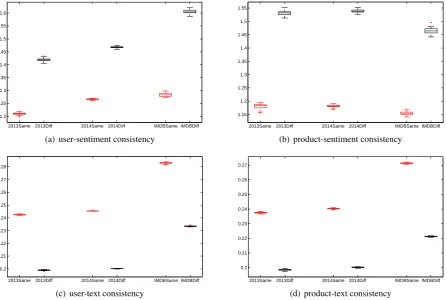
b. We illustrate the results in Figure 1 (a)3, where 2013same/2014same/amzsame (red plots) means that two reviews are written by a same user, and 2013diff/2014diff/amzdiff
(black plots) means that two reviews are written by different users. We can find that: the absolute rating differences between two reviews written by a same user are lower than those written by dif-ferent users (t-test with p-value<0.01). In other words, sentiment ratings from the same user are more consistent than those from different users. This validates the user-sentiment consistency.
For testing product-sentiment consistency, we
3Since the rating scale of IMDB (1-10) is different from
2013Same 2013Diff 2014Same 2014Diff IMDBSame IMDBDiff 1.2
1.25 1.3 1.35 1.4 1.45 1.5 1.55 1.6
(a) user-sentiment consistency
2013Same 2013Diff 2014Same 2014Diff IMDBSame IMDBDiff 1.15
1.2 1.25 1.3 1.35 1.4 1.45 1.5 1.55
(b) product-sentiment consistency
2013Same 2013Diff 2014Same 2014Diff IMDBSame IMDBDiff 0.2
0.21 0.22 0.23 0.24 0.25 0.26 0.27 0.28
(c) user-text consistency
2013Same 2013Diff 2014Same 2014Diff IMDBSame IMDBDiff 0.2
0.21 0.22 0.23 0.24 0.25 0.26 0.27
[image:3.595.78.526.62.362.2](d) product-text consistency
Figure 1: Assumption testing of user-sentiment, product-sentiment, user-text and product-text consisten-cies. We test them on the datasets from IMDB and Yelp Dataset Challenge in 2013 and 2014.
use absolute rating difference as the measuremen-t. The reviewsxi,x+i are towards a same product
pi, and x−i is towards another randomly selected product. From Figure 1 (b), we can see that sen-timent ratings towards the same product are more consistent than those towards different products. In order to verify the assumptions of user-text and product-text consistencies, we use cosine similar-ity between bag-of-words of two reviews as the measurement. Results are given in Figure 1 (c) and (d). We can see that the textual similarity between two reviews written by a same user (or towards a same product) are higher than those written by d-ifferent users (or towards dd-ifferent products).
3 User Product Neural Network (UPNN) for Sentiment Classification
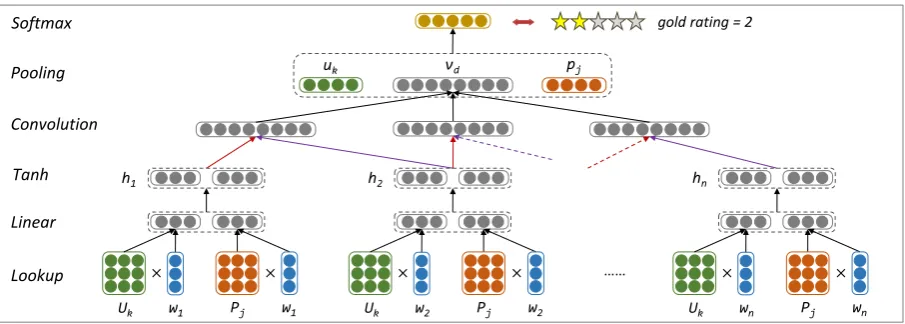
We present the details of User Product Neural Net-work (UPNN) for sentiment classification. An il-lustration of UPNN is given in Figure 2. It takes as input a review, the user who posts the review, and the product which is evaluated. UPNN cap-tures four kinds of consistencies which are veri-fied in Section 2. It outputs the sentiment category
(e.g. 1-5 stars) of a review by considering not only the semantics of review text, but also the informa-tion of user and product. In following subsecinforma-tion- subsection-s, we first describe the use of neural network for modeling semantics of variable-sized documents. We then present the methods for incorporating us-er and product information, followed by the use of UPNN in a supervised learning framework for sentiment classification.
3.1 Modeling Semantics of Document
We model the semantics of documents based on the principle of compositionality (Frege, 1892), which states that the meaning of a longer expres-sion (e.g. a sentence or a document) comes from the meanings of its words and the rules used to combine them. Since a document consists of a list of sentences and each sentence is made up of a list of words, we model the semantic representation of a document in two stages. We first produce con-tinuous vector of each sentence from word repre-sentations. Afterwards, we feed sentence vectors as inputs to compose document representation.
continu-Softmax gold rating = 2
w1 h1
Uk Pj
h2 hn
Lookup Linear
……
Convolution
Pooling uk vd pj
Tanh
w1
× ×
w2
Uk Pj w2
× ×
wn
Uk Pj wn
[image:4.595.73.526.61.223.2]× ×
Figure 2: An illustration of the neural network approach for sentiment classification. wi means the
i-th word of a review text. uk andpj are continuous vector representations of user k and product j for capturing user-sentiment and product-sentiment consistencies. Uk and Pj are continuous matrix representations of userkand productjfor capturing user-text and product-text consistencies.
ous and real-valued vector, also known as word embedding (Bengio et al., 2003). All the word vectors are stacked in a word embedding matrix
Lw ∈ Rd×|V|, wheredis the dimension of word vector and |V| is the size of word vocabulary. These word vectors can be randomly initialized from a uniform distribution, regarded as a param-eter and jointly trained with other paramparam-eters of neural networks. Alternatively, they can be pre-trained from text corpus with embedding learning algorithms (Mikolov et al., 2013; Pennington et al., 2014; Tang et al., 2014b), and applied as ini-tial values of word embedding matrix. We adopt the latter strategy which better exploits the seman-tic and grammaseman-tical associations of words.
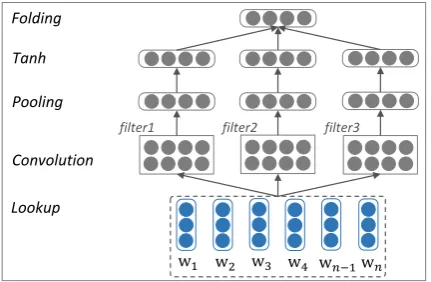
To model semantic representations of sentences, convolutional neural network (CNN) and recur-sive neural network (Socher et al., 2013) are t-wo state-of-the-art methods. We use CNN (Kim, 2014; Kalchbrenner et al., 2014) in this work as it does not rely on external parse tree. Specifical-ly, we use multiple convolutional filters with dif-ferent widths to produce sentence representation. The reason is that they are capable of capturing lo-cal semantics ofn-grams of various granularities, which are proven powerful for sentiment classifi-cation. The convolutional filter with a width of 3 essentially captures the semantics of trigrams in a sentence. Accordingly, multiple convolutional fil-ters with widths of 1, 2 and 3 encode the semantics of unigrams, bigrams and trigrams in a sentence.
An illustration of CNN with three convolu-tional filters is given in Figure 3. Let us
denote a sentence consisting of n words as
{w1, w2, ...wi, ...wn}. Each wordwiis mapped to its embedding representation ei ∈ Rd. A convo-lutional filter is a list of linear layers with shared parameters. Letlcf be the width of a convolution-al filter, and letWcf,bcf be the shared parameters of linear layers in the filter. The input of a linear layer is the concatenation of word embeddings in a fixed-length window sizelcf, which is denoted as
Icf = [ei;ei+1;...;ei+lcf−1]∈ Rd·lcf. The output
of a linear layer is calculated as
Ocf =Wcf·Icf +bcf (1) whereWcf ∈ Rlen×d·lcf, bcf ∈ Rlen, lenis the output length of linear layer. In order to capture the global semantics of a sentence, we feed the output of a convolutional filter to anaverage pool-ing layer, resultpool-ing in an output vector with fixed-length. We further add hyperbolic tangent func-tions (tanh) to incorporate element-wise nonlin-earity, andfold(average) their outputs to generate sentence representation.
We feed sentence vectors as the input of an av-erage pooling layer to obtain the document rep-resentation. Alternative document modeling ap-proaches include CNN or recurrent neural net-work. However, we preferaveragepooling for its computational efficiency and good performance in our experiment.
3.2 Modeling Semantics of Users and Products
Folding
w1
Lookup Convolution Pooling
w2 w3 w4 w𝑛−1w𝑛
Tanh
[image:5.595.74.290.62.203.2]filter1 filter2 filter3
Figure 3: Convolutional neural network with mul-tiple convolutional filters for sentence modeling.
product-sentiment, user-text and product-text con-sistencies.
For modeling user-sentiment and product-sentiment consistencies, we embed each user as a continuous vector uk ∈ Rdu and embed each product as a continuous vectorpj ∈Rdp, wheredu anddp are dimensions of user vector and product vector, respectively. The basic idea behind this is to map users with similar rating preferences (e.g. prefer assigning 4 stars) into close vectors in user embedding space. Similarly, the products which receive similar averaged ratings are mapped into neighboring vectors in product embedding space.
In order to modeluser-textconsistency, we rep-resent each user as a continuous matrix Uk ∈
RdU×d, which acts as an operator to modify the
semantic meaning of a word. This is on the basis of vector based semantic composition (Mitchel-l and Lapata, 2010). They regard compositiona(Mitchel-l modifier as a matrix X1 to modify another com-ponent x2, and use matrix-vector multiplication
y =X1×x2as the composition function. Multi-plicative semantic composition is suitable for our need of user modifying word meaning, and it has been successfully utilized to model adjective-noun composition (Clark et al., 2008; Baroni and Zamparelli, 2010) and adverb-adjective composi-tion (Socher et al., 2012). Similarly, we model product-textconsistency by encoding each prod-uct as a matrix Pj ∈ RdP×d, where d is the di-mension of word vector, dP is the output length of product-word multiplicative composition. After conducting user-word multiplication and product-word multiplication operations, we concatenate their outputs and feed them to CNN (detailed in Section 3.1) for producing user and product en-hanced document representation.
3.3 Sentiment Classification
We apply UPNN to document level sentiment clas-sification under a supervised learning framework (Pang and Lee, 2005). Instead of using hand-crafted features, we use continuous representation of documents, users and products as discrimina-tive features. The sentiment classifier is built from documents with gold standard sentiment labels.
As is shown in Figure 2, the feature represen-tation for building rating predictor is the concate-nation of three parts: continuous user representa-tionuk, continuous product representationpj and continuous document representationvd, wherevd encodes user-text consistency, product-text consis-tency and document level semantic composition. We usesoftmaxto build the classifier because its outputs can be interpreted as conditional probabil-ities. Softmaxis calculated as given in Equation 2, whereCis the category number (e.g. 5 or 10).
softmaxi = PCexp(xi)
i0=1exp(xi0) (2) We regard cross-entropy error between gold sentiment distribution and predicted sen-timent distribution as the loss function of
softmax. We take the derivative of loss function through back-propagation with re-spect to the whole set of parameters θ = [Wcf1,2,3;b1cf,2,3;uk;pj;Uk;Pj;Wsoftmax, bsoftmax], and update parameters with stochastic gradient descent. We set the widths of three convolutional filters as 1, 2 and 3. We learn 200-dimensional sentiment-specific word embeddings (Tang et al., 2014b) on each dataset separately, randomly initialize other parameters from a uniform distri-bution U(−0.01,0.01), and set learning rate as 0.03.
4 Experiment
We conduct experiments to evaluate UPNN by ap-plying it to sentiment classification of documents.
4.1 Experimental Setting
Dataset #users #products #reviews #docs/user #docs/product #sents/doc #words/doc
IMDB 1,310 1,635 84,919 64.82 51.94 16.08 394.6
Yelp 2014 4,818 4,194 231,163 47.97 55.11 11.41 196.9
[image:6.595.71.534.61.120.2]Yelp 2013 1,631 1,633 78,966 48.42 48.36 10.89 189.3
Table 1: Statistical information of IMDB, Yelp 2014 and Yelp 2013 datasets used for sentiment classifi-cation. The rating scale of IMDB dataset is 1-10. The rating scale of Yelp 2014 and Yelp 2013 datasets is 1-5.|V|is the vocabulary size of words in each dataset. #users is the number of users, #docs/user means the average number of documents per user posts in the corpus.
et al., 2014) and Yelp Dataset Challenge4in 2013 and 2014. Statistical information of the generated datasets are given in Table 1.
We split each corpus into training, development and testing sets with a 80/10/10 split, and conduct tokenization and sentence splitting with Stanford CoreNLP (Manning et al., 2014). We use standard accuracy (Manning and Sch¨utze, 1999; Jurafsky and Martin, 2000) to measure the overall senti-ment classification performance, and use MAE
andRMSE to measure the divergences between predicted sentiment ratings (pr) and ground truth ratings (gd).
MAE =
P
i|gdi−pri|
N (3)
RMSE =
rP
i(gdi−pri)2
N (4)
4.2 Baseline Methods
We compare UPNN with the following baseline methods for document-level sentiment classifica-tion.
(1) Majority is a heuristic baseline method, which assigns the majority sentiment category in training set to each review in the test dataset.
(2) In Trigram, we use unigrams, bigrams and trigrams as features and train classifier with sup-ported vector machine (SVM) (Fan et al., 2008).
(3) InTextFeature, we implement hand-crafted text features including word/character ngrams, sentiment lexicon features, negation features, etc al. (Kiritchenko et al., 2014).
(4) We extract user-leniency features (Gao et al., 2013) and corresponding product features (denot-ed as UPF) from training data, and concatenate them with the features in baseline (2) and (3).
(5) We learn word embeddings from training and development sets withword2vec(Mikolov et al., 2013), average word embeddings to get docu-ment representation, and train a SVM classifier.
4http://www.yelp.com/dataset_challenge
(6) We learn sentiment-specific word embed-dings (SSWE) from training and development set-s, and use max/min/average pooling (Tang et al., 2014b) to generate document representation.
(7) We represent sentence with RNTN (Socher et al., 2013) and compose document representa-tion with recurrent neural network. We average hidden vectors of recurrent neural network as the features for sentiment classification.
(8) We re-implement PVDM in Paragraph Vec-tor (Le and Mikolov, 2014) because its codes are not officially provided. The window size is tuned on development set.
(9) We compare with a state-of-the-art recom-mendation algorithm JMARS (Diao et al., 2014), which leverages user and aspects of a review with collaborative filtering and topic modeling.
4.3 Model Comparisons
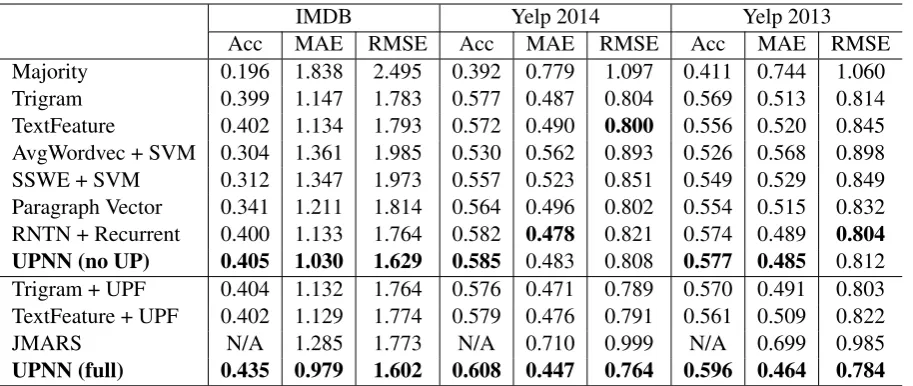
Experimental results are given in Table 2. The re-sults are separated into two groups: the methods above only use texts of review, and the methods below also use user and product information.
From the first group, we can see that majori-ty performs very poor because it does not cap-ture any text or user information. SVM classi-fiers with trigrams and hand-crafted text features are powerful for document level sentiment classi-fication and hard to beat. We compare the word embedding learnt from each corpus with off-the-shell general word embeddings5. Results show that tailored word embedding from each corpus performs slightly better than general word embed-dings (about 0.01 improvement in terms of accu-racy). SSWE performs better than context-based word embedding by incorporating sentiment in-formation of texts. Setting a large window size (e.g. 15) is crucial for effectively training SS-WE from documents with accompanying
senti-5We compare with Glove embeddings learnt from
IMDB Yelp 2014 Yelp 2013
Acc MAE RMSE Acc MAE RMSE Acc MAE RMSE
Majority 0.196 1.838 2.495 0.392 0.779 1.097 0.411 0.744 1.060
Trigram 0.399 1.147 1.783 0.577 0.487 0.804 0.569 0.513 0.814
TextFeature 0.402 1.134 1.793 0.572 0.490 0.800 0.556 0.520 0.845
AvgWordvec + SVM 0.304 1.361 1.985 0.530 0.562 0.893 0.526 0.568 0.898
SSWE + SVM 0.312 1.347 1.973 0.557 0.523 0.851 0.549 0.529 0.849
Paragraph Vector 0.341 1.211 1.814 0.564 0.496 0.802 0.554 0.515 0.832
RNTN + Recurrent 0.400 1.133 1.764 0.582 0.478 0.821 0.574 0.489 0.804
UPNN (no UP) 0.405 1.030 1.629 0.585 0.483 0.808 0.577 0.485 0.812
Trigram + UPF 0.404 1.132 1.764 0.576 0.471 0.789 0.570 0.491 0.803
TextFeature + UPF 0.402 1.129 1.774 0.579 0.476 0.791 0.561 0.509 0.822
JMARS N/A 1.285 1.773 N/A 0.710 0.999 N/A 0.699 0.985
[image:7.595.73.530.61.254.2]UPNN (full) 0.435 0.979 1.602 0.608 0.447 0.764 0.596 0.464 0.784
Table 2: Sentiment classification on IMDB, Yelp 2014 and Yelp 2013 datasets. Evaluation metrics are accuracy (Acc, higher is better), MAE (lower is better) and RMSE (lower is better). Our full model is UPNN (full). Our model without using user and product information is abbreviated as UPNN (no UP). The best method in each group is inbold.
ment labels. RNTN+Reccurent is a strong per-former by effectively modeling document repre-sentation with semantic composition. Our text based model (UPNN no UP) performs slightly bet-ter than RNTN+Reccurent, trigram and text fea-tures.
From the second group, we can see that con-catenating user product feature (UPF) with exist-ing feature sets does not show significant improve-ments. This is because the dimension of existing feature sets is typically huge (e.g. 1M trigram fea-tures in Yelp 2014), so that concatenating a smal-l number of UPF features does not have a great influence on the whole model. We do not evalu-ate JMARS in terms ofaccuracybecause JMARS outputs real-valued ratings. Our full model UPNN yields the best performance on all three dataset-s. Incorporating semantic representations of us-er and product significantly (t-test with p-value<
0.01) boosts our text based model (UPNN no UP). This shows the effectiveness of UPNN over stan-dard trigrams and hand-crafted features when in-corporating user and product information.
4.4 Model Analysis: Effect of User and Product Representations
We investigate the effects of vector based user and product representations (uk, pj) as well as ma-trix based user and product representations (Uk,
Pj) for sentiment classification. We remove vec-tor based representations (uk,pj) and matrix based
representations (Uk, Pj) from UPNN separately, and conduct experiments on three datasets. From Table 3, we can find that vector based representa-tions (uk,pj) are more effective than matrix based representations (Uk,Pj). This is becauseuk and
pj encode user-sentiment and product-sentiment consistencies, which are more directly associat-ed with sentiment labels than user-text (Uk) and product-text (Pj) consistencies. Another reason might be that the parameters of vector represen-tations are less than the matrix represenrepresen-tations, so that the vector representations are better estimat-ed. We also see the contribution from each of user and product by removing (Uk, uk) and (Pj, pj) separately. Results are given in Table 3. It is in-teresting to find that user representations are obvi-ously more effective than product representations for review rating prediction.
4.5 Discussion: Out-Of-Vocabulary Users and Products
IMDB Yelp 2014 Yelp 2013
Acc MAE RMSE Acc MAE RMSE Acc MAE RMSE
UPNN (full) 0.435 0.979 1.602 0.608 0.447 0.764 0.596 0.464 0.784
UPNN−uk−pj 0.409 1.021 1.622 0.585 0.483 0.808 0.572 0.491 0.823
UPNN−Uk−Pj 0.426 0.993 1.607 0.597 0.465 0.789 0.585 0.482 0.802
UPNN−Uk−uk 0.324 1.209 1.743 0.577 0.475 0.778 0.566 0.505 0.828
UPNN−Pj −pj 0.397 1.075 1.712 0.595 0.462 0.776 0.590 0.476 0.802
Table 3: Influence of user and product representations. For user kand product j, uk andpj are their continuous vector representations,UkandPj are their continuous matrix representations (see Figure 2).
IMDB Yelp 2014 Yelp 2013 0.35
0.4 0.45 0.5 0.55 0.6 0.65
[image:8.595.77.522.62.159.2]no UP avg UP unk UP full UP
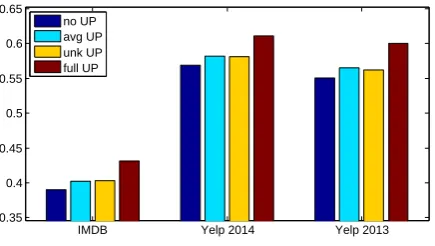
Figure 4: Accuracy of OOV user and product on OOV test set.
In order to evaluate the two strategies for OOV problem, we randomly select 10 percent users and products from each development set, and mask their user and product information. We run avg UP, unk UP together with UPNN (no UP) which only uses text information, and UPNN (full) which learns tailored representation for each user and product. We evaluate classification accuracy on the extracted OOV test set. Experimental results are given in Figure 5. We can find that these two strategies perform slightly better than UPNN (no UP), but still worse than the full model.
5 Related Work
5.1 Sentiment Classification
Sentiment classification is a fundamental prob-lem in sentiment analysis, which targets at infer-ring the sentiment label of a document. Pang and Lee (2002; 2005) cast this problem a classifica-tion task, and use machine learning method in a supervised learning framework. Goldberg and Zhu (2006) use unlabelled reviews in a graph-based semi-supervised learning method. Many s-tudies design effective features, such as text top-ic (Ganu et al., 2009), bag-of-opinion (Qu et al., 2010) and sentiment lexicon features (Kiritchenko et al., 2014). User information is also used for
sentiment classification. Gao et al. (2013) de-sign user-specific features to capture user lenien-cy. Li et al. (2014) incorporate textual topic and user-word factors with supervised topic modeling. Tan et al. (2011) and Hu et al. (2013) utilize user-text and user-user relations for Twitter sentimen-t analysis. Unlike mossentimen-t previous ssentimen-tudies sentimen-thasentimen-t use hand-crafted features, we learn discriminative fea-tures from data. We differ from Li et al. (2014) in that we encode four kinds of consistencies and use neural network approach. User representation is also leveraged for recommendation (Weston et al., 2013), web search (Song et al., 2014) and social media analytics (Perozzi et al., 2014).
5.2 Neural Network for Sentiment Classification
[image:8.595.74.292.214.337.2]Paragraph Vector. Unlike existing neural network approaches that only use the semantics of texts, we take consideration of user and product rep-resentations and leverage their connections with text semantics for sentiment classification. This work is an extension of our previous work (Tang et al., 2015), which only takes consideration of user-word association.
6 Conclusion
In this paper, we introduce User Product Neu-ral Network (UPNN) for document level senti-ment classification under a supervised learning framework. We validate user-sentiment, product-sentiment, user-text and product-text consistencies on massive reviews, and effectively integrate them in UPNN. We apply the model to three datasets derived from IMDB and Yelp Dataset Challenge. Empirical results show that: (1) UPNN outper-forms state-of-the-art methods for document level sentiment classification; (2) incorporating contin-uous user and product representations significantly boosts sentiment classification accuracy.
Acknowledgments
The authors give great thanks to Furu Wei, Lei Cui, Nan Yang, Jiwei Li, Yaming Sun, Mao Zheng and anonymous reviewers for their valuable com-ments. We would like to thank Qiming Diao for providing the IMDB dataset as well as the codes of JMARS. This work was supported by the Nation-al High Technology Development 863 Program of China (No. 2015AA015407), National Natural Science Foundation of China (No. 61133012 and No. 61273321). Duyu Tang is supported by Baidu Fellowship and IBM Ph.D. Fellowship.
References
Marco Baroni and Roberto Zamparelli. 2010. Noun-s are vectorNoun-s, adjectiveNoun-s are matriceNoun-s: RepreNoun-senting adjective-noun constructions in semantic space. In EMNLP, pages 1183–1193.
Yoshua Bengio, R´ejean Ducharme, Pascal Vincent, and Christian Janvin. 2003. A neural probabilistic lan-guage model. Journal of Machine Learning Re-search, 3:1137–1155.
Stephen Clark, Bob Coecke, and Mehrnoosh Sadrzade-h. 2008. A compositional distributional model of meaning. In Quantum Interaction Symposium, pages 133–140.
Qiming Diao, Minghui Qiu, Chao-Yuan Wu, Alexan-der J Smola, Jing Jiang, and Chong Wang. 2014. Jointly modeling aspects, ratings and sentiments for movie recommendation (jmars). InSIGKDD, pages 193–202. ACM.
Pedro Domingos. 2012. A few useful things to know about machine learning. Communications of the ACM, 55(10):78–87.
Li Dong, Furu Wei, Ming Zhou, and Ke Xu. 2014. Adaptive multi-compositionality for recursive neu-ral models with applications to sentiment analysis. InAAAI, pages 1537–1543.
Rong-En Fan, Kai-Wei Chang, Cho-Jui Hsieh, Xiang-Rui Wang, and Chih-Jen Lin. 2008. Liblinear: A library for large linear classification.JMLR.
Gottlob Frege. 1892. On sense and reference. Ludlow (1997), pages 563–584.
Gayatree Ganu, Noemie Elhadad, and Am´elie Marian. 2009. Beyond the stars: Improving rating predic-tions using review text content. InWebDB.
Wenliang Gao, Naoki Yoshinaga, Nobuhiro Kaji, and Masaru Kitsuregawa. 2013. Modeling user leniency and product popularity for sentiment classification. InICJNLP, pages 1107–1111.
Xavier Glorot, Antoine Bordes, and Yoshua Bengio. 2011. Domain adaptation for large-scale sentiment classification: A deep learning approach. InICML, pages 513–520.
Andrew B Goldberg and Xiaojin Zhu. 2006. Seeing s-tars when there aren’t many ss-tars: graph-based semi-supervised learning for sentiment categorization. In GraphBased Method for NLP, pages 45–52.
Xia Hu, Lei Tang, Jiliang Tang, and Huan Liu. 2013. Exploiting social relations for sentiment analysis in microblogging. InWSDM, pages 537–546.
Rie Johnson and Tong Zhang. 2014. Effective use of word order for text categorization with convolution-al neurconvolution-al networks. arXiv preprint: 1412.1058.
Dan Jurafsky and James H Martin. 2000. Speech & language processing. Pearson Education India.
Nal Kalchbrenner, Edward Grefenstette, and Phil Blun-som. 2014. A convolutional neural network for modelling sentences. InACL, pages 655–665.
Yoon Kim. 2014. Convolutional neural networks for sentence classification. In EMNLP, pages 1746– 1751.
Igor Labutov and Hod Lipson. 2013. Re-embedding words. In Annual Meeting of the Association for Computational Linguistics.
Quoc V. Le and Tomas Mikolov. 2014. Distribut-ed representations of sentences and documents. In ICML, pages 1188–1196.
Fangtao Li, Sheng Wang, Shenghua Liu, and Ming Zhang. 2014. Suit: A supervised user-item based topic model for sentiment analysis. InAAAI, pages 1636–1642.
Jiwei Li, Dan Jurafsky, and Eudard Hovy. 2015. When are tree structures necessary for deep learning of rep-resentations? arXiv preprint:1503.00185.
Jiwei Li. 2014. Feature weight tuning for recursive neural networks. Arxiv preprint, 1412.3714.
Bing Liu. 2012. Sentiment analysis and opinion min-ing. Synthesis Lectures on Human Language Tech-nologies, 5(1):1–167.
Andrew L Maas, Raymond E Daly, Peter T Pham, Dan Huang, Andrew Y Ng, and Christopher Potts. 2011. Learning word vectors for sentiment analysis. In A-CL, pages 142–150.
Christopher D Manning and Hinrich Sch¨utze. 1999. Foundations of statistical natural language process-ing. MIT press.
Christopher Manning, Mihai Surdeanu, John Bauer, Jenny Finkel, Steven Bethard, and David McClosky. 2014. The stanford corenlp natural language pro-cessing toolkit. InACL, pages 55–60.
Tomas Mikolov, Ilya Sutskever, Kai Chen, Greg S Cor-rado, and Jeff Dean. 2013. Distributed representa-tions of words and phrases and their compositional-ity. InNIPS, pages 3111–3119.
Jeff Mitchell and Mirella Lapata. 2010. Composition in distributional models of semantics. Cognitive Sci-ence, 34(8):1388–1429.
Bo Pang and Lillian Lee. 2005. Seeing stars: Exploit-ing class relationships for sentiment categorization with respect to rating scales. In ACL, pages 115– 124.
Bo Pang and Lillian Lee. 2008. Opinion mining and sentiment analysis. Foundations and trends in infor-mation retrieval, 2(1-2):1–135.
Bo Pang, Lillian Lee, and Shivakumar Vaithyanathan. 2002. Thumbs up?: sentiment classification using machine learning techniques. InEMNLP, pages 79– 86.
Romain Paulus, Richard Socher, and Christopher D Manning. 2014. Global belief recursive neural net-works. InNIPS, pages 2888–2896.
Jeffrey Pennington, Richard Socher, and Christopher D Manning. 2014. Glove: Global vectors for word representation. InEMNLP, pages 1532–1543. Bryan Perozzi, Rami Al-Rfou, and Steven Skiena.
2014. Deepwalk: Online learning of social repre-sentations. InSIGKDD, pages 701–710. ACM. Lizhen Qu, Georgiana Ifrim, and Gerhard Weikum.
2010. The bag-of-opinions method for review rating prediction from sparse text patterns. In COLING, pages 913–921.
Richard Socher, Brody Huval, Christopher D. Man-ning, and Andrew Y. Ng. 2012. Semantic Composi-tionality Through Recursive Matrix-Vector Spaces. InEMNLP, pages 1201–1211.
Richard Socher, Alex Perelygin, Jean Wu, Jason Chuang, Christopher D. Manning, Andrew Ng, and Christopher Potts. 2013. Recursive deep models for semantic compositionality over a sentiment tree-bank. InEMNLP, pages 1631–1642.
Yang Song, Hongning Wang, and Xiaodong He. 2014. Adapting deep ranknet for personalized search. In WSDM, pages 83–92. ACM.
Chenhao Tan, Lillian Lee, Jie Tang, Long Jiang, Ming Zhou, and Ping Li. 2011. User-level sentiment analysis incorporating social networks. InSIGKDD, pages 1397–1405. ACM.
Duyu Tang, Furu Wei, Bing Qin, Ming Zhou, and T-ing Liu. 2014a. BuildT-ing large-scale twitter-specific sentiment lexicon: A representation learning ap-proach. InCOLING, pages 172–182.
Duyu Tang, Furu Wei, Nan Yang, Ming Zhou, Ting Liu, and Bing Qin. 2014b. Learning sentiment-specific word embedding for twitter sentiment clas-sification. InACL, pages 1555–1565.
Duyu Tang, Bing Qin, Ting Liu, and Yuekui Yang. 2015. User modeling with neural network for re-view rating prediction. InIJCAI.
Jason Weston, Ron J Weiss, and Hector Yee. 2013. Nonlinear latent factorization by embedding multi-ple user interests. InRecSys, pages 65–68. ACM. Liheng Xu, Kang Liu, and Jun Zhao. 2014. Joint
opin-ion relatopin-ion detectopin-ion using one-class deep neural network. InCOLING, pages 677–687.