JEDI: Joint Entity and Relation Detection using Type Inference
Johannes Kirschnick1, Holmer Hemsen1, Volker Markl1,2
1DFKI Project Office Berlin, Alt-Moabit 91c, Berlin
2Technische Univerist¨at Berlin
Database Systems and Information Management Group Einsteinufer 17, 10587 Berlin, Germany
Abstract
FREEBASE contains entities and relation
information but is highly incomplete. Rel-evant information is ubiquitous in web text, but extraction deems challenging. We present JEDI, an automated system to jointly extract typed named entities and FREEBASE relations using dependency
pattern from text. An innovative method for constraint solving on entity types of multiple relations is used to disambiguate pattern. The high precision in the evalua-tion supports our claim that we can detect entities and relations together, alleviating the need to train a custom classifier for an entity type1.
1 Introduction
Finding, tagging and extracting relations in web text is one of the more challenging tasks in In-formation Extraction (IE). It consists of correctly labeling entities as instances of a particular type (such as Person, Organization or Location) and de-tecting relations between them, such as worksIn,
bornInor even more fine grained ones such as re-ceiveDegree. These relations are stored for fur-ther analysis in knowledge bases, but often exist-ing ones are highly incomplete. Min et al. (2013) report that in the collaborative-edited FREEBASE2
knowledge base 93.8%of the person entities are missing aplace of birthentry. To close the cap au-tomated methods are needed that can detect these relations, by analyzing the abundance of web text. A typical process to detect relations uses the linking words (pattern) between two entities to la-bel a relation, but this poses the challenge of deal-ing with ambiguous pattern.
1Demonstrator is available at jedi.textmining.tu-berlin.de 2Freebase is available at www.freebase.com
Dependency
Parse Detect Relations Create Candidate
Multigraph
Pattern Corpus
Input Text Entities and Relations
JE
D
I S
ys
te
[image:1.595.314.511.232.348.2]m
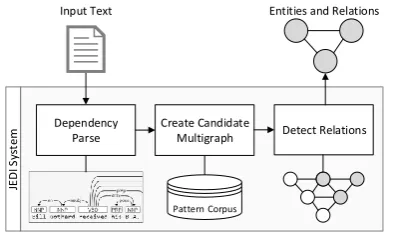
Figure 1: JEDI System Overview. Text is
anno-tated with dependency information. Candidate en-tities connecting shortest path pattern are scored against a corpus. Constraint solving on the rela-tion types resolves ambiguities and determines the final relations.
Consider the following sentences that both con-tain the patternreceiveindicating completely dif-ferent relations: “Bill received his B.A. in Bibli-cal Studies from Wheaton College.”, and “Leo re-ceived an Oscar for Revenant.”.
The first sentence contains the binary relation
receiveDegree, linking a person to a degree, but in the second, the same pattern indicates the per-sonAwardrelation. To correctly disambiguate, we need to incorporate context. This paper proposes the novel method of using the entity types of mul-tiple binary relations to solve the disambiguation.
MotivationTypically labeling relations and en-tities is done in sequence, leading to a pipeline architecture which first detects entities and subse-quently tries to link them to extract relations. As detection errors can easily propagate, there is po-tential in executing these steps jointly. It is driven by the motivation that instead of focusing on indi-vidual binary assignments, multiple entities found in the text can be used to constraint and restrict each other’s entity and relation types.
Figure 1 shows an overview of the entire solu-tion. Entity mentions and potential relations
cated by a pattern form a multi graph. Selecting a particular type for an entity prunes the number of potential relations that this entity can partici-pate in. Furthermore, having established a relation between a pair of entities further restricts the po-tential relations that can hold between any other entity and one of the pair’s members due to in-ferred type restrictions. Thus all candidate entities in a sentence are considered together to support or restrict any contained relations.
Contributions This paper presents and evalu-ates JEDI a system to translate the relation
detec-tion problem into a constraint satisfacdetec-tion prob-lem. The graph of entities and potential relations forms a resolution graph, where each entity is con-strained on the potential types it can hold. Solv-ing this problem jointly resolves entity and rela-tion types without training an entity classifier, al-lowing to detect the large number of relation and types defined in FREEBASE.
The evaluation shows high precision across a variety of texts and relations. We furthermore re-lease the implementation as open source and pro-vide a web demonstrator to showcase the system.
2 Related Work
Most prominent for relation extraction is the idea that entities that co-occur with a similar context have similar meanings, driven by the distribu-tional hypothesis (Harris, 1954). The shortest path kernel is a good estimator for approximat-ing the distribution and has been used by Bunescu and Mooney (2005). Culotta and Sorensen (2004) showed that it is possible to train a relation clas-sifier on the extracted pattern to predict a small number of relations.
Kate and Mooney (2010) proposed a card style resolution algorithm, which infers recursively the most probable relation assignment for a given en-tity pair, but still requires an enen-tity classifier and only works for a small number of relations.
Mintz et al. (2009) proposed to use clustering to group together entity co-occurrences based on their shortest path, to extract relation types. This eliminates the need for a classifier for relation de-tection, but requires one for entity extraction. Pat-tern can only be assigned to one relation and thus capture only the most dominating meaning. The problem of relation extraction can also be solved using matrix decomposition, as shown by Riedel et al. (2013). Their work targets FREEBASE
rela-tions, but demands a complex training step which decomposes the co-occurrence matrix and is de-pendent on the text domain as well.
The SOFIE system (Suchanek et al., 2009) uses logical reasoning to find instances of a relation in text. It does not require any pre-training as it learns the extraction rules alongside the relation detection, but is limited in the amount of data it can process, because of the costly resolution step. Similar to our approach Singh et al. (2013) pro-posed to model the entity tagging and relation ex-traction problem jointly, using belief propagation to find relation instances, but targeting a much smaller number of relations. The idea to incorpo-rate types into the relation extraction process was explored by Koch et al. (2014) improving the re-lation detection performance.
Contrary to existing systems JEDIdoes not need
a pre-trained entity classifier. We leverage a very large corpus of shortest path patterns as reference and use constraint propagation to solve ambigui-ties. Our system also maps into the large number of predefined FREEBASErelations, alleviating the
need to manually specify any relations. The sys-tem can be easily incorporated into a more com-plex IE pipeline that uses the results for example for entity linking.
3 Pattern Corpus
To detect meaningful patterns we use FREEPAL
(Kirschnick et al., 2014). A dataset of 10 mil-lion lexico-syntactic pattern-relation assignments built using distant supervision (Mintz et al., 2009). Each pattern was generated from a shortest depen-dency path between two known FREEBASE
enti-ties in a sentence that participate in a known rela-tion. The corpus uses CLUEWEB09 as text basis
and the FACC1 entity annotations (Gabrilovich et al., 2013) to generate a distribution of relations over pattern. An entropy score indicates the degree of ambiguity, which we use for scoring the relation assignments. Overall more than75%of the con-tained pattern were observed with more than one relation, requiring a disambiguation method.
4 Jointly Detecting Entities and Relations
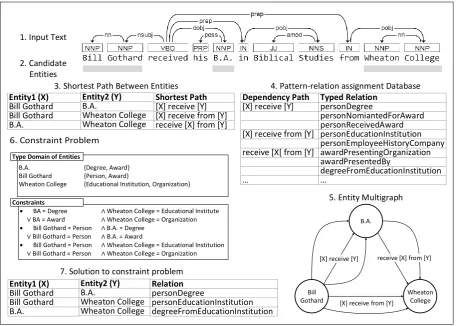
The process of detecting relations is described in Figure 2 and consists of the following steps, de-scribed in the following:
1. Input Text
2. Candidate Entities
3. Shortest Path Between Entities 4. Pattern-relation assignment Database
Entity1 (X)
Bill Gothard Bill Gothard B.A.
Entity2 (Y)
B.A.
Wheaton College Wheaton College
Shortest Path
[X] receive [Y] [X] receive from [Y] receive [X] from [Y]
Dependency Path
[X] receive [Y]
[X] receive from [Y]
receive [X[ from [Y]
Typed Relation
personDegree
personNomiantedForAward personReceivedAward personEducationInstitution personEmployeeHistoryCompany awardPresentingOrganization awardPresentedBy
degreeFromEducationInstitution B.A. {Degree, Award}
Bill Gothard {Person, Award}
Wheaton College {Educational Institution, Organization}
BA = Degree Wheaton College = Educational Institute
BA = Award Wheaton College = Organization
Bill Gothard = Person B.A. = Degree Bill Gothard = Person B.A. = Award
Bill Gothard = Person Wheaton College = Educational Institution Bill Gothard = Person Wheaton College = Organization
Type Domain of Entities
Constraints
Entity1 (X)
Bill Gothard Bill Gothard B.A.
Entity2 (Y)
B.A.
Wheaton College Wheaton College
Relation
personDegree
personEducationInstitution degreeFromEducationInstitution 7. Solution to constraint problem
Bill Gothard
B.A.
Wheaton College [X] receive from [Y]
[X] receive [Y]
5. Entity Multigraph
[image:3.595.72.529.61.387.2]receive [X] from [Y]
Figure 2: Solution overview: Candidate Entities (2) are selected from the source text (1). Shortest path in the dependency tree is extracted (3), pruned against pattern-relation assignment database (4), type information is translated into a multi graph (5) which defines the constraint satisfaction problem (6). The solution yields an assignment of entity types and relations (7). (Types are omitted for readability)
• Selection of candidate entities
• Extract shortest dependency path (pattern) between all pairwise candidate entities
• Match the pattern using the FREEPALcorpus
to determine candidate relations
• Translate the relation detection into a con-straint satisfaction problem which determines the potential types of all entities and thus the connecting relations
4.1 Pre-Processing
The target text is annotated with part-of-speech tags and dependency information using the Stan-ford CoreNLP Toolkit (Manning et al., 2014). Co-reference resolution is applied to further link en-tity mentions across sentence boundaries provid-ing more link targets between entities.
4.2 Selecting Candidate Entities
Instead of trying to find any of the 10 million pat-tern from the patpat-tern corpus in a given text, where every match would provide a candidate subject
and object pair for a relation, we reverse the prob-lem and produce a set of candidate entities and try to match the connecting pattern with the corpus.
JEDI works with any candidate entities,
4.3 Extracting the Shortest Path
Finding the shortest path between two entities equals finding a path in the dependency graph be-tween the head words of each entity. We use a simplified instance of Collins Head finding rule (Collins, 2003) to determine the head in multi-word entities. The pattern is derived by picking up all tokens in their lemmatized form on the path, substituting the start with X and the end with the label Y. To make the pattern more readable, all to-kens are sorted based on their appearance in the source text.
This produces pattern of the form [X] receive [Y] [1-dobj-2,1-nsubj-0]. The pattern is further enriched with the individual dependency annota-tions to differentiate similar textual pattern3.
Conjunctions We apply a simple normalization to conjunctions inspired by CLAUSIE (Corro and
Gemulla, 2013). Removing the last token in pat-terns containing a conjunction dependency. Coreference Resolution Coreference informa-tion expands meninforma-tions across sentence bound-aries. Mentions that are connected through a chain are treated as if they are the same entity, if the source of the chain is marked as a candidate entity. Thus we substitute the coreference target with the source in the extraction process.
4.4 Pattern-Relation Assignments
The shortest path generation process generates a large number of pattern. To reduce the search space, all extracted pattern are matched against the FREEPAL corpus. This produces for each match
a list of potential relations that this pattern has been observed with. Only pattern with an entropy smaller than3.74 and that have been observed at
least five times are considered. This reduces the noise by filtering out very unspecific pattern such as[X] be [Y], but at the same time still allows for a lot of ambiguous pattern.
Each pattern is associated with a list of FREE -BASE relations, for which the argument types are
retrieved. This is used to restrict theX andY en-tity types of the pattern respectively. We use the FREEBASEtype normalization presented in FIGER
(Ling and Weld, 2012) to reduce the number of en-tity types down to112.
3Dependency information for all pattern is omitted in the
paper for readability, but used during the resolution process.
4This entropy cutoff was derived empirically.
To address the problem of arbitrary granularity, we broaden the accepted argument types using a simple type hierarchy. For example, the diedIn
relation, which indicates that a person died in a particular location, restricts the subject argument to be of type deceased person. While this is very specific it prevents linking to this entity in other relations, which only accept the more generic per-son type. The type hierarchy is generated by re-trieving thetype hints category for each type, us-ing the FREEBASEAPI. While this does not
pro-duce a complete type hierarchy, it adds the most commonly used sub types for a given type.
4.5 Constraint Solving using Type Inference The extracted pattern for each pair of entities form a multi-graph, where edges are assigned a confi-dence score based on the FREEPAL entropy. The
resolution process tries to eagerly generate a type assignment for each entity, so that at least one edge between connected vertices, a particular relation, holds according to the type requirements. The choco library (Prud’homme et al., 2015) is used for constraint solving. Each edge is transformed into a constraint, using logical conjunctions be-tween all connected vertex pairs and disjunction for each edge between two vertices and their types. This emits for each relation a constraint with all possible type and subtype combinations.
Scoring Constraint solving produces more than one potential solution. We use a scoring mecha-nism to rank the different solutions, taking into ac-count the number of matched entities, the entropy score taken from the FREEPALdataset, as well as
the type hierarchy. This ensures that if possible, the most specific type assignment for a large num-ber of entities is favored in the resolution process.
Relation P R F Education Degree 0 0 0 Place of Birth 0.76 0.60 0.68 Place of Death 0.89 0.27 0.41 Student Graduate 0.78 0.41 0.53
Table 1: Baseline performance. Precision, Re-call and F-measure without Coreference Resolu-tion and type inference using the Noun strategy.
Stopping The search is terminated early when an adjustable time limit is hit, to ensure that the most probable solution is found early. This trade-off guarantees that the algorithm finishes in fi-nite time, at the expense of not always finding the global optimal solution.
Result Once a solution is found, all vertices of the graph are bound to a type. The qualifying re-lation between any two connected vertices is se-lected as the one which has the highest score as-sociated with it. This produces triples of the form
<entity, entity, relation>.
5 Evaluation
The “Relation Extraction Corpus”5 is used for
evaluation – comparing precision, recall and F-measure. The corpus contains text snippets for four separate relations: person holding an educa-tion degreeeducationDegree(1580 triples),place of death (1955 triples), place of birth (8703 triples) and person graduated from education in-stitutestudentGraduate(32653 triples). Each ex-cerpt is annotated by humans as to whether it sup-ports a particular binary relation.
5.1 Results
Baseline Table 1 shows the baseline perfor-mance of the noun strategy without constraint solving, using the most likely relation for an iden-tified pattern based on the FREEPALentropy score.
The results show high precision for all relations except for education degree. This supports the use of the FREEPAL dataset for relation
extrac-tion, as it covers already a large variety of pattern instances. No instances of the education degree relation were found as almost all pattern for this relation are dominated by the received award rela-tion.
5https://code.google.com/p/relation-extraction-corpus/
Relation P R F
Education Degree 0.94 0.61 0.74 Place of Birth 0.77 0.60 0.67 Place of Death 0.88 0.35 0.50 Student Graduate 0.76 0.37 0.50
Table 2: Type inference performance without Coreference Resolution using the Noun strategy.
Resolution Strategies and Comparison Results Named Entities Nouns Akbik (2014)
Relation P R F P R F P R F
Education Degree 0.96 0.03 0.05 0.96 0.74 0.83 0.87 0.29 0.44 Place of Birth 0.77 0.52 0.62 0.83 0.58 0.68 0.82 0.19 0.31 Place of Death 0.92 0.48 0.63 0.92 0.48 0.63 0.82 0.13 0.22 Student Graduate 0.78 0.51 0.62 0.77 0.51 0.61 0.92 0.17 0.29
Table 3: Performance with type inference and Coreference Resolution using Named Entities and Nouns as entity markers, comparing to Ak-bik (2014), reporting Precision, Recall and F-measures.
Type Inference The effect of type inference can be seen in Table 2. Instances of the degree rela-tion are found with high precision, while the other relations are still found, highlighting that the reso-lution process is not introducing errors.
Table 3 shows the performance of the entity candidate selection strategy (See section 4.2), in-cluding Coreference Resolution. The Noun strat-egy is compared with Named Entities obtained with the Stanford NER classifier (Finkel et al., 2005). For reference we present the results from Akbik et al. (2014), where the authors used a man-ual process to find a set of extraction pattern for a given relation.
Using the simple NOUNS strategy for selecting candidate entities performs on par or better to the NER strategy. Coreferences further improve the F-measure by up to.11 points. This supports our claim that we can detect entities and relations to-gether, alleviating the need to train a custom clas-sifier for an entity type - nouns are sufficient. The education degree relation (not part of the results) is a good example for an entity type, where the standard NER tagger almost always fails to iden-tify the degree entity.
6 Conclusion
We present JEDIa system to extract typed named
entities and FREEBASErelations together.
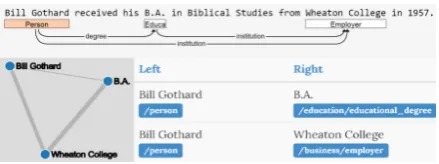
[image:5.595.88.275.61.135.2]Figure 3: Demo system showing output of the re-lation detection process with found entity types and connecting FREEBASErelations.
types is used to disambiguate pattern with multi-ple meanings.
The evaluation shows that the method increases the precision and recall scores for ambiguous re-lations significantly. As the resolution takes ad-vantage of entities that are connected in chains, it is further possible to detect n-ary relations using only binary pattern. The method proves to work well without any pre-training of NER classifiers and validates that pattern learned using distant su-pervision are effective. This makes it possible to expand existing knowledge bases with information found in web text.
A web demonstrator of the complete sys-tem as shown in Figure 3 is available at jedi.textmining.tu-berlin.de. The system is imple-mented as an UIMA module such that it can be easily incorporated into existing IE pipelines, the source code is hosted at github.com/jkirsch/jedi.
Acknowledgments
We would like to thank the anonymous reviewers for their helpful comments. Johannes Kirschnick received funding from the German Federal Min-istry of Economics and Energy (BMWi) un-der grant agreement 01MD15007B (SD4M) and Holmer Hemsen under 01MD15010A (SDW).
References
Alan Akbik, Thilo Michael, and Christoph Boden. 2014. Exploratory Relation Extraction in Large Text
Corpora. InCOLING, pages 2087–2096.
Razvan C Bunescu and Raymond J Mooney. 2005. A shortest path dependency kernel for relation
extrac-tion. InHLT/EMNLP, pages 724–731.
Michael Collins. 2003. Head-driven statistical mod-els for natural language parsing.Computational lin-guistics, 29(4):589–637.
Luciano Del Corro and Rainer Gemulla. 2013.
ClausIE : Clause-Based Open Information
Extrac-tion. InWWW, pages 355–365.
Aron Culotta and Jeffrey Sorensen. 2004. Dependency tree kernels for relation extraction.ACL, pages 423– 429.
Jenny Rose Finkel, Trond Grenager, and Christopher Manning. 2005. Incorporating non-local informa-tion into informainforma-tion extracinforma-tion systems by Gibbs sampling. ACL, pages 363–370.
Evgeniy Gabrilovich, Michael Ringgaard, and Amar-nag Subramanya. 2013. FACC1: Freebase anno-tation of ClueWeb corpora, Version 1 (Release date 2013-06-26, Format version 1, Correction level 0). ZS Harris. 1954. Distributional structure. Word, pages
775–794.
Rohit J. Kate and Raymond J. Mooney. 2010. Joint en-tity and relation extraction using card-pyramid pars-ing.CoNLL, pages 203–212.
Johannes Kirschnick, Alan Akbik, and Holmer Hem-sen. 2014. Freepal: A Large Collection of Deep Lexico-Syntactic Patterns for Relation Extraction.
InLREC, pages 2071–2075.
Mitchell Koch, John Gilmer, Stephen Soderland, and Daniel S Weld. 2014. Type-Aware Distantly Super-vised Relation Extraction with Linked Arguments. InEMNLP, pages 1891–1901.
Xiao Ling and DS Weld. 2012. Fine-Grained Entity
Recognition.AAAI, pages 94–100.
Christopher D Manning, Mihai Surdeanu, John Bauer, Jenny Finkel, Steven J Bethard, and David Mc-Closky. 2014. The Stanford CoreNLP Natural
Lan-guage Processing Toolkit. InACL (System
Demon-strations), pages 55–60.
Bonan Min, Ralph Grishman, Li Wan, Chang Wang, and David Gondek. 2013. Distant supervision for relation extraction with an incomplete knowledge
base. InHLT-NAACL, pages 777–782.
Mike Mintz, Steven Bills, Rion Snow, and Dan Juraf-sky. 2009. Distant supervision for relation extrac-tion without labeled data. ACL, pages 1003–1011. Charles Prud’homme, Jean-Guillaume Fages, and
Xavier Lorca, 2015. Choco Documentation.
Avail-able athttp://www.choco-solver.org.
Sebastian Riedel, Limin Yao, Andrew McCallum, and Benjamin M Marlin. 2013. Relation Extraction with Matrix Factorization and Universal Schemas. InHLT-NAACL, pages 74–84.
Sameer Singh, Sebastian Riedel, Brian Martin, Jiap-ing Zheng, and Andrew McCallum. 2013. Joint inference of entities, relations, and coreference. In
AKBC, pages 1–6.
Fabian M. Suchanek, Mauro Sozio, and Gerhard Weikum. 2009. SOFIE: A Self-Organizing